
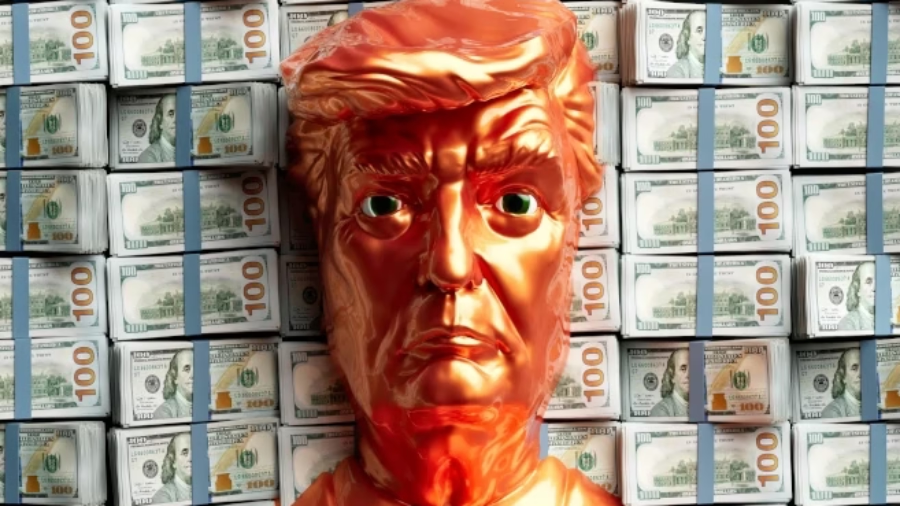
Introduction: A Presidency Built on Trade Shockwaves
Few aspects of Donald Trump’s presidency stirred as much controversy, confusion, and global attention as his aggressive use of tariffs. From steel and aluminum to Chinese imports, Trump wielded trade policy as if it were a universal tool—a blunt instrument meant to achieve multiple political objectives at once.
This strategy, emblematic of Trump, Tariffs, and Turbulence, redefined conventional political playbooks. By fusing economic nationalism with political messaging, tariffs became more than a trade mechanism—they became a symbol of disruption, loyalty, and power projection.
Understanding this legacy is critical, not just for analyzing the Trump era, but for appreciating the profound impact it had on global commerce, domestic politics, and the perception of America on the world stage.
The Philosophy Behind Trump’s Tariff Strategy
Tariffs as a Political Hammer
Unlike traditional trade tools aimed at addressing specific economic imbalances, Trump treated tariffs as a multi-purpose strategy:
- Political Signaling: Showcasing toughness on foreign powers, particularly China, to appeal to nationalist sentiments
- Economic Leverage: Pressuring trade partners into renegotiating agreements (e.g., USMCA)
- Domestic Messaging: Positioning himself as the defender of American workers against “unfair” global competition
This approach transformed a conventional economic tool into a political weapon, merging economic theory with populist messaging. (source)
Disruptive Politics as a Core Tactic
Trump’s reliance on tariffs illustrates his broader political philosophy: disruption is power. By creating unpredictability in trade policy, he sought to:
- Keep political and economic adversaries off balance
- Dominate media narratives through controversy
- Consolidate domestic support among industrial workers affected by globalization
The result was a political climate defined as much by shock and spectacle as by policy outcomes.
Key Tariff Battles and Their Impact
Steel and Aluminum Tariffs
In 2018, Trump imposed a 25% tariff on steel and 10% on aluminum imports from major allies, including Canada, the EU, and Mexico. (source)
- Goal: Protect domestic industries from “unfair competition”
- Impact:
- Short-term gains for U.S. steel producers
- Strained trade relations with allies
- Retaliatory tariffs on American goods
While politically popular in certain U.S. states, these tariffs sparked global concern and demonstrated the collateral effects of unilateral trade actions.
The China Trade War
Trump’s tariffs on Chinese imports were the most consequential:
- Scope: $360 billion in tariffs on Chinese goods
- Objective: Force China to change trade practices, including intellectual property theft and forced technology transfers
- Outcome:
- Temporary trade deals and partial concessions
- Increased costs for American businesses and consumers
- Global supply chain disruptions
The China tariffs epitomized the turbulence of Trump’s economic strategy, blending geopolitics with domestic politics. (source)
Tariffs as Campaign Tools
Tariffs also functioned as messaging devices in election cycles:
- Highlighted Trump’s “America First” ideology
- Reinforced his image as a disruptor fighting unfair trade practices
- Served as a tangible action to appease industrial and working-class voters
This dual role of tariffs—policy and political performance—reinforced Trump’s unorthodox approach.
Economic Consequences of Trump’s Tariff Strategy
Winners and Losers
Tariffs produced uneven outcomes:
- Winners: Domestic steel producers, some agricultural sectors during temporary government support
- Losers: Automakers, manufacturers reliant on global supply chains, and consumers facing higher prices
The strategy revealed the limits of using trade policy as a catch-all political tool.
Global Supply Chain Disruptions
Trump’s tariffs caused significant global disruptions:
- Shifts in manufacturing hubs to avoid tariffs
- Increased costs for multinational corporations
- Uncertainty in markets, affecting investment and growth
This turbulence illustrated the interconnectedness of modern economies and the risks of unilateral action.
Table: Selected Tariff Impacts Under Trump
| Tariff Target | Objective | Economic Outcome | Political Outcome |
|---|---|---|---|
| Steel & Aluminum | Protect domestic producers | Higher domestic prices, global tension | Popular in Rust Belt states |
| Chinese Goods | Force trade concessions | Supply chain disruption, higher costs | Reinforced nationalist messaging |
| Solar Panels & Washing Machines | Protect U.S. manufacturers | Increased consumer prices, limited job growth | Short-term political wins |
| EU Imports | Retaliation for subsidies | Diplomatic tension, threat of trade war | Media attention, tough-guy image |
Tariffs and the Media Spectacle
Trump’s approach to trade policy was inseparable from his mastery of media:
- Frequent tweets amplified trade disputes
- Controversy generated coverage that shaped public perception
- Tariffs became a tool of narrative control, not just economics
In this sense, Trump, Tariffs, and Turbulence exemplify a strategy where policy is performance.
Critics and Supporters Weigh In
Criticism
- Economists argue tariffs increase costs for consumers and reduce competitiveness
- Trade partners saw tariffs as protectionist and destabilizing
- Global markets experienced uncertainty, affecting investment
Support
- Populist voters viewed tariffs as defending American jobs
- Industrial states benefiting from higher prices and restricted competition rewarded Trump politically
- Symbolically, tariffs reinforced the “America First” narrative
This contrast underscores the tension between short-term political gains and long-term economic costs.
Tariffs as a Political Playbook Re-definer
Trump’s approach changed how political actors view trade:
- Blurring Policy and Politics: Economic tools became messaging devices.
- Disruption as Strategy: Predictable trade diplomacy was replaced by unpredictability.
- Populism Meets Economics: Policies were tailored to appeal to emotion and identity, not just markets.
This redefinition of political playbooks will influence how future politicians engage with trade, media, and domestic constituencies.
Lessons for Future Governance
The Limits of Tariffs
- Tariffs cannot replace comprehensive trade policy
- Unilateral action risks global retaliation
- Short-term political messaging may come at long-term economic costs
Strategic Communication
- Policy effectiveness is intertwined with perception management
- Media narratives can amplify or distort policy outcomes
Balancing Politics and Economics
- Leaders must weigh domestic political benefits against global economic realities
- Disruption can mobilize support but may destabilize markets and alliances
Conclusion: Trump, Tariffs, and Turbulence
Trump’s tariff strategy represents a unique blend of economics, politics, and spectacle. Trump, Tariffs, and Turbulence not only disrupted global trade but reshaped domestic political strategy, showing how a single policy tool can be leveraged as a multi-purpose weapon—economic, political, and psychological.
The era serves as a cautionary tale for policymakers: disruption may yield short-term victories, but it comes with long-term consequences for economies, alliances, and governance norms. Future leaders must balance bold action with careful strategy, or risk repeating the turbulence of the Trump years.
Call to Action
- Stay informed: Monitor trade policies and their impacts
- Engage civically: Understand how economic decisions affect daily life
- Share insights: Discuss this post with peers to explore the implications of unconventional political strategies
References & Further Reading
- Council on Foreign Relations, Trump Tariffs and the US-China Trade War. (cfr.org)
- BBC News, Trump Steel and Aluminum Tariffs. (bbc.com)
- Peterson Institute for International Economics, Trade War Analysis. (piie.com)
- CNBC, Tariffs and Economic Impact on U.S. Consumers. (cnbc.com)
- Forbes, How Trump’s Tariffs Reshaped Political Strategy. (forbes.com)
