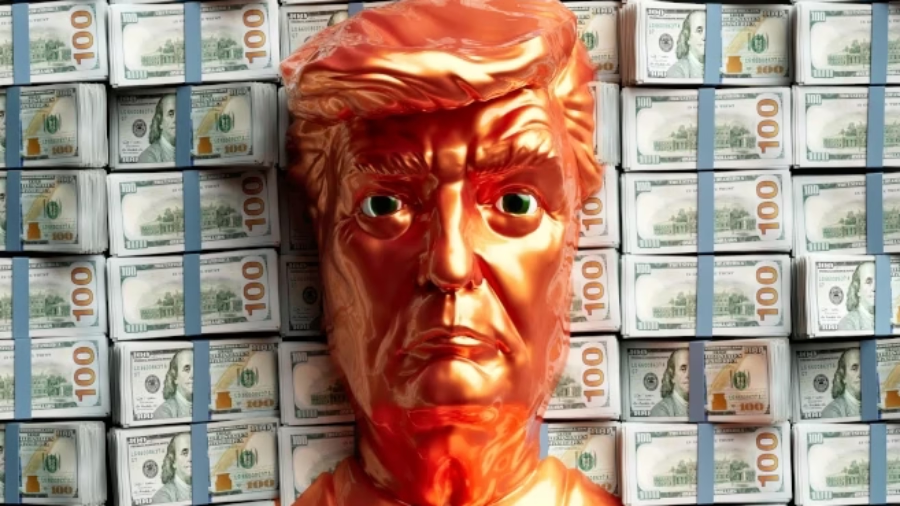
When Donald Trump positioned himself as the leader of the Western Hemisphere during his presidency—and continues this narrative in his 2025 return to office—he wasn’t just making a bold claim. He was announcing a seismic shift in how America views its role in global affairs, one that threatens to upend seven decades of multilateral world order.
Here’s the uncomfortable reality: Trump’s self-appointed hemispheric leadership isn’t just rhetorical bluster. It represents a deliberate return to 19th-century spheres of influence, where great powers carve up the world into exclusive domains. And the implications reach far beyond the Americas.
Let’s dissect what this power grab really means—for democracy, sovereignty, and the fragile architecture holding the international system together.
The Audacious Claim: “Our Hemisphere”
Trump’s framing of hemispheric leadership wasn’t subtle. Throughout his first term and now into his second, he’s consistently referred to Latin America and the Caribbean as America’s natural domain—language that echoes imperial powers dividing Africa at the Berlin Conference.
In his 2019 State of the Union address, Trump declared: “We stand with the Venezuelan people in their noble quest for freedom—and we condemn the brutality of the Maduro regime, whose socialist policies have turned that nation from being the wealthiest in South America into a state of abject poverty and despair.”
Notice the framing: “We stand with”—as if American blessing determines legitimacy throughout the hemisphere.
His administration’s National Security Strategy explicitly stated that the U.S. would prioritize “energy dominance” and counter “adversarial regional powers” in the Western Hemisphere. The document positioned Latin America not as a region of sovereign nations, but as strategic territory where American interests must prevail.
During his 2024 campaign, Trump doubled down, promising to invoke the Alien Enemies Act to remove gang members and threatening military action against Mexican drug cartels—all without consultation with the affected nations. He’s treating sovereign countries as subordinate territories requiring American management.
This isn’t leadership. It’s self-appointed dominion.
The Historical Precedent Nobody’s Acknowledging
Trump isn’t inventing this hemispheric supremacy narrative—he’s resurrecting it from America’s most imperial period.
The concept of the U.S. as the leader of the Western Hemisphere has deep roots:
The Monroe Doctrine (1823): Originally a defensive statement against European colonialism, it was later twisted to justify American intervention throughout Latin America.
Manifest Destiny (1840s): The belief that American expansion across North America was inevitable and divinely ordained—a mentality that didn’t stop at the Pacific.
The Roosevelt Corollary (1904): Theodore Roosevelt explicitly claimed the right to exercise “international police power” in Latin America, turning hemispheric leadership into military intervention doctrine.
The Big Stick Era (1900-1934): The U.S. militarily intervened in Cuba, Nicaragua, Haiti, Dominican Republic, Mexico, and Panama—all justified by its self-declared hemispheric authority.
According to historical data compiled by the Congressional Research Service, the United States conducted over 50 military interventions in Latin America between 1898 and 1994.
President Franklin D. Roosevelt’s “Good Neighbor Policy” in the 1930s explicitly rejected this interventionist approach, recognizing it had bred resentment and instability. For decades afterward, American policy—at least officially—emphasized partnership over paternalism.
Trump’s narrative reverses 90 years of diplomatic evolution.
What “Hemispheric Leadership” Actually Means in Practice
Let’s translate Trump’s rhetoric into concrete policy to understand what this leadership claim actually entails:
Economic Subordination
Trump’s approach to hemispheric leadership manifests primarily through economic coercion:
Trade as leverage: His renegotiation of NAFTA into USMCA included mechanisms giving the U.S. extraordinary oversight of Mexican and Canadian trade deals with other countries—particularly China. This wasn’t negotiation; it was asserting veto power over neighbors’ economic sovereignty.
Sanction diplomacy: Venezuela, Cuba, and Nicaragua have faced escalating U.S. economic sanctions designed to force regime change. These unilateral measures—imposed without UN authorization—treat hemispheric nations as subjects rather than sovereign equals.
Development aid as control: Trump slashed foreign aid to Central America by over 40% between 2016-2020 as punishment for migration flows, then restored it conditionally. Aid became a leash, not assistance.
Military Dominance
Trump’s hemispheric leadership relies heavily on military superiority:
| Military Presence | Trump Era Reality |
|---|---|
| U.S. military bases in region | 76+ installations across Latin America |
| Annual military aid | $2.5+ billion to hemisphere |
| Joint military exercises | 35+ annual operations asserting U.S. military preeminence |
| Naval presence | 4th Fleet reactivated, constant Caribbean/Pacific patrols |
Trump’s threat to use military force against Venezuelan leadership, his deployment of troops to the border, and his willingness to act unilaterally (as in the 2020 Venezuela mercenary incident) all signal that hemispheric leadership includes the option of military intervention.
Political Interference
Perhaps most troubling is the political dimension:
Recognition games: Trump’s decision to recognize Juan Guaidó as Venezuela’s president—despite Maduro controlling the country—set a precedent where Washington decides which governments are legitimate within “its” hemisphere.
Election involvement: The U.S. has funneled millions through organizations like USAID and the National Endowment for Democracy to support opposition parties in countries with governments Washington opposes.
Regime change operations: While details remain classified, reporting suggests ongoing covert operations in Venezuela, Nicaragua, and Cuba—classic Cold War tactics repackaged for the 21st century.
The message is unmistakable: Governments in the Western Hemisphere serve at American pleasure.
The Ripple Effects on Global Order
Here’s where Trump’s hemispheric leadership claim becomes everyone’s problem—not just Latin America’s.
Legitimizing Spheres of Influence
If America can claim exclusive authority over the Western Hemisphere, what stops other powers from making similar claims?
Russia has already taken notes. Vladimir Putin’s justification for intervention in Ukraine, Georgia, and other former Soviet states mirrors American hemispheric rhetoric: these are traditionally Russian areas of influence where Moscow has special interests and responsibilities.
China is watching closely. Beijing’s increasing assertiveness in the South China Sea and its claims over Taiwan echo the same logic Trump applies to Latin America—these are naturally part of China’s sphere.
When the U.S. asserts the right to be the leader of the Western Hemisphere, it demolishes the post-World War II principle that all nations, regardless of size, possess equal sovereignty. That principle—enshrined in the UN Charter—is all that prevents a return to great power imperialism.
Weakening International Institutions
Trump’s unilateral approach bypasses international organizations designed to manage global affairs:
The Organization of American States (OAS) was created to promote cooperation among equals. Trump’s administration weaponized it, pressuring members to support U.S. positions or face consequences—transforming it from a forum into an instrument of American policy.
The United Nations becomes irrelevant if hemispheric leadership justifies ignoring Security Council processes. Why seek UN approval for actions in “your” hemisphere?
The International Criminal Court and other accountability mechanisms lose authority when powerful nations claim special regional privileges exempting them from universal rules.
According to analysis from the International Crisis Group, Trump’s hemispheric approach has accelerated the fragmentation of international law and multilateral institutions.
The Democracy Paradox
Here’s a devastating irony: Trump claims hemispheric leadership to promote democracy while undermining democratic principles.
Sovereignty is foundational to democracy. Nations must be free to choose their own governments without external coercion. Yet Trump’s approach explicitly denies this right to hemispheric neighbors.
International law protects small democracies. When powerful nations can ignore rules in their “sphere of influence,” smaller democracies lose the legal protections that prevent domination by neighbors.
Peaceful conflict resolution suffers. If might makes right within spheres of influence, diplomatic negotiation becomes meaningless. Why negotiate with a self-appointed leader who claims authority to impose solutions?
The Varieties of Democracy Project at the University of Gothenburg has documented how great power spheres of influence correlate with declining democracy in affected regions—precisely because local sovereignty becomes subordinate to external interests.
What Latin America Actually Wants
Let’s inject some reality about how hemispheric nations view this leadership claim.
Mexico’s response has been firm. President Andrés Manuel López Obrador created a new regional organization explicitly excluding the U.S. and Canada—the Community of Latin American and Caribbean States (CELAC)—specifically to reduce American influence.
Brazil oscillates between accepting U.S. leadership under right-wing governments and asserting independence under left-wing ones—revealing how the concept of hemispheric leadership depends on regime compatibility rather than genuine partnership.
Caribbean nations increasingly turn to China. Despite geographic proximity to the U.S., countries like Jamaica and Barbados have embraced Chinese investment specifically to reduce dependence on American leadership.
Regional integration without Washington has accelerated. Organizations like UNASUR, ALBA, and MERCOSUR were all created partly to build Latin American cooperation independent of U.S. oversight.
A 2024 Latinobarómetro survey found that only 28% of Latin Americans view U.S. influence positively—down from 51% in 2009. Trump’s hemispheric leadership rhetoric is alienating the very nations it claims to lead.
The Alternatives Nobody’s Discussing
What if we rejected the entire concept of the leader of the Western Hemisphere?
True Multilateralism
Imagine hemispheric affairs managed through genuinely democratic regional organizations where votes aren’t weighted by military spending. Where Costa Rica’s voice carries the same weight as the United States. Where collective decisions replace unilateral impositions.
The African Union provides a model—imperfect but instructive—of how regions can manage their own affairs without external hegemony.
Economic Partnership Over Dominance
Rather than using trade as leverage, what if the U.S. offered partnerships based on mutual benefit? The European Union’s relationship with neighboring regions shows how economic integration can occur without political subordination.
China’s Belt and Road Initiative, whatever its flaws, demonstrates that developing nations crave investment without the political strings American “leadership” attaches.
Sovereignty as Strategy
Counterintuitively, respecting sovereignty might serve American interests better than asserting dominance. Nations treated as equals become genuine partners. Those treated as subordinates seek alternative relationships—with China, Russia, or regional powers.
The Dangerous Future We’re Building
If Trump’s hemispheric leadership narrative becomes permanent American policy—and indications suggest it’s outlasting his presidency—the consequences will reshape global order fundamentally.
Expect more regional conflicts as nations resist external domination. Venezuela’s crisis will repeat across the hemisphere.
Watch China expand influence precisely in America’s “backyard.” When Washington offers dominance and Beijing offers investment without political conditions, the choice becomes obvious for many nations.
See international law erode as the precedent of spheres of influence justifies Russian aggression in Eastern Europe, Chinese expansion in Asia, and potential Turkish or Iranian regional ambitions.
Witness democracy decline as local sovereignty becomes subordinate to great power interests. Why develop democratic institutions when external powers determine outcomes?
According to projections from the Carnegie Endowment, continued assertion of hemispheric leadership will likely result in Latin America distancing itself from Washington—the opposite of Trump’s stated goal.
The Uncomfortable Truth
Trump’s self-designation as the leader of the Western Hemisphere isn’t making America safer, more influential, or more respected. It’s reviving the most destructive aspects of 20th-century imperialism while abandoning the multilateral system that—for all its flaws—prevented another world war for 80 years.
The Western Hemisphere doesn’t need a leader. It needs partners committed to sovereignty, international law, and genuine cooperation.
The tragic irony is that America had already achieved remarkable influence through soft power, economic opportunity, and cultural appeal. By demanding formal dominance, Trump-era policy is squandering the voluntary cooperation that served American interests far better than imperial posturing ever could.
The world is watching. When America declares itself supreme in its hemisphere, it writes the script for every other power to claim similar authority in theirs. That’s not world order—that’s world chaos with a thin diplomatic veneer.
We can do better. We must do better. Because the alternative is a planet divided into competing empires, where might makes right and sovereignty is a privilege granted by the powerful rather than a right inherent to all nations.
The question isn’t whether America can be the leader of the Western Hemisphere—it’s whether America should want to be. And whether the hemisphere will accept it.
History suggests the answer to both is no.
Your Turn: Leadership or Imperialism?
Does the United States have a legitimate claim to hemispheric leadership, or is this 19th-century thinking that needs to end? Can great powers exercise regional influence without becoming imperial? Drop your perspective in the comments—especially if you’re from Latin America or the Caribbean, whose voices are often excluded from these debates.
If this analysis challenged your assumptions, share it widely. These conversations need to happen before spheres of influence become permanent features of international relations. Subscribe for more unflinching analysis of how power actually works in global politics—no propaganda, just uncomfortable truths.