
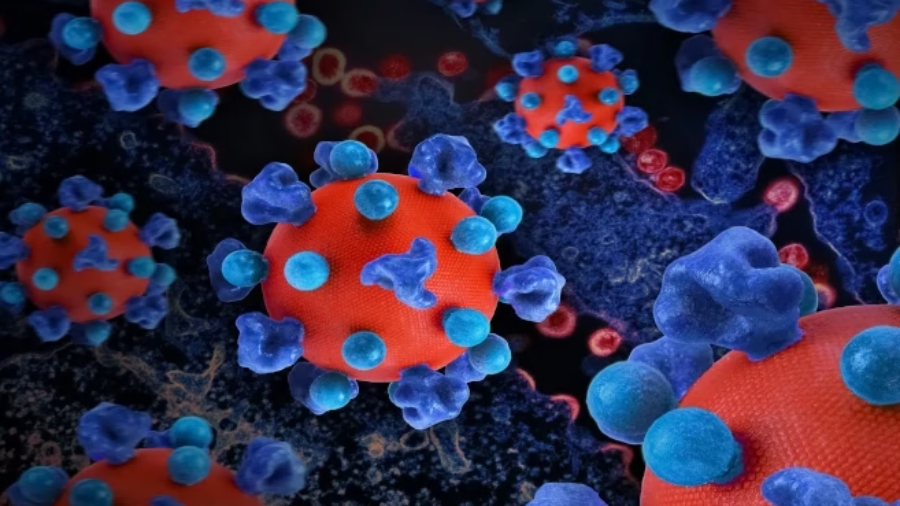
The Hantavirus Outbreak that has engulfed a Dutch cruise ship in the mid-Atlantic is not just a maritime emergency — it is a cold reminder that deadly pathogens remain among the greatest threats to human civilisation. The question gripping public health officials, virologists, and frightened passengers alike is this: could it spread far beyond a single vessel?
It began as an expedition cruise, the kind that wealthy nature-lovers take to Antarctica and Patagonia, aboard the MV Hondius. But since the ship departed Ushuaia, Argentina, on April 1, 2026, it has transformed into something no one signed up for — a floating containment zone in the middle of the Atlantic Ocean, with passengers from 23 nations, three confirmed deaths, and governments from Spain to Singapore scrambling to respond.
So what exactly is happening? And how worried should the rest of the world be?
5+Confirmed cases (WHO, May 7)
3Deaths reported
23Nationalities on board
~40%Fatality rate, Andes strain
What Is Hantavirus — and Why Is This Strain Different?
Most people have never heard of hantavirus, but it has been silently killing people for decades. According to the CDC, hantaviruses are a family of viruses primarily carried by rodents, transmitted to humans through contact with infected urine, droppings, or saliva — often simply by breathing in contaminated dust.
The virus first seized global attention in 1993, when a mysterious respiratory illness killed several young, healthy people in the American Southwest. Scientists eventually identified it as Hantavirus Pulmonary Syndrome (HPS), caused by the Sin Nombre strain — a virus that kills roughly one in four people it infects. Terrifying as that sounds, Sin Nombre shares one critical limitation with almost every other hantavirus: it cannot spread from person to person.
The Andes strain is different. And that difference is everything.
Critical distinction: The Andes virus is the only hantavirus strain in the world known to be capable of human-to-human transmission. It is also the strain confirmed aboard the MV Hondius — and it kills up to 40% of the people it infects.
“The majority of hantaviruses cannot be spread through human-to-human spread,” said Dr. Sabra Klein, a professor of molecular microbiology at the Johns Hopkins Bloomberg School of Public Health. “This happens to be the only one.” But she and other experts are quick to note that even the Andes strain is not easily transmitted between people — requiring very close, sustained contact.
The Cruise Ship That Became a Global Crisis
The story of the MV Hondius reads almost like a thriller novel — but the stakes are devastatingly real. The ship departed Ushuaia, the southernmost city in the world, on April 1 with approximately 150 passengers and crew on board. Among them: a Dutch couple who had spent four months travelling through Argentina, Chile, and Uruguay on a bird-watching trip.
April 1, 2026
MV Hondius departs Ushuaia, Argentina. No passengers show symptoms at departure.
April 11, 2026
A 70-year-old Dutch man dies on board after developing fever, headache, and abdominal pain. His illness onset is later traced back to before the voyage.
April 24–26, 2026
The man’s wife disembarks in Saint Helena. She deteriorates on a flight to Johannesburg and dies upon reaching hospital. She tests positive for hantavirus.
May 2, 2026
WHO receives formal notification. Lab testing in South Africa confirms hantavirus in a critically ill patient. A cluster of seven cases — two confirmed, five suspected — is reported.
May 6–7, 2026
WHO confirms the Andes strain. The ship reaches Cape Verde but cannot disembark. Spain refuses the vessel entry at Tenerife. WHO calls Spain’s refusal legally and morally questionable.
The situation grew more alarming as it became clear that passengers had already scattered across the globe before the outbreak was identified. A KLM airline crew member in Amsterdam sought hospital testing after contact with the Dutch woman who died. Three Canadians self-isolated — one of whom had never even been on the ship, but shared a flight home with those who had. Singapore placed two residents in government isolation facilities.
“We believe more cases will emerge — but we do not anticipate a large epidemic anywhere similar to Covid.”— WHO Director-General Dr. Tedros Adhanom Ghebreyesus, May 2026
How Contagious Is It, Really?
This is where science must cut through the noise of public fear. The Andes virus does have a documented history of person-to-person spread, but the numbers are striking in their rarity. Dr. Gonzalo Palacios, one of the world’s leading Andes virus researchers, estimates that fewer than 300 cases of human-to-human transmission have been recorded in all of recorded history — against roughly 3,000 total Andes cases.
The 2018–2019 outbreak in Epuyén, Argentina — widely studied as a case study in Andes transmission — illustrated both the danger and the limit. One infected person spread the virus to three guests at a birthday party, who then attended social events, ultimately causing 34 infections and 11 deaths. Alarming, yes — but it also burned out. It did not spread city-wide, nationally, or globally, because the transmission window appears to be extremely narrow: roughly one day, centred on when a person develops a fever.
“People are at their peak of infectiousness on the day they develop a fever,” Palacios noted — so unlike SARS-CoV-2, which could be spread by people who were pre-symptomatic for days, the Andes virus gives a narrower and more detectable window for containment.
Comparing the Andes Strain to Other Deadly Pathogens
| Pathogen | Fatality Rate | Human-to-Human? | Pandemic Risk |
|---|---|---|---|
| Andes Hantavirus | ~21–50% | Limited / rare | Moderate — contained |
| Sin Nombre Hantavirus (US) | ~25% | No | Very low |
| Ebola (Zaire strain) | ~50–90% | Yes (contact) | Moderate — burn-out |
| SARS-CoV-2 | ~0.5–1% | Yes (airborne) | Pandemic |
| Seasonal Influenza | ~0.1% | Yes (airborne) | Epidemic — annual |
Sources: CDC, WHO, NEJM. Fatality rates are approximate and context-dependent.
The table above reveals a sobering paradox at the heart of this crisis. The Andes virus is brutally lethal — but it is not built for pandemic spread. COVID-19 killed far fewer people per infection but could travel invisibly, through the air, long before anyone felt sick. Andes kills viciously but tends to choke off its own transmission chain.
Why Argentina Is the Epicentre — and Why That Matters
The MV Hondius outbreak did not begin on the ship. Investigators believe the Dutch couple contracted the virus during their four-month road trip through southern South America — likely near a landfill or rural area frequented by the long-tailed pygmy rice rat, the primary reservoir of the Andes virus in Patagonia.
Crucially, the broader picture in Argentina is worsening. The Argentine health ministry reported 101 hantavirus infections since June 2025 — roughly double the caseload over the same period the previous year. That surge is deeply concerning on its own, but it also raises an urgent question: what is driving the increase?
Factors Behind Rising Hantavirus Cases
- Climate change: Warming temperatures and irregular rainfall alter rodent habitats and population cycles, pushing rats into human settlements.
- Rural tourism: A boom in eco-tourism and bird-watching expeditions brings more people into remote rodent habitats with little knowledge of the risk.
- Urban expansion: New farming practices and rural settlements disrupt the zoonotic interface, increasing spillover events.
- Surveillance gaps: In remote Patagonian communities, cases may go undiagnosed or unreported for days — widening transmission windows.
Research published in peer-reviewed journals has repeatedly flagged that the risks of viral spillover have increased due to new farming practices and disruptions to the zoonotic interface. In other words, the MV Hondius outbreak is not random bad luck — it is a predictable consequence of how humans are reshaping the environment.
Is This the Next COVID? Experts Say No — But With Important Caveats
The comparisons to COVID-19 were inevitable. Passengers dispersing from a single source across dozens of countries, governments scrambling to trace contacts, cruise ships anchored offshore while ports refuse them entry — the imagery is familiar and unsettling. But virologists are urging the public not to draw hasty parallels.
Maria van Kerkhove, WHO’s head of epidemic and pandemic preparedness, was direct at a May 5 press conference: the risk of hantavirus to the general public is low. WHO’s formal risk assessment, published on May 4, echoes this, categorising the global risk as low — so long as containment measures hold.
And yet there are reasons for measured vigilance rather than complacency. There is, as of now, no licensed antiviral treatment for hantavirus infection anywhere in the world. Treatment is entirely supportive — oxygen, fluids, mechanical ventilation in severe cases. No vaccine exists for the Andes strain. And the virus’s incubation period of up to 40 days means that some exposed passengers may still be unknowingly carrying the infection.
“Spain has a moral and legal obligation to assist these people.”— WHO, responding to Tenerife’s refusal to accept the MV Hondius
The Political Dimension: When Fear Overrides Solidarity
Perhaps the most disturbing subplot of the MV Hondius crisis is the response of political leaders. When the ship attempted to dock in Tenerife, the president of the Canary Islands, Fernando Clavijo, flatly refused entry — citing the islands’ traumatic experience with COVID-19 and public pressure from residents who feared contagion.
WHO pushed back sharply, noting that Spain had both a moral and legal obligation under international law to assist the passengers, several of whom are Spanish nationals. The standoff left roughly 150 people — including critically ill patients — stranded at sea for days.
This political failure is not just a humanitarian concern — it is an epidemiological one. When ships cannot dock, patients cannot receive advanced care, and containment becomes harder. The lesson of COVID-19 was that fear-driven border closures often worsened outcomes rather than preventing spread. The same dynamic appears to be playing out here, even on a smaller scale.
What You Should Know: Practical Guidance
For the vast majority of the world’s population, the direct risk from this outbreak remains very low. The Andes strain is geographically concentrated in South America and requires specific conditions — close contact with an infected person or a rodent reservoir — to spread. But there are important lessons worth internalising.
Practical Guidance for Travellers and the Public
- Avoid contact with rodents, their nests, and droppings — especially in rural South America (Argentina, Chile, Uruguay).
- If cleaning potentially contaminated areas, wet the surface with disinfectant first — never dry sweep or vacuum, which aerosolises particles.
- If you have recently travelled to Patagonia or southern South America and develop fever, headache, or respiratory symptoms, seek medical advice and mention your travel history explicitly.
- Be aware that hantavirus symptoms can take up to 40 days to appear after exposure — so vigilance should continue for weeks after returning from at-risk areas.
- There is no specific antiviral treatment — early hospital care and respiratory support are critical to survival.
· · ·
The Bigger Picture: A World Still Not Ready
The MV Hondius crisis is, in many ways, a microcosm of the world’s enduring vulnerability to zoonotic disease. Scientists have warned for years that the next pandemic is not a matter of if but when — and that it is most likely to emerge at the human-animal interface, driven by deforestation, climate change, and encroachment into wild habitats.
What hantavirus demonstrates — in real time — is that even a pathogen with limited pandemic potential can expose the fault lines in global health governance: the gaps in early warning systems, the shortcomings of international solidarity, and the dangerous power of political fear to override scientific reason.
The world survived COVID-19 — battered, grief-stricken, and economically scarred, but intact. The question the MV Hondius outbreak forces us to ask is whether the hard lessons of that pandemic have truly been internalised. Do we have faster diagnostic capacity? Better international coordination? Political leaders willing to act on evidence rather than fear?
The answer, so far, appears to be: partially. And partially is not good enough when lives are at stake on a ship in the middle of the Atlantic.
For now, the WHO’s assessment holds: this is not a global pandemic threat. But the outbreak is a warning siren, and the world would do well to listen — not with panic, but with the focused, evidence-driven urgency that zoonotic disease demands.
Stay Informed. Stay Prepared.
Global health crises evolve fast. Bookmark this page for updates, share this article with someone who should know what’s happening, and follow WHO’s official channels for the latest guidance.Read WHO’s Official Outbreak Notice →
References & Sources
- 1. World Health Organization (2026). Hantavirus cluster linked to cruise ship travel, Multi-country — Disease Outbreak News DON599. who.int
- 2. Wikipedia (2026). MV Hondius hantavirus outbreak. wikipedia.org
- 3. CNN (2026). What doctors know about how the Andes hantavirus spreads. cnn.com
- 4. NBC News (2026). How hantavirus spreads: What to know about rare person-to-person transmission. nbcnews.com
- 5. National Geographic (2026). What is hantavirus? Here’s what to know about how it spreads. nationalgeographic.com
- 6. TIME (2026). What Countries Are Linked to the Hantavirus Outbreak? time.com
- 7. NEJM (2021). “Super-Spreaders” and Person-to-Person Transmission of Andes Virus in Argentina. nejm.org
- 8. PMC / NIH (2022). Evidence for Human-to-Human Transmission of Hantavirus: A Systematic Review. pmc.ncbi.nlm.nih.gov
- 9. NIH / PMC (2026). Virological Characterization of a New Isolated Strain of Andes Virus. ncbi.nlm.nih.gov
- 10. CDC. About Hantavirus. cdc.gov/hantavirus
© 2026 Global Health Watch · All rights reserved · For informational purposes only — always consult official health authorities
