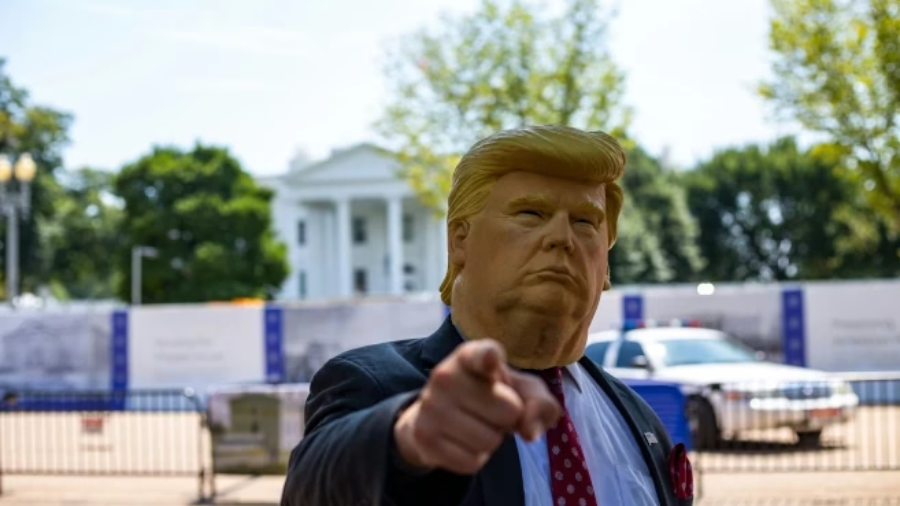
This isn’t a dystopian novel. This is the cost of Trump’s reckless adventurism playing out in real-time during his second term, and American workers, families, and businesses are paying the price while the rest of the world moves on without us. The President of the United States threatens to annex Canada, eyes Greenland like it’s a real estate deal, slaps tariffs on America’s closest allies, and conducts foreign policy via social media tantrums—all while China quietly signs trade agreements with dozens of nations, Canada diversifies its partnerships away from American dependence, and Mexico emerges as a manufacturing powerhouse courted by global investors.
The gap between Trump’s bombastic rhetoric and economic reality has never been wider. While he tweets about “making America great again,” America’s traditional allies are building new partnerships that explicitly exclude the United States. When he is busy boasting about “winning” trade wars, American consumers face rising prices and manufacturers watch jobs move overseas. While he claims to restore American dominance, the world is constructing a post-American order—and doing so with remarkable speed.
The tragedy isn’t just that Trump’s policies are failing. It’s that they’re succeeding brilliantly—for America’s competitors. Every tariff Trump imposes drives allies toward China. Any insult he hurls at democratic partners strengthens authoritarian narratives. Every norm he violates makes American leadership seem less essential and more dangerous.
Let’s examine the devastating real-world consequences of Trump’s reality-free approach to governance, and why the cost of Trump’s reckless adventurism will be paid by Americans for generations.
The Fantasy World of Trump’s Foreign Policy
Trump operates in a parallel universe where economics, diplomacy, and geopolitics work according to his gut instincts rather than decades of evidence and expertise. In Trump’s world:
- Trade wars are “easy to win” (they’re not)
- Tariffs are paid by foreign countries (they’re paid by American consumers)
- Allies are freeloaders who need America more than America needs them (the opposite is true)
- Insulting partners strengthens negotiating positions (it destroys trust permanently)
- Complex global supply chains can be unwound with tweets (they can’t)
- American economic dominance is guaranteed by geography and history (it requires constant diplomatic and economic work)
This disconnect from reality would be merely embarrassing if Trump were a private citizen. As President, it’s catastrophic.
Economic research consistently shows that Trump’s first-term tariffs cost American consumers $51 billion annually while failing to revive manufacturing or reduce trade deficits. His second term is doubling down on these failed policies with even more reckless threats and implementations.
The Yale Budget Lab calculated that Trump’s proposed universal tariffs would amount to a $1,700 annual tax increase on average American households—the largest middle-class tax hike in modern history, imposed not through legislation but presidential whim.
But the economic damage, severe as it is, represents only part of the cost of Trump’s reckless adventurism. The diplomatic and strategic costs may prove even more devastating and longer-lasting.
China’s Strategic Victory: Winning Without Fighting
While Trump wages chaotic trade wars and insults allies, China is executing a masterclass in 21st-century statecraft. Beijing watched Trump’s first term carefully, learned valuable lessons, and is now capitalizing on his second-term chaos with surgical precision.
The Belt and Road Advantage
China’s Belt and Road Initiative now encompasses over 150 countries representing more than 60% of global population and 40% of world GDP. While Trump threatens allies with tariffs, China offers infrastructure investment. While America demands immediate returns, China plays the long game.
The contrast couldn’t be starker. Trump’s “America First” translates to “America Alone” in practice, while China’s approach—however imperfect and sometimes predatory—offers tangible benefits to partner nations.
Consider Southeast Asia. As Trump abandoned the Trans-Pacific Partnership (TPP) in his first term, China filled the vacuum with the Regional Comprehensive Economic Partnership (RCEP), now the world’s largest trade bloc. Countries that wanted to balance between Washington and Beijing increasingly find themselves with no choice but to tilt toward China because America has become unreliable.
Technology and Standards
Perhaps more consequentially, China is winning the battle for technological standards and digital infrastructure. While Trump bans TikTok and restricts tech exports in scattershot fashion, China is building the digital architecture of developing nations through 5G networks, digital payment systems, and smart city technologies.
When Chinese technology becomes the default platform for billions of people, American influence diminishes proportionally. Trump’s reactive, ban-focused approach has accelerated rather than slowed this process by forcing countries to choose sides—and many are choosing the side that offers technology transfer and investment rather than lectures and threats.
The Diplomatic Dimension
China has also capitalized on Trump’s alienation of allies to position itself as a more stable, predictable partner. Beijing now mediates between Saudi Arabia and Iran, brokers deals in Latin America and Africa, and presents itself as a defender of multilateralism and international institutions that Trump routinely attacks and threatens to abandon.
The irony is profound: an authoritarian state gains credibility as a responsible international actor because the leader of the world’s most powerful democracy behaves erratically and undermines the very system America built.
The cost of Trump’s reckless adventurism in China policy isn’t that he’s tough on Beijing—strategic competition with China is necessary and bipartisan. The cost is that his approach is fundamentally unserious, alienating the allies essential for effective China policy while handing Beijing propaganda victories and strategic opportunities.
Canada’s Quiet Pivot: The Neighbor That Had Enough
Few relationships better illustrate the damage of Trump’s approach than America’s catastrophic deterioration of ties with Canada—historically America’s closest ally, largest trading partner, and most reliable security partner.
From NAFTA Chaos to USMCA Instability
Trump’s renegotiation of NAFTA into the USMCA was supposed to be his signature achievement. Instead, it’s become a case study in how not to conduct trade policy. The agreement barely changed substantive trade terms but created massive uncertainty, disrupted supply chains, and damaged trust.
Now, Trump threatens to tear up even that agreement, impose tariffs on Canadian goods, and—in his most unhinged moments—suggests annexing Canada as the “51st state.” Canadian officials have responded with a mixture of bemusement and horror, while Canadian businesses accelerate their diversification away from American market dependence.
The Economic Consequences
Canada’s response has been strategic and methodical. Rather than waiting to see if Trump will follow through on threats, Canadian businesses and government are building alternatives:
- Expanding trade relationships with Europe through CETA
- Deepening partnerships with Asia-Pacific nations through CPTPP
- Attracting foreign investment by positioning Canada as stable alternative to America
- Developing direct shipping routes to Asian markets to bypass American intermediaries
- Strengthening Mexico relationships independent of US
The long-term implications are staggering. American and Canadian supply chains have been integrated for decades—cars cross the border multiple times during manufacturing, energy systems are interconnected, and millions of jobs depend on seamless trade. Trump’s threats are forcing decoupling that will permanently reduce American economic efficiency and competitiveness.
The Strategic Dimension
Beyond economics, Trump’s treatment of Canada has strategic implications. Canada is a NATO ally, a Five Eyes intelligence partner, a NORAD co-defender of North American airspace, and America’s partner in countless security initiatives.
When Trump publicly insults Canadian leaders, questions Canada’s reliability, and threatens economic warfare, he signals to every ally that American partnership is conditional on presidential mood swings rather than shared interests and values. This corrodes the alliance system that has been the foundation of American security since World War II.
Canadian public opinion toward the United States has plummeted to historic lows during Trump’s presidencies. Even when Trump eventually leaves office, the damage to bilateral trust will take decades to repair—if it can be repaired at all.
Mexico’s Moment: Rising While America Stumbles
Perhaps nowhere is the cost of Trump’s reckless adventurism more visible than in the unexpected economic rise of Mexico—the country Trump has spent years demonizing and threatening.
The Manufacturing Renaissance
While Trump promises to bring manufacturing back to America through tariffs and threats, something unexpected is happening: manufacturing is indeed leaving China, but it’s going to Mexico, not the United States.
Nearshoring trends have accelerated dramatically as companies reduce dependence on distant Chinese supply chains. But instead of choosing American locations, manufacturers are choosing Mexico, where they get:
- Lower labor costs than the US
- Modern infrastructure and educated workforce
- Proximity to American markets without American labor costs
- Stable, predictable trade policies
- Growing domestic market of 130 million consumers
Foreign direct investment in Mexico has surged while American manufacturing investment stagnates. Tesla, BMW, Toyota, and countless other companies are building massive facilities in Mexico rather than the United States. These aren’t jobs “stolen” from America—they’re jobs that could have come to America if Trump’s policies hadn’t made the country so unpredictable and hostile to trade.
Diplomatic Maturity
Mexico’s response to Trump’s bullying has been remarkably mature and strategic. Rather than retaliating emotionally, Mexican officials have:
- Maintained stable policy frameworks to attract investment
- Diversified trade relationships beyond North America
- Strengthened partnerships with Europe, Asia, and Latin America
- Invested in border infrastructure and security cooperation
- Taken the high road in public communications while privately building alternatives
President López Obrador and his successor Claudia Sheinbaum have navigated Trump’s chaos by refusing to take the bait. When Trump threatens tariffs, Mexico calmly points to existing agreements and international law. While Trump insults Mexico, Mexican officials respond with dignity. When Trump demands Mexico solve American drug problems, Mexico cooperates where reasonable while maintaining sovereignty.
This approach has won Mexico international respect while making America look petulant and irrational by comparison.
The Long-Term Trajectory
Mexico’s population is younger, its economy is growing faster, and its political system—despite serious challenges with violence and corruption—is consolidating democratically. Meanwhile, America under Trump is growing older, more divided, and less functional.
The 21st century could have been the “North American century” with the US, Canada, and Mexico forming an integrated economic powerhouse to compete with China and Europe. Instead, Trump’s policies are pushing Canada and Mexico to reduce dependence on America and build relationships that exclude us.
Decades from now, historians will identify Trump’s Mexico policy as a catastrophic strategic blunder—choosing jingoistic rhetoric over rational partnership with a neighboring democracy of 130 million people.
The Toll on American Workers and Families
While geopolitical consequences unfold gradually, American families are experiencing the cost of Trump’s reckless adventurism immediately in their daily lives.
The Tariff Tax
Despite Trump’s claims that foreign countries pay tariffs, basic economics shows that tariffs are taxes on imports paid by American businesses and consumers. Studies from the Federal Reserve and academic economists demonstrate that Trump’s first-term tariffs were passed almost entirely to American consumers through higher prices.
Consider a typical American family:
- Their clothing costs more because of tariffs on textiles
- Their electronics cost more because of tariffs on components
- Their cars cost more because of tariffs on steel and aluminum
- Their appliances cost more because of disrupted supply chains
- Their food costs more because of retaliation against American agriculture
The Tax Foundation estimates that Trump’s second-term tariff proposals would reduce GDP by $524 billion, eliminate 684,000 jobs, and reduce average household income by $1,700 annually. These aren’t hypothetical future costs—families are experiencing them right now through inflation that Trump’s policies are directly causing.
The Agriculture Disaster
American farmers have been among the biggest victims of Trump’s trade wars. When Trump imposed tariffs on China, Beijing retaliated by targeting American agricultural exports—soybeans, pork, corn, and other products that Midwestern farmers depend on.
China found alternative suppliers in Brazil, Argentina, and other countries. Even after Trump’s first-term trade war ended, Chinese purchases of American agricultural products haven’t returned to pre-trade-war levels because Chinese supply chains have permanently diversified away from American dependence.
Trump has attempted to compensate farmers with bailout payments—essentially welfare for an industry his policies damaged. These payments cost taxpayers $28 billion and counting, while doing nothing to restore the export markets that farmers actually need for long-term viability.
The human toll is measured in farm bankruptcies, rural suicides, and generational farming operations ending because Trump’s ego and ignorance destroyed markets that took decades to build.
Manufacturing Reality Check
Trump’s promise to revive American manufacturing through tariffs and threats has failed spectacularly. Manufacturing employment increased modestly in his first term but at rates slower than Obama’s second term and far below what Trump promised. His second term is seeing manufacturing employment stagnate or decline as uncertainty and tariffs make American production uncompetitive.
The problem is simple: manufacturing competitiveness requires stable policy, integrated supply chains, skilled workers, and strategic investment. Trump offers none of these. Instead, he provides chaos, disruption, and policies designed for applause lines rather than economic results.
The Credibility Crisis: America’s Word Means Nothing
Beyond measurable economic costs, the cost of Trump’s reckless adventurism includes something harder to quantify but potentially more devastating: the destruction of American credibility.
Treaties and Agreements Worth Nothing
Trump has withdrawn from or threatened to withdraw from:
- Paris Climate Agreement
- Iran Nuclear Deal
- Trans-Pacific Partnership
- Intermediate-Range Nuclear Forces Treaty
- Open Skies Treaty
- World Health Organization
- UNESCO
- UN Human Rights Council
He’s threatened to abandon NATO, questioned defense commitments to allies, and suggested America might not honor treaty obligations unless allies “pay up.”
The message to the world is clear: American commitments are worthless because they last only until the next election or presidential mood swing. This makes America an unreliable partner for any long-term cooperation.
Other nations are responding rationally to American unreliability by building institutions and relationships that don’t depend on Washington. Europe is pursuing strategic autonomy. Asia-Pacific nations are hedging between America and China. Middle Eastern countries are making deals with whoever they can trust—and that’s increasingly not America.
The Democratic Model Discredited
Trump’s chaotic governance, contempt for law and norms, and authoritarian rhetoric have damaged America’s ability to promote democracy globally. When American officials lecture other countries about rule of law, those countries point to January 6th. When America promotes democratic values, authoritarians respond that American democracy elected Trump—twice.
China and Russia actively use Trump as evidence that democracy is unstable, that strongman rule is more effective, and that American-style governance isn’t worthy of emulation. Every Trump scandal, every norm violation, every demonstration of American dysfunction becomes propaganda for authoritarian competitors.
The cost isn’t just reputational—it’s strategic. American influence in the world has historically rested not just on military and economic power but on the attractive power of American ideals. Trump is squandering that soft power with remarkable efficiency.
The Business Community’s Dilemma
Perhaps most telling, the cost of Trump’s reckless adventurism is recognized and opposed by much of the American business community that initially supported him.
Uncertainty Kills Investment
Business leaders consistently cite policy uncertainty as their top concern under Trump. Companies can adapt to almost any policy environment—high taxes or low, heavy regulation or light—if they know the rules and those rules are stable.
Trump provides the opposite: constant threats of tariffs, sudden policy reversals, government-by-tweet that can destroy billions in market value overnight, and regulatory approaches that change based on presidential whims and political vendettas.
This uncertainty is devastating for long-term investment. Why build a factory in America if trade policy might change dramatically next month? What is the use develop supply chains if tariffs might suddenly disrupt them? Why make 20-year infrastructure investments if government policy has a 20-day horizon?
Supply Chain Destruction
Modern manufacturing requires supply chains developed over decades. Components cross borders multiple times, specialized suppliers exist in specific locations, and just-in-time logistics minimize inventory costs.
Trump’s trade wars and tariff threats are destroying these intricate systems. Companies are being forced to choose between eating costs, raising prices, or restructuring entire operations. All three options reduce competitiveness and profitability.
Business Roundtable surveys show CEO confidence plummeting during Trump periods and recovering when he’s not in office. This isn’t political—it’s economic reality that chaos is bad for business regardless of party affiliation.
What Real Leadership Would Look Like
The tragedy is that legitimate concerns exist about China’s trade practices, about balancing free trade with worker protection, about maintaining American competitiveness. These are real issues that deserve serious policy responses.
But Trump offers nothing serious—only bombast, threats, and policies designed for cable news soundbites rather than economic effectiveness.
Real leadership would:
- Work with allies to present united front on China rather than alienating them
- Invest in American competitiveness through education, infrastructure, and R&D rather than tariffs
- Negotiate stable, predictable trade agreements rather than threatening to tear up existing ones
- Support American workers through training and transition assistance rather than false promises
- Engage seriously with economic complexity rather than pretending simple solutions exist
Countries like Canada, China, and Mexico are eating America’s lunch not because they’re smarter or more talented, but because their leadership operates in reality while Trump operates in fantasy.
The Long-Term Damage: Measuring What’s Lost
The cost of Trump’s reckless adventurism will be paid long after he leaves office:
Economic Costs:
- Permanently lost export markets
- Supply chains that won’t return to American involvement
- Manufacturing investment that went elsewhere
- Innovation that happened in other countries
- Trade agreements other nations signed without us
Strategic Costs:
- Alliances weakened or broken
- Institutions built without American input
- Chinese influence expanded into vacuums America created
- Regional orders that exclude American interests
- Military partnerships that no longer trust American reliability
Soft Power Costs:
- Democratic model discredited
- American values associated with chaos
- Moral authority destroyed
- Cultural influence diminished
- Educational and scientific leadership questioned
The United States emerged from World War II as unquestioned global leader. That position required constant maintenance through wise policy, steady leadership, and alliance management. Trump is squandering seven decades of American primacy with stunning speed.
The Choice Before America
The good news—if any exists in this grim assessment—is that the cost of Trump’s reckless adventurism isn’t yet irreversible. America retains enormous economic, military, and innovative capacity. With serious leadership, many damaged relationships could be repaired, though not quickly or easily.
But every day Trump remains in office, every new tariff threat, every insult to allies, every norm violation, makes the hole deeper and recovery harder.
Americans must decide: Do we want a country that leads through partnership and example, or one that bullies and alienates? Do we want economic policy based on evidence, or on the gut instincts of a man who bankrupted casinos? Do we want America as essential global leader, or America as isolated, declining power that the world builds new systems to exclude?
These aren’t partisan questions—they’re survival questions for American prosperity and security.
China, Canada, Mexico, and other countries have already made their choices. They’re building a world that works without American leadership because they’ve concluded they can’t rely on America anymore.
The tragedy is they’re right to reach that conclusion. The greater tragedy is that it didn’t have to be this way.
The cost of Trump’s reckless adventurism isn’t just measured in dollars, jobs, or even lost alliances. It’s measured in squandered potential—the future America could have had if we’d chosen leadership over demagoguery, reality over fantasy, and partnership over isolation.
That future is still possible. But time is running out, and the bill is coming due.
What do you think? Are you experiencing the economic impacts of Trump’s policies in your daily life? How do you see America’s role in the world changing? Share your thoughts and experiences in the comments below. And if this analysis resonated with you, share it with others who need to understand what’s really at stake. The costs are real, the consequences are severe, and every American deserves to understand the price we’re paying for Trump’s reckless adventurism.
References and Further Reading
- Council on Foreign Relations: US Trade Policy Analysis
- Peterson Institute for International Economics: Tariff Impact Studies
- Yale Budget Lab: Tax Impact Analysis
- World Bank: Belt and Road Initiative Assessment
- Carnegie Endowment: China Technology and Influence
- McKinsey: Nearshoring and Manufacturing Trends
- Bureau of Labor Statistics: Employment Data
- Tax Foundation: Economic Impact Analysis
- Pew Research: International Opinion Surveys
- National Bureau of Economic Research: Trade War Studies
Stay informed. Stay engaged. America’s future depends on citizens who understand reality over rhetoric.