
threats against Trump critics

Fighting the Inhumanity and Lawlessness of the Trump Administration — Defending Democracy as a Moral Duty

Introduction – A Warning We Can’t Ignore

When a government treats power as a personal weapon, when laws are bent or broken to punish dissent or target the vulnerable — democracy itself trembles. The phrase “the inhumanity and lawlessness of the Trump Administration” may sound like a political slogan — but behind it lies a stark reality for millions whose lives and rights have been directly impacted.

What happens when institutions meant to guard liberty — courts, civil-rights protections, immigration laws, watchdog agencies — are undermined? When power is concentrated in one person or a faction, and compassion is replaced by cruelty? The consequences extend far beyond partisan politics.

This article explores how democratic systems, human-rights norms, and the rule of law strain under such pressure — why resisting this trend isn’t optional, but a moral and civic duty.

How Lawlessness and Cruelty Have Been Systematically Embedded

Erosion of Human Rights and Assaults on Vulnerable Groups

From early in his presidency onward — and with renewed vigor in his current term — Donald J. Trump has led policies that human-rights groups describe as “cruelty and chaos.” (Amnesty International)

  • Under the administration, asylum protections have been sharply curtailed; migrants have faced family separations, mass deportations, and harsh detentions. (Wikipedia)
  • Vulnerable communities — immigrants, refugees, minorities, women, LGBTQ+ individuals — have seen protections scaled back, and government rhetoric has often demonized them. (Amnesty International Australia)
  • Internationally, the United States under Trump has weakened its role as a human-rights advocate — reducing pressure on abusive regimes and softening official reports of rights violations. (The Washington Post)

The result: a climate of fear, marginalization, and dehumanization — where people’s dignity and rights are treated as expendable under political expediency.

Targeting Institutions, Undermining Checks and Balances

Human rights abuses don’t only stem from individual policies. Equally dangerous is the undermining of institutions meant to restrain power.

  • According to Human Rights Watch, the administration has waged a systematic assault on the institutions responsible for accountability — courts, justice system agencies, oversight bodies. (Human Rights Watch)
  • The effect is chilling: civil servants and public servants who resist abuses are marginalized, career-officials silenced or removed, and legal definitions manipulated to protect power rather than justice. (AP News)
  • On a global scale, U.S. leadership in human rights has weakened. The administration’s “human-rights diplomacy” has shifted toward geo-political interest, often at the expense of defending minorities, refugees, and persecuted communities. (The Washington Post)

Institutional decay like this doesn’t just affect laws — it magnetizes fear, discourages dissent, and signals to the world that power might now be above accountability.

The “Weaponization” of Government: Law as a Tool of Retaliation

One of the most dangerous aspects of this shift is how law and justice — traditionally shields for the weak — have become weapons for the powerful.

  • The administration has reportedly used executive orders and internal directives to punish critics, target law-firms and attorneys, and reshape judicial oversight in ways that prioritize loyalty over justice. (The White House)
  • Civil-servants working in agencies like the U.S. Department of Justice (DOJ) have testified that political loyalty, not lawful conduct, has become the standard — undermining independence, fairness, and public trust. (AP News)
  • Reports indicate removal of content or softening of language in official human-rights documents — undermining transparency and erasing abuses in partner countries or allied regimes. (Human Rights Watch)

This transformation of government into an instrument of power and retaliation turns law into its own opposite — not a guardian of justice, but a tool of suppression.

Why This Matters — Beyond Politics

Democracy’s Fragile Foundations

Democracy isn’t just elections — it’s institutions. Checks and balances. The rule of law. Respect for human dignity.

When core institutions degrade, when laws no longer protect the vulnerable but instead shield the powerful — democracy begins to hollow out.

  • Courts lose independence when law-firms and judges are threatened or punished for rulings.
  • Civil-rights protections lose meaning when agencies meant to enforce them are politicized or dismantled.
  • Trust dissolves — among minorities, immigrants, and the general public — when rights are eroded, and justice becomes selective.

In such a climate, the social contract fractures. Citizens lose faith, and resentment grows. The next generation sees not protection, but danger — not representation, but power for sale.

Global Ripple Effects — From Precedent to Empowerment of Autocrats

When the world’s most powerful democracy scales back human-rights advocacy, the impact is global.

  • Authoritarian regimes take heart: if the U.S. no longer sanctions abuses or calls out corruption, repression abroad gains a powerful cover. This undermines global human-rights norms and emboldens oppressive governments. (OCCRP)
  • Organizations and civil-society defenders abroad lose a powerful ally. With the U.S. withdraw from moral leadership — or polarizing that leadership — vulnerable populations worldwide become more exposed.
  • International human-rights frameworks, treaties, and conventions weaken if a founding global power abandons them or violates their spirit.

The “Trump effect,” as some human-rights organizations call it, isn’t just domestic — it reverberates worldwide. (The Guardian)

Humanity’s Moral Debt — The Voice of Conscience

Beyond institutions and geopolitics lies the human toll — the pain of families separated, of refugees turned away, of minorities stripped of dignity, of individuals persecuted for who they are.

We have a moral debt — not only to those affected now, but to future generations.

If we allow cruelty and lawlessness to take root with impunity, we risk normalizing the unacceptable. We risk teaching our children that might makes right, that power absolves morality.

Who Must Resist — The Many Roles of Defenders

Fighting this isn’t the job of one group. It requires a coalition — a mosaic of voices.

Citizens & Voters

Your vote, your voice, your activism can shape public opinion and influence policy. Silence becomes complicity. Use your voice to challenge abuses, support rights, and demand accountability.

Journalists & Media Organizations

Truth must be told. Through rigorous reporting, exposing abuses, and holding power to the light — journalism remains one of democracy’s most important defenses.

Public Servants & Whistleblowers

Those inside government — civil-service employees, lawyers, inspectors — who value justice over politics, who report abuses despite risk, are crucial. Their courage preserves institutional integrity.

Faith Leaders, Community Organizers & Civil-Society Actors

Compassion, solidarity, and moral clarity often come from faith communities and grassroots activists. They remind us: behind every policy are real people with dignity, suffering, or hope.

International & Human-Rights Organisations

Global coalitions amplify pressure, document abuses, and defend international law. Their work ensures that power cannot hide behind borders.

A Call for Moral Clarity — Not Political Partisanship

Resisting “the inhumanity and lawlessness of the Trump Administration” is not about political parties or ideological purity.

It’s about defending what it means to be human.

It’s about insisting that power must be limited, rights must be protected, and justice must be real — for everyone.

It’s about refusing to allow cruelty, fear, and oppression to become “normal operations.”

Because when we tolerate injustice — even indirectly — we lose more than laws. We lose our dignity, our compassion, our collective humanity.

What You Can Do: Concrete Steps

ActionWhy It Matters
✉️ Write to your representatives — demand oversight and transparencyElected officials can pressure institutions and enact protective laws
📢 Support independent journalism and human-rights organizationsEnsures abuses are exposed and documented
🛑 Stand with immigrants, minorities, marginalized communitiesSolidarity reduces fear and strengthens resistance
💬 Speak publicly — blogs, social media, community forumsVoices create awareness and challenge normalization of cruelty
🧑‍⚖️ Support judges, whistleblowers, civil-servants who defend justiceInstitutional integrity depends on individuals with moral courage
🌍 Promote international human-rights cooperation and solidarityRebuilds global norms weakened by domestic lawlessness

Conclusion — Why This Struggle Matters for All of Humanity

The inhumanity and lawlessness of the Trump Administration — real, repeated, systemic — is not just an American problem. It is a universal warning.

When power goes unchecked, when rights are stripped, when institutions crumble, and when cruelty becomes policy — any society can descend into oppression.

But history also shows another path: the path of resistance, of solidarity, of justice. The path where citizens, communities, and conscience unite to defend dignity.

If you believe that human life — every human life — matters. If you believe that laws exist not to serve power, but to protect people. If you believe that democracy is more than elections — more than politics — but a covenant of trust, respect, and shared responsibility — then this struggle is yours too.

Fighting this inhumanity is not optional. It is a moral duty.

Stand with me. Stand for dignity. Stand for justice.
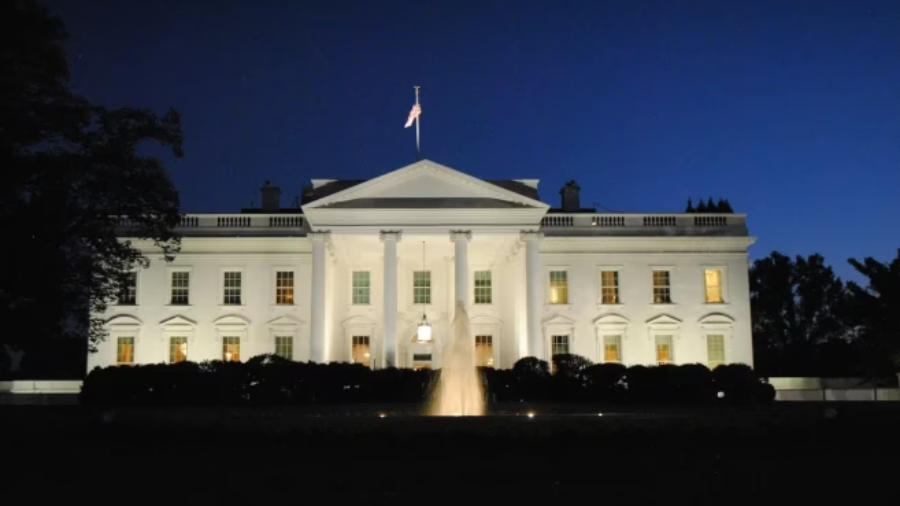
national-conservatism-pic

National Conservatism: How Extremism Goes Mainstream

Introduction: The Return of the Nation

Not long ago, national conservatism was seen as a marginal ideology, confined to the outer edges of political discourse. It evoked images of hyper-traditionalists or fiery far-right populists with little chance of influencing the political center. Yet today, the movement no longer sits on the periphery. It has stepped confidently onto the main stage of politics in the United States, Europe, and beyond.

How did this happen? How did rhetoric once considered extreme—staunch nationalism, suspicion of immigration, attacks on liberal institutions—become normalized in mainstream debates? And more importantly: what does this tell us about the fragility of political norms in the 21st century?

This post explores how national conservatism goes mainstream, the mechanisms it uses to soften its edges, and why its rise matters for democracy and society.

1. What is National Conservatism?

At its heart, national conservatism is the defense of the nation-state against perceived threats from globalism, liberal universalism, and social progressivism. Its advocates argue that human flourishing is best safeguarded by strong national communities rooted in shared culture, history, and often religion.

The movement has been codified by the Edmund Burke Foundation, led by Israeli philosopher Yoram Hazony, whose 2018 book The Virtue of Nationalism laid much of the intellectual groundwork. Hazony insists that national conservatism seeks to protect the “national independence of nations” against supranational bodies like the European Union, the United Nations, or global trade institutions (Hazony, National Affairs).

Key features of the ideology include:

  • National Sovereignty: Nations must resist supranational governance.
  • Cultural Homogeneity: Shared traditions and often religious heritage are seen as binding glue.
  • Skepticism of Globalization: Free trade, open borders, and multiculturalism are treated as threats.
  • Public Religion: Christianity in the West, or other dominant faiths, are viewed as moral anchors.
  • Family as Foundation: Traditional family structures are promoted as essential for social stability.

In short, national conservatism reframes “extremism” as common sense: defend your borders, protect your traditions, prioritize your people. This rhetorical sleight of hand makes it far easier to cross from the fringe into mainstream respectability.

2. The Path from Margin to Mainstream

A. The American Example

In the U.S., national conservatism emerged as the ideological heir of Trumpism. Once Donald Trump introduced slogans like “America First,” his movement blurred the line between far-right populism and the Republican Party’s mainstream identity.

At the 2025 National Conservatism Conference in Washington, Missouri Senator Eric Schmitt triumphantly declared the movement victorious, arguing that it was time to “restore a Christian America” and roll back decades of liberal social progress (AP News). Other speakers emphasized immigration restriction, dismantling DEI programs in universities, and reinstating public religion.

What began as outsider rhetoric under Trump has now become institutional conservatism—think tanks like the Heritage Foundation openly promoting policies such as a new “Manhattan Project for marriage” aimed at reversing demographic decline by strengthening traditional family structures (Washington Post).

B. The European Story

Across Europe, the dynamic is strikingly similar. In Germany, the CDU—long a pillar of centrist conservatism—has flirted with adopting far-right anti-immigration positions to retain voters drifting to the AfD. In Italy, Giorgia Meloni’s Brothers of Italy party, once considered extreme, now governs in coalition. And in France, Marine Le Pen’s National Rally is increasingly indistinguishable from mainstream center-right discourse.

The Financial Times notes that European conservatives are locked in a “vicious cycle,” as mainstream right parties adopt the rhetoric of the far-right in order to compete, thereby normalizing it (FT). This confirms what scholars at the International Centre for Counter-Terrorism call “the margins conquering the mainstream” (ICCT).

3. The Mechanisms of Mainstreaming

How does a movement move from radical to respectable? National conservatism employs several strategies:

MechanismHow It WorksExample
Softened LanguageExtreme ideas reframed as “common sense” concerns.Immigration restrictions as “protecting culture.”
Policy PiggybackingAttach radical ideas to legitimate grievances.Using economic anxiety to justify anti-globalist rhetoric.
Institutional LegitimacyConferences, think tanks, and academics provide respectability.Heritage Foundation & Edmund Burke Foundation.
Narrative ControlRedefine extremism as patriotism.“America First” or “Defend Europe.”
Religious AnchoringTie ideology to moral traditions, making critique harder.Public Christianity in NatCon speeches.

This process is slow but deliberate. By the time the average citizen hears the language, it no longer feels extreme—it feels familiar.

4. A Personal Encounter: The Normalization in Daily Life

During a recent visit to Berlin, I joined a casual conversation in a café. The topic was immigration. One man remarked: “We just want to protect our children’s future by preserving German culture.” His tone was calm, measured, not fiery or aggressive. Yet in those words lay the distilled essence of national conservatism.

What struck me wasn’t the content—versions of this argument have been around for decades—but the delivery. It was spoken as if it were obvious, pragmatic, even benevolent. That’s the power of mainstreaming: ideas once confined to the far-right are now everyday talking points, expressed over coffee by ordinary citizens.

5. Why National Conservatism Matters

A. Erosion of the Political Center

The most profound effect of national conservatism’s rise is the hollowing out of centrist politics. As mainstream conservatives adopt more radical rhetoric, the center weakens, leaving voters with a polarized choice between extremes (Guardian).

B. Democratic Vulnerability

National conservatism emphasizes majority identity—religious, cultural, or ethnic—often at the expense of minority protections. This threatens liberal democracy’s foundation, which is built not only on majority rule but also on minority rights (LSE Blog).

C. Global Ripple Effects

The movement is not confined to the West. In Israel, Hazony’s homeland, national conservatism informs government policy toward Palestinians. In India, parallels can be drawn with Hindu nationalism, which similarly frames cultural homogeneity as national survival.

D. The Radical Center Threat

Sociologist Seymour Martin Lipset once warned of the “extremism of the center”—when mainstream frustration produces radical solutions. National conservatism embodies this: a movement that presents itself as the “reasonable middle,” while quietly shifting the Overton window (Wikipedia).

6. What Comes Next?

The future of national conservatism depends on how institutions, media, and citizens respond. Some scenarios:

  • Normalization Continues: More mainstream parties adopt NatCon rhetoric, making it the new normal.
  • Democratic Pushback: Civil society and centrist coalitions reassert liberal democratic norms.
  • Hybrid Politics: A blend emerges—economic globalization tolerated, but cultural nationalism entrenched.

Much hinges on upcoming elections in the U.S. and Europe. Will voters double down on national conservatism, or will democratic resilience reassert itself?

Conclusion: Watching the Tide

National conservatism’s journey from fringe to mainstream is a reminder of how fluid political norms can be. What was once radical can, in a few years, become policy—or polite café conversation.

Understanding this shift is not about alarmism; it’s about clarity. We need to trace how ideas evolve, how rhetoric reshapes the possible, and how citizens respond. In this sense, national conservatism is both a warning and a case study: a movement that shows us exactly how extremism goes mainstream.

Call to Action

What do you see in your community? Are echoes of national conservatism present in local debates, media narratives, or political slogans? Share your thoughts in the comments below—and explore more of our deep-dives into Dangerous Doctrines and Global Movements to continue unraveling the hidden forces shaping our world.

References

authoritarianism

The Rise of Authoritarian Populism: From Hungary to Brazil

Here’s a rich, deeply researched, and engaging blog post on Authoritarian Populism, focused on the trajectory “From Hungary to Brazil”. At roughly 1,650 words, it blends clarity with insight, weaving in fresh analysis, scholarly context, and recent developments to keep readers informed and provoked.


The Rise of Authoritarian Populism: From Hungary to Brazil

Introduction

Imagine democracy not as a fortress, but a fragile ice sheet—slightly warmed, it bends, cracks, and could melt entirely. That’s the precarious reality of authoritarian populism, which cunningly erodes democratic norms while dressing itself in the garb of populist virtue.

This is not distant history. From Viktor Orbán’s illiberal democracy in Hungary to Jair Bolsonaro’s autocratic drift in Brazil, authoritarian populism is reshaping politics across continents. Let’s navigate how these two leaders weaponized populist narratives to hollow out democracy—and what we should learn from their playbooks.


Hungary: Orbán’s Blueprint for Erosion

The Gradual Slide Toward Electoral Autocracy

Since 2010, Viktor Orbán has methodically dismantled Hungary’s democratic institutions. The transformation is best described as a shift to electoral autocracy, where elections persist—but the checks and balances crumble. The European Parliament explicitly warned: Hungary had become a hybrid regime beyond full democratic status (Wikipedia).

Orbán’s government has:

  • Centralized media and eroded press freedom dramatically (Hungary fell 69 places on the Press Freedom Index between 2010 and 2020)
  • Undermined judicial independence through packed courts
  • Reworked the electoral system to favor his ruling party, Fidesz (Wikipedia)

This isn’t a coup—it’s a gradual authoritarian tumble, with a democratic veneer.

Cultural Strategy Meets Institutional Capture

Orbán’s model wasn’t merely institutional but ideological. Hungary’s relatively homogeneous demographic, combined with a backlash against globalization and immigration, formed fertile ground for a nationalist, populist message. He stoked cultural fears and erected “illiberal” values as a shield for his rule (globalejournal.org, publications.aston.ac.uk, The Loop).

While some commentators condemn him as a soft autocrat or soft fascist, Orbán markets himself as a defender of national sovereignty and traditional values—a message that resonates powerfully with many voters (Wikipedia).


Brazil: Bolsonaro’s Populist Power Play

Attacks on Institutions & Disinformation

In Brazil, Bolsonaro’s rise echoes Orbán’s strategy, repackaged in South American turbulence. From the start, he challenged institutional integrity:

  • He questioned electoral legitimacy, even suggesting the 2022 vote could be canceled unless the system was reformed (Wikipedia)
  • His administration tolerated and at times condoned escalating violence in the Amazon and skeptical attitudes toward the judiciary (ResearchGate, Wikipedia)

Even after losing power, Bolsonaro refused to concede defeat quietly. The post-election carnage included attacks on democratic institutions, mirroring the U.S. on January 6. In response, Brazil’s Supreme Court, led by Justice Alexandre de Moraes, aggressively prosecuted disinformation and coup plotting—invoking lessons from history to defend democratic norms (The New Yorker, The Washington Post).

Education Rollbacks & Caesarist Politics

Beyond his anti-establishment rhetoric, Bolsonaro enacted a reactionary cultural agenda—especially in education, where progressive gains were scrapped in favor of nationalist narratives. The term “Caesarism” best describes it: symbolic theatrics and authoritarian disdain for pluralism, all underpopulated by populist mass mobilization (ResearchGate).


Comparative Table: Hungary vs. Brazil

FeatureHungary (Orbán)Brazil (Bolsonaro)
Institutional ErosionMedia control, judicial capture, electoral rules skewedThreats to elections, judiciary, disinformation campaigns
Cultural MessagingNationalist, anti-globalist, Christian conservative identityAnti-leftist, anti-globalist, Christian-nationalist themes
Populist MechanismIlliberal democracy with legal reforms to sidestep oppositionAnti-elite rhetoric paired with reactionary policies
Resistance & ResilienceOngoing domestic protests and EU pressure (AP News, Financial Times)Supreme Court pushback, judiciary as democratic safeguard (The New Yorker, The Washington Post)

Key Insights: What Can We Learn?

  1. Authoritarian populism thrives on public disillusionment. Harvard’s Carr Center argues that a deficit of representation—people feeling unheard—is the root of this trend (Harvard Kennedy School). When voices feel silenced, radical alternatives seem attractive.
  2. It operates on institutional hollowing, not outright conquest. Both leaders used democratic tools—laws, elections, media—but repurposed them for control. The result: a democracy under erosion, not a collapse at once.
  3. Cultural paranoia is the emotional fuel. Resentment against elites and fear of outsiders form the emotional core feeding populist momentum—whether in Budapest or Brasilia (The Loop, ResearchGate).
  4. Democracy fights back—from courts, media, and people. In Brazil, the judiciary took a stand. In Hungary, civic protests continue amid increasingly repressive laws (AP News, The New Yorker, The Washington Post).
  5. The model exports. Hungary’s blueprint inspired U.S. MAGA factions and furthers authoritarian nostalgia elsewhere. Recognition of this pattern led critics to call Orbán the “Budapest Playbook” author (TIME, The Guardian).

Conclusion

Authoritarian populism is a slow, savvy redecorator of democracy: a problem amplified when societies feel disconnected, battered by inequality, and split by fear. Yet in the cracks of illiberal moves, we find rays of hope—resilient courts, courageous journalists, street-level dissent.

Ready to act?

  • Support institutional watchdogs: Democracy isn’t self-healing.
  • Stay informed & connected: Exposure to disinformation is the first vulnerability.
  • Lift representative politics: Ensure diverse voices are included and heard.

If this analysis sparked something for you, share your thoughts below. Explore our deep dives on Culture & Propaganda or Global Governance next. And don’t forget to subscribe for more fearless insights.


References

  • AP News. Hungarians protest Orbán’s government as EU pressure mounts. apnews.com
  • Aston University. Publications on populism and authoritarianism. publications.aston.ac.uk
  • The Economist’s Loop. How to understand the rise of authoritarian populism. theloop.ecpr.eu
  • Financial Times. EU grapples with Hungary’s illiberal democracy. ft.com
  • Global-e Journal. Transnational lineages of authoritarianism in Hungary and beyond. globalejournal.org
  • Harvard Kennedy School, Carr Center. Democracy in the shadow: the global rise of authoritarian populism. hks.harvard.edu
  • New Yorker. The Brazilian judge taking on the digital far right. newyorker.com
  • ResearchGate. Authoritarian populism in Brazil: Bolsonaro’s Caesarism and education politics. researchgate.net
  • ResearchGate. The rise of populism and its impact on democratic institutions. researchgate.net
  • Time Magazine. The Budapest Playbook: how Orbán inspired Trump’s allies. time.com
  • The Guardian. Hungary’s democratic erosion and its lessons for the U.S. theguardian.com
  • Washington Post. Brazil’s Bolsonaro trial over coup attempt and Trump ties. washingtonpost.com
  • Wikipedia. Electoral autocracy. en.wikipedia.org
  • Wikipedia. Viktor Orbán. en.wikipedia.org
  • Wikipedia. Fidesz. en.wikipedia.org
  • Wikipedia. Democratic backsliding in the Americas by country. en.wikipedia.org

Qanon-two

QAnon and Global Conspiracy Movements

Introduction

In the vast, chaotic information landscape of the 21st century, QAnon stands out as one of the most dangerous and bizarre conspiracy theories to ever take root in modern political discourse. What began as a cryptic internet puzzle on an obscure imageboard evolved into a sprawling, almost cult-like ideology that has inspired real-world violence, undermined democratic institutions, and spread across national borders.

QAnon is not just an “American problem.” It is a globalized belief system, mutating to fit the political and cultural anxieties of different societies. The question is not simply what QAnon is, but why it resonates so deeply with millions of people.

2. The Origins of QAnon

QAnon emerged in October 2017 on the anonymous message board 4chan. A user calling themselves “Q” — supposedly a high-level government insider with “Q-level” security clearance — began posting cryptic messages known as “Q drops.” These vague clues claimed to reveal a secret war between President Donald Trump and a global cabal of elite pedophiles, corrupt politicians, and shadowy power brokers.

From the start, QAnon was designed for viral engagement. The Q drops were intentionally ambiguous, encouraging followers to “research” and “connect the dots” themselves. This turned passive consumers into active participants, a classic cult-recruitment tactic dressed up as citizen investigation.

3. The Historical Roots of Conspiracy Thinking

While QAnon feels like a distinctly internet-age phenomenon, its roots are much older.

  • Medieval Blood Libels: The false claim that Jewish communities kidnapped Christian children for ritual purposes echoes eerily in QAnon’s obsession with child-trafficking rings.
  • The Protocols of the Elders of Zion: This early 20th-century antisemitic forgery laid the groundwork for the “global elite conspiracy” trope.
  • The John Birch Society: In the Cold War era, the Birchers pushed narratives of communist infiltration and globalist control that prefigure QAnon rhetoric.

In short, QAnon is a modern remix of ancient prejudices, Cold War paranoia, and millennial internet culture.

4. Ultimate Causes and Reasons Behind QAnon

The explosive growth of QAnon can be traced to a convergence of psychological, cultural, and technological forces:

  • Distrust in Institutions: Years of political scandals, corporate corruption, and government secrecy eroded public faith in mainstream institutions.
  • The Algorithm Effect: Social media platforms reward emotional, sensational content. QAnon’s outrageous claims were perfectly suited for algorithmic amplification.
  • Cultural Fragmentation: As society becomes more polarized, people retreat into ideological echo chambers where conspiracies flourish unchecked.
  • Search for Meaning: In uncertain times, grand narratives offer comfort, purpose, and a sense of control.
  • Authoritarian Populism: QAnon dovetails neatly with populist political movements that cast themselves as defenders of “the people” against “corrupt elites.”

5. Evolution of the QAnon Movement

Initially dismissed as fringe nonsense, QAnon rapidly gained traction during the Trump presidency. Facebook groups swelled to hundreds of thousands of members. Q slogans appeared at political rallies.

In 2020, the COVID-19 pandemic supercharged the movement. With millions stuck at home, fearful and isolated, QAnon’s simplistic “good vs. evil” story provided an intoxicating sense of clarity. Soon, QAnon merged with anti-lockdown protests, anti-vaccine activism, and other fringe causes.

The January 6th Capitol riot revealed QAnon’s real-world danger. Many participants were open believers, convinced they were part of a patriotic revolution to stop a stolen election.

6. Present-Day Manifestations in the United States

Even after Q’s original posts stopped in late 2020, QAnon ideology persisted. Today, it shows up in:

  • School board meetings, where QAnon-adjacent claims fuel panic over “grooming” and “critical race theory.”
  • Local elections, where Q-affiliated candidates run for office.
  • Alternative media ecosystems, from podcasts to YouTube channels, that keep the movement alive without the Q drops.

QAnon has moved from fringe message boards into mainstream conservative politics, reshaping the Republican base and influencing legislation.

7. QAnon’s Global Offshoots

QAnon is no longer just an American export — it has gone international:

  • Germany: Merged with the Reichsbürger movement, which rejects the legitimacy of the modern German state.
  • France: Fused with anti-vaccine activism and anti-Macron sentiment.
  • Japan: A “JAnon” variant incorporates anti-China nationalism and pandemic disinformation.
  • Brazil: Tied to pro-Bolsonaro circles and anti-globalist rhetoric.
  • Australia & New Zealand: Linked with anti-lockdown protests and “sovereign citizen” ideologies.

Each offshoot adapts QAnon’s core mythos to local grievances, proving the malleable and viral nature of the movement.

8. Teachings, Doctrines, and Core Beliefs

While QAnon lacks a formal creed, several recurring doctrines define it:

  • A secret global cabal controls governments, media, and finance.
  • The cabal engages in child trafficking, satanic rituals, and corruption.
  • Donald Trump (or a local political equivalent) is a divinely inspired hero fighting the cabal.
  • A coming “Great Awakening” will expose the cabal, leading to mass arrests and a utopian society.
  • Followers have a sacred duty to “research” and “spread the truth.”

This framework transforms QAnon from a conspiracy theory into a quasi-religion, complete with prophecy, saviors, and apocalyptic visions.

9. Consequences of the QAnon Phenomenon

The harm QAnon causes is both personal and societal:

  • Radicalization and Violence: QAnon believers have been linked to kidnappings, armed standoffs, and terror plots.
  • Family Fragmentation: Loved ones cut ties with members who become consumed by QAnon.
  • Erosion of Democracy: By promoting distrust in elections and governance, QAnon undermines democratic legitimacy.
  • Public Health Risks: Anti-vaccine narratives fueled by QAnon have worsened pandemic outcomes.
  • Global Destabilization: The spread of QAnon to other countries injects instability into fragile political systems.

10. Fighting QAnon and Its Ideological Spread

Countering QAnon requires a multi-pronged strategy:

  • Digital Literacy Education: Teach people how to critically evaluate information sources.
  • Deplatforming Extremism: Social media companies must take consistent action against harmful content.
  • Community Outreach: Support programs to help people exit conspiracy movements.
  • Transparent Governance: Reduce the appeal of conspiracy theories by increasing institutional transparency.
  • Global Cooperation: QAnon is transnational, so responses must be too.

11. Call to Action

QAnon thrives in darkness — in the shadows of ignorance, fear, and division. Every time we scroll past disinformation without challenging it, every time we allow lies to go uncorrected, we help the movement grow.

This is not about silencing political opponents; it is about defending truth itself. If we care about democracy, social stability, and the safety of our communities, we must confront QAnon and its global variants with courage, clarity, and compassion.

Silence is complicity. Engagement is resistance. The time to act is now.

12. References

  1. Belew, Kathleen. Bring the War Home: The White Power Movement and Paramilitary America. Harvard University Press, 2018.
  2. Roose, Kevin. “What Is QAnon, the Viral Pro-Trump Conspiracy Theory?” The New York Times, Updated 2023.
  3. Argentino, Marc-André. “The QAnon Conspiracy Theory: A Security Threat in the Making?” International Centre for Counter-Terrorism, 2021.
  4. Donovan, Joan, and danah boyd. “Stop the Presses? Moving from Strategic Silence to Strategic Amplification in a Networked Media Ecosystem.” American Behavioral Scientist, 2020.
  5. Frenkel, Sheera, et al. An Ugly Truth: Inside Facebook’s Battle for Domination. Harper, 2021.