
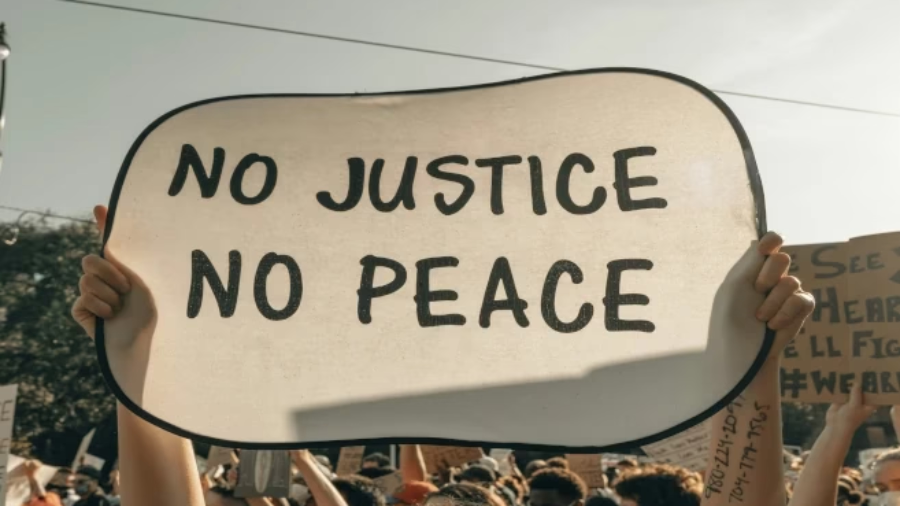
Trumps-Board-of-peace

Donald Trump’s Board of Peace:A Shameless Caricature of World PeaceAmidst the Middle East Crisis

Welcome to Donald Trump’s Board of Peace — the most audaciously branded international body in modern diplomatic history. Conceived as a vehicle to oversee Gaza’s reconstruction, the Board has since mutated into something far more ambitious, far more personal, and far more dangerous to the architecture of international order than any ceasefire plan has a right to be. As the Middle East teeters on the brink of a wider war, the central question is not whether Donald Trump’s Board of Peace can deliver peace — it is whether it was ever genuinely designed to.

On February 19, 2026, Donald Trump convened what he called “the most prestigious board ever put together” inside a building he had personally renamed after himself. Gaza was still smouldering. Iran was bracing for war. And the man chairing the meeting had just announced he intended to keep that chairmanship for the rest of his life.

What follows is an evidence-based investigation into the structure, the membership, the ambitions, and the yawning gap between the Board’s soaring rhetoric and its deeply troubling reality.

📊 Board of Peace — Key Numbers at a Glance

62Countries Invited, 25Signed the Charter, 75,000+Gazans Killed (Lancet), $70BUN Reconstruction Estimate, $17BPledged So Far

What Is Donald Trump’s Board of Peace — Really?

On the surface, Donald Trump’s Board of Peace was embedded in the ninth point of a US-brokered 20-point Gaza ceasefire plan, subsequently endorsed by UN Security Council Resolution 2803 in November 2025 with a mandate running until December 2027. Its original, limited brief: oversee the demilitarisation and reconstruction of the Gaza Strip. Reasonable enough, on its face. Desperately needed, given the scale of destruction.

However, by the time the Board’s charter was ratified at the World Economic Forum in Davos in January 2026, its mandate had expanded so dramatically that the word “Gaza” does not appear in the charter at all. Instead, the document describes an “international organization that seeks to promote stability, restore dependable and lawful governance, and secure enduring peace in areas affected or threatened by conflict” — language broad enough to cover virtually every sovereign dispute on earth. As the Israeli Institute for National Security Studies (INSS) observed, this constitutes a direct deviation from the limited mandate under which the Board was created — and, critically, from the authority Resolution 2803 actually granted.

Furthermore, Trump himself confirmed the expansion explicitly. Speaking before the Davos signing ceremony, he told reporters his Board “might” replace the United Nations — a casual remark that sent tremors through every foreign ministry on the planet that takes the rules-based international order seriously.

Donald Trump’s Board of Peace: Diplomat or Dictator of Diplomacy?

The most structurally alarming feature of Donald Trump’s Board of Peace is not its membership or its funding gap — it is its governance architecture. Analysis of the 2,000-word charter reveals that the word “chairman” appears 34 times — the fourth most frequent word in the entire document, behind “board,” “peace,” and “shall.” That ratio is not coincidental. It is structural.

According to the charter, Trump is named personally as inaugural Chairman — not “the President of the United States,” but Donald J. Trump by name. His chairmanship carries no term limit and is independent of the US presidency itself, meaning it survives beyond January 2029 regardless of who occupies the White House. He can only be removed by voluntary resignation or incapacity — as determined by unanimous vote of the Executive Board, which he himself constituted. He holds exclusive authority to invite or expel member states, approve or veto all charter revisions, and dissolve any subsidiary body at will.

“This is a way for him to guarantee a position of what he sees as supremacy in global affairs — even after he is out of office in the US. It’s very much an ego project for him. On that basis, it really undercuts any actual value such an institution might have.”

— Alanna O’Malley, Chair of Global Governance, Erasmus University Rotterdam, speaking to France 24

Trump personally assembled the Executive Board: his son-in-law Jared Kushner, Secretary of State Marco Rubio, special envoy Steve Witkoff, and former British Prime Minister Tony Blair. The lineup immediately drew pointed questions about conflicts of interest — particularly Kushner, whose well-documented real estate investment interests in the region prompted a formal Senate inquiry. Trump had not staffed a peace board. He had staffed a business development meeting.

The Membership Problem: Pay $1 Billion, Buy Your Seat at the Peace Table

Perhaps nothing exposes the transactional DNA of Donald Trump’s Board of Peace more starkly than its membership model. Member states serve initial three-year terms — renewable, at Trump’s discretion. However, according to reporting by the New York Times, permanent membership requires a $1 billion cash contribution within the first year. Peace, it turns out, has a cover charge.

Of the 62 nations invited, only 25 had signed the charter by early March 2026. Critically, most of the Western democratic world was conspicuously absent. France, Germany, the United Kingdom, Norway, Sweden, Spain, Slovenia, Ukraine, and Greece all declined. Trump personally revoked Canada’s invitation after Prime Minister Mark Carney offered mild criticism at Davos. The only Western European member was Hungary — Vladimir Putin’s closest ally on the continent.

⚖ Who Joined, Who Refused, and Why — A Comparative Overview

Country / EntityDecisionStated Reason
United StatesFounderTrump’s initiative — depository state
HungaryJoinedOnly Western EU member; Putin-aligned foreign policy
IndonesiaPausedSuspended engagement after US-Israel strikes on Iran
United KingdomDeclinedBroad mandate incompatible with UN Charter obligations
FranceDeclinedCharter does not reference Gaza; contradicts UNSCR 2803
CanadaUninvitedInvitation revoked by Trump after PM Carney’s mild criticism
SloveniaDeclined“Dangerously interferes with the broader international order”
ChinaDeclined“Firmly committed to safeguarding the UN system”
NorwayDeclinedRaises questions requiring “further dialogue with the US”
Belarus (Lukashenko)JoinedOften described as Europe’s last dictator
UN Secretary-GeneralOpposed“The UN Security Council stands alone in its Charter-mandated authority”
No Palestinian Rep.ExcludedNo Palestinian seat exists on the Board despite being about Gaza

Notably, Belarusian leader Alexander Lukashenko — widely regarded as Europe’s last dictator — signed on, as did a country whose leader faces alleged war crimes charges. Trump invited Russia while Putin was reportedly considering using frozen US-held assets to pay the $1 billion permanent membership fee. Meanwhile, the people whose territory the Board ostensibly governs — Palestinians — have no seat at the table at all.

The Funding Mirage and the Gaza Reality

While Trump’s rhetoric at the February 19 inaugural meeting was grandiose — declaring the Board the “most consequential international body in history” — the financial picture tells a more sobering story. The US pledged $10 billion. Member states collectively pledged $7 billion. That totals $17 billion against a World Bank reconstruction estimate of $53 billion — and a UN estimate starting at $70 billion. The gap between announcement and reality is immense.

Moreover, Gulf states — among the wealthiest potential contributors — have been forthright about their reluctance. As Annelle Sheline of the Quincy Institute told Al Jazeera, Gulf countries are not interested in financing reconstruction that could be destroyed again within years. Without a credible security guarantee — and without a durable political settlement that includes Palestinians — reconstruction funding remains largely performative.

🔍 The Structural Contradiction at the Heart of the Board

On the same day Trump presided over his Board of Peace in Washington, Israel was issuing Hamas a 60-day ultimatum to disarm or face resumed full-scale military operations. Trump simultaneously suggested the US and Israel “may have to take it a step further” with Iran. The Washington Post described the resulting split-screen as “incongruous, if not incoherent.” A peace board whose founding chairman is simultaneously threatening escalation is not a peace board. It is theatre with a security council backdrop.

Donald Trump’s Board of Peace and the Dismantling of the International Order

The broader civilisational stakes of Donald Trump’s Board of Peace extend well beyond Gaza. As the Arab Center DC’s analysis notes, the 2026 Munich Security Report warned that Trump believes he holds a mandate to “redefine the US role in the world according to a narrow, and often quite personal, interpretation of the national interest.” The Board is the institutional expression of that belief — a vehicle to project American primacy under the personal brand of one man, indefinitely.

UN Secretary-General António Guterres, meanwhile, pointedly noted that “the UN Security Council stands alone in its Charter-mandated authority to act on behalf of all Member States on matters of peace and security” — a rare public rebuke directed squarely at Washington. China similarly rejected the invitation, affirming its commitment to “safeguarding the international system with the UN at its core.” Even Elon Musk — one of Trump’s closest allies — made headlines at Davos by joking about the homophony of “peace” and “piece,” quipping about a “little piece of Greenland, a little piece of Venezuela,” before adding sardonically, “all we want is peace.”

Slovenia’s Prime Minister Robert Golob perhaps put it most precisely when he declined his invitation, stating that the Board “dangerously interferes with the broader international order.” Former UN chair Mary Robinson described it as a “delusion of power.” These are not partisan critics. These are serious statespeople offering sober assessments of structural risk.

The Verdict: Donald Trump’s Board of Peace as Historical Caricature

Gaza needed a genuine reconstruction mechanism. The Middle East needed credible, inclusive, internationally legitimate diplomacy. The board’s charter uses the chairman’s name 34 times, sells permanent seats for $1 billion, excludes the people it claims to help, admits an alleged war criminal and Europe’s last dictator. The most intriguing is the chairman for life – a man who simultaneously threatens to bomb Iran while posing for photographs at a peace summit.

Donald Trump’s Board of Peace is not a diplomatic failure — it is a diplomatic displacement. It replaces the hard, unglamorous, multilateral work of genuine peacebuilding with a personalised, transactional simulacrum that serves one primary purpose: to cement Trump’s legacy and extend his personal global authority beyond the constitutional limits of the American presidency. The building where the inaugural meeting was held was renamed after him. The charter names him personally. The chairmanship has no expiry date. The logo shows the Americas — and omits Europe, Asia, and Oceania entirely.

⚖ Final Verdict

The tragedy of Donald Trump’s Board of Peace is that Gaza genuinely, desperately needs a functioning international reconstruction body. Over 75,000 people have been killed. Up to 90% of Gaza’s 2.1 million inhabitants have been displaced. Reconstruction will cost north of $70 billion and take decades. The window for meaningful international mobilisation is narrow and closing.

Instead of seizing that window with institutional seriousness, Trump delivered a vanity project dressed in diplomatic clothing. Most serious democracies refused to join it, its creator chairs it for life, a billion-dollar membership fee funds it, and the population it claims to govern holds no seat within it.When history looks back at this moment, it will not ask whether Donald Trump’s Board of Peace was audacious. It will ask whether the price of that audacity — in legitimacy, in lives, and in the slow erosion of the rules-based international order — was one the world could afford to pay.

The answer, increasingly, appears to be no.

This story is still developing. Follow it with us.

Subscribe to Ultimate Causes for weekly investigative analysis on the Middle East crisis, global power shifts, and the politics that shape our world — written without fear or favour. Subscribe for Free →
trump-israeli-solution-for-iran

The US-Israeli Attack on Iran:The Implications for Global Peace and Stability

The World Changed on Saturday Morning

There are moments in history when the international order does not bend — it breaks. Saturday, February 28, 2026 was one of those moments. At dawn over Tehran, the US-Israeli attack on Iran — codenamed Operation Epic Fury by Washington and Operation Roar of the Lion by Jerusalem — struck at least nine Iranian cities simultaneously, killed Supreme Leader Ayatollah Ali Khamenei and his most senior commanders, and ignited a retaliatory firestorm that is, as of this writing on Day 3, showing no signs of extinguishing itself.

The strikes were not a surprise to strategists. But their scale, their audacity, and their explicit goal — regime change in a nation of 88 million people — have produced a shockwave that is radiating outward far beyond the borders of Iran and Israel. Oil prices surged 9% on Monday morning. More than 11,000 flights across the region were cancelled. The US State Department issued “depart now” warnings across 15 Middle Eastern countries. And the ICRC president warned that a “dangerous chain reaction” of military escalation was underway with “potentially devastating consequences for civilians.”

So the question this article sets out to answer — with depth, with data, and without diplomatic softening — is this: what does the US-Israeli attack on Iran actually mean for global peace and stability? Not the peace of one region. Not the stability of one market. But the architecture of the world order that has kept great powers from direct confrontation for eighty years.

9%Oil price surge in first 24 hours — Brent hit $79.41/barrel Monday morning

150Oil tankers stalled behind the Strait of Hormuz as of March 2

20%Of global daily oil supply transits Hormuz — 20 million barrels per day at risk

11,000Flights cancelled to and from the region since Saturday’s strikes began

9 citiesIranian cities struck simultaneously in the opening wave of Operation Epic Fury

$100B+Goldman Sachs threshold — oil price at which extended Hormuz disruption tips global recession

How Diplomacy Died — and Why That Matters Beyond Iran

To understand the full implications of the US-Israeli attack on Iran, you must first understand that it did not happen in a diplomatic vacuum. It happened at the precise moment that diplomacy appeared, for the first time in years, to be working.

The UK House of Commons Library confirmed that in February 2026, US-Iran nuclear talks in Oman had reached what the Omani mediator described as “substantial progress.” Iran had agreed, in a formulation the mediator called “completely new,” to “never, ever have nuclear material that will create a bomb.” But Trump said publicly he was “not thrilled” with the talks. And then, days later, the bombs fell.

This use of force sends a message that regimes may be safer if they develop a nuclear programme first. It is telling that there is little talk from this administration of imposing regime change on North Korea.— Stimson Center Expert Analysis, March 1, 2026

The Stimson Center’s panel of geopolitical experts identified the most dangerous long-term implication of this sequencing: the attacks “frame US negotiations as PR stunts meant to buy time, gain information, and conclude with regime change.” If adversaries now believe that engaging in diplomacy with Washington simply tells the US when and where to strike — then diplomacy itself, as a mechanism of global stability, has been critically wounded. And that wound extends far beyond the Middle East.

North Korea is watching. So is Venezuela. So are the dozen countries currently weighing whether to advance their own nuclear programmes. Every one of them just received the same lesson: disarmament leads to vulnerability. The bomb is the only guarantee.

The Strait of Hormuz: The World’s Most Dangerous Chokepoint

For the global economy, the most consequential single piece of geography in this conflict is not Tehran. It is a stretch of water 33 kilometres wide at its narrowest point, between Iran and Oman. The Strait of Hormuz is the passage through which, according to the US Energy Information Administration, approximately 20 million barrels of crude oil — roughly 20% of global liquid petroleum consumption — travel every single day.

Iran has already announced that the Strait is to be closed to shipping. Iran’s IRGC-affiliated news agency Tasmin confirmed the closure announcement. And while multiple Iranian naval ships have been destroyed by US forces — limiting Iran’s immediate ability to enforce a blockade physically — as Al Jazeera reported, at least one oil tanker has already been struck off the coast of Oman, signalling a shift from targeting military facilities to targeting energy assets directly.

Economic IndicatorPre-Strike LevelPost-Strike LevelRisk Scenario
Brent Crude Oil$72.87/barrel$79.41/barrel (+9%)$100+ if Hormuz closes extended period
US Crude (WTI)$67.02/barrel$72.57/barrel (+8%)Inflationary impact within weeks
GoldSafe haven neutral+2% safe-haven flightContinued rise in prolonged conflict
Dow Jones FuturesStable-521 points (-1%)Deeper correction if conflict widens
S&P 500 FuturesStable-1%Risk-off sentiment spreading
Dubai Int’l AirportFull operationsClosed / Partial reopeningLimited ops from March 3 onward
Global Inflation~2.8% averageProjected +0.6–0.7%If oil sustained above $100/barrel

Capital Economics analyst Hamad Hussain told Al Jazeera that if crude reached and sustained $100 per barrel, global inflation could rise by 0.6–0.7%, “pushing fragile economies closer to recession in a matter of weeks.” And JPMorgan Chase CEO Jamie Dimon warned directly that while he believed the odds of “long, just peace” were higher, businesses should “expect cyberattacks or terrorist attacks, either here or around the world — banks may be targets.”

A World Divided: How Global Powers Are Responding

The US-Israeli attack on Iran has produced the sharpest global diplomatic division since the 2003 invasion of Iraq — and in some ways a more dangerous one, because this time China and Russia are more directly invested and more strategically capable of acting on their opposition. Al Jazeera’s comprehensive world reaction analysis makes the fault lines unmistakable.

United States: Trump declared the operation justified by “imminent threat.” Secretary of State Rubio told Congress there “absolutely was an imminent threat” from Iran. Bombing will continue.

Israel: FM Gideon Sa’ar said action was “urgently needed” to prevent Iran reaching nuclear immunity. Netanyahu confirmed Khamenei killed in “Operation Roar of the Lion.”

United Kingdom: Did not participate but granted US use of British bases for “defensive” strikes. RAF deployed in defensive capacity as UK bases in Bahrain, Qatar, and Cyprus were attacked.

European Union: EU Commission President von der Leyen supported “credible transition” for Iran while calling the conflict “greatly concerning.” Urged “maximum restraint” and civilian protection.

China: FM Wang Yi held emergency call with Russia’s Lavrov calling the attacks “unacceptable.” China buys 80%+ of Iran’s oil exports — has enormous economic stake in outcome.

Russia: Medvedev accused the US of using nuclear talks as a “cover-up before military operations.” Called on the international community to assess what it termed “irresponsible actions.”

Turkey: Condemned strikes as starting “a chain of events that risks the future of our region and global stability.” Called on all parties to end the “spiral of violence.”

Pakistan: FM Ishaq Dar “strongly condemned” the attacks, calling for an immediate halt to escalation and urgent resumption of diplomacy to achieve a peaceful resolution.

The Nuclear Shadow: Has the Strike Made the World Safer or More Dangerous?

The UN’s nuclear watchdog chief Rafael Grossi urged a return to diplomacy on Day 3, citing “increasing risk to nuclear safety in the region.” The IAEA Board of Governors convened an emergency session in Vienna requested by Russia — the second emergency UN-level meeting in three days. And Grossi confirmed that while no evidence has been found that nuclear facilities themselves were damaged in the strikes, the risks of accidental nuclear contamination from conventional strikes near nuclear sites are “real and escalating.”

But the deeper nuclear question — the one that will define global security for the next generation — is not about Iran’s current programme. It is about the message the operation sends to every other government on earth currently calculating whether a nuclear weapon is their best guarantee of sovereignty.

⚠️ The Proliferation Paradox — Stimson Center Analysis

Stimson Center experts concluded that Operation Epic Fury “incentivizes proliferation globally.” Nations that gave up nuclear ambitions under US diplomatic pressure — or engaged in negotiations — now see what happens to countries without nuclear deterrence. The administration’s explicit rejection of a near-complete deal in favour of force will be studied in Pyongyang, in Caracas, and in dozens of capitals across the developing world. The US may have set Iran’s nuclear programme back by years. But it may have accelerated everyone else’s by decades.

The Humanitarian Crisis the World Cannot Afford to Ignore

Behind the geopolitical analysis and the market data, there is a human catastrophe unfolding inside Iran that the internet blackout imposed by the Iranian government is making almost impossible to document in real time. UNESCO confirmed that a primary school was bombed during the US-Israeli strikes on Saturday, calling it “a grave violation of humanitarian law.” Iranian state media has confirmed that Khamenei’s wife also died of injuries sustained in the strike. The ICRC president Mirjana Spoljaric warned that “a dangerous chain reaction” of military escalation was underway with “potentially devastating consequences for civilians.”

  • Internet access severely restricted inside Iran — making civilian casualty figures impossible to verify independently
  • The port city of Bushehr was struck — the location of Iran’s nuclear reactor, raising immediate nuclear safety concerns despite IAEA’s initial assessment
  • Iranian retaliatory strikes hit civilian infrastructure in Dubai, including the Fairmont The Palm hotel and Dubai International Airport
  • The US Embassy in Riyadh was struck by Iranian drones — the first confirmed attack on a US diplomatic facility in the conflict
  • Hundreds of Iraqis attempted to storm the US Embassy in Baghdad’s Green Zone in protest
  • The US State Department issued “depart now” emergency warnings to Americans in 15 countries: Bahrain, Egypt, Iran, Iraq, Israel, the West Bank, Gaza, Jordan, Kuwait, Lebanon, Oman, Qatar, Saudi Arabia, Syria, UAE and Yemen

China’s Strategic Calculation — The Wild Card Nobody Is Discussing

While the world watches missiles arc over the Persian Gulf, the most consequential long-term shift may be happening not on a battlefield but in Beijing’s strategic planning rooms. China purchases more than 80% of Iran’s oil exports, accounting for 13.5% of all crude China imports by sea. Iran is also a critical supplier of military drones and missiles that have aided Russia’s war in Ukraine.

CNBC’s analysis quoted analyst Aboudouh directly: “The weaker the Iranian regime gets, the more diplomatically, economically and technologically dependent on China it will become.” And for the longer term: “China will need to make a demonstration of power projection in its region to deter American military action and create a sphere of influence.”

🌏 The Great Power Realignment Nobody Wanted

The US-Israeli attack on Iran may have just accelerated what strategists have feared most: a hardening of the Sino-Russian-Iranian axis into a coherent counter-bloc to Western power. China and Russia’s coordinated condemnation, their emergency bilateral ministerial call, and Beijing’s explicit economic exposure through Iranian oil dependency all point toward a deeper strategic alignment against US unilateralism.

The Chatham House think tank warned that Arab Gulf leaders now view the greatest risks as “an expansionist and aggressive Israel and the chaos of a potentially collapsed Iranian state.” Both descriptions come from Washington’s own traditional regional allies. When your partners are more afraid of your success than your enemy’s strength — that is not a victory. That is a warning.

Conclusion: The Price of This Peace May Be Peace Itself

The US-Israeli attack on Iran has achieved something extraordinary in military terms. The supreme leader of a nation of 88 million people killed in the opening hours of an operation that simultaneously decapitated the military leadership, struck nuclear sites, and sent a message of devastating clarity to every authoritarian regime on earth.

But extraordinary military achievement and strategic success are not the same thing. And right now, on Day 3, the evidence for strategic success is thin. Oil is spiking. 150 tankers stalled at the world’s most important energy chokepoint. China and Russia are in emergency coordination against Washington’s actions. The UN is warning of nuclear safety risks. UNESCO is documenting war crimes. And the IRGC — the real engine of the Iranian state — is still intact, still armed, and now fighting with the fury of a regime that has nothing left to lose.

Stimson Center’s military historian concluded bleakly: “No matter how precise or devastating, air strikes alone cannot topple a government, and Iran in 2026 is likely to emerge battered but not broken — a costly example of American hubris and the limits of airpower.” Trump promised peace throughout the Middle East and the world. But on Day 3, the world has more active missile exchanges, more threatened civilians, more disrupted energy systems, and more alarmed great powers than it did on Friday. The price of this particular peace may yet prove to be peace itself.


This Is the Story That Defines 2026 — And Beyond

The implications of the US-Israeli attack on Iran will shape global politics, energy markets, and the international order for years. Share this analysis, subscribe for live updates as the conflict develops, and tell us in the comments: do you believe this makes the world safer — or more dangerous?💬 Share Your View📩 Subscribe for Live Updates📤 Share This Analysis

📚 Sources & References

  1. CNBC — Iran Conflict: Where Things Stand, Global Responses and What Comes Next (March 2, 2026)
  2. Al Jazeera — World Reacts to US-Israel Attack on Iran and Tehran Retaliation (February 28, 2026)
  3. Al Jazeera — How US-Israel Attacks on Iran Threaten the Strait of Hormuz and Oil Markets (March 1, 2026)
  4. UN News — Middle East Live: Strikes Continue as UN Urges Restraint (March 2, 2026)
  5. UK House of Commons Library — US-Israel Strikes on Iran: February/March 2026 Briefing (March 2, 2026)
  6. Stimson Center — Experts React: What the Epic Fury Iran Strikes Signal to the World (March 1, 2026)
  7. Atlantic Council — Don’t Worry About the Iran Conflict’s Impact on Oil Prices — Yet (March 1, 2026)
  8. CNBC — Iran May Lash Out Harder as Khamenei’s Death Puts Tehran on War Footing (March 1, 2026)
  9. CNBC — US Embassy in Riyadh Hit by Drones; Jamie Dimon Warns of Cyberattacks (March 2, 2026)
  10. CNN Business — What a US Attack on Iran Means for Oil Prices (March 1, 2026)
  11. Euronews — What Does the US-Israel Attack on Iran Mean for Oil Prices? (February 28, 2026)
  12. Wikipedia — 2026 Israeli–United States Strikes on Iran (Updated March 3, 2026)
trump-israeli-solution-for-iran

The Trump-Israeli Approach to Solving the Iranian Equation: Has the Threat Been Eliminated?

The Day the Equation Changed

For decades, the Trump-Israeli approach to solving the Iranian equation operated on a single, unspoken premise: that the Islamic Republic’s most dangerous feature was not its missiles, not its proxies, and not its nuclear programme — but the one man who controlled all three. Remove that man, and the equation collapses. On Saturday, February 28, 2026, that theory was finally tested.

At dawn, in a joint operation that the Pentagon is calling “Operation Epic Fury” and Israel is calling “Roar of the Lion,” a coordinated wave of US and Israeli strikes hit dozens of targets across Tehran simultaneously. When the smoke cleared, Ayatollah Ali Khamenei — the 86-year-old Supreme Leader who had ruled Iran for 36 years, outlasted eight US presidents, survived one previous assassination attempt, and built the most formidable non-state military network in modern history — was dead in the rubble of his own compound.

But the question that every analyst, diplomat, and intelligence officer is now asking, in real time, as the missiles are still flying in both directions, is the one that matters most: does killing the man mean killing the machine? And does the Trump-Israeli approach to solving the Iranian equation produce the solution it promised — or does it simply create a new, less predictable, and potentially more dangerous problem?

Feb 28 – Date of Khamenei’s death — confirmed by Iranian state media March 1, 2026

36 yrs – Khamenei’s reign as Supreme Leader — since 1989, Iran’s longest-serving leader

7+Senior Iranian commanders killed alongside Khamenei in the same strikes

27 – US military bases in the region targeted by Iran in retaliation as of March 1

40 daysIran’s declared mourning period — and 7 days of national public holiday

$100B+ – Estimated value of assets controlled by Khamenei’s office — now disputed territory

Operation Roaring Lion: What Actually Happened

The strikes on February 28 were not impulsive. They were the culmination of a strategy years in the making — and, critically, a reversal of a decision Trump himself had made just eight months earlier. Middle East Forum reported that during the June 2025 Twelve-Day War between Israel and Iran, Trump had personally vetoed Israel’s plan to kill Khamenei, arguing he needed someone with authority to sign a nuclear deal. But negotiations collapsed. Khamenei, the Forum reported, was never going to sign — because doing so would mean admitting that four decades of sacrifice had been for nothing.

So the calculation changed. And on Saturday morning, the CIA — which Axios confirmed had spent weeks tracking Khamenei’s precise movements — provided the targeting intelligence that made the strike possible. Trump confirmed this himself on Truth Social, writing that the ayatollah “was unable to avoid our Intelligence and Highly Sophisticated Tracking Systems.”

The 48-Hour Timeline of the Operation

Feb 28 — Dawn

First wave hits Tehran. Khamenei’s compound, IRGC headquarters, Defence Ministry, and the homes of senior commanders all struck simultaneously in coordinated US-Israeli raids.

Feb 28 — Morning

Netanyahu announces “many signs” Khamenei is dead. Iranian state media initially denies it. Khamenei’s X account posts a verse. Reuters cites a senior Israeli official confirming the body has been located.

Feb 28 — Evening

Trump posts on Truth Social: “Khamenei, one of the most evil people in History, is dead.” He tells NBC and ABC “most” of Iran’s senior leadership is “gone.”

Mar 1 — Early AM

Iranian state television confirms the death. A broadcaster breaks down in tears on air. 40 days of mourning and 7 days of public holiday declared. The IRGC vows “ferocious” retaliation.

Mar 1 — Ongoing

Iran launches sixth wave of retaliatory strikes. 27 US bases targeted, Israel’s military HQ and Tel Aviv defence complex hit. Israel responds with fresh “stand-in” strikes over Tehran. Strikes continue.

The Decapitation Was Complete — Almost

Khamenei did not die alone. Euronews and the Israeli Defense Forces both confirmed that the strikes simultaneously killed the Chief of Staff of the Armed Forces, the Commander-in-Chief of the IRGC, the Secretary of the Defence Council, and the Minister of Defence — all during a single Defence Council meeting. The IRGC’s top commander, General Mohammad Pakpour, was also killed. Iran’s most senior strategic military minds were eliminated in a matter of hours.

But Israel targeted Khamenei’s sons too — and intelligence assessments suggest they survived. Mojtaba Khamenei, the son widely discussed as his father’s likely successor, appears to have escaped the strike. So the decapitation, while devastating, was not total. And in that gap lies the uncertainty that will define the next chapter of this conflict.

NamePositionStatus
Ali KhameneiSupreme Leader of Iran (since 1989)Confirmed Killed
Seyed Abdolrahim MousaviChief of Staff, Armed ForcesConfirmed Killed
Mohammad BagheriCommander-in-Chief, IRGCConfirmed Killed
Ali ShamkhaniSecretary, Defence CouncilConfirmed Killed
Aziz NasirzadehMinister of DefenceConfirmed Killed
Mohammad PakpourIRGC CommanderConfirmed Killed
Mojtaba KhameneiSon / Widely discussed successorReportedly Survived
Ali LarijaniSenior adviser — now most senior civilian standingAlive — Leading transition
Masoud PezeshkianPresident of IranAlive — vowing revenge

The Central Question: Has the Iranian Threat Actually Been Eliminated?

Here is where the Trump-Israeli approach to solving the Iranian equation meets the hardest reality of Middle Eastern geopolitics: killing a leader and destroying a system are two categorically different achievements. And every serious analyst consulted by every major outlet in the past 24 hours is saying the same thing.

Taking out Iranian Supreme Leader Ayatollah Ali Khamenei is not the same as regime change. The Islamic Revolutionary Guard Corps is the regime.— Council on Foreign Relations, March 1, 2026

The IRGC — the Revolutionary Guards — is not just a military organisation. It is an economic empire, a political machine, an intelligence apparatus, and a parallel state that controls an estimated 40% of Iran’s economy. Khamenei built it, nurtured it, and placed it at the centre of every instrument of Iranian power. But he did not own it. It existed before him in its current form, and it will exist after him.

Jason Brodsky, policy director at United Against Nuclear Iran, told Al Arabiya that the IRGC “could try to supplant the entire process given the emergency situation in the country.” And the CIA’s own pre-strike assessment, reported by Reuters, concluded that “hardline figures” of the IRGC were the most likely successors — not moderate reformers, not exiled opposition leaders, not Reza Pahlavi’s monarchists.

The Three Succession Scenarios — and What Each Means for the Threat

Regime Continuity

Scenario 1 — Most Likely

“Khamenei-ism without Khamenei.” A new Supreme Leader is selected by the Assembly of Experts, backed by IRGC hardliners. Nuclear ambitions continue. Proxy networks rebuild. The threat is preserved — but leaderless, weakened, and furious.

IRGC Military Takeover

Scenario 2 — High Risk

The Guards bypass the clerical process entirely and install a security-first government. Iran becomes a military dictatorship draped in religious legitimacy. Potentially more dangerous — fewer restraints, more impulsive, nuclear programme accelerated.

Regime Collapse

Scenario 3 — Trump’s Goal

Popular uprising combines with military disintegration. The Islamic Republic dissolves. But the CFR warns: “None of these near-term scenarios envisage a positive transformation in the year or so after transition.” Power vacuums breed chaos.

A Nation Divided: Celebration, Mourning, and the Streets of Tehran

The reaction inside Iran tells a story more complex than either Washington or Tel Aviv would prefer. CNN reported that cheering could be heard across Tehran as news spread of Khamenei’s death. Masoud Ghodrat Abadi, an Iranian engineer now based in the US, told CNBC: “Khamenei is dead. This is the best day of my life.” Reza Pahlavi, the exiled former crown prince, called on security forces to join the nation and ensure a stable transition.

But by Sunday morning, thousands of mourners dressed in black had gathered in Tehran’s Enghelab Square, waving Iranian flags and chanting “Death to America” and “Death to Israel.” Iranian President Pezeshkian declared revenge Iran’s “legitimate right and duty.” And Iran’s parliament speaker called Trump and Netanyahu “filthy criminals” who will face “devastating blows.”

⚠️ The Jubilation Trap

Analysts are warning Western capitals not to mistake street celebrations for political transformation. The CFR noted clearly that “jubilation does not equal transformation” and compared killing Khamenei to removing a broken light bulb: “To change it, you must first remove the broken bulb. But doing so is not changing the bulb — that requires replacing it with a new one.” The question of who replaces him — and on whose terms — is the defining geopolitical question of 2026.

The Retaliation Has Begun — And It Is Not Small

Within hours of Khamenei’s death being confirmed, Iran launched what it called its sixth wave of retaliatory strikes. France 24 confirmed that 27 US military bases in the region were targeted, alongside Israel’s military headquarters, a large defence industries complex in Tel Aviv, and Gulf state targets. Missiles and drones flew simultaneously across multiple countries.

Israel responded by deploying aircraft in “stand-in” mode directly over Tehran — for the first time in the operation — dropping bombs with precision from within Iranian airspace rather than at long range. Israeli Defence Minister Israel Katz announced “continuous powerful strikes” on Tehran would now follow. The conflict, in other words, has not ended with Khamenei’s death. It has escalated.

  • Iran targeted Israel’s Tel Nof airbase, military headquarters, and a Tel Aviv defence complex in its sixth retaliatory wave
  • Hundreds of Iraqis attempted to storm Baghdad’s Green Zone and the US embassy in protest at Khamenei’s killing
  • Protests erupted in Times Square, New York, with demonstrators chanting “Shame” and “Stop US and Israeli war”
  • An Iranian missile struck Tel Aviv’s city centre, killing one woman — the first confirmed Israeli fatality of the conflict
  • Over 100 girls were killed at an elementary school near a military base in Iran by US-Israeli strikes, per CNN reporting
  • Dubai reported loud explosions for a second consecutive day as Iran struck Gulf targets hosting US forces

Conclusion: The Equation Has Changed — But Has It Been Solved?

The Trump-Israeli approach to solving the Iranian equation has achieved what it set out to achieve at its most literal level. The man at the centre of Iran’s nuclear ambitions, proxy wars, and 36-year stranglehold on the Islamic Republic is dead. The IRGC commander is dead. The Chief of Staff is dead. The Defence Minister is dead. The inner circle that maintained the regime’s direction and coherence has been eliminated in a single operation of extraordinary precision.

But precision targeting does not equal strategic resolution. And the question — “has the threat been eliminated?” — demands a more honest answer than the one currently emanating from Washington and Tel Aviv. The answer is: partially, temporarily, and at a cost that is not yet fully calculable.

The IRGC remains. Iran’s nuclear knowledge remains. Its missile arsenal, though degraded, remains. And the fury of a nation that has just watched its supreme leader killed in his own compound, with his daughter and grandchild beside him, is a force that no intelligence assessment and no strike package has yet found a way to eliminate. The Week’s analysis concluded that “whether the Islamic Republic adapts, hardens or fractures will depend less on constitutional procedure than on the calculations of men with guns.”

Those men still have their guns. The equation has changed. Whether it has been solved is a question that history, not headlines, will answer — and the answer will not come quickly. Trump promised “peace throughout the Middle East and, indeed, the world.” The world is watching. And the airstrikes, as of this moment, show no signs of stopping.


This Story Is Still Breaking — And It Changes Everything

The killing of Khamenei is the most consequential geopolitical event since 9/11. Share this analysis with everyone who needs to understand what is really happening, subscribe for live updates as the story develops, and tell us in the comments: do you believe the Iranian threat has truly been eliminated?💬 Share Your Analysis📩 Subscribe for Live Updates📤 Share This Article

📚 Sources & References

  1. CNN — What We Know About the Death of Iranian Supreme Leader Khamenei (March 1, 2026)
  2. CNN Live Updates — Iran Supreme Leader Dead as Israel Renews Attack on Tehran (March 1, 2026)
  3. Washington Post — Iran’s Supreme Leader Killed in US-Israeli Attack; Tehran Strikes Back (March 1, 2026)
  4. Axios — Iranian Supreme Leader Khamenei Is Dead, State Media Confirms (February 28, 2026)
  5. Euronews — Iran’s Ayatollah Ali Khamenei Has Been Killed, State-Run Media Confirms (February 28, 2026)
  6. NBC News Live — Iran Supreme Leader Ali Khamenei Is Dead After US-Israel Attack (March 1, 2026)
  7. Al Jazeera — Iran Confirms Supreme Leader Ali Khamenei Dead After US-Israeli Attacks (February 28, 2026)
  8. Times of Israel — Massive Explosions Rattle Tehran as Israel-Iran Trade Blows After Supreme Leader Killed (March 1, 2026)
  9. Al Arabiya — Khamenei Killed: What Happens Next for Iran? (March 1, 2026)
  10. CNBC — Iran After Khamenei: What’s Next and What It Means for the Country? (March 1, 2026)
  11. France 24 — Iran’s IRGC Vows Ferocious Retaliation Against US and Israel After Khamenei Killing (February 28, 2026)
  12. Middle East Forum — Khamenei Is Dead: The 2026 Iran War Could Become a Giant Power Vacuum Crisis (February 28, 2026)
  13. The Week — With Khamenei Gone, Iran Confronts an Uncertain and Fiercely Contested Succession Process (March 1, 2026)
  14. Wikipedia — Assassination of Ali Khamenei (Updated March 1, 2026)