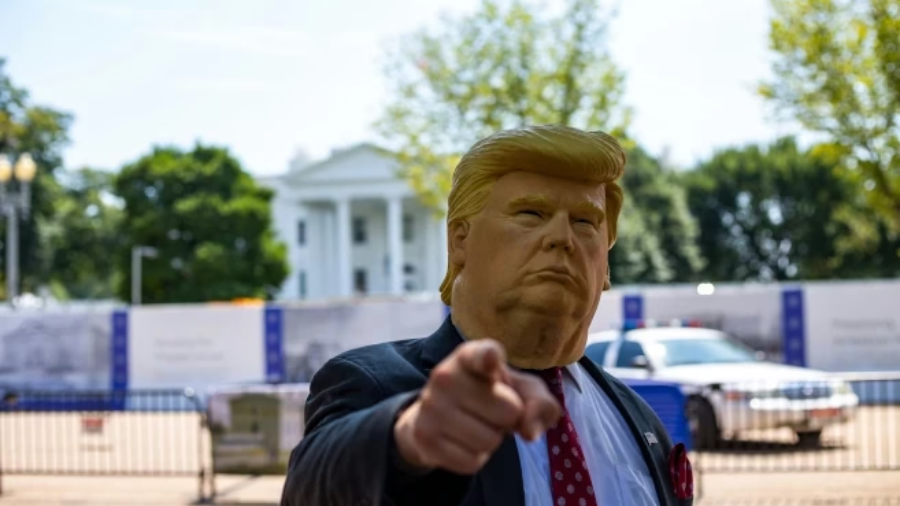
presidential-pardons-in-america

America First, America Alone: How Donald Trump’s Foreign Policy Cost America Its Leadership of the Free World

The Day American Leadership Became a Question Mark

For seven decades, American presidents stood before the world with a consistent message: the United States’ leadership of the free world, defend democratic values, and maintain the international order built from the ashes of World War II. Then, on January 20, 2017, a new president took the oath of office and declared that era over.

“From this day forward, it’s going to be only America first, America first,” Donald Trump announced in his inaugural address. What followed was a systematic dismantling of alliances, withdrawal from international agreements, and embrace of authoritarian leaders that fundamentally altered America’s global standing. The question isn’t whether Trump’s approach changed American foreign policy—it’s whether the damage to America’s leadership of the free world can ever be fully repaired.

This investigation examines how “America First” became “America Alone,” exploring the specific decisions, diplomatic breakdowns, and strategic reversals that left allies bewildered, adversaries emboldened, and the international order more fragile than at any point since 1945.

American Leadership of the Free World: What Was Lost

The Post-War Consensus

American leadership of the free world wasn’t simply about military dominance or economic power—though both mattered enormously. It represented something more complex: a system where U.S. leadership provided predictability, security guarantees, and commitment to shared values that made cooperation worthwhile for allies.

This system, built by presidents from Truman through Obama, included:

Institutional Architecture: The United Nations, NATO, World Trade Organization, and countless other multilateral bodies where American leadership shaped global rules

Alliance Networks: Treaty commitments binding the U.S. to defend allies in Europe, Asia, and beyond, creating security umbrellas that deterred aggression

Values-Based Leadership: Promotion of democracy, human rights, and rule of law as core elements of American foreign policy, however imperfectly applied

Economic Integration: Trade agreements and financial institutions that made American prosperity inseparable from global stability

This wasn’t altruism—it served American interests. But it also created a system where other nations willingly followed American leadership because they benefited from the arrangement.

The Trump Disruption

Trump’s “America First” doctrine rejected this framework as a series of “bad deals” where America was exploited by allies and competitors alike. He viewed alliances as protection rackets where the U.S. paid while others benefited, multilateral agreements as constraints on American sovereignty, and traditional diplomatic engagement as weakness.

The result was a foreign policy of transactional deal-making, unpredictable lurches, and public disparagement of allies that left the world wondering: Could America still be trusted to lead?

The NATO Crisis: Undermining the Foundation

“Obsolete” and Delinquent

Trump’s assault on NATO—the cornerstone of transatlantic security for 70 years—began even before his presidency. In 2016, he called the alliance “obsolete” and suggested the U.S. might not defend allies who hadn’t met defense spending targets.

Once in office, Trump escalated. At the 2017 NATO summit, he refused to explicitly endorse Article 5—the collective defense clause stating that an attack on one member is an attack on all. This was the first time an American president declined to affirm this commitment, sending shockwaves through European capitals.

Former U.S. Ambassador to NATO Ivo Daalder later revealed that European leaders were “genuinely worried” Trump might withdraw from the alliance entirely, forcing them to develop contingency plans for American abandonment.

The Montenegro Moment

Perhaps nothing captured Trump’s contempt for NATO obligations more than his comments about Montenegro. When asked if Americans should defend the tiny Balkan nation (a NATO member since 2017), Trump responded:

“Montenegro is a tiny country with very strong people… They’re very aggressive people. They may get aggressive, and congratulations, you’re in World War III.”

This wasn’t just casual dismissal—it was explicit questioning of whether treaty obligations meant anything at all. If the president suggested Americans shouldn’t fight for a NATO ally because they’re “aggressive,” what did Article 5 actually guarantee?

The Spending Obsession

Trump fixated on NATO defense spending, repeatedly claiming allies “owed” the United States money and that he’d forced them to pay up. This fundamentally misunderstood how NATO works—there’s no common account where members deposit funds.

The 2% GDP defense spending target exists, and Trump deserves credit for pushing allies toward it. Several nations did increase military budgets during his presidency. However, his approach—publicly berating allies, threatening abandonment, and characterizing mutual defense as a protection payment—undermined the alliance’s cohesion even as spending increased.

The damage went beyond hurt feelings. As reported by The New York Times, Trump privately discussed withdrawing from NATO multiple times, forcing administration officials to explain why this would be catastrophic. Allies heard these reports and began questioning American commitment to their defense.

Withdrawing from Agreements: The Credibility Collapse

The Paris Climate Accord: Isolating America

In June 2017, Trump announced U.S. withdrawal from the Paris Climate Agreement—the landmark accord where 195 nations committed to combating climate change. America became the only nation to formally exit the agreement.

Trump’s justification—that the accord disadvantaged American workers—ignored that the agreement allowed each nation to set its own targets. The withdrawal signaled something more troubling: America would abandon international commitments when politically convenient, regardless of global consequences.

The message to allies: Don’t assume American commitments are permanent. The message to adversaries: Wait out U.S. administrations until leadership changes.

The Iran Nuclear Deal: Breaking Your Word

Trump’s 2018 withdrawal from the Joint Comprehensive Plan of Action (Iran nuclear deal) represented an even more severe credibility blow. The agreement, negotiated by six world powers plus the EU, verifiably restricted Iran’s nuclear program in exchange for sanctions relief.

European allies—Britain, France, and Germany—begged Trump to preserve the deal, arguing it was working and that withdrawal would strengthen hardliners in Tehran. Trump withdrew anyway, reimposing sanctions and threatening to punish European companies that continued doing business with Iran.

The consequences were immediate:

Alliance Strain: European allies publicly opposed U.S. policy, creating an unprecedented transatlantic rift Iranian Escalation: Iran progressively violated nuclear restrictions, enriching uranium beyond deal limits Credibility Damage: Nations negotiating with America couldn’t trust commitments would survive political transitions

Former Secretary of State John Kerry noted that the withdrawal taught adversaries “never give up your nuclear program, because the United States won’t honor its commitments.”

The WHO Withdrawal: Pandemic Isolation

In July 2020, amid a global pandemic, Trump formally withdrew the United States from the World Health Organization, claiming the body was too deferential to China. The withdrawal—ultimately reversed by Biden—exemplified Trump’s approach: when international organizations disappointed him, America left rather than leading reform efforts.

The pattern was clear: withdraw first, negotiate never, and assume American power alone was sufficient.

Trading Leadership for Autocrat Admiration

The Dictator Fascination

While Trump disparaged democratic allies, he lavished praise on authoritarian leaders with a consistency that baffled foreign policy experts. His affinity for strongmen included:

Vladimir Putin (Russia): Consistently accepting Putin’s denials of election interference despite unanimous intelligence community assessment to the contrary. At the 2018 Helsinki summit, Trump publicly sided with Putin over American intelligence agencies—an extraordinary moment that shocked observers worldwide.

Kim Jong Un (North Korea): “We fell in love,” Trump said of the North Korean dictator after exchanging letters. Despite three summits, North Korea never provided a weapons inventory, never allowed inspectors, and continued developing its nuclear arsenal.

Xi Jinping (China): Trump praised Xi’s handling of Hong Kong protests, coronavirus response, and even the Uighur concentration camps, according to former National Security Advisor John Bolton’s memoir. This contradicted Trump’s later anti-China rhetoric.

Recep Erdoğan (Turkey): Trump abandoned Kurdish allies in Syria after a phone call with Erdoğan, allowing Turkish forces to attack U.S. partners who’d fought ISIS alongside American troops.

Mohammed bin Salman (Saudi Arabia): Even after U.S. intelligence concluded MBS ordered journalist Jamal Khashoggi’s murder, Trump stood by the Saudi crown prince, prioritizing arms sales over accountability.

Values-Free Foreign Policy

This pattern represented abandonment of values-based leadership of the free world. Trump’s approach suggested American foreign policy cared nothing for democracy, human rights, or rule of law—only transactional benefits.

The Council on Foreign Relations noted this created a moral vacuum where America couldn’t credibly promote democratic governance, human rights, or anti-corruption efforts. How could American diplomats criticize authoritarian practices when the president admired authoritarian leaders?

The Trade War Trap: Alienating Economic Partners

Tariffs Against Allies

Trump didn’t just wage a trade war with China—he imposed tariffs on close allies, justifying them with dubious national security claims. Steel and aluminum tariffs hit Canada, Mexico, and European nations, sparking retaliatory measures against American products.

Canada—America’s closest ally and largest trading partner—faced 25% steel tariffs despite integrated North American manufacturing. Prime Minister Justin Trudeau called the security justification “insulting,” noting Canadian soldiers had fought alongside Americans in every major conflict.

The European Union imposed retaliatory tariffs on American bourbon, motorcycles, and agricultural products, specifically targeting goods from politically important U.S. states.

NAFTA Renegotiation

Trump renegotiated NAFTA into the USMCA, claiming victory in fixing a “disaster.” However, economic analysis showed the changes were relatively modest—tighter rules of origin for automobiles, some dairy market access, and updated digital commerce provisions.

The real cost was intangible: treating trade negotiations as zero-sum battles where America “wins” by forcing concessions from neighbors undermined the cooperative spirit that made North American integration possible. Mexico and Canada negotiated defensively, knowing Trump viewed them as adversaries rather than partners.

The Information Void: Diplomacy by Tweet

Undermining the State Department

Trump systematically weakened the State Department—America’s diplomatic corps and primary foreign policy institution. He left ambassador positions unfilled for years, dismissed career diplomats, and proposed budget cuts exceeding 30%.

Former diplomats reported demoralization, mass resignations, and brain drain as experienced professionals left government service. The American Foreign Service Association documented unprecedented vacancy rates in crucial positions.

This hollowing out meant fewer American voices in foreign capitals, reduced intelligence gathering, and diminished ability to shape events before they became crises.

Policy by Tweet

Trump frequently announced major foreign policy decisions via Twitter, blindsiding allies, his own administration, and military commanders. Examples included:

  • Transgender military ban (surprised Pentagon officials)
  • Syria withdrawal (shocked military commanders and State Department)
  • Moving the U.S. embassy in Israel to Jerusalem (caught regional partners off guard)
  • Tariff announcements (surprised Treasury and Commerce departments)

This approach made American foreign policy unpredictable and unreliable. Allies couldn’t plan, adversaries couldn’t negotiate, and U.S. diplomats couldn’t explain positions they’d learned about from Twitter.

The Kurdish Betrayal: When Allies Can’t Trust America

Background and Partnership

Syrian Kurds fought ISIS alongside American special forces, losing over 11,000 fighters in the campaign to destroy the caliphate. They guarded ISIS prisoners, controlled territory, and relied on implicit American protection from Turkish attack.

In October 2019, after a phone call with Turkey’s Erdoğan, Trump abruptly ordered U.S. forces to withdraw from northern Syria, abandoning Kurdish partners to Turkish military assault.

The Fallout

Turkish forces immediately attacked, displacing hundreds of thousands of civilians and killing Kurdish fighters who’d partnered with America. ISIS prisoners escaped amid the chaos. Syrian Kurds turned to Russia and the Assad regime for protection—a geopolitical gift to American adversaries.

The message was devastating: America abandons partners when convenient. U.S. military commanders were reportedly “ashamed” and “appalled.” One officer told reporters: “We have left our partners to die. We have lost the moral high ground.”

The betrayal had global implications. Why would any group partner with America if they might be abandoned via presidential phone call?

Measuring the Damage: Global Perception Data

Pew Research Polling

Pew Research Center tracking of international attitudes toward America showed dramatic declines during Trump’s presidency:

CountryFavorable View of U.S. (2016)Favorable View of U.S. (2020)Change
Germany57%26%-31%
France63%31%-32%
UK61%41%-20%
Japan72%41%-31%
South Korea88%59%-29%
Canada65%35%-30%

Confidence in the U.S. president “to do the right thing in world affairs” collapsed even more dramatically, falling to single digits in many allied nations.

The Leadership Vacuum

Perhaps most telling were responses to questions about global leadership. By 2020, pluralities or majorities in many allied nations viewed China or Germany as more reliable partners than the United States.

A 2019 Munich Security Conference survey found that 83% of Europeans believed they could no longer rely on the United States, with majorities favoring development of independent European defense capabilities.

This represented a fundamental shift: for the first time since World War II, America’s closest allies questioned whether American leadership was desirable or reliable.

The Institutional Damage: What Changed Permanently

Alliance Recalibration

European nations accelerated plans for “strategic autonomy”—reducing dependence on American security guarantees through enhanced EU defense cooperation. While not abandoning NATO, Europeans began seriously planning for scenarios where America might not fulfill commitments.

This shift represented both insurance against future Trump-like presidents and recognition that American leadership couldn’t be taken for granted. Once allies develop alternative security arrangements, reversing these changes becomes difficult.

Multilateral Order Erosion

Trump’s withdrawal from agreements and attacks on institutions accelerated the erosion of the rules-based international order America built. When the leading power disregards rules it created, why should others follow them?

China and Russia exploited this vacuum, positioning themselves as defenders of multilateralism (however cynically) while America appeared unreliable and isolationist.

The Credibility Question

Perhaps the deepest damage was to American credibility—the intangible asset that makes leadership possible. When America’s word could be trusted, allies made long-term commitments, adversaries moderated behavior, and neutral nations aligned with American positions.

Trump’s presidency demonstrated that domestic political transitions could completely reverse American commitments, making long-term planning with the United States risky. This credibility loss persists regardless of subsequent administrations’ reliability.

The China Opportunity: Beijing’s Strategic Gain

Filling the Leadership Void

While Trump withdrew from the Trans-Pacific Partnership, attacked allies, and abandoned multilateral leadership, China aggressively expanded its global influence through the Belt and Road Initiative, increased UN engagement, and positioning itself as a responsible stakeholder.

Chinese officials explicitly contrasted their “win-win cooperation” with American “America First” nationalism, successfully courting nations that felt abandoned by U.S. withdrawal.

Diplomatic Coups

China achieved several significant diplomatic victories during Trump’s tenure:

  • Expanded influence in international organizations, placing Chinese nationals in key positions
  • Signed the Regional Comprehensive Economic Partnership (RCEP), creating the world’s largest trade bloc without American participation
  • Increased economic leverage over developing nations through infrastructure investments
  • Successfully framed U.S.-China tensions as American aggression rather than Chinese assertiveness

The irony was profound: Trump’s anti-China policies inadvertently strengthened China’s relative position by weakening American alliances and credibility.

The Russia Dimension: Putin’s Strategic Victory

Undermining Western Unity

Vladimir Putin’s strategic objectives included weakening NATO, dividing the transatlantic alliance, and reducing American global influence. Trump’s presidency advanced every one of these goals without Russian coercion—America voluntarily undermined its own alliances.

The 2019 Rand Corporation study noted that Russia couldn’t have designed a more effective strategy to weaken Western unity than Trump’s actual policies. From questioning NATO’s value to praising Putin personally, Trump did more to advance Russian strategic interests than any foreign policy success Moscow could have achieved through traditional means.

The Helsinki Disgrace

The 2018 Helsinki summit, where Trump publicly sided with Putin over American intelligence agencies regarding election interference, represented an unprecedented moment in U.S.-Russia relations. Standing beside Putin, Trump stated: “I don’t see any reason why it would be” Russia that interfered.

The reaction was immediate and bipartisan. Republican Senator John McCain called it “one of the most disgraceful performances by an American president in memory.” Former CIA Director John Brennan termed it “treasonous.”

Beyond the domestic political scandal, the summit sent a message to allies: America’s president trusted an adversary more than his own intelligence community and wouldn’t defend American interests when personally inconvenient.

Comparing Leadership Approaches: Before and After

The Traditional Model

Previous presidents, regardless of party, generally followed a consistent foreign policy framework:

Alliance Management: Regular consultation with allies, predictable policy, commitment to shared security Multilateral Engagement: Leading international institutions rather than abandoning them Values Promotion: Consistent advocacy for democracy and human rights, however imperfect Strategic Patience: Long-term planning over immediate transactional wins

The Trump Model

Trump’s approach represented a fundamental break:

Alliance Skepticism: Viewing partnerships as exploitative arrangements rather than strategic assets Multilateral Withdrawal: Exiting agreements and undermining institutions Values Agnosticism: Praising autocrats and ignoring human rights when convenient
Transactional Short-termism: Seeking immediate “wins” without considering long-term consequences

The question facing America now is which model will prevail in the long run.

Can Leadership Be Restored?

The Biden Reset Attempt

President Biden explicitly promised to restore American leadership of the free world, rejoining the Paris Agreement and WHO, reaffirming NATO commitments, and rebuilding diplomatic capacity. Early actions suggested genuine commitment to alliance restoration.

However, the damage from Trump’s presidency creates lasting complications:

Trust Deficits: Allies know another Trump-like president could reverse commitments in four years Alternative Arrangements: Partners have developed non-American contingencies they won’t fully abandon Changed Perceptions: The world saw that American unreliability is possible, changing risk calculations Domestic Constraints: Political polarization makes sustained foreign policy consensus difficult

The Structural Challenge

Perhaps the deepest problem is structural: if domestic political transitions can completely reverse American commitments every four to eight years, how can America credibly lead?

This question has no easy answer. Constitutional democracy means elections have consequences, including in foreign policy. But American leadership of the free world required unusual bipartisan consensus that sustained policies across administrations—a consensus that may no longer exist.

The Long-Term Implications

A Multipolar Reality

Many analysts believe Trump’s presidency accelerated the shift toward a multipolar world where no single nation dominates. America remains the most powerful country militarily and economically, but its ability to set global agendas and rally allies has diminished.

This multipolarity isn’t inherently bad, but it represents the end of American leadership of the free world as practiced from 1945-2016. The question is whether a more modest American role serves U.S. interests better or worse than traditional leadership.

The Authoritarian Advantage

One troubling implication: authoritarian systems may possess foreign policy advantages in this new environment. Xi Jinping and Putin can maintain consistent long-term strategies without electoral transitions. Their commitments, while often cynical, are predictable in ways American commitments no longer are.

This creates pressure on democracies to develop more institutionalized foreign policies that survive leadership changes—a difficult challenge for presidential systems like America’s.

The Alliance Question

NATO and other American alliances will persist, but their nature may evolve. Less reliance on American security guarantees, more European strategic autonomy, and Asian allies developing alternative arrangements represent the new normal.

Whether this makes America and its allies more or less secure remains contested. Some argue burden-sharing strengthens alliances; others warn that division invites aggression from adversaries who sense opportunity.

Lessons and Warnings

What We Learned

Trump’s presidency taught several uncomfortable lessons about American leadership of the free world:

Norm Fragility: International leadership depends on norms and trust that can be quickly destroyed but slowly rebuilt

Alliance Complexity: Partnerships require continuous maintenance and cannot simply be assumed to persist

Credibility Value: Reputation for reliability is a strategic asset whose loss has concrete consequences

Democratic Vulnerability: Electoral democracy creates foreign policy instability that adversaries can exploit

Leadership Requirements: Global leadership demands sustained commitment, patience, and willingness to consider partners’ interests

The Path Forward

Restoring American leadership, if possible, requires:

  • Sustained bipartisan commitment to alliances across administrations
  • Institutional reforms that make policy more stable across transitions
  • Demonstrated reliability over years, not months
  • Genuine consultation with allies rather than dictation
  • Recognition that leadership means bearing costs for collective benefit

Whether America possesses the political will for this restoration remains uncertain.

Conclusion: The Question That Remains

“America First” promised to make America safer, richer, and more respected through tough deal-making and rejection of outdated international commitments. Four years later, America stood more isolated, less trusted, and strategically weaker than before.

Allies questioned American reliability. Adversaries sensed opportunity. International institutions functioned without American leadership. The rules-based order America built faced existential challenges America itself helped create.

The damage to America’s leadership of the free world wasn’t just diplomatic hurt feelings or temporary policy disagreements. It represented a fundamental break in the post-World War II international system, with consequences that will echo for decades.

Trump’s presidency posed a question America still hasn’t answered: Does American leadership of the free world serve American interests, or is it an outdated burden from which we should be liberated?

The answer will determine America’s role in the world for generations. Will we rebuild the alliances and institutions that made American leadership effective, accepting the costs and responsibilities that come with global engagement? Or will we retreat into nationalist isolation, assuming American power alone is sufficient?

History suggests that “America Alone” is not a sustainable strategy. The post-war order America built wasn’t altruism—it was brilliant strategic design that made American prosperity and security dependent on global stability. Abandoning that system doesn’t make America freer; it makes America more vulnerable.

But history also teaches that lost leadership is hard to reclaim. Trust destroyed is not easily rebuilt. Credibility squandered is not quickly restored.

The question isn’t whether Trump’s “America First” damaged American leadership of the free world—the evidence is overwhelming that it did. The question is whether that damage is permanent, whether American leadership can be restored, and whether Americans believe it’s worth the effort to try.

The world is waiting for an answer. But unlike in the past, they’re not waiting patiently—they’re making alternative arrangements.

Take Action: Shaping America’s Global Role

Understanding how “America First” became “America Alone” is crucial, but what comes next depends on engaged citizens. Here’s how you can participate in shaping America’s foreign policy future:

Stay Informed: Follow foreign policy developments through reputable sources like the Council on Foreign Relations, Brookings Institution, and Carnegie Endowment for International Peace.

Engage Your Representatives: Contact congressional representatives about foreign policy priorities. Bipartisan support for alliances requires constituent pressure on both parties.

Support International Understanding: Advocate for educational exchanges, sister city programs, and international collaboration that builds lasting relationships beyond government policy.

Think Globally: Recognize that American prosperity and security depend on global stability. Isolationism isn’t protection—it’s vulnerability.

Demand Accountability: Hold leaders of both parties accountable for alliance commitments, treaty obligations, and the credibility of American promises.

Join the Conversation: What role should America play in the world? Is traditional leadership worth its costs? How should democracies handle the tension between electoral change and policy stability? Share your perspective in the comments below.

Subscribe for Analysis: Get in-depth investigations of foreign policy, international relations, and America’s global role delivered to your inbox. Subscribe now for expert analysis that goes beyond headlines.


References and Further Reading

presidential-pardons-in-america

Donald Trump and the Presidential Pardon: Abuse, Loyalty, and the Erosion of Accountability

When Mercy Becomes a Political Weapon

Donald Trump and the Presidential Pardon represents one of the most controversial uses of clemency power in American history. Over four years, Trump granted 237 acts of clemency—pardons and commutations combined—with a pattern that distinguished his approach from virtually every modern predecessor. Rather than relying on the Department of Justice’s pardon attorney process, Trump circumvented traditional vetting, granting clemency to political allies, campaign associates, family connections, and individuals with personal or political ties to his administration.

The power to pardon is perhaps the most monarchical authority vested in an American president—absolute, unreviewable, and wielded at sole discretion. It’s meant to be an instrument of mercy, a constitutional safety valve for correcting injustices when the legal system fails. But what happens when this extraordinary power becomes transactional, wielded not to right wrongs but to reward loyalty and shield allies from accountability?

This investigation examines the documented cases, the unprecedented patterns, and what Trump’s use of pardon power reveals about the fragility of constitutional norms when wielded without restraint.

The Constitutional Framework: Power Without Limits

The Founders’ Intent

Article II, Section 2 of the U.S. Constitution grants the president power “to grant Reprieves and Pardons for Offenses against the United States, except in Cases of Impeachment.” This language is deceptively simple but extraordinarily broad.

The framers debated this power extensively. Alexander Hamilton, writing in Federalist No. 74, argued that the pardon power needed to be absolute and vested in a single individual to ensure swift justice and allow for mercy in exceptional circumstances. The only check, Hamilton believed, would be political accountability—the president’s concern for reputation and electoral consequences.

What Hamilton couldn’t foresee was a political environment where partisan loyalty might override reputational concerns, where media fragmentation would allow presidents to communicate directly with supporters, and where traditional institutional guardrails might erode.

Historical Precedent and Norms

Previous presidents exercised pardon power with varying philosophies but generally adhered to certain norms:

The Petition Process: Most pardons originated through formal petitions reviewed by the Office of the Pardon Attorney, which conducts investigations, considers rehabilitation, and recommends worthy candidates.

Waiting Periods: Typically, petitioners waited at least five years after conviction or release before applying, demonstrating sustained rehabilitation.

Non-Political Criteria: Pardons focused on deserving individuals who had served their time, shown remorse, and contributed positively to society—not on political connections.

Avoidance of Self-Interest: Presidents avoided pardoning individuals with direct connections to themselves or their administrations to prevent appearance of corruption.

These weren’t legal requirements—they were norms that preserved the pardon power’s legitimacy and prevented its weaponization.

The Trump Pardon Pattern: Loyalty Over Justice

Statistical Anomaly

Trump’s clemency record stands out not just for individual controversial cases but for systematic departure from presidential norms. According to data compiled by the Pew Research Center, Trump granted clemency at a significantly lower rate than recent predecessors but with a dramatically different recipient profile.

Comparative Statistics:

PresidentTotal ClemenciesPardonsCommutations% Through DOJ Process
Obama1,9272121,715~95%
G.W. Bush20018911~90%
Clinton45939661~85%
Trump23714494~10%

The stark difference in process adherence reveals a fundamental shift. Where previous presidents granted most clemencies through established procedures, Trump largely ignored the pardon attorney’s office, instead relying on personal relationships, Fox News segments, celebrity advocacy, and political considerations.

The Personal Connection Factor

Analysis of Trump’s pardons reveals that recipients fell into several distinct categories:

Political Allies and Associates: Individuals connected to Trump’s campaigns, administration, or political movement Celebrity Advocacy Cases: High-profile individuals championed by celebrities or media figures with Trump’s attention Conservative Cause Célèbres: Cases that resonated with Trump’s political base Personal Connections: Individuals with family, business, or social ties to Trump’s circle

This pattern represented a sharp break from the rehabilitation-focused approach that traditionally guided presidential clemency.

The Russia Investigation Pardons: Protecting the Inner Circle

Roger Stone: The Ultimate Loyalty Reward

Perhaps no pardon better exemplifies Donald Trump and the Presidential Pardon than the clemency granted to Roger Stone who was Trump’s longtime political advisor and self-described “dirty trickster.”

Stone was convicted on seven felony counts: obstruction of an official proceeding, five counts of false statements to Congress, and witness tampering—all related to the Russia investigation. Federal prosecutors proved that Stone lied to protect Trump, threatened a witness (telling him to “prepare to die”), and obstructed congressional inquiry.

Trump initially commuted Stone’s 40-month prison sentence in July 2020, ensuring Stone never spent a day in prison. Then, in December 2020, Trump granted Stone a full pardon, wiping away the conviction entirely.

The message was unmistakable: remain loyal to Trump, even through criminal prosecution, and you’ll be protected. Legal experts noted this created a dangerous incentive structure—allies could obstruct justice on Trump’s behalf knowing clemency awaited.

Paul Manafort and the Campaign Connection

Trump’s 2016 campaign chairman, Paul Manafort, received a pardon despite convictions for bank fraud, tax fraud, and conspiracy—crimes involving millions in undisclosed foreign payments and elaborate money laundering schemes.

Manafort’s case was particularly significant because prosecutors believed he possessed information about Russian interference in the 2016 election. His refusal to fully cooperate with investigators and his eventual pardon raised questions about whether the clemency served to prevent damaging revelations.

Michael Flynn: The National Security Wildcard

Trump’s first National Security Advisor, Michael Flynn, pleaded guilty to lying to the FBI about conversations with Russian Ambassador Sergey Kislyak. Flynn twice affirmed his guilt under oath, acknowledging he made false statements.

After years of legal maneuvering and after the Justice Department controversially moved to dismiss the case, Trump granted Flynn a full pardon in November 2020. The pardon came before sentencing, an unusual move that prevented any judicial accountability for admitted crimes.

Legal scholars noted that Flynn’s pardon, combined with those of Stone and Manafort, effectively shielded all Trump associates who faced prosecution related to the Russia investigation—establishing a protective barrier around Trump himself.

The January 6th Connection: Preemptive Protection

Steve Bannon: Strategic Clemency

In his final hours as president, Trump pardoned Steve Bannon, his former chief strategist, who faced federal fraud charges for allegedly defrauding donors to a “We Build the Wall” fundraising campaign.

Bannon hadn’t yet been tried—the pardon prevented accountability before the legal process could unfold. Federal prosecutors alleged Bannon and co-conspirators pocketed hundreds of thousands of dollars from donors who believed their money would fund border wall construction.

Significantly, Bannon would later play a central role in promoting false claims about the 2020 election and was subsequently charged with contempt of Congress for defying a January 6th Committee subpoena (charges the pardon didn’t cover, as they came later).

The Capitol Riot Context

While Trump didn’t directly pardon January 6th participants during his presidency, he consistently suggested he would if reelected, stating at rallies and in interviews that he would consider “full pardons” for those convicted of crimes related to the Capitol attack.

This promise of future clemency raised unprecedented constitutional concerns—a president potentially using pardon power prospectively to encourage political violence or lawbreaking, knowing supporters could be shielded from consequences.

Family and Financial Ties: The Kushner Dynasty

Charles Kushner: A Personal Favor

Trump’s pardon of Charles Kushner, the father of his son-in-law Jared Kushner, exemplified how personal relationships influenced clemency decisions.

Charles Kushner had pleaded guilty to 18 counts including illegal campaign contributions, tax evasion, and witness tampering. The witness tampering was particularly egregious—Kushner hired a prostitute to seduce his brother-in-law, filmed the encounter, and sent the tape to his sister to intimidate witnesses in a federal investigation.

The prosecutor in that case was Chris Christie, who later called it “one of the most loathsome, disgusting crimes” he’d prosecuted. Trump’s pardon wiped away those convictions, demonstrating that family connection to the president could override even severe criminal conduct.

The Broader Network

Trump also pardoned or commuted sentences for individuals connected to his business interests, campaign donors, and associates of family members, creating what critics called a “two-tier justice system”—one for the politically connected, another for everyone else.

Celebrity Justice: When Fame Trumps Process

The Kim Kardashian Effect

Trump’s pardon of Alice Marie Johnson, a first-time nonviolent drug offender serving life without parole, represented one of his more defensible clemency acts. Johnson’s sentence was disproportionate, and her case deserved reconsideration.

However, the path to her clemency revealed troubling dynamics. Rather than progressing through the pardon attorney’s established process, Johnson’s case reached Trump through celebrity Kim Kardashian’s personal advocacy and a White House visit.

While the outcome was just, the process raised concerns: Should access to presidential clemency depend on celebrity connections rather than systematic review? What about equally deserving individuals without famous advocates?

The Kodak Black and Lil Wayne Paradox

In his final days, Trump pardoned rappers Kodak Black and Lil Wayne, both facing firearms charges. These pardons came after both artists publicly supported Trump or praised his administration—reinforcing perceptions that clemency was transactional.

Meanwhile, thousands of petitioners who’d followed proper procedures, demonstrated rehabilitation, and had no celebrity advocates remained in the pardon attorney’s backlog, their cases never reaching Trump’s desk.

The War Criminals: Undermining Military Justice

Eddie Gallagher and Battlefield Accountability

Trump’s intervention in the case of Navy SEAL Eddie Gallagher represented unprecedented presidential interference in military justice.

Gallagher was accused by fellow SEALs of war crimes including shooting civilians and murdering a teenage ISIS prisoner. A military jury acquitted him of most charges but convicted him of posing with a corpse. Trump restored Gallagher’s rank and intervened to prevent the Navy from removing his SEAL trident—overruling military leadership.

Trump’s actions sent shockwaves through the military justice system. Secretary of the Navy Richard Spencer resigned in protest, warning that presidential interference undermined military discipline and the Uniform Code of Military Justice.

The Broader Message

By pardoning or granting clemency to service members accused or convicted of war crimes, Trump signaled that political loyalty and media attention could override military justice—a dangerous precedent that potentially encouraged future misconduct.

Senior military leaders privately expressed concern that troops in combat zones might believe they could act with impunity if their cases gained presidential attention, fundamentally compromising the laws of war and military accountability.

The Process Breakdown: Circumventing Institutional Guardrails

The Pardon Attorney Sidelined

The Office of the Pardon Attorney exists to ensure clemency decisions are informed, fair, and consistent. The office investigates petitions, considers factors like remorse and rehabilitation, consults with prosecutors and victims, and provides recommendations to the president.

Under Trump, this process collapsed. According to former pardon attorney officials who spoke to media outlets, the office was largely bypassed. Trump granted clemency based on:

  • Personal relationships and loyalty
  • Fox News segments and celebrity advocacy
  • Recommendations from friends, family, and political allies
  • Political calculation and base messaging

This represented an institutional breakdown with lasting consequences. The pardon process existed not just to assist presidents but to ensure fairness, prevent corruption, and maintain public confidence in clemency decisions.

The Transparency Problem

Previous administrations explained clemency decisions through public statements outlining recipients’ rehabilitation and reasons for mercy. Trump often provided minimal or no explanation, leaving observers to infer motivations from recipients’ political connections.

This opacity prevented public accountability—one of Hamilton’s key checks on pardon power. If citizens can’t understand clemency criteria, they can’t evaluate whether power is being used appropriately or corruptly.

Comparative Analysis: How Trump’s Pardons Differed

Presidential Clemency Philosophies

Barack Obama: Focused on sentencing reform, particularly commuting sentences for nonviolent drug offenders serving disproportionate sentences under outdated laws. His Clemency Project 2014 systematically reviewed cases meeting specific criteria.

George W. Bush: Conservative in granting clemency but followed traditional processes. Pardoned individuals who’d demonstrated long-term rehabilitation after serving sentences.

Bill Clinton: Controversial for last-minute pardons including Marc Rich, but the majority of his clemencies followed established procedures and focused on rehabilitation.

Donald Trump: Systematically prioritized political allies, personal connections, and celebrity-advocated cases over rehabilitation-based petitions. Circumvented institutional processes in favor of personal decision-making.

The Numbers Tell the Story

Trump granted clemency to approximately:

  • 30+ individuals with personal or political connections to himself or his administration
  • 10+ individuals who appeared on Fox News or had celebrity advocates
  • Fewer than 20 individuals who progressed through traditional pardon attorney review

This distribution contrasts sharply with predecessors who granted 80-95% of clemencies through established processes.

Constitutional Concerns and Future Implications

The Self-Pardon Question

Throughout his presidency and afterward, Trump repeatedly suggested he possessed the power to pardon himself—a claim that remains constitutionally untested and deeply controversial.

Legal scholars are divided. Some argue the Constitution’s text doesn’t explicitly prohibit self-pardons. Others contend that allowing self-pardons would violate fundamental principles that no one should be the judge in their own case and that the president isn’t above the law.

The Office of Legal Counsel issued a memo in 1974 stating a president cannot pardon himself, but this opinion isn’t binding. The question may ultimately require Supreme Court resolution.

Preemptive and Blanket Pardons

Trump’s use of broad, preemptive pardons—granting clemency before charges were filed or trials completed—raised additional concerns. While not unprecedented (Gerald Ford’s pardon of Richard Nixon), Trump’s systematic use of this approach prevented judicial accountability and public airing of facts.

Legal experts worry this establishes precedent for future presidents to shield associates, family members, or themselves from investigation by issuing sweeping pardons that prevent legal processes from unfolding.

The Accountability Vacuum: When Checks Fail

Political Accountability Erosion

Hamilton’s envisioned check on pardon power—political accountability and reputational concern—proved insufficient in Trump’s case. His base largely supported controversial pardons, seeing them as justified pushback against perceived political persecution.

This dynamic suggests that in polarized political environments, traditional accountability mechanisms may fail. If roughly half the electorate approves of pardons based on partisan loyalty regardless of circumstances, presidents may feel unconstrained by reputational consequences.

The Congressional Response Gap

Congress possesses theoretical checks on pardon abuse—including impeachment, legislation limiting pardon scope, or constitutional amendments. However, partisan gridlock prevented meaningful response to Trump’s clemency pattern.

Some constitutional scholars have proposed reforms:

  • Requiring explanations for pardons
  • Creating waiting periods between crimes and eligible pardons
  • Prohibiting pardons for individuals connected to the president
  • Establishing congressional review for certain categories

None gained traction, highlighting how difficult it is to constrain an unreviewable constitutional power.

The Human Cost: Justice Denied

Victims and Survivors

Lost in the political analysis of Donald Trump and the Presidential Pardon are the victims of pardoned crimes—fraud victims who lost savings, communities harmed by corruption, families affected by violent crimes, and American service members whose complaints about war crimes were dismissed.

When Charles Kushner received a pardon, his victims who’d been intimidated saw justice undone. As war criminals received clemency, Iraqi families who’d lost loved ones saw accountability erased. When campaign finance criminals were pardoned, voters who’d been deceived saw no consequences.

Deserving Petitioners Ignored

Perhaps the greatest injustice is opportunity cost. While Trump focused on political allies, thousands of deserving petitioners who’d followed proper procedures, demonstrated genuine rehabilitation, and had compelling cases remained unreviewed.

These individuals—many serving disproportionate sentences for nonviolent crimes, many having turned their lives around—lacked celebrity advocates, political connections, or media platforms. Their cases deserved presidential attention but received none because Trump circumvented the system designed to identify them.

Lessons and Warnings: Preserving Constitutional Norms

The Norm Dependency Problem

Trump’s pardon record reveals a crucial constitutional vulnerability: many safeguards protecting against abuse aren’t legal requirements but norms—traditions and practices without enforcement mechanisms.

When a president simply ignores these norms and faces minimal political consequences, the safeguards collapse. This pattern extended beyond pardons to many aspects of Trump’s presidency, but the clemency power—being absolute and unreviewable—proved especially vulnerable.

The Reform Imperative

Constitutional scholars increasingly argue that the pardon power needs structural reform. Proposals include:

Transparency Requirements: Mandatory public explanations for clemency decisions, including consultation records and reasoning

Conflict of Interest Restrictions: Prohibiting pardons for family members, business associates, or individuals involved in matters concerning the president

Procedural Minimums: Requiring consultation with the pardon attorney or judicial review for certain categories

Congressional Notification: Advance notice to Congress for controversial pardons, allowing for public debate

Whether such reforms could survive constitutional challenge remains uncertain, but the Trump experience demonstrates that relying solely on presidential restraint is insufficient.

The Precedent Problem: What Comes Next?

Normalizing Abuse

Each controversial norm violation that goes unchecked establishes precedent for future presidents. Trump’s pardon pattern signals to successors that clemency power can be wielded primarily for political benefit without meaningful consequences.

Future presidents from both parties now have a template for:

  • Shielding allies from accountability
  • Rewarding loyalty over justice
  • Circumventing institutional processes
  • Using clemency as a political weapon

This normalization represents perhaps the most enduring damage—not individual pardons but the systematic breakdown of constraints on presidential power.

The Restoration Challenge

Rebuilding norms after they’ve been shattered proves extraordinarily difficult. It requires not just one responsible president but sustained commitment across administrations of both parties to re-establish practices and demonstrate that Trump’s approach was aberrational rather than the new normal.

Conclusion: The Mercy That Became a Shield

Donald Trump and the Presidential Pardon represents a case study in how unchecked constitutional power can be transformed from an instrument of justice to a tool of self-protection and political reward. The clemency power, designed to correct injustices and temper harsh punishment with mercy, became instead a shield for allies and a weapon against accountability.

The pattern was unmistakable: loyalty to Trump protected individuals from consequences for even serious crimes. Those who lied to protect him, obstructed justice on his behalf, or maintained political allegiance received clemency. Those without connections, celebrity advocates, or political value—no matter how deserving—were largely ignored.

This transformation carries profound implications beyond Trump’s presidency. It demonstrates the fragility of constitutional norms, the insufficiency of political accountability in polarized times, and the urgent need for structural reforms to prevent future abuse.

The pardon power will endure—it serves important purposes when used appropriately yet Trump’s legacy is a stark warning: absolute power, even constitutionally granted power, requires more than good faith and institutional norms to prevent corruption. It requires vigilance, reform, and sustained commitment to principles over politics.

The question facing us is whether we’ll learn from this experience and build stronger safeguards, or whether we’ll normalize the abuse and make it the template for future presidents. The answer will determine whether clemency remains an instrument of mercy or becomes merely another weapon in partisan warfare.

What You Can Do: Taking Action on Clemency Reform

Understanding Donald Trump and the Presidential Pardon is only the first step. Here’s how you can engage with this critical issue:

Demand Transparency: Contact your congressional representatives and demand legislation requiring presidents to explain clemency decisions and follow established processes.

Support Reform Organizations: Organizations like the American Civil Liberties Union and FAMM (Families Against Mandatory Minimums) advocate for clemency reform and sentencing justice.

Stay Informed: Follow clemency decisions by current and future presidents and hold leaders accountable regardless of party affiliation.

Advocate for Deserving Cases: The proper use of clemency can transform lives. Support organizations that identify deserving petitioners and advocate through appropriate channels.

Share This Analysis: Help others understand the stakes by sharing well-researched investigations like this one. An informed citizenry is democracy’s best protection.

Join the Conversation: What reforms would you propose to prevent pardon abuse while preserving clemency for deserving cases? Share your thoughts in the comments below.

Subscribe for More Investigations: Get in-depth analysis of political accountability, constitutional issues, and institutional integrity delivered to your inbox. Subscribe now to stay informed.

References and Further Reading

The Nobel Peace Prize

Donald Trump and the Nobel Peace Prize Obsession: Power, Coercion, and Political Ineligibility

The Paradox of Peace: When a Prize Becomes an Obsession

Imagine craving validation so intensely that you’d allegedly orchestrate your own nomination for the world’s most prestigious peace award. This isn’t the plot of a political thriller—it’s the real story behind Donald Trump and the Nobel Peace Prize obsession, a saga that reveals as much about the nature of political ambition as it does about the integrity of international recognition systems.

The Nobel Peace Prize, established in 1895, represents humanity’s highest honor for contributions to peace. Yet in recent years, this venerable institution found itself entangled in a controversy involving the 45th President of the United States, multiple alleged nomination schemes, and questions about what happens when personal ambition collides with diplomatic achievement.

This investigation delves into the documented evidence, the political machinery behind the scenes, and the unprecedented nature of a sitting president’s apparent fixation on an award that has eluded every modern American president except three.

A History of Presidential Peace Laureates—And One Notable Exception

To understand the significance of Donald Trump and the Nobel Peace Prize obsession, we must first recognize the exclusive club he sought to join. Only four sitting or former U.S. presidents have received this honor:

  • Theodore Roosevelt (1906) – For mediating the Russo-Japanese War
  • Woodrow Wilson (1919) – For founding the League of Nations
  • Jimmy Carter (2002) – For decades of peace efforts (awarded post-presidency)
  • Barack Obama (2009) – For strengthening international diplomacy and cooperation

The pattern is clear: recipients demonstrated sustained commitment to conflict resolution, multilateral cooperation, or groundbreaking diplomatic achievements. Obama’s controversial early award sparked debate, but even critics acknowledged his work on nuclear nonproliferation and diplomatic engagement.

Trump’s approach differed fundamentally. Rather than letting achievements speak for themselves, evidence suggests active campaigning for the prize—a strategy that violated both the spirit of the award and potentially its nomination protocols.

The Manufactured Nominations: A Paper Trail of Ambition

The Forged Letters Scandal

In 2018, the Norwegian Nobel Committee made an extraordinary announcement: they had received forged nomination letters for Donald Trump. The committee, which typically maintains strict confidentiality about nominations, broke protocol to report the falsified documents to Norwegian police.

According to investigators, someone had submitted fabricated nomination letters that closely resembled a genuine 2017 nomination. The forgeries appeared professionally crafted, raising questions about who possessed both the motivation and resources to execute such a scheme.

The Nobel Institute’s director, Olav Njølstad, told reporters that the incident was “a troubling violation” of the nomination process. While the forger’s identity was never publicly confirmed, the scandal highlighted the extraordinary lengths someone was willing to go to secure Trump’s nomination.

The Japanese Prime Minister Allegation

Perhaps more revealing than the forgeries was the allegation involving Japanese Prime Minister Shinzo Abe. In 2019, Trump publicly claimed that Abe had nominated him for the Nobel Peace Prize following their diplomatic engagement with North Korea.

“He gave me the most beautiful copy of a letter that he sent to the people who give out a thing called the Nobel Prize,” Trump stated during a press conference, characterizing it as Abe’s initiative.

However, investigative reporting by The Asahi Shimbun and confirmed by American sources suggested a different story: the White House had requested that Japan nominate Trump. An unnamed Japanese government source told reporters that the nomination came “at the request of the U.S. government.”

This revelation transformed the narrative from diplomatic recognition to political maneuvering—a crucial distinction when evaluating the legitimacy of peace prize campaigns.

The North Korea Gambit: Summitry Without Substance?

The Singapore Summit

Trump’s primary claim to Nobel consideration rested on his unprecedented engagement with North Korean leader Kim Jong Un. The June 2018 Singapore summit represented the first meeting between a sitting U.S. president and a North Korean leader—undeniably historic optics.

Supporters argued that Trump’s willingness to engage directly with Kim demonstrated bold diplomacy that previous administrations lacked. The summit produced a joint statement committing to:

  • Complete denuclearization of the Korean Peninsula
  • Building a lasting peace regime
  • Recovery of remains from the Korean War
  • Establishing new U.S.-North Korea relations

However, the agreement lacked enforcement mechanisms, verification protocols, or concrete timelines—critical elements that distinguish symbolic gestures from substantive peace agreements.

The Reality Check

Within months, the optimism faded. North Korea continued its nuclear weapons development, conducted missile tests, and showed no indication of dismantling its weapons program. Subsequent summits in Hanoi (February 2019) collapsed without agreement, and the working-level diplomatic relationship deteriorated.

Arms control experts noted that Trump’s approach yielded significant concessions—including suspending joint military exercises with South Korea—without corresponding North Korean commitments. The International Campaign to Abolish Nuclear Weapons (ICAN), itself a Nobel Peace Prize laureate, expressed skepticism about characterizing the talks as peace progress given the lack of verifiable denuclearization.

By 2020, North Korea’s nuclear arsenal had reportedly grown, not shrunk. The gap between Nobel-worthy achievement and photo-opportunity diplomacy became increasingly apparent.

The Normalization Agreements: Legitimate Achievement or Political Theater?

The Abraham Accords

Trump’s strongest claim to peace credentials came through the Abraham Accords—normalization agreements between Israel and several Arab nations, including the United Arab Emirates, Bahrain, Sudan, and Morocco.

These agreements represented genuine diplomatic progress, breaking decades of Arab-Israeli non-recognition. Supporters rightfully noted:

  • Direct flights and trade between previously isolated nations
  • Technology and security cooperation agreements
  • Potential economic benefits for participating countries
  • A shift in Middle Eastern diplomatic dynamics

Several Republican lawmakers formally nominated Trump for the 2021 Nobel Peace Prize based on these accords, representing legitimate (if partisan) recognition of diplomatic achievement.

The Palestinian Question

However, peace agreements require all affected parties to participate. The Abraham Accords notably excluded Palestinians, whose aspirations for statehood remained unaddressed. Critics argued that normalizing relations while ignoring the Israeli-Palestinian conflict—the region’s core dispute—represented incomplete peacemaking.

Former Palestinian negotiator Saeb Erekat called the accords “a betrayal,” while human rights organizations questioned whether agreements that bypassed Palestinian self-determination could constitute genuine peace progress.

The Nobel Committee’s historical pattern favors inclusive peace processes—agreements that bring conflicting parties together rather than creating new alignments that exclude marginalized groups. The Oslo Accords (1994), which earned Yitzhak Rabin, Shimon Peres, and Yasser Arafat the prize, included all primary stakeholders in direct negotiations.

The Public Campaign: Breaking Unwritten Rules

“They Should Give It To Me”

What distinguished Donald Trump and the Nobel Peace Prize obsession from previous presidential aspirations was the public nature of the campaign. Trump repeatedly referenced the prize in rallies, interviews, and social media posts:

  • “I think I’m going to get a Nobel Prize for a lot of things, if they gave it out fairly” (2019)
  • “I would get a Nobel Prize for North Korea” (2018)
  • Comparing his achievements favorably to Obama’s award

This public lobbying violated the unwritten etiquette surrounding the prize. Previous laureates, particularly peace prize recipients, typically expressed surprise or humility upon receiving the honor. Active campaigning is considered unseemly—the award should recognize accomplished work, not reward self-promotion.

The Political Rallies

Trump incorporated Nobel Prize references into campaign rhetoric, using the topic to criticize media coverage and political opponents. At rallies, he frequently suggested that bias prevented his recognition, framing the issue as another example of establishment unfairness.

This politicization of the Nobel Peace Prize—treating it as a partisan trophy rather than an independent international honor—fundamentally misunderstood the award’s purpose and the committee’s independence from American political considerations.

Understanding Nobel Prize Eligibility and Process

Who Can Nominate?

The Nobel Committee’s rules allow nominations from:

  • National government officials and heads of state
  • Members of national assemblies and governments
  • Members of international courts
  • University professors in specific fields
  • Previous Nobel Peace Prize laureates
  • Board members of organizations awarded the prize

Critically, nominations mean little without merit. The committee receives hundreds of nominations annually—approximately 300 in recent years—making nomination itself relatively unremarkable. What matters is the selection process, where a five-member committee appointed by the Norwegian Parliament evaluates candidates against rigorous criteria.

The Selection Criteria

The Nobel Committee considers:

  • Measurable contributions to peace and conflict resolution
  • Reduction of military forces or weapons proliferation
  • Promotion of peace congresses and international cooperation
  • Lasting impact on global peace and stability

Self-promotion, political maneuvering, and symbolic gestures without verifiable results weigh against candidates. The committee maintains strict independence from political pressure—a principle that makes orchestrated nomination campaigns counterproductive and potentially disqualifying.

The Psychology of Recognition: Why the Obsession?

Narcissism and External Validation

Psychologists have long studied the relationship between narcissistic personality traits and the constant pursuit of external validation. While clinical diagnosis requires professional evaluation, observable behavioral patterns offer insights.

Dr. Craig Malkin, a clinical psychologist specializing in narcissism, explains that individuals with strong narcissistic traits often fixate on prestigious awards as “narcissistic supply”—external validation that temporarily satisfies deep-seated insecurity about self-worth.

The Nobel Peace Prize represents ultimate validation: international recognition, historical permanence, and elevation to a select group of world-changers. For someone prioritizing legacy and status, this prize would represent the pinnacle of achievement.

The Obama Factor

Trump’s Nobel obsession cannot be separated from his predecessor’s 2009 award. Throughout his presidency, Trump frequently compared himself to Obama, often suggesting that his achievements surpassed those of the former president.

The Nobel Prize became another competitive metric in this ongoing comparison—a tangible symbol Trump could point to as evidence of superior accomplishment. His public statements often framed the issue as correcting an unfair imbalance: if Obama received the prize, surely Trump’s achievements warranted equal recognition.

This competitive framing revealed more about personal psychology than diplomatic substance.

The Broader Implications: When Politics Corrupts Peace

Delegitimizing International Institutions

The Donald Trump and the Nobel Peace Prize obsession had consequences beyond one man’s legacy. It contributed to broader skepticism about international institutions and their independence from political manipulation.

When a U.S. president publicly campaigns for an international award, requests allies to provide nominations, and frames the selection process as politically biased, it undermines the institution’s credibility. This erosion of trust in international recognition systems weakens their ability to highlight genuine peace achievements and incentivize conflict resolution.

The Standard for Future Leaders

Perhaps more troubling, Trump’s approach established a precedent. Future leaders might interpret active Nobel campaigning as acceptable behavior rather than a breach of diplomatic norms. This normalization could transform the prize from a recognition of achieved peace to a political prize awarded through lobbying and coalition-building.

The Norwegian Nobel Committee has resisted such pressure throughout its history, but sustained political campaigns threaten the prize’s integrity and its ability to remain above partisan politics.

Comparing Trump’s Claims to Actual Peace Achievements

To contextualize the controversy, consider what Nobel-worthy peace work typically involves:

Mediation and Conflict Resolution:

  • Carter’s multi-decade work on conflict resolution across dozens of countries
  • Martti Ahtisaari’s mediation ending conflicts in Namibia, Kosovo, and Indonesia
  • Actual reduction in violence and loss of life

Weapons Reduction:

  • The International Campaign to Abolish Nuclear Weapons’ treaty work
  • Successful arms limitation agreements with verification mechanisms
  • Measurable reductions in nuclear or conventional weapons arsenals

Human Rights Advancement:

  • Malala Yousafzai’s advocacy for girls’ education amid violent opposition
  • The Tunisian National Dialogue Quartet’s preservation of democracy
  • Documented improvements in human rights conditions

Trump’s diplomatic engagements, while potentially valuable, lacked the sustained commitment, verifiable results, and independence from political calculation that characterize laureate-worthy achievements.

The 2020 Nomination and the Peace House Controversy

The Controversial Nominators

In 2021, reports emerged that Trump had been nominated by a Norwegian politician, Christian Tybring-Gjedde, who cited the Abraham Accords as justification. Additional nominations came from Swedish parliamentarian Magnus Jacobsson and others.

While technically valid under Nobel rules, these nominations sparked controversy in Norway. Critics noted that Tybring-Gjedde represented a far-right populist party with minimal parliamentary representation, and his nomination appeared politically motivated rather than based on impartial peace evaluation.

Norwegian media coverage was largely critical, with commentators noting that the nomination violated Norwegian political culture’s preference for avoiding involvement in foreign political controversies.

The Committee’s Silent Response

The Nobel Committee never publicly commented on Trump’s candidacy—standard procedure given their confidentiality rules. However, when the 2021 prize was awarded to journalists Maria Ressa and Dmitry Muratov for defending freedom of expression, the implicit message was clear: the committee valued independent journalism and democratic values over transactional diplomatic agreements.

What Would Genuine Nobel-Worthy Achievement Look Like?

If Trump or any leader genuinely sought the Nobel Peace Prize based on merit, what would that require?

Sustained Commitment: Years or decades of consistent peace work, not single summit meetings or one-time agreements

Verifiable Results: Measurable reductions in conflict, weapons, or human rights abuses that independent observers can confirm

Personal Risk or Sacrifice: Many laureates faced imprisonment, exile, or death threats for their peace work—genuine cost beyond political calculation

Inclusive Process: Peace agreements that bring all stakeholders to the table, especially marginalized or victimized groups

Independence from Self-Interest: Work motivated by peace itself rather than political legacy, electoral advantage, or personal recognition

The gap between these standards and Donald Trump and the Nobel Peace Prize obsession reveals why the campaign generated more controversy than credibility.

The Lasting Legacy: What the Obsession Reveals

About Political Culture

Trump’s Nobel pursuit illuminated troubling trends in political culture: the prioritization of optics over substance, the weaponization of international recognition for domestic political purposes, and the erosion of norms separating genuine diplomatic achievement from political theater.

About Institutional Integrity

The controversy tested the Nobel Committee’s independence and raised questions about nomination process vulnerabilities. While the committee maintained its standards, the episode highlighted how determined political campaigns could attempt to manipulate even carefully protected institutions.

About Leadership Values

Perhaps most significantly, the obsession revealed competing visions of leadership. One vision sees prizes and recognition as the goal—external validation as the measure of success. Another sees them as byproducts of meaningful work—recognition that may come but should never drive the work itself.

The most respected Nobel laureates typically share a common trait: they pursued their peace work regardless of recognition, often in obscurity, driven by conviction rather than acclaim. Mother Teresa, the Dalai Lama, Nelson Mandela—their work preceded and transcended their awards.

Conclusion: The Peace That Remains Elusive

Donald Trump and the Nobel Peace Prize obsession tells a story larger than one man’s ambition. It reveals how the pursuit of recognition can overshadow the pursuit of peace itself, how political calculation can corrupt diplomatic achievement, and how personal psychology can shape international relations.

The Nobel Peace Prize endures because it represents humanity’s highest aspirations—our belief that conflict can be resolved, that peace can be built, and that individuals can change the course of history through courage and commitment. When that prize becomes a political trophy to be lobbied for, manipulated, or demanded, we lose something precious.

True peace work requires humility, persistence, and a willingness to labor without guarantee of recognition. It demands that leaders prioritize outcomes over optics, substance over spectacle, and lasting change over temporary acclaim.

The irony of Trump’s Nobel pursuit is that genuine peace achievements—reduced nuclear arsenals, resolved conflicts, protected human rights—would have spoken for themselves. The most convincing Nobel case requires no campaign, no forged nominations, no requests for friendly governments to submit paperwork.

It simply requires peace.

What Can We Learn? Your Call to Action

Understanding the dynamics behind Donald Trump and the Nobel Peace Prize obsession helps us become more critical consumers of political claims and more thoughtful evaluators of diplomatic achievement.

Here’s what you can do:

  • Question recognition claims: When leaders highlight awards or nominations, ask about underlying achievements and verifiable results
  • Support substantive peace work: Identify and support organizations doing measurable conflict resolution, disarmament, or human rights work
  • Demand accountability: Hold leaders accountable for diplomatic promises and evaluate outcomes, not just announcements
  • Preserve institutional integrity: Recognize the importance of independent international institutions free from political manipulation

Share your thoughts: What role should personal ambition play in diplomatic achievement? How can international institutions protect themselves from political pressure? Join the conversation in the comments below.

For further reading:

Subscribe to our newsletter for more investigative analysis of political culture, international relations, and the personalities shaping our world.

References

The Nobel Peace Prize

The Nobel Peace Prize Rewards Norms, Not Noise: Examining Trump’s Obsession, Misunderstanding and Misrepresentation of the Nobel Peace Prize

Picture this: A man standing before adoring crowds, claiming—repeatedly, insistently, almost desperately—that he deserves the Nobel Peace Prize more than anyone in recent memory. He cites meetings with dictators as peace accomplishments. He points to agreements that collapse within months. He demands recognition for threats that temporarily de-escalate tensions he himself inflamed.

This isn’t satire. This is Donald Trump’s relationship with the world’s most prestigious peace award—a relationship built on fundamental misunderstanding, strategic misrepresentation, and an obsession that reveals far more about the man than about the prize itself.

While Barack Obama won the Nobel Peace Prize in 2009 (controversially, admittedly, given it came early in his presidency), Trump has spent years insisting he deserved it more—for meeting Kim Jong Un, for Abraham Accords, for “not starting wars.” His fixation illuminates a fascinating paradox: Trump’s very approach to recognition reveals precisely why he’ll never receive it.

The story of Trump and the Nobel isn’t just about one man’s wounded ego. It’s a masterclass in how authoritarians fundamentally misunderstand institutions built on values they don’t share. It’s about the difference between transactional deal-making and principled peace-building. Most importantly, it’s about what the Nobel Peace Prize actually rewards—and why noise will never substitute for norms.

Understanding the Nobel Peace Prize: What It Actually Represents

Before examining Trump’s relationship with the Nobel Peace Prize, we must understand what the award actually honors and the principles that guide its selection.

Alfred Nobel’s Vision: Peace Through Principle

Swedish industrialist Alfred Nobel established the peace prize in his 1895 will, specifying it should go to whoever “shall have done the most or the best work for fraternity between nations, for the abolition or reduction of standing armies and for the holding and promotion of peace congresses.”

Nobel’s vision was remarkably specific. He didn’t envision rewarding powerful people for avoiding war. He imagined honoring those who actively built systems, norms, and institutions that make peace sustainable. The emphasis was always on work—sustained, principled effort toward peaceful coexistence.

The Norwegian Nobel Committee, which awards the prize independently of the Swedish committees handling other Nobel categories, has interpreted this mandate through changing global contexts while maintaining core principles:

Rewarding bridge-building over barrier-erecting. Peace Prize laureates typically spend years, often decades, building connections across divisions—whether between nations, ethnic groups, religions, or ideological camps. This patient work contrasts sharply with transactional deal-making that might reduce immediate tensions without addressing underlying conflicts.

Recognizing norm-creation, not norm-breaking. The prize consistently honors those who strengthen international law, human rights frameworks, and institutional mechanisms for conflict resolution. Recipients like the International Campaign to Ban Landmines or the Organisation for the Prohibition of Chemical Weapons represent efforts to create binding norms that constrain violence.

Valuing sustained commitment over flashy moments. While dramatic breakthroughs sometimes warrant recognition, the Committee typically rewards long-term dedication to peace work rather than singular photo opportunities or temporary de-escalations.

Historical Context: Who Actually Wins and Why

Examining past laureates reveals clear patterns in what the Nobel Peace Prize rewards:

Human rights defenders operating under extreme risk receive frequent recognition. From Malala Yousafzai to Liu Xiaobo to Nadia Murad, the Committee honors those who sacrifice personal safety to defend universal rights. These aren’t powerful politicians cutting deals—they’re vulnerable individuals standing firm on principle.

Institution-builders creating frameworks for peace regularly win. The European Union, United Nations peacekeeping forces, international humanitarian organizations—these prizes recognize that lasting peace requires institutional architecture, not just personality-driven agreements.

Negotiators who achieve genuine reconciliation occasionally receive awards, but notably, the emphasis is on reconciliation, not merely agreement. Nelson Mandela and F.W. de Klerk won for ending apartheid through a process that acknowledged past injustice while building shared future—not just signing papers.

Environmental and humanitarian workers increasingly receive recognition as the Committee broadens its understanding of what threatens peace. Climate activists like Wangari Maathai and humanitarian doctors like Denis Mukwege represent the prize’s evolution.

What’s conspicuously absent from this list? Powerful leaders who use threats, isolation, and unilateral action to force short-term agreements without addressing underlying grievances or building sustainable peace frameworks.

Trump’s Nobel Obsession: A Timeline of Desperation

Trump’s relationship with the Nobel Peace Prize spans years of public statements, tweets, rally speeches, and transparent jealousy that offers remarkable insight into his worldview.

The Origin: Obama’s Prize and Trump’s Resentment

Barack Obama’s 2009 Nobel Peace Prize—awarded just months into his presidency—represented the Committee’s aspirational hope for his promised multilateralist approach and nuclear disarmament goals. Even Obama acknowledged the award was premature, calling it a “call to action.”

The decision generated legitimate controversy. Critics reasonably argued the prize should reward achievement, not potential. Obama himself seemed uncomfortable with recognition before substantive accomplishments.

But Trump’s response to Obama’s prize went far beyond reasonable criticism. For over a decade, he’s returned obsessively to this wound, viewing Obama’s recognition as stolen glory rightfully belonging to him. This zero-sum thinking—where Obama’s award somehow diminishes Trump—reveals the transactional, competitive lens through which Trump views all recognition.

“I Would Get a Nobel Prize”: The Public Campaign

In September 2018, Trump began publicly campaigning for the Nobel Peace Prize, citing his meeting with Kim Jong Un as deserving recognition. At rallies, he suggested supporters write to the Nobel Committee. He retweeted supporters demanding he receive the prize. He compared his achievements favorably to Obama’s.

“They gave one to Obama immediately upon his ascent to the presidency, and he had no idea why he got it,” Trump said. “You know what? That was the only thing I agreed with him on.”

The campaign intensified after Japanese Prime Minister Shinzo Abe reportedly nominated Trump, a fact Trump enthusiastically shared despite Nobel nomination rules requiring 50-year confidentiality. (Abe later carefully avoided confirming or denying the claim when asked directly.)

The Fake Nominations: Desperate Fraud

In 2018, Norwegian authorities discovered someone had fraudulently nominated Trump twice using forged documents. The forgeries were clumsy—easily detected by the Committee. Yet they revealed the desperation of Trump’s most zealous supporters to manufacture legitimacy the actual process wouldn’t provide.

Trump’s response to the fake nominations? He didn’t distance himself from fraud. Instead, he continued discussing his deservingness, apparently unconcerned that supporters felt compelled to manufacture nominations he couldn’t legitimately obtain.

Abraham Accords: The Closest He Came

The 2020 Abraham Accords—normalizing relations between Israel and several Arab states—represented Trump’s strongest case for consideration. Supporters argued the agreements constituted genuine diplomatic achievement worthy of recognition.

Yet even here, the case reveals Trump’s fundamental misunderstanding. The Abraham Accords were classic transactional diplomacy: wealthy Gulf states got U.S. weapons and technology; Israel got regional recognition; the U.S. got another achievement to tout. What the Accords conspicuously lacked was any addressing of Palestinian grievances, any framework for Palestinian self-determination, or any mechanism for resolving the underlying conflict.

The Nobel Peace Prize doesn’t reward powerful parties cutting deals that ignore the interests of powerless parties. It rewards inclusive processes that build sustainable peace through addressing root causes of conflict. The Abraham Accords may have strategic value, but they’re exactly the kind of elite deal-making the Nobel Committee consistently overlooks in favor of principled peace work.

Why Trump Fundamentally Misunderstands the Prize

Trump’s obsession with the Nobel Peace Prize reveals multiple misunderstandings so profound they illuminate his entire approach to power and recognition.

Misunderstanding One: Confusing Deals With Peace

Trump views the Nobel through the lens of deal-making. In his worldview, any agreement between previously hostile parties represents peace worth celebrating. He genuinely seems to believe meeting Kim Jong Un—regardless of outcome—deserved recognition simply because the meeting happened.

This confuses process with progress. The Nobel Committee doesn’t reward meetings, summits, or photo opportunities. It rewards sustained work that demonstrably reduces violence, builds institutions, strengthens norms, or advances human rights.

Trump’s meetings with Kim produced dramatic headlines but no verifiable dismantlement of North Korea’s nuclear program. The “friendship” Trump touted didn’t prevent continued weapons development or human rights catastrophes. The spectacle wasn’t peace—it was theater.

Misunderstanding Two: Thinking Threats Constitute Peace Work

Perhaps most remarkably, Trump cited his threats against North Korea as peace credentials. His “fire and fury” rhetoric, he argued, brought Kim to the negotiating table, therefore deserving recognition.

This gets the Nobel entirely backward. The Nobel Peace Prize doesn’t reward those who create crises then partially de-escalate them. It doesn’t honor firefighters who started the fire. The Committee recognizes those who patiently build conditions where fires don’t start—not those who play with matches then claim credit for putting them out.

Trump’s approach—threaten maximum violence, then pull back slightly and demand recognition for avoiding catastrophe you threatened—is precisely the opposite of what Nobel honored in figures like Dag Hammarskjöld or Martti Ahtisaari, who spent decades developing frameworks for conflict prevention.

Misunderstanding Three: Believing Power Equals Deservingness

Trump’s statements consistently reveal an assumption that powerful people naturally deserve the Nobel Peace Prize more than vulnerable activists operating without state backing.

“I’ll probably never get it,” Trump complained in 2019, suggesting the Committee was biased against him. Yet Malala Yousafzai was shot in the head for advocating girls’ education before receiving her prize. Liu Xiaobo spent his Nobel year in Chinese prison. Denis Mukwege treated thousands of rape survivors in war zones.

The Nobel consistently rewards moral courage in the face of power—not the exercise of power itself. Trump’s assumption that his presidential authority made him deserving reveals complete misunderstanding of what the prize honors.

Misunderstanding Four: The Zero-Sum Recognition Game

Trump’s obsession with Obama’s prize reveals his zero-sum thinking: recognition exists in fixed supply, so Obama’s award diminishes Trump’s potential glory.

But the Nobel Peace Prize doesn’t work this way. The Committee doesn’t distribute recognition based on fairness or taking turns. Each year stands alone, evaluated on that year’s nominations against the prize’s principles. Obama’s 2009 prize didn’t “use up” recognition Trump might otherwise receive.

This transactional, competitive approach to honor fundamentally misunderstands institutions built on principles rather than exchange. The Nobel isn’t a participation trophy or reward for power. It’s recognition of specific work aligned with specific values.

What the Prize Actually Requires: Norms Trump Systematically Violated

The deepest irony of Trump’s Nobel obsession is that his approach to international relations systematically violated nearly every principle the Nobel Peace Prize rewards.

Multilateralism vs. “America First” Isolation

Nobel laureates typically strengthen international cooperation, building institutions and norms that constrain unilateral violence. Trump’s “America First” doctrine represented the opposite: withdrawal from multilateral agreements, hostility to international institutions, and assertion of unilateral power.

He withdrew from the Paris Climate Agreement, abandoned the Iran nuclear deal, threatened to leave NATO, defunded WHO, and consistently treated international cooperation as weakness rather than strength. Every withdrawal represented rejection of exactly the norm-building Nobel rewards.

Human Rights Defense vs. Authoritarian Admiration

The Nobel Committee consistently honors human rights defenders operating under extreme risk. Trump consistently praised authoritarian leaders while attacking human rights advocates.

He called Kim Jong Un “a great leader” who “loves his people.” He said he and Xi Jinping “love each other.” He praised Duterte, Bolsonaro, Putin, and others whose records exemplify everything the Nobel opposes. Meanwhile, he dismissed asylum seekers, implemented family separation policies, and attacked journalists as “enemies of the people.”

Rule of Law vs. Personal Loyalty

Nobel laureates typically strengthen legal frameworks constraining violence and protecting rights. Trump consistently prioritized personal loyalty over rule of law, institutional norms, or constitutional principles.

He demanded loyalty oaths from law enforcement, pardoned allies convicted of crimes, pressured prosecutors to drop investigations, and attempted to overturn election results through extralegal means. The January 6 insurrection represented the ultimate rejection of peaceful democratic norms the Nobel was created to protect.

Long-Term Institution Building vs. Short-Term Deal Making

Perhaps most fundamentally, the Nobel Peace Prize rewards patient, sustained work building durable peace structures. Trump’s entire approach prioritized immediate wins and dramatic announcements over sustainable frameworks.

His deals—whether with North Korea, Taliban, or Middle Eastern states—consistently sacrificed long-term stability for short-term headlines. When agreements collapsed or failed to address underlying conflicts, Trump simply moved to the next photo opportunity, never engaging the sustained, often boring institutional work that produces lasting peace.

The Broader Pattern: Authoritarians and Prestigious Recognition

Trump’s Nobel obsession isn’t unique. It fits a pattern of authoritarian leaders desperate for legitimacy from institutions built on values they reject.

The Prestige Paradox

Authoritarian leaders consistently crave recognition from democratic institutions even while attacking democracy. They want Harvard honorary degrees while denouncing universities as liberal propaganda. They seek Nobel Prizes while imprisoning peace activists. They demand Olympic Games while violating human rights.

This paradox reveals that even authoritarians recognize that legitimacy ultimately flows from values-based institutions, not merely power. Trump wanted the Nobel Peace Prize specifically because it represents recognition based on principles, not transactions—the very thing his worldview denies matters.

Why They’ll Never Understand

The fundamental barrier isn’t political disagreement but worldview incompatibility. Trump genuinely cannot understand why meeting dictators without achieving measurable progress isn’t Nobel-worthy, because he views all interactions as transactional wins or losses rather than steps in principled processes.

He cannot understand why threatening nuclear war then pulling back isn’t peace work, because he views threats as legitimate negotiating tools rather than moral catastrophes to avoid.

He cannot understand why the Committee would honor vulnerable activists over powerful presidents, because he views power as inherently more significant than principle.

This incomprehension runs so deep that explaining it becomes nearly impossible. It’s like explaining color to someone who’s never seen—the conceptual framework simply doesn’t exist.

What the Nobel Actually Rewards: A Comparison Table

Trump’s ApproachNobel Peace Prize Principles
Transactional deal-makingPrincipled peace-building
Photo-op diplomacySustained institutional work
Threats followed by de-escalationConflict prevention and resolution
Admiration for authoritariansDefense of human rights and democracy
Unilateral withdrawal from agreementsMultilateral cooperation strengthening
Personal loyalty over rule of lawInternational law and norms advancement
Short-term winsLong-term sustainable peace frameworks
Power exerciseMoral courage despite vulnerability
Zero-sum competitionCollaborative problem-solving
Noise and bombastQuiet, patient, persistent work

The 2024 Claims: Desperation Intensifies

As Trump campaigns for presidency again, his Nobel claims have intensified with characteristic lack of self-awareness. He’s suggested that if he wins in 2024 and “ends the Ukraine war,” he’ll finally deserve recognition.

But even this hypothetical reveals his misunderstanding. The Nobel Peace Prize wouldn’t reward a powerful U.S. president forcing Ukraine to accept Russian territorial conquest in exchange for temporary ceasefire. It might reward Ukrainian civil society organizations defending democracy and human rights during occupation. It might honor international humanitarian workers providing aid despite danger. It might recognize activists documenting war crimes for future accountability.

But it won’t reward powerful brokers forcing weaker parties into unwanted agreements that sacrifice principle for expedience.

Why This Matters Beyond Trump’s Ego

Trump’s Nobel obsession might seem like mere narcissistic comedy, but it illuminates critical questions about recognition, legitimacy, and values in international relations.

The Battle for Normative Authority

Trump’s insistence that he deserves the Nobel Peace Prize represents an attempt to redefine what deserves recognition. If the Nobel rewarded his approach, it would legitimize transactional power politics over principled peace-building.

The Committee’s consistent refusal to engage this redefinition maintains the prize’s integrity but also reveals the stakes: these aren’t just academic disputes about criteria. They’re battles over what values govern international relations.

The Danger of Cheapening Recognition

If prestigious awards become participation trophies for powerful people, they lose meaning and force. The Nobel matters precisely because it maintains high standards based on clear principles. Compromising those standards for political expediency or to avoid controversy would transform the prize from meaningful recognition to meaningless gesture.

What We Honor Says What We Value

Ultimately, the question of whether Trump deserves the Nobel Peace Prize asks what we collectively value: Is peace simply absence of war, or does it require justice, rights, and dignity? Is diplomacy any agreement between powerful parties, or does it include addressing powerless parties’ grievances? Is leadership about dominating headlines, or about patient institution-building?

The Nobel Committee’s answer is clear and consistent. Trump’s answer reveals the authoritarian alternative.

Conclusion: Norms Over Noise, Always

The Nobel Peace Prize will never reward Donald Trump, not because of political bias or unfairness, but because everything he represents contradicts everything the prize honors. His obsession with an award he fundamentally misunderstands reveals the gulf between transactional power politics and principled peace-building.

The Committee’s consistency in rewarding vulnerable activists over powerful politicians, sustained institution-building over flashy deal-making, and moral courage over strategic positioning maintains the prize’s integrity and meaning. When Malala Yousafzai, Denis Mukwege, or Nadia Murad receive recognition, the world sees that values matter more than power—that principles constrain even the mighty.

Trump’s failure to understand this doesn’t make the Nobel flawed. It makes it essential.

In an age when authoritarians worldwide seek to redefine international norms around power rather than principle, maintaining institutions that reward courage, compassion, and commitment becomes critical. The Nobel Peace Prize reminds us that history ultimately honors those who build peace patiently, not those who dominate headlines loudly.

The prize rewards norms, not noise—and no amount of noise will ever substitute for the patient, principled work of genuine peace-building.


What are your thoughts on the relationship between recognition and values in international relations? How should prestigious prizes maintain integrity while remaining relevant? Share your perspective in the comments below, and explore our related content on authoritarianism, international institutions, and the battle for democratic values worldwide.

References and Further Reading

Standing for principle over power, always. Because in the long arc of history, norms outlast noise.

threats against Trump critics

The Cost of Trump’s Reckless Adventurism: How America’s Rivals Are Thriving While Trump Destroys US Credibility and Standing in the Free World

This isn’t a dystopian novel. This is the cost of Trump’s reckless adventurism playing out in real-time during his second term, and American workers, families, and businesses are paying the price while the rest of the world moves on without us. The President of the United States threatens to annex Canada, eyes Greenland like it’s a real estate deal, slaps tariffs on America’s closest allies, and conducts foreign policy via social media tantrums—all while China quietly signs trade agreements with dozens of nations, Canada diversifies its partnerships away from American dependence, and Mexico emerges as a manufacturing powerhouse courted by global investors.

The gap between Trump’s bombastic rhetoric and economic reality has never been wider. While he tweets about “making America great again,” America’s traditional allies are building new partnerships that explicitly exclude the United States. When he is busy boasting about “winning” trade wars, American consumers face rising prices and manufacturers watch jobs move overseas. While he claims to restore American dominance, the world is constructing a post-American order—and doing so with remarkable speed.

The tragedy isn’t just that Trump’s policies are failing. It’s that they’re succeeding brilliantly—for America’s competitors. Every tariff Trump imposes drives allies toward China. Any insult he hurls at democratic partners strengthens authoritarian narratives. Every norm he violates makes American leadership seem less essential and more dangerous.

Let’s examine the devastating real-world consequences of Trump’s reality-free approach to governance, and why the cost of Trump’s reckless adventurism will be paid by Americans for generations.

The Fantasy World of Trump’s Foreign Policy

Trump operates in a parallel universe where economics, diplomacy, and geopolitics work according to his gut instincts rather than decades of evidence and expertise. In Trump’s world:

  • Trade wars are “easy to win” (they’re not)
  • Tariffs are paid by foreign countries (they’re paid by American consumers)
  • Allies are freeloaders who need America more than America needs them (the opposite is true)
  • Insulting partners strengthens negotiating positions (it destroys trust permanently)
  • Complex global supply chains can be unwound with tweets (they can’t)
  • American economic dominance is guaranteed by geography and history (it requires constant diplomatic and economic work)

This disconnect from reality would be merely embarrassing if Trump were a private citizen. As President, it’s catastrophic.

Economic research consistently shows that Trump’s first-term tariffs cost American consumers $51 billion annually while failing to revive manufacturing or reduce trade deficits. His second term is doubling down on these failed policies with even more reckless threats and implementations.

The Yale Budget Lab calculated that Trump’s proposed universal tariffs would amount to a $1,700 annual tax increase on average American households—the largest middle-class tax hike in modern history, imposed not through legislation but presidential whim.

But the economic damage, severe as it is, represents only part of the cost of Trump’s reckless adventurism. The diplomatic and strategic costs may prove even more devastating and longer-lasting.

China’s Strategic Victory: Winning Without Fighting

While Trump wages chaotic trade wars and insults allies, China is executing a masterclass in 21st-century statecraft. Beijing watched Trump’s first term carefully, learned valuable lessons, and is now capitalizing on his second-term chaos with surgical precision.

The Belt and Road Advantage

China’s Belt and Road Initiative now encompasses over 150 countries representing more than 60% of global population and 40% of world GDP. While Trump threatens allies with tariffs, China offers infrastructure investment. While America demands immediate returns, China plays the long game.

The contrast couldn’t be starker. Trump’s “America First” translates to “America Alone” in practice, while China’s approach—however imperfect and sometimes predatory—offers tangible benefits to partner nations.

Consider Southeast Asia. As Trump abandoned the Trans-Pacific Partnership (TPP) in his first term, China filled the vacuum with the Regional Comprehensive Economic Partnership (RCEP), now the world’s largest trade bloc. Countries that wanted to balance between Washington and Beijing increasingly find themselves with no choice but to tilt toward China because America has become unreliable.

Technology and Standards

Perhaps more consequentially, China is winning the battle for technological standards and digital infrastructure. While Trump bans TikTok and restricts tech exports in scattershot fashion, China is building the digital architecture of developing nations through 5G networks, digital payment systems, and smart city technologies.

When Chinese technology becomes the default platform for billions of people, American influence diminishes proportionally. Trump’s reactive, ban-focused approach has accelerated rather than slowed this process by forcing countries to choose sides—and many are choosing the side that offers technology transfer and investment rather than lectures and threats.

The Diplomatic Dimension

China has also capitalized on Trump’s alienation of allies to position itself as a more stable, predictable partner. Beijing now mediates between Saudi Arabia and Iran, brokers deals in Latin America and Africa, and presents itself as a defender of multilateralism and international institutions that Trump routinely attacks and threatens to abandon.

The irony is profound: an authoritarian state gains credibility as a responsible international actor because the leader of the world’s most powerful democracy behaves erratically and undermines the very system America built.

The cost of Trump’s reckless adventurism in China policy isn’t that he’s tough on Beijing—strategic competition with China is necessary and bipartisan. The cost is that his approach is fundamentally unserious, alienating the allies essential for effective China policy while handing Beijing propaganda victories and strategic opportunities.

Canada’s Quiet Pivot: The Neighbor That Had Enough

Few relationships better illustrate the damage of Trump’s approach than America’s catastrophic deterioration of ties with Canada—historically America’s closest ally, largest trading partner, and most reliable security partner.

From NAFTA Chaos to USMCA Instability

Trump’s renegotiation of NAFTA into the USMCA was supposed to be his signature achievement. Instead, it’s become a case study in how not to conduct trade policy. The agreement barely changed substantive trade terms but created massive uncertainty, disrupted supply chains, and damaged trust.

Now, Trump threatens to tear up even that agreement, impose tariffs on Canadian goods, and—in his most unhinged moments—suggests annexing Canada as the “51st state.” Canadian officials have responded with a mixture of bemusement and horror, while Canadian businesses accelerate their diversification away from American market dependence.

The Economic Consequences

Canada’s response has been strategic and methodical. Rather than waiting to see if Trump will follow through on threats, Canadian businesses and government are building alternatives:

  • Expanding trade relationships with Europe through CETA
  • Deepening partnerships with Asia-Pacific nations through CPTPP
  • Attracting foreign investment by positioning Canada as stable alternative to America
  • Developing direct shipping routes to Asian markets to bypass American intermediaries
  • Strengthening Mexico relationships independent of US

The long-term implications are staggering. American and Canadian supply chains have been integrated for decades—cars cross the border multiple times during manufacturing, energy systems are interconnected, and millions of jobs depend on seamless trade. Trump’s threats are forcing decoupling that will permanently reduce American economic efficiency and competitiveness.

The Strategic Dimension

Beyond economics, Trump’s treatment of Canada has strategic implications. Canada is a NATO ally, a Five Eyes intelligence partner, a NORAD co-defender of North American airspace, and America’s partner in countless security initiatives.

When Trump publicly insults Canadian leaders, questions Canada’s reliability, and threatens economic warfare, he signals to every ally that American partnership is conditional on presidential mood swings rather than shared interests and values. This corrodes the alliance system that has been the foundation of American security since World War II.

Canadian public opinion toward the United States has plummeted to historic lows during Trump’s presidencies. Even when Trump eventually leaves office, the damage to bilateral trust will take decades to repair—if it can be repaired at all.

Mexico’s Moment: Rising While America Stumbles

Perhaps nowhere is the cost of Trump’s reckless adventurism more visible than in the unexpected economic rise of Mexico—the country Trump has spent years demonizing and threatening.

The Manufacturing Renaissance

While Trump promises to bring manufacturing back to America through tariffs and threats, something unexpected is happening: manufacturing is indeed leaving China, but it’s going to Mexico, not the United States.

Nearshoring trends have accelerated dramatically as companies reduce dependence on distant Chinese supply chains. But instead of choosing American locations, manufacturers are choosing Mexico, where they get:

  • Lower labor costs than the US
  • Modern infrastructure and educated workforce
  • Proximity to American markets without American labor costs
  • Stable, predictable trade policies
  • Growing domestic market of 130 million consumers

Foreign direct investment in Mexico has surged while American manufacturing investment stagnates. Tesla, BMW, Toyota, and countless other companies are building massive facilities in Mexico rather than the United States. These aren’t jobs “stolen” from America—they’re jobs that could have come to America if Trump’s policies hadn’t made the country so unpredictable and hostile to trade.

Diplomatic Maturity

Mexico’s response to Trump’s bullying has been remarkably mature and strategic. Rather than retaliating emotionally, Mexican officials have:

  • Maintained stable policy frameworks to attract investment
  • Diversified trade relationships beyond North America
  • Strengthened partnerships with Europe, Asia, and Latin America
  • Invested in border infrastructure and security cooperation
  • Taken the high road in public communications while privately building alternatives

President López Obrador and his successor Claudia Sheinbaum have navigated Trump’s chaos by refusing to take the bait. When Trump threatens tariffs, Mexico calmly points to existing agreements and international law. While Trump insults Mexico, Mexican officials respond with dignity. When Trump demands Mexico solve American drug problems, Mexico cooperates where reasonable while maintaining sovereignty.

This approach has won Mexico international respect while making America look petulant and irrational by comparison.

The Long-Term Trajectory

Mexico’s population is younger, its economy is growing faster, and its political system—despite serious challenges with violence and corruption—is consolidating democratically. Meanwhile, America under Trump is growing older, more divided, and less functional.

The 21st century could have been the “North American century” with the US, Canada, and Mexico forming an integrated economic powerhouse to compete with China and Europe. Instead, Trump’s policies are pushing Canada and Mexico to reduce dependence on America and build relationships that exclude us.

Decades from now, historians will identify Trump’s Mexico policy as a catastrophic strategic blunder—choosing jingoistic rhetoric over rational partnership with a neighboring democracy of 130 million people.

The Toll on American Workers and Families

While geopolitical consequences unfold gradually, American families are experiencing the cost of Trump’s reckless adventurism immediately in their daily lives.

The Tariff Tax

Despite Trump’s claims that foreign countries pay tariffs, basic economics shows that tariffs are taxes on imports paid by American businesses and consumers. Studies from the Federal Reserve and academic economists demonstrate that Trump’s first-term tariffs were passed almost entirely to American consumers through higher prices.

Consider a typical American family:

  • Their clothing costs more because of tariffs on textiles
  • Their electronics cost more because of tariffs on components
  • Their cars cost more because of tariffs on steel and aluminum
  • Their appliances cost more because of disrupted supply chains
  • Their food costs more because of retaliation against American agriculture

The Tax Foundation estimates that Trump’s second-term tariff proposals would reduce GDP by $524 billion, eliminate 684,000 jobs, and reduce average household income by $1,700 annually. These aren’t hypothetical future costs—families are experiencing them right now through inflation that Trump’s policies are directly causing.

The Agriculture Disaster

American farmers have been among the biggest victims of Trump’s trade wars. When Trump imposed tariffs on China, Beijing retaliated by targeting American agricultural exports—soybeans, pork, corn, and other products that Midwestern farmers depend on.

China found alternative suppliers in Brazil, Argentina, and other countries. Even after Trump’s first-term trade war ended, Chinese purchases of American agricultural products haven’t returned to pre-trade-war levels because Chinese supply chains have permanently diversified away from American dependence.

Trump has attempted to compensate farmers with bailout payments—essentially welfare for an industry his policies damaged. These payments cost taxpayers $28 billion and counting, while doing nothing to restore the export markets that farmers actually need for long-term viability.

The human toll is measured in farm bankruptcies, rural suicides, and generational farming operations ending because Trump’s ego and ignorance destroyed markets that took decades to build.

Manufacturing Reality Check

Trump’s promise to revive American manufacturing through tariffs and threats has failed spectacularly. Manufacturing employment increased modestly in his first term but at rates slower than Obama’s second term and far below what Trump promised. His second term is seeing manufacturing employment stagnate or decline as uncertainty and tariffs make American production uncompetitive.

The problem is simple: manufacturing competitiveness requires stable policy, integrated supply chains, skilled workers, and strategic investment. Trump offers none of these. Instead, he provides chaos, disruption, and policies designed for applause lines rather than economic results.

The Credibility Crisis: America’s Word Means Nothing

Beyond measurable economic costs, the cost of Trump’s reckless adventurism includes something harder to quantify but potentially more devastating: the destruction of American credibility.

Treaties and Agreements Worth Nothing

Trump has withdrawn from or threatened to withdraw from:

  • Paris Climate Agreement
  • Iran Nuclear Deal
  • Trans-Pacific Partnership
  • Intermediate-Range Nuclear Forces Treaty
  • Open Skies Treaty
  • World Health Organization
  • UNESCO
  • UN Human Rights Council

He’s threatened to abandon NATO, questioned defense commitments to allies, and suggested America might not honor treaty obligations unless allies “pay up.”

The message to the world is clear: American commitments are worthless because they last only until the next election or presidential mood swing. This makes America an unreliable partner for any long-term cooperation.

Other nations are responding rationally to American unreliability by building institutions and relationships that don’t depend on Washington. Europe is pursuing strategic autonomy. Asia-Pacific nations are hedging between America and China. Middle Eastern countries are making deals with whoever they can trust—and that’s increasingly not America.

The Democratic Model Discredited

Trump’s chaotic governance, contempt for law and norms, and authoritarian rhetoric have damaged America’s ability to promote democracy globally. When American officials lecture other countries about rule of law, those countries point to January 6th. When America promotes democratic values, authoritarians respond that American democracy elected Trump—twice.

China and Russia actively use Trump as evidence that democracy is unstable, that strongman rule is more effective, and that American-style governance isn’t worthy of emulation. Every Trump scandal, every norm violation, every demonstration of American dysfunction becomes propaganda for authoritarian competitors.

The cost isn’t just reputational—it’s strategic. American influence in the world has historically rested not just on military and economic power but on the attractive power of American ideals. Trump is squandering that soft power with remarkable efficiency.

The Business Community’s Dilemma

Perhaps most telling, the cost of Trump’s reckless adventurism is recognized and opposed by much of the American business community that initially supported him.

Uncertainty Kills Investment

Business leaders consistently cite policy uncertainty as their top concern under Trump. Companies can adapt to almost any policy environment—high taxes or low, heavy regulation or light—if they know the rules and those rules are stable.

Trump provides the opposite: constant threats of tariffs, sudden policy reversals, government-by-tweet that can destroy billions in market value overnight, and regulatory approaches that change based on presidential whims and political vendettas.

This uncertainty is devastating for long-term investment. Why build a factory in America if trade policy might change dramatically next month? What is the use develop supply chains if tariffs might suddenly disrupt them? Why make 20-year infrastructure investments if government policy has a 20-day horizon?

Supply Chain Destruction

Modern manufacturing requires supply chains developed over decades. Components cross borders multiple times, specialized suppliers exist in specific locations, and just-in-time logistics minimize inventory costs.

Trump’s trade wars and tariff threats are destroying these intricate systems. Companies are being forced to choose between eating costs, raising prices, or restructuring entire operations. All three options reduce competitiveness and profitability.

Business Roundtable surveys show CEO confidence plummeting during Trump periods and recovering when he’s not in office. This isn’t political—it’s economic reality that chaos is bad for business regardless of party affiliation.

What Real Leadership Would Look Like

The tragedy is that legitimate concerns exist about China’s trade practices, about balancing free trade with worker protection, about maintaining American competitiveness. These are real issues that deserve serious policy responses.

But Trump offers nothing serious—only bombast, threats, and policies designed for cable news soundbites rather than economic effectiveness.

Real leadership would:

  • Work with allies to present united front on China rather than alienating them
  • Invest in American competitiveness through education, infrastructure, and R&D rather than tariffs
  • Negotiate stable, predictable trade agreements rather than threatening to tear up existing ones
  • Support American workers through training and transition assistance rather than false promises
  • Engage seriously with economic complexity rather than pretending simple solutions exist

Countries like Canada, China, and Mexico are eating America’s lunch not because they’re smarter or more talented, but because their leadership operates in reality while Trump operates in fantasy.

The Long-Term Damage: Measuring What’s Lost

The cost of Trump’s reckless adventurism will be paid long after he leaves office:

Economic Costs:

  • Permanently lost export markets
  • Supply chains that won’t return to American involvement
  • Manufacturing investment that went elsewhere
  • Innovation that happened in other countries
  • Trade agreements other nations signed without us

Strategic Costs:

  • Alliances weakened or broken
  • Institutions built without American input
  • Chinese influence expanded into vacuums America created
  • Regional orders that exclude American interests
  • Military partnerships that no longer trust American reliability

Soft Power Costs:

  • Democratic model discredited
  • American values associated with chaos
  • Moral authority destroyed
  • Cultural influence diminished
  • Educational and scientific leadership questioned

The United States emerged from World War II as unquestioned global leader. That position required constant maintenance through wise policy, steady leadership, and alliance management. Trump is squandering seven decades of American primacy with stunning speed.

The Choice Before America

The good news—if any exists in this grim assessment—is that the cost of Trump’s reckless adventurism isn’t yet irreversible. America retains enormous economic, military, and innovative capacity. With serious leadership, many damaged relationships could be repaired, though not quickly or easily.

But every day Trump remains in office, every new tariff threat, every insult to allies, every norm violation, makes the hole deeper and recovery harder.

Americans must decide: Do we want a country that leads through partnership and example, or one that bullies and alienates? Do we want economic policy based on evidence, or on the gut instincts of a man who bankrupted casinos? Do we want America as essential global leader, or America as isolated, declining power that the world builds new systems to exclude?

These aren’t partisan questions—they’re survival questions for American prosperity and security.

China, Canada, Mexico, and other countries have already made their choices. They’re building a world that works without American leadership because they’ve concluded they can’t rely on America anymore.

The tragedy is they’re right to reach that conclusion. The greater tragedy is that it didn’t have to be this way.

The cost of Trump’s reckless adventurism isn’t just measured in dollars, jobs, or even lost alliances. It’s measured in squandered potential—the future America could have had if we’d chosen leadership over demagoguery, reality over fantasy, and partnership over isolation.

That future is still possible. But time is running out, and the bill is coming due.


What do you think? Are you experiencing the economic impacts of Trump’s policies in your daily life? How do you see America’s role in the world changing? Share your thoughts and experiences in the comments below. And if this analysis resonated with you, share it with others who need to understand what’s really at stake. The costs are real, the consequences are severe, and every American deserves to understand the price we’re paying for Trump’s reckless adventurism.

References and Further Reading

Stay informed. Stay engaged. America’s future depends on citizens who understand reality over rhetoric.

repression-authoritarian-playbook-africa

The Urgency of Liberation from Political Repression in Africa

Let us begin with a journalist in a dimly lit cell in Kigali typing frantically on a smuggled phone, documenting the torture of political prisoners. In Addis Ababa, a student activist disappears after criticizing the government online. In Kampala, opposition leaders are tear-gassed for attempting a peaceful protest. Across Lagos, independent media outlets receive threatening calls warning them to “tone down” their coverage of government corruption.

These aren’t isolated incidents from a bygone era of African history—they’re the lived reality of millions of Africans today, trapped under the suffocating weight of political repression in Africa that continues to intensify despite the continent’s supposed march toward democracy.

The question isn’t whether political repression exists across Africa—the evidence is overwhelming and undeniable. The real question is far more urgent: How much longer will the international community, African citizens, and regional bodies allow authoritarian regimes to crush dissent, silence critics, and systematically dismantle the foundations of democratic governance?

The time for polite diplomatic language and cautious optimism has passed. Africa stands at a crossroads where the choice between liberation and deeper authoritarianism will shape the continent’s trajectory for generations. This isn’t hyperbole—it’s the stark reality facing over 1.4 billion people whose fundamental rights hang in the balance.

The Landscape of Repression: Understanding the Current Crisis

The Scope of the Problem

Political repression in Africa has evolved into a sophisticated, multi-layered system of control that goes far beyond the crude military dictatorships of the post-independence era. Today’s African authoritarians have learned from their predecessors’ mistakes, adopting more subtle but equally devastating tactics to maintain power.

According to Freedom House’s 2024 report, sub-Saharan Africa experienced its 18th consecutive year of democratic decline, with 22 countries seeing deterioration in political rights and civil liberties. The numbers tell a chilling story: only 9 out of 49 sub-Saharan African countries are classified as “Free,” while 21 are rated “Not Free.”

But statistics alone can’t capture the human cost. Behind every data point lies a family torn apart by arbitrary detention, a community traumatized by state violence, or a generation of young people who’ve never experienced genuine political freedom.

The Modern Authoritarian Toolkit

Contemporary African authoritarians have mastered the art of maintaining a democratic facade while systematically dismantling genuine democracy from within. Their playbook includes:

Judicial Manipulation: Courts become weapons against political opposition rather than arbiters of justice. Rwanda’s Paul Kagame has perfected this approach, using the judiciary to silence critics while maintaining international respectability through economic development.

Digital Repression: Governments increasingly weaponize technology for surveillance and control. Uganda’s shutdown of social media during the 2021 elections demonstrated how internet blackouts have become standard tools for preventing mobilization and communication. Ethiopia, Tanzania, and Chad have all deployed similar tactics, creating what human rights organizations call “digital authoritarianism.”

Legislative Warfare: Authoritarian regimes pass increasingly restrictive laws ostensibly targeting terrorism or hate speech but designed to criminalize legitimate dissent. Kenya’s Computer Misuse and Cybercrimes Act, Tanzania’s Electronic and Postal Communications Act, and similar legislation across the continent create legal frameworks for repression wrapped in the language of security and public order.

Economic Coercion: Opposition supporters face targeted economic harassment—losing jobs, having businesses shut down, or being denied access to government services. This economic dimension of political repression in Africa receives less attention than physical violence but proves equally effective at forcing compliance.

Regional Variations in Repression

The intensity and methods of political repression vary significantly across Africa’s diverse political landscape, but troubling patterns emerge when examining specific regions.

East Africa has witnessed a particularly disturbing trend toward electoral authoritarianism. Uganda’s Yoweri Museveni, in power since 1986, has mastered the art of winning elections while systematically eliminating genuine competition. The 2021 election saw opposition candidate Bobi Wine placed under house arrest, his supporters killed, and social media shut down—yet the regime maintained the veneer of democratic legitimacy.

West Africa faces a different crisis: the return of military coups. Since 2020, military takeovers in Mali, Guinea, Burkina Faso, and Niger have reversed democratic gains and installed juntas that promise stability but deliver increased repression. These coups often enjoy initial popular support due to frustration with corrupt civilian governments, but enthusiasm quickly fades as military rulers prove no better—and often worse—at respecting human rights.

Southern Africa, once celebrated as the region’s democratic bright spot, shows concerning signs of backsliding. Zimbabwe’s post-Mugabe era has disappointed those hoping for genuine reform, with President Mnangagwa’s government continuing many repressive practices of the previous regime. Even South Africa, the region’s democratic anchor, faces threats from corruption, state capture, and increasing political violence.

Central Africa remains the continent’s most consistently repressive region. Cameroon’s 41-year rule by the Biya family, Equatorial Guinea’s 44-year Obiang dictatorship, and the Republic of Congo’s 38-year Sassou Nguesso reign represent some of Africa’s most entrenched authoritarian systems, where political opposition exists only at enormous personal risk.

The Human Cost: Stories Behind the Statistics

Journalists in the Crosshairs

Perhaps no group faces more direct threats than journalists attempting to document government abuses. The Committee to Protect Journalists reports that sub-Saharan Africa imprisoned at least 42 journalists in 2023, with many more facing harassment, physical assault, and economic pressure.

Consider the case of Ethiopian journalist Gobeze Sisay, arrested in 2020 for his coverage of the Tigray conflict and held without charge for over a year. Or Hopewell Chin’ono in Zimbabwe, repeatedly arrested for exposing government corruption through social media. These aren’t isolated cases—they represent a systematic campaign to silence independent journalism across the continent.

The message sent by such repression extends far beyond the targeted journalists themselves. When reporters know that investigating government corruption might result in imprisonment, torture, or death, self-censorship becomes inevitable. The result is an information vacuum where citizens lack access to accurate information about their own governments.

Political Opposition Under Siege

Opposition politicians in many African countries operate knowing that their political activity could result in imprisonment or death. Tanzania’s Tundu Lissu survived an assassination attempt in 2017, with 16 bullets striking his vehicle. After exile and medical treatment abroad, he returned to challenge President Magufuli in 2020, only to flee again after escalating threats and the suspicious deaths of opposition figures.

Uganda’s Bobi Wine has endured arrest, tear gas, physical assault, and constant surveillance simply for challenging Museveni’s decades-long rule. His presidential campaign became a testament to the obstacles facing democratic opposition in authoritarian systems—rallies banned, supporters beaten, and the candidate himself attacked by security forces.

The systematic targeting of opposition leaders serves dual purposes: eliminating immediate threats to power while discouraging others from entering politics. When young Africans see opposition figures imprisoned, exiled, or killed, many conclude that political engagement isn’t worth the risk.

Civil Society Under Pressure

Beyond journalists and politicians, civil society organizations face increasing restrictions through NGO laws, funding limitations, and outright harassment. Ethiopia’s 2009 Charities and Societies Proclamation, copied by other authoritarian regimes, severely restricted organizations working on human rights and governance issues.

Political repression in Africa increasingly targets the entire ecosystem of democratic accountability—not just individuals but the institutions and organizations that make sustained resistance possible. When human rights organizations can’t operate, when lawyers defending political prisoners face disbarment, and when activists disappear after organizing protests, the infrastructure of democracy itself collapses.

Root Causes: Why Repression Persists

The Resource Curse and Elite Interests

Many of Africa’s most repressive regimes control significant natural resources—oil in Equatorial Guinea and Angola, minerals in the Democratic Republic of Congo, diamonds in Zimbabwe. This “resource curse” creates powerful incentives for elites to maintain authoritarian control, as democratic accountability might threaten their ability to extract wealth.

Research from the Natural Resource Governance Institute demonstrates clear correlations between resource dependence and authoritarian governance across Africa. When ruling elites can fund themselves through resource extraction rather than taxation, they become less responsive to citizen demands and more willing to use repression to maintain control.

International Enablers

Western governments and international institutions bear significant responsibility for enabling political repression in Africa through inconsistent application of democratic principles. Countries receive foreign aid, trade privileges, and diplomatic support despite egregious human rights violations, sending clear messages that repression carries minimal consequences.

China’s expanding influence across Africa has further complicated this dynamic. Unlike Western donors who at least rhetorically emphasize governance and human rights, China’s “no strings attached” approach provides authoritarian regimes with alternative partners unconcerned about domestic repression. This competition for influence often results in a race to the bottom where neither Western nor Chinese partners seriously pressure African governments on human rights.

Weak Regional Institutions

The African Union’s tepid responses to coups, electoral fraud, and human rights violations reveal the weakness of continental accountability mechanisms. While the AU’s founding documents emphasize democratic governance and human rights, enforcement remains virtually non-existent. Member states protect each other from criticism, creating an environment where authoritarianism faces few regional consequences.

The AU’s silence on Kagame’s Rwanda, its acceptance of obviously fraudulent elections, and its failure to prevent or reverse military coups all demonstrate that regional institutions currently lack the capacity or political will to constrain authoritarian excess.

Generational Trauma and Historical Factors

The colonial legacy of repressive governance, followed by post-independence military coups and one-party states, created political cultures where authoritarianism became normalized. Many current African leaders came of age during periods when political pluralism didn’t exist, and security services were designed for population control rather than public service.

Breaking these deeply entrenched patterns requires more than constitutional reforms or elections—it demands fundamental cultural transformation in how power is understood and exercised. This generational challenge makes quick solutions unlikely but doesn’t diminish the urgency of beginning the transformation process.

Glimmers of Hope: Resistance and Resilience

Despite the grim landscape, resistance movements across Africa demonstrate remarkable courage and creativity in fighting political repression in Africa.

Youth-Led Movements

Africa’s demographic reality—with over 60% of the population under 25—creates both challenges and opportunities. Young Africans increasingly refuse to accept the authoritarian bargains their parents’ generation made, using social media and digital organizing to circumvent traditional gatekeepers.

Nigeria’s #EndSARS movement, though ultimately suppressed through violence, demonstrated young Africans’ capacity for large-scale mobilization around governance issues. Similar youth movements have emerged in Senegal, Kenya, and across the continent, suggesting that generational change may eventually overcome entrenched authoritarianism.

Diaspora Activism

African diaspora communities increasingly serve as critical voices for democratic change, using their platforms abroad to amplify domestic struggles and pressure international actors. Rwandan, Ethiopian, Ugandan, and other diaspora activists have become essential to documenting abuses and maintaining international attention on repression that domestic media cannot safely cover.

This transnational dimension of resistance leverages technologies and freedoms unavailable to those operating within repressive systems, creating networks that authoritarian regimes struggle to fully suppress.

Legal and Judicial Resistance

Even in repressive environments, courageous lawyers and judges sometimes resist authoritarian overreach. South Africa’s Constitutional Court has repeatedly checked executive power. Kenyan courts blocked attempted constitutional changes that would have entrenched executive authority. These judicial victories, though incomplete, demonstrate that legal institutions can serve as constraint even in difficult circumstances.

Women at the Forefront

Women activists have proven particularly effective at mobilizing resistance to authoritarianism, from Sudan’s women-led revolution that toppled Omar al-Bashir to grassroots organizing against violence and corruption across the continent. Women’s movements often prove more sustainable than male-dominated political opposition because they connect governance issues to daily lived experiences of economic hardship, violence, and service delivery failures.

The Path Forward: Practical Solutions for Liberation

Strengthening Domestic Accountability

Electoral Reform: Genuine liberation requires electoral systems that reflect citizen preferences rather than ratifying predetermined outcomes. This means independent electoral commissions with real authority, transparent vote counting, and consequences for electoral fraud. The international community should condition support on meaningful electoral reforms rather than accepting flawed elections as “good enough.”

Judicial Independence: Courts must become genuine checks on executive power rather than rubber stamps for authoritarianism. This requires constitutional protections for judicial tenure, adequate funding independent of executive discretion, and international support for judges facing political pressure.

Civil Service Professionalization: Breaking the pattern where government institutions serve ruling parties rather than citizens requires protecting civil servants from political interference and creating merit-based hiring and promotion systems.

International Pressure and Support

Targeted Sanctions: The international community should deploy Magnitsky-style sanctions against individual officials responsible for repression rather than broad sanctions that harm ordinary citizens. Freezing assets and blocking travel for repressive officials and their families creates personal consequences for authoritarian behavior.

Conditioning Aid and Trade: Development assistance and trade preferences should carry meaningful governance conditions. When governments imprison journalists, rig elections, or massacre protesters, continued “business as usual” relationships send messages that repression is acceptable.

Supporting Civil Society: International donors should prioritize funding for organizations working on governance, human rights, and accountability, even when this creates tension with host governments. Digital security tools, legal defense funds, and safe haven programs for threatened activists all deserve increased support.

Regional Accountability Mechanisms

Strengthening the African Union: The AU needs enforcement mechanisms with teeth—the ability to suspend members, impose sanctions, and support pro-democracy movements. The current toothless approach enables repression rather than constraining it.

Peer Review Processes: The African Peer Review Mechanism, while conceptually sound, needs mandatory participation and consequences for countries failing to meet democratic standards. Voluntary self-assessment without accountability serves little purpose.

Regional Courts: The African Court on Human and Peoples’ Rights should receive expanded jurisdiction and resources, with member states unable to opt out of its authority as many currently do.

Empowering Citizens

Media Freedom: Independent journalism remains democracy’s best defense against authoritarianism. Supporting investigative journalism through funding, training, and digital security protections helps create the information environment democracy requires.

Civic Education: Citizens can’t effectively resist political repression in Africa without understanding their rights and the mechanisms of democratic accountability. Investment in civic education, particularly for youth, builds long-term capacity for democratic engagement.

Technology for Democracy: While authoritarian regimes weaponize technology for surveillance and control, technology also empowers resistance. Secure communication tools, documentation apps, and platforms for organizing all help level the playing field between citizens and oppressive states.

The Cost of Inaction: Why Liberation Can’t Wait

Some argue that pushing too hard for democratic change risks instability, and that gradual reform serves Africa better than disruptive confrontation with authoritarian regimes. This perspective, while superficially reasonable, ignores the enormous costs already being paid under current systems.

Economic Development Suffers: Authoritarian governance correlates strongly with corruption, poor service delivery, and economic underperformance. African countries trapped in authoritarian systems consistently lag behind democratizing peers in human development indicators. The prosperity and opportunity young Africans seek requires governance systems that serve citizens rather than ruling elites.

Brain Drain Accelerates: When political participation becomes impossible and economic opportunity remains concentrated among regime cronies, Africa’s best and brightest increasingly vote with their feet. The hemorrhaging of talent to Europe, North America, and elsewhere represents an enormous loss that perpetuates underdevelopment.

Extremism Finds Fertile Ground: The Sahel’s explosion of jihadist violence connects directly to governance failures and political repression. When legitimate political participation becomes impossible, some turn to extremism as the only available form of opposition. Democratic openness serves as extremism’s most effective antidote.

Generational Despair: Perhaps most tragically, the grinding persistence of authoritarianism creates widespread cynicism and despair among young Africans who see no possibility for positive change. This psychological cost may prove hardest to reverse even after political systems eventually open.

A Call to Action: Every Voice Matters

The urgency of liberation from political repression in Africa demands action from multiple actors—international partners, African leaders, civil society, and ordinary citizens all have roles to play.

If you’re an international policymaker:

Stop accepting obviously flawed elections as democratic. Condition aid on meaningful governance reforms. Impose personal consequences on officials who imprison journalists, rig elections, or massacre protesters. Support civil society organizations even when host governments object.

If you’re an African citizen:

Document abuses when safe to do so. Support independent journalism. Join or create civil society organizations working on governance issues. Vote in every election despite frustrations with the process. Run for office if you can. Refuse to accept authoritarianism as inevitable.

If you’re in the diaspora:

Use your platform to amplify voices that domestic repression silences. Pressure your host country’s government to take African democracy seriously. Support organizations working on governance and human rights. Don’t let distance create indifference.

If you’re a journalist or researcher:

Tell the stories statistics can’t capture. Investigate the networks enabling authoritarianism. Hold international actors accountable for enabling repression. Connect domestic struggles to global patterns.

The path to liberation won’t be quick or easy. Entrenched authoritarian systems don’t voluntarily relinquish power, and decades of repression can’t be undone overnight. But the alternative—acceptance of permanent authoritarianism for over a billion Africans—is morally unacceptable and practically unsustainable.

Democracy in Africa isn’t a Western imposition or cultural imperialism—it’s what millions of Africans have consistently demanded when given the opportunity to express their preferences freely. The urgent task facing this generation is building the movements, institutions, and international pressure necessary to make those demands reality.

History will judge harshly those who stood silent while political repression in Africa crushed the aspirations of millions. The time to act is now, before another generation loses hope that change is possible.

What role can you play in supporting Africa’s democratic movements? Share your thoughts in the comments, and consider supporting organizations working to defend human rights and promote accountability across the continent. Democracy anywhere depends on democracy everywhere—Africa’s liberation struggle is ultimately everyone’s struggle.

References and Further Reading

Stand with Africa’s freedom fighters. Democracy delayed is democracy denied.

trumps-kleptokratic-fascist-gangster

Gangster Fascism in the White House: How Donald Trump’s Kleptocratic Regime Threatens American Democracy and World Order

When historians look back at this era, they won’t ask if American democracy faced an existential threat—they’ll ask why so many people failed to recognize gangster fascism in the White House until it was almost too late.

Picture this: A leader who treats the presidency like a criminal enterprise, surrounds himself with loyalists willing to break laws, attacks judges and prosecutors investigating him, threatens political opponents with imprisonment, and systematically dismantles the checks and balances designed to prevent tyranny. This isn’t a dystopian novel. This is the documented reality of Donald Trump’s approach to power—a toxic blend of authoritarianism, organized crime tactics, and kleptocratic corruption that scholars increasingly recognize as a distinct threat to democratic governance worldwide.

The term “gangster fascism” isn’t hyperbole. It’s a precise descriptor for a political movement that combines fascist ideology’s worship of strongman leadership with the operational tactics of organized crime syndicates. And understanding this phenomenon isn’t just an academic exercise—it’s essential for anyone who values democratic freedoms, the rule of law, and international stability.

Understanding Gangster Fascism: When Organized Crime Meets Authoritarian Politics

Traditional fascism, as practiced by Mussolini and Hitler, relied on state power, military might, and bureaucratic control. Gangster fascism in the White House operates differently—it’s more personal, more transactional, and arguably more insidious because it masquerades as populism while systematically looting public resources and institutions.

The Defining Characteristics

Political scientists studying authoritarian movements have identified several hallmarks that distinguish gangster fascism from other forms of authoritarianism:

Loyalty Over Competence: Like a mob boss surrounding himself with “made men,” Trump has consistently prioritized personal loyalty over expertise or qualifications. This explains appointments ranging from unqualified family members to key positions to pardoning allies convicted of federal crimes. The pattern became undeniable when competent officials who refused to break laws or violate norms were systematically purged and replaced with compliant yes-men.

Transactional Corruption: Every relationship becomes a transaction. Foreign policy decisions get weighed against personal business interests. Presidential pardons become favors for those who “keep their mouths shut.” Government contracts flow to supporters and donors. This isn’t traditional political corruption—it’s the wholesale conversion of democratic governance into a protection racket.

Intimidation and Threats: Journalists, judges, prosecutors, election officials, and even members of his own party face relentless attacks, threats, and intimidation campaigns. The message is clear: cross the boss, and you’ll pay. This creates what researchers call a “chilling effect” that undermines the courage required for democratic accountability.

Reality Distortion: Perhaps most dangerously, gangster fascism requires followers to reject objective reality in favor of the leader’s narrative. Election fraud claims without evidence, crowd size lies, and the constant drumbeat of “fake news” accusations all serve to create an alternate reality where only the leader’s word matters.

The Kleptocratic Foundation: Following the Money

If you want to understand gangster fascism in the White House, follow the money. Kleptocracy—rule by thieves—isn’t just a side effect of Trump’s approach; it’s the entire point.

Blurring Private and Public Interest

Trump never fully divested from his business empire, creating unprecedented conflicts of interest. Foreign governments and special interests could—and did—curry favor by booking expensive hotel rooms, hosting events at Trump properties, and directing business to Trump family enterprises. This wasn’t subtle corruption; it was corruption in plain sight, normalized through shamelessness.

The emoluments clause of the Constitution, designed specifically to prevent this kind of corruption, became a dead letter. When the guardrails failed, the floodgates opened.

The Grift That Never Stops

Consider the financial patterns that emerged:

  • Campaign funds and political action committees spending millions at Trump properties
  • Secret Service agents required to rent rooms at Trump hotels at inflated rates
  • Foreign leaders and lobbyists booking entire floors of Trump hotels they never use
  • Government events relocated to Trump properties, funneling taxpayer money to the president’s pockets

This systematic looting of public resources for private gain defines kleptocracy. It’s not about policy disagreements or political philosophy—it’s about using governmental power as a personal ATM machine.

International Kleptocratic Networks

Perhaps most troubling, Trump’s approach aligned America with a global network of kleptocratic leaders. His admiration for Vladimir Putin, Kim Jong Un, Viktor Orbán, and other authoritarian rulers wasn’t coincidental—these leaders operate the same gangster fascism playbook. They understand each other because they share the same value system: power, wealth, and loyalty trump everything else.

This created a feedback loop where democratic backsliding in America encouraged and legitimized authoritarianism globally, while international kleptocrats provided Trump with models and support for dismantling democratic norms at home.

The Assault on Democratic Institutions: Demolishing the Guardrails

Gangster fascism in the White House doesn’t announce itself with tanks and troops. It operates more subtly, methodically weakening the institutions that prevent tyranny.

Weaponizing the Justice Department

Trump’s repeated attempts to use the Department of Justice as a personal law firm and political weapon represent one of the gravest threats to American democracy. Presidents from both parties have traditionally respected DOJ independence, understanding that politicizing prosecution destroys faith in equal justice under law.

Trump shattered this norm. He demanded loyalty oaths from FBI directors, pressured attorneys general to prosecute political opponents, attempted to stop investigations into himself and his allies, and pardoned associates who refused to cooperate with investigators. The message: the law applies differently depending on your relationship with the president.

This corruption of justice follows classic authoritarian patterns. When laws become tools for rewarding friends and punishing enemies rather than instruments of blind justice, democracy dies.

Attacking Election Integrity

The January 6, 2021 insurrection represented the logical endpoint of gangster fascism in the White House: when democratic processes don’t deliver the desired outcome, try to overturn them through violence and intimidation.

But January 6 wasn’t an isolated incident—it was the culmination of months of systematic efforts to undermine election legitimacy:

  • Pressuring state officials to “find votes” or alter results
  • Submitting false electoral certificates
  • Coordinating fake elector schemes across multiple states
  • Inciting mob violence to stop the constitutional certification of results

This goes beyond normal political disputes. It represents an attempted coup—a fundamental rejection of the principle that voters, not the powerful, should determine who governs.

Corrupting Oversight Mechanisms

Congressional oversight, inspector general investigations, whistleblower protections, and media scrutiny all serve as checks on executive power. Trump systematically attacked each: He fired inspectors general investigating corruption in his administration. He blocked congressional subpoenas and instructed officials to ignore lawful oversight requests. Trump retaliated against whistleblowers who exposed wrongdoing. He labeled critical journalism “fake news” and encouraged violence against reporters.

These aren’t isolated incidents of a thin-skinned leader—they’re coordinated attacks designed to eliminate accountability and transparency, the oxygen that democracy needs to survive.

Global Implications: When American Democracy Falters

The United States has long positioned itself as a beacon of democratic values globally. When gangster fascism in the White House becomes normalized in America, the ripple effects spread worldwide with devastating consequences.

Emboldening Autocrats Everywhere

Authoritarian leaders from Beijing to Budapest watched Trump’s playbook carefully and adapted it for their own contexts. If the world’s most powerful democracy could abandon democratic norms, investigate political opponents, attack press freedom, and face minimal consequences, why shouldn’t they do the same?

Turkey’s Erdoğan, Brazil’s Bolsonaro, the Philippines’ Duterte, and Hungary’s Orbán all borrowed from Trump’s tactical manual. The global democratic recession that democracy monitors have documented over the past decade accelerated dramatically during Trump’s tenure.

Weakening International Institutions

Trump’s hostility toward NATO, the United Nations, the World Health Organization, and other international bodies didn’t just represent policy disagreements—it reflected the gangster fascist worldview that sees cooperation as weakness and views all relationships through a zero-sum, transactional lens.

This undermined the post-World War II international order that, despite its flaws, helped maintain relative peace and prosperity. When America withdraws from global leadership, the vacuum gets filled by authoritarian powers like China and Russia that have no interest in promoting democratic values or human rights.

Creating Humanitarian Crises

The “America First” nationalism that defines Trump’s movement wasn’t just rhetoric—it had real consequences. Refugee and asylum policies became deliberately cruel, separating children from parents as a deterrent strategy. Climate change denial and environmental deregulation accelerated planetary destruction. Pandemic response became politicized, contributing to hundreds of thousands of preventable deaths.

These weren’t unfortunate side effects—they reflected the core gangster fascist principle that might makes right and that vulnerable populations deserve no protection or consideration.

Why It Matters: The Stakes Couldn’t Be Higher

Some might argue that focusing on gangster fascism in the White House represents partisan overreaction or alarmism. The evidence suggests otherwise.

Democracy Is Fragile

Political scientists studying democratic breakdown have identified clear warning signs: attacks on media freedom, erosion of checks and balances, politicization of law enforcement, questioning of election legitimacy, and normalization of political violence. Trump’s movement checks every box.

History shows that democracies rarely die from external conquest—they rot from within when citizens become complacent, institutions grow weak, and authoritarian movements exploit democratic freedoms to gain power before destroying them. The playbook is depressingly familiar.

The Corruption Spreads

Kleptocracy and gangster fascism don’t remain contained at the top—they metastasize throughout the system. When the president acts corruptly without consequences, corruption becomes normalized at every level. Election officials face pressure to cheat. Law enforcement becomes politicized. Government agencies prioritize loyalty over mission. Civil servants either comply or get purged.

This institutional rot proves extraordinarily difficult to reverse once established.

International Security Deteriorates

American democratic backsliding creates strategic opportunities for adversaries. Russia’s invasion of Ukraine, China’s increased aggression toward Taiwan, and numerous other threats emerged partly because authoritarian powers sensed American weakness and internal division.

Democracy and dictatorship aren’t just different systems—they’re fundamentally opposed worldviews locked in a long-term struggle. When democratic powers falter, authoritarian powers advance.

Resistance and Resilience: The Path Forward

Understanding gangster fascism in the White House matters because knowledge enables resistance. Citizens can’t defend democracy if they don’t recognize the threats it faces.

Institutional Fortification

Democratic institutions need strengthening against future authoritarian assaults. This means:

  • Codifying norms into enforceable laws rather than relying on tradition
  • Protecting inspector general independence
  • Strengthening congressional oversight powers
  • Ensuring Justice Department independence through structural reforms
  • Protecting election administration from political interference

Media Literacy and Critical Thinking

Gangster fascism relies on reality distortion. Citizens equipped with critical thinking skills, media literacy, and healthy skepticism toward propaganda prove more resistant to authoritarian manipulation.

Education systems, journalism organizations, and civil society groups all play crucial roles in building these capabilities across the population.

Active Civic Engagement

Perhaps most importantly, democracy requires active participation. When citizens disengage, authoritarians win by default. Voting, contacting representatives, supporting accountability journalism, participating in civic organizations, and speaking out against injustice all matter.

Democracy isn’t a spectator sport—it’s a participation requirement.

Conclusion: The Choice Before Us

Gangster fascism in the White House isn’t an abstract theoretical concern—it’s a documented reality with clear precedents and predictable consequences. The question isn’t whether this threat exists but whether Americans and their democratic allies worldwide will recognize it in time and muster the courage to resist it effectively.

History teaches painful lessons about what happens when good people rationalize, minimize, or normalize authoritarian movements. The early warning signs always seem obvious in retrospect, but in the moment, they’re easy to dismiss as partisan exaggeration or political theater.

The stakes extend far beyond one leader or one election cycle. They involve the fundamental question of whether democratic self-governance can survive in an era of sophisticated propaganda, kleptocratic corruption, and authoritarian movements that exploit democratic freedoms to destroy democracy itself.

Understanding the threat is the first step. What we do with that understanding determines whether future generations inherit functioning democracies or cautionary tales about civilizations that failed to defend their freedoms when it mattered most.


What are your thoughts on the threat gangster fascism poses to democratic institutions? Have you witnessed concerning patterns in your own community or country? Share your perspectives in the comments below, and consider subscribing to stay informed about threats to democratic governance worldwide.

References & Further Reading


Democracy requires eternal vigilance. Stay informed, stay engaged, and never take freedom for granted.

the end of American Internationalism

US Hegemony in the Western Hemisphere: Resource Control, Small Nation Sovereignty, Leverage and the Limits of American Power

And it’s the latest chapter in a 200-year story about US hegemony in the Western Hemisphere—a story that forces us to confront uncomfortable questions: Is American dominance in Latin America strategic necessity or imperial bullying? Does the United States “protect” smaller nations, or does it exploit them? And in an era when China offers an alternative model of influence, can Washington’s old playbook even work anymore?

The answers aren’t simple. But they matter profoundly—not just for Venezuelans, Nicaraguans, or Hondurans, but for anyone who cares about sovereignty, international law, and the future of global power.

The “Donroe Doctrine”: When a 200-Year-Old Policy Gets a 2026 Makeover

When President Trump announced the military operation that captured Venezuelan President Nicolás Maduro, he didn’t just claim success—he claimed history. This wasn’t merely regime change, he declared. This was an update to the Monroe Doctrine, now jokingly rebranded the “Donroe Doctrine.”

For those who slept through high school history: The Monroe Doctrine, articulated by President James Monroe in 1823, essentially told European powers to stay out of the Western Hemisphere. In return, America promised not to meddle in European affairs.

It sounded defensive. It was actually the opening move in two centuries of American intervention.

But here’s what makes 2026 different—and more troubling. US hegemony in the Western Hemisphere is no longer just about keeping European powers out. Trump’s 2025 National Security Strategy explicitly states the United States will “deny non-Hemispheric competitors”—read: China—the ability to operate in Latin America, and that American “preeminence in the Western Hemisphere” is a condition of US “security and prosperity.”

Translation: Your hemisphere is our backyard. And we decide what happens here.

From Monroe to Roosevelt to Trump: The Evolution of American Dominance

To understand where we are, we need to understand how we got here. US hegemony in the Western Hemisphere didn’t emerge fully formed. It evolved through distinct phases, each justified by the politics of its era.

1: The Original Monroe Doctrine (1823-1900s)

When Monroe first articulated his doctrine, America lacked the military power to enforce it. It was aspiration dressed as policy. But as America industrialized and built naval might, the doctrine transformed from symbolic statement to actionable strategy.

2: The Roosevelt Corollary—Imperial Policeman (1904-1930s)

Enter Theodore “Teddy” Roosevelt, who in 1904 added his infamous Corollary to the Monroe Doctrine. Roosevelt declared that “chronic wrongdoing” by Latin American nations gave the United States the right to “exercise international police power” in the region.

What did “chronic wrongdoing” mean? Whatever Washington decided it meant.

The result? American troops invaded and occupied:

  • Dominican Republic (1904, 1916-1924)
  • Nicaragua (1911-1933)
  • Haiti (1915-1934)
  • Mexico (1914, 1916)
  • Panama (1903, supporting secession from Colombia to secure canal rights)

The pattern was clear: American banks and corporations made risky investments in unstable countries. When those countries couldn’t pay, American gunboats showed up to “restore order”—and coincidentally protect business interests.

3: The Cold War—Communism as Justification (1950s-1990s)

After World War II, the rationale shifted from protecting economic interests to fighting communism. But the method remained the same: intervention—now often covert.

The CIA’s greatest hits in Latin America include:

  • Guatemala (1954): Overthrowing democratically-elected President Jacobo Árbenz, whose land reform threatened United Fruit Company
  • Cuba (1961): The failed Bay of Pigs invasion
  • Chile (1973): Supporting the military coup that overthrew Salvador Allende and installed Augusto Pinochet
  • Nicaragua (1980s): Funding Contra rebels against the Sandinista government, leading to the Iran-Contra scandal

Each intervention was justified as necessary to prevent Soviet expansion. Each left decades of instability, human rights abuses, and deep anti-American sentiment.

4: Post-Cold War—The Quiet Period? (1990s-2010s)

For a brief moment, it seemed like things might change. Franklin D. Roosevelt’s “Good Neighbor Policy” in the 1930s had promised non-intervention. After the Cold War, some scholars declared the Monroe Doctrine dead.

They were wrong. American interventions continued, just with different justifications:

  • Haiti (1994, 2004): Multiple interventions
  • Colombia (2000s): Billions in military aid through Plan Colombia
  • Honduras (2009): Supporting a coup against President Manuel Zelaya
  • Venezuela (2002): Backing a failed coup against Hugo Chávez

And then came 2026—and the most brazen display of US hegemony in the Western Hemisphere in decades.

Venezuela 2026: What Really Happened and Why It Matters

On January 4, 2026, American forces conducted airstrikes on Caracas and captured President Maduro, bringing him to the United States to face drug trafficking charges. The operation marked the first time since Manuel Noriega in 1989 that America had forcibly removed a Latin American head of state.

Trump’s justification was blunt: “We’ll be selling oil,” he said, “probably in much larger doses because they couldn’t produce very much because their infrastructure was so bad.”

Let’s be clear about what happened here. The United States:

  1. Decided a foreign leader was illegitimate
  2. Launched military strikes without UN authorization
  3. Abducted that leader to face charges in American courts
  4. Announced intentions to “run” the country and extract its oil
  5. Installed an interim leader (Delcy Rodríguez, a Maduro loyalist) rather than the actual democratic opposition

The Strategic Calculus: Why Venezuela, Why Now?

Analysts identify several intersecting motives:

1. Oil and Resources

Venezuela has the world’s largest proven oil reserves—more than Saudi Arabia. While the industry has collapsed under mismanagement, American companies see opportunity. Critical minerals and rare earth elements add to Venezuela’s strategic value.

2. Cutting China Out

China has invested billions in Venezuela and across Latin America. The 2025 National Security Strategy explicitly aims to “deny non-Hemispheric competitors” access to the region. Venezuela’s action sends a message: Play with China, pay the price.

3. Domestic Political Theater

Nothing unites Americans quite like foreign military action. Trump, facing political challenges, gets to look decisive, anti-communist, and tough on drugs—all while accessing resources.

4. Threatening Other Left-Wing Governments

Cuba, Nicaragua, Bolivia, and even moderate left governments in Brazil, Colombia, and Mexico got the message loud and clear. Step out of line, and you could be next.

The Leverage Playbook: How American Hegemony Actually Works

US hegemony in the Western Hemisphere doesn’t only operate through military invasions. That’s just the most dramatic tool. American influence operates through what scholars call “three dependency mechanisms: markets, leverage, and linkage.”

Markets: Economic Integration as Control

Latin American economies are deeply integrated with the United States. The US is:

  • The largest trading partner for most Latin American nations
  • The primary destination for exports
  • The main source of remittances (money sent home by immigrants)
  • The dominant financial market for investment

This creates asymmetric dependence. When the US threatens tariffs—as Trump routinely does—Latin American governments panic. Their economies can’t afford to lose American market access.

Leverage: The Carrot and Stick

The United States wields enormous financial leverage through:

  • Foreign aid that can be suspended at any moment
  • World Bank and IMF loans where America holds veto power
  • Drug Enforcement Administration (DEA) operations that can be used politically
  • Financial sanctions that can cripple economies
  • Visa restrictions that affect elites’ ability to travel and bank internationally

Recent examples of leverage in action:

  • Honduras (2009): US acquiesced to coup after initial criticism
  • Paraguay (2012): US recognized questionable impeachment
  • Brazil (2016): US supported process that removed Dilma Rousseff
  • Bolivia (2019): US quickly recognized interim government after contested election

Linkage: Elite Capture

Perhaps most insidiously, American hegemony operates through elite capture. Latin American political, economic, and military elites are:

  • Educated in American universities
  • Connected to American business interests
  • Invested in American financial markets
  • Reliant on American political support

When these elites govern, they naturally align with American interests—not because of military threats, but because their personal interests are bound up with American power.

The Other Side: Is US Hegemony Sometimes Beneficial?

Before we conclude that US hegemony in the Western Hemisphere is purely exploitative, honesty demands we examine counter-arguments.

1: Stability and Security

Proponents argue that American hegemony prevents great power conflicts in the hemisphere. Without US dominance, might Russia or China establish military bases in Cuba or Venezuela? Would regional conflicts escalate without American mediation?

Colombia’s decades-long conflict, for instance, received billions in American aid that—whatever its problems—did help degrade drug cartels and guerrilla groups.

2: Economic Development

Despite obvious exploitation, American investment has contributed to Latin American development. The Panama Canal, for all its imperial origins, has been an economic boon. Free trade agreements have created jobs and lowered consumer prices.

Panama itself is often cited as a rare successful American intervention—stable democracy, peaceful elections, significant economic growth since Noriega’s removal.

3: Democratic Support (Sometimes)

The United States has, at times, supported democratic transitions and human rights. American pressure helped end military dictatorships in Argentina, Chile, and Brazil in the 1980s. American election monitors and civil society funding have supported democracy.

The problem? American support for democracy is highly selective. When democratic governments threaten American interests—as in Guatemala (1954) or Chile (1973)—democracy suddenly matters less than “stability.”

4: Countering Genuine Threats

Some Latin American governments pose legitimate concerns:

  • Drug trafficking: Cocaine and fentanyl flowing north kill Americans
  • Corruption: Some governments are kleptocracies that torture opponents
  • Humanitarian crises: Venezuela’s collapse created 7+ million refugees
  • Terrorism: Groups like Shining Path genuinely threatened civilians

Is American intervention justified if it addresses real problems? Or does intervention typically make things worse?

The China Challenge: A New Model or New Master?

The elephant—or dragon—in the room is China. Beijing has dramatically increased its presence in Latin America over the past two decades:

China’s Playbook:

  • $140+ billion in loans since 2005, dwarfing World Bank lending
  • Trade partnerships that don’t impose political conditions
  • Infrastructure investment in ports, railways, 5G networks
  • No military interventions or regime change operations
  • No human rights lectures or democracy promotion

For Latin American governments frustrated with American heavy-handedness, China offers an alternative. You can trade with Beijing without fearing a coup.

But is China’s model better? Critics note:

  • Debt traps: Loans that countries struggle to repay
  • Environmental damage: Chinese mining and logging with minimal oversight
  • Labor exploitation: Poor conditions in Chinese-run operations
  • Surveillance technology: Exporting authoritarian tools to willing governments
  • Strategic control: China now owns or operates major ports across the region

The choice facing Latin America isn’t between American hegemony and independence. It’s between American hegemony and Chinese hegemony. Neither is ideal.

Small Nation Sovereignty: The Voices Nobody Hears

Lost in great power competition are the voices of Latin Americans themselves. What do they think about US hegemony in the Western Hemisphere?

The Left-Wing Perspective

Leaders like Brazil’s Lula, Mexico’s Sheinbaum, Colombia’s Petro, and Chile’s Boric condemned the Venezuela intervention as illegal and destabilizing. Their argument:

Even if Maduro is a dictator, military intervention sets an “extremely dangerous precedent.” International law exists for a reason. If the United States can unilaterally invade and remove leaders, what stops any powerful nation from doing the same? This is might-makes-right imperialism, not a rules-based international order.

The Right-Wing Perspective

Conservative governments in Argentina, Chile (under previous administration), Ecuador, and Bolivia initially praised Maduro’s removal—until Trump announced he’d work with Maduro’s vice president rather than the democratic opposition. Suddenly, the intervention looked less like support for democracy and more like resource grab.

The Popular Perspective

Public opinion varies dramatically. Some Venezuelans celebrated Maduro’s capture, seeing him as a brutal dictator who destroyed their country. Others, even those who hate Maduro, resented American military intervention as violation of sovereignty.

A Guatemalan taxi driver might worry about CIA-backed coups returning. A Nicaraguan farmer might appreciate American aid programs. A Colombian business owner might want closer US ties for security and investment. A Bolivian indigenous leader might see American influence as existential threat to traditional ways of life.

There is no monolithic “Latin American view”—which is precisely why treating the entire hemisphere as America’s strategic backyard is so problematic.

The Ultimate Question: Is This System Sustainable?

Here’s the brutal truth: US hegemony in the Western Hemisphere is simultaneously:

  • Historically unprecedented in its reach
  • Economically asymmetric and often exploitative
  • Strategically rational from Washington’s perspective
  • Internationally illegal by UN Charter standards
  • Deeply resented by many Latin Americans
  • Pragmatically accepted by others who see no alternative
  • Under challenge from China’s rising influence
  • Maintained through economic leverage more than military force
  • Based on elite capture as much as coercion

Can it last?

Why It Might Continue

  • Military dominance: No Latin American nation can challenge American military supremacy
  • Economic integration: Decades of trade ties can’t be easily unwound
  • Elite alignment: Powerful Latin Americans benefit from the current system
  • Chinese limitations: Beijing’s model has its own problems and limitations
  • Domestic challenges: Many Latin American nations face internal crises that distract from challenging US power

Why It Might Crumble

  • Legitimacy deficit: Interventions like Venezuela 2026 destroy any pretense of “partnership”
  • Economic alternatives: China offers a different model of engagement
  • Demographic shifts: Younger Latin Americans less sympathetic to US
  • American overreach: Every brazen intervention creates more enemies
  • Multipolar world: US hegemony anywhere requires hegemony everywhere—increasingly difficult

Academic research suggests that hegemons who rely primarily on coercion rather than persuasion and benefits create unstable systems. Trump’s approach—demanding obedience, threatening military force, extracting resources without compensation—represents a shift from traditional hegemony to something closer to naked imperialism.

And history shows us: naked imperialism ultimately fails. It’s too expensive to maintain, generates too much resistance, and becomes unsustainable as rivals emerge.

The Path Forward: Beyond Hegemony?

What would a better relationship between the United States and Latin America look like?

Option 1: Actual Partnership

Instead of US hegemony in the Western Hemisphere, imagine genuine regional cooperation:

  • Mutual respect for sovereignty
  • Economic relationships that benefit both sides
  • Security cooperation against shared threats (drug trafficking, climate change)
  • No military interventions without UN authorization
  • Support for democracy that’s consistent, not selective
  • Development aid without political strings

Sounds utopian? Perhaps. But consider: The European Union evolved from centuries of warfare into genuine partnership. Is a Western Hemisphere Community too much to imagine?

Option 2: Managed Decline

America accepts it can no longer dominate the hemisphere unilaterally. Instead of fighting Chinese influence, Washington competes on better terms—offering better deals, respecting sovereignty more, using force less.

This requires swallowing American pride. Can Washington accept being one power among several in “its” backyard?

Option 3: Doubling Down

This appears to be Trump’s choice: reassert American dominance through force, threaten anyone who challenges US interests, and dare the world to stop us.

The problem? Every doubling-down requires more force, creates more enemies, costs more treasure, and ultimately proves unsustainable. Ask the British Empire how that worked out.

What You Should Take Away From This

If you’ve read this far, you’ve earned some hard truths:

1: US hegemony in the Western Hemisphere is real, extensive, and often destructive to small nation sovereignty.

2: The system serves American interests, which doesn’t automatically make it wrong—but doesn’t make it right either.

3: Latin American nations face a choice between American hegemony and Chinese hegemony, neither of which respects their full sovereignty.

4: Military interventions like Venezuela 2026 represent a dangerous escalation that undermines any pretense of rules-based international order.

5: The system is changing. Whether it evolves toward genuine partnership or descends into naked imperialism depends on choices being made right now.

6: Your opinion on this matters—because democratic societies theoretically control their foreign policy. If Americans demand better, better becomes possible.

Join the Conversation: Where Do You Stand?

This isn’t an easy topic. Reasonable people can disagree about whether American influence in Latin America is primarily beneficial or harmful, whether national security justifies intervention, whether sovereignty should be absolute or conditional.

But we can’t have that conversation if we’re not honest about what’s actually happening.

So here’s the uncomfortable question: When a military superpower tells smaller, poorer nations that “your hemisphere is our backyard” and enforces that claim with bombs and sanctions—is that leadership, or is that bullying?

Your answer reveals what you believe about power, justice, and the world we want to build.

What do you think? Is US hegemony in the Western Hemisphere necessary for stability, or does it perpetuate injustice? Should America maintain dominance, or step back and allow genuine multipolarity?

Share this article with someone who needs to understand the complexity beyond simple “America bad” or “America good” narratives. Subscribe to Ultimate Causes for more honest analysis of global power dynamics. Comment below with your perspective—even if you disagree with everything written here. Especially if you disagree.

Because the only way we move beyond endless cycles of hegemony and resistance is by honestly reckoning with what we’re doing—and deciding whether we want to keep doing it.

References & Further Reading

  1. NBC News: US Allies and Foes Fear Venezuela Precedent
  2. Geopolitical Economy Report: Donroe Doctrine Analysis
  3. SAGE Journals: Hegemony and Dependency in Latin America
  4. Taylor & Francis: Hegemony and Resistance Strategies
  5. Brookings Institution: Making Sense of Venezuela Operation
  6. NPR: US Interventions in Latin America History
  7. National Archives: Monroe Doctrine Original Document
  8. PBS: Monroe Doctrine and Maduro Capture
  9. Chatham House: Trump Corollary Security Strategy
  10. Americas Quarterly: Monroe Doctrine Turns 200
  11. US State Department: Roosevelt Corollary History
  12. SAGE: US Hegemony Perception Study
  13. Wikipedia: Monroe Doctrine
  14. NPR: Venezuela vs Panama Intervention Comparison
  15. PBS: US Capture Divides Latin America

trump's threats to Greenland

Trump’s Greenland Threat: What It Means for Global Politics

When a sitting U.S. president declares interest in purchasing another nation’s territory—and refuses to rule out military force to acquire it—the world takes notice. Trump’s Greenland threat has evolved from what many initially dismissed as political theater into a serious geopolitical flashpoint that reveals deeper currents reshaping international relations in 2025.

This isn’t just about ice sheets and Arctic real estate. It’s about resource competition, strategic positioning, and the unraveling of post-World War II norms that have governed how nations interact. Whether you’re tracking global politics, concerned about climate security, or simply trying to understand today’s headlines, what’s happening with Greenland matters more than you might think.

The Story Behind Trump’s Greenland Obsession

Donald Trump’s interest in Greenland didn’t begin in 2025. Back in 2019, during his first presidency, he floated the idea of purchasing the autonomous Danish territory, drawing bewildered reactions from Copenhagen to Nuuk. Danish Prime Minister Mette Frederiksen called the notion “absurd,” and Trump canceled a state visit in response.

Fast forward to 2025, and Trump has returned to the White House with renewed determination. This time, the rhetoric has escalated dramatically. He’s suggested that U.S. control of Greenland is necessary for national security and hasn’t dismissed the possibility of using economic or military pressure to achieve it.

Why Greenland Matters Now More Than Ever

Greenland sits at the intersection of three converging forces: climate change, great power competition, and resource scarcity.

The Climate Factor: As Arctic ice melts at unprecedented rates, Greenland is transforming from a frozen periphery into prime real estate. New shipping routes through the Northwest Passage could cut travel time between Asia and Europe by days, reshaping global trade patterns.

Strategic Location: Greenland’s position between North America and Europe makes it invaluable for military monitoring and missile defense systems. The U.S. already operates Pituffik Space Base (formerly Thule Air Base), one of America’s northernmost military installations, crucial for detecting missile launches and tracking satellites.

Resource Wealth: Beneath Greenland’s ice lies a geological treasure chest. Rare earth elements essential for smartphones, electric vehicles, and military technology. Uranium deposits. Potentially massive oil and gas reserves. As China currently dominates rare earth production, alternative sources have become matters of national security for Western nations.

Unpacking the Geopolitical Implications

Trump’s Greenland threat reverberates far beyond the Arctic Circle, touching on sovereignty, international law, and the future of American diplomacy.

Denmark and NATO in Crisis

Denmark finds itself in an impossible position. As a founding NATO member, it’s supposed to count on American protection. Instead, it faces implicit threats from its most powerful ally.

The Danish government has responded with unusual firmness. Officials have made clear that Greenland is not for sale and that its status is non-negotiable. But there’s genuine anxiety in Copenhagen about what Trump might do next—economic sanctions? Diplomatic isolation? Reduced NATO cooperation?

This crisis is fracturing the Nordic bloc. Sweden and Finland, NATO’s newest members, are watching nervously. If America treats a loyal ally this way over territorial ambitions, what does that say about the alliance’s foundational principle of collective defense?

Greenland’s Voice and Self-Determination

Lost in the superpower maneuvering is Greenland itself—a self-governing territory of roughly 57,000 people, predominantly Indigenous Inuit, who have their own aspirations.

Greenland’s government has been on a path toward full independence from Denmark, a process that requires economic self-sufficiency. The territory currently receives substantial subsidies from Copenhagen and must navigate between maintaining this relationship and asserting autonomy.

Múte Bourup Egede, Greenland’s premier, has stated bluntly: “Greenland is ours. We are not for sale and will never be for sale.” Yet Trump’s attention has inadvertently accelerated independence discussions. Some Greenlanders see potential partnerships with the U.S. as an economic pathway away from Danish dependency—though decidedly on their own terms, not through coercion or purchase.

This raises uncomfortable questions about self-determination in the 21st century. Do Indigenous populations have true agency when superpowers compete over their homeland? How does a small nation assert sovereignty when its strategic value attracts unwanted attention?

China’s Arctic Ambitions and the Great Game

Trump’s focus on Greenland doesn’t exist in isolation—it’s partly a response to China’s Arctic strategy. Beijing has designated itself a “near-Arctic state” and invested billions in polar infrastructure, research stations, and resource extraction partnerships.

China has courted Greenland aggressively, offering financing for mining projects and infrastructure development that the territory desperately needs but Denmark cannot fully fund. When a Chinese company attempted to purchase an abandoned naval base in Greenland in 2018, Denmark stepped in to block the sale under U.S. pressure.

Trump’s aggressive posture, whatever its other flaws, acknowledges a real strategic challenge: if the U.S. doesn’t engage with Greenland constructively, China will. The question is whether threats and territorial acquisition attempts are the right approach—or whether they drive Greenland into arrangements with other powers out of pure defensiveness.

International Law and Territorial Integrity

Trump’s willingness to consider forceful acquisition of Greenland strikes at fundamental principles of international law established after World War II. The UN Charter explicitly prohibits territorial acquisition through force or threat of force.

Legal experts point out that even discussing military options violates these norms. It sets dangerous precedents. If the United States—the architect and enforcer of the rules-based international order—openly flouts these principles, what’s to stop Russia from claiming more of Ukraine, or China from seizing disputed territories in the South China Sea?

Some Trump defenders argue that purchasing territory has historical precedent—America bought Alaska from Russia in 1867 and the Louisiana Territory from France in 1803. But these transactions occurred in different eras, before modern concepts of self-determination and indigenous rights. More importantly, they involved willing sellers, not coerced acquisitions from resistant parties.

The Resource Rush: What’s Really at Stake

Understanding Trump’s Greenland threat requires grasping what lies beneath the ice and why it matters for 21st-century power politics.

Rare Earth Elements and Technology Supremacy

Rare earth elements—17 metallic elements with unique magnetic and conductive properties—are indispensable for modern technology. They’re in your smartphone screen, hybrid car motor, wind turbine, and precision-guided missile.

China controls approximately 70% of global rare earth production and 90% of processing capacity. This monopoly gives Beijing enormous leverage. During trade disputes, China has threatened to restrict exports, sending panic through Western supply chains.

Greenland’s Kvanefjeld deposit represents one of the world’s largest rare earth resources outside China. Developing this and other sites could diversify global supply, reducing Chinese dominance. For U.S. policymakers, this isn’t just economic—it’s a matter of technological sovereignty and military readiness.

Energy Resources in a Warming Arctic

As sea ice retreats, previously inaccessible Arctic oil and gas reserves become exploitable. The U.S. Geological Survey estimates that the Arctic contains 13% of the world’s undiscovered oil and 30% of undiscovered natural gas.

Greenland’s offshore areas remain largely unexplored but potentially lucrative. As Europe seeks alternatives to Russian energy and global demand remains high despite climate commitments, Arctic fossil fuels represent substantial value.

There’s bitter irony here: climate change makes these resources accessible, while extracting them accelerates the very warming that’s transforming the Arctic. Greenland itself faces existential threats from its melting ice sheet, which contributes to global sea level rise.

The Fishing and Maritime Economy

Warming waters have brought fish stocks northward, making Greenland’s fisheries increasingly valuable. Commercial fishing grounds are expanding, and new species are appearing in Arctic waters.

Control over maritime zones—exclusive economic zones extending 200 nautical miles from coastlines—determines who can exploit these resources. As Arctic ice diminishes, competing territorial claims and fishing rights will intensify, making sovereignty questions even more contentious.

What This Means for American Foreign Policy

Trump’s approach to Greenland reflects a broader shift in how he conceptualizes American power and international relations—one that breaks sharply with decades of bipartisan consensus.

Transactional Diplomacy and Alliance Erosion

Traditional U.S. foreign policy treated alliances as force multipliers—investments that enhanced American power through cooperation, shared burden, and coordinated action. Trump views them transactionally, as deals that either benefit America directly or aren’t worth maintaining.

This worldview leads to threatening allies over territorial disputes, demanding protection payments from NATO members, and viewing international institutions as constraints rather than tools. The consequences extend far beyond Greenland:

  • Alliance Credibility: If the U.S. bullies Denmark, why would Taiwan, South Korea, or Baltic states trust American security guarantees?
  • Partner Choices: Middle powers may hedge their bets, developing security relationships with multiple partners rather than relying on Washington.
  • Institutional Weakening: American unpredictability undermines the rules and norms that amplify U.S. influence beyond raw military might.

The New Nationalism and Territorial Expansion

Trump’s rhetoric about Greenland—alongside similar statements about reclaiming the Panama Canal and absorbing Canada—signals a revival of territorial nationalism that most analysts thought had died with 19th-century imperialism.

This isn’t just campaign bluster. It reflects a genuine belief that America should expand its territorial control to secure resources, strategic positions, and economic advantages. It’s Manifest Destiny for the 21st century, divorced from the international legal frameworks established after two world wars.

Such thinking appeals to certain domestic constituencies who see the world as a zero-sum competition for resources and dominance. But it’s deeply destabilizing internationally, signaling that borders and sovereignty are negotiable if you have sufficient power.

Climate Security and Arctic Governance

Paradoxically, Trump’s Greenland focus highlights the growing importance of climate security while his administration remains skeptical of climate science.

The Arctic Council, which includes the U.S., Canada, Russia, Nordic countries, and Indigenous representatives, has tried to manage Arctic issues cooperatively. But great power competition is overwhelming these mechanisms. Russia has militarized its Arctic territories. China seeks commercial access. Now America pursues territorial control.

Effective Arctic governance requires international cooperation on issues like shipping regulations, environmental protection, Indigenous rights, and resource management. Aggressive unilateralism makes such cooperation nearly impossible, potentially accelerating the Arctic’s transformation into a zone of competition and conflict.

Global Reactions and Regional Responses

The international community’s response to Trump’s Greenland threat reveals shifting geopolitical alignments and anxieties about American leadership.

European Unity and Defense

European nations have responded with rare unanimity, defending Denmark and rejecting American territorial ambitions. The European Union issued statements affirming Greenland’s right to self-determination and Denmark’s sovereignty.

But words don’t equal military capacity. If Trump were to somehow pressure Greenland through economic means or indirect coercion, what would Europe actually do? The EU lacks unified military capability to counter American pressure. This vulnerability is driving renewed discussions about European strategic autonomy—the ability to act independently of the United States.

Russia’s Calculated Silence

Notably, Russia has remained relatively quiet about Trump’s statements. Moscow has its own extensive Arctic claims and territorial disputes. Supporting international norms against territorial revision would constrain Russian actions elsewhere. Yet Russia also benefits from American actions that divide NATO and weaken Western unity.

This silence speaks volumes about the new geopolitical landscape—one where traditional rivals may tacitly support each other’s revisionist behavior because they share interests in overturning the existing order.

China’s Opportunistic Positioning

Beijing has positioned itself as a defender of sovereignty and international law, criticizing American unilateralism while courting Greenland with investment offers. The Belt and Road Initiative has polar dimensions, and China would gladly expand economic ties with Greenland if it distances itself from both Denmark and the United States.

China’s government-controlled media has highlighted the contradiction: America, which lectures others about rules-based order, threatens to seize an ally’s territory. This messaging resonates in the Global South, where many nations remember their own experiences with Western imperialism.

The Path Forward: Possible Scenarios

What actually happens with Trump’s Greenland threat depends on numerous variables—domestic politics, international reactions, and whether Trump’s statements translate into concrete policy.

Scenario 1: Diplomatic De-escalation

The most likely outcome remains that Trump’s statements don’t result in actual territorial acquisition attempts. The legal, diplomatic, and practical barriers are enormous. Cooler heads in the administration or Congress might constrain impulses toward coercive action.

Denmark and Greenland could offer increased U.S. access to bases, resources, and strategic cooperation—a face-saving arrangement that addresses security concerns without territorial transfer. This would require all parties to step back from maximalist positions and focus on practical cooperation.

Scenario 2: Economic Pressure Campaign

Trump could pursue economic coercion—threatening trade restrictions on Denmark, conditioning NATO protection on Greenland negotiations, or offering Greenland massive financial inducements that create internal political divisions.

This approach would damage U.S.-European relations severely but might be politically sustainable domestically. It would test whether economic interdependence still constrains great power behavior or whether major nations can fragment global economic systems into competing blocs.

Scenario 3: Permanent Strategic Realignment

The most consequential possibility is that Trump’s Greenland focus, regardless of immediate outcomes, permanently reorients Arctic politics toward great power competition. Denmark might accelerate Greenland’s independence to remove it from American pressure. Greenland might diversify partnerships with China, Canada, or others. The Arctic could become what the South China Sea already is—a zone of permanent tension and competing claims.

This scenario wouldn’t involve military conflict necessarily, but it would mean the end of Arctic exceptionalism—the idea that the polar regions could remain zones of scientific cooperation and peaceful development even as other regions grew more contested.

What This Tells Us About the Future

Trump’s Greenland threat is ultimately about more than one island, one president, or one political moment. It’s symptomatic of deeper shifts in how power works internationally.

The Return of Territory: For decades, experts predicted that globalization made territorial control less important than controlling technology, finance, and information. The Greenland situation suggests that physical geography, resources, and strategic positioning still matter enormously—perhaps increasingly so as climate change and resource competition intensify.

The Fragility of Norms: International law and shared norms only work when major powers buy into them. Once great powers openly disregard rules against territorial acquisition or threatening allies, those norms erode quickly. We’re witnessing in real-time how international orders can unravel not through catastrophic war but through accumulating violations and normalized deviance.

Indigenous Agency in Geopolitics: Greenland’s population increasingly asserts their voice in determining their future. This tension—between great power interests and Indigenous self-determination—will replay across the Arctic and other resource-rich regions. How the international community handles Greenland sets precedents for these future conflicts.

Climate as Geopolitical Accelerant: Every scenario involving Greenland assumes continued warming and ice loss. Climate change isn’t just an environmental issue; it’s actively reshaping political geography, creating new resources, opening new territories, and intensifying competition. The Arctic is the laboratory where these climate-geopolitics interactions are most visible.

Final Thoughts: Beyond the Headlines

When you see headlines about Trump’s Greenland threat, understand that you’re watching several historical processes collide simultaneously: the warming Arctic opening new frontiers, great powers competing for strategic advantage, Indigenous peoples asserting self-determination, and international norms being tested by nationalist pressures.

There’s no simple resolution here. Greenland’s location, resources, and strategic value guarantee continued attention from multiple powers regardless of who occupies the White House. The question isn’t whether Greenland becomes geopolitically important—it already is. The question is whether that importance manifests through cooperation or coercion, through respect for sovereignty or revival of territorial imperialism.

For those of us watching from afar, Trump’s Greenland threat offers uncomfortable lessons about how quickly international stability can erode, how resource competition drives conflict, and how climate change will reshape not just coastlines but the entire architecture of global politics.

The Arctic is warming, the ice is melting, and the old rules are cracking. What happens in Greenland won’t stay in Greenland—it will set precedents that echo across every contested border, strategic resource, and Indigenous territory on Earth.

What are your thoughts on Trump’s approach to Greenland? Do you think territorial expansion has any place in modern international relations, or does it represent a dangerous return to imperialist thinking? Share your perspective in the comments below, and don’t forget to subscribe for more in-depth analysis of the geopolitical issues shaping our world.


References

the leader of the Western Hemisphere

Trump’s Hemispheric Power Play: When America Declares Itself Supreme Leader of the Western Hemisphere

When Donald Trump positioned himself as the leader of the Western Hemisphere during his presidency—and continues this narrative in his 2025 return to office—he wasn’t just making a bold claim. He was announcing a seismic shift in how America views its role in global affairs, one that threatens to upend seven decades of multilateral world order.

Here’s the uncomfortable reality: Trump’s self-appointed hemispheric leadership isn’t just rhetorical bluster. It represents a deliberate return to 19th-century spheres of influence, where great powers carve up the world into exclusive domains. And the implications reach far beyond the Americas.

Let’s dissect what this power grab really means—for democracy, sovereignty, and the fragile architecture holding the international system together.

The Audacious Claim: “Our Hemisphere”

Trump’s framing of hemispheric leadership wasn’t subtle. Throughout his first term and now into his second, he’s consistently referred to Latin America and the Caribbean as America’s natural domain—language that echoes imperial powers dividing Africa at the Berlin Conference.

In his 2019 State of the Union address, Trump declared: “We stand with the Venezuelan people in their noble quest for freedom—and we condemn the brutality of the Maduro regime, whose socialist policies have turned that nation from being the wealthiest in South America into a state of abject poverty and despair.”

Notice the framing: “We stand with”—as if American blessing determines legitimacy throughout the hemisphere.

His administration’s National Security Strategy explicitly stated that the U.S. would prioritize “energy dominance” and counter “adversarial regional powers” in the Western Hemisphere. The document positioned Latin America not as a region of sovereign nations, but as strategic territory where American interests must prevail.

During his 2024 campaign, Trump doubled down, promising to invoke the Alien Enemies Act to remove gang members and threatening military action against Mexican drug cartels—all without consultation with the affected nations. He’s treating sovereign countries as subordinate territories requiring American management.

This isn’t leadership. It’s self-appointed dominion.

The Historical Precedent Nobody’s Acknowledging

Trump isn’t inventing this hemispheric supremacy narrative—he’s resurrecting it from America’s most imperial period.

The concept of the U.S. as the leader of the Western Hemisphere has deep roots:

The Monroe Doctrine (1823): Originally a defensive statement against European colonialism, it was later twisted to justify American intervention throughout Latin America.

Manifest Destiny (1840s): The belief that American expansion across North America was inevitable and divinely ordained—a mentality that didn’t stop at the Pacific.

The Roosevelt Corollary (1904): Theodore Roosevelt explicitly claimed the right to exercise “international police power” in Latin America, turning hemispheric leadership into military intervention doctrine.

The Big Stick Era (1900-1934): The U.S. militarily intervened in Cuba, Nicaragua, Haiti, Dominican Republic, Mexico, and Panama—all justified by its self-declared hemispheric authority.

According to historical data compiled by the Congressional Research Service, the United States conducted over 50 military interventions in Latin America between 1898 and 1994.

President Franklin D. Roosevelt’s “Good Neighbor Policy” in the 1930s explicitly rejected this interventionist approach, recognizing it had bred resentment and instability. For decades afterward, American policy—at least officially—emphasized partnership over paternalism.

Trump’s narrative reverses 90 years of diplomatic evolution.

What “Hemispheric Leadership” Actually Means in Practice

Let’s translate Trump’s rhetoric into concrete policy to understand what this leadership claim actually entails:

Economic Subordination

Trump’s approach to hemispheric leadership manifests primarily through economic coercion:

Trade as leverage: His renegotiation of NAFTA into USMCA included mechanisms giving the U.S. extraordinary oversight of Mexican and Canadian trade deals with other countries—particularly China. This wasn’t negotiation; it was asserting veto power over neighbors’ economic sovereignty.

Sanction diplomacy: Venezuela, Cuba, and Nicaragua have faced escalating U.S. economic sanctions designed to force regime change. These unilateral measures—imposed without UN authorization—treat hemispheric nations as subjects rather than sovereign equals.

Development aid as control: Trump slashed foreign aid to Central America by over 40% between 2016-2020 as punishment for migration flows, then restored it conditionally. Aid became a leash, not assistance.

Military Dominance

Trump’s hemispheric leadership relies heavily on military superiority:

Military PresenceTrump Era Reality
U.S. military bases in region76+ installations across Latin America
Annual military aid$2.5+ billion to hemisphere
Joint military exercises35+ annual operations asserting U.S. military preeminence
Naval presence4th Fleet reactivated, constant Caribbean/Pacific patrols

Trump’s threat to use military force against Venezuelan leadership, his deployment of troops to the border, and his willingness to act unilaterally (as in the 2020 Venezuela mercenary incident) all signal that hemispheric leadership includes the option of military intervention.

Political Interference

Perhaps most troubling is the political dimension:

Recognition games: Trump’s decision to recognize Juan Guaidó as Venezuela’s president—despite Maduro controlling the country—set a precedent where Washington decides which governments are legitimate within “its” hemisphere.

Election involvement: The U.S. has funneled millions through organizations like USAID and the National Endowment for Democracy to support opposition parties in countries with governments Washington opposes.

Regime change operations: While details remain classified, reporting suggests ongoing covert operations in Venezuela, Nicaragua, and Cuba—classic Cold War tactics repackaged for the 21st century.

The message is unmistakable: Governments in the Western Hemisphere serve at American pleasure.

The Ripple Effects on Global Order

Here’s where Trump’s hemispheric leadership claim becomes everyone’s problem—not just Latin America’s.

Legitimizing Spheres of Influence

If America can claim exclusive authority over the Western Hemisphere, what stops other powers from making similar claims?

Russia has already taken notes. Vladimir Putin’s justification for intervention in Ukraine, Georgia, and other former Soviet states mirrors American hemispheric rhetoric: these are traditionally Russian areas of influence where Moscow has special interests and responsibilities.

China is watching closely. Beijing’s increasing assertiveness in the South China Sea and its claims over Taiwan echo the same logic Trump applies to Latin America—these are naturally part of China’s sphere.

When the U.S. asserts the right to be the leader of the Western Hemisphere, it demolishes the post-World War II principle that all nations, regardless of size, possess equal sovereignty. That principle—enshrined in the UN Charter—is all that prevents a return to great power imperialism.

Weakening International Institutions

Trump’s unilateral approach bypasses international organizations designed to manage global affairs:

The Organization of American States (OAS) was created to promote cooperation among equals. Trump’s administration weaponized it, pressuring members to support U.S. positions or face consequences—transforming it from a forum into an instrument of American policy.

The United Nations becomes irrelevant if hemispheric leadership justifies ignoring Security Council processes. Why seek UN approval for actions in “your” hemisphere?

The International Criminal Court and other accountability mechanisms lose authority when powerful nations claim special regional privileges exempting them from universal rules.

According to analysis from the International Crisis Group, Trump’s hemispheric approach has accelerated the fragmentation of international law and multilateral institutions.

The Democracy Paradox

Here’s a devastating irony: Trump claims hemispheric leadership to promote democracy while undermining democratic principles.

Sovereignty is foundational to democracy. Nations must be free to choose their own governments without external coercion. Yet Trump’s approach explicitly denies this right to hemispheric neighbors.

International law protects small democracies. When powerful nations can ignore rules in their “sphere of influence,” smaller democracies lose the legal protections that prevent domination by neighbors.

Peaceful conflict resolution suffers. If might makes right within spheres of influence, diplomatic negotiation becomes meaningless. Why negotiate with a self-appointed leader who claims authority to impose solutions?

The Varieties of Democracy Project at the University of Gothenburg has documented how great power spheres of influence correlate with declining democracy in affected regions—precisely because local sovereignty becomes subordinate to external interests.

What Latin America Actually Wants

Let’s inject some reality about how hemispheric nations view this leadership claim.

Mexico’s response has been firm. President Andrés Manuel López Obrador created a new regional organization explicitly excluding the U.S. and Canada—the Community of Latin American and Caribbean States (CELAC)—specifically to reduce American influence.

Brazil oscillates between accepting U.S. leadership under right-wing governments and asserting independence under left-wing ones—revealing how the concept of hemispheric leadership depends on regime compatibility rather than genuine partnership.

Caribbean nations increasingly turn to China. Despite geographic proximity to the U.S., countries like Jamaica and Barbados have embraced Chinese investment specifically to reduce dependence on American leadership.

Regional integration without Washington has accelerated. Organizations like UNASUR, ALBA, and MERCOSUR were all created partly to build Latin American cooperation independent of U.S. oversight.

A 2024 Latinobarómetro survey found that only 28% of Latin Americans view U.S. influence positively—down from 51% in 2009. Trump’s hemispheric leadership rhetoric is alienating the very nations it claims to lead.

The Alternatives Nobody’s Discussing

What if we rejected the entire concept of the leader of the Western Hemisphere?

True Multilateralism

Imagine hemispheric affairs managed through genuinely democratic regional organizations where votes aren’t weighted by military spending. Where Costa Rica’s voice carries the same weight as the United States. Where collective decisions replace unilateral impositions.

The African Union provides a model—imperfect but instructive—of how regions can manage their own affairs without external hegemony.

Economic Partnership Over Dominance

Rather than using trade as leverage, what if the U.S. offered partnerships based on mutual benefit? The European Union’s relationship with neighboring regions shows how economic integration can occur without political subordination.

China’s Belt and Road Initiative, whatever its flaws, demonstrates that developing nations crave investment without the political strings American “leadership” attaches.

Sovereignty as Strategy

Counterintuitively, respecting sovereignty might serve American interests better than asserting dominance. Nations treated as equals become genuine partners. Those treated as subordinates seek alternative relationships—with China, Russia, or regional powers.

The Dangerous Future We’re Building

If Trump’s hemispheric leadership narrative becomes permanent American policy—and indications suggest it’s outlasting his presidency—the consequences will reshape global order fundamentally.

Expect more regional conflicts as nations resist external domination. Venezuela’s crisis will repeat across the hemisphere.

Watch China expand influence precisely in America’s “backyard.” When Washington offers dominance and Beijing offers investment without political conditions, the choice becomes obvious for many nations.

See international law erode as the precedent of spheres of influence justifies Russian aggression in Eastern Europe, Chinese expansion in Asia, and potential Turkish or Iranian regional ambitions.

Witness democracy decline as local sovereignty becomes subordinate to great power interests. Why develop democratic institutions when external powers determine outcomes?

According to projections from the Carnegie Endowment, continued assertion of hemispheric leadership will likely result in Latin America distancing itself from Washington—the opposite of Trump’s stated goal.

The Uncomfortable Truth

Trump’s self-designation as the leader of the Western Hemisphere isn’t making America safer, more influential, or more respected. It’s reviving the most destructive aspects of 20th-century imperialism while abandoning the multilateral system that—for all its flaws—prevented another world war for 80 years.

The Western Hemisphere doesn’t need a leader. It needs partners committed to sovereignty, international law, and genuine cooperation.

The tragic irony is that America had already achieved remarkable influence through soft power, economic opportunity, and cultural appeal. By demanding formal dominance, Trump-era policy is squandering the voluntary cooperation that served American interests far better than imperial posturing ever could.

The world is watching. When America declares itself supreme in its hemisphere, it writes the script for every other power to claim similar authority in theirs. That’s not world order—that’s world chaos with a thin diplomatic veneer.

We can do better. We must do better. Because the alternative is a planet divided into competing empires, where might makes right and sovereignty is a privilege granted by the powerful rather than a right inherent to all nations.

The question isn’t whether America can be the leader of the Western Hemisphere—it’s whether America should want to be. And whether the hemisphere will accept it.

History suggests the answer to both is no.


Your Turn: Leadership or Imperialism?

Does the United States have a legitimate claim to hemispheric leadership, or is this 19th-century thinking that needs to end? Can great powers exercise regional influence without becoming imperial? Drop your perspective in the comments—especially if you’re from Latin America or the Caribbean, whose voices are often excluded from these debates.

If this analysis challenged your assumptions, share it widely. These conversations need to happen before spheres of influence become permanent features of international relations. Subscribe for more unflinching analysis of how power actually works in global politics—no propaganda, just uncomfortable truths.

Essential References