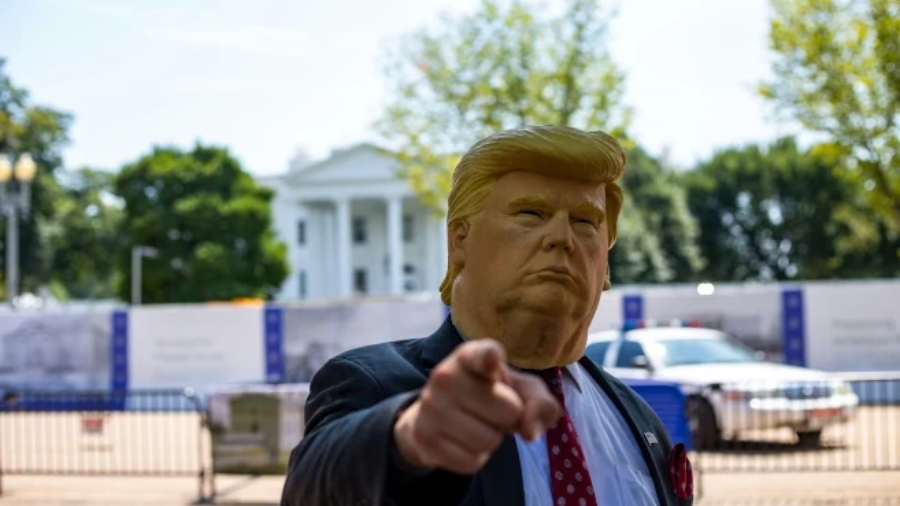
Picture this: A man standing before adoring crowds, claiming—repeatedly, insistently, almost desperately—that he deserves the Nobel Peace Prize more than anyone in recent memory. He cites meetings with dictators as peace accomplishments. He points to agreements that collapse within months. He demands recognition for threats that temporarily de-escalate tensions he himself inflamed.
This isn’t satire. This is Donald Trump’s relationship with the world’s most prestigious peace award—a relationship built on fundamental misunderstanding, strategic misrepresentation, and an obsession that reveals far more about the man than about the prize itself.
While Barack Obama won the Nobel Peace Prize in 2009 (controversially, admittedly, given it came early in his presidency), Trump has spent years insisting he deserved it more—for meeting Kim Jong Un, for Abraham Accords, for “not starting wars.” His fixation illuminates a fascinating paradox: Trump’s very approach to recognition reveals precisely why he’ll never receive it.
The story of Trump and the Nobel isn’t just about one man’s wounded ego. It’s a masterclass in how authoritarians fundamentally misunderstand institutions built on values they don’t share. It’s about the difference between transactional deal-making and principled peace-building. Most importantly, it’s about what the Nobel Peace Prize actually rewards—and why noise will never substitute for norms.
Understanding the Nobel Peace Prize: What It Actually Represents
Before examining Trump’s relationship with the Nobel Peace Prize, we must understand what the award actually honors and the principles that guide its selection.
Alfred Nobel’s Vision: Peace Through Principle
Swedish industrialist Alfred Nobel established the peace prize in his 1895 will, specifying it should go to whoever “shall have done the most or the best work for fraternity between nations, for the abolition or reduction of standing armies and for the holding and promotion of peace congresses.”
Nobel’s vision was remarkably specific. He didn’t envision rewarding powerful people for avoiding war. He imagined honoring those who actively built systems, norms, and institutions that make peace sustainable. The emphasis was always on work—sustained, principled effort toward peaceful coexistence.
The Norwegian Nobel Committee, which awards the prize independently of the Swedish committees handling other Nobel categories, has interpreted this mandate through changing global contexts while maintaining core principles:
Rewarding bridge-building over barrier-erecting. Peace Prize laureates typically spend years, often decades, building connections across divisions—whether between nations, ethnic groups, religions, or ideological camps. This patient work contrasts sharply with transactional deal-making that might reduce immediate tensions without addressing underlying conflicts.
Recognizing norm-creation, not norm-breaking. The prize consistently honors those who strengthen international law, human rights frameworks, and institutional mechanisms for conflict resolution. Recipients like the International Campaign to Ban Landmines or the Organisation for the Prohibition of Chemical Weapons represent efforts to create binding norms that constrain violence.
Valuing sustained commitment over flashy moments. While dramatic breakthroughs sometimes warrant recognition, the Committee typically rewards long-term dedication to peace work rather than singular photo opportunities or temporary de-escalations.
Historical Context: Who Actually Wins and Why
Examining past laureates reveals clear patterns in what the Nobel Peace Prize rewards:
Human rights defenders operating under extreme risk receive frequent recognition. From Malala Yousafzai to Liu Xiaobo to Nadia Murad, the Committee honors those who sacrifice personal safety to defend universal rights. These aren’t powerful politicians cutting deals—they’re vulnerable individuals standing firm on principle.
Institution-builders creating frameworks for peace regularly win. The European Union, United Nations peacekeeping forces, international humanitarian organizations—these prizes recognize that lasting peace requires institutional architecture, not just personality-driven agreements.
Negotiators who achieve genuine reconciliation occasionally receive awards, but notably, the emphasis is on reconciliation, not merely agreement. Nelson Mandela and F.W. de Klerk won for ending apartheid through a process that acknowledged past injustice while building shared future—not just signing papers.
Environmental and humanitarian workers increasingly receive recognition as the Committee broadens its understanding of what threatens peace. Climate activists like Wangari Maathai and humanitarian doctors like Denis Mukwege represent the prize’s evolution.
What’s conspicuously absent from this list? Powerful leaders who use threats, isolation, and unilateral action to force short-term agreements without addressing underlying grievances or building sustainable peace frameworks.
Trump’s Nobel Obsession: A Timeline of Desperation
Trump’s relationship with the Nobel Peace Prize spans years of public statements, tweets, rally speeches, and transparent jealousy that offers remarkable insight into his worldview.
The Origin: Obama’s Prize and Trump’s Resentment
Barack Obama’s 2009 Nobel Peace Prize—awarded just months into his presidency—represented the Committee’s aspirational hope for his promised multilateralist approach and nuclear disarmament goals. Even Obama acknowledged the award was premature, calling it a “call to action.”
The decision generated legitimate controversy. Critics reasonably argued the prize should reward achievement, not potential. Obama himself seemed uncomfortable with recognition before substantive accomplishments.
But Trump’s response to Obama’s prize went far beyond reasonable criticism. For over a decade, he’s returned obsessively to this wound, viewing Obama’s recognition as stolen glory rightfully belonging to him. This zero-sum thinking—where Obama’s award somehow diminishes Trump—reveals the transactional, competitive lens through which Trump views all recognition.
“I Would Get a Nobel Prize”: The Public Campaign
In September 2018, Trump began publicly campaigning for the Nobel Peace Prize, citing his meeting with Kim Jong Un as deserving recognition. At rallies, he suggested supporters write to the Nobel Committee. He retweeted supporters demanding he receive the prize. He compared his achievements favorably to Obama’s.
“They gave one to Obama immediately upon his ascent to the presidency, and he had no idea why he got it,” Trump said. “You know what? That was the only thing I agreed with him on.”
The campaign intensified after Japanese Prime Minister Shinzo Abe reportedly nominated Trump, a fact Trump enthusiastically shared despite Nobel nomination rules requiring 50-year confidentiality. (Abe later carefully avoided confirming or denying the claim when asked directly.)
The Fake Nominations: Desperate Fraud
In 2018, Norwegian authorities discovered someone had fraudulently nominated Trump twice using forged documents. The forgeries were clumsy—easily detected by the Committee. Yet they revealed the desperation of Trump’s most zealous supporters to manufacture legitimacy the actual process wouldn’t provide.
Trump’s response to the fake nominations? He didn’t distance himself from fraud. Instead, he continued discussing his deservingness, apparently unconcerned that supporters felt compelled to manufacture nominations he couldn’t legitimately obtain.
Abraham Accords: The Closest He Came
The 2020 Abraham Accords—normalizing relations between Israel and several Arab states—represented Trump’s strongest case for consideration. Supporters argued the agreements constituted genuine diplomatic achievement worthy of recognition.
Yet even here, the case reveals Trump’s fundamental misunderstanding. The Abraham Accords were classic transactional diplomacy: wealthy Gulf states got U.S. weapons and technology; Israel got regional recognition; the U.S. got another achievement to tout. What the Accords conspicuously lacked was any addressing of Palestinian grievances, any framework for Palestinian self-determination, or any mechanism for resolving the underlying conflict.
The Nobel Peace Prize doesn’t reward powerful parties cutting deals that ignore the interests of powerless parties. It rewards inclusive processes that build sustainable peace through addressing root causes of conflict. The Abraham Accords may have strategic value, but they’re exactly the kind of elite deal-making the Nobel Committee consistently overlooks in favor of principled peace work.
Why Trump Fundamentally Misunderstands the Prize
Trump’s obsession with the Nobel Peace Prize reveals multiple misunderstandings so profound they illuminate his entire approach to power and recognition.
Misunderstanding One: Confusing Deals With Peace
Trump views the Nobel through the lens of deal-making. In his worldview, any agreement between previously hostile parties represents peace worth celebrating. He genuinely seems to believe meeting Kim Jong Un—regardless of outcome—deserved recognition simply because the meeting happened.
This confuses process with progress. The Nobel Committee doesn’t reward meetings, summits, or photo opportunities. It rewards sustained work that demonstrably reduces violence, builds institutions, strengthens norms, or advances human rights.
Trump’s meetings with Kim produced dramatic headlines but no verifiable dismantlement of North Korea’s nuclear program. The “friendship” Trump touted didn’t prevent continued weapons development or human rights catastrophes. The spectacle wasn’t peace—it was theater.
Misunderstanding Two: Thinking Threats Constitute Peace Work
Perhaps most remarkably, Trump cited his threats against North Korea as peace credentials. His “fire and fury” rhetoric, he argued, brought Kim to the negotiating table, therefore deserving recognition.
This gets the Nobel entirely backward. The Nobel Peace Prize doesn’t reward those who create crises then partially de-escalate them. It doesn’t honor firefighters who started the fire. The Committee recognizes those who patiently build conditions where fires don’t start—not those who play with matches then claim credit for putting them out.
Trump’s approach—threaten maximum violence, then pull back slightly and demand recognition for avoiding catastrophe you threatened—is precisely the opposite of what Nobel honored in figures like Dag Hammarskjöld or Martti Ahtisaari, who spent decades developing frameworks for conflict prevention.
Misunderstanding Three: Believing Power Equals Deservingness
Trump’s statements consistently reveal an assumption that powerful people naturally deserve the Nobel Peace Prize more than vulnerable activists operating without state backing.
“I’ll probably never get it,” Trump complained in 2019, suggesting the Committee was biased against him. Yet Malala Yousafzai was shot in the head for advocating girls’ education before receiving her prize. Liu Xiaobo spent his Nobel year in Chinese prison. Denis Mukwege treated thousands of rape survivors in war zones.
The Nobel consistently rewards moral courage in the face of power—not the exercise of power itself. Trump’s assumption that his presidential authority made him deserving reveals complete misunderstanding of what the prize honors.
Misunderstanding Four: The Zero-Sum Recognition Game
Trump’s obsession with Obama’s prize reveals his zero-sum thinking: recognition exists in fixed supply, so Obama’s award diminishes Trump’s potential glory.
But the Nobel Peace Prize doesn’t work this way. The Committee doesn’t distribute recognition based on fairness or taking turns. Each year stands alone, evaluated on that year’s nominations against the prize’s principles. Obama’s 2009 prize didn’t “use up” recognition Trump might otherwise receive.
This transactional, competitive approach to honor fundamentally misunderstands institutions built on principles rather than exchange. The Nobel isn’t a participation trophy or reward for power. It’s recognition of specific work aligned with specific values.
What the Prize Actually Requires: Norms Trump Systematically Violated
The deepest irony of Trump’s Nobel obsession is that his approach to international relations systematically violated nearly every principle the Nobel Peace Prize rewards.
Multilateralism vs. “America First” Isolation
Nobel laureates typically strengthen international cooperation, building institutions and norms that constrain unilateral violence. Trump’s “America First” doctrine represented the opposite: withdrawal from multilateral agreements, hostility to international institutions, and assertion of unilateral power.
He withdrew from the Paris Climate Agreement, abandoned the Iran nuclear deal, threatened to leave NATO, defunded WHO, and consistently treated international cooperation as weakness rather than strength. Every withdrawal represented rejection of exactly the norm-building Nobel rewards.
Human Rights Defense vs. Authoritarian Admiration
The Nobel Committee consistently honors human rights defenders operating under extreme risk. Trump consistently praised authoritarian leaders while attacking human rights advocates.
He called Kim Jong Un “a great leader” who “loves his people.” He said he and Xi Jinping “love each other.” He praised Duterte, Bolsonaro, Putin, and others whose records exemplify everything the Nobel opposes. Meanwhile, he dismissed asylum seekers, implemented family separation policies, and attacked journalists as “enemies of the people.”
Rule of Law vs. Personal Loyalty
Nobel laureates typically strengthen legal frameworks constraining violence and protecting rights. Trump consistently prioritized personal loyalty over rule of law, institutional norms, or constitutional principles.
He demanded loyalty oaths from law enforcement, pardoned allies convicted of crimes, pressured prosecutors to drop investigations, and attempted to overturn election results through extralegal means. The January 6 insurrection represented the ultimate rejection of peaceful democratic norms the Nobel was created to protect.
Long-Term Institution Building vs. Short-Term Deal Making
Perhaps most fundamentally, the Nobel Peace Prize rewards patient, sustained work building durable peace structures. Trump’s entire approach prioritized immediate wins and dramatic announcements over sustainable frameworks.
His deals—whether with North Korea, Taliban, or Middle Eastern states—consistently sacrificed long-term stability for short-term headlines. When agreements collapsed or failed to address underlying conflicts, Trump simply moved to the next photo opportunity, never engaging the sustained, often boring institutional work that produces lasting peace.
The Broader Pattern: Authoritarians and Prestigious Recognition
Trump’s Nobel obsession isn’t unique. It fits a pattern of authoritarian leaders desperate for legitimacy from institutions built on values they reject.
The Prestige Paradox
Authoritarian leaders consistently crave recognition from democratic institutions even while attacking democracy. They want Harvard honorary degrees while denouncing universities as liberal propaganda. They seek Nobel Prizes while imprisoning peace activists. They demand Olympic Games while violating human rights.
This paradox reveals that even authoritarians recognize that legitimacy ultimately flows from values-based institutions, not merely power. Trump wanted the Nobel Peace Prize specifically because it represents recognition based on principles, not transactions—the very thing his worldview denies matters.
Why They’ll Never Understand
The fundamental barrier isn’t political disagreement but worldview incompatibility. Trump genuinely cannot understand why meeting dictators without achieving measurable progress isn’t Nobel-worthy, because he views all interactions as transactional wins or losses rather than steps in principled processes.
He cannot understand why threatening nuclear war then pulling back isn’t peace work, because he views threats as legitimate negotiating tools rather than moral catastrophes to avoid.
He cannot understand why the Committee would honor vulnerable activists over powerful presidents, because he views power as inherently more significant than principle.
This incomprehension runs so deep that explaining it becomes nearly impossible. It’s like explaining color to someone who’s never seen—the conceptual framework simply doesn’t exist.
What the Nobel Actually Rewards: A Comparison Table
| Trump’s Approach | Nobel Peace Prize Principles |
|---|---|
| Transactional deal-making | Principled peace-building |
| Photo-op diplomacy | Sustained institutional work |
| Threats followed by de-escalation | Conflict prevention and resolution |
| Admiration for authoritarians | Defense of human rights and democracy |
| Unilateral withdrawal from agreements | Multilateral cooperation strengthening |
| Personal loyalty over rule of law | International law and norms advancement |
| Short-term wins | Long-term sustainable peace frameworks |
| Power exercise | Moral courage despite vulnerability |
| Zero-sum competition | Collaborative problem-solving |
| Noise and bombast | Quiet, patient, persistent work |
The 2024 Claims: Desperation Intensifies
As Trump campaigns for presidency again, his Nobel claims have intensified with characteristic lack of self-awareness. He’s suggested that if he wins in 2024 and “ends the Ukraine war,” he’ll finally deserve recognition.
But even this hypothetical reveals his misunderstanding. The Nobel Peace Prize wouldn’t reward a powerful U.S. president forcing Ukraine to accept Russian territorial conquest in exchange for temporary ceasefire. It might reward Ukrainian civil society organizations defending democracy and human rights during occupation. It might honor international humanitarian workers providing aid despite danger. It might recognize activists documenting war crimes for future accountability.
But it won’t reward powerful brokers forcing weaker parties into unwanted agreements that sacrifice principle for expedience.
Why This Matters Beyond Trump’s Ego
Trump’s Nobel obsession might seem like mere narcissistic comedy, but it illuminates critical questions about recognition, legitimacy, and values in international relations.
The Battle for Normative Authority
Trump’s insistence that he deserves the Nobel Peace Prize represents an attempt to redefine what deserves recognition. If the Nobel rewarded his approach, it would legitimize transactional power politics over principled peace-building.
The Committee’s consistent refusal to engage this redefinition maintains the prize’s integrity but also reveals the stakes: these aren’t just academic disputes about criteria. They’re battles over what values govern international relations.
The Danger of Cheapening Recognition
If prestigious awards become participation trophies for powerful people, they lose meaning and force. The Nobel matters precisely because it maintains high standards based on clear principles. Compromising those standards for political expediency or to avoid controversy would transform the prize from meaningful recognition to meaningless gesture.
What We Honor Says What We Value
Ultimately, the question of whether Trump deserves the Nobel Peace Prize asks what we collectively value: Is peace simply absence of war, or does it require justice, rights, and dignity? Is diplomacy any agreement between powerful parties, or does it include addressing powerless parties’ grievances? Is leadership about dominating headlines, or about patient institution-building?
The Nobel Committee’s answer is clear and consistent. Trump’s answer reveals the authoritarian alternative.
Conclusion: Norms Over Noise, Always
The Nobel Peace Prize will never reward Donald Trump, not because of political bias or unfairness, but because everything he represents contradicts everything the prize honors. His obsession with an award he fundamentally misunderstands reveals the gulf between transactional power politics and principled peace-building.
The Committee’s consistency in rewarding vulnerable activists over powerful politicians, sustained institution-building over flashy deal-making, and moral courage over strategic positioning maintains the prize’s integrity and meaning. When Malala Yousafzai, Denis Mukwege, or Nadia Murad receive recognition, the world sees that values matter more than power—that principles constrain even the mighty.
Trump’s failure to understand this doesn’t make the Nobel flawed. It makes it essential.
In an age when authoritarians worldwide seek to redefine international norms around power rather than principle, maintaining institutions that reward courage, compassion, and commitment becomes critical. The Nobel Peace Prize reminds us that history ultimately honors those who build peace patiently, not those who dominate headlines loudly.
The prize rewards norms, not noise—and no amount of noise will ever substitute for the patient, principled work of genuine peace-building.
What are your thoughts on the relationship between recognition and values in international relations? How should prestigious prizes maintain integrity while remaining relevant? Share your perspective in the comments below, and explore our related content on authoritarianism, international institutions, and the battle for democratic values worldwide.
References and Further Reading
- The Nobel Peace Prize Official Website
- Norwegian Nobel Committee
- Arms Control Association – North Korea
- BBC News – Trump Nobel Prize Nomination
- Amnesty International – Human Rights Reports
- International Campaign to Ban Landmines
Standing for principle over power, always. Because in the long arc of history, norms outlast noise.