
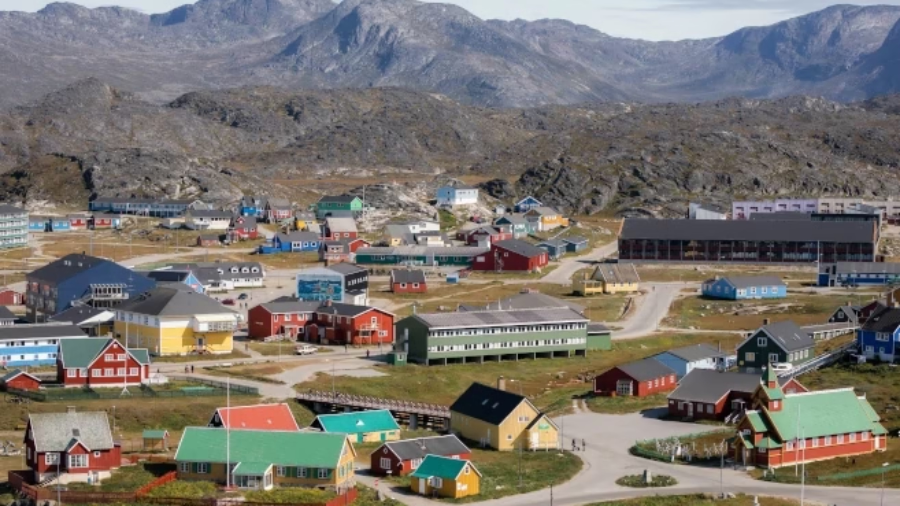
When a sitting U.S. president declares interest in purchasing another nation’s territory—and refuses to rule out military force to acquire it—the world takes notice. Trump’s Greenland threat has evolved from what many initially dismissed as political theater into a serious geopolitical flashpoint that reveals deeper currents reshaping international relations in 2025.
This isn’t just about ice sheets and Arctic real estate. It’s about resource competition, strategic positioning, and the unraveling of post-World War II norms that have governed how nations interact. Whether you’re tracking global politics, concerned about climate security, or simply trying to understand today’s headlines, what’s happening with Greenland matters more than you might think.
The Story Behind Trump’s Greenland Obsession
Donald Trump’s interest in Greenland didn’t begin in 2025. Back in 2019, during his first presidency, he floated the idea of purchasing the autonomous Danish territory, drawing bewildered reactions from Copenhagen to Nuuk. Danish Prime Minister Mette Frederiksen called the notion “absurd,” and Trump canceled a state visit in response.
Fast forward to 2025, and Trump has returned to the White House with renewed determination. This time, the rhetoric has escalated dramatically. He’s suggested that U.S. control of Greenland is necessary for national security and hasn’t dismissed the possibility of using economic or military pressure to achieve it.
Why Greenland Matters Now More Than Ever
Greenland sits at the intersection of three converging forces: climate change, great power competition, and resource scarcity.
The Climate Factor: As Arctic ice melts at unprecedented rates, Greenland is transforming from a frozen periphery into prime real estate. New shipping routes through the Northwest Passage could cut travel time between Asia and Europe by days, reshaping global trade patterns.
Strategic Location: Greenland’s position between North America and Europe makes it invaluable for military monitoring and missile defense systems. The U.S. already operates Pituffik Space Base (formerly Thule Air Base), one of America’s northernmost military installations, crucial for detecting missile launches and tracking satellites.
Resource Wealth: Beneath Greenland’s ice lies a geological treasure chest. Rare earth elements essential for smartphones, electric vehicles, and military technology. Uranium deposits. Potentially massive oil and gas reserves. As China currently dominates rare earth production, alternative sources have become matters of national security for Western nations.
Unpacking the Geopolitical Implications
Trump’s Greenland threat reverberates far beyond the Arctic Circle, touching on sovereignty, international law, and the future of American diplomacy.
Denmark and NATO in Crisis
Denmark finds itself in an impossible position. As a founding NATO member, it’s supposed to count on American protection. Instead, it faces implicit threats from its most powerful ally.
The Danish government has responded with unusual firmness. Officials have made clear that Greenland is not for sale and that its status is non-negotiable. But there’s genuine anxiety in Copenhagen about what Trump might do next—economic sanctions? Diplomatic isolation? Reduced NATO cooperation?
This crisis is fracturing the Nordic bloc. Sweden and Finland, NATO’s newest members, are watching nervously. If America treats a loyal ally this way over territorial ambitions, what does that say about the alliance’s foundational principle of collective defense?
Greenland’s Voice and Self-Determination
Lost in the superpower maneuvering is Greenland itself—a self-governing territory of roughly 57,000 people, predominantly Indigenous Inuit, who have their own aspirations.
Greenland’s government has been on a path toward full independence from Denmark, a process that requires economic self-sufficiency. The territory currently receives substantial subsidies from Copenhagen and must navigate between maintaining this relationship and asserting autonomy.
Múte Bourup Egede, Greenland’s premier, has stated bluntly: “Greenland is ours. We are not for sale and will never be for sale.” Yet Trump’s attention has inadvertently accelerated independence discussions. Some Greenlanders see potential partnerships with the U.S. as an economic pathway away from Danish dependency—though decidedly on their own terms, not through coercion or purchase.
This raises uncomfortable questions about self-determination in the 21st century. Do Indigenous populations have true agency when superpowers compete over their homeland? How does a small nation assert sovereignty when its strategic value attracts unwanted attention?
China’s Arctic Ambitions and the Great Game
Trump’s focus on Greenland doesn’t exist in isolation—it’s partly a response to China’s Arctic strategy. Beijing has designated itself a “near-Arctic state” and invested billions in polar infrastructure, research stations, and resource extraction partnerships.
China has courted Greenland aggressively, offering financing for mining projects and infrastructure development that the territory desperately needs but Denmark cannot fully fund. When a Chinese company attempted to purchase an abandoned naval base in Greenland in 2018, Denmark stepped in to block the sale under U.S. pressure.
Trump’s aggressive posture, whatever its other flaws, acknowledges a real strategic challenge: if the U.S. doesn’t engage with Greenland constructively, China will. The question is whether threats and territorial acquisition attempts are the right approach—or whether they drive Greenland into arrangements with other powers out of pure defensiveness.
International Law and Territorial Integrity
Trump’s willingness to consider forceful acquisition of Greenland strikes at fundamental principles of international law established after World War II. The UN Charter explicitly prohibits territorial acquisition through force or threat of force.
Legal experts point out that even discussing military options violates these norms. It sets dangerous precedents. If the United States—the architect and enforcer of the rules-based international order—openly flouts these principles, what’s to stop Russia from claiming more of Ukraine, or China from seizing disputed territories in the South China Sea?
Some Trump defenders argue that purchasing territory has historical precedent—America bought Alaska from Russia in 1867 and the Louisiana Territory from France in 1803. But these transactions occurred in different eras, before modern concepts of self-determination and indigenous rights. More importantly, they involved willing sellers, not coerced acquisitions from resistant parties.
The Resource Rush: What’s Really at Stake
Understanding Trump’s Greenland threat requires grasping what lies beneath the ice and why it matters for 21st-century power politics.
Rare Earth Elements and Technology Supremacy
Rare earth elements—17 metallic elements with unique magnetic and conductive properties—are indispensable for modern technology. They’re in your smartphone screen, hybrid car motor, wind turbine, and precision-guided missile.
China controls approximately 70% of global rare earth production and 90% of processing capacity. This monopoly gives Beijing enormous leverage. During trade disputes, China has threatened to restrict exports, sending panic through Western supply chains.
Greenland’s Kvanefjeld deposit represents one of the world’s largest rare earth resources outside China. Developing this and other sites could diversify global supply, reducing Chinese dominance. For U.S. policymakers, this isn’t just economic—it’s a matter of technological sovereignty and military readiness.
Energy Resources in a Warming Arctic
As sea ice retreats, previously inaccessible Arctic oil and gas reserves become exploitable. The U.S. Geological Survey estimates that the Arctic contains 13% of the world’s undiscovered oil and 30% of undiscovered natural gas.
Greenland’s offshore areas remain largely unexplored but potentially lucrative. As Europe seeks alternatives to Russian energy and global demand remains high despite climate commitments, Arctic fossil fuels represent substantial value.
There’s bitter irony here: climate change makes these resources accessible, while extracting them accelerates the very warming that’s transforming the Arctic. Greenland itself faces existential threats from its melting ice sheet, which contributes to global sea level rise.
The Fishing and Maritime Economy
Warming waters have brought fish stocks northward, making Greenland’s fisheries increasingly valuable. Commercial fishing grounds are expanding, and new species are appearing in Arctic waters.
Control over maritime zones—exclusive economic zones extending 200 nautical miles from coastlines—determines who can exploit these resources. As Arctic ice diminishes, competing territorial claims and fishing rights will intensify, making sovereignty questions even more contentious.
What This Means for American Foreign Policy
Trump’s approach to Greenland reflects a broader shift in how he conceptualizes American power and international relations—one that breaks sharply with decades of bipartisan consensus.
Transactional Diplomacy and Alliance Erosion
Traditional U.S. foreign policy treated alliances as force multipliers—investments that enhanced American power through cooperation, shared burden, and coordinated action. Trump views them transactionally, as deals that either benefit America directly or aren’t worth maintaining.
This worldview leads to threatening allies over territorial disputes, demanding protection payments from NATO members, and viewing international institutions as constraints rather than tools. The consequences extend far beyond Greenland:
- Alliance Credibility: If the U.S. bullies Denmark, why would Taiwan, South Korea, or Baltic states trust American security guarantees?
- Partner Choices: Middle powers may hedge their bets, developing security relationships with multiple partners rather than relying on Washington.
- Institutional Weakening: American unpredictability undermines the rules and norms that amplify U.S. influence beyond raw military might.
The New Nationalism and Territorial Expansion
Trump’s rhetoric about Greenland—alongside similar statements about reclaiming the Panama Canal and absorbing Canada—signals a revival of territorial nationalism that most analysts thought had died with 19th-century imperialism.
This isn’t just campaign bluster. It reflects a genuine belief that America should expand its territorial control to secure resources, strategic positions, and economic advantages. It’s Manifest Destiny for the 21st century, divorced from the international legal frameworks established after two world wars.
Such thinking appeals to certain domestic constituencies who see the world as a zero-sum competition for resources and dominance. But it’s deeply destabilizing internationally, signaling that borders and sovereignty are negotiable if you have sufficient power.
Climate Security and Arctic Governance
Paradoxically, Trump’s Greenland focus highlights the growing importance of climate security while his administration remains skeptical of climate science.
The Arctic Council, which includes the U.S., Canada, Russia, Nordic countries, and Indigenous representatives, has tried to manage Arctic issues cooperatively. But great power competition is overwhelming these mechanisms. Russia has militarized its Arctic territories. China seeks commercial access. Now America pursues territorial control.
Effective Arctic governance requires international cooperation on issues like shipping regulations, environmental protection, Indigenous rights, and resource management. Aggressive unilateralism makes such cooperation nearly impossible, potentially accelerating the Arctic’s transformation into a zone of competition and conflict.
Global Reactions and Regional Responses
The international community’s response to Trump’s Greenland threat reveals shifting geopolitical alignments and anxieties about American leadership.
European Unity and Defense
European nations have responded with rare unanimity, defending Denmark and rejecting American territorial ambitions. The European Union issued statements affirming Greenland’s right to self-determination and Denmark’s sovereignty.
But words don’t equal military capacity. If Trump were to somehow pressure Greenland through economic means or indirect coercion, what would Europe actually do? The EU lacks unified military capability to counter American pressure. This vulnerability is driving renewed discussions about European strategic autonomy—the ability to act independently of the United States.
Russia’s Calculated Silence
Notably, Russia has remained relatively quiet about Trump’s statements. Moscow has its own extensive Arctic claims and territorial disputes. Supporting international norms against territorial revision would constrain Russian actions elsewhere. Yet Russia also benefits from American actions that divide NATO and weaken Western unity.
This silence speaks volumes about the new geopolitical landscape—one where traditional rivals may tacitly support each other’s revisionist behavior because they share interests in overturning the existing order.
China’s Opportunistic Positioning
Beijing has positioned itself as a defender of sovereignty and international law, criticizing American unilateralism while courting Greenland with investment offers. The Belt and Road Initiative has polar dimensions, and China would gladly expand economic ties with Greenland if it distances itself from both Denmark and the United States.
China’s government-controlled media has highlighted the contradiction: America, which lectures others about rules-based order, threatens to seize an ally’s territory. This messaging resonates in the Global South, where many nations remember their own experiences with Western imperialism.
The Path Forward: Possible Scenarios
What actually happens with Trump’s Greenland threat depends on numerous variables—domestic politics, international reactions, and whether Trump’s statements translate into concrete policy.
Scenario 1: Diplomatic De-escalation
The most likely outcome remains that Trump’s statements don’t result in actual territorial acquisition attempts. The legal, diplomatic, and practical barriers are enormous. Cooler heads in the administration or Congress might constrain impulses toward coercive action.
Denmark and Greenland could offer increased U.S. access to bases, resources, and strategic cooperation—a face-saving arrangement that addresses security concerns without territorial transfer. This would require all parties to step back from maximalist positions and focus on practical cooperation.
Scenario 2: Economic Pressure Campaign
Trump could pursue economic coercion—threatening trade restrictions on Denmark, conditioning NATO protection on Greenland negotiations, or offering Greenland massive financial inducements that create internal political divisions.
This approach would damage U.S.-European relations severely but might be politically sustainable domestically. It would test whether economic interdependence still constrains great power behavior or whether major nations can fragment global economic systems into competing blocs.
Scenario 3: Permanent Strategic Realignment
The most consequential possibility is that Trump’s Greenland focus, regardless of immediate outcomes, permanently reorients Arctic politics toward great power competition. Denmark might accelerate Greenland’s independence to remove it from American pressure. Greenland might diversify partnerships with China, Canada, or others. The Arctic could become what the South China Sea already is—a zone of permanent tension and competing claims.
This scenario wouldn’t involve military conflict necessarily, but it would mean the end of Arctic exceptionalism—the idea that the polar regions could remain zones of scientific cooperation and peaceful development even as other regions grew more contested.
What This Tells Us About the Future
Trump’s Greenland threat is ultimately about more than one island, one president, or one political moment. It’s symptomatic of deeper shifts in how power works internationally.
The Return of Territory: For decades, experts predicted that globalization made territorial control less important than controlling technology, finance, and information. The Greenland situation suggests that physical geography, resources, and strategic positioning still matter enormously—perhaps increasingly so as climate change and resource competition intensify.
The Fragility of Norms: International law and shared norms only work when major powers buy into them. Once great powers openly disregard rules against territorial acquisition or threatening allies, those norms erode quickly. We’re witnessing in real-time how international orders can unravel not through catastrophic war but through accumulating violations and normalized deviance.
Indigenous Agency in Geopolitics: Greenland’s population increasingly asserts their voice in determining their future. This tension—between great power interests and Indigenous self-determination—will replay across the Arctic and other resource-rich regions. How the international community handles Greenland sets precedents for these future conflicts.
Climate as Geopolitical Accelerant: Every scenario involving Greenland assumes continued warming and ice loss. Climate change isn’t just an environmental issue; it’s actively reshaping political geography, creating new resources, opening new territories, and intensifying competition. The Arctic is the laboratory where these climate-geopolitics interactions are most visible.
Final Thoughts: Beyond the Headlines
When you see headlines about Trump’s Greenland threat, understand that you’re watching several historical processes collide simultaneously: the warming Arctic opening new frontiers, great powers competing for strategic advantage, Indigenous peoples asserting self-determination, and international norms being tested by nationalist pressures.
There’s no simple resolution here. Greenland’s location, resources, and strategic value guarantee continued attention from multiple powers regardless of who occupies the White House. The question isn’t whether Greenland becomes geopolitically important—it already is. The question is whether that importance manifests through cooperation or coercion, through respect for sovereignty or revival of territorial imperialism.
For those of us watching from afar, Trump’s Greenland threat offers uncomfortable lessons about how quickly international stability can erode, how resource competition drives conflict, and how climate change will reshape not just coastlines but the entire architecture of global politics.
The Arctic is warming, the ice is melting, and the old rules are cracking. What happens in Greenland won’t stay in Greenland—it will set precedents that echo across every contested border, strategic resource, and Indigenous territory on Earth.
What are your thoughts on Trump’s approach to Greenland? Do you think territorial expansion has any place in modern international relations, or does it represent a dangerous return to imperialist thinking? Share your perspective in the comments below, and don’t forget to subscribe for more in-depth analysis of the geopolitical issues shaping our world.
References
- Arctic Council – Greenland Profile
- Council on Foreign Relations – Arctic Geopolitics
- U.S. Space Force – Pituffik Space Base
- U.S. Geological Survey – Critical Minerals in Greenland
- NATO – Member Countries
- Government of Greenland – Official Site
- CSIS – China’s Arctic Strategy
- UN Charter – Territorial Integrity
- U.S. Department of Energy – Rare Earth Elements
- European Parliament – Strategic Autonomy
