
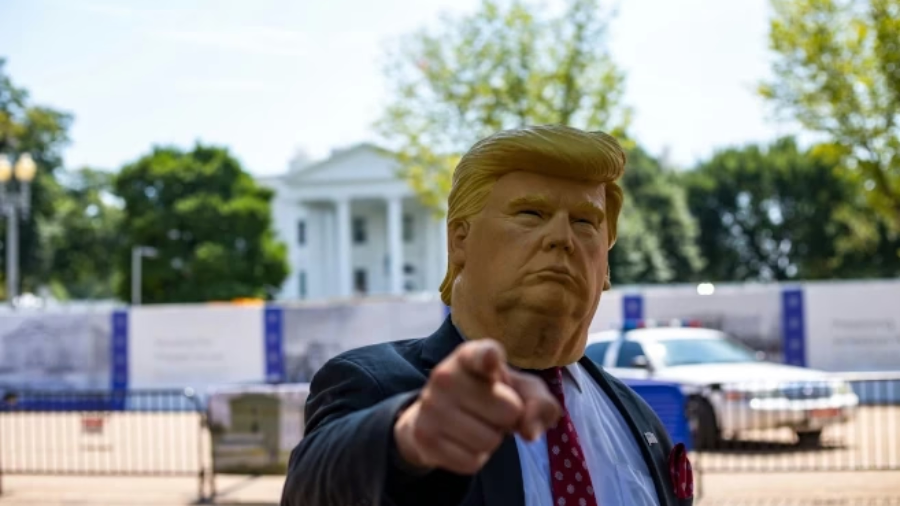
Introduction: Why the Turbulence Still Matters
Few chapters in modern American political history have generated as much debate, devotion, and distress as the Trump administration’s disruptive politics. For some, Donald Trump represented a long-overdue revolt against political elitism. For others, he embodied a dangerous departure from democratic norms, institutional stability, and responsible leadership.
But beyond the noise—beyond the tweets, scandals, and headlines—a deeper, more urgent question remains:
Was the chaos accidental, or was it the whole point?
Did the Trump administration’s disruptive politics stem from genuine incompetence and buffoonery?
Was it driven by the reckless improvisation of a leader out of his depth?
Or was it something far more intentional—a strategy of deliberate political malice designed to destabilize, divide, and dominate?
This post takes a critical, research-backed tour through these competing explanations, comparing evidence, examining patterns, and offering a clear, engaging analysis of the years that reshaped American democracy.
Understanding the Architecture of Disruption
Although Trump’s governing style seemed chaotic on the surface, scholars, journalists, and political psychologists have identified recurring themes that help decode the underlying drivers of his administration’s behavior.
Below are four major interpretations often used to explain his governance:
- Gross incompetence – a leader unprepared for governance
- Buffoonery – impulsive, unserious, performative politics
- Reckless strategy – disruption as a political weapon
- Deliberate malice – intentional degradation of norms and institutions
Each theory holds truth. But each also fails to fully explain the complete picture.
Was It Incompetence? Examining the Evidence
One of the most common critiques of Trump’s presidency is rooted in institutional incompetence. From rapid staff turnover to poorly briefed policy launches, the administration often looked like a revolving door of chaos.
Record-Setting Staff Turnover
According to multiple analyses from think tanks and political researchers, the Trump White House recorded the highest staff turnover rate of any modern presidency. Senior officials left in waves—some fired unexpectedly, others departing amid scandal or exhaustion.
Frequent turnover meant:
- No consistent policy direction
- Internal power struggles
- Poor communication between agencies
- Lawsuits, blocked executive orders, and policy reversals
Governments require continuity. Trump’s environment fostered none.
Policy Making Without Processes
Many major policies were unveiled without:
- Interagency review
- Legal vetting
- Legislative consultation
- Implementation planning
Some famously chaotic examples include:
- The first travel ban, blocked almost immediately in court
- Sudden troop withdrawal announcements via Twitter
- Conflicts between the president and his own cabinet
- Government shutdowns over easily negotiable issues
These failures weren’t just political missteps—they were structural signs of an administration struggling to function normally.
Lack of Expertise
Trump frequently appointed individuals with little or no experience in the roles they held. Several appointees openly opposed the very agencies they led.
This produced:
- Contradictory mandates
- Confusion within departments
- Difficulty coordinating national responses
Whether one views Trump as a disruptive reformer or an accidental arsonist, the evidence of incompetence is difficult to ignore.
Buffoonery or Performative Politics? The Role of Impulse and Spectacle
Another interpretation frames Trump not as malicious, but as profoundly unserious—a showman who treated governance as performance.
The Politics of Outrage
Trump mastered the art of constant spectacle. Outrage drives attention. Attention drives power.
His communication style relied heavily on:
- Provocative insults
- Conspiracy-tinged rhetoric
- Episodic policy pronouncements
- Frequent exaggerations or misstatements
- Late-night tweetstorms that could shift global markets
Political psychologists describe this as “performative dominance”—acting unpredictably to project strength and destabilize opponents. But its downside is obvious:
Chaos becomes the default operating mode.
Reality-TV Governance
Trump’s background in entertainment shaped his sense of leadership:
- Every conflict was a “season”
- Every scandal an “episode”
- Every firing a “plot twist”
- Every rally a “live performance”
This performative posture may explain why so many decisions seemed spontaneous, improvised, or even whimsical.
But was it just buffoonery—or part of something more strategic?
Reckless Strategy—Chaos as a Political Weapon
Some analysts argue that Trump deliberately used chaos to consolidate power. Not through detailed plans, but through instinctive, opportunistic strategies.
The “Shock-and-Disorient” Method
By overwhelming the media and public with:
- Constant controversies
- Rapid-fire policy changes
- Personal attacks on opponents
- Insults directed at institutions
Trump made it nearly impossible for critics to focus on any single issue for long. This created an environment where serious concerns—ethics violations, conflicts of interest, foreign entanglements—were drowned out by daily scandals.
Normalizing the Abnormal
When chaos becomes constant, people stop reacting.
This allowed Trump to:
- Undermine institutions without immediate backlash
- Replace experienced public servants with loyalists
- Redraw political red lines
- Discredit the electoral system
- Attack civil servants, journalists, and even the judiciary
Whether intentional or instinctual, the effect was the same: the Overton Window shifted dramatically.
Division as a Governing Tool
Under this interpretation, the Trump administration’s disruptive politics wasn’t a bug—it was a feature.
Division ensured:
- Increased base loyalty
- Heightened culture wars
- Distrust in shared facts
- Fragmented opposition
Reckless strategy, in this sense, became a tool for political survival.
Or Was It Deliberate Political Malice?
The most serious interpretation suggests not incompetence, nor buffoonery, nor even reckless strategy—but deliberate, calculated malice toward democratic institutions.
Attacks on Democratic Norms
Trump repeatedly challenged foundational norms:
- Refusing to commit to peaceful power transitions
- Declaring elections “rigged” without evidence
- Pressuring officials to “find votes”
- Encouraging challenges to certified results
- Attempting to overturn democratic outcomes
Democratic norms depend on leaders respecting rules even when inconvenient. Trump frequently did the opposite.
Autocratic Admiration
Trump consistently expressed admiration for strongman leaders:
- Vladimir Putin
- Kim Jong-un
- Xi Jinping
- Rodrigo Duterte
These relationships often raised concerns about his comfort with authoritarianism and his willingness to emulate its strategies—targeting the press, undermining institutions, and attacking independent bodies.
Weaponization of Government
Evidence of punitive political targeting included:
- Efforts to pressure the Justice Department
- Attempts to jail political rivals
- Loyalty tests for federal employees
- Attacks on whistleblowers
- Expulsion of Inspectors General
Viewed through this lens, chaos served a deeper objective: weakening guardrails that limit executive power.
A Comparative Summary — Which Explanation Dominates?
Below is a simple breakdown to illustrate how each interpretation fits different patterns of behavior:
| Explanation | Supporting Evidence | Limitations |
|---|---|---|
| Incompetence | Staff turnover, poor planning, failed policies | Cannot explain consistent patterns of authoritarian behavior |
| Buffoonery | Performative politics, impulsivity, exaggerations | Underestimates systematic institutional attacks |
| Reckless Strategy | Chaos to overwhelm critics, division as tool | May exaggerate Trump’s strategic foresight |
| Deliberate Malice | Attacks on norms, autocratic admiration, loyalty tests | Some chaotic actions may still be incompetence, not strategy |
Conclusion of the comparison:
The most accurate understanding is likely a hybrid model. Trump’s governance combined incompetence, buffoonery, reckless strategy, and intentional malice—each reinforcing and amplifying the others.
Key Insights — What This Means for the Future of American Democracy
Fragile Institutions Need Active Protection
The Trump years revealed how quickly norms can erode when a leader exploits legal gray zones.
Personality Matters More Than Ever
The presidency is a position of immense discretion. A leader’s temperament can reshape national fabric virtually overnight.
The Media Must Evolve
Traditional journalism struggled to handle a president who saw truth as negotiable and chaos as power.
Citizens Need Civic Literacy
A misinformed public is vulnerable to manipulation, demagoguery, and authoritarian drift.
Conclusion: So What Was the Real Cause of the Chaos?
After carefully examining all perspectives, one truth becomes clear:
The Trump administration’s disruptive politics were not the result of one factor—but a volatile mixture of all four.
- Incompetence created confusion.
- Buffoonery masked deeper intentions.
- Reckless strategy weaponized division.
- Deliberate malice weakened democratic safeguards.
Whether Trump returns to power or not, understanding this interplay is critical. The lessons of that era are not simply historical—they are warnings, urging Americans and democracies everywhere to remain vigilant, informed, and united against leaders who choose disruption over governance.
Call to Action
If this analysis helped clarify your understanding of the Trump administration’s disruptive politics, consider:
👉 Sharing your thoughts in the comments
👉 Forwarding this post to someone passionate about democracy
👉 Exploring related analyses on political instability and governance
👉 Subscribing for future deep dives into political behavior and global democracy
Your voice matters. Democracy depends on it.
