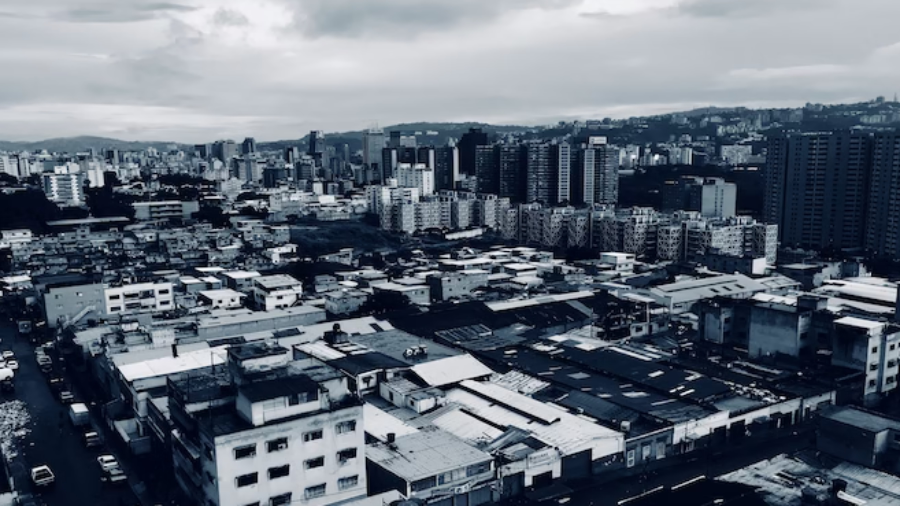
And it’s the latest chapter in a 200-year story about US hegemony in the Western Hemisphere—a story that forces us to confront uncomfortable questions: Is American dominance in Latin America strategic necessity or imperial bullying? Does the United States “protect” smaller nations, or does it exploit them? And in an era when China offers an alternative model of influence, can Washington’s old playbook even work anymore?
The answers aren’t simple. But they matter profoundly—not just for Venezuelans, Nicaraguans, or Hondurans, but for anyone who cares about sovereignty, international law, and the future of global power.
The “Donroe Doctrine”: When a 200-Year-Old Policy Gets a 2026 Makeover
When President Trump announced the military operation that captured Venezuelan President Nicolás Maduro, he didn’t just claim success—he claimed history. This wasn’t merely regime change, he declared. This was an update to the Monroe Doctrine, now jokingly rebranded the “Donroe Doctrine.”
For those who slept through high school history: The Monroe Doctrine, articulated by President James Monroe in 1823, essentially told European powers to stay out of the Western Hemisphere. In return, America promised not to meddle in European affairs.
It sounded defensive. It was actually the opening move in two centuries of American intervention.
But here’s what makes 2026 different—and more troubling. US hegemony in the Western Hemisphere is no longer just about keeping European powers out. Trump’s 2025 National Security Strategy explicitly states the United States will “deny non-Hemispheric competitors”—read: China—the ability to operate in Latin America, and that American “preeminence in the Western Hemisphere” is a condition of US “security and prosperity.”
Translation: Your hemisphere is our backyard. And we decide what happens here.
From Monroe to Roosevelt to Trump: The Evolution of American Dominance
To understand where we are, we need to understand how we got here. US hegemony in the Western Hemisphere didn’t emerge fully formed. It evolved through distinct phases, each justified by the politics of its era.
1: The Original Monroe Doctrine (1823-1900s)
When Monroe first articulated his doctrine, America lacked the military power to enforce it. It was aspiration dressed as policy. But as America industrialized and built naval might, the doctrine transformed from symbolic statement to actionable strategy.
2: The Roosevelt Corollary—Imperial Policeman (1904-1930s)
Enter Theodore “Teddy” Roosevelt, who in 1904 added his infamous Corollary to the Monroe Doctrine. Roosevelt declared that “chronic wrongdoing” by Latin American nations gave the United States the right to “exercise international police power” in the region.
What did “chronic wrongdoing” mean? Whatever Washington decided it meant.
The result? American troops invaded and occupied:
- Dominican Republic (1904, 1916-1924)
- Nicaragua (1911-1933)
- Haiti (1915-1934)
- Mexico (1914, 1916)
- Panama (1903, supporting secession from Colombia to secure canal rights)
The pattern was clear: American banks and corporations made risky investments in unstable countries. When those countries couldn’t pay, American gunboats showed up to “restore order”—and coincidentally protect business interests.
3: The Cold War—Communism as Justification (1950s-1990s)
After World War II, the rationale shifted from protecting economic interests to fighting communism. But the method remained the same: intervention—now often covert.
The CIA’s greatest hits in Latin America include:
- Guatemala (1954): Overthrowing democratically-elected President Jacobo Árbenz, whose land reform threatened United Fruit Company
- Cuba (1961): The failed Bay of Pigs invasion
- Chile (1973): Supporting the military coup that overthrew Salvador Allende and installed Augusto Pinochet
- Nicaragua (1980s): Funding Contra rebels against the Sandinista government, leading to the Iran-Contra scandal
Each intervention was justified as necessary to prevent Soviet expansion. Each left decades of instability, human rights abuses, and deep anti-American sentiment.
4: Post-Cold War—The Quiet Period? (1990s-2010s)
For a brief moment, it seemed like things might change. Franklin D. Roosevelt’s “Good Neighbor Policy” in the 1930s had promised non-intervention. After the Cold War, some scholars declared the Monroe Doctrine dead.
They were wrong. American interventions continued, just with different justifications:
- Haiti (1994, 2004): Multiple interventions
- Colombia (2000s): Billions in military aid through Plan Colombia
- Honduras (2009): Supporting a coup against President Manuel Zelaya
- Venezuela (2002): Backing a failed coup against Hugo Chávez
And then came 2026—and the most brazen display of US hegemony in the Western Hemisphere in decades.
Venezuela 2026: What Really Happened and Why It Matters
On January 4, 2026, American forces conducted airstrikes on Caracas and captured President Maduro, bringing him to the United States to face drug trafficking charges. The operation marked the first time since Manuel Noriega in 1989 that America had forcibly removed a Latin American head of state.
Trump’s justification was blunt: “We’ll be selling oil,” he said, “probably in much larger doses because they couldn’t produce very much because their infrastructure was so bad.”
Let’s be clear about what happened here. The United States:
- Decided a foreign leader was illegitimate
- Launched military strikes without UN authorization
- Abducted that leader to face charges in American courts
- Announced intentions to “run” the country and extract its oil
- Installed an interim leader (Delcy Rodríguez, a Maduro loyalist) rather than the actual democratic opposition
The Strategic Calculus: Why Venezuela, Why Now?
Analysts identify several intersecting motives:
1. Oil and Resources
Venezuela has the world’s largest proven oil reserves—more than Saudi Arabia. While the industry has collapsed under mismanagement, American companies see opportunity. Critical minerals and rare earth elements add to Venezuela’s strategic value.
2. Cutting China Out
China has invested billions in Venezuela and across Latin America. The 2025 National Security Strategy explicitly aims to “deny non-Hemispheric competitors” access to the region. Venezuela’s action sends a message: Play with China, pay the price.
3. Domestic Political Theater
Nothing unites Americans quite like foreign military action. Trump, facing political challenges, gets to look decisive, anti-communist, and tough on drugs—all while accessing resources.
4. Threatening Other Left-Wing Governments
Cuba, Nicaragua, Bolivia, and even moderate left governments in Brazil, Colombia, and Mexico got the message loud and clear. Step out of line, and you could be next.
The Leverage Playbook: How American Hegemony Actually Works
US hegemony in the Western Hemisphere doesn’t only operate through military invasions. That’s just the most dramatic tool. American influence operates through what scholars call “three dependency mechanisms: markets, leverage, and linkage.”
Markets: Economic Integration as Control
Latin American economies are deeply integrated with the United States. The US is:
- The largest trading partner for most Latin American nations
- The primary destination for exports
- The main source of remittances (money sent home by immigrants)
- The dominant financial market for investment
This creates asymmetric dependence. When the US threatens tariffs—as Trump routinely does—Latin American governments panic. Their economies can’t afford to lose American market access.
Leverage: The Carrot and Stick
The United States wields enormous financial leverage through:
- Foreign aid that can be suspended at any moment
- World Bank and IMF loans where America holds veto power
- Drug Enforcement Administration (DEA) operations that can be used politically
- Financial sanctions that can cripple economies
- Visa restrictions that affect elites’ ability to travel and bank internationally
Recent examples of leverage in action:
- Honduras (2009): US acquiesced to coup after initial criticism
- Paraguay (2012): US recognized questionable impeachment
- Brazil (2016): US supported process that removed Dilma Rousseff
- Bolivia (2019): US quickly recognized interim government after contested election
Linkage: Elite Capture
Perhaps most insidiously, American hegemony operates through elite capture. Latin American political, economic, and military elites are:
- Educated in American universities
- Connected to American business interests
- Invested in American financial markets
- Reliant on American political support
When these elites govern, they naturally align with American interests—not because of military threats, but because their personal interests are bound up with American power.
The Other Side: Is US Hegemony Sometimes Beneficial?
Before we conclude that US hegemony in the Western Hemisphere is purely exploitative, honesty demands we examine counter-arguments.
1: Stability and Security
Proponents argue that American hegemony prevents great power conflicts in the hemisphere. Without US dominance, might Russia or China establish military bases in Cuba or Venezuela? Would regional conflicts escalate without American mediation?
Colombia’s decades-long conflict, for instance, received billions in American aid that—whatever its problems—did help degrade drug cartels and guerrilla groups.
2: Economic Development
Despite obvious exploitation, American investment has contributed to Latin American development. The Panama Canal, for all its imperial origins, has been an economic boon. Free trade agreements have created jobs and lowered consumer prices.
Panama itself is often cited as a rare successful American intervention—stable democracy, peaceful elections, significant economic growth since Noriega’s removal.
3: Democratic Support (Sometimes)
The United States has, at times, supported democratic transitions and human rights. American pressure helped end military dictatorships in Argentina, Chile, and Brazil in the 1980s. American election monitors and civil society funding have supported democracy.
The problem? American support for democracy is highly selective. When democratic governments threaten American interests—as in Guatemala (1954) or Chile (1973)—democracy suddenly matters less than “stability.”
4: Countering Genuine Threats
Some Latin American governments pose legitimate concerns:
- Drug trafficking: Cocaine and fentanyl flowing north kill Americans
- Corruption: Some governments are kleptocracies that torture opponents
- Humanitarian crises: Venezuela’s collapse created 7+ million refugees
- Terrorism: Groups like Shining Path genuinely threatened civilians
Is American intervention justified if it addresses real problems? Or does intervention typically make things worse?
The China Challenge: A New Model or New Master?
The elephant—or dragon—in the room is China. Beijing has dramatically increased its presence in Latin America over the past two decades:
China’s Playbook:
- $140+ billion in loans since 2005, dwarfing World Bank lending
- Trade partnerships that don’t impose political conditions
- Infrastructure investment in ports, railways, 5G networks
- No military interventions or regime change operations
- No human rights lectures or democracy promotion
For Latin American governments frustrated with American heavy-handedness, China offers an alternative. You can trade with Beijing without fearing a coup.
But is China’s model better? Critics note:
- Debt traps: Loans that countries struggle to repay
- Environmental damage: Chinese mining and logging with minimal oversight
- Labor exploitation: Poor conditions in Chinese-run operations
- Surveillance technology: Exporting authoritarian tools to willing governments
- Strategic control: China now owns or operates major ports across the region
The choice facing Latin America isn’t between American hegemony and independence. It’s between American hegemony and Chinese hegemony. Neither is ideal.
Small Nation Sovereignty: The Voices Nobody Hears
Lost in great power competition are the voices of Latin Americans themselves. What do they think about US hegemony in the Western Hemisphere?
The Left-Wing Perspective
Leaders like Brazil’s Lula, Mexico’s Sheinbaum, Colombia’s Petro, and Chile’s Boric condemned the Venezuela intervention as illegal and destabilizing. Their argument:
Even if Maduro is a dictator, military intervention sets an “extremely dangerous precedent.” International law exists for a reason. If the United States can unilaterally invade and remove leaders, what stops any powerful nation from doing the same? This is might-makes-right imperialism, not a rules-based international order.
The Right-Wing Perspective
Conservative governments in Argentina, Chile (under previous administration), Ecuador, and Bolivia initially praised Maduro’s removal—until Trump announced he’d work with Maduro’s vice president rather than the democratic opposition. Suddenly, the intervention looked less like support for democracy and more like resource grab.
The Popular Perspective
Public opinion varies dramatically. Some Venezuelans celebrated Maduro’s capture, seeing him as a brutal dictator who destroyed their country. Others, even those who hate Maduro, resented American military intervention as violation of sovereignty.
A Guatemalan taxi driver might worry about CIA-backed coups returning. A Nicaraguan farmer might appreciate American aid programs. A Colombian business owner might want closer US ties for security and investment. A Bolivian indigenous leader might see American influence as existential threat to traditional ways of life.
There is no monolithic “Latin American view”—which is precisely why treating the entire hemisphere as America’s strategic backyard is so problematic.
The Ultimate Question: Is This System Sustainable?
Here’s the brutal truth: US hegemony in the Western Hemisphere is simultaneously:
- Historically unprecedented in its reach
- Economically asymmetric and often exploitative
- Strategically rational from Washington’s perspective
- Internationally illegal by UN Charter standards
- Deeply resented by many Latin Americans
- Pragmatically accepted by others who see no alternative
- Under challenge from China’s rising influence
- Maintained through economic leverage more than military force
- Based on elite capture as much as coercion
Can it last?
Why It Might Continue
- Military dominance: No Latin American nation can challenge American military supremacy
- Economic integration: Decades of trade ties can’t be easily unwound
- Elite alignment: Powerful Latin Americans benefit from the current system
- Chinese limitations: Beijing’s model has its own problems and limitations
- Domestic challenges: Many Latin American nations face internal crises that distract from challenging US power
Why It Might Crumble
- Legitimacy deficit: Interventions like Venezuela 2026 destroy any pretense of “partnership”
- Economic alternatives: China offers a different model of engagement
- Demographic shifts: Younger Latin Americans less sympathetic to US
- American overreach: Every brazen intervention creates more enemies
- Multipolar world: US hegemony anywhere requires hegemony everywhere—increasingly difficult
Academic research suggests that hegemons who rely primarily on coercion rather than persuasion and benefits create unstable systems. Trump’s approach—demanding obedience, threatening military force, extracting resources without compensation—represents a shift from traditional hegemony to something closer to naked imperialism.
And history shows us: naked imperialism ultimately fails. It’s too expensive to maintain, generates too much resistance, and becomes unsustainable as rivals emerge.
The Path Forward: Beyond Hegemony?
What would a better relationship between the United States and Latin America look like?
Option 1: Actual Partnership
Instead of US hegemony in the Western Hemisphere, imagine genuine regional cooperation:
- Mutual respect for sovereignty
- Economic relationships that benefit both sides
- Security cooperation against shared threats (drug trafficking, climate change)
- No military interventions without UN authorization
- Support for democracy that’s consistent, not selective
- Development aid without political strings
Sounds utopian? Perhaps. But consider: The European Union evolved from centuries of warfare into genuine partnership. Is a Western Hemisphere Community too much to imagine?
Option 2: Managed Decline
America accepts it can no longer dominate the hemisphere unilaterally. Instead of fighting Chinese influence, Washington competes on better terms—offering better deals, respecting sovereignty more, using force less.
This requires swallowing American pride. Can Washington accept being one power among several in “its” backyard?
Option 3: Doubling Down
This appears to be Trump’s choice: reassert American dominance through force, threaten anyone who challenges US interests, and dare the world to stop us.
The problem? Every doubling-down requires more force, creates more enemies, costs more treasure, and ultimately proves unsustainable. Ask the British Empire how that worked out.
What You Should Take Away From This
If you’ve read this far, you’ve earned some hard truths:
1: US hegemony in the Western Hemisphere is real, extensive, and often destructive to small nation sovereignty.
2: The system serves American interests, which doesn’t automatically make it wrong—but doesn’t make it right either.
3: Latin American nations face a choice between American hegemony and Chinese hegemony, neither of which respects their full sovereignty.
4: Military interventions like Venezuela 2026 represent a dangerous escalation that undermines any pretense of rules-based international order.
5: The system is changing. Whether it evolves toward genuine partnership or descends into naked imperialism depends on choices being made right now.
6: Your opinion on this matters—because democratic societies theoretically control their foreign policy. If Americans demand better, better becomes possible.
Join the Conversation: Where Do You Stand?
This isn’t an easy topic. Reasonable people can disagree about whether American influence in Latin America is primarily beneficial or harmful, whether national security justifies intervention, whether sovereignty should be absolute or conditional.
But we can’t have that conversation if we’re not honest about what’s actually happening.
So here’s the uncomfortable question: When a military superpower tells smaller, poorer nations that “your hemisphere is our backyard” and enforces that claim with bombs and sanctions—is that leadership, or is that bullying?
Your answer reveals what you believe about power, justice, and the world we want to build.
What do you think? Is US hegemony in the Western Hemisphere necessary for stability, or does it perpetuate injustice? Should America maintain dominance, or step back and allow genuine multipolarity?
Share this article with someone who needs to understand the complexity beyond simple “America bad” or “America good” narratives. Subscribe to Ultimate Causes for more honest analysis of global power dynamics. Comment below with your perspective—even if you disagree with everything written here. Especially if you disagree.
Because the only way we move beyond endless cycles of hegemony and resistance is by honestly reckoning with what we’re doing—and deciding whether we want to keep doing it.
References & Further Reading
- NBC News: US Allies and Foes Fear Venezuela Precedent
- Geopolitical Economy Report: Donroe Doctrine Analysis
- SAGE Journals: Hegemony and Dependency in Latin America
- Taylor & Francis: Hegemony and Resistance Strategies
- Brookings Institution: Making Sense of Venezuela Operation
- NPR: US Interventions in Latin America History
- National Archives: Monroe Doctrine Original Document
- PBS: Monroe Doctrine and Maduro Capture
- Chatham House: Trump Corollary Security Strategy
- Americas Quarterly: Monroe Doctrine Turns 200
- US State Department: Roosevelt Corollary History
- SAGE: US Hegemony Perception Study
- Wikipedia: Monroe Doctrine
- NPR: Venezuela vs Panama Intervention Comparison
- PBS: US Capture Divides Latin America