
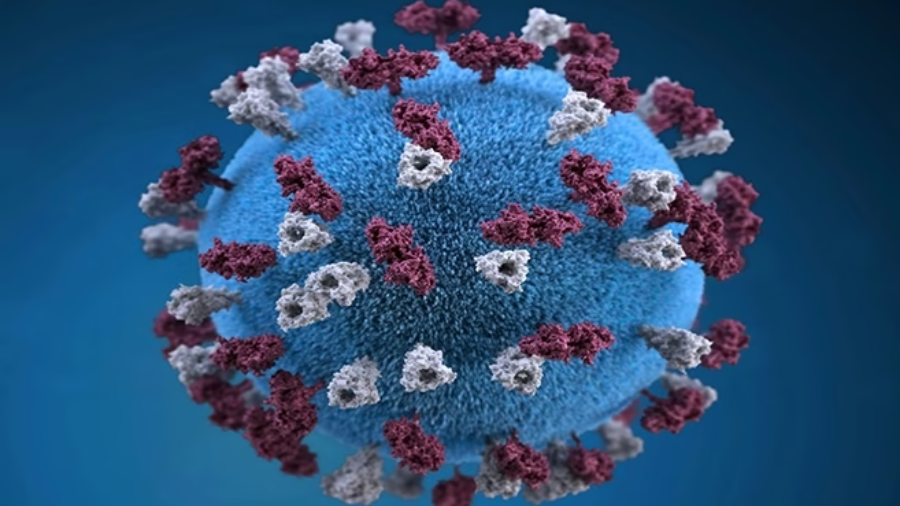
The South Carolina Measles Crisis Explained isn’t a story about bad luck or unavoidable tragedy. It’s a case study in what happens when vaccine hesitancy—fueled by social media misinformation, eroding trust in public health, and increasingly permissive state laws—collides with one of the most contagious viruses known to medicine.
Here’s a number that should make every parent’s blood run cold: 876 confirmed measles cases. That’s how many people in South Carolina have contracted a disease that was supposed to be eliminated from America 26 years ago.
And here’s the statistic that explains everything: 800 of those 876 patients were unvaccinated. That’s 91%.
This is now the largest measles outbreak in the United States in 25 years, surpassing last year’s catastrophic Texas outbreak (762 cases) in just four months. It started with a single case in October 2025. By February 6, 2026, it had infected nearly 900 people, shut down dozens of schools, and put hundreds in quarantine.
And the most infuriating part? Every single one of these cases was preventable.
Welcome to America in 2026, where a disease we conquered a quarter-century ago is roaring back because we’ve forgotten what it’s like to watch children die from infections that vaccines could have stopped.
The Numbers That Tell the Whole Story
Let’s start with the brutal math that explains The South Carolina Measles Crisis Explained:
| Metric | South Carolina | National Context |
|---|---|---|
| Total Cases | 876 (as of Feb 3) | 588 in all of 2026 so far |
| Unvaccinated Patients | 800 (91%) | 93% nationally |
| Concentrated Location | Spartanburg County (95% of cases) | SC = 81% of all US 2026 cases |
| Time to Surpass Texas Record | 16 weeks | Texas took 7 months |
| Kindergarten Vaccination Rate | 92.1% (2023-24) | Down from 95% (2019-20) |
| Spartanburg County Rate | 89% | Below 95% herd immunity threshold |
Here’s what those numbers mean in plain English:
South Carolina accounts for 4 out of every 5 measles cases in America this year. In just the first month of 2026, the U.S. has already seen 588 cases—projecting to over 7,000 by year’s end if the trend continues.
State epidemiologist Dr. Linda Bell put it bluntly: reaching 876 cases in 16 weeks is “very unfortunate” and “disconcerting to consider what our final trajectory will look like.”
Translation: This is nowhere near over.
How We Got Here: The Vaccine Hesitancy Pipeline
The South Carolina Measles Crisis Explained begins with understanding how Spartanburg County went from 95% kindergarten vaccination rates to 89% in just five years.
The Perfect Storm of Distrust
Multiple factors converged to create South Carolina’s vulnerability:
1. COVID-19 Pandemic Fallout
Vaccine hesitancy surged after the COVID-19 pandemic, leaving communities vulnerable to outbreaks of measles and other preventable diseases.
Parents who felt betrayed by changing COVID guidance, mandates, and politicized messaging extended that distrust to all vaccines—including the MMR vaccine that’s been safely used for over 50 years.
2. Social Media Misinformation
Dr. Graham Tse of MemorialCare warned: “With continued vaccine hesitancy, and the number of mistruths on social media and the community, and the confusing and conflicting recommendations coming from the FDA and CDC, there is every reason to suspect that more parents/guardians will decline routine childhood vaccinations.”
Pediatrician Dr. Leigh Bragg described the challenge: “It’s just kind of a feeling that they have or something that they have seen on social media. That has been a challenge as a pediatrician. It’s kind of hard to explain why [vaccines are] important and ease their mind if you don’t really know what their reservations are.”
3. Permissive State Laws
Increasingly relaxed exemption requirements made it easier for parents to opt out of school vaccination requirements, creating concentrated pockets of vulnerability.
4. Federal Mixed Messaging
HHS Secretary Robert F. Kennedy Jr.—who has no medical training—initially encouraged vaccination after Texas deaths, writing: “The most effective way to prevent measles is the MMR vaccine.”
But he later told NewsNation: “The MMR vaccine contains a lot of aborted fetus debris and DNA particles”—a claim that spreads misinformation while holding the nation’s top health position.
Even more damaging: CDC Principal Deputy Director Dr. Ralph Abraham said losing measles elimination status is the “cost of doing business” and emphasized “personal freedom” over vaccination.
When the people running public health agencies downplay vaccines, why would parents trust them?
The Spartanburg Vulnerability
Spartanburg County wasn’t randomly unlucky—it was structurally vulnerable.
The county experienced a measles outbreak about a decade ago, but vaccination rates fell from 95% to 90% over five years.
That 5% drop sounds small. It’s catastrophic.
Measles requires 95% vaccination coverage to maintain herd immunity because it’s extraordinarily contagious. The CDC estimates that if one person has measles, they could infect 9 out of every 10 unvaccinated people around them.
At 89% coverage, Spartanburg County dropped below the protection threshold—creating the perfect environment for explosive spread.
The Outbreak Timeline: How 1 Case Became 876
The South Carolina Measles Crisis Explained timeline reveals how fast measles can move through an undervaccinated community:
September 2025: First cases identified in Upstate region
October 2: South Carolina Department of Public Health declares outbreak
October 14: 16 total cases
November 18: 49 cases
December 2: 76 cases
January 2: 185 cases
On January 9: 310 cases (+125 in one week—68% jump during holidays)
January 23: 700 cases
And on January 27: 789 cases (surpasses Texas as largest outbreak in 25 years)
February 3: 876 cases
The acceleration is terrifying. Dr. Bell noted that Texas took seven months to reach 762 cases. South Carolina hit 876 in just 16 weeks.
Why Measles Is So Dangerous: The Science Nobody Wants to Hear
Here’s what vaccine-hesitant parents need to understand about measles:
It’s One of the Most Contagious Diseases on Earth
Measles is more contagious than Ebola, smallpox, or nearly any other infectious disease.
How it spreads:
- A person is contagious four days before the rash appears
- The virus can linger in the air for up to two hours after an infected person leaves
- You can get measles by walking into a room an infected person left 90 minutes earlier
Recent CDC research detailed how one sick traveler who spent a night in Denver last May infected 15 people across multiple states, with four ending up hospitalized.
The traveler had a fever and cough during an 11-hour layover, stayed at a hotel, got on a plane, and triggered a multi-state outbreak.
One person. Fifteen infections. Just by existing in public spaces.
The Complications Are Severe
The WHO estimates that for every 1,000 reported measles cases, there are 2-3 deaths.
Children are especially vulnerable to:
- High fever (103-105°F)
- Hearing or vision loss
- Encephalitis (brain inflammation)
- Pneumonia
- Death
In 2025, three people died from measles in the U.S.—the first deaths since 2015. Two were children.
The MMR Vaccine Works
The MMR vaccine is 97% effective after two doses.
Of the 876 South Carolina cases:
- 800 were unvaccinated
- 4 were partially vaccinated (one dose only)
- 4 had unknown status
- Only 1 was fully vaccinated
That lone breakthrough case among 876 infections represents the 3% vaccine failure rate—and even then, vaccinated patients who do get measles typically experience milder symptoms.
The vaccine works. Full stop.
The Collateral Damage: What Outbreaks Actually Cost
The South Carolina Measles Crisis Explained isn’t just about sick kids—it’s about systemic disruption affecting entire communities.
Schools in Chaos
About two dozen schools have reported cases or quarantines. As of late January:
- 557 people in quarantine
- 20 people in isolation
- 18 hospitalized
Clemson University and Anderson University have reported cases, disrupting higher education.
Schools with undervaccinated populations face impossible choices: close and disrupt education, or stay open and risk exponential spread.
Cross-State Transmission
The virus doesn’t respect borders:
- North Carolina has confirmed 12 measles cases linked to South Carolina
- Washington state reported 6 cases in unvaccinated children from a family visiting from South Carolina
Economic Devastation
Estimates suggest the average cost for a measles outbreak is $43,000 per case, with costs escalating to well over $1 million for outbreaks of 50+ cases.
At 876 cases, South Carolina’s outbreak could cost $37-40 million—and that’s before calculating:
- Lost productivity from quarantines
- School closures
- Healthcare worker time diverted from other priorities
- Long-term complications requiring ongoing medical care
The Elimination Status We’re About to Lose
The U.S. achieved measles elimination status in 2000 after decades of vaccination efforts. The Pan American Health Organization will evaluate U.S. data in April 2026 to determine if that status continues.
Spoiler: it won’t.
Elimination status requires no continuous domestic spread for 12+ months. With outbreaks spanning from Texas (starting February 2025) through South Carolina (ongoing through at least February 2026), that threshold is shattered.
Epidemiologist Caitlin Rivers of Johns Hopkins said it perfectly: “We maintained elimination for 25 years. And so now, to be facing its loss, it really points to the cycle of panic and neglect, where I think that we have forgotten what it’s like to face widespread measles.”
The Glimmer of Hope: Vaccinations Are Surging
Here’s the one positive development in The South Carolina Measles Crisis Explained:
Vaccinations in Spartanburg County surged 102% over the past four months compared to the same period last year. Statewide, vaccinations jumped 72%.
Dr. Bell reported: “So far, this is the best month for measles vaccination during this outbreak.”
Pediatrician Dr. Stuart Simko described the shift: “We are getting people who weren’t vaccinated calling. I think we’ve reached that level of, ‘Oh wow. This looks like it’s more than just a smolder. This is starting to catch fire.'”
Translation: Nothing convinces people like watching their neighbors get sick.
Parents are:
- Getting early MMR shots for infants (6-11 months instead of waiting until 12 months)
- Moving up second doses (given at age 1-2 instead of waiting until age 4)
- Finally responding to mobile health clinics
But Dr. Bell warned that “a few thousand children and adults remain unvaccinated” in Spartanburg County alone.
The outbreak isn’t over. Not even close.
The Uncomfortable Truths Nobody Wants to Say
Let me be brutally frank about what The South Carolina Measles Crisis Explained actually reveals:
Truth #1: Personal Freedom Ends Where Public Health Begins
CDC’s Dr. Kirk Milhoan, chair of the Advisory Committee on Immunization Practices, said on a podcast: “I also am saddened when people die of alcoholic diseases. Freedom of choice and bad health outcomes.”
He added: “What we are doing is returning individual autonomy to the first order—not public health but individual autonomy.”
This is insane.
Alcohol consumption doesn’t make the person standing next to you at Walmart develop cirrhosis. Measles infection absolutely can—and will—spread to everyone in the room who isn’t immune.
Your “personal freedom” to avoid vaccines directly threatens my infant who’s too young to be vaccinated, the immunocompromised cancer patient in chemotherapy, and the pregnant woman whose fetus could be harmed by infection.
Truth #2: Social Media Is Killing Children
When pediatricians report that parents can’t even articulate why they’re vaccine-hesitant beyond “something they saw on social media,” we have a knowledge crisis.
Algorithms optimized for engagement amplify fear-mongering content over boring scientific facts. A viral TikTok claiming vaccines cause autism gets 10 million views. The peer-reviewed study debunking that claim gets 10,000.
Misinformation spreads faster than measles—and kills just as surely.
Truth #3: We’ve Forgotten What Vaccine-Preventable Diseases Look Like
Dr. Anna-Kathryn Burch, pediatric infectious disease specialist, said her heart breaks watching South Carolina’s outbreak: “I’m from here, born and raised—this is my state. And I think that we are going to see those numbers continue to grow over the next several months.”
The tragedy? An entire generation of parents has never seen a child disabled by measles encephalitis, never watched a baby struggle to breathe with measles pneumonia, never attended the funeral of a classmate who died from a preventable disease.
Vaccines became victims of their own success. They worked so well that people forgot why they existed.
What Parents Need to Do Right Now
If you’re a parent reading this—especially in South Carolina or neighboring states—here’s your action plan:
Immediate Steps:
1. Check your child’s vaccination records TODAY
- First MMR dose should be given at 12-15 months
- Second dose at 4-6 years
- If behind schedule, contact your pediatrician immediately
2. If you live in or near South Carolina:
- Check the DPH public exposure list (updated Feb 4)
- Monitor for symptoms 7-21 days after any potential exposure
- Get vaccinated if unvaccinated—mobile clinics available at no cost
3. Know the symptoms:
- Cough, runny nose, red watery eyes
- Fever (often 103-105°F)
- Tiny white spots inside mouth (Koplik spots)
- Red, blotchy rash spreading from face downward
If you see these symptoms: ISOLATE IMMEDIATELY and call your doctor before going to their office (to avoid exposing others).
Long-Term Actions:
1. Advocate for school vaccination requirements
- Contact school boards and state legislators
- Support evidence-based exemption policies
- Demand transparency on school vaccination rates
2. Combat misinformation
- When you see vaccine misinformation on social media, report it
- Share credible sources (CDC, AAP, WHO)
- Have respectful conversations with hesitant friends
3. Vote accordingly
Research candidates’ positions on public health and vaccination. Leaders who downplay vaccine importance or spread misinformation should face electoral consequences.
The Choice We’re Making for America’s Future
The South Carolina Measles Crisis Explained is ultimately about the kind of country we want to be.
Firstly, Do we want to be a nation where preventable diseases surge because we’ve prioritized “personal freedom” over collective responsibility?
Secondly, Do we want to sacrifice children’s lives on the altar of social media misinformation and political posturing?
And thirdly, Do we want to watch elimination status slip away after 25 years of success because we forgot how devastating these diseases actually are?
As Bloomberg’s Lisa Jarvis wrote: “We’re entering a stage where measles is becoming the status quo, rather than the rare exception; where the stray case can easily turn into a monthslong outbreak.”
That’s the future we’re choosing right now. In real time. With every vaccination we skip and every piece of misinformation we share.
South Carolina’s 876 cases aren’t just statistics. They’re 876 preventable infections. Families disrupted. Schools closed. Children hospitalized. Communities paralyzed by fear.
And it’s going to get worse before it gets better—unless we collectively decide that evidence matters more than Facebook posts, that public health trumps personal convenience, and that protecting vulnerable children is worth overcoming our hesitations.
The vaccine works. The science is clear. The choice is ours.
Take Action Today
Don’t wait for the outbreak to reach your community. Share this article with every parent you know. Knowledge is the only weapon against misinformation.
Check your family’s vaccination records right now. Not tomorrow. Not next week. Today. If anyone is behind schedule, call your pediatrician’s office before they close.
Subscribe for ongoing public health updates as measles continues to spread and elimination status hangs in the balance. Because in 2026 America, staying informed isn’t optional—it’s survival.