the end of American Internationalism

US Hegemony in the Western Hemisphere: Resource Control, Small Nation Sovereignty, Leverage and the Limits of American Power

And it’s the latest chapter in a 200-year story about US hegemony in the Western Hemisphere—a story that forces us to confront uncomfortable questions: Is American dominance in Latin America strategic necessity or imperial bullying? Does the United States “protect” smaller nations, or does it exploit them? And in an era when China offers an alternative model of influence, can Washington’s old playbook even work anymore?

The answers aren’t simple. But they matter profoundly—not just for Venezuelans, Nicaraguans, or Hondurans, but for anyone who cares about sovereignty, international law, and the future of global power.

The “Donroe Doctrine”: When a 200-Year-Old Policy Gets a 2026 Makeover

When President Trump announced the military operation that captured Venezuelan President Nicolás Maduro, he didn’t just claim success—he claimed history. This wasn’t merely regime change, he declared. This was an update to the Monroe Doctrine, now jokingly rebranded the “Donroe Doctrine.”

For those who slept through high school history: The Monroe Doctrine, articulated by President James Monroe in 1823, essentially told European powers to stay out of the Western Hemisphere. In return, America promised not to meddle in European affairs.

It sounded defensive. It was actually the opening move in two centuries of American intervention.

But here’s what makes 2026 different—and more troubling. US hegemony in the Western Hemisphere is no longer just about keeping European powers out. Trump’s 2025 National Security Strategy explicitly states the United States will “deny non-Hemispheric competitors”—read: China—the ability to operate in Latin America, and that American “preeminence in the Western Hemisphere” is a condition of US “security and prosperity.”

Translation: Your hemisphere is our backyard. And we decide what happens here.

From Monroe to Roosevelt to Trump: The Evolution of American Dominance

To understand where we are, we need to understand how we got here. US hegemony in the Western Hemisphere didn’t emerge fully formed. It evolved through distinct phases, each justified by the politics of its era.

1: The Original Monroe Doctrine (1823-1900s)

When Monroe first articulated his doctrine, America lacked the military power to enforce it. It was aspiration dressed as policy. But as America industrialized and built naval might, the doctrine transformed from symbolic statement to actionable strategy.

2: The Roosevelt Corollary—Imperial Policeman (1904-1930s)

Enter Theodore “Teddy” Roosevelt, who in 1904 added his infamous Corollary to the Monroe Doctrine. Roosevelt declared that “chronic wrongdoing” by Latin American nations gave the United States the right to “exercise international police power” in the region.

What did “chronic wrongdoing” mean? Whatever Washington decided it meant.

The result? American troops invaded and occupied:

  • Dominican Republic (1904, 1916-1924)
  • Nicaragua (1911-1933)
  • Haiti (1915-1934)
  • Mexico (1914, 1916)
  • Panama (1903, supporting secession from Colombia to secure canal rights)

The pattern was clear: American banks and corporations made risky investments in unstable countries. When those countries couldn’t pay, American gunboats showed up to “restore order”—and coincidentally protect business interests.

3: The Cold War—Communism as Justification (1950s-1990s)

After World War II, the rationale shifted from protecting economic interests to fighting communism. But the method remained the same: intervention—now often covert.

The CIA’s greatest hits in Latin America include:

  • Guatemala (1954): Overthrowing democratically-elected President Jacobo Árbenz, whose land reform threatened United Fruit Company
  • Cuba (1961): The failed Bay of Pigs invasion
  • Chile (1973): Supporting the military coup that overthrew Salvador Allende and installed Augusto Pinochet
  • Nicaragua (1980s): Funding Contra rebels against the Sandinista government, leading to the Iran-Contra scandal

Each intervention was justified as necessary to prevent Soviet expansion. Each left decades of instability, human rights abuses, and deep anti-American sentiment.

4: Post-Cold War—The Quiet Period? (1990s-2010s)

For a brief moment, it seemed like things might change. Franklin D. Roosevelt’s “Good Neighbor Policy” in the 1930s had promised non-intervention. After the Cold War, some scholars declared the Monroe Doctrine dead.

They were wrong. American interventions continued, just with different justifications:

  • Haiti (1994, 2004): Multiple interventions
  • Colombia (2000s): Billions in military aid through Plan Colombia
  • Honduras (2009): Supporting a coup against President Manuel Zelaya
  • Venezuela (2002): Backing a failed coup against Hugo Chávez

And then came 2026—and the most brazen display of US hegemony in the Western Hemisphere in decades.

Venezuela 2026: What Really Happened and Why It Matters

On January 4, 2026, American forces conducted airstrikes on Caracas and captured President Maduro, bringing him to the United States to face drug trafficking charges. The operation marked the first time since Manuel Noriega in 1989 that America had forcibly removed a Latin American head of state.

Trump’s justification was blunt: “We’ll be selling oil,” he said, “probably in much larger doses because they couldn’t produce very much because their infrastructure was so bad.”

Let’s be clear about what happened here. The United States:

  1. Decided a foreign leader was illegitimate
  2. Launched military strikes without UN authorization
  3. Abducted that leader to face charges in American courts
  4. Announced intentions to “run” the country and extract its oil
  5. Installed an interim leader (Delcy Rodríguez, a Maduro loyalist) rather than the actual democratic opposition

The Strategic Calculus: Why Venezuela, Why Now?

Analysts identify several intersecting motives:

1. Oil and Resources

Venezuela has the world’s largest proven oil reserves—more than Saudi Arabia. While the industry has collapsed under mismanagement, American companies see opportunity. Critical minerals and rare earth elements add to Venezuela’s strategic value.

2. Cutting China Out

China has invested billions in Venezuela and across Latin America. The 2025 National Security Strategy explicitly aims to “deny non-Hemispheric competitors” access to the region. Venezuela’s action sends a message: Play with China, pay the price.

3. Domestic Political Theater

Nothing unites Americans quite like foreign military action. Trump, facing political challenges, gets to look decisive, anti-communist, and tough on drugs—all while accessing resources.

4. Threatening Other Left-Wing Governments

Cuba, Nicaragua, Bolivia, and even moderate left governments in Brazil, Colombia, and Mexico got the message loud and clear. Step out of line, and you could be next.

The Leverage Playbook: How American Hegemony Actually Works

US hegemony in the Western Hemisphere doesn’t only operate through military invasions. That’s just the most dramatic tool. American influence operates through what scholars call “three dependency mechanisms: markets, leverage, and linkage.”

Markets: Economic Integration as Control

Latin American economies are deeply integrated with the United States. The US is:

  • The largest trading partner for most Latin American nations
  • The primary destination for exports
  • The main source of remittances (money sent home by immigrants)
  • The dominant financial market for investment

This creates asymmetric dependence. When the US threatens tariffs—as Trump routinely does—Latin American governments panic. Their economies can’t afford to lose American market access.

Leverage: The Carrot and Stick

The United States wields enormous financial leverage through:

  • Foreign aid that can be suspended at any moment
  • World Bank and IMF loans where America holds veto power
  • Drug Enforcement Administration (DEA) operations that can be used politically
  • Financial sanctions that can cripple economies
  • Visa restrictions that affect elites’ ability to travel and bank internationally

Recent examples of leverage in action:

  • Honduras (2009): US acquiesced to coup after initial criticism
  • Paraguay (2012): US recognized questionable impeachment
  • Brazil (2016): US supported process that removed Dilma Rousseff
  • Bolivia (2019): US quickly recognized interim government after contested election

Linkage: Elite Capture

Perhaps most insidiously, American hegemony operates through elite capture. Latin American political, economic, and military elites are:

  • Educated in American universities
  • Connected to American business interests
  • Invested in American financial markets
  • Reliant on American political support

When these elites govern, they naturally align with American interests—not because of military threats, but because their personal interests are bound up with American power.

The Other Side: Is US Hegemony Sometimes Beneficial?

Before we conclude that US hegemony in the Western Hemisphere is purely exploitative, honesty demands we examine counter-arguments.

1: Stability and Security

Proponents argue that American hegemony prevents great power conflicts in the hemisphere. Without US dominance, might Russia or China establish military bases in Cuba or Venezuela? Would regional conflicts escalate without American mediation?

Colombia’s decades-long conflict, for instance, received billions in American aid that—whatever its problems—did help degrade drug cartels and guerrilla groups.

2: Economic Development

Despite obvious exploitation, American investment has contributed to Latin American development. The Panama Canal, for all its imperial origins, has been an economic boon. Free trade agreements have created jobs and lowered consumer prices.

Panama itself is often cited as a rare successful American intervention—stable democracy, peaceful elections, significant economic growth since Noriega’s removal.

3: Democratic Support (Sometimes)

The United States has, at times, supported democratic transitions and human rights. American pressure helped end military dictatorships in Argentina, Chile, and Brazil in the 1980s. American election monitors and civil society funding have supported democracy.

The problem? American support for democracy is highly selective. When democratic governments threaten American interests—as in Guatemala (1954) or Chile (1973)—democracy suddenly matters less than “stability.”

4: Countering Genuine Threats

Some Latin American governments pose legitimate concerns:

  • Drug trafficking: Cocaine and fentanyl flowing north kill Americans
  • Corruption: Some governments are kleptocracies that torture opponents
  • Humanitarian crises: Venezuela’s collapse created 7+ million refugees
  • Terrorism: Groups like Shining Path genuinely threatened civilians

Is American intervention justified if it addresses real problems? Or does intervention typically make things worse?

The China Challenge: A New Model or New Master?

The elephant—or dragon—in the room is China. Beijing has dramatically increased its presence in Latin America over the past two decades:

China’s Playbook:

  • $140+ billion in loans since 2005, dwarfing World Bank lending
  • Trade partnerships that don’t impose political conditions
  • Infrastructure investment in ports, railways, 5G networks
  • No military interventions or regime change operations
  • No human rights lectures or democracy promotion

For Latin American governments frustrated with American heavy-handedness, China offers an alternative. You can trade with Beijing without fearing a coup.

But is China’s model better? Critics note:

  • Debt traps: Loans that countries struggle to repay
  • Environmental damage: Chinese mining and logging with minimal oversight
  • Labor exploitation: Poor conditions in Chinese-run operations
  • Surveillance technology: Exporting authoritarian tools to willing governments
  • Strategic control: China now owns or operates major ports across the region

The choice facing Latin America isn’t between American hegemony and independence. It’s between American hegemony and Chinese hegemony. Neither is ideal.

Small Nation Sovereignty: The Voices Nobody Hears

Lost in great power competition are the voices of Latin Americans themselves. What do they think about US hegemony in the Western Hemisphere?

The Left-Wing Perspective

Leaders like Brazil’s Lula, Mexico’s Sheinbaum, Colombia’s Petro, and Chile’s Boric condemned the Venezuela intervention as illegal and destabilizing. Their argument:

Even if Maduro is a dictator, military intervention sets an “extremely dangerous precedent.” International law exists for a reason. If the United States can unilaterally invade and remove leaders, what stops any powerful nation from doing the same? This is might-makes-right imperialism, not a rules-based international order.

The Right-Wing Perspective

Conservative governments in Argentina, Chile (under previous administration), Ecuador, and Bolivia initially praised Maduro’s removal—until Trump announced he’d work with Maduro’s vice president rather than the democratic opposition. Suddenly, the intervention looked less like support for democracy and more like resource grab.

The Popular Perspective

Public opinion varies dramatically. Some Venezuelans celebrated Maduro’s capture, seeing him as a brutal dictator who destroyed their country. Others, even those who hate Maduro, resented American military intervention as violation of sovereignty.

A Guatemalan taxi driver might worry about CIA-backed coups returning. A Nicaraguan farmer might appreciate American aid programs. A Colombian business owner might want closer US ties for security and investment. A Bolivian indigenous leader might see American influence as existential threat to traditional ways of life.

There is no monolithic “Latin American view”—which is precisely why treating the entire hemisphere as America’s strategic backyard is so problematic.

The Ultimate Question: Is This System Sustainable?

Here’s the brutal truth: US hegemony in the Western Hemisphere is simultaneously:

  • Historically unprecedented in its reach
  • Economically asymmetric and often exploitative
  • Strategically rational from Washington’s perspective
  • Internationally illegal by UN Charter standards
  • Deeply resented by many Latin Americans
  • Pragmatically accepted by others who see no alternative
  • Under challenge from China’s rising influence
  • Maintained through economic leverage more than military force
  • Based on elite capture as much as coercion

Can it last?

Why It Might Continue

  • Military dominance: No Latin American nation can challenge American military supremacy
  • Economic integration: Decades of trade ties can’t be easily unwound
  • Elite alignment: Powerful Latin Americans benefit from the current system
  • Chinese limitations: Beijing’s model has its own problems and limitations
  • Domestic challenges: Many Latin American nations face internal crises that distract from challenging US power

Why It Might Crumble

  • Legitimacy deficit: Interventions like Venezuela 2026 destroy any pretense of “partnership”
  • Economic alternatives: China offers a different model of engagement
  • Demographic shifts: Younger Latin Americans less sympathetic to US
  • American overreach: Every brazen intervention creates more enemies
  • Multipolar world: US hegemony anywhere requires hegemony everywhere—increasingly difficult

Academic research suggests that hegemons who rely primarily on coercion rather than persuasion and benefits create unstable systems. Trump’s approach—demanding obedience, threatening military force, extracting resources without compensation—represents a shift from traditional hegemony to something closer to naked imperialism.

And history shows us: naked imperialism ultimately fails. It’s too expensive to maintain, generates too much resistance, and becomes unsustainable as rivals emerge.

The Path Forward: Beyond Hegemony?

What would a better relationship between the United States and Latin America look like?

Option 1: Actual Partnership

Instead of US hegemony in the Western Hemisphere, imagine genuine regional cooperation:

  • Mutual respect for sovereignty
  • Economic relationships that benefit both sides
  • Security cooperation against shared threats (drug trafficking, climate change)
  • No military interventions without UN authorization
  • Support for democracy that’s consistent, not selective
  • Development aid without political strings

Sounds utopian? Perhaps. But consider: The European Union evolved from centuries of warfare into genuine partnership. Is a Western Hemisphere Community too much to imagine?

Option 2: Managed Decline

America accepts it can no longer dominate the hemisphere unilaterally. Instead of fighting Chinese influence, Washington competes on better terms—offering better deals, respecting sovereignty more, using force less.

This requires swallowing American pride. Can Washington accept being one power among several in “its” backyard?

Option 3: Doubling Down

This appears to be Trump’s choice: reassert American dominance through force, threaten anyone who challenges US interests, and dare the world to stop us.

The problem? Every doubling-down requires more force, creates more enemies, costs more treasure, and ultimately proves unsustainable. Ask the British Empire how that worked out.

What You Should Take Away From This

If you’ve read this far, you’ve earned some hard truths:

1: US hegemony in the Western Hemisphere is real, extensive, and often destructive to small nation sovereignty.

2: The system serves American interests, which doesn’t automatically make it wrong—but doesn’t make it right either.

3: Latin American nations face a choice between American hegemony and Chinese hegemony, neither of which respects their full sovereignty.

4: Military interventions like Venezuela 2026 represent a dangerous escalation that undermines any pretense of rules-based international order.

5: The system is changing. Whether it evolves toward genuine partnership or descends into naked imperialism depends on choices being made right now.

6: Your opinion on this matters—because democratic societies theoretically control their foreign policy. If Americans demand better, better becomes possible.

Join the Conversation: Where Do You Stand?

This isn’t an easy topic. Reasonable people can disagree about whether American influence in Latin America is primarily beneficial or harmful, whether national security justifies intervention, whether sovereignty should be absolute or conditional.

But we can’t have that conversation if we’re not honest about what’s actually happening.

So here’s the uncomfortable question: When a military superpower tells smaller, poorer nations that “your hemisphere is our backyard” and enforces that claim with bombs and sanctions—is that leadership, or is that bullying?

Your answer reveals what you believe about power, justice, and the world we want to build.

What do you think? Is US hegemony in the Western Hemisphere necessary for stability, or does it perpetuate injustice? Should America maintain dominance, or step back and allow genuine multipolarity?

Share this article with someone who needs to understand the complexity beyond simple “America bad” or “America good” narratives. Subscribe to Ultimate Causes for more honest analysis of global power dynamics. Comment below with your perspective—even if you disagree with everything written here. Especially if you disagree.

Because the only way we move beyond endless cycles of hegemony and resistance is by honestly reckoning with what we’re doing—and deciding whether we want to keep doing it.

References & Further Reading

  1. NBC News: US Allies and Foes Fear Venezuela Precedent
  2. Geopolitical Economy Report: Donroe Doctrine Analysis
  3. SAGE Journals: Hegemony and Dependency in Latin America
  4. Taylor & Francis: Hegemony and Resistance Strategies
  5. Brookings Institution: Making Sense of Venezuela Operation
  6. NPR: US Interventions in Latin America History
  7. National Archives: Monroe Doctrine Original Document
  8. PBS: Monroe Doctrine and Maduro Capture
  9. Chatham House: Trump Corollary Security Strategy
  10. Americas Quarterly: Monroe Doctrine Turns 200
  11. US State Department: Roosevelt Corollary History
  12. SAGE: US Hegemony Perception Study
  13. Wikipedia: Monroe Doctrine
  14. NPR: Venezuela vs Panama Intervention Comparison
  15. PBS: US Capture Divides Latin America

us-surrender-of-ukraine

The New US ‘Peace Plan’ for Ukraine: A Path to Surrender and a Gift to Russian Aggression?

Introduction: A Peace Plan or a Pyrrhic Gift?

When The New US ‘Peace Plan’ for Ukraine was unveiled, it was sold by its proponents as a breakthrough — a realistic way to end a brutal war. But for many observers, the draft reads less like diplomacy and more like capitulation. It demands Ukraine cede critical territory, slash its military forces, and abandon any hope of NATO membership. In short, critics say it’s not a path to peace — it’s a roadmap to surrender.

This proposal, which has reportedly gained backing from Donald Trump, has provoked outrage across Kyiv, Washington, and European capitals. Is it a genuine attempt to broker stability — or a dangerous appeasement that emboldens Russian aggression? And what does it mean for Ukraine’s very sovereignty?

In this post, we’ll unpack what’s in the plan, why it is deeply problematic, who stands to gain, and why many see it as “a gift to the aggressor.”

What’s Inside the So-Called Peace Plan?

Based on multiple media reports, including The Guardian and Al Jazeera, the draft includes a 28-point framework that places unusually heavy demands on Ukraine. (The Guardian) Key points include:

  • Recognition of Russian claims over Crimea, Luhansk, and Donetsk. The plan reportedly asks for de facto recognition of these regions as under Russian control. (The Guardian)
  • Limiting Ukraine’s military: The draft states that Ukraine’s armed forces would be capped at 600,000 personnel — a steep reduction from current levels. (United24 Media)
  • Abandon NATO aspirations: Ukraine is to enshrine in its constitution a ban on joining NATO, and NATO itself would amend its statutes to reflect this. (United24 Media)
  • No foreign troops in Ukraine: The proposal reportedly prohibits NATO or other foreign troops from being stationed in Ukraine, although European fighter jets would be based in Poland as part of “security guarantees.” (United24 Media)
  • Economic reintegration for Russia: The plan envisions phased sanction relief for Russia and reintegration into the global economy, including a possible return to the G8. (The Guardian)
  • Huge reconstruction fund: Around $100 billion of frozen Russian assets would be used for Ukrainian reconstruction — but with a controversial caveat: the U.S. would profit from this fund. (United24 Media)
  • Elections and constitutional changes: The draft allegedly requires Ukraine to hold elections within 100 days and to amend its constitution to reflect the new security arrangement. (Sky News)

Taken together, these elements look less like a negotiated peace and more like a deep strategic concession to Russia — one that weakens Ukraine’s sovereignty and long-term defense posture.

Why Many View It as a Capitulation

1. Territorial Surrender Under the Guise of Diplomacy

By demanding the formal or de facto cession of Crimea, Donbas, and other contested territories, the plan effectively asks Ukraine to normalize Russia’s military gains. For many, this is not compromise but capitulation. As The Guardian reported, the terms repeat Moscow’s maximalist demands, violating Ukrainian red lines. (The Guardian)

Ukraine’s leaders have historically rejected ceding these territories. As noted by AP News, recognizing Russian sovereignty over Crimea would require a constitutional amendment and a national referendum — a politically explosive move. (AP News)

2. A Weakened Military = Weakened Defense

Limiting Ukraine’s army to 600,000 soldiers significantly reduces its capacity to defend its territory, deter future aggression, or maintain internal stability. For a country still under threat, this is more than a concession — it’s a structural handicap.

3. Neutrality: Permanent Isolation from NATO

One of the most controversial parts of the proposal: Ukraine would constitutionally commit to never joining NATO. That weakens its long-term security prospects and prevents future Western alliances from offering robust guarantees against Russian re-aggression. (United24 Media)

4. Legitimizing the Aggressor

By granting Russia economic reintegration and recognizing its territorial gains, the plan could be seen as rewarding Moscow’s violent behavior. Many argue this sets a dangerous precedent for international law: conquer by force and negotiate later.

5. Opaque Guarantees

The security guarantees promised to Ukraine are vague. Reports indicate that while there would be U.S. backing, specifics are light, and the deal carries significant conditions — including a cut of profits from the reconstruction fund. (United24 Media)

Reactions from Kyiv, Europe, and Beyond

Kyiv’s Response: A Mix of Caution and Alarm

Ukrainian President Volodymyr Zelenskyy has expressed a willingness to “work honestly” on the plan, emphasizing the need for “respect for our independence, sovereignty, and dignity.” (Novaya Gazeta Europe) But not all in Ukraine are so diplomatic. Several officials have denounced the plan as “absurd”, equating it with surrender. (The Guardian)

European Leaders Push Back

European allies are deeply skeptical. Analysts and politicians from NATO countries have warned that concessions to Russia undermine the core logic of European security. As The Guardian notes, accepting this proposal could effectively hand Russia a permanent strategic advantage. (The Guardian) Germany’s defense minister has publicly rejected what he calls “weakness through peace,” arguing that capitulation risks long-term instability. (The Guardian)

Russian Influence in the Draft

Alarmingly, some reports suggest that the plan was not just U.S.-led — it may have been co-drafted with Russian officials. The Guardian names Kirill Dmitriev, a close Putin ally, as being centrally involved in the negotiations alongside U.S. envoy Steve Witkoff. (The Guardian) If true, it undermines claims that this is a balanced proposal — instead, it suggests it may more closely reflect Moscow’s agenda than Kyiv’s.

The Strategic Risk: Why This Is Dangerous for Ukraine — and Europe

A Precedent for Aggressors

If the world accepts this proposal, it sends a message:
Military aggression can pay. Stare down your adversary, grab what you want, and then negotiate.

That emboldens not just Russia — but other autocratic regimes watching.

Long-Term Military Weakening

Capping Ukraine’s army permanently weakens its deterrence against future Russian encroachment. A future conflict could become more likely, not less.

Fragile Guarantees

Ambiguous security guarantees haven’t protected Ukraine so far. Without strong, binding commitments, there’s no guarantee that future leaders — on any side — will uphold the deal.

Erosion of International Norms

Normalizing Russia’s territorial gains undermines decades of post-Cold War consensus about sovereignty, borders, and the rule of law.

European Security at Risk

With Ukraine weakened, Russia’s posture toward Europe becomes more aggressive. A weaker Ukraine could invite further destabilization on NATO’s eastern flank — not peace.

Why Is the U.S. Supporting This, If at All?

Understanding why such a controversial plan is being floated requires peeling back political, ideological, and geopolitical layers:

  1. Domestic Calculations
    For Donald Trump, the peace plan is deeply tied to his “deal-maker” identity. Offering a “deal” with Russia plays to his base and reinforces his geopolitical brand.
  2. War Fatigue
    In the U.S. and Europe, public appetite for continued involvement in Ukraine is waning. A “peace” deal with concessions may seem politically palatable — even if dangerous.
  3. Backchannel Diplomacy
    The plan seems to have been developed through informal channels (e.g., Trump envoy Steve Witkoff, Kirill Dmitriev), not through traditional diplomatic forums. This raises concerns about transparency, accountability, and whose interests are really being served. (The Guardian)
  4. Global Strategy
    Reintegrating Russia economically could appeal to U.S. economic interests, while avoiding long-term military commitments — a trade-off that some policymakers may view as pragmatic rather than principled.

Is There Any Path Forward That Avoids Surrender?

Critics argue that real peace must include:

  • No irreversible territorial concessions
  • Strong, enforceable, legal security guarantees
  • Constitutional clarity in Ukraine (with full sovereignty preserved)
  • A genuine NATO pathway or equivalent alliance guarantees
  • Transparent international reconstruction funding
  • Respect for Ukrainian national identity, including language and institutions

Without these, a “peace” deal risks being heartbreakingly hollow — more a tactical retreat than a lasting resolution.

A Personal Reflection: Why This Matters to Me

Watching this proposal unfold has been deeply unsettling. As someone who cares deeply about democratic values, global stability, and the right of oppressed nations to defend themselves, the contours of this plan feel like a betrayal.

I’ve talked with people in Ukraine — citizens, analysts, veterans — and they express a sense of déjà vu. Surrender dressed as peace, deals made in back rooms, terms that diminish national dignity. They’re haunted by history: once you concede land, once you cap your military, once you promise neutrality — the cost is not just strategic, it’s existential.

This isn’t just a geopolitical move: it’s a test of moral courage, of our collective will to defend freedom, and of whether the world supports sovereignty or sacrifice.

Key Takeaways

Here’s what should be front of mind for anyone following this proposal:

  • It’s not purely a peace plan; it mirrors Russia’s war goals.
  • Military limitations weaken Ukraine’s ability to defend itself long-term.
  • Neutrality and NATO exclusion undermine Europe’s collective security.
  • Economic reintegration of Russia could reward aggression.
  • The security guarantees are vague and potentially hollow.
  • This could set a dangerous international precedent.

Conclusion: A Peace Plan That Risks More Than It Promises

At first glance, The New US ‘Peace Plan’ for Ukraine may appear as a generous olive branch. But if you peel back the veneer, you find terms that align far more closely with Russian strategic objectives than Ukrainian sovereignty. Recognizing occupied territories, shrinking military capacity, limiting alliance membership — these are not compromises born of compromise, but terms drafted under pressure.

If this plan moves forward as is, it may mark a pivotal moment: not just for Ukraine, but for the future of international order. It could embolden aggressors, signal a weakening of NATO, and celebrate peace on terms that undermine justice.

In this moment, the world must ask: is this a path to peace, or a prescription for capitulation?

Call to Action

What do you think?

  • Is this “peace plan” a genuine diplomatic breakthrough — or a dangerous concession?
  • Can Ukraine afford to accept these terms?
  • Should the international community support or reject a deal shaped so heavily by the aggressor?

Let me know your thoughts in the comments — and please share this post if you believe the gravity of these proposals needs to be widely understood. Subscribe for more in-depth political analysis and breaking commentary about Ukraine, geopolitics, and global security.

Sources & References

  • The Guardian: analysis of U.S.-Russian drafted peace plan (The Guardian)
  • Al Jazeera: review of Ukraine ceding land and weapons (Al Jazeera)
  • Novaya Gazeta Europe: Zelenskyy’s response (Novaya Gazeta Europe)
  • Sky News: text of the 28-point draft plan (Sky News)
  • Time Magazine: Trump’s public statements on Crimea & NATO (TIME)
  • Al Jazeera: why Russia rejected earlier Trump proposals (Al Jazeera)
  • Le Monde: report on U.S. ultimatum to Ukraine (Le Monde.fr)
the Russian war in Ukraine

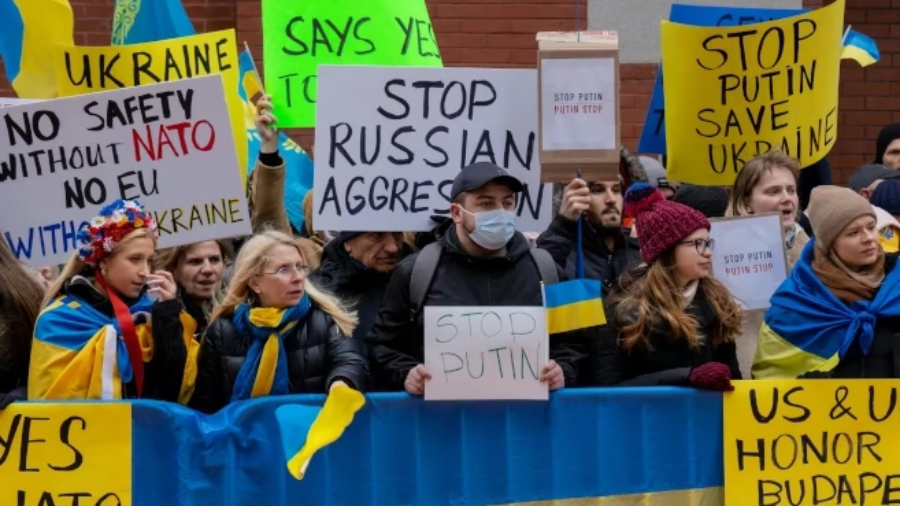
Talking Tough but Doing Nothing: The Inability of the US and Allies to Take Real Defense Action Against The Russian Aggression in Ukraine

When you hear Western leaders condemn the Russian aggression in Ukraine, their words are loud, urgent, and full of moral clarity. But while the rhetoric echoes across capitals and global media, the actions often fall short — or at least not decisively enough to match the scale of the threat. In short: they’re talking tough, but doing relatively little.

This gap between words and deeds is not just frustrating for Kyiv — it’s deeply perilous. Because every moment of hesitation, every limited escalation, every red line unpulled, risks emboldening Moscow’s ambitions.

In this blog post, we’ll explore why the U.S. and its allies, despite their power and influence, have struggled to take real defensive action against Russia. We’ll examine political constraints, military risks, strategic dilemmas, and the deeper paradox of deterrence in an era of nuclear-armed great powers.

The Current Reality: What “Doing Nothing” Really Means

To be clear: Western countries are doing a lot of things. There is massive financial aid, weapons shipments, intelligence-sharing, and tough economic sanctions. But when it comes to direct military intervention or meaningful escalation, there’s a striking reluctance to cross certain thresholds.

Key examples of this tepid response:

  • No no-fly zone. Despite repeated calls from Ukraine, NATO has refused to enforce a no-fly zone, fearing direct conflict with Russian aircraft. (Wikipedia)
  • Sanctions only — not boots. The European Union recently renewed its economic restrictive measures against Russia, but these remain financial and diplomatic, not a step toward putting Western troops into the fight. (Consilium)
  • Limited escalation. While countries supply Ukraine with increasingly capable weapons, they are cautious about giving long-range strike capabilities or creating the kind of escalation that could provoke a direct NATO–Russia confrontation. (Mirage News)
  • Risk of nuclear escalation. Experts warn that more aggressive actions risk triggering horizontal escalation or even a nuclear standoff. (Bulletin of the Atomic Scientists)
  • Fragile support. According to recent scenario analyses, Ukraine’s survival depends on ongoing Western aid — but that support is fragmented, condition-based, and could become unstable. (ACAPS)

So while the West is supporting Ukraine, it’s doing so in a way that appears cautious, constrained, and calculated — not bold.

Why the Reluctance? Understanding the Strategic Dilemmas

1. Fear of Escalation and the Nuclear Risk

One of the most significant barriers to decisive action is the risk of escalation. Putin doesn’t just lead a conventional military — he oversees a nuclear superpower. Western leaders know that pushing too hard could trigger catastrophic consequences.

  • The fog of war increases the danger. Analysts argue that miscalculations could lead to horizontal escalation (spreading conflict to other countries) or worse. (Bulletin of the Atomic Scientists)
  • NATO, by design, is a defensive alliance, not an offensive one. Direct intervention could be framed by Russia as an existential threat, potentially justifying a more aggressive response.
  • Some Western commentary suggests an overcautious approach may actually embolden Russia rather than restrain it. Politically safe moves often seem strategically weak. (The Guardian)

2. Domestic Political Constraints

Domestic politics matter. Western governments face significant constraints:

  • Public fatigue: Voters may support sanctions and aid, but are much more hesitant about seeing Western soldiers at war in Ukraine.
  • Partisan divides: In the U.S., for example, support for Ukraine is not uniformly bipartisan. (Wikipedia)
  • Economic risks: Escalating the conflict could further destabilize energy markets, disrupt supply chains, and hit European economies hard. (Mirage News)

These constraints mean that leaders must carefully weigh what their domestic audiences will tolerate — not just what is strategically ideal.

3. Strategic Ambiguity as Policy

Western leaders often rely on strategic ambiguity: providing Ukraine with enough help to resist, but stopping short of full-scale intervention. This ambiguity serves multiple purposes:

  • It signals resolve without committing to all-out war.
  • It gives NATO plausible deniability if things go wrong.
  • It preserves the option to escalate later — but only if necessary.

However, this ambiguity comes at a cost. It may allow Russia to interpret “restraint” as weakness, giving it room to maneuver and test the limits of Western will.

The Moral and Political Costs: Why “Tough Talk” Isn’t Enough

There is a real human cost to this cautious strategy. Every day the war drags on, civilians suffer. Infrastructure is destroyed. Ukrainian lives are put at risk not just by aggression, but by the limits of foreign support.

From a moral standpoint, one could argue that the West’s inaction undermines its own values. If defending democracy and sovereignty is truly a priority, why not take bolder action?

Politically, the cost is also high:

  • Credibility is at stake. Repeated strong statements against Russian aggression lose power when not backed by meaningful action.
  • Global norms are being tested. If the world’s most powerful militaries refuse to act decisively against a blatant act of aggression, what does that imply for future conflicts?
  • Long-term deterrence is weakened. If Russia sees that aggressive moves generate only sanctions, not intervention, it may be emboldened in the future.

The Alternatives: What Could Real Action Look Like?

Let’s explore what more robust action might involve — and why Western leaders have hesitated to take it.

  1. Enforcing a No-Fly Zone
    It’s been one of Ukraine’s most persistent asks. A no-fly zone enforced by NATO could significantly reduce Russian air superiority. But it would require Western aircraft to risk being shot down, potentially escalating into a broader war. (Wikipedia)
  2. Providing Long-Range Strike Capabilities
    Equipping Ukraine with longer-range weapons (e.g., missiles) would let them strike deeper into occupied or Russian territory. But that raises red lines: are Western countries ready for a war that could draw them directly into Russia?
  3. Deploying Troops
    Direct deployment of Western troops to fight in Ukraine would be a seismic decision — likely only if a NATO member is attacked. So far, there’s no indication that NATO wants to go that route.
  4. Stronger Multinational Forces
    Some European leaders have floated creating a “reassurance force” — a multinational force to guard Ukraine or other vulnerable regions — though it hinges on U.S. backing. (Le Monde.fr)
  5. Tightening Sanctions and Cutting Energy Ties
    More aggressive economic measures could further isolate Russia, although there’s a trade-off: energy supply, inflation, and economic blowback.

Why These Alternatives Remain Elusive

Putting these alternatives into action runs into structural and political barriers:

  • NATO’s fundamental design: It’s defensive, not offensive. Engaging Russia inside Ukraine could be seen as offensive.
  • Nuclear deterrence: Escalation risk is not theoretical — it’s real and existential.
  • Alliance politics: NATO is not a monolith; different states have different risk tolerances, histories, and political pressures.
  • Resource constraints: While the U.S. is a major supporter of Ukraine, not all allies have the capacity or political will to follow its lead.
  • Public opinion volatility: Even generous public support can reverse if costs (financial, human, or geopolitical) surge.

A Personal Reflection: Why the Gap Frustrates Me

As a global citizen and an observer of geopolitics, watching this gap between words and deeds feels deeply unsettling. It’s not just about Ukraine — it’s about what the West says it stands for, and what it actually does. The war in Ukraine is a test not only of military power, but of moral clarity and political courage.

I often think of the Ukrainian people, whose resolve is fierce and whose suffering is profound. They deserve more than just powerful statements. They deserve a coalition that matches its rhetoric with commensurate risk.

Key Insights: The True Cost of Inaction

  • Deterrence without risk isn’t deterrence: Real deterrence demands willingness to act, not just punish.
  • Moral leadership may require moral risk: Standing up to aggression sometimes means accepting escalation risk.
  • Strategic ambiguity is a double-edged sword: It gives flexibility — but may erode credibility.
  • Alliance politics shape real-world power: NATO’s structure, public opinion, and diversity of interests constrain bold action.
  • Long-term future hinges on precedent: If the West doesn’t act decisively now, future aggressors will take note.

Conclusion: The Illusion of Power

The United States and its allies appear strong when they speak, but their restraint reveals a more fragile posture. The Russian aggression in Ukraine is a test — a test not just of military mettle, but of how serious the West really is when it claims to defend democracy, sovereignty, and the rules-based order.

If the West is serious, words must evolve into risky deeds. Strategy must become courage. And alliances must commit not just to supporting Ukraine — but to standing up in a way that deters the next act of aggression. Because deterrence built on caution is fragile; and in the face of bold aggression, it may simply crack.


Call to Action

  • What do you think — should the U.S. and NATO take more aggressive action to defend Ukraine?
  • Share your views in the comments below — and if you found this post insightful, subscribe for more geopolitical analysis and deep dives into global power dynamics.
  • For further reading: check out reliable reporting from NATO, EU, and policy think tanks on Western strategy toward Russia.

References

  • Andriy Zagorodnyuk, The Guardian: On how Western caution risks emboldening Putin. (The Guardian)
  • NATO Review: Consequences of Russia’s invasion for international security. (NATO)
  • EU Council press release: Extension of sanctions on Russia. (Consilium)
  • EU timeline of response to Russian military aggression. (Consilium)
  • Scenario analysis from Supply Chain Business Council / RAND: Long-range weapons risk. (The International Trade Council)
  • Bulletin of the Atomic Scientists: Nuclear escalation & fog of war. (Bulletin of the Atomic Scientists)
  • ACAPS Ukraine scenarios report: Fragility of Western support. (ACAPS)