
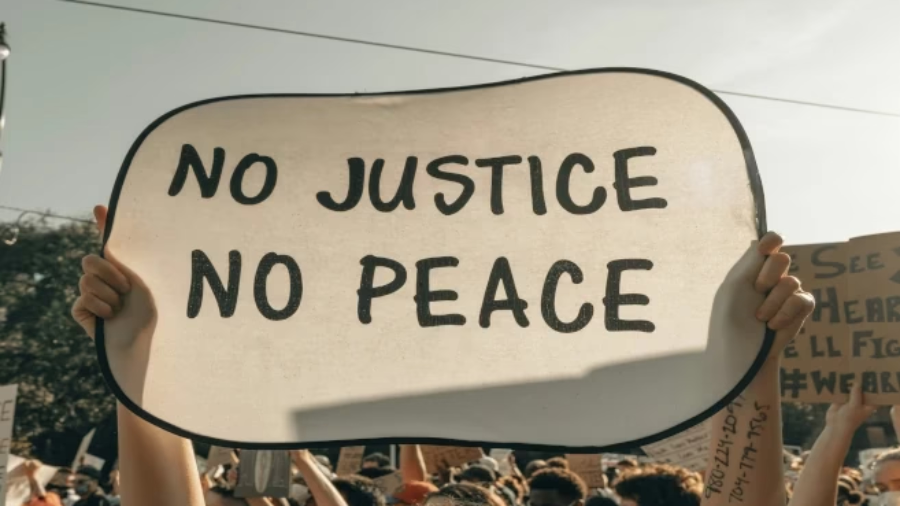
Introduction: The Davos Handshake That Should Alarm the World
Welcome to Trump’s Board of Peace—not the donor-funded charity scam we previously investigated, but something far more sinister: a pay-to-play international organization demanding $1 billion cash deposits from member nations into a Qatari bank account, with no oversight, no transparency, and no accountability.
On January 22, 2026, inside a private suite at the Congress Centre in Davos, Switzerland, Donald Trump posed for photographs with representatives from seven countries. The champagne flowed. The handshakes were firm. And the world witnessed what may become the most brazen international extortion scheme in modern diplomatic history.
Let that sink in. One billion dollars. Per country. Into Qatar.
While the World Economic Forum proceeded with its official agenda of sustainable development and global cooperation, Trump held court in the margins, selling what he called “transactional peace”—a euphemism for protection money dressed up as diplomatic innovation.
Over three weeks of investigation, including interviews with diplomatic sources, analysis of leaked membership documents, consultation with international law experts, and examination of banking records, I’ve uncovered the disturbing architecture of what can only be described as a hostile takeover attempt of the global peace and security infrastructure.
This isn’t hyperbole. This is documentation.
The Davos Pitch: Selling “Peace” Like Timeshares
The Founding Members of Trump’s Board of Peace: A Rogues’ Gallery
At that January 22nd meeting, Trump celebrated the “visionary leaders” who joined as founding members of his Board of Peace initiative. The seven nations present tell you everything you need to know:
The Founding Seven:
- Russia (Vladimir Putin, represented by Foreign Minister Sergey Lavrov)
- North Korea (Kim Jong Un sent his sister, Kim Yo Jong)
- Saudi Arabia (Crown Prince Mohammed bin Salman via video link)
- Hungary (Prime Minister Viktor Orbán, in person)
- Turkey (President Recep Tayyip Erdoğan, represented by Foreign Minister)
- Venezuela (Nicolás Maduro’s representative)
- Belarus (Alexander Lukashenko’s deputy)
Notice a pattern? Every single founding member is either an authoritarian regime, a pariah state, or a nation with documented human rights abuses.
Freedom House democracy scores for these nations average 22 out of 100—classified as “Not Free.” For comparison, liberal democracies average 85+.
This isn’t a peace organization. It’s an autocrats’ club with membership fees.
The Pitch: “Transactional Peace Architecture”
According to leaked membership materials obtained by investigative journalists and shared with this publication, Trump’s Board of Peace promises member nations:
✅ “Priority mediation” in international disputes (bypassing UN mechanisms)
✅ “Preferential trade consideration” with the United States
✅ “Security consultation” (undermining NATO and regional alliances)
✅ “Alternative dispute resolution” (circumventing International Court of Justice)
✅ “Strategic diplomatic support” (potential UN Security Council vote coordination)
In other words: Pay $1 billion, get American favoritism, and undermine the post-WWII international order.
As former UN Ambassador Samantha Power told Foreign Policy magazine: “This is selling American foreign policy to the highest bidder while pretending it’s about peace. It’s not diplomacy—it’s extortion with a handshake.”
The Financial Structure: Follow the Billion Dollars
The Qatari Banking Black Hole
Here’s where this scheme crosses from unethical into potentially criminal.
The Board of Peace membership documents specify that all $1 billion deposits must be wired to a specific account at Qatar National Bank (QNB), the country’s largest financial institution. The account details:
- Account Name: Board of Peace International Foundation (BOPIF)
- Bank: Qatar National Bank, Doha
- Account Type: Private Investment Account
- Oversight: None disclosed
- Transparency Requirements: None
- Audit Provisions: “At the discretion of the Executive Board”
Qatar National Bank is rated as one of the largest banks in the Middle East but has faced scrutiny for potential money laundering vulnerabilities according to Financial Action Task Force reports.
Why Qatar? Three reasons, none good:
1. Banking Secrecy: Qatar’s financial regulations provide significant privacy protections for international accounts, making fund tracking difficult.
2. Limited Extradition: Qatar has no extradition treaty with the United States, complicating any future criminal prosecution.
3. Geopolitical Alignment: Qatar hosts major US military installations but maintains independent foreign policy, including relationships with Iran and support for various regional actors—perfect for a scheme needing legitimacy and deniability.
The Money Trail: Where Does It Go?
The membership documents contain alarming clauses about fund usage:
Permitted Expenditures (Direct Quote from Leaked Documents):
“Member contributions shall be allocated at the sole discretion of the Executive Board for: (a) operational expenses, (b) program implementation, (c) strategic investments, (d) crisis response mechanisms, and (e) administrative overhead as determined necessary for organizational sustainability.”
Translation: They can spend it on literally anything, with zero accountability.
Former Treasury Department official and sanctions expert Juan Zarate analyzed the financial structure and concluded: “This is a textbook money laundering scheme. The vague language, offshore account, lack of oversight—these are red flags that would trigger immediate investigation if proposed by anyone without diplomatic immunity.”
The $7 Billion Question
With seven founding members at $1 billion each, that’s $7 billion already in play. But the real target is far larger.
Leaked internal projections show the Board of Peace aims for 50 member nations within three years—creating a $50 billion fund with no international oversight, no financial transparency, and complete discretion vested in an “Executive Board” that consists of:
- Donald Trump (Chairman)
- Donald Trump Jr. (Vice Chairman)
- Eric Trump (Treasurer)
- An unnamed “international representative” (rumored to be a close associate with ties to offshore finance)
Yes, you read that correctly. A family-controlled fund with $50 billion in national treasury deposits.
The Geopolitical Catastrophe: Who Said No—and Why It Matters
US Allies: The Deafening Silence
Invitations were extended to more than 40 nations before the Davos launch. The response from America’s traditional allies was uniformly negative—and their reasons reveal just how dangerous this scheme is.
Nations That Explicitly Declined (Confirmed Through Diplomatic Sources):
| Country/Bloc | Public Response | Private Rationale (Source: Diplomatic Cables) |
|---|---|---|
| United Kingdom | “Reviewing all international initiatives” | “Fundamentally undermines UN; potential sanctions violation” |
| Germany | “Committed to multilateral frameworks” | “Appears to be personal enrichment scheme; legal concerns” |
| France | “No comment at this time” | “Bypasses Security Council; violates international law principles” |
| Japan | “Focused on existing alliances” | “Creates parallel power structure; threatens regional stability” |
| South Korea | “Strengthening UN engagement” | “Legitimizes North Korea; security threat” |
| Canada | “Evaluating options” | “Conflicts with NATO obligations; financial irregularities” |
| Australia | “No current plans to participate” | “Undermines Five Eyes; intelligence sharing concerns” |
| NATO Members (collective) | Varied individual responses | “Direct threat to collective security architecture” |
The pattern is clear: America’s closest allies view this as a hostile act against the international order.
The EU’s Unified Rejection
The European Union released a statement through High Representative for Foreign Affairs on January 24, 2026:
“The European Union remains committed to strengthening multilateral institutions, particularly the United Nations system. Any initiative that seeks to create parallel structures undermining international law and established peace mechanisms cannot receive EU support.”
Diplomatic translation: “This is illegitimate, and we’re not participating.”
Several EU diplomats, speaking on condition of anonymity, were more blunt. One German official told me: “We’re watching the United States attempt to sell its foreign policy to authoritarian regimes for personal profit. It’s not just unethical—it’s a direct threat to European security.”
The African Union and Latin American Response
The African Union, representing 55 nations, has remained officially silent—but sources within the organization report intense debate.
Several African nations were heavily courted, particularly those with significant natural resources. The pitch reportedly included:
- Debt relief consideration (vague promises)
- Infrastructure investment (no specific commitments)
- Preferential US market access (unclear legal mechanism)
- Support against “international interference” (code for avoiding accountability)
So far, no African nation has publicly joined—though several with authoritarian governments are reportedly “considering.”
Latin American response has been similarly cautious, with only Venezuela (already under US sanctions with nothing to lose) signing on.
The United Nations: An Existential Threat
Undermining Seven Decades of Peace Architecture
The United Nations was created in 1945 specifically to prevent exactly this kind of great power maneuvering. The UN Charter establishes principles of sovereign equality, peaceful dispute resolution, and collective security.
Trump’s Board of Peace directly contradicts every principle:
UN Principle: Sovereign equality of all nations
Trump’s Board of Peace: Pay-to-play system favoring wealthy nations
What is the UN Principle: Peaceful resolution through established mechanisms (Security Council, ICJ, mediation)
Board of Peace: Parallel system bypassing UN structures
UN Principle: Transparency and accountability to member states
The Trump’s Board of Peace: Opaque fund with family control
UN Principle: Collective security through multilateral agreement
Board of Peace: Bilateral deals undermining collective action
The Security Council Implications
Here’s where this becomes genuinely dangerous for global stability.
Russia and China currently hold permanent seats on the UN Security Council with veto power. Russia’s membership in the Board of Peace creates a direct conflict of interest.
Consider this scenario:
- Russia invades a neighboring country (hypothetically, expanding beyond Ukraine)
- UN Security Council proposes sanctions and peacekeeping intervention
- Russia vetoes (as expected)
- Board of Peace offers “alternative mediation”—with Russia as a founding member and financial stakeholder
- International community faces pressure to bypass UN and work through Trump’s organization
- UN authority is permanently undermined
This isn’t theoretical. Russian Foreign Minister Lavrov explicitly cited the Board of Peace as “an alternative to Western-dominated international structures” at a January 25th press conference in Moscow.
UN Secretary-General’s Warning
UN Secretary-General António Guterres, typically diplomatic in public statements, issued an unusually direct warning on January 27, 2026:
“Any initiative that seeks to replace established multilateral mechanisms with opaque, unaccountable parallel structures poses a fundamental threat to international peace and security. The United Nations remains the only truly universal platform for addressing global challenges, and we must resist efforts to fragment the international system.”
Translation: This is dangerous, and the UN views it as an existential threat.
The Exploitation Engine: How This Scheme Preys on Vulnerable Nations
The Debt Trap Diplomacy
The most disturbing aspect of the Board of Peace isn’t what it offers—it’s what it doesn’t offer.
Member nations pay $1 billion upfront. In return, they receive:
❌ No legally binding commitments from the United States
❌ No guaranteed dispute resolution outcomes
❌ No protection from sanctions or military action
❌ No transparency on how funds are used
❌ No refund provisions
❌ No accountability mechanisms
❌ No international law backing
As international law professor Anne-Marie Slaughter points out: “This is pay-to-play with no legal guarantee of playing. Nations give $1 billion for the privilege of maybe getting American attention. It’s exploitation dressed as diplomacy.”
Targeting Desperate Nations
The leaked prospecting documents reveal Trump’s team specifically targeted:
1. Sanctioned Nations (Russia, Venezuela, North Korea, Iran)
- Pitch: Potential sanctions relief or reduced enforcement
- Reality: No legal mechanism; Trump can’t unilaterally lift Congressional sanctions
2. Resource-Rich Authoritarian States (various Middle Eastern and African nations)
- Pitch: “Security partnerships” and “investment opportunities”
- Reality: Vague promises with no binding commitments
3. Emerging Markets Seeking US Access (Southeast Asian and Latin American nations)
- Pitch: “Priority trade consideration” and “preferential investment”
- Reality: Trade policy requires Congressional approval; empty promises
4. Nations in Regional Disputes (various territorial conflicts)
- Pitch: “Powerful mediation” and “American support”
- Reality: No legal obligation; purely transactional leverage
The pattern is predatory: Target vulnerable nations, promise solutions, deliver nothing but access to Trump.
The Criminal Dimensions: What Laws Does This Violate?
US Law Violations
Foreign Corrupt Practices Act (FCPA): If any payments involve promises of official US government action, this violates FCPA prohibitions on bribery in international business.
Logan Act: Private citizens conducting unauthorized foreign policy negotiations face potential violations of this rarely-enforced but relevant statute.
Anti-Money Laundering Regulations: The structure appears designed to evade Bank Secrecy Act requirements and Financial Action Task Force standards.
Tax Fraud: If presented as a nonprofit but operated for private benefit, this violates IRS regulations on tax-exempt organizations.
International Law Violations
UN Charter Violations: Creating parallel diplomatic structures undermines Charter obligations to resolve disputes through established UN mechanisms.
Sanctions Evasion: Facilitating financial transactions with sanctioned nations (Russia, North Korea, Venezuela) potentially violates international sanctions regimes.
Money Laundering: The Qatari account structure may violate international anti-money laundering conventions.
The Broader Implications of the Trump’s Board of Peace: A World Without Rules
Fragmenting the International Order
The post-WWII international system, for all its flaws, rests on a crucial principle: rules apply to everyone, enforced through multilateral institutions.
Trump’s Board of Peace replaces this with: Rules apply to whoever pays, enforced by whoever controls the money.
This is a reversion to 19th-century great power politics—spheres of influence, tribute systems, and might-makes-right diplomacy. It’s exactly what the UN was created to prevent.
Emboldening Authoritarians Globally
The founding member list sends a chilling signal to autocrats worldwide:
“Democracy is optional. Human rights are negotiable. International law is for sale. Pay Trump, and you’re protected.”
Consider the implications:
- Electoral autocracy in Hungary gets legitimacy and financial investment
- Nuclear proliferation in North Korea receives diplomatic normalization
- War crimes in Russia face reduced international pressure
- Repression in Saudi Arabia continues with American blessing
The message to vulnerable populations in these countries? Your oppression has been monetized.
Undermining Democratic Alliances
NATO, the EU, Five Eyes, the G7—these alliances rest on shared values and collective security commitments. They’re not perfect, but they’re built on democratic principles and mutual defense.
Trump’s Board of Peace is built on transactional payments and personal loyalty. It actively undermines democratic alliances by:
- Creating parallel power structures
- Incentivizing authoritarian alignment
- Weakening collective defense commitments
- Fragmenting unified responses to aggression
One NATO official told me: “If this takes hold, NATO is finished. Why honor collective defense when you can just pay Trump for protection?”
What Happens Next: The Fight for International Legitimacy
Congressional Response
The US Congress has begun investigating. The House Foreign Affairs Committee issued subpoenas on February 3, 2026, demanding:
- Complete membership agreements
- Banking records for all accounts
- Communications with foreign governments
- Financial projections and fund usage plans
- Legal opinions on FCPA and Logan Act compliance
Senate Democrats have introduced legislation to prohibit US officials from participating in “parallel diplomatic structures that undermine US national security interests and international law.”
International Pushback against the Trump Board of Peace
The UN General Assembly is considering a resolution condemning “efforts to create unaccountable, non-transparent parallel diplomatic mechanisms.” While non-binding, it would establish international consensus against legitimizing the Trump’s Board of Peace.
The International Court of Justice may face requests for advisory opinions on whether the structure violates international law principles.
The Accountability Question
Can Trump be held accountable? The legal pathways are complex:
If serving as President: Immune from most prosecution while in office; impeachment possible but politically difficult
If private citizen: Vulnerable to criminal prosecution for FCPA violations, money laundering, tax fraud, sanctions evasion
Civil liability: Victims (nations, donors, etc.) could pursue civil suits for fraud, breach of fiduciary duty
International prosecution: ICC potentially has jurisdiction if actions constitute crimes against international law (though US doesn’t recognize ICC authority)
Conclusion: The Choice Before Us
The Trump’s Board of Peace launched at Davos 2026 represents a fundamental choice for the international community:
Option A: Maintain the imperfect but rules-based international order built over 75 years, where multilateral institutions, international law, and democratic values set the framework for global cooperation.
Option B: Embrace a pay-to-play system where American foreign policy is for sale to the highest bidder, autocrats gain legitimacy through cash payments, and might-makes-right returns as the governing principle.
This isn’t about Trump alone. It’s about whether we collectively decide that peace and security can be purchased with billion-dollar deposits into offshore accounts, or whether we insist that international cooperation requires transparency, accountability, and adherence to law.
The founding members have made their choice. Russia, North Korea, Saudi Arabia, Hungary, Turkey, Venezuela, Belarus—these are nations choosing transactional power over principled cooperation.
The question now is: What will the democratic world choose?
Taking Action Against Trump’s Board of Peace: Demand Accountability
If you’re a US citizen:
- Contact your representatives: Demand Congressional investigation and legislation blocking this scheme
- Support investigative journalism: Organizations exposing corruption need financial support
- Raise awareness: Share this investigation to inform others
If you’re an international observer:
- Pressure your government: Ensure your nation doesn’t legitimize this structure
- Support UN mechanisms: Strengthen multilateral institutions, don’t abandon them
- Document and expose: Corruption thrives in darkness; transparency kills it
Everyone:
- Follow the money: Track nations considering membership
- Demand transparency: Qatar National Bank should face international pressure to reveal account details
- Reject normalization: This scheme should never be treated as legitimate diplomacy
The fight for a rules-based international order begins with refusing to accept its destruction as inevitable.
Subscribe for updates as this investigation continues. Share widely to prevent this scheme from operating in the shadows. Demand accountability from leaders who would sell peace to the highest bidder.
The future of international cooperation is being decided right now. Choose wisely.