
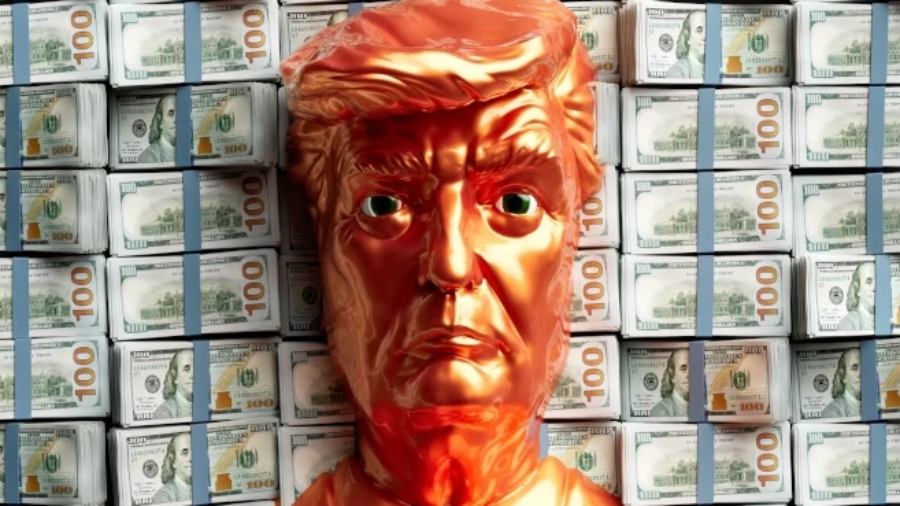
Trump Tariffs and Turbulence

Trump, Tariffs, and Turbulence: The Unconventional Strategy That Redefined Political Playbooks

Introduction: A Presidency Built on Trade Shockwaves

Few aspects of Donald Trump’s presidency stirred as much controversy, confusion, and global attention as his aggressive use of tariffs. From steel and aluminum to Chinese imports, Trump wielded trade policy as if it were a universal tool—a blunt instrument meant to achieve multiple political objectives at once.

This strategy, emblematic of Trump, Tariffs, and Turbulence, redefined conventional political playbooks. By fusing economic nationalism with political messaging, tariffs became more than a trade mechanism—they became a symbol of disruption, loyalty, and power projection.

Understanding this legacy is critical, not just for analyzing the Trump era, but for appreciating the profound impact it had on global commerce, domestic politics, and the perception of America on the world stage.

The Philosophy Behind Trump’s Tariff Strategy

Tariffs as a Political Hammer

Unlike traditional trade tools aimed at addressing specific economic imbalances, Trump treated tariffs as a multi-purpose strategy:

  • Political Signaling: Showcasing toughness on foreign powers, particularly China, to appeal to nationalist sentiments
  • Economic Leverage: Pressuring trade partners into renegotiating agreements (e.g., USMCA)
  • Domestic Messaging: Positioning himself as the defender of American workers against “unfair” global competition

This approach transformed a conventional economic tool into a political weapon, merging economic theory with populist messaging. (source)

Disruptive Politics as a Core Tactic

Trump’s reliance on tariffs illustrates his broader political philosophy: disruption is power. By creating unpredictability in trade policy, he sought to:

  • Keep political and economic adversaries off balance
  • Dominate media narratives through controversy
  • Consolidate domestic support among industrial workers affected by globalization

The result was a political climate defined as much by shock and spectacle as by policy outcomes.

Key Tariff Battles and Their Impact

Steel and Aluminum Tariffs

In 2018, Trump imposed a 25% tariff on steel and 10% on aluminum imports from major allies, including Canada, the EU, and Mexico. (source)

  • Goal: Protect domestic industries from “unfair competition”
  • Impact:
    • Short-term gains for U.S. steel producers
    • Strained trade relations with allies
    • Retaliatory tariffs on American goods

While politically popular in certain U.S. states, these tariffs sparked global concern and demonstrated the collateral effects of unilateral trade actions.

The China Trade War

Trump’s tariffs on Chinese imports were the most consequential:

  • Scope: $360 billion in tariffs on Chinese goods
  • Objective: Force China to change trade practices, including intellectual property theft and forced technology transfers
  • Outcome:
    • Temporary trade deals and partial concessions
    • Increased costs for American businesses and consumers
    • Global supply chain disruptions

The China tariffs epitomized the turbulence of Trump’s economic strategy, blending geopolitics with domestic politics. (source)

Tariffs as Campaign Tools

Tariffs also functioned as messaging devices in election cycles:

  • Highlighted Trump’s “America First” ideology
  • Reinforced his image as a disruptor fighting unfair trade practices
  • Served as a tangible action to appease industrial and working-class voters

This dual role of tariffs—policy and political performance—reinforced Trump’s unorthodox approach.

Economic Consequences of Trump’s Tariff Strategy

Winners and Losers

Tariffs produced uneven outcomes:

  • Winners: Domestic steel producers, some agricultural sectors during temporary government support
  • Losers: Automakers, manufacturers reliant on global supply chains, and consumers facing higher prices

The strategy revealed the limits of using trade policy as a catch-all political tool.

Global Supply Chain Disruptions

Trump’s tariffs caused significant global disruptions:

  • Shifts in manufacturing hubs to avoid tariffs
  • Increased costs for multinational corporations
  • Uncertainty in markets, affecting investment and growth

This turbulence illustrated the interconnectedness of modern economies and the risks of unilateral action.

Table: Selected Tariff Impacts Under Trump

Tariff TargetObjectiveEconomic OutcomePolitical Outcome
Steel & AluminumProtect domestic producersHigher domestic prices, global tensionPopular in Rust Belt states
Chinese GoodsForce trade concessionsSupply chain disruption, higher costsReinforced nationalist messaging
Solar Panels & Washing MachinesProtect U.S. manufacturersIncreased consumer prices, limited job growthShort-term political wins
EU ImportsRetaliation for subsidiesDiplomatic tension, threat of trade warMedia attention, tough-guy image

Tariffs and the Media Spectacle

Trump’s approach to trade policy was inseparable from his mastery of media:

  • Frequent tweets amplified trade disputes
  • Controversy generated coverage that shaped public perception
  • Tariffs became a tool of narrative control, not just economics

In this sense, Trump, Tariffs, and Turbulence exemplify a strategy where policy is performance.

Critics and Supporters Weigh In

Criticism

  • Economists argue tariffs increase costs for consumers and reduce competitiveness
  • Trade partners saw tariffs as protectionist and destabilizing
  • Global markets experienced uncertainty, affecting investment

Support

  • Populist voters viewed tariffs as defending American jobs
  • Industrial states benefiting from higher prices and restricted competition rewarded Trump politically
  • Symbolically, tariffs reinforced the “America First” narrative

This contrast underscores the tension between short-term political gains and long-term economic costs.

Tariffs as a Political Playbook Re-definer

Trump’s approach changed how political actors view trade:

  1. Blurring Policy and Politics: Economic tools became messaging devices.
  2. Disruption as Strategy: Predictable trade diplomacy was replaced by unpredictability.
  3. Populism Meets Economics: Policies were tailored to appeal to emotion and identity, not just markets.

This redefinition of political playbooks will influence how future politicians engage with trade, media, and domestic constituencies.

Lessons for Future Governance

The Limits of Tariffs

  • Tariffs cannot replace comprehensive trade policy
  • Unilateral action risks global retaliation
  • Short-term political messaging may come at long-term economic costs

Strategic Communication

  • Policy effectiveness is intertwined with perception management
  • Media narratives can amplify or distort policy outcomes

Balancing Politics and Economics

  • Leaders must weigh domestic political benefits against global economic realities
  • Disruption can mobilize support but may destabilize markets and alliances

Conclusion: Trump, Tariffs, and Turbulence

Trump’s tariff strategy represents a unique blend of economics, politics, and spectacle. Trump, Tariffs, and Turbulence not only disrupted global trade but reshaped domestic political strategy, showing how a single policy tool can be leveraged as a multi-purpose weapon—economic, political, and psychological.

The era serves as a cautionary tale for policymakers: disruption may yield short-term victories, but it comes with long-term consequences for economies, alliances, and governance norms. Future leaders must balance bold action with careful strategy, or risk repeating the turbulence of the Trump years.

Call to Action

  • Stay informed: Monitor trade policies and their impacts
  • Engage civically: Understand how economic decisions affect daily life
  • Share insights: Discuss this post with peers to explore the implications of unconventional political strategies

References & Further Reading

  1. Council on Foreign Relations, Trump Tariffs and the US-China Trade War. (cfr.org)
  2. BBC News, Trump Steel and Aluminum Tariffs. (bbc.com)
  3. Peterson Institute for International Economics, Trade War Analysis. (piie.com)
  4. CNBC, Tariffs and Economic Impact on U.S. Consumers. (cnbc.com)
  5. Forbes, How Trump’s Tariffs Reshaped Political Strategy. (forbes.com)

tariffs as a flawed political strategy

Why Tariffs Don’t Work: Exposing the Flawed Political Strategy Behind Trump’s Trade Wars

Introduction: When One Tool Becomes the Whole Toolbox

When Donald Trump launched his aggressive trade war, he framed tariffs as a masterstroke — a simple, bold, America-first solution to complex global problems. But as history, economics, and lived experience now make painfully clear, tariffs as a flawed political strategy became less a tool of negotiation and more a political crutch, wielded impulsively to project strength while masking deeper policy failures.

The Trump administration used tariffs to solve everything:
• Trade deficits
• Foreign policy disputes
• Immigration issues
• Political leverage
• Diplomatic conflicts
• Even domestic campaign messaging

The problem? Tariffs don’t work that way.
They are blunt, outdated instruments — poorly suited to the modern, integrated global economy. And yet, under Trump, tariffs were elevated from occasional remedies to the centerpiece of national strategy.

This blog post digs beneath the surface narrative:
Why did Trump rely so heavily on tariffs? Why did the strategy fail? And what does the fallout reveal about leadership, governance, and the dangers of political shortcuts?

Welcome to a deep dive into the turbulence behind the trade wars.

Tariffs as a Political Weapon — Not an Economic Strategy

Tariffs have existed for centuries, but their traditional purpose has been limited:

  • Protect young industries
  • Respond to unfair foreign practices
  • Generate government revenue
  • Balance trade deficits in isolated cases

Trump, however, transformed tariffs into a universal political weapon, applying them to scenarios that had nothing to do with trade.

Tariffs Used for Immigration Pressure

In 2019, Trump threatened tariffs on Mexico unless it stopped migrants at the U.S.–Mexico border.
This was unprecedented. Immigration enforcement and trade policy are distinct domains — but the administration blurred them for political effect.

Tariffs Used to Strong-Arm China

The U.S.–China trade war escalated into hundreds of billions in tariffs, yet:
• Manufacturing jobs did not return in meaningful numbers
• U.S. farmers were devastated, requiring up to $28 billion in bailout subsidies
• China found alternative suppliers
• U.S. consumers faced higher prices

Tariffs Used as Campaign Theater

Rallies often included dramatic declarations:
“We’re winning the trade war!”
“China is paying billions!”

This was politically effective rhetoric — but economically false.
U.S. importers (and ultimately American consumers) bore the cost.

Trump’s tariffs weren’t just economic tools — they were performance politics.

How Tariffs Backfired — A Strategy Built on Misunderstanding

The Biggest Myth — “China Pays”

Every credible economic study shows the same result:
American consumers and companies paid nearly 100% of tariff costs.

Businesses absorbed higher costs or passed them to consumers through:
• Higher retail prices
• Reduced product choices
• Slower wage growth
• Lower investment spending

The strategy’s cornerstone claim was simply untrue.

Global Supply Chains Don’t Bend Easily

Trump appeared to believe that U.S. companies could swiftly abandon China and “come home.”

But modern supply chains are:

  • Multi-layered
  • Regionally specialized
  • Capital-intensive
  • Built over decades

Shifting production is not a switch — it is a multi-year transformation costing billions.

This is why many firms paid tariffs rather than move operations.
Apple didn’t move iPhone production.
Major auto companies didn’t return factories to Ohio or Michigan.
Manufacturing reshoring remained modest.

Tariffs could not reshape the global economy — only disrupt it.

Farmers Became Collateral Damage

No group suffered more from Trump’s trade war than American farmers.

China retaliated immediately, cutting U.S. agricultural imports drastically.

The consequences:

  • Soybean exports plummeted
  • Farm bankruptcies spiked
  • Rural communities faced financial trauma
  • Taxpayer bailouts ballooned to historic levels

Many farmers supported Trump politically — but economically, they were left exposed.

The Economic Impact — Data Tells a Clear Story

Below is a simplified comparison showing the intended vs. actual outcomes of the tariff strategy.

Table: Trump’s Tariff Goals vs. Reality

GoalIntended OutcomeWhat Actually Happened
Reduce trade deficitDramatic decreaseTrade deficit reached all-time highs
Bring jobs backManufacturing boomJobs had a brief uptick, followed by slowdown and decline
Make China “pay”China absorbs tariff costsAmericans paid 90–100% of costs
Boost U.S. farmingStrong export marketFarm bankruptcies increased; subsidies required
Strengthen U.S. leverageChina capitulatesChina retaliated and diversified suppliers
Stabilize marketsPredictability and confidenceMarket volatility surged

Why Tariffs Appealed to Trump — The Psychological and Political Angle

Tariffs were not just a tool — they were a symbol.
Here’s why they fit Trump’s worldview so perfectly:

1. Tariffs Are Simple

Trade policy is complex.
Tariffs reduce everything to a single, dramatic action — ideal for political storytelling.

2. Tariffs Sound “Tough”

Trump favored optics of confrontation.
Tariffs project dominance, even when they weaken your own economy.

3. Tariffs Create Villains

China. Mexico. Europe.
Tariffs allowed Trump to frame himself as a warrior on behalf of “forgotten Americans.”

4. Tariffs Distract From Domestic Failures

Rather than address structural issues — automation, education, infrastructure, innovation — tariffs provided a quick villain and a quick applause line.

5. Tariffs Fit the “Transactional” Mindset

Trump prefers zero-sum thinking:
“If I win, you lose.”
Tariffs reinforce this worldview, even when the economics contradict it.

Global Backlash — How Allies and Competitors Responded

Trump’s tariff obsession did not just reshape domestic politics; it rattled alliances and empowered adversaries.

Europe Hit Back

The EU targeted politically sensitive products, including:
• Bourbon (Kentucky)
• Motorcycles (Wisconsin)
• Orange juice (Florida)

These were not random — they were aimed at Republican strongholds.

China Played the Long Game

China waited out Trump, doubled down on global partnerships, and invested heavily in:

  • Belt and Road Initiative
  • Semiconductor independence
  • Trade relationships with Asia, Africa, and Latin America

Trump’s tariffs accelerated China’s diversification — a long-term strategic win for Beijing.

Allies Questioned U.S. Leadership

Tariffs were placed even on allies like Canada and the EU, justified under “national security.”

This damaged trust and pushed some countries toward alternative trade blocs.

Lessons Learned — Why Tariffs Are a Political Dead End

The Trump era confirmed a truth economists already knew:
Tariffs are outdated tools in a hyper-connected world.

Tariffs fail because:

  • They hurt your citizens more than your rivals
  • They destabilize markets
  • They inflame political tensions
  • They don’t create long-term manufacturing jobs
  • They don’t reshape global supply chains
  • They invite retaliation
  • They can trigger domestic inflation

Tariffs succeed only when:

  • They are targeted
  • They are temporary
  • They address a specific unfair practice
  • They are part of a broader strategy

Trump’s tariffs met none of these conditions.

What a Real Economic Strategy Could Have Looked Like

Instead of tariffs, a smarter strategy would include:

• Investing in high-tech manufacturing

Semiconductors, EVs, medical equipment.

• Strengthening alliances

A unified front against China is far more effective.

• Workforce development

Skilled workers are the real backbone of competitive manufacturing.

• Modernizing infrastructure

Ports, broadband, energy grids.

• Incentivizing innovation at home

R&D, startups, entrepreneurship ecosystems.

Tariffs were easy politics — but the wrong tool for the real problems.

Conclusion: The Danger of Over-Simplified Political Weapons

Trump’s trade wars exposed something deeper than economic miscalculation.
They revealed the inherent weakness in leadership that relies on performative strength instead of strategic thinking.

Using tariffs as a flawed political strategy became a symbol of the broader governance style:

  • impulsive
  • confrontational
  • simplistic
  • disconnected from expert advice
  • driven by optics over outcomes

America paid the price — higher costs, broken alliances, economic turbulence, and a weakened global position.

In the end, tariffs did not fix America’s problems.
They exposed them.

Call to Action (CTA)

If you found this breakdown insightful, share your thoughts below. How do you think America should approach global trade in the years ahead?
👉 Share this post, leave a comment, and explore more of our deep-dive analyses on politics, economics, and governance.