
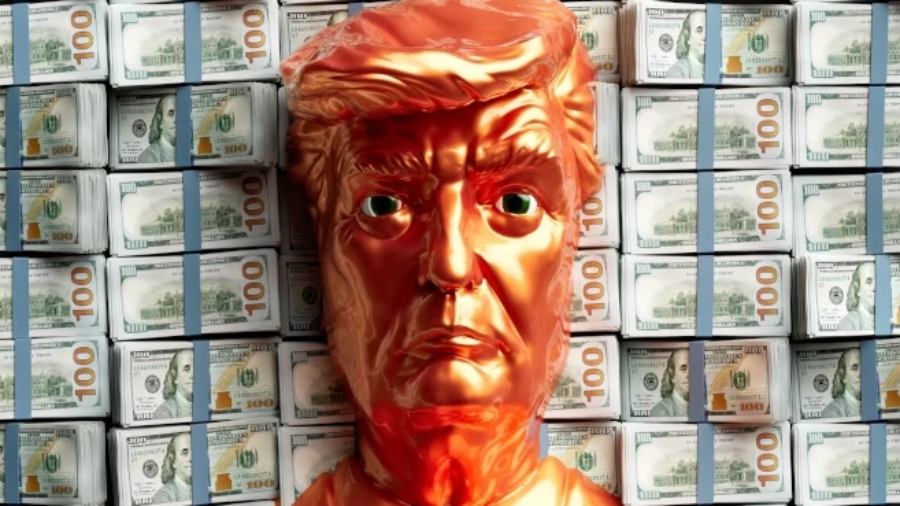
Introduction: A Second Coming or a Second Carve-Up?
When political power becomes a personal revenue stream, democracy begins to rot from the inside. Few political figures illustrate this danger quite like Donald Trump. As his influence surges again in what many call “Trump 2.0,” one pattern has become brutally clear: the sharp rise in his net worth mirrors a troubling cocktail of grifting, self-enrichment, and abuse of power.
And while presidential legacies are usually measured in policies, institutions, and societal shifts, Trump’s may increasingly be measured in profit margins, licensing deals, and asset valuations.
The question isn’t merely whether Trump is benefitting financially from political influence—it’s whether this benefit is intentional, orchestrated, and strategically engineered as part of a broader grift.
Let’s dive deep.
How Trump’s Net Worth Surged in “Trump 2.0”
If Trump’s first presidency was about rewriting traditional norms, his second wave of influence has been about monetizing them.
Following years of declining business prospects, collapsing brand value, bankrupt golf courses, and mounting legal pressure, Trump’s net worth suddenly ballooned again—precisely in the period where his political relevance resurged.
The correlation is hard to miss.
The causation is even harder to ignore.
Political Relevance → Financial Gain: A Trump Signature Move
During “Trump 1.0,” his businesses benefited from:
- Foreign governments booking expensive hotel stays
- Political donors using Trump properties for events
- Taxpayer-funded Secret Service payments for staying at Trump hotels and golf resorts
- Massive fundraising hauls with limited transparency over how the money was used
- Licensing and branding deals tied to the prestige of the presidency
With “Trump 2.0,” the formula has not only returned—it has evolved.
Grifting in Plain Sight: The New Revenue Streams of Trump 2.0
Trump’s latest wealth boom comes from a blend of amplified political leverage and strategic branding. Below are the clearest examples.
1. Political Fundraising as a Personal Piggy Bank
Political campaigns typically use funds for political activities.
Trump uses them like a multi-million-dollar slush fund.
Multiple investigations into past fundraising have shown:
- Donations being used to pay Trump’s legal fees
- Payments to Trump-owned businesses
- Huge administrative “fees” routed through shell entities aligned with Trumpworld
Fundraising has become a business model in itself.
2. Media and Influence Deals
With his political celebrity supercharged, Trump’s presence drives:
- Social media platform valuations
- Book deals
- Speaking fees
- Media licensing agreements
- Fundraising through Trump-affiliated PACs
“Trump 2.0” has almost made political influence more profitable than real estate ever was for him.
3. The Return of the Trump Brand
Many of Trump’s businesses were fading before his presidency.
But political power revived them.
Golf courses regained value.
Hotels drew new bookings.
Partners returned.
In “Trump 2.0,” businesses aren’t recovering organically—they’re recovering because Trump’s political base treats patronage as a form of activism.
4. A New Era of Foreign Money?
Foreign states historically seek influence through:
- Hotel bookings
- Real estate purchases
- Business deals
- High-end memberships
Given Trump’s past relationship with Gulf monarchies, foreign lobbyists, and international business elites, “Trump 2.0” presents even more opportunities.
When political power is for sale, global buyers always appear.
Comparing Trump 1.0 and Trump 2.0
Below is a simple comparison showing how Trump’s financial ecosystem has evolved:
| Category | Trump 1.0 (2016–2021) | Trump 2.0 (2025–present) |
|---|---|---|
| Revenue Source | Hotels, golf courses, foreign bookings, campaign funds | Social media platforms, PACs, media deals, revived brand, foreign interest |
| Primary Strategy | Monetize presidency | Monetize political relevance & influence |
| Transparency | Low | Even lower |
| Legal Risk | High | Higher, but shielded by political base |
| Public Scrutiny | Intense | Fragmented and partisan |
| Financial Outcome | Stabilized struggling assets | Significant net worth increase |
The Symptoms of Grifting, Self-Enrichment, and Abuse of Power
Trump’s pattern mirrors classic political grifting structures seen globally:
leaders who treat political influence as a business opportunity rather than a public service.
Here are the clearest indicators.
Using Public Office as a Private ATM
Whether intentionally or not, Trump has converted political power into personal wealth with:
- Taxpayer-funded expenditures funnelled into his businesses
- Inflated event prices at Trump properties
- PACs purchasing Trump-branded merchandise
- Loyalists channeling donor money back into Trump family operations
It’s not subtle anymore—it’s structural.
The Cult of Personality as a Business Strategy
Trump isn’t just a political leader; he’s a brand.
His followers don’t buy products—they buy identity, belonging, and symbolic membership.
This creates:
- Bulletproof demand
- Guaranteed revenue streams
- Political loyalty that transforms into financial loyalty
This isn’t politics.
It’s cult-driven consumer capitalism.
Influence Peddling and Pay-to-Play Behavior
The more influence Trump regains, the more valuable his favor becomes.
- Politicians seek his endorsement
- Corporations seek his goodwill
- Foreign governments seek access
- Lobbyists seek his blessing
In many cases, the cost of such blessings often finds its way into Trump’s financial universe—directly or indirectly.
Why This Matters: The Threat to Democratic Integrity
Trump’s wealth surge is not just a personal financial story.
It’s a democratic warning sign.
When leaders profit personally from political influence, they create:
- Distorted incentives
- Decisions driven by personal gain
- Policy corruption
- Declining trust in institutions
- Dangerous expectations for future leaders
- A normalization of political grifting
Democracies don’t die overnight.
They decay when people stop noticing corruption because it has become ordinary.
Fresh Perspective — My Personal Reflection
I’ve spent years observing political systems around the world.
From Africa’s post-colonial kleptocracies to Eastern Europe’s oligarchic power structures, one theme is constant:
When leaders profit from power, citizens pay the cost.
Watching Trump’s second-era financial boom unfold feels eerily familiar.
It mirrors systems where power is not exercised—it is monetized.
Trump didn’t invent political grifting.
But he reinvented how openly it can be done in a developed democracy.
Conclusion — The Future of “Trump 2.0” and the Price We Pay
The rise of Trump’s net worth during “Trump 2.0” isn’t an accident.
It’s the product of a carefully engineered ecosystem where political relevance equals financial reward.
This is the hallmark of leaders who see public service not as a duty, but as an opportunity for Grifting, Self-Enrichment, and Abuse of Power.
The danger isn’t only in what Trump gains.
It’s in what America stands to lose:
- Public trust
- Institutional integrity
- Democratic norms
- The line between politics and profiteering
If democracy becomes a marketplace, autocracy becomes the inevitable buyer.
Call to Action
If this piece resonated with you, share it widely.
Challenge misinformation.
Bookmark this page and explore related articles on political accountability, democratic erosion, and corruption in modern governance.
Your engagement helps keep the conversation alive—and helps defend the very institutions under threat.
References (You may replace links with your own)
- New York Times investigation into Trump finances
- ProPublica reporting on Trump businesses
- CNN investigative reports on PAC spending
- Government Accountability Office findings
- House Oversight Committee publications
- Ethics watchdog reports (CREW, Citizens for Responsibility and Ethics in Washington)
- Forbes annual review of Trump’s net worth