
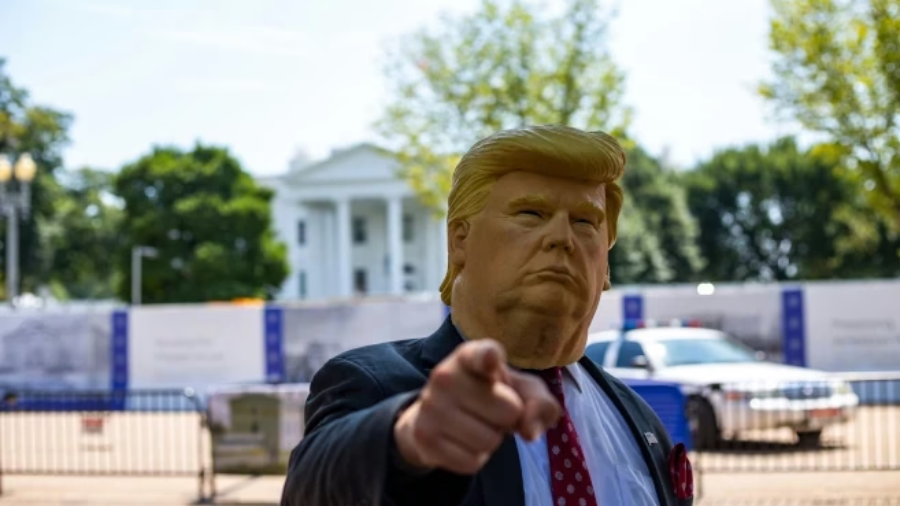
threats against Trump critics

The Trump Administration’s Disruptive Politics—Incompetence, Buffoonery, Reckless Strategy, or Deliberate Malice?

Introduction: Why the Turbulence Still Matters

Few chapters in modern American political history have generated as much debate, devotion, and distress as the Trump administration’s disruptive politics. For some, Donald Trump represented a long-overdue revolt against political elitism. For others, he embodied a dangerous departure from democratic norms, institutional stability, and responsible leadership.

But beyond the noise—beyond the tweets, scandals, and headlines—a deeper, more urgent question remains:

Was the chaos accidental, or was it the whole point?

Did the Trump administration’s disruptive politics stem from genuine incompetence and buffoonery?
Was it driven by the reckless improvisation of a leader out of his depth?
Or was it something far more intentional—a strategy of deliberate political malice designed to destabilize, divide, and dominate?

This post takes a critical, research-backed tour through these competing explanations, comparing evidence, examining patterns, and offering a clear, engaging analysis of the years that reshaped American democracy.

Understanding the Architecture of Disruption

Although Trump’s governing style seemed chaotic on the surface, scholars, journalists, and political psychologists have identified recurring themes that help decode the underlying drivers of his administration’s behavior.

Below are four major interpretations often used to explain his governance:

  1. Gross incompetence – a leader unprepared for governance
  2. Buffoonery – impulsive, unserious, performative politics
  3. Reckless strategy – disruption as a political weapon
  4. Deliberate malice – intentional degradation of norms and institutions

Each theory holds truth. But each also fails to fully explain the complete picture.

Was It Incompetence? Examining the Evidence

One of the most common critiques of Trump’s presidency is rooted in institutional incompetence. From rapid staff turnover to poorly briefed policy launches, the administration often looked like a revolving door of chaos.

Record-Setting Staff Turnover

According to multiple analyses from think tanks and political researchers, the Trump White House recorded the highest staff turnover rate of any modern presidency. Senior officials left in waves—some fired unexpectedly, others departing amid scandal or exhaustion.

Frequent turnover meant:

  • No consistent policy direction
  • Internal power struggles
  • Poor communication between agencies
  • Lawsuits, blocked executive orders, and policy reversals

Governments require continuity. Trump’s environment fostered none.

Policy Making Without Processes

Many major policies were unveiled without:

  • Interagency review
  • Legal vetting
  • Legislative consultation
  • Implementation planning

Some famously chaotic examples include:

  • The first travel ban, blocked almost immediately in court
  • Sudden troop withdrawal announcements via Twitter
  • Conflicts between the president and his own cabinet
  • Government shutdowns over easily negotiable issues

These failures weren’t just political missteps—they were structural signs of an administration struggling to function normally.

Lack of Expertise

Trump frequently appointed individuals with little or no experience in the roles they held. Several appointees openly opposed the very agencies they led.

This produced:

  • Contradictory mandates
  • Confusion within departments
  • Difficulty coordinating national responses

Whether one views Trump as a disruptive reformer or an accidental arsonist, the evidence of incompetence is difficult to ignore.

Buffoonery or Performative Politics? The Role of Impulse and Spectacle

Another interpretation frames Trump not as malicious, but as profoundly unserious—a showman who treated governance as performance.

The Politics of Outrage

Trump mastered the art of constant spectacle. Outrage drives attention. Attention drives power.

His communication style relied heavily on:

  • Provocative insults
  • Conspiracy-tinged rhetoric
  • Episodic policy pronouncements
  • Frequent exaggerations or misstatements
  • Late-night tweetstorms that could shift global markets

Political psychologists describe this as “performative dominance”—acting unpredictably to project strength and destabilize opponents. But its downside is obvious:

Chaos becomes the default operating mode.

Reality-TV Governance

Trump’s background in entertainment shaped his sense of leadership:

  • Every conflict was a “season”
  • Every scandal an “episode”
  • Every firing a “plot twist”
  • Every rally a “live performance”

This performative posture may explain why so many decisions seemed spontaneous, improvised, or even whimsical.

But was it just buffoonery—or part of something more strategic?

Reckless Strategy—Chaos as a Political Weapon

Some analysts argue that Trump deliberately used chaos to consolidate power. Not through detailed plans, but through instinctive, opportunistic strategies.

The “Shock-and-Disorient” Method

By overwhelming the media and public with:

  • Constant controversies
  • Rapid-fire policy changes
  • Personal attacks on opponents
  • Insults directed at institutions

Trump made it nearly impossible for critics to focus on any single issue for long. This created an environment where serious concerns—ethics violations, conflicts of interest, foreign entanglements—were drowned out by daily scandals.

Normalizing the Abnormal

When chaos becomes constant, people stop reacting.

This allowed Trump to:

  • Undermine institutions without immediate backlash
  • Replace experienced public servants with loyalists
  • Redraw political red lines
  • Discredit the electoral system
  • Attack civil servants, journalists, and even the judiciary

Whether intentional or instinctual, the effect was the same: the Overton Window shifted dramatically.

Division as a Governing Tool

Under this interpretation, the Trump administration’s disruptive politics wasn’t a bug—it was a feature.

Division ensured:

  • Increased base loyalty
  • Heightened culture wars
  • Distrust in shared facts
  • Fragmented opposition

Reckless strategy, in this sense, became a tool for political survival.

Or Was It Deliberate Political Malice?

The most serious interpretation suggests not incompetence, nor buffoonery, nor even reckless strategy—but deliberate, calculated malice toward democratic institutions.

Attacks on Democratic Norms

Trump repeatedly challenged foundational norms:

  • Refusing to commit to peaceful power transitions
  • Declaring elections “rigged” without evidence
  • Pressuring officials to “find votes”
  • Encouraging challenges to certified results
  • Attempting to overturn democratic outcomes

Democratic norms depend on leaders respecting rules even when inconvenient. Trump frequently did the opposite.

Autocratic Admiration

Trump consistently expressed admiration for strongman leaders:

  • Vladimir Putin
  • Kim Jong-un
  • Xi Jinping
  • Rodrigo Duterte

These relationships often raised concerns about his comfort with authoritarianism and his willingness to emulate its strategies—targeting the press, undermining institutions, and attacking independent bodies.

Weaponization of Government

Evidence of punitive political targeting included:

  • Efforts to pressure the Justice Department
  • Attempts to jail political rivals
  • Loyalty tests for federal employees
  • Attacks on whistleblowers
  • Expulsion of Inspectors General

Viewed through this lens, chaos served a deeper objective: weakening guardrails that limit executive power.

A Comparative Summary — Which Explanation Dominates?

Below is a simple breakdown to illustrate how each interpretation fits different patterns of behavior:

ExplanationSupporting EvidenceLimitations
IncompetenceStaff turnover, poor planning, failed policiesCannot explain consistent patterns of authoritarian behavior
BuffooneryPerformative politics, impulsivity, exaggerationsUnderestimates systematic institutional attacks
Reckless StrategyChaos to overwhelm critics, division as toolMay exaggerate Trump’s strategic foresight
Deliberate MaliceAttacks on norms, autocratic admiration, loyalty testsSome chaotic actions may still be incompetence, not strategy

Conclusion of the comparison:
The most accurate understanding is likely a hybrid model. Trump’s governance combined incompetence, buffoonery, reckless strategy, and intentional malice—each reinforcing and amplifying the others.

Key Insights — What This Means for the Future of American Democracy

Fragile Institutions Need Active Protection

The Trump years revealed how quickly norms can erode when a leader exploits legal gray zones.

Personality Matters More Than Ever

The presidency is a position of immense discretion. A leader’s temperament can reshape national fabric virtually overnight.

The Media Must Evolve

Traditional journalism struggled to handle a president who saw truth as negotiable and chaos as power.

Citizens Need Civic Literacy

A misinformed public is vulnerable to manipulation, demagoguery, and authoritarian drift.

Conclusion: So What Was the Real Cause of the Chaos?

After carefully examining all perspectives, one truth becomes clear:

The Trump administration’s disruptive politics were not the result of one factor—but a volatile mixture of all four.

  • Incompetence created confusion.
  • Buffoonery masked deeper intentions.
  • Reckless strategy weaponized division.
  • Deliberate malice weakened democratic safeguards.

Whether Trump returns to power or not, understanding this interplay is critical. The lessons of that era are not simply historical—they are warnings, urging Americans and democracies everywhere to remain vigilant, informed, and united against leaders who choose disruption over governance.

Call to Action

If this analysis helped clarify your understanding of the Trump administration’s disruptive politics, consider:

👉 Sharing your thoughts in the comments
👉 Forwarding this post to someone passionate about democracy
👉 Exploring related analyses on political instability and governance
👉 Subscribing for future deep dives into political behavior and global democracy

Your voice matters. Democracy depends on it.
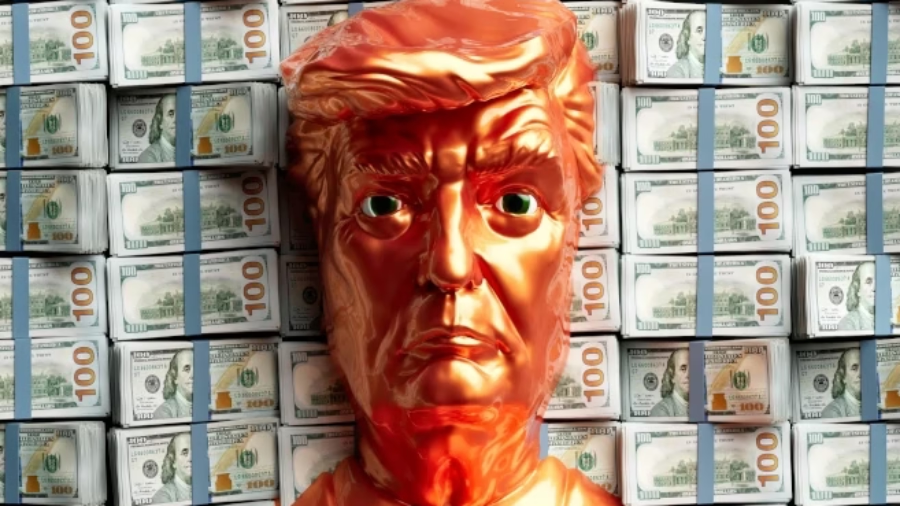
Trump Tariffs and Turbulence

Trump, Tariffs, and Turbulence: The Unconventional Strategy That Redefined Political Playbooks

Introduction: A Presidency Built on Trade Shockwaves

Few aspects of Donald Trump’s presidency stirred as much controversy, confusion, and global attention as his aggressive use of tariffs. From steel and aluminum to Chinese imports, Trump wielded trade policy as if it were a universal tool—a blunt instrument meant to achieve multiple political objectives at once.

This strategy, emblematic of Trump, Tariffs, and Turbulence, redefined conventional political playbooks. By fusing economic nationalism with political messaging, tariffs became more than a trade mechanism—they became a symbol of disruption, loyalty, and power projection.

Understanding this legacy is critical, not just for analyzing the Trump era, but for appreciating the profound impact it had on global commerce, domestic politics, and the perception of America on the world stage.

The Philosophy Behind Trump’s Tariff Strategy

Tariffs as a Political Hammer

Unlike traditional trade tools aimed at addressing specific economic imbalances, Trump treated tariffs as a multi-purpose strategy:

  • Political Signaling: Showcasing toughness on foreign powers, particularly China, to appeal to nationalist sentiments
  • Economic Leverage: Pressuring trade partners into renegotiating agreements (e.g., USMCA)
  • Domestic Messaging: Positioning himself as the defender of American workers against “unfair” global competition

This approach transformed a conventional economic tool into a political weapon, merging economic theory with populist messaging. (source)

Disruptive Politics as a Core Tactic

Trump’s reliance on tariffs illustrates his broader political philosophy: disruption is power. By creating unpredictability in trade policy, he sought to:

  • Keep political and economic adversaries off balance
  • Dominate media narratives through controversy
  • Consolidate domestic support among industrial workers affected by globalization

The result was a political climate defined as much by shock and spectacle as by policy outcomes.

Key Tariff Battles and Their Impact

Steel and Aluminum Tariffs

In 2018, Trump imposed a 25% tariff on steel and 10% on aluminum imports from major allies, including Canada, the EU, and Mexico. (source)

  • Goal: Protect domestic industries from “unfair competition”
  • Impact:
    • Short-term gains for U.S. steel producers
    • Strained trade relations with allies
    • Retaliatory tariffs on American goods

While politically popular in certain U.S. states, these tariffs sparked global concern and demonstrated the collateral effects of unilateral trade actions.

The China Trade War

Trump’s tariffs on Chinese imports were the most consequential:

  • Scope: $360 billion in tariffs on Chinese goods
  • Objective: Force China to change trade practices, including intellectual property theft and forced technology transfers
  • Outcome:
    • Temporary trade deals and partial concessions
    • Increased costs for American businesses and consumers
    • Global supply chain disruptions

The China tariffs epitomized the turbulence of Trump’s economic strategy, blending geopolitics with domestic politics. (source)

Tariffs as Campaign Tools

Tariffs also functioned as messaging devices in election cycles:

  • Highlighted Trump’s “America First” ideology
  • Reinforced his image as a disruptor fighting unfair trade practices
  • Served as a tangible action to appease industrial and working-class voters

This dual role of tariffs—policy and political performance—reinforced Trump’s unorthodox approach.

Economic Consequences of Trump’s Tariff Strategy

Winners and Losers

Tariffs produced uneven outcomes:

  • Winners: Domestic steel producers, some agricultural sectors during temporary government support
  • Losers: Automakers, manufacturers reliant on global supply chains, and consumers facing higher prices

The strategy revealed the limits of using trade policy as a catch-all political tool.

Global Supply Chain Disruptions

Trump’s tariffs caused significant global disruptions:

  • Shifts in manufacturing hubs to avoid tariffs
  • Increased costs for multinational corporations
  • Uncertainty in markets, affecting investment and growth

This turbulence illustrated the interconnectedness of modern economies and the risks of unilateral action.

Table: Selected Tariff Impacts Under Trump

Tariff TargetObjectiveEconomic OutcomePolitical Outcome
Steel & AluminumProtect domestic producersHigher domestic prices, global tensionPopular in Rust Belt states
Chinese GoodsForce trade concessionsSupply chain disruption, higher costsReinforced nationalist messaging
Solar Panels & Washing MachinesProtect U.S. manufacturersIncreased consumer prices, limited job growthShort-term political wins
EU ImportsRetaliation for subsidiesDiplomatic tension, threat of trade warMedia attention, tough-guy image

Tariffs and the Media Spectacle

Trump’s approach to trade policy was inseparable from his mastery of media:

  • Frequent tweets amplified trade disputes
  • Controversy generated coverage that shaped public perception
  • Tariffs became a tool of narrative control, not just economics

In this sense, Trump, Tariffs, and Turbulence exemplify a strategy where policy is performance.

Critics and Supporters Weigh In

Criticism

  • Economists argue tariffs increase costs for consumers and reduce competitiveness
  • Trade partners saw tariffs as protectionist and destabilizing
  • Global markets experienced uncertainty, affecting investment

Support

  • Populist voters viewed tariffs as defending American jobs
  • Industrial states benefiting from higher prices and restricted competition rewarded Trump politically
  • Symbolically, tariffs reinforced the “America First” narrative

This contrast underscores the tension between short-term political gains and long-term economic costs.

Tariffs as a Political Playbook Re-definer

Trump’s approach changed how political actors view trade:

  1. Blurring Policy and Politics: Economic tools became messaging devices.
  2. Disruption as Strategy: Predictable trade diplomacy was replaced by unpredictability.
  3. Populism Meets Economics: Policies were tailored to appeal to emotion and identity, not just markets.

This redefinition of political playbooks will influence how future politicians engage with trade, media, and domestic constituencies.

Lessons for Future Governance

The Limits of Tariffs

  • Tariffs cannot replace comprehensive trade policy
  • Unilateral action risks global retaliation
  • Short-term political messaging may come at long-term economic costs

Strategic Communication

  • Policy effectiveness is intertwined with perception management
  • Media narratives can amplify or distort policy outcomes

Balancing Politics and Economics

  • Leaders must weigh domestic political benefits against global economic realities
  • Disruption can mobilize support but may destabilize markets and alliances

Conclusion: Trump, Tariffs, and Turbulence

Trump’s tariff strategy represents a unique blend of economics, politics, and spectacle. Trump, Tariffs, and Turbulence not only disrupted global trade but reshaped domestic political strategy, showing how a single policy tool can be leveraged as a multi-purpose weapon—economic, political, and psychological.

The era serves as a cautionary tale for policymakers: disruption may yield short-term victories, but it comes with long-term consequences for economies, alliances, and governance norms. Future leaders must balance bold action with careful strategy, or risk repeating the turbulence of the Trump years.

Call to Action

  • Stay informed: Monitor trade policies and their impacts
  • Engage civically: Understand how economic decisions affect daily life
  • Share insights: Discuss this post with peers to explore the implications of unconventional political strategies

References & Further Reading

  1. Council on Foreign Relations, Trump Tariffs and the US-China Trade War. (cfr.org)
  2. BBC News, Trump Steel and Aluminum Tariffs. (bbc.com)
  3. Peterson Institute for International Economics, Trade War Analysis. (piie.com)
  4. CNBC, Tariffs and Economic Impact on U.S. Consumers. (cnbc.com)
  5. Forbes, How Trump’s Tariffs Reshaped Political Strategy. (forbes.com)
lies, racism, and authoritarianism

Trump’s Legacy of Lies, Racism, and Authoritarianism Fueled by Conspiracy Theories

Introduction: The Making of a Political Era

The political era of Donald J. Trump is unlike anything in modern American history. His presidency was marked not only by policy decisions but by a deliberate reshaping of political norms. At the core lies a disturbing triad: lies, racism, and authoritarianism, all amplified by conspiracy theories that undermined truth and sowed division.

This is Trump’s legacy of lies, racism, and authoritarianism—a period that redefined the Republican Party, polarized the electorate, and challenged the very foundations of American democracy.

Understanding this legacy is essential, not just to analyze the past, but to safeguard the future. In this post, we explore the mechanisms of Trump’s influence, the consequences for governance and society, and the enduring impact of misinformation on American politics.

Lies as a Tool of Political Power

Lying is not new in politics, but Trump elevated it into a systemic tool. The Washington Post reported over 30,000 false or misleading statements during his four-year presidency. (source)

Disinformation and Reality Manipulation

Trump repeatedly used false narratives to:

  • Undermine critics
  • Justify policy decisions
  • Mobilize his political base

Examples include:

  • Election fraud claims: Trump’s persistent false assertion that the 2020 election was “stolen” created widespread distrust in democratic institutions.
  • COVID-19 misinformation: From downplaying the virus to promoting unproven treatments, these lies had tangible public health consequences. (source)

By weaponizing falsehoods, Trump blurred the line between fact and fiction, weakening public trust and creating fertile ground for authoritarian impulses.

Lies as Loyalty Tests

In Trump’s ecosystem, loyalty to the leader often trumped allegiance to truth. Politicians, journalists, and even institutions faced a stark choice: align with the narrative—or risk marginalization, censure, or career damage.

This approach normalized deception and incentivized complicity, reinforcing authoritarian tendencies within the political system.

Racism as Policy and Rhetoric

Racism in the Trump era was not always overt; it often manifested through coded language, targeted policies, and symbolic gestures.

Policy-Driven Racism

Several initiatives exemplify systemic bias:

  • The travel ban: Widely criticized as targeting Muslim-majority countries. (source)
  • Immigration enforcement: Aggressive deportation policies disproportionately affected Latino communities.
  • Criminal justice rhetoric: Statements labeling certain neighborhoods and populations as “dangerous” reinforced racial stereotypes.

Symbolic Racism and Dog Whistles

Beyond policy, Trump frequently deployed racially coded language:

  • Criticizing NFL players for kneeling during the national anthem as “disrespectful”
  • Repeatedly referring to Mexican immigrants as criminals or “rapists”

These messages fueled divisions and mobilized voters along racial lines, deepening societal fractures.

Authoritarianism as Governance Style

Trump’s approach to leadership displayed hallmark traits of authoritarianism: concentration of power, attacks on dissent, and disdain for democratic norms.

Undermining Institutions

  • Politicization of the Department of Justice
  • Public attacks on federal judges who ruled against him
  • Attempts to pressure the FBI and intelligence agencies

Such actions eroded institutional independence, a cornerstone of democratic governance.

Centralization of Power

By bypassing legislative and judicial checks, Trump exemplified the authoritarian tactic of executive overreach. Executive orders became a primary tool to enforce policy unilaterally, often disregarding procedural norms.

Table: Comparing Democratic Norms vs. Authoritarian Practices Under Trump

Democratic NormsTrump Era Authoritarian Practices
Free and fair electionsRepeated false claims of election fraud
Independent judiciaryPublic attacks on judges and DOJ
Checks and balancesOveruse of executive orders, bypassing Congress
Respect for truthSystematic misinformation and conspiracy propagation
Civil discourseThreats to journalists and opponents
Transparent governanceWithholding of key information and politicized institutions

Conspiracy Theories as a Catalyst

Conspiracy theories were central to Trump’s political strategy, reinforcing lies, racism, and authoritarianism.

Popularizing Fringe Ideas

Trump elevated fringe theories into mainstream political discourse:

  • QAnon narratives suggesting a deep-state conspiracy
  • False claims about voter fraud in 2020
  • COVID-19 origin and treatment conspiracies

By doing so, he mobilized a base willing to reject evidence and reality if it contradicted party loyalty.

Effects on Political Culture

Conspiracy-driven governance:

  • Polarized society further
  • Undermined faith in elections and institutions
  • Encouraged radical actions, exemplified by the January 6th insurrection (source)

The integration of conspiracies into mainstream politics marked a shift from debate to belief-based allegiance—a defining feature of authoritarian systems.

Intersections of Lies, Racism, and Authoritarianism

Trump’s legacy cannot be understood through a single lens. Lies, racism, and authoritarianism were mutually reinforcing:

  • Lies justified authoritarian measures (“the election was stolen”)
  • Racist narratives mobilized loyalty and fear, undermining pluralism
  • Authoritarian governance enforced compliance and punished dissent

This interconnected framework created a self-reinforcing ecosystem that normalized extreme political behavior.

Societal and Political Consequences

Polarization and Distrust

  • Partisan identity now often outweighs objective reality
  • Mistrust of media, judiciary, and election infrastructure has become entrenched
  • Civic engagement is often reactive, rooted in fear or grievance

Threats to Minority Communities

  • Policies and rhetoric created environments hostile to minorities
  • Structural inequities were reinforced through legal and political channels

Erosion of Democratic Norms

  • Acceptance of falsehoods as political strategy
  • Undermining of independent institutions
  • Increasingly centralized and personalized power in executive office

Visual Suggestion:

  • Infographic showing “Cycle of Lies, Racism, and Authoritarianism”
  • Timeline highlighting key conspiracies and policy moves under Trump

Lessons and the Path Forward

Strengthening Institutions

  • Judicial independence and legislative oversight must be prioritized
  • Transparency and accountability mechanisms should be reinforced

Combating Misinformation

  • Civic media literacy initiatives
  • Fact-checking campaigns and responsible reporting
  • Social media accountability

Rebuilding Ethical Governance

  • Promote leaders committed to truth and equality
  • Reward integrity over loyalty
  • Institutionalize checks to prevent consolidation of power

Conclusion: The Enduring Legacy

Trump’s legacy of lies, racism, and authoritarianism fueled by conspiracy theories is more than a historical footnote; it is a cautionary tale. The erosion of democratic norms, amplification of racial and social divisions, and normalization of falsehoods have reshaped American politics and society.

Rebuilding trust, restoring accountability, and confronting misinformation are critical to preventing this legacy from defining future governance.

America’s democracy is resilient—but only if citizens, institutions, and civil society actively resist authoritarian and divisive forces.

Call to Action

  • Engage critically: Question information sources and verify claims
  • Defend democracy: Participate in civic duties and advocate for transparency
  • Raise awareness: Share this post to inform others about the political risks of lies, racism, and authoritarianism

Together, awareness and action can counter the dangerous trends set in motion by Trump’s legacy of lies, racism, and authoritarianism.

References & Further Reading

  1. Washington Post, Trump’s False Claims Database. (washingtonpost.com)
  2. Brookings Institution, January 6 Insurrection Analysis. (brookings.edu)
  3. Vox, Trump’s Travel Ban and Muslim Discrimination. (vox.com)
  4. Levitsky, Steven & Ziblatt, Daniel. How Democracies Die. Crown, 2018. (foreignaffairs.com)
  5. CDC, COVID-19 Misinformation Resources. (cdc.gov)