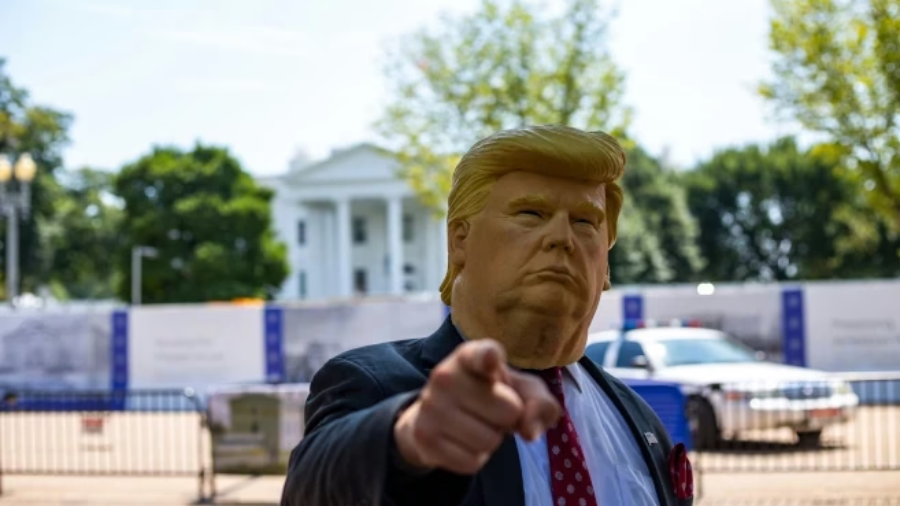
When historians look back at this era, they won’t ask if American democracy faced an existential threat—they’ll ask why so many people failed to recognize gangster fascism in the White House until it was almost too late.
Picture this: A leader who treats the presidency like a criminal enterprise, surrounds himself with loyalists willing to break laws, attacks judges and prosecutors investigating him, threatens political opponents with imprisonment, and systematically dismantles the checks and balances designed to prevent tyranny. This isn’t a dystopian novel. This is the documented reality of Donald Trump’s approach to power—a toxic blend of authoritarianism, organized crime tactics, and kleptocratic corruption that scholars increasingly recognize as a distinct threat to democratic governance worldwide.
The term “gangster fascism” isn’t hyperbole. It’s a precise descriptor for a political movement that combines fascist ideology’s worship of strongman leadership with the operational tactics of organized crime syndicates. And understanding this phenomenon isn’t just an academic exercise—it’s essential for anyone who values democratic freedoms, the rule of law, and international stability.
Understanding Gangster Fascism: When Organized Crime Meets Authoritarian Politics
Traditional fascism, as practiced by Mussolini and Hitler, relied on state power, military might, and bureaucratic control. Gangster fascism in the White House operates differently—it’s more personal, more transactional, and arguably more insidious because it masquerades as populism while systematically looting public resources and institutions.
The Defining Characteristics
Political scientists studying authoritarian movements have identified several hallmarks that distinguish gangster fascism from other forms of authoritarianism:
Loyalty Over Competence: Like a mob boss surrounding himself with “made men,” Trump has consistently prioritized personal loyalty over expertise or qualifications. This explains appointments ranging from unqualified family members to key positions to pardoning allies convicted of federal crimes. The pattern became undeniable when competent officials who refused to break laws or violate norms were systematically purged and replaced with compliant yes-men.
Transactional Corruption: Every relationship becomes a transaction. Foreign policy decisions get weighed against personal business interests. Presidential pardons become favors for those who “keep their mouths shut.” Government contracts flow to supporters and donors. This isn’t traditional political corruption—it’s the wholesale conversion of democratic governance into a protection racket.
Intimidation and Threats: Journalists, judges, prosecutors, election officials, and even members of his own party face relentless attacks, threats, and intimidation campaigns. The message is clear: cross the boss, and you’ll pay. This creates what researchers call a “chilling effect” that undermines the courage required for democratic accountability.
Reality Distortion: Perhaps most dangerously, gangster fascism requires followers to reject objective reality in favor of the leader’s narrative. Election fraud claims without evidence, crowd size lies, and the constant drumbeat of “fake news” accusations all serve to create an alternate reality where only the leader’s word matters.
The Kleptocratic Foundation: Following the Money
If you want to understand gangster fascism in the White House, follow the money. Kleptocracy—rule by thieves—isn’t just a side effect of Trump’s approach; it’s the entire point.
Blurring Private and Public Interest
Trump never fully divested from his business empire, creating unprecedented conflicts of interest. Foreign governments and special interests could—and did—curry favor by booking expensive hotel rooms, hosting events at Trump properties, and directing business to Trump family enterprises. This wasn’t subtle corruption; it was corruption in plain sight, normalized through shamelessness.
The emoluments clause of the Constitution, designed specifically to prevent this kind of corruption, became a dead letter. When the guardrails failed, the floodgates opened.
The Grift That Never Stops
Consider the financial patterns that emerged:
- Campaign funds and political action committees spending millions at Trump properties
- Secret Service agents required to rent rooms at Trump hotels at inflated rates
- Foreign leaders and lobbyists booking entire floors of Trump hotels they never use
- Government events relocated to Trump properties, funneling taxpayer money to the president’s pockets
This systematic looting of public resources for private gain defines kleptocracy. It’s not about policy disagreements or political philosophy—it’s about using governmental power as a personal ATM machine.
International Kleptocratic Networks
Perhaps most troubling, Trump’s approach aligned America with a global network of kleptocratic leaders. His admiration for Vladimir Putin, Kim Jong Un, Viktor Orbán, and other authoritarian rulers wasn’t coincidental—these leaders operate the same gangster fascism playbook. They understand each other because they share the same value system: power, wealth, and loyalty trump everything else.
This created a feedback loop where democratic backsliding in America encouraged and legitimized authoritarianism globally, while international kleptocrats provided Trump with models and support for dismantling democratic norms at home.
The Assault on Democratic Institutions: Demolishing the Guardrails
Gangster fascism in the White House doesn’t announce itself with tanks and troops. It operates more subtly, methodically weakening the institutions that prevent tyranny.
Weaponizing the Justice Department
Trump’s repeated attempts to use the Department of Justice as a personal law firm and political weapon represent one of the gravest threats to American democracy. Presidents from both parties have traditionally respected DOJ independence, understanding that politicizing prosecution destroys faith in equal justice under law.
Trump shattered this norm. He demanded loyalty oaths from FBI directors, pressured attorneys general to prosecute political opponents, attempted to stop investigations into himself and his allies, and pardoned associates who refused to cooperate with investigators. The message: the law applies differently depending on your relationship with the president.
This corruption of justice follows classic authoritarian patterns. When laws become tools for rewarding friends and punishing enemies rather than instruments of blind justice, democracy dies.
Attacking Election Integrity
The January 6, 2021 insurrection represented the logical endpoint of gangster fascism in the White House: when democratic processes don’t deliver the desired outcome, try to overturn them through violence and intimidation.
But January 6 wasn’t an isolated incident—it was the culmination of months of systematic efforts to undermine election legitimacy:
- Pressuring state officials to “find votes” or alter results
- Submitting false electoral certificates
- Coordinating fake elector schemes across multiple states
- Inciting mob violence to stop the constitutional certification of results
This goes beyond normal political disputes. It represents an attempted coup—a fundamental rejection of the principle that voters, not the powerful, should determine who governs.
Corrupting Oversight Mechanisms
Congressional oversight, inspector general investigations, whistleblower protections, and media scrutiny all serve as checks on executive power. Trump systematically attacked each: He fired inspectors general investigating corruption in his administration. He blocked congressional subpoenas and instructed officials to ignore lawful oversight requests. Trump retaliated against whistleblowers who exposed wrongdoing. He labeled critical journalism “fake news” and encouraged violence against reporters.
These aren’t isolated incidents of a thin-skinned leader—they’re coordinated attacks designed to eliminate accountability and transparency, the oxygen that democracy needs to survive.
Global Implications: When American Democracy Falters
The United States has long positioned itself as a beacon of democratic values globally. When gangster fascism in the White House becomes normalized in America, the ripple effects spread worldwide with devastating consequences.
Emboldening Autocrats Everywhere
Authoritarian leaders from Beijing to Budapest watched Trump’s playbook carefully and adapted it for their own contexts. If the world’s most powerful democracy could abandon democratic norms, investigate political opponents, attack press freedom, and face minimal consequences, why shouldn’t they do the same?
Turkey’s Erdoğan, Brazil’s Bolsonaro, the Philippines’ Duterte, and Hungary’s Orbán all borrowed from Trump’s tactical manual. The global democratic recession that democracy monitors have documented over the past decade accelerated dramatically during Trump’s tenure.
Weakening International Institutions
Trump’s hostility toward NATO, the United Nations, the World Health Organization, and other international bodies didn’t just represent policy disagreements—it reflected the gangster fascist worldview that sees cooperation as weakness and views all relationships through a zero-sum, transactional lens.
This undermined the post-World War II international order that, despite its flaws, helped maintain relative peace and prosperity. When America withdraws from global leadership, the vacuum gets filled by authoritarian powers like China and Russia that have no interest in promoting democratic values or human rights.
Creating Humanitarian Crises
The “America First” nationalism that defines Trump’s movement wasn’t just rhetoric—it had real consequences. Refugee and asylum policies became deliberately cruel, separating children from parents as a deterrent strategy. Climate change denial and environmental deregulation accelerated planetary destruction. Pandemic response became politicized, contributing to hundreds of thousands of preventable deaths.
These weren’t unfortunate side effects—they reflected the core gangster fascist principle that might makes right and that vulnerable populations deserve no protection or consideration.
Why It Matters: The Stakes Couldn’t Be Higher
Some might argue that focusing on gangster fascism in the White House represents partisan overreaction or alarmism. The evidence suggests otherwise.
Democracy Is Fragile
Political scientists studying democratic breakdown have identified clear warning signs: attacks on media freedom, erosion of checks and balances, politicization of law enforcement, questioning of election legitimacy, and normalization of political violence. Trump’s movement checks every box.
History shows that democracies rarely die from external conquest—they rot from within when citizens become complacent, institutions grow weak, and authoritarian movements exploit democratic freedoms to gain power before destroying them. The playbook is depressingly familiar.
The Corruption Spreads
Kleptocracy and gangster fascism don’t remain contained at the top—they metastasize throughout the system. When the president acts corruptly without consequences, corruption becomes normalized at every level. Election officials face pressure to cheat. Law enforcement becomes politicized. Government agencies prioritize loyalty over mission. Civil servants either comply or get purged.
This institutional rot proves extraordinarily difficult to reverse once established.
International Security Deteriorates
American democratic backsliding creates strategic opportunities for adversaries. Russia’s invasion of Ukraine, China’s increased aggression toward Taiwan, and numerous other threats emerged partly because authoritarian powers sensed American weakness and internal division.
Democracy and dictatorship aren’t just different systems—they’re fundamentally opposed worldviews locked in a long-term struggle. When democratic powers falter, authoritarian powers advance.
Resistance and Resilience: The Path Forward
Understanding gangster fascism in the White House matters because knowledge enables resistance. Citizens can’t defend democracy if they don’t recognize the threats it faces.
Institutional Fortification
Democratic institutions need strengthening against future authoritarian assaults. This means:
- Codifying norms into enforceable laws rather than relying on tradition
- Protecting inspector general independence
- Strengthening congressional oversight powers
- Ensuring Justice Department independence through structural reforms
- Protecting election administration from political interference
Media Literacy and Critical Thinking
Gangster fascism relies on reality distortion. Citizens equipped with critical thinking skills, media literacy, and healthy skepticism toward propaganda prove more resistant to authoritarian manipulation.
Education systems, journalism organizations, and civil society groups all play crucial roles in building these capabilities across the population.
Active Civic Engagement
Perhaps most importantly, democracy requires active participation. When citizens disengage, authoritarians win by default. Voting, contacting representatives, supporting accountability journalism, participating in civic organizations, and speaking out against injustice all matter.
Democracy isn’t a spectator sport—it’s a participation requirement.
Conclusion: The Choice Before Us
Gangster fascism in the White House isn’t an abstract theoretical concern—it’s a documented reality with clear precedents and predictable consequences. The question isn’t whether this threat exists but whether Americans and their democratic allies worldwide will recognize it in time and muster the courage to resist it effectively.
History teaches painful lessons about what happens when good people rationalize, minimize, or normalize authoritarian movements. The early warning signs always seem obvious in retrospect, but in the moment, they’re easy to dismiss as partisan exaggeration or political theater.
The stakes extend far beyond one leader or one election cycle. They involve the fundamental question of whether democratic self-governance can survive in an era of sophisticated propaganda, kleptocratic corruption, and authoritarian movements that exploit democratic freedoms to destroy democracy itself.
Understanding the threat is the first step. What we do with that understanding determines whether future generations inherit functioning democracies or cautionary tales about civilizations that failed to defend their freedoms when it mattered most.
What are your thoughts on the threat gangster fascism poses to democratic institutions? Have you witnessed concerning patterns in your own community or country? Share your perspectives in the comments below, and consider subscribing to stay informed about threats to democratic governance worldwide.
References & Further Reading
- Brookings Institution – Democracy Studies
- OpenSecrets – Money in Politics Research
- Citizens for Responsibility and Ethics in Washington
- Freedom House – Democracy Reports
- V-Dem Institute – Democratic Backsliding Data
Democracy requires eternal vigilance. Stay informed, stay engaged, and never take freedom for granted.