
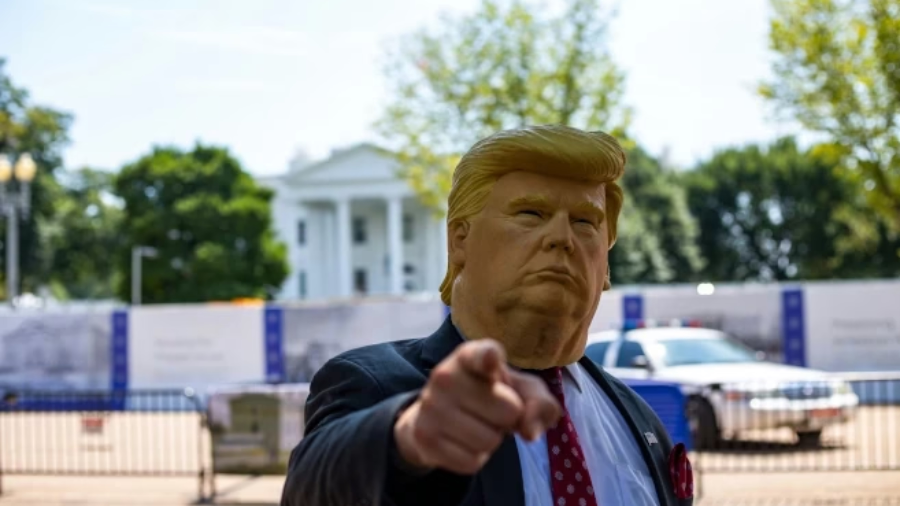
threats against Trump critics

“Incompetence, Imbecility and a Continuous Zeal to Revenge”: How Apt Is This Description to the Trump Administration (Trump 2.0)?

Introduction: Setting the Stage for Trump 2.0

When a prosecutor described the second Trump presidency as defined by “incompetence, imbecility and a continuous zeal to revenge,” it grabbed headlines—and for good reason. That scathing assessment is not just rhetorical flourish; it resonates with concerns echoed by political opponents, some former insiders, and media commentators alike. But how accurate is it?

Is Trump’s second term really a series of chaotic missteps and vindictive power plays? Or is there more method than madness—a strategic, even deliberate, effort to reshape the U.S. government in his image? To explore these questions, we’ll investigate each part of the assertion: incompetence, imbecility (stupidity), and an obsessive quest for revenge.

Incompetence: Chaos as Governance Strategy

A Return to Disorder?

Many critics argue that Trump 2.0 is marked by a return to the same kind of chaos that characterized his first term—but worse. According to an editorial in The Inquirer, early executive orders were issued without full planning or coherence, and some were quickly reversed. (Inquirer.com)
This kind of volatility suggests not just mistakes, but a lack of governing discipline.

National Security Risks

Questions about competence aren’t limited to policy flips. The Washington Post reports that national security experts are alarmed by a Signal chat group that included the Vice President and the Secretary of Defense. In one conversation, sensitive military operations were discussed in a context that reportedly breached long-standing norms. (The Washington Post)
For a government running on brinkmanship, this kind of protocol breakdown feels deeply destabilizing.

Incompetence by Design?

Some political analysts don’t see this as accidental. According to a piece in the Foreign Affairs Forum, Trump’s second administration doesn’t simply tolerate disorder—it embraces it. (Foreign Affairs Forum)
They argue that “recursive incompetence”—chaos creating more chaos—is being leveraged as a tool to disorient opponents, maintain unpredictability, and prevent institutional pushback.

Imbecility (Stupidity): Beyond Simple Mistakes

A Critique of Pure Stupidity

Critics have gone further than labeling Trump merely incompetent—they question his rationality. A recent analysis in The Guardian argues that some of Trump 2.0’s most baffling policies are not just bad—they’re stupid. (The Guardian)
The article cites examples such as radical tariff policy, defunding of scientific programs, and the appointment of unqualified individuals, suggesting that these aren’t just errors—they’re out of touch with consequences and evidence.

Ideational Weakness

Stupidity here refers not to a lack of intelligence, but to a disregard for institutional memory, expertise, and reasoned debate. The Guardian essay argues that this isn’t just deception—it’s a different kind of governance: “abandonment of reason.” (The Guardian)
This viewpoint helps explain why some policies seem wildly self-undermining, not just ideologically driven.

A Continuous Zeal to Revenge: Retribution as Central Theme

Revenge as Political Motive

Perhaps the most troubling aspect of the prosecutor’s phrase is the notion of a “continuous zeal to revenge.” This isn’t just political rivalry—it’s personal vendetta.

Trump’s return to power has been accompanied by a sustained campaign of retribution. According to reporting in The Washington Post, Trump and his allies are already mapping paths to use government power against critics in his second term. (The Washington Post)
These plans reportedly include leveraging the Justice Department, reworking prosecutorial priorities, and even invoking aggressive domestic powers.

Targeting the Media

Trump’s antagonism toward the press is nothing new. But in Trump 2.0, some analysts argue revenge has become more systematic. Bill Press, a longtime commentator, describes it as an escalation toward authoritarianism: Trump is allegedly curbing the freedom of the press and targeting media figures he sees as enemies. (The Guardian)
This is not just rhetorical pushback—it risks chilling free expression.

Weaponizing Justice

Under Attorney General Pam Bondi, critics argue, the Justice Department has been reshaped into an instrument of political retribution. (Reuters)
Reporters and legal experts say Bondi has purged career attorneys, replaced them with political loyalists, and launched investigations into figures Trump sees as adversaries, undermining the traditional independence of the DOJ.

Public Social Media Vengeance

According to a CREW (Citizens for Responsibility and Ethics in Washington) analysis, Trump has used his Truth Social platform to express repeated threats of legal and political retribution—targeting judges, political opponents, and other perceived enemies. (The Guardian)
This pattern shows that vengeance isn’t just a private ambition—it’s a public, amplified strategy.

Revenge in Popular Culture

Trump’s narrative of retribution resonates deeply in his public rhetoric. As The Spectator observes, he cast himself as the avenger: “I am your warrior, I am your justice … I am your retribution.” (The Spectator)
This message isn’t just about power—it’s about settling scores, galvanizing his base around grievance, and rewriting perceived wrongs from his past.

Weighing the Claims: Is the Description “Apt”?

To assess how well “incompetence, imbecility and a continuous zeal to revenge” describes Trump 2.0, it’s helpful to compare these charges against observed behavior. Here’s a summary matrix:

ChargeSupporting EvidenceLimitations / Counterarguments
IncompetenceGovernment chaos, poor management, unvetted policy rollouts (Inquirer.com)Some argue disorder is strategic rather than unintentional. (Foreign Affairs Forum)
ImbecilityPolicies seemingly disconnected from expert consensus, reckless governance. (The Guardian)Critics could argue this is ideological nonconformity, not stupidity.
Zeal to RevengeTargeted attacks on media, justice system retribution, purges of government institutions. (The Washington Post)Supporters claim these are policy resets rather than personal vendettas.

From this comparison, the description seems largely accurate, especially when one sees not just isolated incidents, but a pattern: chaos, punitive politics, and institutional destabilization all working in tandem.

Deeper Insights: Why This Might Be More Than Personality

Power as Payback

Trump’s strategy in this second term feels less like governance and more like personal settlement. His rhetoric of retribution isn’t metaphor — it’s literal: critics, former allies, and institutions are openly threatened or restructured in ways that benefit his loyalists.

Populism Meets Authoritarianism

The mix of revenge and chaos isn’t new in politics—but Trump 2.0 marries it with a populist narrative: “I was wronged; now I will right those wrongs.” That narrative empowers his base and helps justify institutional upheaval.

The Normalization of Retribution

If revenge becomes central to how power is wielded, democratic norms erode. What once seemed like occasional political payback increasingly looks like a tool of permanent governance.

A Risk to Institutional Independence

A core danger lies in the weakening of checks and balances: when the DOJ or press is retribution-equipped, democratic institutions risk being hollowed out.

Real-World Impact: Concrete Examples

  1. Justice Department Purge
    Under Bondi, the DOJ has reportedly dismissed or marginalized long-serving career attorneys. (Reuters)
    This isn’t just staffing — it’s restructuring the heart of legal accountability.
  2. Social Media Retaliation
    Trump’s Truth Social posts have repeatedly threatened legal action, raids, and investigations against his enemies. (The Guardian)
    Such public promises deepen the culture of intimidation.
  3. Media Crackdown
    Commentators warn that Trump is targeting the press in a manner consistent with strongmen worldwide. (The Guardian)
    This trend poses real risks to press freedom.
  4. Governance Through Disruption
    By governing amid constant reversals, Trump keeps momentum on his own terms — but at the cost of clarity, stability, and reliable policy outcomes. (Foreign Affairs Forum)

Conclusion: A Strikingly Fitting Description

When viewed through the lens of evidence and analysis, the prosecutor’s indictment-like phrase—“incompetence, imbecility and a continuous zeal to revenge”—resonates deeply with the character and actions of Trump 2.0.

  • The incompetence is not just accidental but systemic, perhaps even strategic.
  • The imbecility is less about a lack of intelligence and more about a rejection of rational constraints and expertise.
  • The zeal to revenge appears central to his political identity, structuring not just his rhetoric, but his institutional decisions.

In other words: this isn’t just turmoil. It’s a coherent (if disturbing) political method.

Call to Action

What do you think? Is this harsh characterization fair—or exaggerated?

  • Share your thoughts in the comments below
  • Forward this article to someone interested in political analysis
  • Subscribe for more deep dives into the personalities and power plays shaping modern democracy

Your voice matters in this conversation about where power and retribution intersect.

threats against Trump critics

The Trump Administration’s Disruptive Politics—Incompetence, Buffoonery, Reckless Strategy, or Deliberate Malice?

Introduction: Why the Turbulence Still Matters

Few chapters in modern American political history have generated as much debate, devotion, and distress as the Trump administration’s disruptive politics. For some, Donald Trump represented a long-overdue revolt against political elitism. For others, he embodied a dangerous departure from democratic norms, institutional stability, and responsible leadership.

But beyond the noise—beyond the tweets, scandals, and headlines—a deeper, more urgent question remains:

Was the chaos accidental, or was it the whole point?

Did the Trump administration’s disruptive politics stem from genuine incompetence and buffoonery?
Was it driven by the reckless improvisation of a leader out of his depth?
Or was it something far more intentional—a strategy of deliberate political malice designed to destabilize, divide, and dominate?

This post takes a critical, research-backed tour through these competing explanations, comparing evidence, examining patterns, and offering a clear, engaging analysis of the years that reshaped American democracy.

Understanding the Architecture of Disruption

Although Trump’s governing style seemed chaotic on the surface, scholars, journalists, and political psychologists have identified recurring themes that help decode the underlying drivers of his administration’s behavior.

Below are four major interpretations often used to explain his governance:

  1. Gross incompetence – a leader unprepared for governance
  2. Buffoonery – impulsive, unserious, performative politics
  3. Reckless strategy – disruption as a political weapon
  4. Deliberate malice – intentional degradation of norms and institutions

Each theory holds truth. But each also fails to fully explain the complete picture.

Was It Incompetence? Examining the Evidence

One of the most common critiques of Trump’s presidency is rooted in institutional incompetence. From rapid staff turnover to poorly briefed policy launches, the administration often looked like a revolving door of chaos.

Record-Setting Staff Turnover

According to multiple analyses from think tanks and political researchers, the Trump White House recorded the highest staff turnover rate of any modern presidency. Senior officials left in waves—some fired unexpectedly, others departing amid scandal or exhaustion.

Frequent turnover meant:

  • No consistent policy direction
  • Internal power struggles
  • Poor communication between agencies
  • Lawsuits, blocked executive orders, and policy reversals

Governments require continuity. Trump’s environment fostered none.

Policy Making Without Processes

Many major policies were unveiled without:

  • Interagency review
  • Legal vetting
  • Legislative consultation
  • Implementation planning

Some famously chaotic examples include:

  • The first travel ban, blocked almost immediately in court
  • Sudden troop withdrawal announcements via Twitter
  • Conflicts between the president and his own cabinet
  • Government shutdowns over easily negotiable issues

These failures weren’t just political missteps—they were structural signs of an administration struggling to function normally.

Lack of Expertise

Trump frequently appointed individuals with little or no experience in the roles they held. Several appointees openly opposed the very agencies they led.

This produced:

  • Contradictory mandates
  • Confusion within departments
  • Difficulty coordinating national responses

Whether one views Trump as a disruptive reformer or an accidental arsonist, the evidence of incompetence is difficult to ignore.

Buffoonery or Performative Politics? The Role of Impulse and Spectacle

Another interpretation frames Trump not as malicious, but as profoundly unserious—a showman who treated governance as performance.

The Politics of Outrage

Trump mastered the art of constant spectacle. Outrage drives attention. Attention drives power.

His communication style relied heavily on:

  • Provocative insults
  • Conspiracy-tinged rhetoric
  • Episodic policy pronouncements
  • Frequent exaggerations or misstatements
  • Late-night tweetstorms that could shift global markets

Political psychologists describe this as “performative dominance”—acting unpredictably to project strength and destabilize opponents. But its downside is obvious:

Chaos becomes the default operating mode.

Reality-TV Governance

Trump’s background in entertainment shaped his sense of leadership:

  • Every conflict was a “season”
  • Every scandal an “episode”
  • Every firing a “plot twist”
  • Every rally a “live performance”

This performative posture may explain why so many decisions seemed spontaneous, improvised, or even whimsical.

But was it just buffoonery—or part of something more strategic?

Reckless Strategy—Chaos as a Political Weapon

Some analysts argue that Trump deliberately used chaos to consolidate power. Not through detailed plans, but through instinctive, opportunistic strategies.

The “Shock-and-Disorient” Method

By overwhelming the media and public with:

  • Constant controversies
  • Rapid-fire policy changes
  • Personal attacks on opponents
  • Insults directed at institutions

Trump made it nearly impossible for critics to focus on any single issue for long. This created an environment where serious concerns—ethics violations, conflicts of interest, foreign entanglements—were drowned out by daily scandals.

Normalizing the Abnormal

When chaos becomes constant, people stop reacting.

This allowed Trump to:

  • Undermine institutions without immediate backlash
  • Replace experienced public servants with loyalists
  • Redraw political red lines
  • Discredit the electoral system
  • Attack civil servants, journalists, and even the judiciary

Whether intentional or instinctual, the effect was the same: the Overton Window shifted dramatically.

Division as a Governing Tool

Under this interpretation, the Trump administration’s disruptive politics wasn’t a bug—it was a feature.

Division ensured:

  • Increased base loyalty
  • Heightened culture wars
  • Distrust in shared facts
  • Fragmented opposition

Reckless strategy, in this sense, became a tool for political survival.

Or Was It Deliberate Political Malice?

The most serious interpretation suggests not incompetence, nor buffoonery, nor even reckless strategy—but deliberate, calculated malice toward democratic institutions.

Attacks on Democratic Norms

Trump repeatedly challenged foundational norms:

  • Refusing to commit to peaceful power transitions
  • Declaring elections “rigged” without evidence
  • Pressuring officials to “find votes”
  • Encouraging challenges to certified results
  • Attempting to overturn democratic outcomes

Democratic norms depend on leaders respecting rules even when inconvenient. Trump frequently did the opposite.

Autocratic Admiration

Trump consistently expressed admiration for strongman leaders:

  • Vladimir Putin
  • Kim Jong-un
  • Xi Jinping
  • Rodrigo Duterte

These relationships often raised concerns about his comfort with authoritarianism and his willingness to emulate its strategies—targeting the press, undermining institutions, and attacking independent bodies.

Weaponization of Government

Evidence of punitive political targeting included:

  • Efforts to pressure the Justice Department
  • Attempts to jail political rivals
  • Loyalty tests for federal employees
  • Attacks on whistleblowers
  • Expulsion of Inspectors General

Viewed through this lens, chaos served a deeper objective: weakening guardrails that limit executive power.

A Comparative Summary — Which Explanation Dominates?

Below is a simple breakdown to illustrate how each interpretation fits different patterns of behavior:

ExplanationSupporting EvidenceLimitations
IncompetenceStaff turnover, poor planning, failed policiesCannot explain consistent patterns of authoritarian behavior
BuffooneryPerformative politics, impulsivity, exaggerationsUnderestimates systematic institutional attacks
Reckless StrategyChaos to overwhelm critics, division as toolMay exaggerate Trump’s strategic foresight
Deliberate MaliceAttacks on norms, autocratic admiration, loyalty testsSome chaotic actions may still be incompetence, not strategy

Conclusion of the comparison:
The most accurate understanding is likely a hybrid model. Trump’s governance combined incompetence, buffoonery, reckless strategy, and intentional malice—each reinforcing and amplifying the others.

Key Insights — What This Means for the Future of American Democracy

Fragile Institutions Need Active Protection

The Trump years revealed how quickly norms can erode when a leader exploits legal gray zones.

Personality Matters More Than Ever

The presidency is a position of immense discretion. A leader’s temperament can reshape national fabric virtually overnight.

The Media Must Evolve

Traditional journalism struggled to handle a president who saw truth as negotiable and chaos as power.

Citizens Need Civic Literacy

A misinformed public is vulnerable to manipulation, demagoguery, and authoritarian drift.

Conclusion: So What Was the Real Cause of the Chaos?

After carefully examining all perspectives, one truth becomes clear:

The Trump administration’s disruptive politics were not the result of one factor—but a volatile mixture of all four.

  • Incompetence created confusion.
  • Buffoonery masked deeper intentions.
  • Reckless strategy weaponized division.
  • Deliberate malice weakened democratic safeguards.

Whether Trump returns to power or not, understanding this interplay is critical. The lessons of that era are not simply historical—they are warnings, urging Americans and democracies everywhere to remain vigilant, informed, and united against leaders who choose disruption over governance.

Call to Action

If this analysis helped clarify your understanding of the Trump administration’s disruptive politics, consider:

👉 Sharing your thoughts in the comments
👉 Forwarding this post to someone passionate about democracy
👉 Exploring related analyses on political instability and governance
👉 Subscribing for future deep dives into political behavior and global democracy

Your voice matters. Democracy depends on it.