presidential-pardons-in-america

America First, America Alone: How Donald Trump’s Foreign Policy Cost America Its Leadership of the Free World

The Day American Leadership Became a Question Mark

For seven decades, American presidents stood before the world with a consistent message: the United States’ leadership of the free world, defend democratic values, and maintain the international order built from the ashes of World War II. Then, on January 20, 2017, a new president took the oath of office and declared that era over.

“From this day forward, it’s going to be only America first, America first,” Donald Trump announced in his inaugural address. What followed was a systematic dismantling of alliances, withdrawal from international agreements, and embrace of authoritarian leaders that fundamentally altered America’s global standing. The question isn’t whether Trump’s approach changed American foreign policy—it’s whether the damage to America’s leadership of the free world can ever be fully repaired.

This investigation examines how “America First” became “America Alone,” exploring the specific decisions, diplomatic breakdowns, and strategic reversals that left allies bewildered, adversaries emboldened, and the international order more fragile than at any point since 1945.

American Leadership of the Free World: What Was Lost

The Post-War Consensus

American leadership of the free world wasn’t simply about military dominance or economic power—though both mattered enormously. It represented something more complex: a system where U.S. leadership provided predictability, security guarantees, and commitment to shared values that made cooperation worthwhile for allies.

This system, built by presidents from Truman through Obama, included:

Institutional Architecture: The United Nations, NATO, World Trade Organization, and countless other multilateral bodies where American leadership shaped global rules

Alliance Networks: Treaty commitments binding the U.S. to defend allies in Europe, Asia, and beyond, creating security umbrellas that deterred aggression

Values-Based Leadership: Promotion of democracy, human rights, and rule of law as core elements of American foreign policy, however imperfectly applied

Economic Integration: Trade agreements and financial institutions that made American prosperity inseparable from global stability

This wasn’t altruism—it served American interests. But it also created a system where other nations willingly followed American leadership because they benefited from the arrangement.

The Trump Disruption

Trump’s “America First” doctrine rejected this framework as a series of “bad deals” where America was exploited by allies and competitors alike. He viewed alliances as protection rackets where the U.S. paid while others benefited, multilateral agreements as constraints on American sovereignty, and traditional diplomatic engagement as weakness.

The result was a foreign policy of transactional deal-making, unpredictable lurches, and public disparagement of allies that left the world wondering: Could America still be trusted to lead?

The NATO Crisis: Undermining the Foundation

“Obsolete” and Delinquent

Trump’s assault on NATO—the cornerstone of transatlantic security for 70 years—began even before his presidency. In 2016, he called the alliance “obsolete” and suggested the U.S. might not defend allies who hadn’t met defense spending targets.

Once in office, Trump escalated. At the 2017 NATO summit, he refused to explicitly endorse Article 5—the collective defense clause stating that an attack on one member is an attack on all. This was the first time an American president declined to affirm this commitment, sending shockwaves through European capitals.

Former U.S. Ambassador to NATO Ivo Daalder later revealed that European leaders were “genuinely worried” Trump might withdraw from the alliance entirely, forcing them to develop contingency plans for American abandonment.

The Montenegro Moment

Perhaps nothing captured Trump’s contempt for NATO obligations more than his comments about Montenegro. When asked if Americans should defend the tiny Balkan nation (a NATO member since 2017), Trump responded:

“Montenegro is a tiny country with very strong people… They’re very aggressive people. They may get aggressive, and congratulations, you’re in World War III.”

This wasn’t just casual dismissal—it was explicit questioning of whether treaty obligations meant anything at all. If the president suggested Americans shouldn’t fight for a NATO ally because they’re “aggressive,” what did Article 5 actually guarantee?

The Spending Obsession

Trump fixated on NATO defense spending, repeatedly claiming allies “owed” the United States money and that he’d forced them to pay up. This fundamentally misunderstood how NATO works—there’s no common account where members deposit funds.

The 2% GDP defense spending target exists, and Trump deserves credit for pushing allies toward it. Several nations did increase military budgets during his presidency. However, his approach—publicly berating allies, threatening abandonment, and characterizing mutual defense as a protection payment—undermined the alliance’s cohesion even as spending increased.

The damage went beyond hurt feelings. As reported by The New York Times, Trump privately discussed withdrawing from NATO multiple times, forcing administration officials to explain why this would be catastrophic. Allies heard these reports and began questioning American commitment to their defense.

Withdrawing from Agreements: The Credibility Collapse

The Paris Climate Accord: Isolating America

In June 2017, Trump announced U.S. withdrawal from the Paris Climate Agreement—the landmark accord where 195 nations committed to combating climate change. America became the only nation to formally exit the agreement.

Trump’s justification—that the accord disadvantaged American workers—ignored that the agreement allowed each nation to set its own targets. The withdrawal signaled something more troubling: America would abandon international commitments when politically convenient, regardless of global consequences.

The message to allies: Don’t assume American commitments are permanent. The message to adversaries: Wait out U.S. administrations until leadership changes.

The Iran Nuclear Deal: Breaking Your Word

Trump’s 2018 withdrawal from the Joint Comprehensive Plan of Action (Iran nuclear deal) represented an even more severe credibility blow. The agreement, negotiated by six world powers plus the EU, verifiably restricted Iran’s nuclear program in exchange for sanctions relief.

European allies—Britain, France, and Germany—begged Trump to preserve the deal, arguing it was working and that withdrawal would strengthen hardliners in Tehran. Trump withdrew anyway, reimposing sanctions and threatening to punish European companies that continued doing business with Iran.

The consequences were immediate:

Alliance Strain: European allies publicly opposed U.S. policy, creating an unprecedented transatlantic rift Iranian Escalation: Iran progressively violated nuclear restrictions, enriching uranium beyond deal limits Credibility Damage: Nations negotiating with America couldn’t trust commitments would survive political transitions

Former Secretary of State John Kerry noted that the withdrawal taught adversaries “never give up your nuclear program, because the United States won’t honor its commitments.”

The WHO Withdrawal: Pandemic Isolation

In July 2020, amid a global pandemic, Trump formally withdrew the United States from the World Health Organization, claiming the body was too deferential to China. The withdrawal—ultimately reversed by Biden—exemplified Trump’s approach: when international organizations disappointed him, America left rather than leading reform efforts.

The pattern was clear: withdraw first, negotiate never, and assume American power alone was sufficient.

Trading Leadership for Autocrat Admiration

The Dictator Fascination

While Trump disparaged democratic allies, he lavished praise on authoritarian leaders with a consistency that baffled foreign policy experts. His affinity for strongmen included:

Vladimir Putin (Russia): Consistently accepting Putin’s denials of election interference despite unanimous intelligence community assessment to the contrary. At the 2018 Helsinki summit, Trump publicly sided with Putin over American intelligence agencies—an extraordinary moment that shocked observers worldwide.

Kim Jong Un (North Korea): “We fell in love,” Trump said of the North Korean dictator after exchanging letters. Despite three summits, North Korea never provided a weapons inventory, never allowed inspectors, and continued developing its nuclear arsenal.

Xi Jinping (China): Trump praised Xi’s handling of Hong Kong protests, coronavirus response, and even the Uighur concentration camps, according to former National Security Advisor John Bolton’s memoir. This contradicted Trump’s later anti-China rhetoric.

Recep Erdoğan (Turkey): Trump abandoned Kurdish allies in Syria after a phone call with Erdoğan, allowing Turkish forces to attack U.S. partners who’d fought ISIS alongside American troops.

Mohammed bin Salman (Saudi Arabia): Even after U.S. intelligence concluded MBS ordered journalist Jamal Khashoggi’s murder, Trump stood by the Saudi crown prince, prioritizing arms sales over accountability.

Values-Free Foreign Policy

This pattern represented abandonment of values-based leadership of the free world. Trump’s approach suggested American foreign policy cared nothing for democracy, human rights, or rule of law—only transactional benefits.

The Council on Foreign Relations noted this created a moral vacuum where America couldn’t credibly promote democratic governance, human rights, or anti-corruption efforts. How could American diplomats criticize authoritarian practices when the president admired authoritarian leaders?

The Trade War Trap: Alienating Economic Partners

Tariffs Against Allies

Trump didn’t just wage a trade war with China—he imposed tariffs on close allies, justifying them with dubious national security claims. Steel and aluminum tariffs hit Canada, Mexico, and European nations, sparking retaliatory measures against American products.

Canada—America’s closest ally and largest trading partner—faced 25% steel tariffs despite integrated North American manufacturing. Prime Minister Justin Trudeau called the security justification “insulting,” noting Canadian soldiers had fought alongside Americans in every major conflict.

The European Union imposed retaliatory tariffs on American bourbon, motorcycles, and agricultural products, specifically targeting goods from politically important U.S. states.

NAFTA Renegotiation

Trump renegotiated NAFTA into the USMCA, claiming victory in fixing a “disaster.” However, economic analysis showed the changes were relatively modest—tighter rules of origin for automobiles, some dairy market access, and updated digital commerce provisions.

The real cost was intangible: treating trade negotiations as zero-sum battles where America “wins” by forcing concessions from neighbors undermined the cooperative spirit that made North American integration possible. Mexico and Canada negotiated defensively, knowing Trump viewed them as adversaries rather than partners.

The Information Void: Diplomacy by Tweet

Undermining the State Department

Trump systematically weakened the State Department—America’s diplomatic corps and primary foreign policy institution. He left ambassador positions unfilled for years, dismissed career diplomats, and proposed budget cuts exceeding 30%.

Former diplomats reported demoralization, mass resignations, and brain drain as experienced professionals left government service. The American Foreign Service Association documented unprecedented vacancy rates in crucial positions.

This hollowing out meant fewer American voices in foreign capitals, reduced intelligence gathering, and diminished ability to shape events before they became crises.

Policy by Tweet

Trump frequently announced major foreign policy decisions via Twitter, blindsiding allies, his own administration, and military commanders. Examples included:

  • Transgender military ban (surprised Pentagon officials)
  • Syria withdrawal (shocked military commanders and State Department)
  • Moving the U.S. embassy in Israel to Jerusalem (caught regional partners off guard)
  • Tariff announcements (surprised Treasury and Commerce departments)

This approach made American foreign policy unpredictable and unreliable. Allies couldn’t plan, adversaries couldn’t negotiate, and U.S. diplomats couldn’t explain positions they’d learned about from Twitter.

The Kurdish Betrayal: When Allies Can’t Trust America

Background and Partnership

Syrian Kurds fought ISIS alongside American special forces, losing over 11,000 fighters in the campaign to destroy the caliphate. They guarded ISIS prisoners, controlled territory, and relied on implicit American protection from Turkish attack.

In October 2019, after a phone call with Turkey’s Erdoğan, Trump abruptly ordered U.S. forces to withdraw from northern Syria, abandoning Kurdish partners to Turkish military assault.

The Fallout

Turkish forces immediately attacked, displacing hundreds of thousands of civilians and killing Kurdish fighters who’d partnered with America. ISIS prisoners escaped amid the chaos. Syrian Kurds turned to Russia and the Assad regime for protection—a geopolitical gift to American adversaries.

The message was devastating: America abandons partners when convenient. U.S. military commanders were reportedly “ashamed” and “appalled.” One officer told reporters: “We have left our partners to die. We have lost the moral high ground.”

The betrayal had global implications. Why would any group partner with America if they might be abandoned via presidential phone call?

Measuring the Damage: Global Perception Data

Pew Research Polling

Pew Research Center tracking of international attitudes toward America showed dramatic declines during Trump’s presidency:

CountryFavorable View of U.S. (2016)Favorable View of U.S. (2020)Change
Germany57%26%-31%
France63%31%-32%
UK61%41%-20%
Japan72%41%-31%
South Korea88%59%-29%
Canada65%35%-30%

Confidence in the U.S. president “to do the right thing in world affairs” collapsed even more dramatically, falling to single digits in many allied nations.

The Leadership Vacuum

Perhaps most telling were responses to questions about global leadership. By 2020, pluralities or majorities in many allied nations viewed China or Germany as more reliable partners than the United States.

A 2019 Munich Security Conference survey found that 83% of Europeans believed they could no longer rely on the United States, with majorities favoring development of independent European defense capabilities.

This represented a fundamental shift: for the first time since World War II, America’s closest allies questioned whether American leadership was desirable or reliable.

The Institutional Damage: What Changed Permanently

Alliance Recalibration

European nations accelerated plans for “strategic autonomy”—reducing dependence on American security guarantees through enhanced EU defense cooperation. While not abandoning NATO, Europeans began seriously planning for scenarios where America might not fulfill commitments.

This shift represented both insurance against future Trump-like presidents and recognition that American leadership couldn’t be taken for granted. Once allies develop alternative security arrangements, reversing these changes becomes difficult.

Multilateral Order Erosion

Trump’s withdrawal from agreements and attacks on institutions accelerated the erosion of the rules-based international order America built. When the leading power disregards rules it created, why should others follow them?

China and Russia exploited this vacuum, positioning themselves as defenders of multilateralism (however cynically) while America appeared unreliable and isolationist.

The Credibility Question

Perhaps the deepest damage was to American credibility—the intangible asset that makes leadership possible. When America’s word could be trusted, allies made long-term commitments, adversaries moderated behavior, and neutral nations aligned with American positions.

Trump’s presidency demonstrated that domestic political transitions could completely reverse American commitments, making long-term planning with the United States risky. This credibility loss persists regardless of subsequent administrations’ reliability.

The China Opportunity: Beijing’s Strategic Gain

Filling the Leadership Void

While Trump withdrew from the Trans-Pacific Partnership, attacked allies, and abandoned multilateral leadership, China aggressively expanded its global influence through the Belt and Road Initiative, increased UN engagement, and positioning itself as a responsible stakeholder.

Chinese officials explicitly contrasted their “win-win cooperation” with American “America First” nationalism, successfully courting nations that felt abandoned by U.S. withdrawal.

Diplomatic Coups

China achieved several significant diplomatic victories during Trump’s tenure:

  • Expanded influence in international organizations, placing Chinese nationals in key positions
  • Signed the Regional Comprehensive Economic Partnership (RCEP), creating the world’s largest trade bloc without American participation
  • Increased economic leverage over developing nations through infrastructure investments
  • Successfully framed U.S.-China tensions as American aggression rather than Chinese assertiveness

The irony was profound: Trump’s anti-China policies inadvertently strengthened China’s relative position by weakening American alliances and credibility.

The Russia Dimension: Putin’s Strategic Victory

Undermining Western Unity

Vladimir Putin’s strategic objectives included weakening NATO, dividing the transatlantic alliance, and reducing American global influence. Trump’s presidency advanced every one of these goals without Russian coercion—America voluntarily undermined its own alliances.

The 2019 Rand Corporation study noted that Russia couldn’t have designed a more effective strategy to weaken Western unity than Trump’s actual policies. From questioning NATO’s value to praising Putin personally, Trump did more to advance Russian strategic interests than any foreign policy success Moscow could have achieved through traditional means.

The Helsinki Disgrace

The 2018 Helsinki summit, where Trump publicly sided with Putin over American intelligence agencies regarding election interference, represented an unprecedented moment in U.S.-Russia relations. Standing beside Putin, Trump stated: “I don’t see any reason why it would be” Russia that interfered.

The reaction was immediate and bipartisan. Republican Senator John McCain called it “one of the most disgraceful performances by an American president in memory.” Former CIA Director John Brennan termed it “treasonous.”

Beyond the domestic political scandal, the summit sent a message to allies: America’s president trusted an adversary more than his own intelligence community and wouldn’t defend American interests when personally inconvenient.

Comparing Leadership Approaches: Before and After

The Traditional Model

Previous presidents, regardless of party, generally followed a consistent foreign policy framework:

Alliance Management: Regular consultation with allies, predictable policy, commitment to shared security Multilateral Engagement: Leading international institutions rather than abandoning them Values Promotion: Consistent advocacy for democracy and human rights, however imperfect Strategic Patience: Long-term planning over immediate transactional wins

The Trump Model

Trump’s approach represented a fundamental break:

Alliance Skepticism: Viewing partnerships as exploitative arrangements rather than strategic assets Multilateral Withdrawal: Exiting agreements and undermining institutions Values Agnosticism: Praising autocrats and ignoring human rights when convenient
Transactional Short-termism: Seeking immediate “wins” without considering long-term consequences

The question facing America now is which model will prevail in the long run.

Can Leadership Be Restored?

The Biden Reset Attempt

President Biden explicitly promised to restore American leadership of the free world, rejoining the Paris Agreement and WHO, reaffirming NATO commitments, and rebuilding diplomatic capacity. Early actions suggested genuine commitment to alliance restoration.

However, the damage from Trump’s presidency creates lasting complications:

Trust Deficits: Allies know another Trump-like president could reverse commitments in four years Alternative Arrangements: Partners have developed non-American contingencies they won’t fully abandon Changed Perceptions: The world saw that American unreliability is possible, changing risk calculations Domestic Constraints: Political polarization makes sustained foreign policy consensus difficult

The Structural Challenge

Perhaps the deepest problem is structural: if domestic political transitions can completely reverse American commitments every four to eight years, how can America credibly lead?

This question has no easy answer. Constitutional democracy means elections have consequences, including in foreign policy. But American leadership of the free world required unusual bipartisan consensus that sustained policies across administrations—a consensus that may no longer exist.

The Long-Term Implications

A Multipolar Reality

Many analysts believe Trump’s presidency accelerated the shift toward a multipolar world where no single nation dominates. America remains the most powerful country militarily and economically, but its ability to set global agendas and rally allies has diminished.

This multipolarity isn’t inherently bad, but it represents the end of American leadership of the free world as practiced from 1945-2016. The question is whether a more modest American role serves U.S. interests better or worse than traditional leadership.

The Authoritarian Advantage

One troubling implication: authoritarian systems may possess foreign policy advantages in this new environment. Xi Jinping and Putin can maintain consistent long-term strategies without electoral transitions. Their commitments, while often cynical, are predictable in ways American commitments no longer are.

This creates pressure on democracies to develop more institutionalized foreign policies that survive leadership changes—a difficult challenge for presidential systems like America’s.

The Alliance Question

NATO and other American alliances will persist, but their nature may evolve. Less reliance on American security guarantees, more European strategic autonomy, and Asian allies developing alternative arrangements represent the new normal.

Whether this makes America and its allies more or less secure remains contested. Some argue burden-sharing strengthens alliances; others warn that division invites aggression from adversaries who sense opportunity.

Lessons and Warnings

What We Learned

Trump’s presidency taught several uncomfortable lessons about American leadership of the free world:

Norm Fragility: International leadership depends on norms and trust that can be quickly destroyed but slowly rebuilt

Alliance Complexity: Partnerships require continuous maintenance and cannot simply be assumed to persist

Credibility Value: Reputation for reliability is a strategic asset whose loss has concrete consequences

Democratic Vulnerability: Electoral democracy creates foreign policy instability that adversaries can exploit

Leadership Requirements: Global leadership demands sustained commitment, patience, and willingness to consider partners’ interests

The Path Forward

Restoring American leadership, if possible, requires:

  • Sustained bipartisan commitment to alliances across administrations
  • Institutional reforms that make policy more stable across transitions
  • Demonstrated reliability over years, not months
  • Genuine consultation with allies rather than dictation
  • Recognition that leadership means bearing costs for collective benefit

Whether America possesses the political will for this restoration remains uncertain.

Conclusion: The Question That Remains

“America First” promised to make America safer, richer, and more respected through tough deal-making and rejection of outdated international commitments. Four years later, America stood more isolated, less trusted, and strategically weaker than before.

Allies questioned American reliability. Adversaries sensed opportunity. International institutions functioned without American leadership. The rules-based order America built faced existential challenges America itself helped create.

The damage to America’s leadership of the free world wasn’t just diplomatic hurt feelings or temporary policy disagreements. It represented a fundamental break in the post-World War II international system, with consequences that will echo for decades.

Trump’s presidency posed a question America still hasn’t answered: Does American leadership of the free world serve American interests, or is it an outdated burden from which we should be liberated?

The answer will determine America’s role in the world for generations. Will we rebuild the alliances and institutions that made American leadership effective, accepting the costs and responsibilities that come with global engagement? Or will we retreat into nationalist isolation, assuming American power alone is sufficient?

History suggests that “America Alone” is not a sustainable strategy. The post-war order America built wasn’t altruism—it was brilliant strategic design that made American prosperity and security dependent on global stability. Abandoning that system doesn’t make America freer; it makes America more vulnerable.

But history also teaches that lost leadership is hard to reclaim. Trust destroyed is not easily rebuilt. Credibility squandered is not quickly restored.

The question isn’t whether Trump’s “America First” damaged American leadership of the free world—the evidence is overwhelming that it did. The question is whether that damage is permanent, whether American leadership can be restored, and whether Americans believe it’s worth the effort to try.

The world is waiting for an answer. But unlike in the past, they’re not waiting patiently—they’re making alternative arrangements.

Take Action: Shaping America’s Global Role

Understanding how “America First” became “America Alone” is crucial, but what comes next depends on engaged citizens. Here’s how you can participate in shaping America’s foreign policy future:

Stay Informed: Follow foreign policy developments through reputable sources like the Council on Foreign Relations, Brookings Institution, and Carnegie Endowment for International Peace.

Engage Your Representatives: Contact congressional representatives about foreign policy priorities. Bipartisan support for alliances requires constituent pressure on both parties.

Support International Understanding: Advocate for educational exchanges, sister city programs, and international collaboration that builds lasting relationships beyond government policy.

Think Globally: Recognize that American prosperity and security depend on global stability. Isolationism isn’t protection—it’s vulnerability.

Demand Accountability: Hold leaders of both parties accountable for alliance commitments, treaty obligations, and the credibility of American promises.

Join the Conversation: What role should America play in the world? Is traditional leadership worth its costs? How should democracies handle the tension between electoral change and policy stability? Share your perspective in the comments below.

Subscribe for Analysis: Get in-depth investigations of foreign policy, international relations, and America’s global role delivered to your inbox. Subscribe now for expert analysis that goes beyond headlines.


References and Further Reading

the leader of the Western Hemisphere

Trump’s Hemispheric Power Play: When America Declares Itself Supreme Leader of the Western Hemisphere

When Donald Trump positioned himself as the leader of the Western Hemisphere during his presidency—and continues this narrative in his 2025 return to office—he wasn’t just making a bold claim. He was announcing a seismic shift in how America views its role in global affairs, one that threatens to upend seven decades of multilateral world order.

Here’s the uncomfortable reality: Trump’s self-appointed hemispheric leadership isn’t just rhetorical bluster. It represents a deliberate return to 19th-century spheres of influence, where great powers carve up the world into exclusive domains. And the implications reach far beyond the Americas.

Let’s dissect what this power grab really means—for democracy, sovereignty, and the fragile architecture holding the international system together.

The Audacious Claim: “Our Hemisphere”

Trump’s framing of hemispheric leadership wasn’t subtle. Throughout his first term and now into his second, he’s consistently referred to Latin America and the Caribbean as America’s natural domain—language that echoes imperial powers dividing Africa at the Berlin Conference.

In his 2019 State of the Union address, Trump declared: “We stand with the Venezuelan people in their noble quest for freedom—and we condemn the brutality of the Maduro regime, whose socialist policies have turned that nation from being the wealthiest in South America into a state of abject poverty and despair.”

Notice the framing: “We stand with”—as if American blessing determines legitimacy throughout the hemisphere.

His administration’s National Security Strategy explicitly stated that the U.S. would prioritize “energy dominance” and counter “adversarial regional powers” in the Western Hemisphere. The document positioned Latin America not as a region of sovereign nations, but as strategic territory where American interests must prevail.

During his 2024 campaign, Trump doubled down, promising to invoke the Alien Enemies Act to remove gang members and threatening military action against Mexican drug cartels—all without consultation with the affected nations. He’s treating sovereign countries as subordinate territories requiring American management.

This isn’t leadership. It’s self-appointed dominion.

The Historical Precedent Nobody’s Acknowledging

Trump isn’t inventing this hemispheric supremacy narrative—he’s resurrecting it from America’s most imperial period.

The concept of the U.S. as the leader of the Western Hemisphere has deep roots:

The Monroe Doctrine (1823): Originally a defensive statement against European colonialism, it was later twisted to justify American intervention throughout Latin America.

Manifest Destiny (1840s): The belief that American expansion across North America was inevitable and divinely ordained—a mentality that didn’t stop at the Pacific.

The Roosevelt Corollary (1904): Theodore Roosevelt explicitly claimed the right to exercise “international police power” in Latin America, turning hemispheric leadership into military intervention doctrine.

The Big Stick Era (1900-1934): The U.S. militarily intervened in Cuba, Nicaragua, Haiti, Dominican Republic, Mexico, and Panama—all justified by its self-declared hemispheric authority.

According to historical data compiled by the Congressional Research Service, the United States conducted over 50 military interventions in Latin America between 1898 and 1994.

President Franklin D. Roosevelt’s “Good Neighbor Policy” in the 1930s explicitly rejected this interventionist approach, recognizing it had bred resentment and instability. For decades afterward, American policy—at least officially—emphasized partnership over paternalism.

Trump’s narrative reverses 90 years of diplomatic evolution.

What “Hemispheric Leadership” Actually Means in Practice

Let’s translate Trump’s rhetoric into concrete policy to understand what this leadership claim actually entails:

Economic Subordination

Trump’s approach to hemispheric leadership manifests primarily through economic coercion:

Trade as leverage: His renegotiation of NAFTA into USMCA included mechanisms giving the U.S. extraordinary oversight of Mexican and Canadian trade deals with other countries—particularly China. This wasn’t negotiation; it was asserting veto power over neighbors’ economic sovereignty.

Sanction diplomacy: Venezuela, Cuba, and Nicaragua have faced escalating U.S. economic sanctions designed to force regime change. These unilateral measures—imposed without UN authorization—treat hemispheric nations as subjects rather than sovereign equals.

Development aid as control: Trump slashed foreign aid to Central America by over 40% between 2016-2020 as punishment for migration flows, then restored it conditionally. Aid became a leash, not assistance.

Military Dominance

Trump’s hemispheric leadership relies heavily on military superiority:

Military PresenceTrump Era Reality
U.S. military bases in region76+ installations across Latin America
Annual military aid$2.5+ billion to hemisphere
Joint military exercises35+ annual operations asserting U.S. military preeminence
Naval presence4th Fleet reactivated, constant Caribbean/Pacific patrols

Trump’s threat to use military force against Venezuelan leadership, his deployment of troops to the border, and his willingness to act unilaterally (as in the 2020 Venezuela mercenary incident) all signal that hemispheric leadership includes the option of military intervention.

Political Interference

Perhaps most troubling is the political dimension:

Recognition games: Trump’s decision to recognize Juan Guaidó as Venezuela’s president—despite Maduro controlling the country—set a precedent where Washington decides which governments are legitimate within “its” hemisphere.

Election involvement: The U.S. has funneled millions through organizations like USAID and the National Endowment for Democracy to support opposition parties in countries with governments Washington opposes.

Regime change operations: While details remain classified, reporting suggests ongoing covert operations in Venezuela, Nicaragua, and Cuba—classic Cold War tactics repackaged for the 21st century.

The message is unmistakable: Governments in the Western Hemisphere serve at American pleasure.

The Ripple Effects on Global Order

Here’s where Trump’s hemispheric leadership claim becomes everyone’s problem—not just Latin America’s.

Legitimizing Spheres of Influence

If America can claim exclusive authority over the Western Hemisphere, what stops other powers from making similar claims?

Russia has already taken notes. Vladimir Putin’s justification for intervention in Ukraine, Georgia, and other former Soviet states mirrors American hemispheric rhetoric: these are traditionally Russian areas of influence where Moscow has special interests and responsibilities.

China is watching closely. Beijing’s increasing assertiveness in the South China Sea and its claims over Taiwan echo the same logic Trump applies to Latin America—these are naturally part of China’s sphere.

When the U.S. asserts the right to be the leader of the Western Hemisphere, it demolishes the post-World War II principle that all nations, regardless of size, possess equal sovereignty. That principle—enshrined in the UN Charter—is all that prevents a return to great power imperialism.

Weakening International Institutions

Trump’s unilateral approach bypasses international organizations designed to manage global affairs:

The Organization of American States (OAS) was created to promote cooperation among equals. Trump’s administration weaponized it, pressuring members to support U.S. positions or face consequences—transforming it from a forum into an instrument of American policy.

The United Nations becomes irrelevant if hemispheric leadership justifies ignoring Security Council processes. Why seek UN approval for actions in “your” hemisphere?

The International Criminal Court and other accountability mechanisms lose authority when powerful nations claim special regional privileges exempting them from universal rules.

According to analysis from the International Crisis Group, Trump’s hemispheric approach has accelerated the fragmentation of international law and multilateral institutions.

The Democracy Paradox

Here’s a devastating irony: Trump claims hemispheric leadership to promote democracy while undermining democratic principles.

Sovereignty is foundational to democracy. Nations must be free to choose their own governments without external coercion. Yet Trump’s approach explicitly denies this right to hemispheric neighbors.

International law protects small democracies. When powerful nations can ignore rules in their “sphere of influence,” smaller democracies lose the legal protections that prevent domination by neighbors.

Peaceful conflict resolution suffers. If might makes right within spheres of influence, diplomatic negotiation becomes meaningless. Why negotiate with a self-appointed leader who claims authority to impose solutions?

The Varieties of Democracy Project at the University of Gothenburg has documented how great power spheres of influence correlate with declining democracy in affected regions—precisely because local sovereignty becomes subordinate to external interests.

What Latin America Actually Wants

Let’s inject some reality about how hemispheric nations view this leadership claim.

Mexico’s response has been firm. President Andrés Manuel López Obrador created a new regional organization explicitly excluding the U.S. and Canada—the Community of Latin American and Caribbean States (CELAC)—specifically to reduce American influence.

Brazil oscillates between accepting U.S. leadership under right-wing governments and asserting independence under left-wing ones—revealing how the concept of hemispheric leadership depends on regime compatibility rather than genuine partnership.

Caribbean nations increasingly turn to China. Despite geographic proximity to the U.S., countries like Jamaica and Barbados have embraced Chinese investment specifically to reduce dependence on American leadership.

Regional integration without Washington has accelerated. Organizations like UNASUR, ALBA, and MERCOSUR were all created partly to build Latin American cooperation independent of U.S. oversight.

A 2024 Latinobarómetro survey found that only 28% of Latin Americans view U.S. influence positively—down from 51% in 2009. Trump’s hemispheric leadership rhetoric is alienating the very nations it claims to lead.

The Alternatives Nobody’s Discussing

What if we rejected the entire concept of the leader of the Western Hemisphere?

True Multilateralism

Imagine hemispheric affairs managed through genuinely democratic regional organizations where votes aren’t weighted by military spending. Where Costa Rica’s voice carries the same weight as the United States. Where collective decisions replace unilateral impositions.

The African Union provides a model—imperfect but instructive—of how regions can manage their own affairs without external hegemony.

Economic Partnership Over Dominance

Rather than using trade as leverage, what if the U.S. offered partnerships based on mutual benefit? The European Union’s relationship with neighboring regions shows how economic integration can occur without political subordination.

China’s Belt and Road Initiative, whatever its flaws, demonstrates that developing nations crave investment without the political strings American “leadership” attaches.

Sovereignty as Strategy

Counterintuitively, respecting sovereignty might serve American interests better than asserting dominance. Nations treated as equals become genuine partners. Those treated as subordinates seek alternative relationships—with China, Russia, or regional powers.

The Dangerous Future We’re Building

If Trump’s hemispheric leadership narrative becomes permanent American policy—and indications suggest it’s outlasting his presidency—the consequences will reshape global order fundamentally.

Expect more regional conflicts as nations resist external domination. Venezuela’s crisis will repeat across the hemisphere.

Watch China expand influence precisely in America’s “backyard.” When Washington offers dominance and Beijing offers investment without political conditions, the choice becomes obvious for many nations.

See international law erode as the precedent of spheres of influence justifies Russian aggression in Eastern Europe, Chinese expansion in Asia, and potential Turkish or Iranian regional ambitions.

Witness democracy decline as local sovereignty becomes subordinate to great power interests. Why develop democratic institutions when external powers determine outcomes?

According to projections from the Carnegie Endowment, continued assertion of hemispheric leadership will likely result in Latin America distancing itself from Washington—the opposite of Trump’s stated goal.

The Uncomfortable Truth

Trump’s self-designation as the leader of the Western Hemisphere isn’t making America safer, more influential, or more respected. It’s reviving the most destructive aspects of 20th-century imperialism while abandoning the multilateral system that—for all its flaws—prevented another world war for 80 years.

The Western Hemisphere doesn’t need a leader. It needs partners committed to sovereignty, international law, and genuine cooperation.

The tragic irony is that America had already achieved remarkable influence through soft power, economic opportunity, and cultural appeal. By demanding formal dominance, Trump-era policy is squandering the voluntary cooperation that served American interests far better than imperial posturing ever could.

The world is watching. When America declares itself supreme in its hemisphere, it writes the script for every other power to claim similar authority in theirs. That’s not world order—that’s world chaos with a thin diplomatic veneer.

We can do better. We must do better. Because the alternative is a planet divided into competing empires, where might makes right and sovereignty is a privilege granted by the powerful rather than a right inherent to all nations.

The question isn’t whether America can be the leader of the Western Hemisphere—it’s whether America should want to be. And whether the hemisphere will accept it.

History suggests the answer to both is no.


Your Turn: Leadership or Imperialism?

Does the United States have a legitimate claim to hemispheric leadership, or is this 19th-century thinking that needs to end? Can great powers exercise regional influence without becoming imperial? Drop your perspective in the comments—especially if you’re from Latin America or the Caribbean, whose voices are often excluded from these debates.

If this analysis challenged your assumptions, share it widely. These conversations need to happen before spheres of influence become permanent features of international relations. Subscribe for more unflinching analysis of how power actually works in global politics—no propaganda, just uncomfortable truths.

Essential References

the-monroe-doctrine-to-attack

Trump’s Monroe Doctrine Revival: Does 200-Year-Old Policy Justify Venezuela Intervention?

When President Donald Trump invoked the Monroe Doctrine in attacking Venezuela, while discussing potential military action against Venezuela in 2019, he resurrected a ghost from America’s imperial past. But here’s the uncomfortable truth: using a 19th-century policy designed to keep European powers out of the Western Hemisphere as justification for 21st-century regime change reveals either a profound misunderstanding of history or a cynical rebranding of interventionism.

The question isn’t whether the Monroe Doctrine exists—it’s whether weaponizing it against Venezuela has any legitimate justification in our interconnected world.

Let’s cut through the diplomatic double-speak and examine what’s really happening when American presidents dust off this colonial-era doctrine to justify modern geopolitical maneuvering.

What Exactly Is the Monroe Doctrine?

Before we dissect Trump’s application of the Monroe Doctrine in attacking Venezuela, we need to understand what President James Monroe actually said in 1823.

The doctrine contained three core principles:

  • Non-colonization: European powers should not establish new colonies in the Americas
  • Non-intervention: Europe should stay out of the internal affairs of independent American nations
  • Mutual non-interference: The United States would not meddle in European affairs

Notice something ironic? The very doctrine Trump invoked to justify intervention was originally designed to prevent intervention in Latin American affairs. Monroe specifically stated that the U.S. would respect the independence and governments “which they have declared and maintained.”

According to historical records maintained by the Office of the Historian, Monroe’s message was primarily defensive—warning European monarchies against reasserting colonial control after Latin American independence movements.

The doctrine said nothing about the United States having carte blanche to overthrow governments it disliked.

Trump’s Venezuela Strategy: Monroe Doctrine 2.0?

In February 2019, Trump administration officials explicitly cited the Monroe Doctrine when discussing Venezuela. National Security Advisor John Bolton declared it “alive and well,” while Secretary of State Mike Pompeo referenced it in speeches justifying U.S. recognition of Juan Guaidó as Venezuela’s legitimate president.

Here’s what the Trump administration actually did:

Economic warfare: Implemented crushing sanctions targeting Venezuela’s oil industry, the country’s economic lifeline. The Center for Economic and Policy Research estimated these sanctions contributed to over 40,000 deaths between 2017-2018 alone.

Diplomatic isolation: Pressured dozens of countries to withdraw recognition from the Maduro government, creating a parallel government structure with Guaidó.

Military threats: Trump repeatedly refused to rule out military intervention, stating “all options are on the table”—a phrase typically reserved for hostile nations.

Covert operations: While details remain classified, reports suggest support for opposition groups and possible coup attempts, including a bizarre 2020 mercenary incursion.

The administration framed this multipronged pressure campaign as protecting hemisphere security and promoting democracy. But was the Monroe Doctrine ever meant to justify regime change operations?

The Glaring Contradiction Nobody’s Talking About

Here’s where the logic completely falls apart.

The Monroe Doctrine was anti-interventionist. It told European powers: “You don’t get to interfere in the Americas.” Yet Trump used it to justify… American interference in a sovereign nation.

This isn’t a new perversion of Monroe’s words. For over a century, U.S. administrations have twisted the doctrine into what Latin Americans call “the Big Stick”—justification for American hegemony rather than protection from European colonialism.

Consider the historical record:

YearU.S. ActionMonroe Doctrine Cited?
1904Roosevelt Corollary: U.S. declares right to intervene in Latin AmericaYes
1954CIA overthrows Guatemalan governmentImplicitly
1961Bay of Pigs invasion of CubaYes
1965Invasion of Dominican RepublicYes
1983Invasion of GrenadaYes
2019Venezuela intervention campaignYes

The pattern is unmistakable. What began as “Europe, stay out” evolved into “America, come in.”

President Theodore Roosevelt’s 1904 “Corollary” to the Monroe Doctrine claimed the U.S. had the right to exercise “international police power” in Latin America. This reinterpretation, detailed in diplomatic correspondence from the era, fundamentally changed the doctrine from defensive to offensive.

Venezuela’s Reality: Democracy vs. Authoritarianism

Now let’s address the elephant in the room: Nicolás Maduro’s government is genuinely problematic.

The Maduro regime has:

  • Overseen an economic collapse with hyperinflation exceeding 130,000% in 2018
  • Presided over a humanitarian crisis forcing over 7 million Venezuelans to flee
  • Suppressed political opposition, including imprisoning activists and journalists
  • Manipulated elections and dissolved the opposition-controlled National Assembly

These are legitimate concerns. Venezuela under Maduro fails basic democratic standards by any objective measure.

But here’s the brutally honest question: Does that justify invoking the Monroe Doctrine?

If poor governance and authoritarianism justified intervention under this doctrine, the United States would need to intervene in dozens of countries globally—including some of its own allies. Saudi Arabia, Egypt, and numerous other nations with questionable democratic credentials maintain warm relations with Washington.

The selective application reveals the doctrine’s use as a geopolitical tool rather than a principled stand for democracy.

What International Law Actually Says

Let’s inject some legal reality into this discussion.

The United Nations Charter, which the United States helped draft and signed, explicitly prohibits the use of force against the territorial integrity or political independence of any state (Article 2, paragraph 4). The only exceptions are self-defense or Security Council authorization.

Venezuela hasn’t attacked the United States. The Security Council hasn’t authorized intervention.

Furthermore, the Charter of the Organization of American States—signed by both the U.S. and Venezuela—states in Article 19: “No State or group of States has the right to intervene, directly or indirectly, for any reason whatever, in the internal or external affairs of any other State.”

This is crystal clear. Using the Monroe Doctrine to justify intervention contradicts the very international legal framework the United States helped establish after World War II.

As international law scholar Mary Ellen O’Connell pointed out, Trump’s Venezuela policy violated fundamental principles of sovereignty and non-intervention enshrined in modern international law.

The Real Motivations Behind the Rhetoric

Strip away the democracy promotion rhetoric, and several less noble motivations emerge:

Oil interests: Venezuela possesses the world’s largest proven oil reserves—approximately 303 billion barrels. John Bolton’s infamous 2019 comment about American companies getting “commercial opportunities” in Venezuela wasn’t subtle.

Geopolitical positioning: Venezuela’s alliances with Russia, China, and Iran challenge U.S. influence in what Washington considers its “backyard.” Changing Venezuela’s government would eliminate a thorn in America’s geopolitical side.

Domestic political theater: Trump’s hardline stance appealed to Cuban and Venezuelan exile communities in Florida—a crucial swing state. Politics, not principle, often drives foreign policy.

Monroe Doctrine nostalgia: For certain conservative policymakers, invoking the doctrine signals a return to unchallenged American dominance in Latin America—a fantasy that ignores how the region has changed.

These motivations aren’t unique to Trump. The Obama administration also imposed sanctions on Venezuela, and the Biden administration has largely maintained Trump’s policy while softening the rhetoric.

What Latin America Actually Thinks

Here’s a reality check Americans rarely hear: Latin America is tired of this paternalistic interventionism.

When the Trump administration invoked the Monroe Doctrine, Mexico’s Foreign Ministry responded with a statement rejecting it as outdated and contrary to international law. Mexico explicitly stated it would not support any intervention in Venezuela.

The Lima Group—14 Latin American countries initially supporting opposition to Maduro—specifically ruled out military intervention. Even nations critical of Maduro rejected the idea of forced regime change.

Why? Because Latin America remembers.

They remember Guatemala 1954. Chile 1973. Nicaragua throughout the 1980s. Panama 1989. The list of U.S. interventions—many justified with Monroe Doctrine rhetoric—left deep scars across the region.

Regional organizations like CELAC (Community of Latin American and Caribbean States) were created partly to reduce U.S. influence and promote Latin American solutions to Latin American problems.

When Trump revived Monroe Doctrine language, it reinforced precisely the imperial image America has spent decades trying to overcome.

A More Honest Approach

So what’s the alternative to Monroe Doctrine posturing?

Genuine multilateralism: Work through international organizations rather than unilateral action. If Venezuela’s situation warrants intervention, build a true international consensus—not just among allies, but including regional powers.

Consistent principles: Apply the same standards to all countries. Either sovereignty matters or it doesn’t. Cherry-picking when to care about authoritarianism based on strategic interests destroys credibility.

Economic support, not sanctions: Rather than punishing Venezuelan civilians with sanctions, invest in refugee support for neighboring countries and humanitarian aid for Venezuelans. Research consistently shows that broad economic sanctions hurt ordinary citizens while entrenching authoritarian leaders.

Acknowledge past mistakes: The U.S. should openly recognize its history of intervention in Latin America and commit to a new approach based on partnership rather than paternalism.

Focus on actual threats: Venezuela under Maduro poses no military threat to the United States. Treat it as a humanitarian and diplomatic challenge, not a security crisis requiring Monroe Doctrine invocation.

The Uncomfortable Conclusion

President Trump’s use of the Monroe Doctrine in attacking Venezuela had no legitimate justification—legally, historically, or morally.

The doctrine was never meant to authorize regime change. International law explicitly prohibits it. And the selective application reveals it as a convenient excuse rather than a principled policy.

Yes, the Maduro government is authoritarian and has created immense suffering. That’s undeniable. But responding with economic warfare wrapped in 19th-century rhetoric doesn’t promote democracy—it reinforces the very imperial dynamics that breed anti-American sentiment throughout Latin America.

The Monroe Doctrine should remain where it belongs: in history books, not foreign policy briefings. The Western Hemisphere doesn’t need a self-appointed policeman. It needs partners committed to international law, human rights, and genuine respect for sovereignty.

Until American policymakers understand that distinction, they’ll keep making the same mistakes under different presidential administrations, wondering why Latin America keeps rejecting their “help.”

The emperor’s new doctrine has no clothes. It’s time we all admitted it.


What Do You Think?

Has the Monroe Doctrine outlived its usefulness, or does America still have a special role in the Western Hemisphere? Should sovereignty be absolute, or are there situations justifying intervention? Share your thoughts in the comments below—this conversation needs diverse perspectives, especially from those in Latin America who live with the consequences of these policies.

If this post challenged your thinking, share it with someone who needs to read it. Subscribe for more brutally honest foreign policy analysis that cuts through the propaganda from all sides.

References & Further Reading


Meta Title: Trump’s Monroe Doctrine & Venezuela: Any Justification? | Brutal Analysis

Meta Description: Examining Trump’s use of the Monroe Doctrine in attacking Venezuela—does a 200-year-old policy justify modern intervention? A frank, factual analysis.

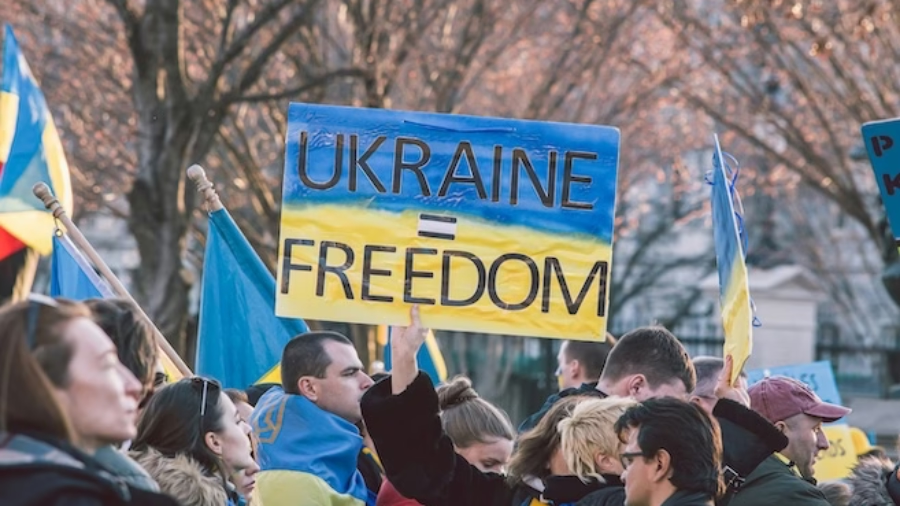
Ukraine needs freedom

When Diplomacy Becomes Deference: The Dangerous Reality of President Donald Trump’s Softness Towards Vladimir Putin

Introduction

Let’s cut through the diplomatic niceties and confront an uncomfortable truth: President Donald Trump’s relationship with Russian President Vladimir Putin isn’t just unusual—it’s actively undermining decades of international security architecture and emboldening aggression at precisely the moment when global peace hangs in the balance.

As I write this on December 30, 2025, the world watches another chapter unfold in this troubling saga. Just this past Sunday, Trump spoke with Putin for over an hour before hosting Ukrainian President Volodymyr Zelenskyy at Mar-a-Lago, reportedly catching Ukrainian officials off guard. The optics alone should alarm anyone concerned about America’s role as a defender of democracy and international law.

The Pattern of Presidential Deference

Helsinki: The Original Sin

To understand President Donald Trump’s softness towards Vladimir Putin and its impact on international peace, we must rewind to July 16, 2018. Standing beside Putin in Helsinki, days after Special Counsel Robert Mueller indicted twelve Russian intelligence officers for election interference, Trump delivered what Senator John McCain called “one of the most disgraceful performances by an American president in memory.”

Trump’s own words that day remain stunning: “I have great confidence in my intelligence people, but I will tell you that President Putin was extremely strong and powerful in his denial today.” He chose Putin’s “denial” over the unanimous assessment of seventeen U.S. intelligence agencies. This wasn’t diplomacy—it was capitulation on the world stage.

Former CIA Director John Brennan didn’t mince words, calling Trump’s performance “nothing short of treasonous.” Even Trump’s usual allies recoiled. Former House Speaker Newt Gingrich termed it “the most serious mistake of his presidency.”

What makes Helsinki particularly relevant today? Trump himself referenced it during Sunday’s meeting with Zelenskyy, claiming the “Russia, Russia, Russia hoax” had somehow bonded him with Putin. This revisionist history ignores a documented Russian interference campaign that has been confirmed by multiple bipartisan investigations, Mueller’s probe, and Trump’s own intelligence officials.

The NATO Threat That Won’t Die

President Donald Trump’s softness towards Vladimir Putin manifests most dangerously in his consistent undermining of NATO, the most successful military alliance in history. In February 2024, Trump told a rally crowd that he would “encourage” Russia to do “whatever the hell they want” to NATO countries he deemed “delinquent” on defense spending.

Think about that for a moment. An American president—the leader of NATO’s most powerful member—publicly encouraging Russian aggression against democratic allies.

NATO Secretary General Jens Stoltenberg’s response was unusually blunt: “Any suggestion that allies will not defend each other undermines all of our security, including that of the US, and puts American and European soldiers at increased risk.”

The criticism transcended party lines. President Biden called it “appalling and dangerous,” while Polish Defense Minister Władysław Kosiniak-Kamysz warned that “undermining the credibility of allied countries means weakening the entire NATO.”

Here’s what Trump fundamentally misunderstands: NATO isn’t a protection racket where countries pay dues. It’s a collective defense agreement where an attack on one is an attack on all—a principle that has prevented World War III for seventy-five years. The 2% GDP defense spending goal is about each nation’s domestic military investment, not payments to the United States.

Trump’s NATO rhetoric does Putin’s work for him. Russia doesn’t need to attack when doubt about American commitment might paralyze the alliance’s response to aggression in the Baltic states or Eastern Europe.

The Current Crisis: Territorial Concessions and False Peace

The Troubling Mar-a-Lago Summit

Sunday’s meeting revealed that territorial demands in the Donbas region remain the thorniest unresolved issue, with Trump pushing for an agreement that would require painful Ukrainian concessions. Sources close to the Ukrainian government have characterized the proposal as heavily biased toward Russia, noting it clearly specifies Russia’s tangible gains while being vague about Ukraine’s benefits.

The leaked details of Trump’s peace framework are staggering:

  • De facto U.S. recognition of Russian control over Crimea, nearly all of Luhansk, and occupied portions of Donetsk, Kherson, and Zaporizhzhia
  • Ukraine would cede additional territory in Donbas beyond what Russia has captured
  • Constitutional abandonment of NATO membership
  • Limits on Ukraine’s military to 600,000-800,000 personnel
  • Establishment of a demilitarized zone

This isn’t peace—it’s rewarding aggression. Russia invaded a sovereign nation, killed hundreds of thousands, committed documented war crimes, and now Trump proposes legitimizing these conquests.

The Ceasefire Rejection That Speaks Volumes

Perhaps most revealing: Trump and Putin jointly rejected Ukraine’s proposal for a temporary ceasefire, with Trump stating he understood Putin’s position that stopping and potentially restarting would be problematic. This alignment with Putin over Zelenskyy exposes where Trump’s sympathies truly lie.

Zelenskyy wants a sixty-day ceasefire to hold a referendum on territorial concessions—a democratic process allowing Ukrainians to decide their own fate. Putin wants no ceasefire, only immediate capitulation. And Trump? He sides with the autocrat who invaded, not the democratically elected leader defending his homeland.

The Strategic Consequences: Why This Matters Beyond Ukraine

Emboldening Global Aggression

Every territorial concession to Russia sends a message to authoritarian regimes worldwide: military aggression works. China watches intently as it considers Taiwan. Iran observes as it calculates regional moves. North Korea takes notes on nuclear brinkmanship.

The Carnegie Endowment for International Peace warns that Trump’s “Russia First” approach may attempt to pull Putin from Xi Jinping’s orbit, but it’s more likely to undermine the most successful alliance in history and make the world more dangerous for both America and Europe.

The Erosion of Democratic Unity

Trump’s recent National Security Strategy document describes the U.S. as “at odds” with European NATO allies over “unrealistic expectations” for Ukraine and criticizes them for “subversion of democratic processes” to suppress opposition wanting quicker peace with Russia.

Let that sink in. The American president is attacking democratic allies for supporting a democracy under invasion while cozying up to the autocrat doing the invading. This inverted moral framework threatens the entire post-World War II international order.

Military Reality: Starving Ukraine While Russia Advances

President Donald Trump’s softness towards Vladimir Putin has manifested in concrete military consequences. Ukrainian commanders now face artillery fire ratios as dire as 1:9, directly resulting from suspended U.S. ammunition shipments. This isn’t leverage—it’s manufacturing the “military reality” used to justify territorial concessions.

By depriving Kyiv of defensive weapons, Washington creates the very weakness it then cites as reason for surrender. Russia advances 12-17 square kilometers daily not because of superior military prowess, but because Ukraine fights with one hand tied behind its back.

The Historical Parallel We Can’t Ignore

This moment echoes the 1930s in uncomfortable ways. Then, Western democracies chose appeasement, allowing Hitler to consume territory piece by piece—the Rhineland, Austria, the Sudetenland—each time accepting assurances that this would be the last demand.

We know how that ended.

Putin has already taken Crimea in 2014, parts of Georgia in 2008, and now large swaths of Ukraine. What makes anyone believe recognizing these conquests will satisfy him rather than embolden him? History suggests the opposite.

As the Institute for the Study of War notes, at current advance rates, Russia wouldn’t fully capture Donetsk until August 2027. Yet Trump pushes Ukraine to surrender it now, manufacturing urgency that serves only Putin’s interests.

What Genuine Peace Would Require

Let’s be clear: wanting peace isn’t naive. Everyone wants this devastating war to end. But peace isn’t simply the absence of active combat—it requires conditions that prevent future aggression.

A genuine peace framework would include:

Security Guarantees with Teeth
Not vague promises, but binding commitments from NATO members to defend Ukraine against future Russian attacks. The alternative is watching Putin rebuild his military and attack again in 5-10 years.

Territorial Integrity
International law prohibits changing borders by force. Any settlement legitimizing Russia’s conquests destroys this principle and invites global chaos.

Accountability for War Crimes
Documented atrocities in Bucha, Mariupol, and elsewhere demand justice, not amnesty. Trump’s original plan included automatic amnesty for all war crimes—a moral obscenity.

Ukrainian Self-Determination
Any territorial concessions must receive approval through free referendum under international supervision during a genuine ceasefire—not forced acceptance under ongoing bombardment.

Rebuilding Support Without Rewarding Aggression
Reconstruction aid should come from frozen Russian assets and the international community, not from normalizing relations with Moscow before accountability.

The European Response: Democracy’s Last Stand?

To their credit, European allies haven’t followed Trump down this path. France’s Emmanuel Macron has convened a “Coalition of the Willing” meeting in Paris for early January, ensuring Europe isn’t sidelined by a Washington-Moscow deal.

The European counter-proposal rejects preordained territorial concessions, keeps NATO membership as an option pending alliance consensus, and proposes using frozen Russian assets for reconstruction rather than handing them to U.S. investors. It reaffirms Ukraine’s sovereignty rather than bartering it away.

The Kremlin rejected this European framework, calling it “completely unconstructive.” Of course they did—it doesn’t give Putin everything he wants.

That European leaders must work around American policy rather than with it represents a profound failure. The transatlantic alliance faces its gravest crisis since World War II, not from external threat but from American abdication.

The Questions Trump Can’t Answer

President Donald Trump’s softness towards Vladimir Putin raises questions that deserve straight answers:

Why does Trump consistently accept Putin’s word over American intelligence? From election interference to current negotiations, Trump sides with Moscow’s version of events despite overwhelming evidence to the contrary.

Why the rush to deal-making that benefits Russia? Trump boasted he’d end the war in a day as a candidate. Now he pushes Ukraine toward territorial surrender while Russia bombs civilians during peace talks.

What happened in Helsinki? That two-hour private meeting between Trump and Putin, with no American note-taker present, remains shrouded in mystery. What was discussed that Trump doesn’t want disclosed?

Why undermine NATO while courting Putin? Trump threatens America’s oldest allies while seeking to normalize relations with a regime that invaded a neighbor, committed war crimes, and continuously threatens Europe.

What does Putin have on Trump? Whether kompromat, business entanglements, or simple ego manipulation, something drives Trump’s consistent pro-Kremlin tilt that defies American interests.

The Stakes: Beyond Ukraine to Global Order

This isn’t just about one country in Eastern Europe. The international order built after World War II—however imperfect—has prevented great power conflicts for eighty years. It’s based on principles: territorial integrity, collective security, democratic self-determination, and accountability for aggression.

President Donald Trump’s softness towards Vladimir Putin threatens these foundational concepts. If military conquest succeeds in Ukraine with American blessing, every border dispute becomes a potential war. Every dictator with military capability and territorial ambitions gets a green light.

The Defense Post warns that without restored U.S. commitment, European countermeasures may prove insufficient against Russia emboldened by diplomatic concession. Trump may believe he’s closing a deal, but he’s actually presiding over the quiet normalization of a Russian sphere of influence.

A Call for Moral Clarity

Americans deserve better than a president who treats democratic allies as adversaries and autocrats as friends. We need leadership that understands that genuine strength means defending principles, not cutting deals that reward aggression.

Supporting Ukraine isn’t about foreign aid charity—it’s about preserving a world where borders aren’t changed by force, where democracies stand together, where international law matters. Every dollar spent supporting Ukraine’s defense saves future expenditures confronting unchecked aggression elsewhere.

President Donald Trump’s softness towards Vladimir Putin represents a betrayal of these values and a danger to American interests. His approach doesn’t make America safer—it makes the world more dangerous for everyone.

What Happens Next?

The negotiations continue. Trump projects optimism while acknowledging talks could “go poorly.” European leaders scramble to salvage what they can. Ukrainian forces fight and die daily as diplomatic games play out in luxury Florida estates.

Putin watches, calculating, knowing time favors Russia as Ukrainian ammunition dwindles and Trump pushes Zelenskyy toward capitulation. The Russian leader gets what he wants without winning militarily—Trump does the work for him.

Meanwhile, the fundamental question looms: When this “peace” inevitably collapses because it rewards rather than punishes aggression, will Trump finally understand that appeasement never works? Or will we repeat this cycle as Putin eyes Moldova, Georgia, or the Baltic states?

History suggests we already know the answer. The only question is whether enough Americans recognize the danger before it’s too late.


Take Action

This isn’t academic theory—it’s unfolding now with consequences for decades to come. Contact your representatives in Congress. Demand they support robust Ukraine aid regardless of presidential pressure. Support organizations working to preserve democracy and international law. And when you vote, remember that leadership matters, that moral clarity matters, and that President Donald Trump’s softness towards Vladimir Putin represents a clear and present danger to peace.

The time for silence has passed. Democracy requires vigilance, and right now, it needs your voice.


References

us-surrender-of-ukraine

The New US ‘Peace Plan’ for Ukraine: A Path to Surrender and a Gift to Russian Aggression?

Introduction: A Peace Plan or a Pyrrhic Gift?

When The New US ‘Peace Plan’ for Ukraine was unveiled, it was sold by its proponents as a breakthrough — a realistic way to end a brutal war. But for many observers, the draft reads less like diplomacy and more like capitulation. It demands Ukraine cede critical territory, slash its military forces, and abandon any hope of NATO membership. In short, critics say it’s not a path to peace — it’s a roadmap to surrender.

This proposal, which has reportedly gained backing from Donald Trump, has provoked outrage across Kyiv, Washington, and European capitals. Is it a genuine attempt to broker stability — or a dangerous appeasement that emboldens Russian aggression? And what does it mean for Ukraine’s very sovereignty?

In this post, we’ll unpack what’s in the plan, why it is deeply problematic, who stands to gain, and why many see it as “a gift to the aggressor.”

What’s Inside the So-Called Peace Plan?

Based on multiple media reports, including The Guardian and Al Jazeera, the draft includes a 28-point framework that places unusually heavy demands on Ukraine. (The Guardian) Key points include:

  • Recognition of Russian claims over Crimea, Luhansk, and Donetsk. The plan reportedly asks for de facto recognition of these regions as under Russian control. (The Guardian)
  • Limiting Ukraine’s military: The draft states that Ukraine’s armed forces would be capped at 600,000 personnel — a steep reduction from current levels. (United24 Media)
  • Abandon NATO aspirations: Ukraine is to enshrine in its constitution a ban on joining NATO, and NATO itself would amend its statutes to reflect this. (United24 Media)
  • No foreign troops in Ukraine: The proposal reportedly prohibits NATO or other foreign troops from being stationed in Ukraine, although European fighter jets would be based in Poland as part of “security guarantees.” (United24 Media)
  • Economic reintegration for Russia: The plan envisions phased sanction relief for Russia and reintegration into the global economy, including a possible return to the G8. (The Guardian)
  • Huge reconstruction fund: Around $100 billion of frozen Russian assets would be used for Ukrainian reconstruction — but with a controversial caveat: the U.S. would profit from this fund. (United24 Media)
  • Elections and constitutional changes: The draft allegedly requires Ukraine to hold elections within 100 days and to amend its constitution to reflect the new security arrangement. (Sky News)

Taken together, these elements look less like a negotiated peace and more like a deep strategic concession to Russia — one that weakens Ukraine’s sovereignty and long-term defense posture.

Why Many View It as a Capitulation

1. Territorial Surrender Under the Guise of Diplomacy

By demanding the formal or de facto cession of Crimea, Donbas, and other contested territories, the plan effectively asks Ukraine to normalize Russia’s military gains. For many, this is not compromise but capitulation. As The Guardian reported, the terms repeat Moscow’s maximalist demands, violating Ukrainian red lines. (The Guardian)

Ukraine’s leaders have historically rejected ceding these territories. As noted by AP News, recognizing Russian sovereignty over Crimea would require a constitutional amendment and a national referendum — a politically explosive move. (AP News)

2. A Weakened Military = Weakened Defense

Limiting Ukraine’s army to 600,000 soldiers significantly reduces its capacity to defend its territory, deter future aggression, or maintain internal stability. For a country still under threat, this is more than a concession — it’s a structural handicap.

3. Neutrality: Permanent Isolation from NATO

One of the most controversial parts of the proposal: Ukraine would constitutionally commit to never joining NATO. That weakens its long-term security prospects and prevents future Western alliances from offering robust guarantees against Russian re-aggression. (United24 Media)

4. Legitimizing the Aggressor

By granting Russia economic reintegration and recognizing its territorial gains, the plan could be seen as rewarding Moscow’s violent behavior. Many argue this sets a dangerous precedent for international law: conquer by force and negotiate later.

5. Opaque Guarantees

The security guarantees promised to Ukraine are vague. Reports indicate that while there would be U.S. backing, specifics are light, and the deal carries significant conditions — including a cut of profits from the reconstruction fund. (United24 Media)

Reactions from Kyiv, Europe, and Beyond

Kyiv’s Response: A Mix of Caution and Alarm

Ukrainian President Volodymyr Zelenskyy has expressed a willingness to “work honestly” on the plan, emphasizing the need for “respect for our independence, sovereignty, and dignity.” (Novaya Gazeta Europe) But not all in Ukraine are so diplomatic. Several officials have denounced the plan as “absurd”, equating it with surrender. (The Guardian)

European Leaders Push Back

European allies are deeply skeptical. Analysts and politicians from NATO countries have warned that concessions to Russia undermine the core logic of European security. As The Guardian notes, accepting this proposal could effectively hand Russia a permanent strategic advantage. (The Guardian) Germany’s defense minister has publicly rejected what he calls “weakness through peace,” arguing that capitulation risks long-term instability. (The Guardian)

Russian Influence in the Draft

Alarmingly, some reports suggest that the plan was not just U.S.-led — it may have been co-drafted with Russian officials. The Guardian names Kirill Dmitriev, a close Putin ally, as being centrally involved in the negotiations alongside U.S. envoy Steve Witkoff. (The Guardian) If true, it undermines claims that this is a balanced proposal — instead, it suggests it may more closely reflect Moscow’s agenda than Kyiv’s.

The Strategic Risk: Why This Is Dangerous for Ukraine — and Europe

A Precedent for Aggressors

If the world accepts this proposal, it sends a message:
Military aggression can pay. Stare down your adversary, grab what you want, and then negotiate.

That emboldens not just Russia — but other autocratic regimes watching.

Long-Term Military Weakening

Capping Ukraine’s army permanently weakens its deterrence against future Russian encroachment. A future conflict could become more likely, not less.

Fragile Guarantees

Ambiguous security guarantees haven’t protected Ukraine so far. Without strong, binding commitments, there’s no guarantee that future leaders — on any side — will uphold the deal.

Erosion of International Norms

Normalizing Russia’s territorial gains undermines decades of post-Cold War consensus about sovereignty, borders, and the rule of law.

European Security at Risk

With Ukraine weakened, Russia’s posture toward Europe becomes more aggressive. A weaker Ukraine could invite further destabilization on NATO’s eastern flank — not peace.

Why Is the U.S. Supporting This, If at All?

Understanding why such a controversial plan is being floated requires peeling back political, ideological, and geopolitical layers:

  1. Domestic Calculations
    For Donald Trump, the peace plan is deeply tied to his “deal-maker” identity. Offering a “deal” with Russia plays to his base and reinforces his geopolitical brand.
  2. War Fatigue
    In the U.S. and Europe, public appetite for continued involvement in Ukraine is waning. A “peace” deal with concessions may seem politically palatable — even if dangerous.
  3. Backchannel Diplomacy
    The plan seems to have been developed through informal channels (e.g., Trump envoy Steve Witkoff, Kirill Dmitriev), not through traditional diplomatic forums. This raises concerns about transparency, accountability, and whose interests are really being served. (The Guardian)
  4. Global Strategy
    Reintegrating Russia economically could appeal to U.S. economic interests, while avoiding long-term military commitments — a trade-off that some policymakers may view as pragmatic rather than principled.

Is There Any Path Forward That Avoids Surrender?

Critics argue that real peace must include:

  • No irreversible territorial concessions
  • Strong, enforceable, legal security guarantees
  • Constitutional clarity in Ukraine (with full sovereignty preserved)
  • A genuine NATO pathway or equivalent alliance guarantees
  • Transparent international reconstruction funding
  • Respect for Ukrainian national identity, including language and institutions

Without these, a “peace” deal risks being heartbreakingly hollow — more a tactical retreat than a lasting resolution.

A Personal Reflection: Why This Matters to Me

Watching this proposal unfold has been deeply unsettling. As someone who cares deeply about democratic values, global stability, and the right of oppressed nations to defend themselves, the contours of this plan feel like a betrayal.

I’ve talked with people in Ukraine — citizens, analysts, veterans — and they express a sense of déjà vu. Surrender dressed as peace, deals made in back rooms, terms that diminish national dignity. They’re haunted by history: once you concede land, once you cap your military, once you promise neutrality — the cost is not just strategic, it’s existential.

This isn’t just a geopolitical move: it’s a test of moral courage, of our collective will to defend freedom, and of whether the world supports sovereignty or sacrifice.

Key Takeaways

Here’s what should be front of mind for anyone following this proposal:

  • It’s not purely a peace plan; it mirrors Russia’s war goals.
  • Military limitations weaken Ukraine’s ability to defend itself long-term.
  • Neutrality and NATO exclusion undermine Europe’s collective security.
  • Economic reintegration of Russia could reward aggression.
  • The security guarantees are vague and potentially hollow.
  • This could set a dangerous international precedent.

Conclusion: A Peace Plan That Risks More Than It Promises

At first glance, The New US ‘Peace Plan’ for Ukraine may appear as a generous olive branch. But if you peel back the veneer, you find terms that align far more closely with Russian strategic objectives than Ukrainian sovereignty. Recognizing occupied territories, shrinking military capacity, limiting alliance membership — these are not compromises born of compromise, but terms drafted under pressure.

If this plan moves forward as is, it may mark a pivotal moment: not just for Ukraine, but for the future of international order. It could embolden aggressors, signal a weakening of NATO, and celebrate peace on terms that undermine justice.

In this moment, the world must ask: is this a path to peace, or a prescription for capitulation?

Call to Action

What do you think?

  • Is this “peace plan” a genuine diplomatic breakthrough — or a dangerous concession?
  • Can Ukraine afford to accept these terms?
  • Should the international community support or reject a deal shaped so heavily by the aggressor?

Let me know your thoughts in the comments — and please share this post if you believe the gravity of these proposals needs to be widely understood. Subscribe for more in-depth political analysis and breaking commentary about Ukraine, geopolitics, and global security.

Sources & References

  • The Guardian: analysis of U.S.-Russian drafted peace plan (The Guardian)
  • Al Jazeera: review of Ukraine ceding land and weapons (Al Jazeera)
  • Novaya Gazeta Europe: Zelenskyy’s response (Novaya Gazeta Europe)
  • Sky News: text of the 28-point draft plan (Sky News)
  • Time Magazine: Trump’s public statements on Crimea & NATO (TIME)
  • Al Jazeera: why Russia rejected earlier Trump proposals (Al Jazeera)
  • Le Monde: report on U.S. ultimatum to Ukraine (Le Monde.fr)