
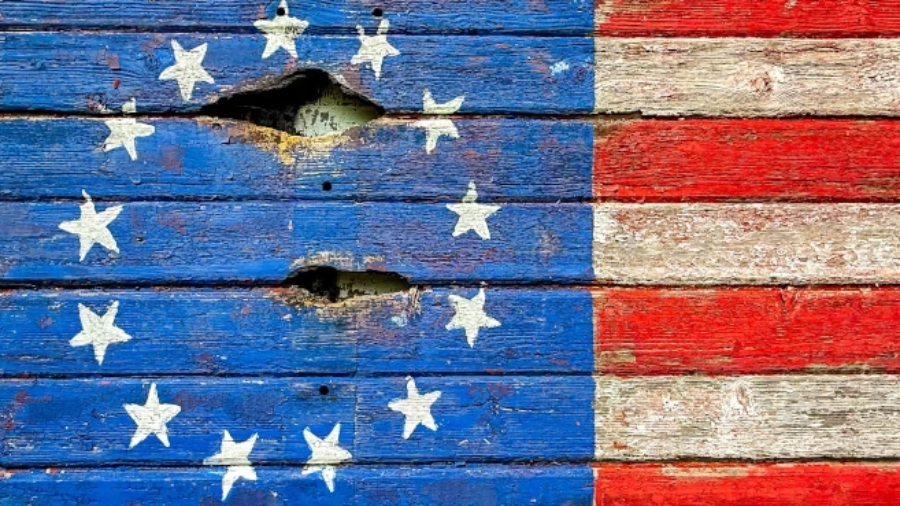
the end of American Internationalism

Is Trumpism a Threat to Democracy? Examining Authoritarianism, Propaganda, Arrogance & Political Thuggery in the Trump Era

Introduction:

Is the United States sleepwalking into authoritarianism?
This question, once dismissed as hysterical, now echoes across academic circles, global institutions, and households worldwide. At the center of this debate is Trumpism, a political force shaped by authoritarianism, propaganda, and political thuggery — the focus keywords guiding our journey.

Donald Trump may be only one man, but the political movement crafted around him has become something bigger, darker, and more enduring. Scholars at institutions like Harvard University’s Ash Center have openly warned about how Trump-style politics mirrors modern autocracies. Freedom House, which measures the health of global democracies, noted a steady decline in U.S. democratic norms during the Trump era.

But how did a country once seen as a global model of democratic governance become entangled in the same patterns of strongman politics it used to condemn? And what does the rise of Trumpism reveal about the dangerous mix of arrogance, grievance-based rhetoric, propaganda, and organized political intimidation?

This blog post unpacks these trends — with research, lived observation, and critical analysis — to understand whether Trumpism is merely a disruptive political movement or a full-blown democratic threat.

Understanding Trumpism: A Movement Built on Grievance and Strongman Politics

Trumpism is not just a collection of policies.
It is a political culture built on:

  • Strongman posturing
  • Cult-like loyalty
  • Aggressive misinformation
  • Demonization of political opponents
  • Narratives of victimhood and grievance

In this sense, it resembles the political styles of modern authoritarian leaders such as:

  • Viktor Orbán (Hungary)
  • Jair Bolsonaro (Brazil)
  • Recep Tayyip Erdoğan (Turkey)
  • Vladimir Putin (Russia)

The Global Context Matters

Scholars at Brookings Institution and International IDEA have documented a global wave of democratic backsliding. Trumpism fits squarely into this trend by:

  • Discrediting elections
  • Delegitimizing independent media
  • Threatening institutions
  • Promoting violence as a political tool

And crucially:

Trumpism Rewards Arrogance and Punishes Accountability

The defining moral code of Trumpism is simple:
Loyalty to Trump is more important than loyalty to the Constitution.

From his cabinet to Congress, to local officials, those who question Trump are attacked, mocked, and politically destroyed. Those who obey thrive.

That is how autocratic systems are built.

Authoritarianism in the Trump Era: The Warning Signs Are Not Subtle

Political scientists often note that authoritarianism grows slowly at first — until it suddenly accelerates. Trump’s presidency and post-presidency show clear warning signs identified by scholars like Steven Levitsky and Daniel Ziblatt, authors of How Democracies Die.

Below is a concise comparison of Trumpism versus classical authoritarian behavior:

Table: Authoritarian Warning Signs & How Trumpism Fits

Authoritarian BehaviorDescriptionExample in Trumpism
Attacks on independent mediaLabeling journalists as enemies of the stateTrump calling the press “the enemy of the people”
Delegitimizing election resultsClaiming fraud without evidenceThe 2020 “Stop the Steal” movement
Weakening checks and balancesInterfering in justice systems, pressuring agenciesAttempts to weaponize DOJ against critics
Glorification of violenceEndorsing political intimidationPraising Jan. 6 rioters as “patriots”
Cult of personalityLeader seen as infallibleMAGA movement’s loyalty to Trump over GOP

Attacking the Press: A Classic Authoritarian Move

Independent journalism is a cornerstone of democracy.
Trump repeatedly attempted to tear that cornerstone down.

He used terms historically associated with dictators such as Stalin and Mao — branding critical media outlets as:

  • “Fake news”
  • “The enemy of the people”

Press freedom organizations like the Committee to Protect Journalists (CPJ) warned that Trump’s rhetoric directly endangered journalists, both in the U.S. and abroad.

When leaders attempt to silence the press, it’s not a policy argument.
It’s an authoritarian tactic.

The Election Denial Movement: A Direct Assault on Democracy

Trump’s refusal to accept the 2020 election results — despite over 60 failed court cases — was not mere political theater. It was a calculated attack on the electoral system.

Organizations like The Brennan Center for Justice have tracked how election denial, fueled by Trump’s propaganda machine, has led to:

  • Threats against election workers
  • Attempts to overturn certified results
  • New laws restricting voting rights

This is not normal.
This is how democracies decline.

Propaganda as a Political Weapon: The Trump Playbook

Propaganda under Trumpism is not accidental.
It is strategic, pervasive, and deliberately designed to inflame grievances.

The Four-Part Propaganda Strategy

  1. Create “alternative facts”
    Trump officials literally used this term to justify false claims.
  2. Repeat lies until they feel true
    Studies from MIT found that false political news spreads faster than real news.
  3. Attack institutions that contradict the lies
    Courts, FBI, intelligence agencies — all targeted.
  4. Elevate conspiracy theories
    From QAnon to “deep state” fantasies, Trumpism thrives on unverified claims.

Why Propaganda Works in the Trump Movement

Propaganda is effective because Trumpism is not built on policy — it’s built on identity.
Supporters often embrace conspiracy theories not because they are plausible, but because they reinforce belonging to the political tribe.

That is how propaganda becomes a political weapon.

Political Thuggery: From Rhetoric to Real-World Violence

Perhaps the clearest indicator of Trumpism’s authoritarian tilt is the normalization of political intimidation and violence.

January 6 Was Not an Accident — It Was a Culmination

The storming of the U.S. Capitol was the result of:

  • Months of election lies
  • A direct call to “fight like hell”
  • A coordinated effort to stop certification

Academic researchers at Princeton University and The Atlantic Council classify this type of event as a proto-coup — an attempt to remain in power outside constitutional means.

Political Violence as a Feature, Not a Bug

Trump has repeatedly:

  • Encouraged supporters to attack protestors
  • Promised pardons to convicted rioters
  • Referred to violent extremists as “very fine people” or “patriots”

In modern democracy studies, this is known as democratic erosion through normalization of violence.

The Arrogance Factor: Why Trumpism Rejects Accountability

Arrogance — not confidence — is the ideological glue of Trumpism.

It manifests as:

  • A belief in personal infallibility
  • A refusal to accept blame
  • An insistence on loyalty
  • A dismissal of legal and moral constraints

This arrogance is why Trumpism:

  • Rejects oversight
  • Condemns investigations
  • Undermines courts
  • Treats institutions as enemies

It is also why the movement cannot reform itself.
Accountability is the ultimate enemy of the strongman.

Key Insights: What Makes Trumpism a Unique Democratic Threat?

1. It centralizes loyalty around one man, not the Constitution.

This is the core of authoritarian movements worldwide.

2. It thrives on propaganda, not policy.

This allows falsehoods to replace facts in public discourse.

3. It normalizes political violence.

This is historically one of the strongest predictors of authoritarian decline.

4. It weakens institutions slowly — then suddenly.

Democracy erodes not with tanks, but with legal manipulation, lies, and intimidation.

5. It promotes a culture of arrogance.

When leaders reject accountability, democracies destabilize.

Conclusion: The Future of American Democracy Depends on Recognizing the Threat

Authoritarianism rarely arrives wearing a military uniform.
It arrives wearing a suit, repeating familiar slogans, promising to fight for “the people” while dismantling the institutions that protect them.

Trumpism is not simply populism.
It is a political movement defined by:

  • Authoritarian impulses
  • Relentless propaganda
  • Political thuggery
  • Dangerous arrogance

Whether America confronts this reality will determine whether democracy remains resilient — or continues to deteriorate.

Call to Action

If you found this article insightful, share it with others who care about democratic values.
Leave a comment, join the conversation, and explore related posts on democracy, governance, and political accountability.

Birtherism Conspiracy theory

The “Birtherism Conspiracy theory”: Donald Trump as Its Loudest and Shameless Megaphone

Introduction: When a Fringe Lie Became a Political Weapon

Every conspiracy theory has an origin story. Some fade quietly. Others ignite a spark and die out.
But then there are those rare ones—like the Birtherism Conspiracy theory—that mutate into powerful political machines when the right messenger picks up the megaphone.

And no one embraced, amplified, and weaponized Birtherism more aggressively than Donald J. Trump.

Before 2011, Birtherism was little more than a fringe rumor circulating on obscure blogs and forwarded email chains. Yet, by the time Trump was done with it, the conspiracy had shaped national discourse, influenced presidential politics, and opened a dark new chapter in America’s relationship with truth.

This post takes you on a deep, meticulously researched exploration of:

  • how Trump became the face of Birtherism
  • why the conspiracy resonated with millions
  • the racial, cultural, and political dynamics that fueled its rise
  • and how it foreshadowed the disinformation ecosystem we live in today

Let’s dig in.

What Exactly Was the Birtherism Conspiracy Theory? A Brief Refresher

Put simply, Birtherism was the false claim that Barack Obama was not born in the United States, and thus was constitutionally ineligible to be president.

Despite Obama releasing his short-form birth certificate in 2008, and later his long-form version in 2011, the conspiracy persisted for years. Why?
Because Birtherism was never truly about documents—it was about identity.

It challenged the legitimacy of the first Black president not on the basis of policy, but on the basis of belonging.

How Birtherism Started—And Why It Was Ripe for Hijacking

Birtherism didn’t begin with Trump. Initial murmurs emerged during the 2008 Democratic primaries, mostly from fringe Hillary Clinton supporters. But these were small fires, easily containable.

The conspiracy lacked:

  • a national voice
  • media amplification
  • a charismatic promoter
  • a platform large enough to push it mainstream

In other words—it needed someone like Trump.

Donald Trump Enters the Arena: How the Conspiracy Found Its Champion

A Celebrity in Search of Relevance

By 2011, Trump was known more for The Apprentice than for serious political engagement. Yet he wanted something deeper: relevance, power, a seat at the national table.

Birtherism was his gateway.

Trump began:

  • calling in to TV interviews
  • posting provocative tweets
  • demanding Obama “prove” his citizenship
  • implying he had private investigators “on the ground in Hawaii”
  • repeatedly insisting that “people are saying” shocking new details

Trump wasn’t fact-finding. He was experimenting with what would later define his political brand:

  • repetition
  • spectacle
  • manufactured controversy
  • the illusion of insider knowledge
  • media manipulation

Birtherism worked because Trump knew one simple truth:
A controversy doesn’t need evidence—only attention.

The Media’s Role: How They Fell for Trump’s Game

Birtherism exploded when major networks—CNN, NBC, Fox News—began inviting Trump onto their platforms under the guise of political commentary.

The result?

Trump turned breakfast-hour TV into a launchpad for the conspiracy.
He had:

  • free media coverage
  • millions of curious viewers
  • no fact-checking boundaries
  • an endless supply of provocative soundbites

Newsrooms treated the conspiracy as political theater, not disinformation. Ratings surged. Trump’s visibility soared. Birtherism became mainstreamed.

This moment marked a cultural shift:
America’s political conversation became a reality show, with Trump writing the script.

A Racialized Conspiracy: Why Birtherism Was Never Just About Birth Certificates

One reason Birtherism stuck is because it exploited long-standing racial anxieties in America.

Trump didn’t invent racialized doubt—but he understood how to weaponize it.

The conspiracy fed into:

  • xenophobic fears
  • stereotypes about African nations
  • discomfort with a Black man in the White House
  • the notion that Obama was “other,” “foreign,” “un-American”

Trump leaned into these sentiments with precision.

By repeatedly calling Obama’s citizenship into question, he wasn’t just spreading misinformation—
he was attacking the legitimacy of Black leadership in America.

Birtherism became a dog whistle wrapped in a question:
“Where is he really from?”

Why People Believed It: Understanding the Psychology Behind the Lie

Birtherism succeeded not because the evidence was compelling, but because the human mind is vulnerable to certain psychological triggers.

1. Confirmation Bias

People predisposed to distrust Obama saw Birtherism as validation of their fears.

2. Repetition Effect

The more Trump repeated it, the more “true” it felt—regardless of evidence.

3. Identity Protection

For some, believing the conspiracy resolved cognitive dissonance:
“How could a country elect someone who doesn’t look like our past presidents?”

4. Mistrust of Institutions

Doubting Obama was easier for many than trusting:

  • the media
  • the government
  • the Democratic Party

Trump leveraged all these psychological levers expertly—long before political analysts recognized what was happening.

Trump vs. Reality: The Moment Obama Released the Long-Form Birth Certificate

When Obama finally released his long-form birth certificate in April 2011, the media expected the conspiracy to die.

Instead, something fascinating happened:

  • Trump took a victory lap, claiming he had “forced” Obama’s hand
  • Support for Birtherism actually remained strong among conservatives
  • Public trust in Obama’s legitimacy barely shifted

This proved something profound:
Birtherism was never meant to be solved. It was meant to be sustained.

Trump wasn’t debunked—he was rewarded.

A Look at the Data: Birtherism by the Numbers

Here’s a simplified visual showing how belief in the conspiracy shifted:

YearPercentage of Republicans Who Believed Obama Was Not Born in the U.S.
2009~17%
2010~31%
2011 (Trump peak)43%–51%
2016 (Trump campaign)72% believed Obama was born abroad or were “not sure”

The more Trump amplified it, the more people believed it.

How Birtherism Became Trump’s Political Springboard

Birtherism didn’t just elevate Trump—it prepared his future base.

1. It positioned Trump as a political outsider

Someone willing to say “what others won’t.”

2. It tested his influence on conservative voters

The results? Overwhelming.

3. It built a movement grounded in grievance, identity, and distrust

These ingredients later fueled:

  • anti-immigrant rhetoric
  • attacks on the press
  • “fake news” culture
  • Stop the Steal narratives
  • January 6 disinformation

Birtherism was the prototype for Trumpism.

The 2016 Pivot: Trump Finally Admits the Truth—But Only Halfway

In 2016—five years after igniting the conspiracy—Trump finally stated:
“President Obama was born in the United States. Period.”

But even then, he:

  • refused responsibility
  • blamed Hillary Clinton (falsely)
  • used the admission as a political stunt
  • offered no apology

For Trump, retracting Birtherism wasn’t an act of honesty—it was a strategy shift.

The conspiracy had served its purpose.
A new target awaited: Hillary Clinton.

Key Insights: What Birtherism Reveals About Modern American Politics

1. Conspiracies thrive when reality is optional

For millions, belief had nothing to do with documents—only loyalty and identity.

2. Racism adapts to new languages

Birtherism offered a “respectable” vehicle for racialized doubt.

3. Media ecosystems reward spectacle over truth

Trump understood this better than any politician in generations.

4. Disinformation is powerful because it is emotional

Birtherism wasn’t just a lie—it was a narrative.

5. The conspiracy prepared the ground for future democratic erosion

Everything from COVID denialism to election lies traces its lineage to Birtherism.

Conclusion: Trump Didn’t Just Promote Birtherism—He Perfected a Political Blueprint

The Birtherism Conspiracy theory wasn’t just a smear campaign against Barack Obama.
It was the birth of a political era defined by:

  • emotional manipulation
  • racialized disinformation
  • media spectacle
  • truth decay
  • political identity wars

Trump didn’t invent the lie.
He industrialized it.

And America is still living with the consequences.

Call to Action

If you found this deep-dive insightful:
✔️ Share your thoughts in the comments — where do you think Birtherism ranks among the most damaging political conspiracies?
✔️ Explore more articles on political disinformation, Trumpism, and democratic resilience.
✔️ Subscribe to stay updated on new analyses and long-form essays.

trumpism-and-the-maga-cult

The American Undoing: Trumpism and the Cult That Captured a Nation

Introduction: The Rise of a Political Cult

The United States has long prided itself on democracy, debate, and the peaceful transfer of power. Yet, over the past decade, a powerful political phenomenon has emerged that threatens these pillars: Trumpism and the MAGA cult.

This movement goes beyond political ideology. It is a culture built on loyalty to a single personality, fueled by misinformation, grievance politics, and a fervent sense of identity. Trump’s rise did not create this movement—it captured and amplified deep-seated cultural anxieties, turning them into a political force that dominates contemporary American politics.

Understanding this phenomenon is not optional. It is essential to comprehending how American democracy can be manipulated, reshaped, and, at times, threatened from within.

What is Trumpism?

Trumpism is more than a political philosophy; it is a hybrid of populism, nationalism, and authoritarian tendencies, centered around loyalty to Donald J. Trump.

Core Features of Trumpism

  • Personality-Centric Politics: The movement revolves around Trump’s persona rather than policy.
  • Anti-Establishment Rhetoric: Institutions, experts, and long-standing political norms are portrayed as enemies.
  • Grievance Politics: Appeals to cultural, economic, and racial anxieties motivate the base.
  • Conspiratorial Thinking: Misinformation and conspiracies reinforce belief systems and loyalty.
  • Authoritarian Impulses: Norms are subverted to maintain power and control dissent.

Trumpism is not confined to Republican voters. It has influenced media, social networks, and even political discourse globally, reshaping norms and redefining the boundaries of political acceptability. (source)

The MAGA Cult: Loyalty Over Ideology

The MAGA movement is the social and psychological manifestation of Trumpism. Unlike traditional political movements, it operates more like a cult, demanding allegiance to the leader over ideology, facts, or ethical considerations.

Cult Dynamics in Politics

  • Unquestioning Loyalty: Members often defend Trump regardless of evidence or truth.
  • Demonization of Outsiders: Critics, including moderate Republicans, media, and institutions, are framed as existential threats.
  • Emotional Manipulation: Fear, anger, and grievance drive engagement and mobilization.
  • Symbolic Rituals: Slogans, rallies, and merchandise reinforce identity and belonging.

These dynamics explain why many followers remain committed even after public controversies or legal challenges, demonstrating the psychological depth of the movement. (source)


Lies and Misinformation as Glue

One of the most potent tools of the MAGA cult is misinformation. Repeated falsehoods create an alternate reality, eroding the shared factual foundation necessary for democracy.

Weaponizing Falsehoods

  • Election Fraud Claims: The 2020 election lies undermined public trust in democracy.
  • COVID-19 Misinformation: Promoting unproven treatments and downplaying risks endangered public health.
  • Media Vilification: Labeling credible sources as “fake news” delegitimizes independent oversight.

The repetition of these narratives fosters cognitive loyalty, conditioning followers to accept misinformation as truth. (source)

Table: Traditional Political Movements vs. Trumpism/MAGA Cult

Traditional MovementsTrumpism/MAGA Cult
Policy-driven debatePersonality-driven loyalty
Respect for institutionsAttacks on judiciary, media, and Congress
Fact-based discourseMisinformation and conspiracy acceptance
Democratic normsAuthoritarian impulses and norm subversion
Civil discoursePolarization and demonization of opponents
Collective civic responsibilityGrievance-driven identity politics

Racism and Cultural Division

Racism and nativism are core drivers of the MAGA cult, not just incidental features. Trumpism leverages identity politics to solidify loyalty.

Policy and Rhetoric

  • Immigration Bans: Policies disproportionately targeting Muslim-majority nations (source)
  • Border Enforcement: Aggressive deportation policies fueling cultural anxieties
  • Racialized Messaging: Repeatedly framing minorities or immigrants as threats

These tactics cultivate fear and resentment, creating a sense of shared struggle among followers, which reinforces group cohesion.

Authoritarian Tendencies and Power Consolidation

Trumpism demonstrates hallmark authoritarian strategies: centralizing power, subverting norms, and punishing dissent.

Examples of Authoritarian Governance

  • Politicizing the Department of Justice and intelligence agencies
  • Overreliance on executive orders bypassing legislative checks
  • Public threats to and marginalization of political opponents

This approach destabilizes democratic institutions and creates a culture of obedience rather than debate. (source)

Conspiracy Theories and the MAGA Psyche

Conspiratorial thinking is not just tolerated—it is amplified. From QAnon to election “stolen” narratives, these conspiracies provide the MAGA cult with an internal logic that justifies extreme loyalty and delegitimizes dissent.

Political and Social Impact

  • Reinforcement of group identity
  • Polarization of public opinion
  • Justification for political violence, exemplified by January 6th (source)

Without the conspiratorial scaffolding, the cult loses its cohesion and purpose.

Why Trumpism Persisted Despite Controversies

Even after scandals, impeachment proceedings, and electoral defeat, Trumpism endures. Key reasons include:

  • Emotional Loyalty: Personal identity is tied to support for Trump
  • Information Control: Echo chambers reinforce beliefs
  • Fear of “Other”: Cultural, racial, and political threats strengthen group cohesion
  • Punishment of Dissent: Political marginalization of those who oppose Trump consolidates base loyalty

This resilience illustrates that Trumpism is not simply political—it is social, psychological, and cultural.

Consequences for American Democracy

Erosion of Trust

  • Reduced faith in elections, courts, and media
  • Increased polarization and partisanship

Threats to Institutions

  • Politicization of independent agencies
  • Normalization of executive overreach

Societal Division

  • Deepening racial and cultural divides
  • Tribalism replacing civic engagement

The implications are long-term, affecting governance, social cohesion, and the ability to respond to national crises effectively.

Visual Suggestions:

  • Infographic: “The Anatomy of the MAGA Cult” (showing lies, loyalty, conspiracies, and identity politics)
  • Timeline: Key events in Trumpism and MAGA cult formation (2015–2025)

Lessons and the Path Forward

Rebuilding Democratic Norms

  • Protect judicial independence
  • Strengthen electoral systems and oversight
  • Promote civic education and critical media literacy

Combating Misinformation

  • Support independent fact-checking
  • Encourage media accountability
  • Educate the public on misinformation tactics

Cultural and Political Healing

  • Dialogue across ideological divides
  • Encourage ethical political leadership
  • Promote civic responsibility over partisan loyalty

Conclusion: The American Undoing and the Road Ahead

Trumpism and the MAGA cult represent more than a political movement—they are a cultural and psychological phenomenon that has reshaped American politics. Lies, conspiracies, authoritarian impulses, and cultural grievances form a self-reinforcing ecosystem, capturing loyalty and polarizing society.

The challenge is immense but not insurmountable. Restoring democracy requires vigilance, education, ethical governance, and the courage to confront misinformation and cult-like loyalty. The future of American democracy depends on understanding the mechanics of this movement—and taking steps to ensure it does not capture the nation again.

Call to Action

  • Stay informed: Critically evaluate information sources
  • Engage civically: Vote, attend town halls, and participate in community discussions
  • Promote accountability: Support transparent governance and ethical leadership
  • Share this post: Help others understand the threat of political cults and the dynamics of Trumpism

References

  1. Brookings Institution, January 6 Insurrection Analysis. (brookings.edu)
  2. Vox, Trump’s Travel Ban and Muslim Discrimination. (vox.com)
  3. Psychology Today, Trump and the Psychology of Political Cults. (psychologytoday.com)
  4. Foreign Affairs, Trumpism and Its Global Impact. (foreignaffairs.com)
  5. CDC, COVID-19 Misinformation Resources. (cdc.gov)
lies, racism, and authoritarianism

Trump’s Legacy of Lies, Racism, and Authoritarianism Fueled by Conspiracy Theories

Introduction: The Making of a Political Era

The political era of Donald J. Trump is unlike anything in modern American history. His presidency was marked not only by policy decisions but by a deliberate reshaping of political norms. At the core lies a disturbing triad: lies, racism, and authoritarianism, all amplified by conspiracy theories that undermined truth and sowed division.

This is Trump’s legacy of lies, racism, and authoritarianism—a period that redefined the Republican Party, polarized the electorate, and challenged the very foundations of American democracy.

Understanding this legacy is essential, not just to analyze the past, but to safeguard the future. In this post, we explore the mechanisms of Trump’s influence, the consequences for governance and society, and the enduring impact of misinformation on American politics.

Lies as a Tool of Political Power

Lying is not new in politics, but Trump elevated it into a systemic tool. The Washington Post reported over 30,000 false or misleading statements during his four-year presidency. (source)

Disinformation and Reality Manipulation

Trump repeatedly used false narratives to:

  • Undermine critics
  • Justify policy decisions
  • Mobilize his political base

Examples include:

  • Election fraud claims: Trump’s persistent false assertion that the 2020 election was “stolen” created widespread distrust in democratic institutions.
  • COVID-19 misinformation: From downplaying the virus to promoting unproven treatments, these lies had tangible public health consequences. (source)

By weaponizing falsehoods, Trump blurred the line between fact and fiction, weakening public trust and creating fertile ground for authoritarian impulses.

Lies as Loyalty Tests

In Trump’s ecosystem, loyalty to the leader often trumped allegiance to truth. Politicians, journalists, and even institutions faced a stark choice: align with the narrative—or risk marginalization, censure, or career damage.

This approach normalized deception and incentivized complicity, reinforcing authoritarian tendencies within the political system.

Racism as Policy and Rhetoric

Racism in the Trump era was not always overt; it often manifested through coded language, targeted policies, and symbolic gestures.

Policy-Driven Racism

Several initiatives exemplify systemic bias:

  • The travel ban: Widely criticized as targeting Muslim-majority countries. (source)
  • Immigration enforcement: Aggressive deportation policies disproportionately affected Latino communities.
  • Criminal justice rhetoric: Statements labeling certain neighborhoods and populations as “dangerous” reinforced racial stereotypes.

Symbolic Racism and Dog Whistles

Beyond policy, Trump frequently deployed racially coded language:

  • Criticizing NFL players for kneeling during the national anthem as “disrespectful”
  • Repeatedly referring to Mexican immigrants as criminals or “rapists”

These messages fueled divisions and mobilized voters along racial lines, deepening societal fractures.

Authoritarianism as Governance Style

Trump’s approach to leadership displayed hallmark traits of authoritarianism: concentration of power, attacks on dissent, and disdain for democratic norms.

Undermining Institutions

  • Politicization of the Department of Justice
  • Public attacks on federal judges who ruled against him
  • Attempts to pressure the FBI and intelligence agencies

Such actions eroded institutional independence, a cornerstone of democratic governance.

Centralization of Power

By bypassing legislative and judicial checks, Trump exemplified the authoritarian tactic of executive overreach. Executive orders became a primary tool to enforce policy unilaterally, often disregarding procedural norms.

Table: Comparing Democratic Norms vs. Authoritarian Practices Under Trump

Democratic NormsTrump Era Authoritarian Practices
Free and fair electionsRepeated false claims of election fraud
Independent judiciaryPublic attacks on judges and DOJ
Checks and balancesOveruse of executive orders, bypassing Congress
Respect for truthSystematic misinformation and conspiracy propagation
Civil discourseThreats to journalists and opponents
Transparent governanceWithholding of key information and politicized institutions

Conspiracy Theories as a Catalyst

Conspiracy theories were central to Trump’s political strategy, reinforcing lies, racism, and authoritarianism.

Popularizing Fringe Ideas

Trump elevated fringe theories into mainstream political discourse:

  • QAnon narratives suggesting a deep-state conspiracy
  • False claims about voter fraud in 2020
  • COVID-19 origin and treatment conspiracies

By doing so, he mobilized a base willing to reject evidence and reality if it contradicted party loyalty.

Effects on Political Culture

Conspiracy-driven governance:

  • Polarized society further
  • Undermined faith in elections and institutions
  • Encouraged radical actions, exemplified by the January 6th insurrection (source)

The integration of conspiracies into mainstream politics marked a shift from debate to belief-based allegiance—a defining feature of authoritarian systems.

Intersections of Lies, Racism, and Authoritarianism

Trump’s legacy cannot be understood through a single lens. Lies, racism, and authoritarianism were mutually reinforcing:

  • Lies justified authoritarian measures (“the election was stolen”)
  • Racist narratives mobilized loyalty and fear, undermining pluralism
  • Authoritarian governance enforced compliance and punished dissent

This interconnected framework created a self-reinforcing ecosystem that normalized extreme political behavior.

Societal and Political Consequences

Polarization and Distrust

  • Partisan identity now often outweighs objective reality
  • Mistrust of media, judiciary, and election infrastructure has become entrenched
  • Civic engagement is often reactive, rooted in fear or grievance

Threats to Minority Communities

  • Policies and rhetoric created environments hostile to minorities
  • Structural inequities were reinforced through legal and political channels

Erosion of Democratic Norms

  • Acceptance of falsehoods as political strategy
  • Undermining of independent institutions
  • Increasingly centralized and personalized power in executive office

Visual Suggestion:

  • Infographic showing “Cycle of Lies, Racism, and Authoritarianism”
  • Timeline highlighting key conspiracies and policy moves under Trump

Lessons and the Path Forward

Strengthening Institutions

  • Judicial independence and legislative oversight must be prioritized
  • Transparency and accountability mechanisms should be reinforced

Combating Misinformation

  • Civic media literacy initiatives
  • Fact-checking campaigns and responsible reporting
  • Social media accountability

Rebuilding Ethical Governance

  • Promote leaders committed to truth and equality
  • Reward integrity over loyalty
  • Institutionalize checks to prevent consolidation of power

Conclusion: The Enduring Legacy

Trump’s legacy of lies, racism, and authoritarianism fueled by conspiracy theories is more than a historical footnote; it is a cautionary tale. The erosion of democratic norms, amplification of racial and social divisions, and normalization of falsehoods have reshaped American politics and society.

Rebuilding trust, restoring accountability, and confronting misinformation are critical to preventing this legacy from defining future governance.

America’s democracy is resilient—but only if citizens, institutions, and civil society actively resist authoritarian and divisive forces.

Call to Action

  • Engage critically: Question information sources and verify claims
  • Defend democracy: Participate in civic duties and advocate for transparency
  • Raise awareness: Share this post to inform others about the political risks of lies, racism, and authoritarianism

Together, awareness and action can counter the dangerous trends set in motion by Trump’s legacy of lies, racism, and authoritarianism.

References & Further Reading

  1. Washington Post, Trump’s False Claims Database. (washingtonpost.com)
  2. Brookings Institution, January 6 Insurrection Analysis. (brookings.edu)
  3. Vox, Trump’s Travel Ban and Muslim Discrimination. (vox.com)
  4. Levitsky, Steven & Ziblatt, Daniel. How Democracies Die. Crown, 2018. (foreignaffairs.com)
  5. CDC, COVID-19 Misinformation Resources. (cdc.gov)