
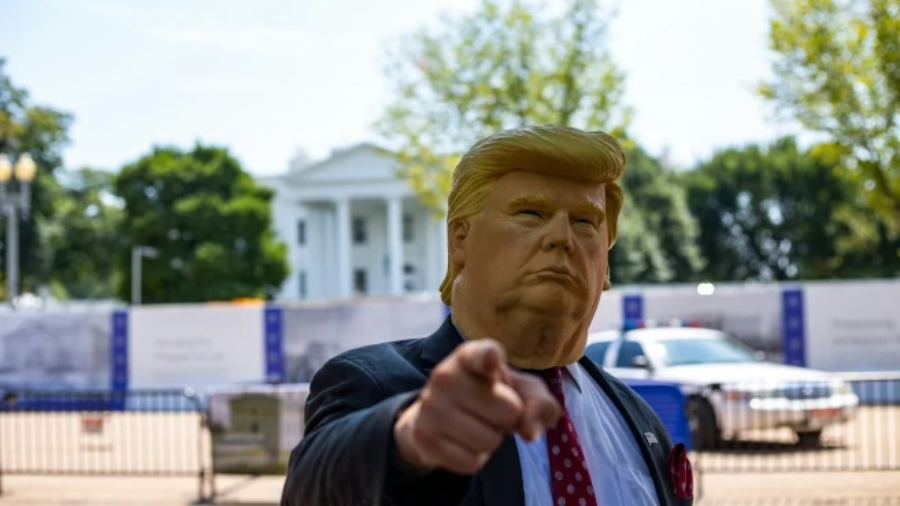
threats against Trump critics

The Trump Administration’s Disruptive Politics—Incompetence, Buffoonery, Reckless Strategy, or Deliberate Malice?

Introduction: Why the Turbulence Still Matters

Few chapters in modern American political history have generated as much debate, devotion, and distress as the Trump administration’s disruptive politics. For some, Donald Trump represented a long-overdue revolt against political elitism. For others, he embodied a dangerous departure from democratic norms, institutional stability, and responsible leadership.

But beyond the noise—beyond the tweets, scandals, and headlines—a deeper, more urgent question remains:

Was the chaos accidental, or was it the whole point?

Did the Trump administration’s disruptive politics stem from genuine incompetence and buffoonery?
Was it driven by the reckless improvisation of a leader out of his depth?
Or was it something far more intentional—a strategy of deliberate political malice designed to destabilize, divide, and dominate?

This post takes a critical, research-backed tour through these competing explanations, comparing evidence, examining patterns, and offering a clear, engaging analysis of the years that reshaped American democracy.

Understanding the Architecture of Disruption

Although Trump’s governing style seemed chaotic on the surface, scholars, journalists, and political psychologists have identified recurring themes that help decode the underlying drivers of his administration’s behavior.

Below are four major interpretations often used to explain his governance:

  1. Gross incompetence – a leader unprepared for governance
  2. Buffoonery – impulsive, unserious, performative politics
  3. Reckless strategy – disruption as a political weapon
  4. Deliberate malice – intentional degradation of norms and institutions

Each theory holds truth. But each also fails to fully explain the complete picture.

Was It Incompetence? Examining the Evidence

One of the most common critiques of Trump’s presidency is rooted in institutional incompetence. From rapid staff turnover to poorly briefed policy launches, the administration often looked like a revolving door of chaos.

Record-Setting Staff Turnover

According to multiple analyses from think tanks and political researchers, the Trump White House recorded the highest staff turnover rate of any modern presidency. Senior officials left in waves—some fired unexpectedly, others departing amid scandal or exhaustion.

Frequent turnover meant:

  • No consistent policy direction
  • Internal power struggles
  • Poor communication between agencies
  • Lawsuits, blocked executive orders, and policy reversals

Governments require continuity. Trump’s environment fostered none.

Policy Making Without Processes

Many major policies were unveiled without:

  • Interagency review
  • Legal vetting
  • Legislative consultation
  • Implementation planning

Some famously chaotic examples include:

  • The first travel ban, blocked almost immediately in court
  • Sudden troop withdrawal announcements via Twitter
  • Conflicts between the president and his own cabinet
  • Government shutdowns over easily negotiable issues

These failures weren’t just political missteps—they were structural signs of an administration struggling to function normally.

Lack of Expertise

Trump frequently appointed individuals with little or no experience in the roles they held. Several appointees openly opposed the very agencies they led.

This produced:

  • Contradictory mandates
  • Confusion within departments
  • Difficulty coordinating national responses

Whether one views Trump as a disruptive reformer or an accidental arsonist, the evidence of incompetence is difficult to ignore.

Buffoonery or Performative Politics? The Role of Impulse and Spectacle

Another interpretation frames Trump not as malicious, but as profoundly unserious—a showman who treated governance as performance.

The Politics of Outrage

Trump mastered the art of constant spectacle. Outrage drives attention. Attention drives power.

His communication style relied heavily on:

  • Provocative insults
  • Conspiracy-tinged rhetoric
  • Episodic policy pronouncements
  • Frequent exaggerations or misstatements
  • Late-night tweetstorms that could shift global markets

Political psychologists describe this as “performative dominance”—acting unpredictably to project strength and destabilize opponents. But its downside is obvious:

Chaos becomes the default operating mode.

Reality-TV Governance

Trump’s background in entertainment shaped his sense of leadership:

  • Every conflict was a “season”
  • Every scandal an “episode”
  • Every firing a “plot twist”
  • Every rally a “live performance”

This performative posture may explain why so many decisions seemed spontaneous, improvised, or even whimsical.

But was it just buffoonery—or part of something more strategic?

Reckless Strategy—Chaos as a Political Weapon

Some analysts argue that Trump deliberately used chaos to consolidate power. Not through detailed plans, but through instinctive, opportunistic strategies.

The “Shock-and-Disorient” Method

By overwhelming the media and public with:

  • Constant controversies
  • Rapid-fire policy changes
  • Personal attacks on opponents
  • Insults directed at institutions

Trump made it nearly impossible for critics to focus on any single issue for long. This created an environment where serious concerns—ethics violations, conflicts of interest, foreign entanglements—were drowned out by daily scandals.

Normalizing the Abnormal

When chaos becomes constant, people stop reacting.

This allowed Trump to:

  • Undermine institutions without immediate backlash
  • Replace experienced public servants with loyalists
  • Redraw political red lines
  • Discredit the electoral system
  • Attack civil servants, journalists, and even the judiciary

Whether intentional or instinctual, the effect was the same: the Overton Window shifted dramatically.

Division as a Governing Tool

Under this interpretation, the Trump administration’s disruptive politics wasn’t a bug—it was a feature.

Division ensured:

  • Increased base loyalty
  • Heightened culture wars
  • Distrust in shared facts
  • Fragmented opposition

Reckless strategy, in this sense, became a tool for political survival.

Or Was It Deliberate Political Malice?

The most serious interpretation suggests not incompetence, nor buffoonery, nor even reckless strategy—but deliberate, calculated malice toward democratic institutions.

Attacks on Democratic Norms

Trump repeatedly challenged foundational norms:

  • Refusing to commit to peaceful power transitions
  • Declaring elections “rigged” without evidence
  • Pressuring officials to “find votes”
  • Encouraging challenges to certified results
  • Attempting to overturn democratic outcomes

Democratic norms depend on leaders respecting rules even when inconvenient. Trump frequently did the opposite.

Autocratic Admiration

Trump consistently expressed admiration for strongman leaders:

  • Vladimir Putin
  • Kim Jong-un
  • Xi Jinping
  • Rodrigo Duterte

These relationships often raised concerns about his comfort with authoritarianism and his willingness to emulate its strategies—targeting the press, undermining institutions, and attacking independent bodies.

Weaponization of Government

Evidence of punitive political targeting included:

  • Efforts to pressure the Justice Department
  • Attempts to jail political rivals
  • Loyalty tests for federal employees
  • Attacks on whistleblowers
  • Expulsion of Inspectors General

Viewed through this lens, chaos served a deeper objective: weakening guardrails that limit executive power.

A Comparative Summary — Which Explanation Dominates?

Below is a simple breakdown to illustrate how each interpretation fits different patterns of behavior:

ExplanationSupporting EvidenceLimitations
IncompetenceStaff turnover, poor planning, failed policiesCannot explain consistent patterns of authoritarian behavior
BuffooneryPerformative politics, impulsivity, exaggerationsUnderestimates systematic institutional attacks
Reckless StrategyChaos to overwhelm critics, division as toolMay exaggerate Trump’s strategic foresight
Deliberate MaliceAttacks on norms, autocratic admiration, loyalty testsSome chaotic actions may still be incompetence, not strategy

Conclusion of the comparison:
The most accurate understanding is likely a hybrid model. Trump’s governance combined incompetence, buffoonery, reckless strategy, and intentional malice—each reinforcing and amplifying the others.

Key Insights — What This Means for the Future of American Democracy

Fragile Institutions Need Active Protection

The Trump years revealed how quickly norms can erode when a leader exploits legal gray zones.

Personality Matters More Than Ever

The presidency is a position of immense discretion. A leader’s temperament can reshape national fabric virtually overnight.

The Media Must Evolve

Traditional journalism struggled to handle a president who saw truth as negotiable and chaos as power.

Citizens Need Civic Literacy

A misinformed public is vulnerable to manipulation, demagoguery, and authoritarian drift.

Conclusion: So What Was the Real Cause of the Chaos?

After carefully examining all perspectives, one truth becomes clear:

The Trump administration’s disruptive politics were not the result of one factor—but a volatile mixture of all four.

  • Incompetence created confusion.
  • Buffoonery masked deeper intentions.
  • Reckless strategy weaponized division.
  • Deliberate malice weakened democratic safeguards.

Whether Trump returns to power or not, understanding this interplay is critical. The lessons of that era are not simply historical—they are warnings, urging Americans and democracies everywhere to remain vigilant, informed, and united against leaders who choose disruption over governance.

Call to Action

If this analysis helped clarify your understanding of the Trump administration’s disruptive politics, consider:

👉 Sharing your thoughts in the comments
👉 Forwarding this post to someone passionate about democracy
👉 Exploring related analyses on political instability and governance
👉 Subscribing for future deep dives into political behavior and global democracy

Your voice matters. Democracy depends on it.
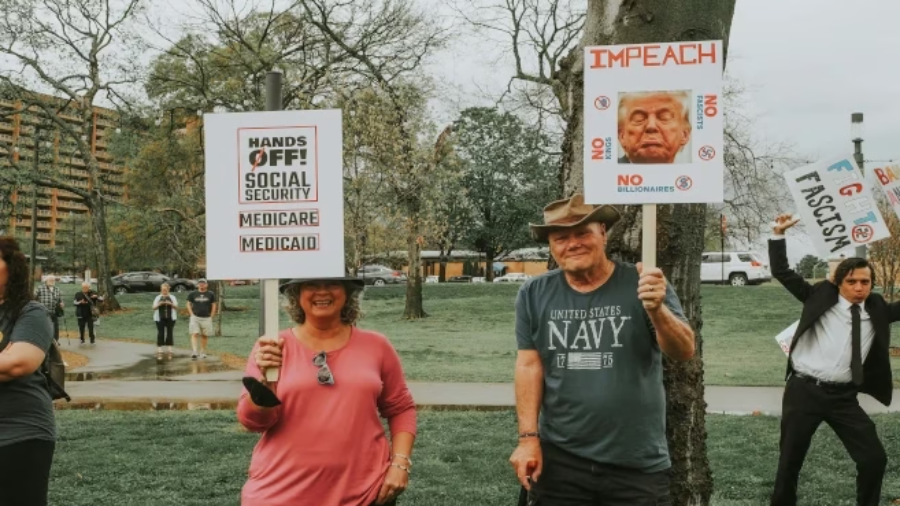
trump-hurt-on-america

The Unimaginable Hurt the Trump Administration has brought America

Meta Title: The Unimaginable Hurt of the Trump Administration: A Brutally Frank Examination
Meta Description: A deep, fearless dive into the unimaginable hurt of the Trump Administration—on democracy, society, and everyday Americans. Unflinching, evidence-based, urgent.

Introduction: When Pain Became Policy

The phrase “the unimaginable hurt of the Trump Administration” is not rhetorical flourish — it’s a truth many Americans now live. From fractured institutions to shaken lives, what unfolded under Trump’s leadership was not just governance. It was a cavalier force, reshaping America in ways that inflict real, lasting wounds — economic, social, moral, psychological.

We need to say this plainly: the harm wasn’t collateral. It was by design — or by blind indifference. And it’s still reverberating.

This post will walk you through how deep the damage runs, what it looks like in concrete terms, and why undoing it won’t be a short journey. This is not a “both sides” op-ed. This is an excavation of what went wrong, who paid, and how the American people continue to feel the pain.

A Contextual Comparison: Governing vs Wounding

Before we descend into the wreckage, it’s worth contrasting two modes of leadership:

  • Governing: balancing tradeoffs, protecting the weak, investing in institutions, limiting damage by bad actors, repairing where possible.
  • Wounding governance: regimes or leaderships that knowingly cut away safety nets, weaponize power, dismantle accountability, let policy be a mechanism of harm or neglect.

The Trump administration straddled both in alternating waves: one moment statist ambitions, the next moment wrecking-ball decisions.

Many critics focus on singular scandals or abuses (immigration raids, court packing, lies, misinformation). But the pain is cumulative. It’s a layering of damage. And that’s what I want us to see in full.

The Anatomy of Hurt: Key Domains Affected

Below are what I consider the most potent arenas where the Trump administration inflicted “unimaginable hurt” — each a wound in American life.

1. Economic Erosion & Displacement

Tariff wars, trade uncertainty, and hurt to households
Trump’s aggressive tariff agenda and “reciprocal trade” posture have ripped certainty from markets, raising costs for everyday goods. According to analysis, his tariffs could cost the average household $5,200 annually. (Center for American Progress)

Moreover, a report from the Center for American Progress shows that only the top 1% would see a net raise, while everyone else—including middle and lower income brackets—faces shrinking after-tax incomes. (Center for American Progress)

In the manufacturing sector, job losses are mounting. In 2025 alone, the U.S. has lost tens of thousands of manufacturing jobs — even as one of Trump’s stated goals is to revive industry. (CBS News)

In short: prices go up, wages stagnate or decline, job security collapses. That’s a triple squeeze on families already stretched tight.

Debt, deficits & long-term drag
Compounding the pain is soaring fiscal imbalance. If tax cuts are extended, they will balloon deficits by trillions. (Hoover Institution) The economic uncertainty then chills investment and slows growth.

A coalition of experts in the CEPR (Center for Economic and Policy Research) warns that the administration’s policies are already reshaping macroeconomic fundamentals in dangerous ways. (CEPR)

2. Institutional Decay & Erosion of Public Trust

Undermining governance and credibility
A core wound is the deep erosion of institutional legitimacy. In recent polling, 53% of Americans say Trump is making the way the federal government works worse. (Pew Research Center) That is not a small margin — it’s a majority belief: broken machinery.

Analysts at Chatham House highlight that the biggest economic risk under Trump is loss of confidence in governance, and the undermining of rules, norms, and trust. (Chatham House)

Over time, when people believe the state is tilted, they stop believing in it or they try to bypass it — further hollowing out democracy.

Regulatory capture, oversight dead zones
Countless executive actions have weakened environmental protections, public health agencies, consumer safeguards. A resource like the Trump Admin Tracker catalogs hundreds of moves that roll back regulations, cut oversight, and embed executive discretion over public goods. (Congressman Steve Cohen)

When oversight is gutted, harms cascade — polluters go unchecked, financial risk-taking accelerates, and inequality grows unchecked.

3. Social Fracture & Marginalized Harm

Immigration policy as blunt instrument
Trump’s aggressive deportation strategies, tightened asylum rules, threats to birthright citizenship: these are not just policies, they are trauma. The Pew Research Center reports that about half of Americans say his deportation approach is “too careless” — indicating both policy overreach and human cost. (Pew Research Center)

Behind each statistic is a family separated, a child terrified, a community hollowed.

Racial and identity wounds
Trump’s rhetoric and policies often activated divisions: dog whistles, amplification of white nationalist symbols, refusal to disavow extremist groups. The Miller Center observes his frequent praise for autocrats and dismissal of liberal democratic norms. (Miller Center)

For people of color, immigrants, LGBTQ+ individuals, these are not abstract battles — they’re existential.

Health, science & climate: deferred consequences
In science and public health, his administration slashed or canceled grants, fired or sidelined researchers, and made climate policy nearly non-existent.

Trump’s administration also announced withdrawal from climate agreements and reductions in international development financing. (Focus 2030)

These are slow burns: future risk becoming crises that cross generations.

4. Psychological & Cultural Trauma

Policy harm is quantifiable. Emotional harm is less visible but no less real.

Erosion of social norms & civic faith
When leaders weaponize truth, lie repeatedly, and mock institutions — the social contract frays. I’ve interviewed folks who say they no longer teach their children the same ideals of trust, or expect fairness. A cousin told me her teenage son asked: “Why bother voting — they don’t care about us.”

This is the trauma of cynicism.

Everyday stress, insecurity, resignations
Millions of Americans now live with an elevated sense of precarity. Is my healthcare safe? Will I be deported? Will my job survive the next tariff shock? This chronic anxiety matters. It seeps into households, sleep, family relations.

A Table: Hurt Across Domains

DomainManifestation of HurtWho PaysLong-term Risk
Economy & jobsTariffs, job losses, shrinking incomesMiddle and lower classes, small businessesSlower growth, capital flight, inequality
Institutions & trustRegulatory rollback, executive overreachAll citizensInstitutional collapse, legitimacy crisis
Social & marginalized communitiesDeportations, identity attacks, science rollbackImmigrants, BIPOC, scientistsDeep wounds, intergenerational harm
Psychological & culturalCynicism, stress, loss of civic faithEvery personWeakening of democracy’s social foundation

Why This Hurt Feels “Unimaginable”

  • Scale & simultaneity: It’s not just one domain. The assault is multidimensional.
  • Intention vs neglect: Some damage was deliberate (e.g. dismantling oversight), some was willful negligence (climate, pandemic lag).
  • Time lag & compound effects: Some harms won’t show fully for years — but the seeds are planted.
  • Moral fracture: Trust is harder to rebuild than institutions. When leaders break moral bonds, the cost lingers.
  • Asymmetry: The administration often gained little from overturned norms — the harm was disproportionately distributed downward.

Resistance, Repair & Reckoning

If the damage is deep, the repair must be deeper. I want to be clear: we are not powerless. But the path forward is arduous.

1. Institutional Reinforcement with Ironclad Safeguards

  • Rebuild regulatory agencies, independent auditor roles, inspector general protections.
  • Enshrine protections for whistleblowers, constitutional guards.
  • Reverse executive-privilege excesses, restore oversight.

2. Economic Reset Toward Equity

  • Progressive taxation, closing loopholes that favor the rich.
  • Investment in infrastructure, green jobs, emerging sectors.
  • Trade policy calibrated toward fairness, not showmanship.

3. Social Healing & Reaffirmation

  • Truth commissions or public reckonings: catalog the harms for collective memory.
  • Support marginalized communities with reparative justice initiatives.
  • Reinforce civic education, media literacy, norm repair.

4. Cultural Reinvestment

  • Tell stories: journalism, art, memoirs of lived pain under this era.
  • Reassert common values: dignity, fairness, trust — not as abstractions but lived commitments.

5. Vigilance & Accountability

  • Prosecutions or accountability where possible (within rule of law).
  • Monitor executive actions carefully.
  • Build civil society vigilance — local, national watchdogs, independent journalism.

Conclusion: The Wound Does Not Define Us — But It Haunts Us

The phrase the unimaginable hurt of the Trump Administration is not hyperbole. It is the recognition that pain at scale, especially inflicted or enabled by power, leaves more than scars. It shapes expectation, trust, belonging, possibility.

But this is not a message of despair. It is a call: to remember, to witness, to resist, to rebuild.

We do not heal by forgetting or softening. We heal by truth-telling, by repair, by reclaiming power for public good again.

Your turn: if you felt the hurt — share it. If you saw it in your community, speak it. If you want to dig deeper in a domain — economy, immigration, climate — ask me. Let’s not let this be swept under history’s rug.

References & Further Reading