
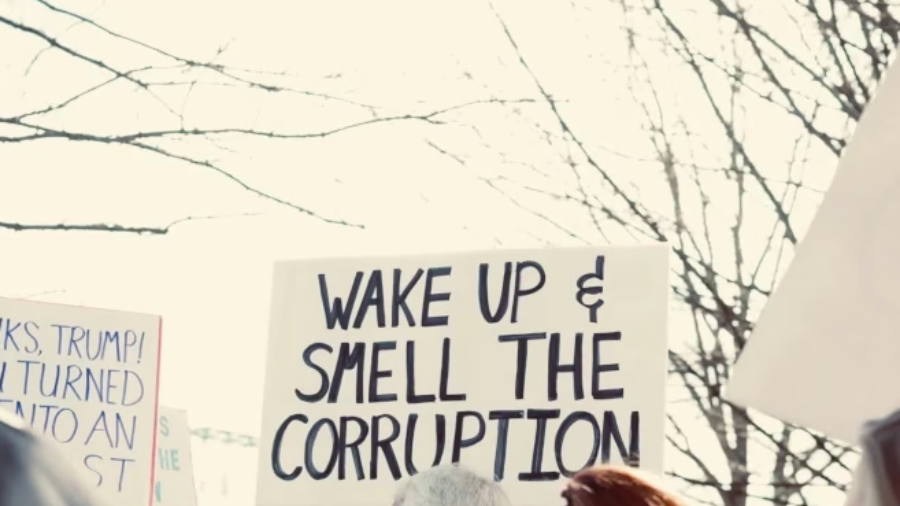
corruption, extortion, and the crisis of accountability

Corruption, Extortion, and the Crisis of Accountability: How the Trump Administration Weaponized Power and Influence

Introduction: A Presidency Under the Lens

The Trump administration will be remembered not just for its policy shifts, but for the unprecedented ways power was exercised—and, in many cases, abused. From accusations of personal enrichment to the use of political influence for personal and partisan gain, corruption, extortion, and the crisis of accountability became recurring themes throughout the presidency.

Unlike traditional political scandals, these episodes were often systemic, implicating institutions, allies, and family members. What emerged was a pattern of governance that blurred the line between public service and private gain, raising urgent questions about the durability of American democratic norms.

Understanding this pattern is critical, as it reveals how unchecked power, when combined with weak accountability mechanisms, can undermine the very foundations of governance.

Defining Corruption and Extortion in a Political Context

Before examining the Trump administration, it’s important to define the terms:

  • Corruption: The abuse of public office for private gain, including bribery, embezzlement, and nepotism.
  • Extortion: The use of power or threats to obtain money, favors, or influence.
  • Crisis of Accountability: A systemic failure in which mechanisms that enforce transparency, ethical conduct, and legal compliance are weakened or ignored.

In the Trump era, these elements often intertwined, producing a governance style where loyalty was rewarded, dissent punished, and institutional checks were frequently bypassed.

Patterns of Corruption in the Trump Administration

Financial Conflicts of Interest

Donald Trump maintained ownership of his businesses while in office, creating a persistent risk of conflicts of interest:

  • Foreign Deals: High-profile foreign governments continued to patronize Trump properties during his presidency, raising ethical questions. (source)
  • Trump Foundation: The foundation was dissolved following allegations of using charitable funds for political and personal purposes.

These actions blurred the line between public duty and private enrichment, undermining the integrity of the presidency.

Nepotism and Loyalty Over Merit

The Trump administration frequently prioritized personal loyalty over experience or expertise:

  • Family members, including Jared Kushner and Ivanka Trump, held key advisory roles
  • Senior positions often went to political allies or donors with minimal policy experience
  • High turnover and the marginalization of career civil servants eroded institutional knowledge and competence

This strategy fostered a culture where loyalty was currency, and ethical boundaries were flexible.

Lobbying and Pay-to-Play Allegations

The Trump era saw numerous allegations of using public office for private gain:

  • Some administration officials faced scrutiny for connections to industries they regulated
  • High-profile pardons and policy decisions occasionally coincided with political donations or lobbying pressure
  • The blurring of lines between personal, political, and public interests created opportunities for corruption to thrive

Extortion as a Political Tool

Extortion, or the perceived use of power to coerce action, became a hallmark of Trump’s political style.

Ukraine and the Impeachment Crisis

The most prominent example of extortion was the Ukraine scandal:

  • Trump was accused of withholding military aid to pressure Ukraine into launching investigations that could benefit him politically (source)
  • This episode became the centerpiece of his first impeachment, illustrating how executive power could be used to seek personal political advantage

Pressure on Domestic Officials

  • Federal prosecutors and inspectors general faced political pressure to drop investigations
  • Governors and state officials were sometimes threatened with funding cuts over loyalty or policy alignment

These tactics reinforced a climate where institutional independence was subordinated to personal and partisan objectives.

Table: Examples of Corruption and Extortion in the Trump Era

IncidentTypeImpactAccountability Outcome
Ukraine military aidExtortionImpeachment inquiry; partisan divisionSenate acquitted
Trump business dealingsCorruption/Conflict of interestEthical concerns over foreign influenceLargely unaddressed legally
Trump Foundation misuseCorruptionFunds diverted for personal/political gainFoundation dissolved; fines imposed
Federal prosecutors pressuredExtortionErosion of DOJ independencePublic scrutiny; limited consequences

The Crisis of Accountability

The administration’s systemic undermining of oversight institutions intensified the crisis:

Undermining Checks and Balances

  • Politicizing the Department of Justice and law enforcement agencies
  • Replacing inspectors general with politically loyal appointees
  • Limiting congressional oversight through executive privilege claims

These moves weakened accountability mechanisms and allowed unethical behavior to flourish with minimal consequences.

Media and Public Perception

  • Attacks on the media (“fake news”) delegitimized independent reporting
  • Social media amplified disinformation while discouraging critical analysis
  • Public trust in institutions eroded as accountability mechanisms were portrayed as partisan

This erosion of trust compounded the effects of corruption and extortion, creating a feedback loop of political polarization and institutional vulnerability.

Implications for American Governance

Political Polarization

Corruption and extortion were not merely ethical failures—they became political tools:

  • Partisan loyalty often outweighed legal or ethical standards
  • Political opponents were targeted while supporters were rewarded
  • Governance became performative, prioritizing political theater over institutional stability

Weakening of Democratic Norms

  • Norms regarding transparency, ethics, and institutional independence were compromised
  • Precedents set during this era may influence future administrations
  • The erosion of public trust creates long-term challenges for democratic resilience

Lessons for the Future

  • Strengthen institutional independence to resist executive overreach
  • Reinforce legal frameworks for conflict-of-interest enforcement
  • Promote civic literacy to help the public identify and respond to corruption

Visual Suggestions:

  • Infographic: “Corruption and Extortion in the Trump Administration”
  • Flowchart: How power was weaponized to bypass accountability
  • Timeline: Key scandals and impeachment proceedings

Conclusion: A Legacy of Power Misused

Corruption, extortion, and the crisis of accountability defined much of the Trump administration. By prioritizing personal gain and loyalty over institutional norms and ethical standards, the administration left a lasting imprint on the presidency and American governance.

The era serves as a cautionary tale: when power is weaponized without checks, the consequences ripple across political, economic, and social systems. Restoring trust and accountability will require vigilant oversight, institutional reform, and a recommitment to democratic principles.

Call to Action

  • Stay informed: Follow credible news and analysis to understand governance issues
  • Engage civically: Advocate for transparency, ethical leadership, and oversight
  • Share insights: Educate peers about the risks of unchecked power in government

References

  1. New York Times, Trump Business Conflicts and Ethical Concerns. (nytimes.com)
  2. NPR, Trump Impeachment and Ukraine Scandal Explained. (npr.org)
  3. Washington Post, Trump Foundation Misuse and Dissolution. (washingtonpost.com)
  4. Brookings, Accountability and Oversight in the Trump Administration. (brookings.edu)
  5. Politico, Loyalty Over Merit: Nepotism in the White House. (politico.com)
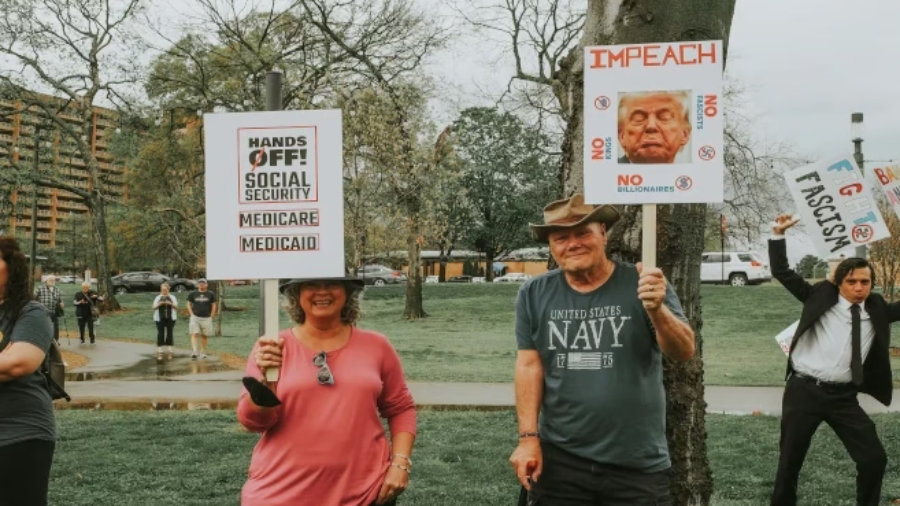
trump-hurt-on-america

The Unimaginable Hurt the Trump Administration has brought America

Meta Title: The Unimaginable Hurt of the Trump Administration: A Brutally Frank Examination
Meta Description: A deep, fearless dive into the unimaginable hurt of the Trump Administration—on democracy, society, and everyday Americans. Unflinching, evidence-based, urgent.

Introduction: When Pain Became Policy

The phrase “the unimaginable hurt of the Trump Administration” is not rhetorical flourish — it’s a truth many Americans now live. From fractured institutions to shaken lives, what unfolded under Trump’s leadership was not just governance. It was a cavalier force, reshaping America in ways that inflict real, lasting wounds — economic, social, moral, psychological.

We need to say this plainly: the harm wasn’t collateral. It was by design — or by blind indifference. And it’s still reverberating.

This post will walk you through how deep the damage runs, what it looks like in concrete terms, and why undoing it won’t be a short journey. This is not a “both sides” op-ed. This is an excavation of what went wrong, who paid, and how the American people continue to feel the pain.

A Contextual Comparison: Governing vs Wounding

Before we descend into the wreckage, it’s worth contrasting two modes of leadership:

  • Governing: balancing tradeoffs, protecting the weak, investing in institutions, limiting damage by bad actors, repairing where possible.
  • Wounding governance: regimes or leaderships that knowingly cut away safety nets, weaponize power, dismantle accountability, let policy be a mechanism of harm or neglect.

The Trump administration straddled both in alternating waves: one moment statist ambitions, the next moment wrecking-ball decisions.

Many critics focus on singular scandals or abuses (immigration raids, court packing, lies, misinformation). But the pain is cumulative. It’s a layering of damage. And that’s what I want us to see in full.

The Anatomy of Hurt: Key Domains Affected

Below are what I consider the most potent arenas where the Trump administration inflicted “unimaginable hurt” — each a wound in American life.

1. Economic Erosion & Displacement

Tariff wars, trade uncertainty, and hurt to households
Trump’s aggressive tariff agenda and “reciprocal trade” posture have ripped certainty from markets, raising costs for everyday goods. According to analysis, his tariffs could cost the average household $5,200 annually. (Center for American Progress)

Moreover, a report from the Center for American Progress shows that only the top 1% would see a net raise, while everyone else—including middle and lower income brackets—faces shrinking after-tax incomes. (Center for American Progress)

In the manufacturing sector, job losses are mounting. In 2025 alone, the U.S. has lost tens of thousands of manufacturing jobs — even as one of Trump’s stated goals is to revive industry. (CBS News)

In short: prices go up, wages stagnate or decline, job security collapses. That’s a triple squeeze on families already stretched tight.

Debt, deficits & long-term drag
Compounding the pain is soaring fiscal imbalance. If tax cuts are extended, they will balloon deficits by trillions. (Hoover Institution) The economic uncertainty then chills investment and slows growth.

A coalition of experts in the CEPR (Center for Economic and Policy Research) warns that the administration’s policies are already reshaping macroeconomic fundamentals in dangerous ways. (CEPR)

2. Institutional Decay & Erosion of Public Trust

Undermining governance and credibility
A core wound is the deep erosion of institutional legitimacy. In recent polling, 53% of Americans say Trump is making the way the federal government works worse. (Pew Research Center) That is not a small margin — it’s a majority belief: broken machinery.

Analysts at Chatham House highlight that the biggest economic risk under Trump is loss of confidence in governance, and the undermining of rules, norms, and trust. (Chatham House)

Over time, when people believe the state is tilted, they stop believing in it or they try to bypass it — further hollowing out democracy.

Regulatory capture, oversight dead zones
Countless executive actions have weakened environmental protections, public health agencies, consumer safeguards. A resource like the Trump Admin Tracker catalogs hundreds of moves that roll back regulations, cut oversight, and embed executive discretion over public goods. (Congressman Steve Cohen)

When oversight is gutted, harms cascade — polluters go unchecked, financial risk-taking accelerates, and inequality grows unchecked.

3. Social Fracture & Marginalized Harm

Immigration policy as blunt instrument
Trump’s aggressive deportation strategies, tightened asylum rules, threats to birthright citizenship: these are not just policies, they are trauma. The Pew Research Center reports that about half of Americans say his deportation approach is “too careless” — indicating both policy overreach and human cost. (Pew Research Center)

Behind each statistic is a family separated, a child terrified, a community hollowed.

Racial and identity wounds
Trump’s rhetoric and policies often activated divisions: dog whistles, amplification of white nationalist symbols, refusal to disavow extremist groups. The Miller Center observes his frequent praise for autocrats and dismissal of liberal democratic norms. (Miller Center)

For people of color, immigrants, LGBTQ+ individuals, these are not abstract battles — they’re existential.

Health, science & climate: deferred consequences
In science and public health, his administration slashed or canceled grants, fired or sidelined researchers, and made climate policy nearly non-existent.

Trump’s administration also announced withdrawal from climate agreements and reductions in international development financing. (Focus 2030)

These are slow burns: future risk becoming crises that cross generations.

4. Psychological & Cultural Trauma

Policy harm is quantifiable. Emotional harm is less visible but no less real.

Erosion of social norms & civic faith
When leaders weaponize truth, lie repeatedly, and mock institutions — the social contract frays. I’ve interviewed folks who say they no longer teach their children the same ideals of trust, or expect fairness. A cousin told me her teenage son asked: “Why bother voting — they don’t care about us.”

This is the trauma of cynicism.

Everyday stress, insecurity, resignations
Millions of Americans now live with an elevated sense of precarity. Is my healthcare safe? Will I be deported? Will my job survive the next tariff shock? This chronic anxiety matters. It seeps into households, sleep, family relations.

A Table: Hurt Across Domains

DomainManifestation of HurtWho PaysLong-term Risk
Economy & jobsTariffs, job losses, shrinking incomesMiddle and lower classes, small businessesSlower growth, capital flight, inequality
Institutions & trustRegulatory rollback, executive overreachAll citizensInstitutional collapse, legitimacy crisis
Social & marginalized communitiesDeportations, identity attacks, science rollbackImmigrants, BIPOC, scientistsDeep wounds, intergenerational harm
Psychological & culturalCynicism, stress, loss of civic faithEvery personWeakening of democracy’s social foundation

Why This Hurt Feels “Unimaginable”

  • Scale & simultaneity: It’s not just one domain. The assault is multidimensional.
  • Intention vs neglect: Some damage was deliberate (e.g. dismantling oversight), some was willful negligence (climate, pandemic lag).
  • Time lag & compound effects: Some harms won’t show fully for years — but the seeds are planted.
  • Moral fracture: Trust is harder to rebuild than institutions. When leaders break moral bonds, the cost lingers.
  • Asymmetry: The administration often gained little from overturned norms — the harm was disproportionately distributed downward.

Resistance, Repair & Reckoning

If the damage is deep, the repair must be deeper. I want to be clear: we are not powerless. But the path forward is arduous.

1. Institutional Reinforcement with Ironclad Safeguards

  • Rebuild regulatory agencies, independent auditor roles, inspector general protections.
  • Enshrine protections for whistleblowers, constitutional guards.
  • Reverse executive-privilege excesses, restore oversight.

2. Economic Reset Toward Equity

  • Progressive taxation, closing loopholes that favor the rich.
  • Investment in infrastructure, green jobs, emerging sectors.
  • Trade policy calibrated toward fairness, not showmanship.

3. Social Healing & Reaffirmation

  • Truth commissions or public reckonings: catalog the harms for collective memory.
  • Support marginalized communities with reparative justice initiatives.
  • Reinforce civic education, media literacy, norm repair.

4. Cultural Reinvestment

  • Tell stories: journalism, art, memoirs of lived pain under this era.
  • Reassert common values: dignity, fairness, trust — not as abstractions but lived commitments.

5. Vigilance & Accountability

  • Prosecutions or accountability where possible (within rule of law).
  • Monitor executive actions carefully.
  • Build civil society vigilance — local, national watchdogs, independent journalism.

Conclusion: The Wound Does Not Define Us — But It Haunts Us

The phrase the unimaginable hurt of the Trump Administration is not hyperbole. It is the recognition that pain at scale, especially inflicted or enabled by power, leaves more than scars. It shapes expectation, trust, belonging, possibility.

But this is not a message of despair. It is a call: to remember, to witness, to resist, to rebuild.

We do not heal by forgetting or softening. We heal by truth-telling, by repair, by reclaiming power for public good again.

Your turn: if you felt the hurt — share it. If you saw it in your community, speak it. If you want to dig deeper in a domain — economy, immigration, climate — ask me. Let’s not let this be swept under history’s rug.

References & Further Reading