
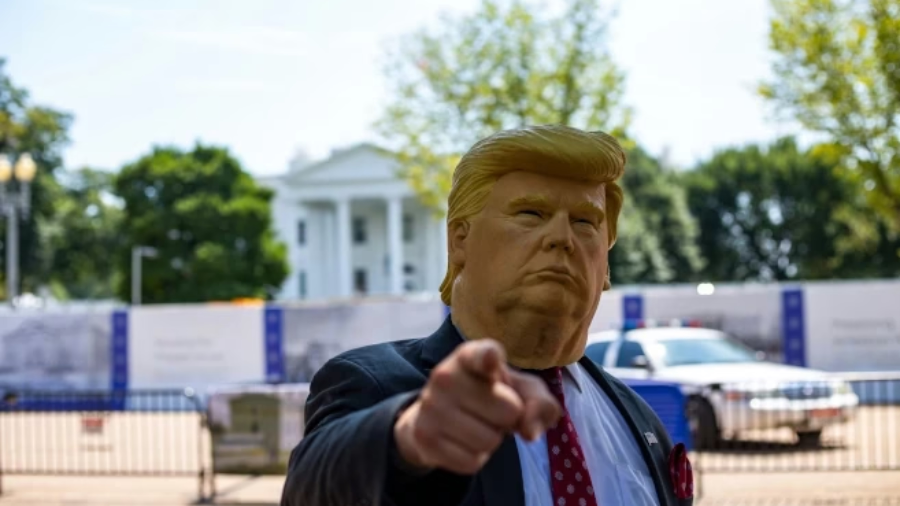
We will delve into Trump’s Davos 2026 catastrophe. When President Donald Trump touched down in Davos, Switzerland this week for the World Economic Forum, he didn’t just arrive late due to Air Force One mechanical issues. He arrived to a room that had fundamentally turned against him—and by extension, against American leadership itself.
The result? Trump’s Davos 2026 catastrophe dragging American credibility, market stability, and global influence down with him in a spectacular display of imperial overreach that left even America’s closest allies questioning whether the transatlantic partnership has a future.
Let’s cut through the diplomatic niceties and examine exactly how the United States, under Trump’s chaotic leadership, managed to alienate the entire Western world in less than a week—and what this seismic shift means for American power.
The Greenland Catastrophe: When Bullying Backfires
Before Trump even arrived in Davos, he’d already poisoned the well. His weekend announcement threatening 10% tariffs on eight NATO allies starting February 1st, escalating to 25% by June, unless they supported his plan to purchase Greenland—sent shockwaves through global markets and diplomatic circles.
This wasn’t subtle statecraft. This was a shakedown.
French President Emmanuel Macron warned of a shift to “a world without rules” and decried “bullies,” without mentioning Trump by name. The subtext was crystal clear: America’s president had become the bully everyone needed to unite against.
Canadian Prime Minister Mark Carney was even more direct, telling Davos that the old order is not coming back and warning that “nostalgia is not a strategy.” He described the new reality as “a system of intensifying great power rivalry where the most powerful pursue their interests using economic integration as coercion.”
Translation: America under Trump has become exactly what it claims to oppose—an authoritarian power weaponizing its economic dominance to coerce allies.
The Markets Spoke—And Trump Blinked
Perhaps most revealing was how investors sent Trump a message he wasn’t hearing from European leaders: threatening allies with tariffs and land seizure doesn’t generate confidence in the global economy.
U.S. markets plummeted in the first trading session following Trump’s threat, with the three major averages notching their worst days since October. The “sell America” trade—where investors dump U.S. assets en masse—roared back to life.
| Market Impact | Tuesday’s Carnage | Wednesday’s Partial Recovery |
|---|---|---|
| Dow Jones | Down significantly (worst since Oct) | Up 588 points (+1.21%) after Trump backed down |
| S&P 500 | Fell into negative territory for 2026 | Gained 1.16% |
| Nasdaq | Also negative for the year | Advanced 1.18% |
| U.S. Dollar | Declined alongside stocks | Recovered after tariff retreat |
| Treasury Yields | Spiked on uncertainty | Normalized |
Even Danish pension operator AkademikerPension announced it was exiting around $100 million in U.S. investments—a small but symbolically devastating vote of no confidence in American stability.
Trump got the message. During his Davos speech, he grumbled about what he called a stock market “dip” with some annoyance, complaining the market gyrations happened despite the U.S. “giving NATO and European nations trillions and trillions of dollars in defense.”
Translation: Even Trump realized the markets were rejecting his reckless gambits. Money talks louder than presidential bluster.
The Speech: Confusion, Contradiction, and Contempt
Trump’s actual Davos address on Wednesday was a masterclass in how NOT to conduct diplomacy on the world stage.
The Greenland Obsession
Trump repeatedly called Greenland “a piece of ice” that Denmark should be willing to give up, framing the U.S. as having a right to it after establishing military presence there in World War II.
He also kept referring to Greenland as a “piece of ice” and appeared to confuse it with Iceland—another European country altogether—four times during his remarks.
Let that sink in. The President of the United States, speaking to global leaders about territorial acquisition, repeatedly confused the territory he wants to acquire with a completely different country.
This wasn’t a minor slip. It revealed the shallow understanding driving his imperial ambitions.
Europe: “Unrecognizable” and Destroying Itself
Trump’s contempt for America’s European allies dripped from every sentence.
“Friends come back from different places—I don’t want to insult anybody—and say, I don’t recognize it. And that’s not in a positive way, that’s in a very negative way,” Trump said. “I love Europe and I want to see Europe go good, but it’s not heading in the right direction.”
“Certain places in Europe are not recognizable anymore. They’re not recognizable,” he said, slamming European values as inferior to the values he is attempting to impose on the United States.
He even described former Swiss President Karin Keller-Sutter as “difficult,” saying “She kept saying the same thing over and over. She rubbed me the wrong way.”
This is how you speak to a room full of European leaders? With disdain, condescension, and barely concealed hostility?
The Backtrack: Weakness Disguised as Strategy
By Wednesday afternoon, reality had forced Trump’s hand. Following a meeting with NATO Secretary General Mark Rutte, Trump announced they had “formed the framework of a future deal with respect to Greenland and, in fact, the entire Arctic Region.”
He ruled out using military force: “We probably won’t get anything unless I decide to use excessive strength and force where we would be, frankly, unstoppable. But I won’t do that,” he said. “I won’t use force.”
He also backed off the tariff threats entirely, claiming victory in a “framework” that NATO’s Rutte described in vague, face-saving terms that committed to nothing concrete.
By the time Trump’s speech ended—after well over an hour—some of the audience had begun to drift out. As one reporter documented, a tech CEO summed it up: he wasn’t sure whether to laugh or feel nervous, a sentiment echoed by several others. “Yes, we laughed,” one politician said.
Laughter. Not respect. Not admiration. Laughter.
The International Response: Unity Against America
What Trump achieved that no one thought possible: he united Europe—not behind American leadership, but against American coercion.
European Leaders Draw Red Lines
European Commission President Ursula von der Leyen called Trump’s planned tariffs “a mistake especially between long-standing allies” and vowed that Europe’s response would be “unflinching, united and proportional.”
Bernd Lange, who chairs the European Parliament’s international trade committee, said the tariff threats were an “attack” on the EU’s economic and territorial sovereignty.
French President Emmanuel Macron said a potential response could involve using the EU’s Anti-Coercion Instrument, which would restrict U.S. businesses’ access to Europe’s single market, exclude American suppliers from EU public tenders, place export and import restrictions, and limit foreign direct investment.
This isn’t bluster. These are concrete countermeasures that would devastate American companies operating in Europe’s $18 trillion economy.
The Private Messages: Desperation and Rejection
Perhaps most damaging were the private communications Trump himself made public—revealing how isolated America has become.
Trump shared an apparent text message from Macron, who wrote that he doesn’t understand the U.S. leader’s strategy on Greenland.
Trump told Norwegian Prime Minister Jonas Gahr Store that he no longer felt “an obligation to think purely of Peace” in a text message—linking his aggressive stance to last year’s decision not to award him the Nobel Peace Prize he deeply coveted.
These aren’t the communications of a respected leader. They’re the texts of someone everyone is trying to manage, placate, or avoid.
The “Board of Peace” Fiasco
Trump’s proposed Board of Peace—born from his 20-point plan to end the Israel-Hamas war—requires countries wanting permanent membership to pay $1 billion, with Trump as permanent chair even after his presidency.
French President Emmanuel Macron said he will not join the board. A few European nations have even declined their invitations.
A “peace” board that charges a billion-dollar entry fee, with the American president as permanent autocrat, rejected by major allies? This is American soft power in freefall.
What America Lost This Week
The Trump Davos 2026 debacle isn’t just embarrassing—it marks a fundamental shift in how the world views American power.
Credibility: Destroyed
When your closest allies laugh at your speech, when markets panic at your threats, when you confuse basic geography while demanding territorial acquisition—you’ve lost credibility.
The crowd of world leaders, business executives and others in Davos remained silent during the beginning of Trump’s address to the World Economic Forum, without clapping, as he described his transformation of the U.S.
Silence. Not applause. Silence.
Economic Stability: Shattered
The “sell America” trade demonstrates that global investors are reconsidering whether U.S. assets deserve their traditional safe-haven status.
When Danish pension funds start pulling out of American investments over political chaos, when Treasury yields spike on presidential tantrums, when the dollar weakens because the president threatens allies—America’s economic dominance becomes vulnerable.
Alliance Cohesion: Fractured
Mark Carney warned that “when we only negotiate bilaterally with a hegemon, we negotiate from weakness. We accept what’s offered. We compete with each other to be the most accommodating. This is not sovereignty. It’s the performance of sovereignty while accepting subordination.”
He called on other nations to “stop invoking rules-based international order as though it still functions as advertised. Call it what it is—a system of intensifying great power rivalry, where the most powerful pursue their interests, using economic integration as coercion.”
This is Canada’s Prime Minister essentially declaring the American-led order dead. From America’s closest neighbor and ally.
Moral Authority: Abandoned
Trump said alliance members can say yes “and we’ll be very appreciative. Or you can say, ‘No,’ and we will remember.”
This is mob language. “Nice alliance you’ve got there. Be a shame if something happened to it.”
When America threatens allies, demands tribute, confuses geography, and backs down when markets force its hand—it no longer leads through principle. It attempts to dominate through power. And as Davos 2026 proved, that power is increasingly questioned.
The China Factor: Who Really Won Davos?
While America’s president embarrassed himself and his country, who was quietly winning?
Chinese Vice Premier He Lifeng—China’s “economic czar”—received top billing on the forum’s first day, speaking right after EU Commission President von der Leyen.
China didn’t need to threaten anyone. They didn’t need to demand territorial concessions. They didn’t confuse basic geography. They simply presented themselves as a stable, predictable partner for economic cooperation.
When America becomes unstable and coercive, countries don’t just reject American leadership—they seek alternatives. China is ready and waiting.
JPMorgan’s Dimon: The Voice of Reason
Perhaps the most telling moment came from JPMorgan Chase CEO Jamie Dimon, speaking at Davos.
“I still think that’s the best thing, to keep the Western world together,” he said. “That would be my goal: make the world safer and stronger for democracy so that we don’t read that book 40 years from now, ‘How the West lost.'”
But, Dimon said, “I would be more polite” about criticizing Europe than Trump is.
When America’s top banker has to publicly coach the president on basic diplomatic courtesy, you know how far America has fallen.
The Aftermath: What Comes Next
For Trump
“President Trump is so unpredictable and he changes direction so quickly. The stock market no longer assumes that his pronouncements are going to be enforced,” noted Jed Ellerbroek, portfolio manager at Argent Capital Management.
This is the new reality: Trump’s threats are no longer taken seriously. He’s the boy who cried tariff. Markets now wait for his inevitable backtrack.
That’s not strength. That’s irrelevance wearing a tough-guy costume.
For America
The damage extends far beyond one chaotic week:
Trust eroded: Allies now know America under Trump will threaten them, insult them, and demand subordination—then back down when it hurts economically. This isn’t leadership. It’s bullying followed by capitulation.
Alternatives explored: EU leaders convened an emergency summit in Brussels on Thursday evening not to coordinate with America, but to coordinate against American coercion. They’re building systems that don’t need Washington’s approval.
Economic retaliation prepared: European leaders aren’t bluffing about countermeasures. They’ve watched Trump back down before. They know he responds to economic pain. They’re preparing to inflict it if necessary.
Global order reshaped: The forum tackled issues including “the growing gap between rich and poor; AI’s impact on jobs; concerns about geo-economic conflict; tariffs that have rocked longstanding trade relationships; and an erosion of trust between communities and countries.”
Every single one of these issues was made worse by Trump’s Davos performance.
The Imperial Overreach
Trump’s Greenland gambit reveals a fundamental misunderstanding of American power. He contends Greenland is a must-have asset for U.S. national security due to alleged threats from Russia and China.
But his method of pursuing it—threatening allies, demanding territorial transfer, weaponizing trade—demonstrates that America no longer leads. It attempts to dominate. And domination, as Davos 2026 proved, breeds resistance.
Trump urged NATO to allow the U.S. to take Greenland and added: “What I’m asking for is a piece of ice, cold and poorly located. It’s a very small ask compared to what we have given them for many, many decades.”
This transactional view—we’ve “given” you defense, so you owe us territory—fundamentally misunderstands why alliances exist. They’re not protection rackets. They’re mutual defense pacts based on shared values and interests.
Trump treats them like the former. Allies see through it. And they’re not interested.
The Bigger Picture: American Decline Accelerates
Oxfam released a report showing the world’s billionaires reached more than 3,000 last year, with collective wealth totaling a record $18.3 trillion—their combined fortunes increased by 16%, or $2.5 trillion, in 2025.
That acceleration is worsening global inequality, with the collective $18.3 trillion fortunes of billionaires nearly equaling the total wealth of the poorest half of the world’s population, about 4.1 billion people.
This is the world Trump represented at Davos: unprecedented inequality, declining faith in democratic institutions, and great power competition replacing rules-based cooperation.
He didn’t cause all of this. But his performance at Davos 2026 accelerated every negative trend.
The Verdict: Trump’s Self-Inflicted Defeat
Let’s be brutally clear about what happened this week:
- Trump threatened America’s closest allies with economic warfare unless they surrendered territory
- Markets panicked, sending a message Trump couldn’t ignore
- He backed down, claiming victory in a vague “framework” that commits to nothing
- Allies laughed at him (literally, according to attendees)
- America’s credibility suffered potentially irreparable damage
Critics have long accused the annual meeting of generating more rhetoric than results, and they see Trump’s return as sign of the disconnect between haves and have-nots.
But this year was different. Trump didn’t just fail to achieve results. He achieved the opposite: unified European opposition, market chaos, diplomatic humiliation, and accelerated American decline.
How does a superpower become Davos 2026’s biggest loser?
By confusing bullying for strength.
By threatening allies while courting adversaries.
By demanding respect while earning contempt.
By wielding economic weapons that backfire spectacularly.
By having a president who confuses Iceland and Greenland while demanding to acquire one of them.
What This Means for You
If you’re an American investor: Your portfolio is now subject to presidential tantrums that can erase billions in value before breakfast. Diversification beyond U.S. assets isn’t paranoia—it’s prudence.
If you’re an American businessperson: Your European operations just became more complicated as allies prepare countermeasures against U.S. coercion. That “special relationship”? It’s becoming quite ordinary.
If you’re a European: Your choice is clear—subordination to American demands or unified resistance. Davos 2026 showed which path you’re choosing.
If you’re Chinese: Keep doing what you’re doing. America is defeating itself.
If you’re anyone who values international stability: The rules-based order just took another massive hit. We’re entering a world where might makes right, alliances mean nothing, and chaos is the only constant.
The Path Forward: Learning from Humiliation
There’s a better way forward, but it requires Americans to acknowledge an uncomfortable truth: Trump made America weaker at Davos 2026, not stronger.
Real strength doesn’t threaten allies. It inspires them.
Real leadership doesn’t demand subordination. It earns cooperation.
Real power doesn’t need to back down when markets panic. It operates with stability and foresight.
America possesses tremendous assets: a massive economy, innovative companies, strong institutions (under stress but still functional), cultural influence, and yes, military superiority. But under Trump’s leadership, these assets are being squandered through reckless adventurism and diplomatic malpractice.
The question Americans must ask: Is this who we want to be?
A nation that demands tribute from allies?
That threatens territorial seizure?
That backs down when faced with economic consequences?
That becomes a global laughingstock?
Or can America remember what made it actually great—not the bluster and bullying, but the principles, the partnerships, and the belief that rules should apply to everyone, including us?
Davos 2026 provided the answer to how the world sees Trump’s America.
And the world is laughing.
Your Voice Matters: What Do You Think?
Has Trump irreparably damaged American global standing, or can these relationships be repaired? Is demanding Greenland strategic thinking or imperial madness? Share your perspective in the comments below—this conversation needs diverse voices, especially from our European readers who are living through this diplomatic crisis.
If this analysis opened your eyes to what’s really happening in Davos, share it widely. Americans deserve to know how their country is being perceived on the world stage. Subscribe for more unflinching analysis of Trump’s foreign policy disasters as they unfold.