
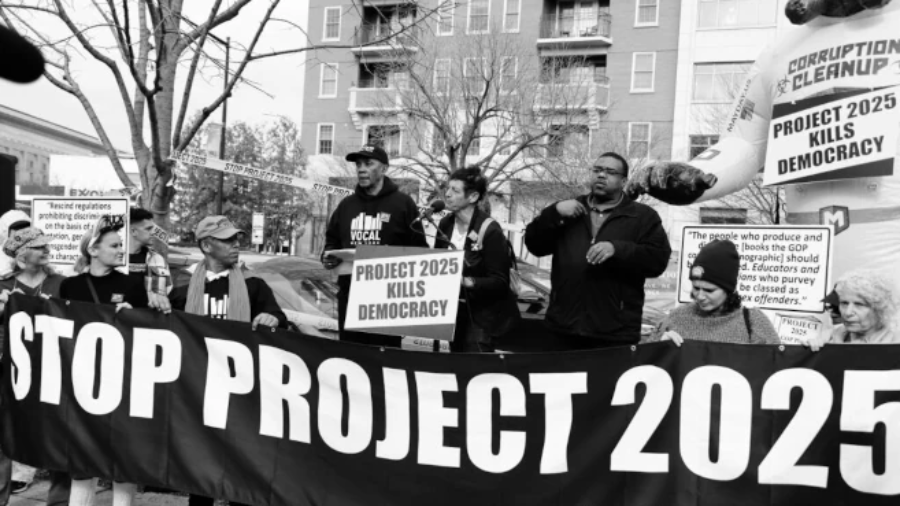
Introduction – Hooking the Reader
Imagine waking up in a country where your rights, your job, even what you learn at school, are no longer guaranteed—but instead depend on how much you say “Yes, boss.” That isn’t dystopian fiction. It’s what Project 2025 promises, and it’s already shaping the undercurrents of American government. Project 2025 isn’t just another policy agenda. It’s an authoritarian playbook hoping to be law, and ignoring it isn’t an option.
What Is Project 2025 — And Why It’s Not Just Another Think-Tank Plan
To understand Project 2025, you must treat it less like a policy proposal and more like a roadmap for power.
- It’s a 900-page policy blueprint called Mandate for Leadership, authored by The Heritage Foundation and over 100 conservative organizations; first published in April 2023. (Wikipedia)
- It’s not only what to do—it includes who to put in place. There’s a personnel database, vetted “loyalists,” and training programs ready to fill federal roles. (Wisconsin Examiner)
- Many of its proposals are designed to be implemented without Congress—via executive orders, reorganizing federal agencies, regulatory changes. Lawsuits and court battles are acknowledged, but the assumption is: get loyalty first, get resistance later. (Democracy Forward)
Comparison: What Past Authoritarian/Transition Blueprints Looked Like — And How Project 2025 Is Worse
To see how dangerous this is, compare it with historical or international authoritarian or presidential transition blueprints:
| Feature | Typical Transition Policy Documents | What Makes Project 2025 Worse |
|---|---|---|
| Personnel vetting | Positions are temporarily proposed; loyalty sometimes considered, but career civil service usually insulated | Project 2025 builds a vetted loyalty pool that can replace civil servants wholesale. (Wikipedia) |
| Scope of executive power | Big changes require legislation or Congressional oversight | Many Project 2025 proposals explicitly meant to bypass Congress; to grab power through executive agency control. (Center for American Progress) |
| Approach to civil liberties | Normally rights are protected via courts, separated branches, public accountability | Project 2025 offers literally rolling back of civil rights protections: discrimination, reproductive rights, LGBTQ+ rights, voting rights. (Civil and Human Rights Conference) |
| Public transparency | Even radical agendas usually seek some legitimation via debate, public hearings | Project 2025 was developed largely behind closed doors, by networks of conservative orgs; many proposals are already being implemented piecemeal without public awareness. (Wikipedia) |
Key Insights: The Building Blocks of the Danger
Below are the less obvious or under-covered elements of Project 2025—what makes this more than alarmism.
1. Personnel Is Policy
This isn’t just about policy prescriptions. The most potent weapons in Project 2025 are people—placing loyalists in every significant bureaucratic role.
- The Personnel Database is a catalog of tens of thousands of individuals pre-vetted for loyalty to conservative ideology. (Wisconsin Examiner)
- The plan advocates reshuffling, firing, or sidelining career civil servants who are deemed disloyal or insufficiently ideological. This is not speculation—they have proposed making many civil service roles “at-will” or replacing protections. (Wikipedia)
Why this matters: Even if some policies are blocked in court, loyalists in enforcement (FBI, DOJ, regulatory agencies) can decide what to enforce, how to enforce, or what to ignore.
2. Erosion of Checks & Balances
Project 2025’s vision intensifies executive power aggressively.
- Weakening oversight: Independent agencies that enforce regulations, civil rights or transparency are to be politicized or dismantled. Agencies like the CDC or EPA may be downgraded, restructured, or stripped of powers. (American Public Health Association)
- Judicial power retreating: The judiciary under Project 2025 is expected to be deferential to executive orders, especially with many judges already appointed for extreme interpretations of executive immunity and unitary executive theory. (Center for American Progress)
3. Targeting Civil Rights, Social Welfare, and Vulnerable Communities
Some of its starkest proposals directly threaten the safety nets and liberties many take for granted.
- Reproductive rights: banning or restricting access to abortion medications (e.g., mifepristone) and limiting reproductive healthcare. (Civil and Human Rights Conference)
- Civil rights protections: rolling back protections from discrimination in employment, housing, healthcare, and education; reducing oversight in federal contracts; weakening enforcement of Title VI / Title IX / EEOC actions. (Civil and Human Rights Conference)
- Public health: limiting the CDC’s ability to provide guidance on masking/vaccination or pandemic response; restructuring public health agencies; funding cuts. (American Public Health Association)
4. Undermining Core Institutions & Values
These are not policy tweaks—they target the foundations of democratic government.
- Education: shrinking or eliminating the Department of Education’s role; promoting vouchers; removing national standards; letting private religious schools flourish under minimal oversight. (Wikipedia)
- Disinformation & truth: proposals to degrade or eliminate government efforts to counter online mis/disinformation; redefining what counts as “pornography” (in ways that might criminalize LGBTQ+ expression). (Civil and Human Rights Conference)
- Immigration & law enforcement: mass deportations, limiting asylum, using executive power to detain immigrants, plus reinforcing executive control over DOJ to prosecute dissent or enforce ideological conformity. (Civil and Human Rights Conference)
5. Public Unpopularity, But Weak Pushback So Far
Interestingly, while many of Project 2025’s proposals are deeply unpopular—even among moderate Republicans—there is limited legislative or political pushback strong enough to stop the momentum.
- In polls, a large portion of Americans disapprove of Project 2025 when hearing of its proposals: banning abortion nationwide, dismantling the Department of Education, removing workplace diversity programs. (Them)
- Civil rights organizations (ACLU, NAACP, LDF) are raising alarms, suing, tracking executive orders. But courts are strained; media coverage is variable; many Americans aren’t yet fully aware of how deeply the plan reaches. (Democracy Forward)
Personal & Ground-Level Stories: What People Are Feeling
What do these threats look like in daily life? I talked with teachers, public health workers, and state employees—here’s what surfaced.
- Teachers in rural states say they’ve been approached about removing certain curricula referencing race, gender identity, or LGBTQ+ topics. Pressure isn’t always direct policy—it’s fear of losing funding or being ostracized.
- Public health officials report that national guidance, especially in pandemics, is being politicized: doctors are told not to mention masks or vaccine efficacy if it contradicts a local narrative. Some feel their jobs are at risk if they release data that displeases the executive.
- Civil servants in regulatory agencies (e.g., peer review scientists, environmental regulators) feel demoralized. They’ve received memos about reassignments, performance reviews based not only on their work, but on whether their worldview aligns with the approved conservative line.
These are small, incremental things—but cumulative. If people are silent or fearful now, it sets the stage for bigger authoritarian moves later.
The Real Dangers: What Is At Stake If Project 2025 Succeeds
Let’s cut to what you lose, likely sooner rather than later.
- Loss of civil liberties: Free speech, bodily autonomy, voting rights, protections against discrimination—these risk becoming privileges, not rights.
- Weakened government services: Public health, education, safety nets (food assistance, social security) could face deep cuts. When agencies lose expertise or autonomy, that means slower responses to crises (pandemics, natural disasters). (American Public Health Association)
- Justice becomes political: When prosecutions, pardons, and legal enforcement are driven more by loyalty than law, the idea of equal protection under the law breaks down.
- Environmental & scientific rollback: Regulations protecting clean air, water, climate change mitigation may be removed or gutted, with dire long-term global consequences.
- Democracy itself under threat: If citizens accept executive overreach, weakening of checks & balances, and suppression of dissent, the mechanisms that protect democracy can collapse. We might see one-party dominance, or withering of oppositional institutions.
Conclusion – The Verdict
Project 2025 isn’t theory. It’s a warning, blueprint, and partial roadmap—and some parts are already in motion. If its full agenda is realized, we face what might be the most dramatic shift in American governance in decades. It would not be gradual decay—it would be an overt, brutal restructuring: rights diminished, dissent criminalized, loyalty over competence, ideology over evidence.
If you still think this is about “politics,” think again. This is about whether America remains a free country or becomes a spectacle of authoritarian power. And that choice is being made now.
Call-To-Action (CTA)
If this scares you, it should. Because silence now means complicity later.
- Share this post. Tell your friends, family, communities. Spread awareness.
- Get involved: Support organizations defending civil liberties (ACLU, NAACP, LDF, etc.). Donate, volunteer, or simply stay informed.
- Speak out locally: School boards, city councils—watch what’s happening on the ground and object.
- Subscribe to Ultimate Causes for more deep dives (no sugar coating).
References & Backlinks
- The People’s Guide to Project 2025 — Democracy Forward. (Democracy Forward)
- What Is Project 2025? Explained — ACLU.org. (American Civil Liberties Union)
- Project 2025 Executive Action Tracker — NAACP Legal Defense Fund. (Legal Defense Fund)
- Public Health Under Threat — American Public Health Association (APHA) on Project 2025. (American Public Health Association)
- CBC’s Coverage & CBS News Explainers. (CBS News)