
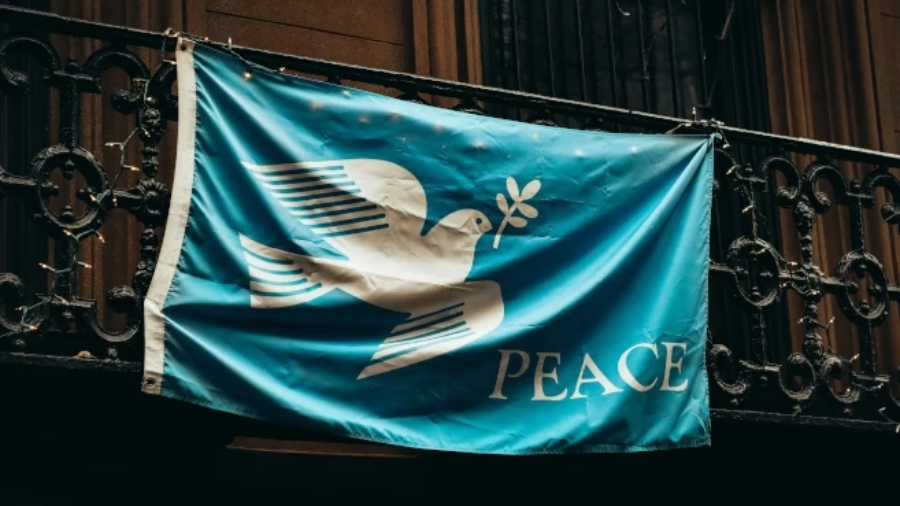
The Paradox of Peace: When a Prize Becomes an Obsession
Imagine craving validation so intensely that you’d allegedly orchestrate your own nomination for the world’s most prestigious peace award. This isn’t the plot of a political thriller—it’s the real story behind Donald Trump and the Nobel Peace Prize obsession, a saga that reveals as much about the nature of political ambition as it does about the integrity of international recognition systems.
The Nobel Peace Prize, established in 1895, represents humanity’s highest honor for contributions to peace. Yet in recent years, this venerable institution found itself entangled in a controversy involving the 45th President of the United States, multiple alleged nomination schemes, and questions about what happens when personal ambition collides with diplomatic achievement.
This investigation delves into the documented evidence, the political machinery behind the scenes, and the unprecedented nature of a sitting president’s apparent fixation on an award that has eluded every modern American president except three.
A History of Presidential Peace Laureates—And One Notable Exception
To understand the significance of Donald Trump and the Nobel Peace Prize obsession, we must first recognize the exclusive club he sought to join. Only four sitting or former U.S. presidents have received this honor:
- Theodore Roosevelt (1906) – For mediating the Russo-Japanese War
- Woodrow Wilson (1919) – For founding the League of Nations
- Jimmy Carter (2002) – For decades of peace efforts (awarded post-presidency)
- Barack Obama (2009) – For strengthening international diplomacy and cooperation
The pattern is clear: recipients demonstrated sustained commitment to conflict resolution, multilateral cooperation, or groundbreaking diplomatic achievements. Obama’s controversial early award sparked debate, but even critics acknowledged his work on nuclear nonproliferation and diplomatic engagement.
Trump’s approach differed fundamentally. Rather than letting achievements speak for themselves, evidence suggests active campaigning for the prize—a strategy that violated both the spirit of the award and potentially its nomination protocols.
The Manufactured Nominations: A Paper Trail of Ambition
The Forged Letters Scandal
In 2018, the Norwegian Nobel Committee made an extraordinary announcement: they had received forged nomination letters for Donald Trump. The committee, which typically maintains strict confidentiality about nominations, broke protocol to report the falsified documents to Norwegian police.
According to investigators, someone had submitted fabricated nomination letters that closely resembled a genuine 2017 nomination. The forgeries appeared professionally crafted, raising questions about who possessed both the motivation and resources to execute such a scheme.
The Nobel Institute’s director, Olav Njølstad, told reporters that the incident was “a troubling violation” of the nomination process. While the forger’s identity was never publicly confirmed, the scandal highlighted the extraordinary lengths someone was willing to go to secure Trump’s nomination.
The Japanese Prime Minister Allegation
Perhaps more revealing than the forgeries was the allegation involving Japanese Prime Minister Shinzo Abe. In 2019, Trump publicly claimed that Abe had nominated him for the Nobel Peace Prize following their diplomatic engagement with North Korea.
“He gave me the most beautiful copy of a letter that he sent to the people who give out a thing called the Nobel Prize,” Trump stated during a press conference, characterizing it as Abe’s initiative.
However, investigative reporting by The Asahi Shimbun and confirmed by American sources suggested a different story: the White House had requested that Japan nominate Trump. An unnamed Japanese government source told reporters that the nomination came “at the request of the U.S. government.”
This revelation transformed the narrative from diplomatic recognition to political maneuvering—a crucial distinction when evaluating the legitimacy of peace prize campaigns.
The North Korea Gambit: Summitry Without Substance?
The Singapore Summit
Trump’s primary claim to Nobel consideration rested on his unprecedented engagement with North Korean leader Kim Jong Un. The June 2018 Singapore summit represented the first meeting between a sitting U.S. president and a North Korean leader—undeniably historic optics.
Supporters argued that Trump’s willingness to engage directly with Kim demonstrated bold diplomacy that previous administrations lacked. The summit produced a joint statement committing to:
- Complete denuclearization of the Korean Peninsula
- Building a lasting peace regime
- Recovery of remains from the Korean War
- Establishing new U.S.-North Korea relations
However, the agreement lacked enforcement mechanisms, verification protocols, or concrete timelines—critical elements that distinguish symbolic gestures from substantive peace agreements.
The Reality Check
Within months, the optimism faded. North Korea continued its nuclear weapons development, conducted missile tests, and showed no indication of dismantling its weapons program. Subsequent summits in Hanoi (February 2019) collapsed without agreement, and the working-level diplomatic relationship deteriorated.
Arms control experts noted that Trump’s approach yielded significant concessions—including suspending joint military exercises with South Korea—without corresponding North Korean commitments. The International Campaign to Abolish Nuclear Weapons (ICAN), itself a Nobel Peace Prize laureate, expressed skepticism about characterizing the talks as peace progress given the lack of verifiable denuclearization.
By 2020, North Korea’s nuclear arsenal had reportedly grown, not shrunk. The gap between Nobel-worthy achievement and photo-opportunity diplomacy became increasingly apparent.
The Normalization Agreements: Legitimate Achievement or Political Theater?
The Abraham Accords
Trump’s strongest claim to peace credentials came through the Abraham Accords—normalization agreements between Israel and several Arab nations, including the United Arab Emirates, Bahrain, Sudan, and Morocco.
These agreements represented genuine diplomatic progress, breaking decades of Arab-Israeli non-recognition. Supporters rightfully noted:
- Direct flights and trade between previously isolated nations
- Technology and security cooperation agreements
- Potential economic benefits for participating countries
- A shift in Middle Eastern diplomatic dynamics
Several Republican lawmakers formally nominated Trump for the 2021 Nobel Peace Prize based on these accords, representing legitimate (if partisan) recognition of diplomatic achievement.
The Palestinian Question
However, peace agreements require all affected parties to participate. The Abraham Accords notably excluded Palestinians, whose aspirations for statehood remained unaddressed. Critics argued that normalizing relations while ignoring the Israeli-Palestinian conflict—the region’s core dispute—represented incomplete peacemaking.
Former Palestinian negotiator Saeb Erekat called the accords “a betrayal,” while human rights organizations questioned whether agreements that bypassed Palestinian self-determination could constitute genuine peace progress.
The Nobel Committee’s historical pattern favors inclusive peace processes—agreements that bring conflicting parties together rather than creating new alignments that exclude marginalized groups. The Oslo Accords (1994), which earned Yitzhak Rabin, Shimon Peres, and Yasser Arafat the prize, included all primary stakeholders in direct negotiations.
The Public Campaign: Breaking Unwritten Rules
“They Should Give It To Me”
What distinguished Donald Trump and the Nobel Peace Prize obsession from previous presidential aspirations was the public nature of the campaign. Trump repeatedly referenced the prize in rallies, interviews, and social media posts:
- “I think I’m going to get a Nobel Prize for a lot of things, if they gave it out fairly” (2019)
- “I would get a Nobel Prize for North Korea” (2018)
- Comparing his achievements favorably to Obama’s award
This public lobbying violated the unwritten etiquette surrounding the prize. Previous laureates, particularly peace prize recipients, typically expressed surprise or humility upon receiving the honor. Active campaigning is considered unseemly—the award should recognize accomplished work, not reward self-promotion.
The Political Rallies
Trump incorporated Nobel Prize references into campaign rhetoric, using the topic to criticize media coverage and political opponents. At rallies, he frequently suggested that bias prevented his recognition, framing the issue as another example of establishment unfairness.
This politicization of the Nobel Peace Prize—treating it as a partisan trophy rather than an independent international honor—fundamentally misunderstood the award’s purpose and the committee’s independence from American political considerations.
Understanding Nobel Prize Eligibility and Process
Who Can Nominate?
The Nobel Committee’s rules allow nominations from:
- National government officials and heads of state
- Members of national assemblies and governments
- Members of international courts
- University professors in specific fields
- Previous Nobel Peace Prize laureates
- Board members of organizations awarded the prize
Critically, nominations mean little without merit. The committee receives hundreds of nominations annually—approximately 300 in recent years—making nomination itself relatively unremarkable. What matters is the selection process, where a five-member committee appointed by the Norwegian Parliament evaluates candidates against rigorous criteria.
The Selection Criteria
The Nobel Committee considers:
- Measurable contributions to peace and conflict resolution
- Reduction of military forces or weapons proliferation
- Promotion of peace congresses and international cooperation
- Lasting impact on global peace and stability
Self-promotion, political maneuvering, and symbolic gestures without verifiable results weigh against candidates. The committee maintains strict independence from political pressure—a principle that makes orchestrated nomination campaigns counterproductive and potentially disqualifying.
The Psychology of Recognition: Why the Obsession?
Narcissism and External Validation
Psychologists have long studied the relationship between narcissistic personality traits and the constant pursuit of external validation. While clinical diagnosis requires professional evaluation, observable behavioral patterns offer insights.
Dr. Craig Malkin, a clinical psychologist specializing in narcissism, explains that individuals with strong narcissistic traits often fixate on prestigious awards as “narcissistic supply”—external validation that temporarily satisfies deep-seated insecurity about self-worth.
The Nobel Peace Prize represents ultimate validation: international recognition, historical permanence, and elevation to a select group of world-changers. For someone prioritizing legacy and status, this prize would represent the pinnacle of achievement.
The Obama Factor
Trump’s Nobel obsession cannot be separated from his predecessor’s 2009 award. Throughout his presidency, Trump frequently compared himself to Obama, often suggesting that his achievements surpassed those of the former president.
The Nobel Prize became another competitive metric in this ongoing comparison—a tangible symbol Trump could point to as evidence of superior accomplishment. His public statements often framed the issue as correcting an unfair imbalance: if Obama received the prize, surely Trump’s achievements warranted equal recognition.
This competitive framing revealed more about personal psychology than diplomatic substance.
The Broader Implications: When Politics Corrupts Peace
Delegitimizing International Institutions
The Donald Trump and the Nobel Peace Prize obsession had consequences beyond one man’s legacy. It contributed to broader skepticism about international institutions and their independence from political manipulation.
When a U.S. president publicly campaigns for an international award, requests allies to provide nominations, and frames the selection process as politically biased, it undermines the institution’s credibility. This erosion of trust in international recognition systems weakens their ability to highlight genuine peace achievements and incentivize conflict resolution.
The Standard for Future Leaders
Perhaps more troubling, Trump’s approach established a precedent. Future leaders might interpret active Nobel campaigning as acceptable behavior rather than a breach of diplomatic norms. This normalization could transform the prize from a recognition of achieved peace to a political prize awarded through lobbying and coalition-building.
The Norwegian Nobel Committee has resisted such pressure throughout its history, but sustained political campaigns threaten the prize’s integrity and its ability to remain above partisan politics.
Comparing Trump’s Claims to Actual Peace Achievements
To contextualize the controversy, consider what Nobel-worthy peace work typically involves:
Mediation and Conflict Resolution:
- Carter’s multi-decade work on conflict resolution across dozens of countries
- Martti Ahtisaari’s mediation ending conflicts in Namibia, Kosovo, and Indonesia
- Actual reduction in violence and loss of life
Weapons Reduction:
- The International Campaign to Abolish Nuclear Weapons’ treaty work
- Successful arms limitation agreements with verification mechanisms
- Measurable reductions in nuclear or conventional weapons arsenals
Human Rights Advancement:
- Malala Yousafzai’s advocacy for girls’ education amid violent opposition
- The Tunisian National Dialogue Quartet’s preservation of democracy
- Documented improvements in human rights conditions
Trump’s diplomatic engagements, while potentially valuable, lacked the sustained commitment, verifiable results, and independence from political calculation that characterize laureate-worthy achievements.
The 2020 Nomination and the Peace House Controversy
The Controversial Nominators
In 2021, reports emerged that Trump had been nominated by a Norwegian politician, Christian Tybring-Gjedde, who cited the Abraham Accords as justification. Additional nominations came from Swedish parliamentarian Magnus Jacobsson and others.
While technically valid under Nobel rules, these nominations sparked controversy in Norway. Critics noted that Tybring-Gjedde represented a far-right populist party with minimal parliamentary representation, and his nomination appeared politically motivated rather than based on impartial peace evaluation.
Norwegian media coverage was largely critical, with commentators noting that the nomination violated Norwegian political culture’s preference for avoiding involvement in foreign political controversies.
The Committee’s Silent Response
The Nobel Committee never publicly commented on Trump’s candidacy—standard procedure given their confidentiality rules. However, when the 2021 prize was awarded to journalists Maria Ressa and Dmitry Muratov for defending freedom of expression, the implicit message was clear: the committee valued independent journalism and democratic values over transactional diplomatic agreements.
What Would Genuine Nobel-Worthy Achievement Look Like?
If Trump or any leader genuinely sought the Nobel Peace Prize based on merit, what would that require?
Sustained Commitment: Years or decades of consistent peace work, not single summit meetings or one-time agreements
Verifiable Results: Measurable reductions in conflict, weapons, or human rights abuses that independent observers can confirm
Personal Risk or Sacrifice: Many laureates faced imprisonment, exile, or death threats for their peace work—genuine cost beyond political calculation
Inclusive Process: Peace agreements that bring all stakeholders to the table, especially marginalized or victimized groups
Independence from Self-Interest: Work motivated by peace itself rather than political legacy, electoral advantage, or personal recognition
The gap between these standards and Donald Trump and the Nobel Peace Prize obsession reveals why the campaign generated more controversy than credibility.
The Lasting Legacy: What the Obsession Reveals
About Political Culture
Trump’s Nobel pursuit illuminated troubling trends in political culture: the prioritization of optics over substance, the weaponization of international recognition for domestic political purposes, and the erosion of norms separating genuine diplomatic achievement from political theater.
About Institutional Integrity
The controversy tested the Nobel Committee’s independence and raised questions about nomination process vulnerabilities. While the committee maintained its standards, the episode highlighted how determined political campaigns could attempt to manipulate even carefully protected institutions.
About Leadership Values
Perhaps most significantly, the obsession revealed competing visions of leadership. One vision sees prizes and recognition as the goal—external validation as the measure of success. Another sees them as byproducts of meaningful work—recognition that may come but should never drive the work itself.
The most respected Nobel laureates typically share a common trait: they pursued their peace work regardless of recognition, often in obscurity, driven by conviction rather than acclaim. Mother Teresa, the Dalai Lama, Nelson Mandela—their work preceded and transcended their awards.
Conclusion: The Peace That Remains Elusive
Donald Trump and the Nobel Peace Prize obsession tells a story larger than one man’s ambition. It reveals how the pursuit of recognition can overshadow the pursuit of peace itself, how political calculation can corrupt diplomatic achievement, and how personal psychology can shape international relations.
The Nobel Peace Prize endures because it represents humanity’s highest aspirations—our belief that conflict can be resolved, that peace can be built, and that individuals can change the course of history through courage and commitment. When that prize becomes a political trophy to be lobbied for, manipulated, or demanded, we lose something precious.
True peace work requires humility, persistence, and a willingness to labor without guarantee of recognition. It demands that leaders prioritize outcomes over optics, substance over spectacle, and lasting change over temporary acclaim.
The irony of Trump’s Nobel pursuit is that genuine peace achievements—reduced nuclear arsenals, resolved conflicts, protected human rights—would have spoken for themselves. The most convincing Nobel case requires no campaign, no forged nominations, no requests for friendly governments to submit paperwork.
It simply requires peace.
What Can We Learn? Your Call to Action
Understanding the dynamics behind Donald Trump and the Nobel Peace Prize obsession helps us become more critical consumers of political claims and more thoughtful evaluators of diplomatic achievement.
Here’s what you can do:
- Question recognition claims: When leaders highlight awards or nominations, ask about underlying achievements and verifiable results
- Support substantive peace work: Identify and support organizations doing measurable conflict resolution, disarmament, or human rights work
- Demand accountability: Hold leaders accountable for diplomatic promises and evaluate outcomes, not just announcements
- Preserve institutional integrity: Recognize the importance of independent international institutions free from political manipulation
Share your thoughts: What role should personal ambition play in diplomatic achievement? How can international institutions protect themselves from political pressure? Join the conversation in the comments below.
For further reading:
- Explore the Nobel Peace Prize official archives
- Read detailed analysis at the Arms Control Association
- Follow ongoing diplomatic developments at the Council on Foreign Relations
Subscribe to our newsletter for more investigative analysis of political culture, international relations, and the personalities shaping our world.
References
- Nobel Peace Prize Official Website – nobelprize.org
- Norwegian Nobel Institute – nobelpeaceprize.org
- Council on Foreign Relations – cfr.org
- Arms Control Association – armscontrol.org
- U.S. Department of State – state.gov
- International Campaign to Abolish Nuclear Weapons – icanw.org
- 38 North (North Korea Analysis) – 38north.org
- The Carter Center – cartercenter.org
- United Nations Information System on the Question of Palestine – un.org/unispal