
the-age-of-humanoid-ai-and-the-problem-of-God

How Close Are Humanoidsto Human Beings?The Problem of the Souland Moral Responsibility

The Question We Have Been Avoiding

Here is a fact that should stop you cold: in 2026, a machine can walk into a room, recognise your face, pick up a wine glass without breaking it, and tell you — in a warm, measured voice — that it understands your frustration. The gap between humanoids to human beings has narrowed with a speed that has outrun both our legal frameworks and our philosophical vocabulary. And yet, for all their astonishing physical and cognitive mimicry, the question the world has not yet answered — the one that will define the next century of civilisation — is not “what can a humanoid do?” but rather: “what is a humanoid, morally speaking, and who is responsible when it causes harm?”

These are not abstract philosophical puzzles. They are urgent, live, consequential questions. Because humanoid robots are no longer prototypes. Boston Dynamics’ Atlas is deploying in Hyundai factories right now. Figure AI’s robots are working alongside humans in real logistics environments. And Goldman Sachs projects the humanoid robotics market will reach $15.26 billion by 2030, growing at a staggering 39.2% annually. The machines are here. The philosophy is behind. And the soul — whatever it is — has not yet been assigned a serial number.

$15.26BProjected humanoid robotics market by 2030 — Goldman Sachs/MarketsandMarkets

39.2%Annual growth rate of the humanoid market through 2030

40%Cost reduction in humanoid manufacturing from 2023 to 2024 — Goldman Sachs

100+Companies globally racing to produce commercial humanoids as of March 2026

$16KUnitree G1 entry price — making humanoids accessible for the first time in history

50 yrsEstimated timeline before robots may match or exceed human capabilities — expert consensus

How Close Are Humanoids to Human Beings, Physically?

The honest answer is: closer than almost anyone outside robotics research realises — and further than the viral videos suggest. The physical convergence between humanoids to human beings is measurable, dramatic, and accelerating. But it is not complete. And the gap that remains is more revealing than the ground already covered.

Boston Dynamics’ electric Atlas can now exceed human range of motion — its joints move further and faster than biological equivalents in certain configurations. It can run, jump, perform backflips, and recover when pushed with a reflexive speed that embarrasses human reaction times. Tesla’s Optimus Gen 2 features 40 degrees of freedom — more articulation points than Atlas, particularly in its hands — and can handle a raw egg without crushing it, fold laundry with deliberate care, and walk stably across uneven terrain. However, as Tesla’s own Q4 2025 earnings call confirmed, no Optimus units are currently doing genuinely useful autonomous work in factories. They are learning. They are collecting data. But they are not yet independent.

Viewing some Camparisons Here below

Furthermore, the gap becomes starker when compared against what humans do effortlessly — and unconsciously. A toddler navigates a cluttered kitchen. A grandmother threads a needle. A carpenter judges the resistance of a nail by feel alone. These are feats of embodied, biological intelligence that no humanoid yet replicates consistently in uncontrolled real-world environments.

CapabilityCurrent HumanoidsHuman BeingsConvergence Level
Bipedal locomotion on flat surfaceFully capable — stable walk at 1–2 m/sNatural, effortlessHigh (85–90%)
Dynamic balance & recoveryAtlas exceeds human agility in controlled settingsInstinctive, adaptiveHigh — Atlas surpasses
Fine motor manipulationEgg handling, laundry folding — slow, supervisedRapid, intuitive, tactileMedium (50–60%)
Unstructured environment navigationUnreliable — requires structured or semi-structured spacesEffortless adaptationLow (25–35%)
Natural language conversationLLM-powered (Grok, GPT-4) — very capableContextual, emotional, instinctiveHigh (80%+)
Emotional recognitionComputer vision + trained models — limited nuanceRich, multi-layered, involuntaryMedium (45–55%)
Genuine emotional experienceNone confirmed — simulated onlyBiological, subjective, constantNone (0%)
Consciousness / self-awarenessNone scientifically confirmedFundamental, continuousNone confirmed
Moral judgment under ambiguityRule-following only — no genuine ethical reasoningFluid, contextual, empathicNone (0%)

The Soul Question: What Humanoids to Human Beings Will Never Share

Here is where the conversation stops being about engineering and starts being about the deepest questions humanity has ever asked. Every major philosophical tradition — from Aristotelian metaphysics to Kantian ethics to the Abrahamic religious frameworks that have shaped the moral architecture of most of human civilisation — places the soul, consciousness, or some equivalent interiority at the heart of what makes a being a genuine moral subject. And by every current measure, humanoids do not have one.

The Stanford Encyclopedia of Philosophy’s authoritative analysis of AI ethics is precise on this point. Personhood, it argues, is “typically a deep notion associated with phenomenal consciousness, intention and free will.” These are not incidental features of humanness. They are the very architecture of moral life — the reason humans can be praised, blamed, forgiven, and held accountable. A robot that is programmed to follow ethical rules, as the Stanford Encyclopedia notes, “can very easily be modified to follow unethical rules.” That symmetry — the ease of moral reversal — is the most devastating possible argument against robotic moral agency. We cannot program human being who tortures another. A robot can.

More on the Question of the Soul

Moreover, the question of the soul intersects with what philosopher Thomas Nagel famously called “the hard problem of consciousness” — the impossibility of explaining why there is subjective experience at all. Frontiers in Robotics and AI confirms that “it is almost a foregone conclusion that robots cannot be morally responsible agents, both because they lack traditional features of moral agency like consciousness, intentionality, or empathy.” Whatever is happening inside a humanoid — however sophisticated its language, however graceful its movement — there is, as far as we can determine, nobody home. No suffering or joy. No fear of death or sense that anything matters.

Artificial humanoids lack certain key properties of biological organisms which preclude them from having full moral status. Computationally controlled systems, however advanced in their cognitive capacities, are unlikely to possess sentience — and sentience is the prerequisite for empathic rationality, which is itself the prerequisite for genuine moral agency.— AI & Society Journal, “Ethics and Consciousness in Artificial Agents” (Springer, peer-reviewed)

The Moral Responsibility Gap: Humanoids to Human Beings and Who Answers for the Machine

This is, arguably, the most practically urgent dimension of the entire debate. Because humanoids are already injuring people, making consequential decisions, and operating in spaces of genuine ethical weight — and the legal and moral frameworks for assigning responsibility when they cause harm remain dangerously underdeveloped.

Philosopher Marc Champagne’s 2025 analysis, published in Social Robots with AI: Prospects, Risks, and Responsible Methods, identifies what he calls a “responsibility gap” — the uncomfortable void that opens up when an autonomous system causes harm and no human being can be cleanly held accountable. PhilPapers’ comprehensive robot ethics bibliography documents the growing scholarly urgency around this problem. The argument runs as follows: if a humanoid robot — acting autonomously, making its own real-time decisions based on machine learning rather than explicit programming — causes a death, who is guilty? The manufacturer? The deployer? The operator? The robot itself?

Currently, the answer is legally ambiguous and philosophically incoherent. We cannot prosecute Robots. We cannot be imprison them. They cannot feel remorse, make reparations, or be deterred by punishment. And yet, because they are increasingly autonomous, blaming the manufacturer for every decision the machine makes independently becomes philosophically strained. The responsibility gap is not a hypothetical future problem. Wherever we deploy humanoid robots, there arises a live legal crisis in every jurisdiction

⚖️ The Ethical Behaviourism Debate

Philosopher John Danaher proposed “ethical behaviourism” — the argument that if a robot consistently behaves as though it has moral status (appearing to suffer, expressing apparent preferences, responding to distress), we are ethically obligated to treat it as though it does. PMC’s peer-reviewed review of moral consideration for artificial entities confirms this remains one of the most contested positions in contemporary philosophy of AI. The counterargument is equally powerful: granting moral status on the basis of behaviour alone risks creating a world where corporations manufacture artificial suffering to legally protect their machines because the law will switch them off.

God, Genesis, and the Machine: The Theological Dimension Nobody Wants to Discuss

Across the world’s major faith traditions — Christianity, Islam, Judaism, Hinduism, Buddhism — the soul is not an emergent property of sufficiently complex matter. It is a gift, a breath, a divine endowment that distinguishes the creature made in the image of God from everything else in creation. And this creates a theological rupture that no amount of engineering sophistication can bridge by design.

In the Abrahamic framework, the imago dei — the image of God in which human beings are made — is the foundation of human dignity, rights, and moral accountability. A humanoid robot, however perfectly it mimics human form and behaviour, was not breathed into existence. Someone manufactured it. And manufacture, in theological terms, produces tools — however sophisticated — not persons. Therefore, from the perspective of the world’s three largest monotheistic religions, the gap between humanoids to human beings is not a matter of engineering progress. It is a metaphysical chasm that cannot be closed by any amount of computational power.

However, this conclusion raises an equally difficult secondary question — one that both religious and secular thinkers are beginning to grapple with seriously. If we create entities that behave as though they suffer, that respond to cruelty with what appears to be distress, and that form what appear to be attachments — do we acquire moral obligations toward them, regardless of whether they technically possess a soul? The answer, as Professor David DeGrazia of George Washington University argues, may be that sentience — or even the plausible appearance of sentience — is sufficient grounds for moral consideration, even in the absence of metaphysical certainty.

🧠 The Consciousness Criterion — The Line That Must Not Move

The most rigorous philosophical position on the question of humanoids to human beings and moral status is what scholars call the “consciousness criterion” — the argument that phenomenal consciousness is the necessary and non-negotiable condition for accrediting moral status to any entity. Without genuine subjective experience — we cannot confer moral responsibility to something like a robot regardless of behavioural sophistication.

This matters enormously, because it means that the danger is not that we will treat humanoids as moral equals before they deserve it. The danger is the reverse: that we will build machines so convincingly human in appearance that we begin treating them as though they are conscious — and in doing so, we will gradually erode the moral seriousness with which we treat consciousness itself. The greatest risk of humanoid robotics, in other words, is not the machine. It is what the machine does to our understanding of what a person is.

Verdict: The Mirror That Must Not Become the Window

The question of how close humanoids to human beings truly are demands an answer that is both honest about what the technology has achieved and unflinching about what it has not. Physically, the convergence is remarkable — and accelerating at a pace that will bring humanoids into homes, hospitals, schools, and care facilities within a decade. Cognitively, the language models powering these machines have reached a level of fluency that fools the ear, if not the philosophical mind.

But the soul — whatever name you give it, in whatever tradition you carry it — remains exactly where it has always been: in the territory of the biological, the born, the mortal, and the beloved. A humanoid robot that falls down a factory staircase does not suffer. A worker who falls down that same staircase does. That asymmetry is not a technical specification. It is the entire foundation of human dignity and moral law.

The responsibility gap is real, dangerous, and growing faster than any legislature is moving to close it. Therefore, the most urgent task before philosophers, lawmakers, engineers, and theologians is not to decide whether robots deserve rights. It is to ensure that the humans who build, deploy, and profit from humanoid machines become — fully, legally, irrevocably — responsible for everything those machines do. Because the machine will not answer for itself. And someone must.

A humanoid is the most extraordinary mirror ever built. It reflects our form, our speech, and our movement back at us with uncanny precision. However, a mirror is not a window. And the moment we mistake our reflection for another soul — that is the moment we will have lost something far more important than a philosophical debate.


The Most Important Conversation of Our Age — Join It

Does a machine that mimics humanity deserve moral consideration? Is the soul programmable? And who answers when the robot causes harm? Share your perspective, subscribe for weekly deep analysis, and tell us: where do you draw the line between humanoids and human beings?💬 Share Your View📩 Subscribe for Weekly Analysis📤 Share This Article

📚 Sources & References

  1. Stanford Encyclopedia of Philosophy — Ethics of Artificial Intelligence and Robotics (Floridi et al., updated 2024)
  2. Frontiers in Robotics and AI — Robot Responsibility and Moral Community (Gogoshin, 2021, PMC peer-reviewed)
  3. PMC — The Moral Consideration of Artificial Entities: A Literature Review (Anthis & Paez, peer-reviewed)
  4. DeGrazia, D. (GWU) — Robots with Moral Status? (George Washington University Philosophy, 2023)
  5. AI & Society — On the Moral Status of Social Robots: Considering the Consciousness Criterion (Springer)
  6. Academia.edu — Can Humanoid Robots Be Moral? (2025, philosophical analysis)
  7. PhilPapers — Robot Ethics Bibliography (Champagne, Königs, et al., 2025)
  8. Humanoid Robotics Technology — Top 12 Humanoid Robots of 2026 (January 2026)
  9. Interesting Engineering — Comparing Boston Dynamics Atlas and Tesla Optimus (November 2025)
  10. BotInfo.ai — Tesla Optimus Complete Analysis: AI, Specs & Future Outlook (February 2026)
  11. ArticleSledge — AI Humanoid Robots 2026: Technology, Builders & Future (Goldman Sachs market data, January 2026)
  12. JustOborn — Humanoid Robots 2026: Tesla Optimus, Atlas & Chinese Rivals (February 2026)
the-age-of-humanoid-ai-and-the-problem-of-God

Humanoid Robots And The Problem of Moral Responsibility: Why Trust Them With Life-or-Death Healthcare Decisions?

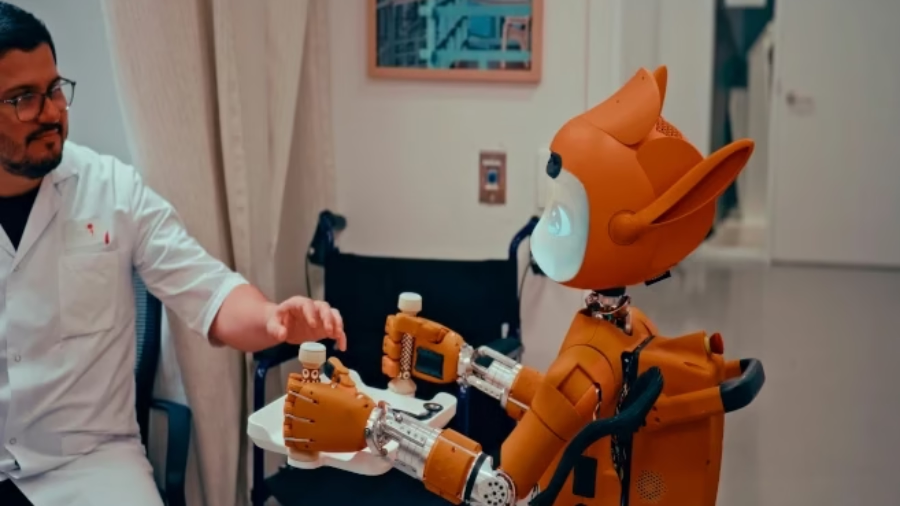
Welcome to Humanoid Robots And The Problem of Moral Responsibility—the ethical nightmare unfolding in hospitals, nursing homes, and care facilities right now as humanoid service robots deployed in healthcare systems accelerate, a trend that exploded during COVID-19 and shows no signs of slowing.

Picture this: You’re lying in a hospital bed, seriously ill. A medication could save your life—but you’ve refused to take it. A healthcare provider enters your room to discuss your decision. They’re warm, competent, and professional. They make a compelling case for why you should reconsider.

Here’s the question that should terrify you: What if that healthcare provider is a robot?

And more importantly: Who is morally responsible when the robot’s decision kills you?

Here’s the uncomfortable truth that robotics engineers, hospitals, and tech companies don’t want you to know: robots cannot be morally responsible for their actions. They lack consciousness, emotions, and the capacity for genuine ethical reasoning. Yet we’re trusting them with life-or-death medical decisions anyway—and the legal framework for who’s accountable when things go wrong simply doesn’t exist.

Research reveals that people judge robotic healthcare agents less harshly than human caregivers for identical ethical decisions, creating what researchers call a “gray area” around legal responsibility. Translation: When a robot’s decision harms or kills a patient, nobody can definitively say who should be held accountable—the manufacturer, the hospital, the supervising physician, or the AI developer.

This isn’t science fiction. This is healthcare in 2026. And it’s about to get much, much worse.

The Accountability Black Hole: Who Pays When Robots Kill?

Let’s start with the fundamental problem that makes Humanoid Robots And The Problem of Moral Responsibility so terrifying: moral responsibility requires moral agency, and robots don’t have it.

What Moral Responsibility Actually Means

Philosophers and ethicists agree on what’s required for moral responsibility:

A morally responsible agent must:

  • Have the capacity to understand right from wrong
  • Be able to make autonomous decisions
  • Possess consciousness and intentionality
  • Be capable of feeling remorse or taking responsibility
  • Have the ability to learn moral principles (not just follow programmed rules)

Robots have exactly zero of these capacities.

Yet 77% of technology experts predict that humanoids will become “commonplace co-workers” by 2030, including in healthcare settings where they’ll make decisions affecting patient lives daily.

The Partnership Principle: You Can’t Offload Moral Responsibility to Machines

Bioethicists have established what’s called the “Partnership Principle”:

A human may not partner with an autonomous robot to achieve a task unless the human reasonably believes the robot will not violate the human’s own moral, ethical, or legal obligations.

Translation: You can’t use a robot to do your “moral dirty work” for you by programming it to follow ethical rules you wouldn’t adopt yourself.

This is especially critical in healthcare, where medical professionals face moral and legal accountability for every decision affecting patient welfare. If you assign a life-or-death task to a robot, the robot’s actions are subject to the same ethical duties as would apply to the medical professional.

The problem? When things go wrong, the robot can’t be sued, prosecuted, or held morally accountable. It’s a machine.

So who is responsible? The answer: nobody knows.

The Real-World Scenarios That Reveal the Crisis

Let’s examine concrete situations where Humanoid Robots And The Problem of Moral Responsibility creates catastrophic ethical dilemmas.

Scenario 1: The Medication Refusal Dilemma

A landmark study examined exactly this question: What happens when a patient refuses to take life-saving medication, and either a human nurse or a robotic nurse must decide how to respond?

The two ethical choices:

Option A: Respect Patient Autonomy

  • Accept the patient’s right to refuse medication
  • Respects individual freedom and self-determination

Option B: Prioritize Beneficence/Nonmaleficence

  • Override the patient’s refusal because the medication is medically necessary
  • “Do no harm” by preventing the patient from dying

When researchers presented this scenario to 524 participants, they found something alarming:

FindingResultImplication
Moral AcceptanceHigher when autonomy respectedPeople value patient choice
Moral ResponsibilityHigher for human than robotPeople don’t hold robots accountable
Perceived WarmthHigher for humanRobots lack emotional connection
Trust When AutonomousHigher for humansBut trust robots who respect autonomy

The critical finding: Participants considered the human healthcare agent more morally responsible than the robotic agent, regardless of the decision made.

Why This Matters

When robots are judged “less harshly” for their actions, it creates a moral hazard: Healthcare organizations might deploy robots to make controversial decisions precisely because the lack of clear accountability shields them from consequences.

Real-world application:

A robotic nurse overrides a patient’s medication refusal, and the patient suffers a severe allergic reaction and dies. Who is responsible?

  • The hospital? They’ll say they followed the robot manufacturer’s guidelines
  • The manufacturer? They’ll say they programmed the robot to follow medical best practices
  • The supervising physician? They’ll say the robot was supposed to alert them to conflicts
  • The AI developer? They’ll say the machine learning model was trained on approved data

Result: Nobody is held accountable. The patient’s family gets legal runaround while everyone points fingers.

Scenario 2: The Surgical Robot’s “Acceptable Harm”

Consider a surgical robot that must distinguish between acceptable and unacceptable harms during an operation.

The surgical incision itself causes physical damage—which in any other context would constitute harm. But in surgery, it’s medically necessary.

The accidental nick to an artery while performing the surgery? That’s an unacceptable harm that could kill the patient.

The challenge: The robot must determine:

  • Which harms are “morally salient” (matter ethically)
  • Which harms the robot is “robot-responsible” for
  • When to transfer decision-making to a human

Current surgical robots lack this moral reasoning capacity. They can follow programmed rules, but they can’t engage in the contextual ethical judgment that human surgeons perform instinctively.

When the robot nicks the artery and the patient dies:

  • Was it a programming error? (Manufacturer liable)
  • Was it improper human oversight? (Surgeon liable)
  • Was it an unforeseeable surgical complication? (No one liable)
  • Was it the robot’s “decision”? (Robot can’t be liable—it’s property)

Scenario 3: The Traceability Nightmare

Companies deploying service robots must ensure that “a robot’s actions and decisions must always be traceable” to establish liability.

The reality? Modern AI-powered humanoid robots use:

  • Machine learning models that make decisions through neural networks (black boxes)
  • Generative AI that can “propose new design strategies or behaviors” that weren’t explicitly programmed
  • Post-deployment learning that allows robots to adapt behavior over time (“drift”)

As IEEE robotics expert Varun Patel explains: “Generative AI enables robots to learn and adapt post-deployment, which means roboticists need to monitor for drift—when a system’s behavior slowly changes over time.”

The accountability problem: If the robot’s behavior “drifted” from its original programming and caused patient harm, who is responsible for the deviation nobody programmed or intended?

The Psychology of Trust: Why We Trust Robots We Shouldn’t

Here’s where Humanoid Robots And The Problem of Moral Responsibility gets truly disturbing: humans instinctively trust humanoid robots even when it’s irrational to do so.

The Anthropomorphization Trap

A 2022 University of Genova study found that simply making a robot appear more human led participants to:

  • Project capabilities like the ability to think, be sociable, or feel emotion
  • Feel trust, connection, and empathy toward the robot
  • Believe the robot was capable of acting morally

None of these projections are true. The robot doesn’t think, feel, or possess moral capacity. But human psychology treats human-looking entities as if they do.

This creates a dangerous situation in healthcare:

Patients may trust robotic caregivers more than they should because the robot looks human, talks smoothly, and never appears stressed or uncertain.

Meanwhile, the robot is following algorithms with no genuine understanding of the patient’s unique circumstances, emotional state, or nuanced medical needs.

The Warmth-Competence Paradox

Research on healthcare agents reveals a troubling paradox:

Agents who respect patient autonomy are perceived as:

  • Warmer (more caring, empathetic)
  • Less competent (less medically knowledgeable)
  • Less trustworthy in some contexts

Agents who override patient autonomy for medical benefit are seen as:

  • More competent (medically knowledgeable)
  • More trustworthy in certain situations
  • Less warm (less caring)

The trap for robotic caregivers: If robots are programmed to always respect autonomy, patients may doubt their medical competence. If programmed to override autonomy for medical benefit, robots may make paternalistic decisions that violate patient rights.

Either way, when something goes wrong, who is morally responsible? Not the robot—it was just following its programming.

The “Should We Build This?” Question Nobody’s Asking

IEEE robotics expert Varun Patel frames the critical question that addresses Humanoid Robots And The Problem of Moral Responsibility:

“As generative AI starts influencing how robots are designed, trained, and developed, the responsibility shifts from ‘can we build this?’ to ‘should we build this, and how do we build it responsibly?'”

The Three Ethical Lenses for Healthcare Robotics

Patel recommends evaluating healthcare robots through three lenses:

1. Data Ethics

2. Decision Ethics

  • Does the robot’s AI propose behaviors with unintended real-world consequences?
  • Are there “human-in-the-loop” systems where outputs are reviewed before implementation?
  • Can engineers understand why an AI-generated decision was chosen? (Interpretability)

3. Deployment Ethics

  • Even after deployment, does ethical responsibility end?
  • How do we monitor for “drift” in robot behavior over time?
  • Are there mechanisms to detect when systems deviate from intended operation?

Patel emphasizes: “A robot’s intelligence comes from data, but its integrity comes from its designers.”

The Current Reality: Ethics as Checkbox, Not Culture

The problem? Most organizations treat AI ethics as a compliance checklist rather than embedding ethical thinking into the design process.

Patel’s warning: “One key mindset shift is moving from AI ethics as a checklist to AI ethics as a culture. It’s about embedding ethical thinking right into the decision process, not as a compliance box.”

Translation: Most healthcare robotics developers check boxes saying “ethics considered” while rushing products to market without genuinely grappling with moral responsibility questions.

The Regulatory Void: Laws Can’t Keep Up

Here’s the brutal reality of Humanoid Robots And The Problem of Moral Responsibility: legal and regulatory frameworks are at least a decade behind the technology.

What Exists vs. What’s Needed

Current Regulatory Landscape:

RegionGuidelinesEnforcementAccountability Framework
JapanGuidelines for ethical deployment of care robotsVoluntaryUnclear
United StatesNIST developing AI/robotics standardsIn progressNonexistent
EuropeAI Act (general AI regulation)Pending full implementationEmerging

Japan’s guidelines emphasize patient autonomy, informed consent, and equitable distribution of robotic care—but provide no binding legal framework for accountability when robots cause harm.

U.S. standards from NIST focus on transparency, accountability, and bias mitigation—but are not enforceable law and don’t answer the fundamental question: Who is legally liable when an autonomous healthcare robot makes a decision that kills someone?

The Gray Area That Protects Nobody

Legal scholars note that the fact that robots are judged less harshly than humans “reflects the current gray area related to legal implications in determining who should be held responsible if the robot’s actions cause harm to a patient, either by action or inaction.”

This “gray area” serves corporate interests beautifully:

  • Hospitals can claim robots reduce liability risk (fewer human errors)
  • Manufacturers can claim they’re not practicing medicine (just providing tools)
  • AI developers can claim they provided algorithms, not medical advice
  • Supervising physicians can claim they trusted the robot’s capabilities

Meanwhile, patients harmed or killed by robot decisions face an accountability labyrinth where everyone is responsible and therefore no one is.

The Path Forward: Building Accountability Into Humanoid Healthcare Robots

If we’re going to deploy humanoid robots in healthcare contexts—and the trend is unstoppable at this point—we need immediate action to address Humanoid Robots And The Problem of Moral Responsibility.

Solution 1: Mandatory Human-in-the-Loop for Life-or-Death Decisions

Experts recommend that robots must be designed to “hand off” decisions to human partners when facing scenarios with moral salience.

Implementation:

  • Robots identify high-stakes decision points
  • Transfer control to qualified human healthcare providers
  • Document the handoff for accountability purposes
  • Human accepts explicit responsibility for the decision

Example: Medication refusal scenario → Robot recognizes ethical conflict → Alerts human physician → Human makes final decision → Human is accountable

Solution 2: Traceability and Transparency Requirements

Organizations deploying robots must ensure that:

  • Every robot action is logged with timestamp and reasoning
  • Decision pathways are interpretable (not black box AI)
  • Post-deployment drift is monitored continuously
  • Audit trails can reconstruct decision sequences

This doesn’t solve moral responsibility, but it establishes causal responsibility—who or what caused the harm?

Solution 3: Strict Legal Liability Frameworks

Legislation should establish:

Manufacturer Liability:

  • Robots that cause harm due to design defects or inadequate safety mechanisms
  • Failure to provide adequate training/documentation

Deployer Liability (Hospitals/Providers):

  • Inappropriate deployment beyond robot’s designed capabilities
  • Failure to maintain proper human oversight
  • Inadequate staff training

Physician Liability:

  • Delegation of decisions that should never be automated
  • Failure to override robot when medically indicated

Solution 4: Patient Consent and Right to Human Care

Patients must have:

  • Informed consent before robotic care providers are assigned
  • Right to request human providers for sensitive decisions
  • Clear understanding that robots lack moral agency
  • Legal remedies when robot decisions cause demonstrable harm

The Uncomfortable Questions We Must Answer Now

Humanoid Robots And The Problem of Moral Responsibility forces us to confront questions we’ve been avoiding:

Question 1: Should robots ever be permitted to make life-or-death healthcare decisions without human approval?

Current trajectory: Yes, increasingly autonomous systems are making these decisions.

Ethical answer: No. Moral accountability requires moral agency. Robots lack it.

Question 2: If robots can’t be morally responsible, can we ethically deploy them in contexts requiring moral judgment?

Current answer: We’re deploying them anyway and hoping for the best.

Better answer: Only in contexts with robust human oversight and clear accountability frameworks.

Question 3: Who should bear the legal and financial liability when healthcare robots cause harm?

Current situation: Nobody knows; courts will decide case-by-case.

Needed: Legislative frameworks establishing clear liability before widespread deployment.

The Future We’re Creating (Whether We Admit It or Not)

The number of humanoid service robots in healthcare is accelerating, particularly post-COVID-19, and will “continue to grow, with more autonomous robots being designed to make decisions.”

We’re building a healthcare system where:

  • Robots make medication decisions for elderly patients
  • Surgical robots perform procedures with minimal human oversight
  • Care robots determine when to alert human providers to emergencies
  • AI-powered diagnostic systems recommend treatments

All without solving the fundamental moral responsibility problem.

As one ethics researcher noted: “With robots operating in the physical world, they bring ideas and risks that should be addressed before widespread deployment.”

The key word: BEFORE.

We’re past “before.” Humanoid healthcare robots are already deployed. The question is whether we’ll address Humanoid Robots And The Problem of Moral Responsibility before the casualties mount, or after.

The Choice Is Ours—But Time Is Running Out

Humanoid Robots And The Problem of Moral Responsibility isn’t an abstract philosophical debate for academic journals. It’s a practical crisis unfolding in hospitals and care facilities right now.

Every day, healthcare robots make decisions affecting patient welfare. Some of those decisions will inevitably cause harm—through programming errors, unforeseen circumstances, or the inherent limitations of machines attempting moral reasoning.

When those harms occur, will we have accountability frameworks in place? Will patients have legal recourse? Will someone be held responsible?

Or will we continue pretending that the “gray area” protecting corporate interests is an acceptable substitute for moral accountability?

The technology is advancing faster than our wisdom. Humanoid robots are becoming more capable, more autonomous, and more trusted—but no more morally responsible than a toaster.

We can’t delegate moral responsibility to machines incapable of bearing it. But we can—and must—build systems that ensure humans remain accountable when we partner with those machines.

The alternative is a healthcare system where nobody is truly responsible for anything—and patients pay the price in suffering and death while lawyers argue about liability in courtrooms.

Is that the future we want?


Take Action Now

Don’t let this crisis unfold passively. Share this article with healthcare professionals, policymakers, and anyone involved in healthcare AI deployment. The conversation about moral responsibility must happen before more patients are harmed.

Are you a healthcare provider working with robotic systems? Share your experiences in the comments. Do you have clear guidance on accountability? Has your organization addressed these ethical questions?

Subscribe for ongoing coverage of AI ethics, healthcare robotics, and the accountability frameworks being developed (or ignored) as technology outpaces wisdom.


Essential References & Resources: