
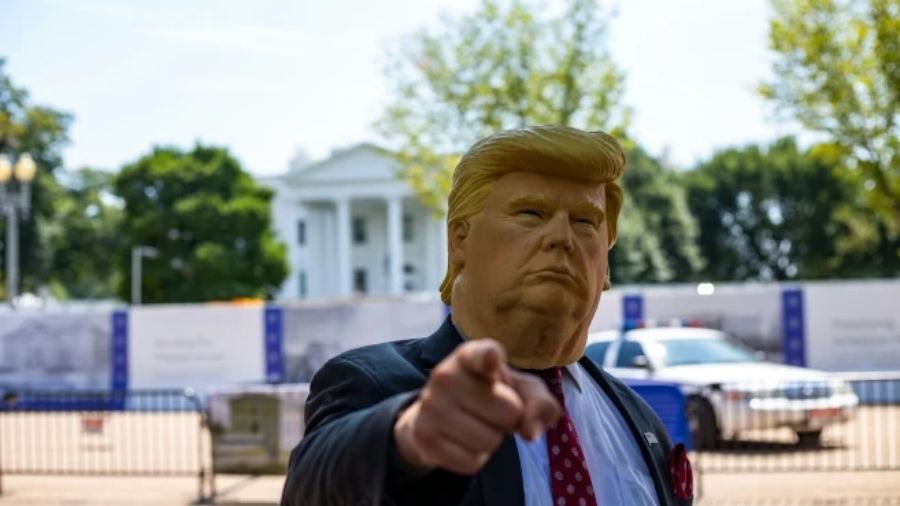
threats against Trump critics

Fighting the Inhumanity and Lawlessness of the Trump Administration — Defending Democracy as a Moral Duty

Introduction – A Warning We Can’t Ignore

When a government treats power as a personal weapon, when laws are bent or broken to punish dissent or target the vulnerable — democracy itself trembles. The phrase “the inhumanity and lawlessness of the Trump Administration” may sound like a political slogan — but behind it lies a stark reality for millions whose lives and rights have been directly impacted.

What happens when institutions meant to guard liberty — courts, civil-rights protections, immigration laws, watchdog agencies — are undermined? When power is concentrated in one person or a faction, and compassion is replaced by cruelty? The consequences extend far beyond partisan politics.

This article explores how democratic systems, human-rights norms, and the rule of law strain under such pressure — why resisting this trend isn’t optional, but a moral and civic duty.

How Lawlessness and Cruelty Have Been Systematically Embedded

Erosion of Human Rights and Assaults on Vulnerable Groups

From early in his presidency onward — and with renewed vigor in his current term — Donald J. Trump has led policies that human-rights groups describe as “cruelty and chaos.” (Amnesty International)

  • Under the administration, asylum protections have been sharply curtailed; migrants have faced family separations, mass deportations, and harsh detentions. (Wikipedia)
  • Vulnerable communities — immigrants, refugees, minorities, women, LGBTQ+ individuals — have seen protections scaled back, and government rhetoric has often demonized them. (Amnesty International Australia)
  • Internationally, the United States under Trump has weakened its role as a human-rights advocate — reducing pressure on abusive regimes and softening official reports of rights violations. (The Washington Post)

The result: a climate of fear, marginalization, and dehumanization — where people’s dignity and rights are treated as expendable under political expediency.

Targeting Institutions, Undermining Checks and Balances

Human rights abuses don’t only stem from individual policies. Equally dangerous is the undermining of institutions meant to restrain power.

  • According to Human Rights Watch, the administration has waged a systematic assault on the institutions responsible for accountability — courts, justice system agencies, oversight bodies. (Human Rights Watch)
  • The effect is chilling: civil servants and public servants who resist abuses are marginalized, career-officials silenced or removed, and legal definitions manipulated to protect power rather than justice. (AP News)
  • On a global scale, U.S. leadership in human rights has weakened. The administration’s “human-rights diplomacy” has shifted toward geo-political interest, often at the expense of defending minorities, refugees, and persecuted communities. (The Washington Post)

Institutional decay like this doesn’t just affect laws — it magnetizes fear, discourages dissent, and signals to the world that power might now be above accountability.

The “Weaponization” of Government: Law as a Tool of Retaliation

One of the most dangerous aspects of this shift is how law and justice — traditionally shields for the weak — have become weapons for the powerful.

  • The administration has reportedly used executive orders and internal directives to punish critics, target law-firms and attorneys, and reshape judicial oversight in ways that prioritize loyalty over justice. (The White House)
  • Civil-servants working in agencies like the U.S. Department of Justice (DOJ) have testified that political loyalty, not lawful conduct, has become the standard — undermining independence, fairness, and public trust. (AP News)
  • Reports indicate removal of content or softening of language in official human-rights documents — undermining transparency and erasing abuses in partner countries or allied regimes. (Human Rights Watch)

This transformation of government into an instrument of power and retaliation turns law into its own opposite — not a guardian of justice, but a tool of suppression.

Why This Matters — Beyond Politics

Democracy’s Fragile Foundations

Democracy isn’t just elections — it’s institutions. Checks and balances. The rule of law. Respect for human dignity.

When core institutions degrade, when laws no longer protect the vulnerable but instead shield the powerful — democracy begins to hollow out.

  • Courts lose independence when law-firms and judges are threatened or punished for rulings.
  • Civil-rights protections lose meaning when agencies meant to enforce them are politicized or dismantled.
  • Trust dissolves — among minorities, immigrants, and the general public — when rights are eroded, and justice becomes selective.

In such a climate, the social contract fractures. Citizens lose faith, and resentment grows. The next generation sees not protection, but danger — not representation, but power for sale.

Global Ripple Effects — From Precedent to Empowerment of Autocrats

When the world’s most powerful democracy scales back human-rights advocacy, the impact is global.

  • Authoritarian regimes take heart: if the U.S. no longer sanctions abuses or calls out corruption, repression abroad gains a powerful cover. This undermines global human-rights norms and emboldens oppressive governments. (OCCRP)
  • Organizations and civil-society defenders abroad lose a powerful ally. With the U.S. withdraw from moral leadership — or polarizing that leadership — vulnerable populations worldwide become more exposed.
  • International human-rights frameworks, treaties, and conventions weaken if a founding global power abandons them or violates their spirit.

The “Trump effect,” as some human-rights organizations call it, isn’t just domestic — it reverberates worldwide. (The Guardian)

Humanity’s Moral Debt — The Voice of Conscience

Beyond institutions and geopolitics lies the human toll — the pain of families separated, of refugees turned away, of minorities stripped of dignity, of individuals persecuted for who they are.

We have a moral debt — not only to those affected now, but to future generations.

If we allow cruelty and lawlessness to take root with impunity, we risk normalizing the unacceptable. We risk teaching our children that might makes right, that power absolves morality.

Who Must Resist — The Many Roles of Defenders

Fighting this isn’t the job of one group. It requires a coalition — a mosaic of voices.

Citizens & Voters

Your vote, your voice, your activism can shape public opinion and influence policy. Silence becomes complicity. Use your voice to challenge abuses, support rights, and demand accountability.

Journalists & Media Organizations

Truth must be told. Through rigorous reporting, exposing abuses, and holding power to the light — journalism remains one of democracy’s most important defenses.

Public Servants & Whistleblowers

Those inside government — civil-service employees, lawyers, inspectors — who value justice over politics, who report abuses despite risk, are crucial. Their courage preserves institutional integrity.

Faith Leaders, Community Organizers & Civil-Society Actors

Compassion, solidarity, and moral clarity often come from faith communities and grassroots activists. They remind us: behind every policy are real people with dignity, suffering, or hope.

International & Human-Rights Organisations

Global coalitions amplify pressure, document abuses, and defend international law. Their work ensures that power cannot hide behind borders.

A Call for Moral Clarity — Not Political Partisanship

Resisting “the inhumanity and lawlessness of the Trump Administration” is not about political parties or ideological purity.

It’s about defending what it means to be human.

It’s about insisting that power must be limited, rights must be protected, and justice must be real — for everyone.

It’s about refusing to allow cruelty, fear, and oppression to become “normal operations.”

Because when we tolerate injustice — even indirectly — we lose more than laws. We lose our dignity, our compassion, our collective humanity.

What You Can Do: Concrete Steps

ActionWhy It Matters
✉️ Write to your representatives — demand oversight and transparencyElected officials can pressure institutions and enact protective laws
📢 Support independent journalism and human-rights organizationsEnsures abuses are exposed and documented
🛑 Stand with immigrants, minorities, marginalized communitiesSolidarity reduces fear and strengthens resistance
💬 Speak publicly — blogs, social media, community forumsVoices create awareness and challenge normalization of cruelty
🧑‍⚖️ Support judges, whistleblowers, civil-servants who defend justiceInstitutional integrity depends on individuals with moral courage
🌍 Promote international human-rights cooperation and solidarityRebuilds global norms weakened by domestic lawlessness

Conclusion — Why This Struggle Matters for All of Humanity

The inhumanity and lawlessness of the Trump Administration — real, repeated, systemic — is not just an American problem. It is a universal warning.

When power goes unchecked, when rights are stripped, when institutions crumble, and when cruelty becomes policy — any society can descend into oppression.

But history also shows another path: the path of resistance, of solidarity, of justice. The path where citizens, communities, and conscience unite to defend dignity.

If you believe that human life — every human life — matters. If you believe that laws exist not to serve power, but to protect people. If you believe that democracy is more than elections — more than politics — but a covenant of trust, respect, and shared responsibility — then this struggle is yours too.

Fighting this inhumanity is not optional. It is a moral duty.

Stand with me. Stand for dignity. Stand for justice.

threats against Trump critics

“Incompetence, Imbecility and a Continuous Zeal to Revenge”: How Apt Is This Description to the Trump Administration (Trump 2.0)?

Introduction: Setting the Stage for Trump 2.0

When a prosecutor described the second Trump presidency as defined by “incompetence, imbecility and a continuous zeal to revenge,” it grabbed headlines—and for good reason. That scathing assessment is not just rhetorical flourish; it resonates with concerns echoed by political opponents, some former insiders, and media commentators alike. But how accurate is it?

Is Trump’s second term really a series of chaotic missteps and vindictive power plays? Or is there more method than madness—a strategic, even deliberate, effort to reshape the U.S. government in his image? To explore these questions, we’ll investigate each part of the assertion: incompetence, imbecility (stupidity), and an obsessive quest for revenge.

Incompetence: Chaos as Governance Strategy

A Return to Disorder?

Many critics argue that Trump 2.0 is marked by a return to the same kind of chaos that characterized his first term—but worse. According to an editorial in The Inquirer, early executive orders were issued without full planning or coherence, and some were quickly reversed. (Inquirer.com)
This kind of volatility suggests not just mistakes, but a lack of governing discipline.

National Security Risks

Questions about competence aren’t limited to policy flips. The Washington Post reports that national security experts are alarmed by a Signal chat group that included the Vice President and the Secretary of Defense. In one conversation, sensitive military operations were discussed in a context that reportedly breached long-standing norms. (The Washington Post)
For a government running on brinkmanship, this kind of protocol breakdown feels deeply destabilizing.

Incompetence by Design?

Some political analysts don’t see this as accidental. According to a piece in the Foreign Affairs Forum, Trump’s second administration doesn’t simply tolerate disorder—it embraces it. (Foreign Affairs Forum)
They argue that “recursive incompetence”—chaos creating more chaos—is being leveraged as a tool to disorient opponents, maintain unpredictability, and prevent institutional pushback.

Imbecility (Stupidity): Beyond Simple Mistakes

A Critique of Pure Stupidity

Critics have gone further than labeling Trump merely incompetent—they question his rationality. A recent analysis in The Guardian argues that some of Trump 2.0’s most baffling policies are not just bad—they’re stupid. (The Guardian)
The article cites examples such as radical tariff policy, defunding of scientific programs, and the appointment of unqualified individuals, suggesting that these aren’t just errors—they’re out of touch with consequences and evidence.

Ideational Weakness

Stupidity here refers not to a lack of intelligence, but to a disregard for institutional memory, expertise, and reasoned debate. The Guardian essay argues that this isn’t just deception—it’s a different kind of governance: “abandonment of reason.” (The Guardian)
This viewpoint helps explain why some policies seem wildly self-undermining, not just ideologically driven.

A Continuous Zeal to Revenge: Retribution as Central Theme

Revenge as Political Motive

Perhaps the most troubling aspect of the prosecutor’s phrase is the notion of a “continuous zeal to revenge.” This isn’t just political rivalry—it’s personal vendetta.

Trump’s return to power has been accompanied by a sustained campaign of retribution. According to reporting in The Washington Post, Trump and his allies are already mapping paths to use government power against critics in his second term. (The Washington Post)
These plans reportedly include leveraging the Justice Department, reworking prosecutorial priorities, and even invoking aggressive domestic powers.

Targeting the Media

Trump’s antagonism toward the press is nothing new. But in Trump 2.0, some analysts argue revenge has become more systematic. Bill Press, a longtime commentator, describes it as an escalation toward authoritarianism: Trump is allegedly curbing the freedom of the press and targeting media figures he sees as enemies. (The Guardian)
This is not just rhetorical pushback—it risks chilling free expression.

Weaponizing Justice

Under Attorney General Pam Bondi, critics argue, the Justice Department has been reshaped into an instrument of political retribution. (Reuters)
Reporters and legal experts say Bondi has purged career attorneys, replaced them with political loyalists, and launched investigations into figures Trump sees as adversaries, undermining the traditional independence of the DOJ.

Public Social Media Vengeance

According to a CREW (Citizens for Responsibility and Ethics in Washington) analysis, Trump has used his Truth Social platform to express repeated threats of legal and political retribution—targeting judges, political opponents, and other perceived enemies. (The Guardian)
This pattern shows that vengeance isn’t just a private ambition—it’s a public, amplified strategy.

Revenge in Popular Culture

Trump’s narrative of retribution resonates deeply in his public rhetoric. As The Spectator observes, he cast himself as the avenger: “I am your warrior, I am your justice … I am your retribution.” (The Spectator)
This message isn’t just about power—it’s about settling scores, galvanizing his base around grievance, and rewriting perceived wrongs from his past.

Weighing the Claims: Is the Description “Apt”?

To assess how well “incompetence, imbecility and a continuous zeal to revenge” describes Trump 2.0, it’s helpful to compare these charges against observed behavior. Here’s a summary matrix:

ChargeSupporting EvidenceLimitations / Counterarguments
IncompetenceGovernment chaos, poor management, unvetted policy rollouts (Inquirer.com)Some argue disorder is strategic rather than unintentional. (Foreign Affairs Forum)
ImbecilityPolicies seemingly disconnected from expert consensus, reckless governance. (The Guardian)Critics could argue this is ideological nonconformity, not stupidity.
Zeal to RevengeTargeted attacks on media, justice system retribution, purges of government institutions. (The Washington Post)Supporters claim these are policy resets rather than personal vendettas.

From this comparison, the description seems largely accurate, especially when one sees not just isolated incidents, but a pattern: chaos, punitive politics, and institutional destabilization all working in tandem.

Deeper Insights: Why This Might Be More Than Personality

Power as Payback

Trump’s strategy in this second term feels less like governance and more like personal settlement. His rhetoric of retribution isn’t metaphor — it’s literal: critics, former allies, and institutions are openly threatened or restructured in ways that benefit his loyalists.

Populism Meets Authoritarianism

The mix of revenge and chaos isn’t new in politics—but Trump 2.0 marries it with a populist narrative: “I was wronged; now I will right those wrongs.” That narrative empowers his base and helps justify institutional upheaval.

The Normalization of Retribution

If revenge becomes central to how power is wielded, democratic norms erode. What once seemed like occasional political payback increasingly looks like a tool of permanent governance.

A Risk to Institutional Independence

A core danger lies in the weakening of checks and balances: when the DOJ or press is retribution-equipped, democratic institutions risk being hollowed out.

Real-World Impact: Concrete Examples

  1. Justice Department Purge
    Under Bondi, the DOJ has reportedly dismissed or marginalized long-serving career attorneys. (Reuters)
    This isn’t just staffing — it’s restructuring the heart of legal accountability.
  2. Social Media Retaliation
    Trump’s Truth Social posts have repeatedly threatened legal action, raids, and investigations against his enemies. (The Guardian)
    Such public promises deepen the culture of intimidation.
  3. Media Crackdown
    Commentators warn that Trump is targeting the press in a manner consistent with strongmen worldwide. (The Guardian)
    This trend poses real risks to press freedom.
  4. Governance Through Disruption
    By governing amid constant reversals, Trump keeps momentum on his own terms — but at the cost of clarity, stability, and reliable policy outcomes. (Foreign Affairs Forum)

Conclusion: A Strikingly Fitting Description

When viewed through the lens of evidence and analysis, the prosecutor’s indictment-like phrase—“incompetence, imbecility and a continuous zeal to revenge”—resonates deeply with the character and actions of Trump 2.0.

  • The incompetence is not just accidental but systemic, perhaps even strategic.
  • The imbecility is less about a lack of intelligence and more about a rejection of rational constraints and expertise.
  • The zeal to revenge appears central to his political identity, structuring not just his rhetoric, but his institutional decisions.

In other words: this isn’t just turmoil. It’s a coherent (if disturbing) political method.

Call to Action

What do you think? Is this harsh characterization fair—or exaggerated?

  • Share your thoughts in the comments below
  • Forward this article to someone interested in political analysis
  • Subscribe for more deep dives into the personalities and power plays shaping modern democracy

Your voice matters in this conversation about where power and retribution intersect.

trumpism-and-the-maga-cult

The American Undoing: Trumpism and the Cult That Captured a Nation

Introduction: The Rise of a Political Cult

The United States has long prided itself on democracy, debate, and the peaceful transfer of power. Yet, over the past decade, a powerful political phenomenon has emerged that threatens these pillars: Trumpism and the MAGA cult.

This movement goes beyond political ideology. It is a culture built on loyalty to a single personality, fueled by misinformation, grievance politics, and a fervent sense of identity. Trump’s rise did not create this movement—it captured and amplified deep-seated cultural anxieties, turning them into a political force that dominates contemporary American politics.

Understanding this phenomenon is not optional. It is essential to comprehending how American democracy can be manipulated, reshaped, and, at times, threatened from within.

What is Trumpism?

Trumpism is more than a political philosophy; it is a hybrid of populism, nationalism, and authoritarian tendencies, centered around loyalty to Donald J. Trump.

Core Features of Trumpism

  • Personality-Centric Politics: The movement revolves around Trump’s persona rather than policy.
  • Anti-Establishment Rhetoric: Institutions, experts, and long-standing political norms are portrayed as enemies.
  • Grievance Politics: Appeals to cultural, economic, and racial anxieties motivate the base.
  • Conspiratorial Thinking: Misinformation and conspiracies reinforce belief systems and loyalty.
  • Authoritarian Impulses: Norms are subverted to maintain power and control dissent.

Trumpism is not confined to Republican voters. It has influenced media, social networks, and even political discourse globally, reshaping norms and redefining the boundaries of political acceptability. (source)

The MAGA Cult: Loyalty Over Ideology

The MAGA movement is the social and psychological manifestation of Trumpism. Unlike traditional political movements, it operates more like a cult, demanding allegiance to the leader over ideology, facts, or ethical considerations.

Cult Dynamics in Politics

  • Unquestioning Loyalty: Members often defend Trump regardless of evidence or truth.
  • Demonization of Outsiders: Critics, including moderate Republicans, media, and institutions, are framed as existential threats.
  • Emotional Manipulation: Fear, anger, and grievance drive engagement and mobilization.
  • Symbolic Rituals: Slogans, rallies, and merchandise reinforce identity and belonging.

These dynamics explain why many followers remain committed even after public controversies or legal challenges, demonstrating the psychological depth of the movement. (source)


Lies and Misinformation as Glue

One of the most potent tools of the MAGA cult is misinformation. Repeated falsehoods create an alternate reality, eroding the shared factual foundation necessary for democracy.

Weaponizing Falsehoods

  • Election Fraud Claims: The 2020 election lies undermined public trust in democracy.
  • COVID-19 Misinformation: Promoting unproven treatments and downplaying risks endangered public health.
  • Media Vilification: Labeling credible sources as “fake news” delegitimizes independent oversight.

The repetition of these narratives fosters cognitive loyalty, conditioning followers to accept misinformation as truth. (source)

Table: Traditional Political Movements vs. Trumpism/MAGA Cult

Traditional MovementsTrumpism/MAGA Cult
Policy-driven debatePersonality-driven loyalty
Respect for institutionsAttacks on judiciary, media, and Congress
Fact-based discourseMisinformation and conspiracy acceptance
Democratic normsAuthoritarian impulses and norm subversion
Civil discoursePolarization and demonization of opponents
Collective civic responsibilityGrievance-driven identity politics

Racism and Cultural Division

Racism and nativism are core drivers of the MAGA cult, not just incidental features. Trumpism leverages identity politics to solidify loyalty.

Policy and Rhetoric

  • Immigration Bans: Policies disproportionately targeting Muslim-majority nations (source)
  • Border Enforcement: Aggressive deportation policies fueling cultural anxieties
  • Racialized Messaging: Repeatedly framing minorities or immigrants as threats

These tactics cultivate fear and resentment, creating a sense of shared struggle among followers, which reinforces group cohesion.

Authoritarian Tendencies and Power Consolidation

Trumpism demonstrates hallmark authoritarian strategies: centralizing power, subverting norms, and punishing dissent.

Examples of Authoritarian Governance

  • Politicizing the Department of Justice and intelligence agencies
  • Overreliance on executive orders bypassing legislative checks
  • Public threats to and marginalization of political opponents

This approach destabilizes democratic institutions and creates a culture of obedience rather than debate. (source)

Conspiracy Theories and the MAGA Psyche

Conspiratorial thinking is not just tolerated—it is amplified. From QAnon to election “stolen” narratives, these conspiracies provide the MAGA cult with an internal logic that justifies extreme loyalty and delegitimizes dissent.

Political and Social Impact

  • Reinforcement of group identity
  • Polarization of public opinion
  • Justification for political violence, exemplified by January 6th (source)

Without the conspiratorial scaffolding, the cult loses its cohesion and purpose.

Why Trumpism Persisted Despite Controversies

Even after scandals, impeachment proceedings, and electoral defeat, Trumpism endures. Key reasons include:

  • Emotional Loyalty: Personal identity is tied to support for Trump
  • Information Control: Echo chambers reinforce beliefs
  • Fear of “Other”: Cultural, racial, and political threats strengthen group cohesion
  • Punishment of Dissent: Political marginalization of those who oppose Trump consolidates base loyalty

This resilience illustrates that Trumpism is not simply political—it is social, psychological, and cultural.

Consequences for American Democracy

Erosion of Trust

  • Reduced faith in elections, courts, and media
  • Increased polarization and partisanship

Threats to Institutions

  • Politicization of independent agencies
  • Normalization of executive overreach

Societal Division

  • Deepening racial and cultural divides
  • Tribalism replacing civic engagement

The implications are long-term, affecting governance, social cohesion, and the ability to respond to national crises effectively.

Visual Suggestions:

  • Infographic: “The Anatomy of the MAGA Cult” (showing lies, loyalty, conspiracies, and identity politics)
  • Timeline: Key events in Trumpism and MAGA cult formation (2015–2025)

Lessons and the Path Forward

Rebuilding Democratic Norms

  • Protect judicial independence
  • Strengthen electoral systems and oversight
  • Promote civic education and critical media literacy

Combating Misinformation

  • Support independent fact-checking
  • Encourage media accountability
  • Educate the public on misinformation tactics

Cultural and Political Healing

  • Dialogue across ideological divides
  • Encourage ethical political leadership
  • Promote civic responsibility over partisan loyalty

Conclusion: The American Undoing and the Road Ahead

Trumpism and the MAGA cult represent more than a political movement—they are a cultural and psychological phenomenon that has reshaped American politics. Lies, conspiracies, authoritarian impulses, and cultural grievances form a self-reinforcing ecosystem, capturing loyalty and polarizing society.

The challenge is immense but not insurmountable. Restoring democracy requires vigilance, education, ethical governance, and the courage to confront misinformation and cult-like loyalty. The future of American democracy depends on understanding the mechanics of this movement—and taking steps to ensure it does not capture the nation again.

Call to Action

  • Stay informed: Critically evaluate information sources
  • Engage civically: Vote, attend town halls, and participate in community discussions
  • Promote accountability: Support transparent governance and ethical leadership
  • Share this post: Help others understand the threat of political cults and the dynamics of Trumpism

References

  1. Brookings Institution, January 6 Insurrection Analysis. (brookings.edu)
  2. Vox, Trump’s Travel Ban and Muslim Discrimination. (vox.com)
  3. Psychology Today, Trump and the Psychology of Political Cults. (psychologytoday.com)
  4. Foreign Affairs, Trumpism and Its Global Impact. (foreignaffairs.com)
  5. CDC, COVID-19 Misinformation Resources. (cdc.gov)
trumpism-and-the-republican-party

The Radicalization of the Republican Party: From Conservatism to Trump Worship

Introduction: How a Party Became a Personality Cult

The Radicalization of the Republican Party is not just a political shift—it is one of the most dramatic ideological transformations in modern democratic history. What was once the party of limited government, free markets, and constitutional conservatism has evolved into a movement centered around loyalty to one man: Donald J. Trump.

This evolution didn’t happen overnight. It simmered beneath the surface for decades, fueled by cultural anxiety, political polarization, and a media ecosystem designed to amplify outrage. But Trump didn’t just tap into this energy—he weaponized it. And in doing so, he reshaped the Republican Party into something unrecognizable to its own political forefathers.

Today, Trump’s grip on the GOP is so absolute that adherence to his narrative—not conservative principles—has become the litmus test for political survival.

How did we get here?

To understand the rise of Trump worship, we need to examine how traditional conservatism gradually eroded, making room for grievance politics, conspiratorial thinking, and authoritarian tendencies.

This is the deep dive many avoid—but the one America urgently needs.

Conservatism Before Trump: A Once-Ideological Movement

Before the rise of Trumpism, the Republican Party had an ideological core—one that prided itself on intellectual rigor. Thinkers like William F. Buckley Jr., economists like Milton Friedman, and presidents like Ronald Reagan anchored the party in traditional conservative principles.

Core principles of pre-Trump conservatism included:

  • Limited government
  • Strong national defense
  • Fiscal responsibility
  • Free enterprise
  • Respect for institutions
  • Moral conservatism and “family values”
  • A belief in civic responsibility

This was the conservative movement that shaped American politics for much of the 20th century.

But by the early 2000s, cracks began to appear. A series of political and cultural flashpoints changed everything.

The Conditions That Made Radicalization Possible

The Radicalization of the Republican Party didn’t come from nowhere. Several long-term forces destabilized conservatism.The Rise of Hyper-Partisan Media

With the explosion of Fox News, talk radio, and later online outlets like Breitbart, conservative media became more about entertainment than ideology.

Political identity became:

  • performative
  • fear-based
  • emotion-driven

Facts became optional. Loyalty became everything.

As one conservative commentator put it to The Atlantic, “We spent 20 years telling our audience the world was ending. Eventually, they believed us.”

Trump simply stepped into an arena already primed for a demagogue.

The Tea Party Movement: The First Radicalization Wave

Many analysts see the Tea Party Movement (2009–2011) as the beginning of the GOP’s departure from establishment conservatism.

It brought:

  • anti-government absolutism
  • conspiracy theories
  • anti-immigrant sentiment
  • deep suspicion of institutions

The Tea Party served as a proto-Trump coalition—fueled by anger at elites and fear of demographic change.

White Grievance Politics and Demographic Anxiety

By the mid-2010s, demographic projections showed the U.S. heading toward a majority–minority society.

Research by the Pew Research Center indicates that fears of cultural displacement strongly influenced conservative political identity. Trump understood this instinctively—and seized on it.

His message was simple:

“You are losing your country. Only I can save it.”

This was not policy. This was identity warfare.

Institutional Collapse and Distrust in Democracy

Long before Trump, faith in institutions—from Congress to the courts—had already plummeted. This distrust created the perfect storm for a political figure who promised to “destroy the system” rather than improve it.

Trump’s base didn’t want better governance—they wanted vengeance.

Trump’s Takeover: How Conservatism Became Trump Worship

Trump didn’t just win the GOP—he rearranged its DNA.

Below is a breakdown of exactly how the transformation unfolded.

Table: Conservatism vs. Trumpism

Traditional ConservatismTrumpism (Post-2016 GOP)
Belief in limited governmentExpansion of executive power
Fiscal restraintMassive spending + debt
Respect for constitutional institutionsAttacks on courts, DOJ, FBI
Free tradeNationalist protectionism
Strong moral valuesMoral relativism if Trump commits it
American leadership abroadIsolationism + admiration for autocrats
Policy grounded in dataConspiracy-driven worldview

Conservatism emphasized ideas.
Trumpism emphasizes loyalty to the leader.

This is the defining characteristic of political radicalization.

Trump’s Core Tactics That Radicalized the GOP

Loyalty as a Weapon

The moment Trump demanded that Republicans choose between:

  • conservative principles
    or
  • personal loyalty to Trump

most chose Trump.

Why?

He controlled the base. And Republican politicians feared the backlash more than they valued integrity.

The Purge of Republican Dissidents

Trump systematically targeted Republicans who resisted him. Names like:

  • Liz Cheney
  • Adam Kinzinger
  • Jeff Flake
  • Mitt Romney
  • Justin Amash

became symbols of defiance—and were punished accordingly.

The message to the party was clear:

Disloyalty equals political death.

This is not normal democratic behavior. It is characteristic of political cults.

Weaponization of Grievance Politics

Trump reframed conservative politics around victimhood.

Suddenly, the richest, most powerful political movement in America claimed to be:

  • oppressed
  • silenced
  • persecuted
  • under attack

This gave rise to a politics of rage rather than reason.

Scholars like Steven Levitsky and Daniel Ziblatt have warned that grievance-based political movements are precursors to authoritarianism.

Embrace of Conspiracy Theories

Trumpism thrives on conspiratorial thinking:

  • “The election was stolen.”
  • “The deep state is out to get me.”
  • “Immigrants are destroying America.”
  • “The media is the enemy.”
  • “The justice system is rigged.”

These narratives didn’t just misinform the base—they radicalized them.

The QAnon movement didn’t stay fringe. It became mainstream within GOP ranks.

This is the kind of radicalization normally seen in authoritarian regimes—not Western democracies.

January 6th: The Day Radicalization Went Mainstream

The attack on the U.S. Capitol on January 6, 2021 wasn’t an anomaly. It was the culmination of years of escalating radicalization.

It was the moment Trump supporters moved from:

  • believing conspiracy theories
    to
  • acting violently to overturn an election.

Even more concerning?

Most Republican voters still believe the election was stolen, according to surveys from YouGov and AP-NORC.

Meanwhile, Republican leaders either:

  • supported the lie
    or
  • feared publicly contradicting it

A party cannot return to conservatism if it cannot return to the truth.

Why Trump Worship Replaced Conservatism

Simplicity Over Substance

Conservatism required intellectual commitment.
Trumpism requires emotional loyalty.

People chose the easier path.

The Idolization of Strongman Politics

Many Republican voters admire Trump not despite his authoritarian tendencies—but because of them.

They see:

  • defiance
  • aggression
  • vengeance

as signs of strength.

It is the psychology of a political cult, not a democratic movement.

Identity Overshadowed Ideology

In Trumpism, being Republican means:

  • fighting liberals
  • owning the “deep state”
  • defending Trump at all costs

Ideology no longer matters.
Identity is everything.

Can the GOP Return to Conservatism?

This is the central question haunting political analysts.

There are three possible futures:

1. Total Trump Dominance

The party remains fully loyal to Trump or Trumpism, becoming a permanent populist-nationalist movement.

2. Internal Civil War

Moderates attempt to reclaim the party, leading to breakdowns, primary fights, and ideological chaos.

3. A Post-Trump Reconstruction

A new conservative movement emerges—but only after Trump exits the stage politically.

Right now, the GOP is firmly in scenario #1.

Conclusion: A Party Unmoored From Its Past

The Radicalization of the Republican Party is more than a political storyline—it is a transformation that has reshaped American democracy. Traditional conservatism didn’t die; it was absorbed, repurposed, and ultimately replaced by a movement centered on Trump’s personality, grievances, and authoritarian impulses.

This isn’t just a Republican problem.
It’s an American problem.

Because when a major political party abandons truth, democracy, and constitutional principles, the entire nation is at risk.

The question now is whether the GOP will continue down this radicalized path—or whether a new generation of conservatives will rise to reclaim the party’s lost soul.

Call to Action

If this analysis resonated, share your thoughts in the comments.
Do you believe the GOP can return to traditional conservatism?
Or has the transformation into a Trump-centric movement become permanent?

👉 Subscribe for more deep-dive political analysis, historical context, and explorations of modern democracy.
👉 Explore related articles on political polarization, Trumpism, and the future of American governance.

maga-cap

How Trump Broke the Republican Party — And America With It

Introduction – Hook & Focus

They say power corrupts. But what if someone comes along who doesn’t just use power—he rewires the machine around it? How Trump broke the Republican Party isn’t just a question of policy. It’s about norms shattered, institutions hollowed, loyalty replacing competence, and a party that once claimed moral high ground becoming a vehicle for resentment, spectacle, and authoritarian drift.

This isn’t hyperbole. The fractures are real, the consequences are severe, and what happens inside the GOP doesn’t stay there—it ripples across America. If you’re asking why democracy seems brittle, trust weak, or promises hollow, you’re seeing the reflection of a party transformed beyond recognition.

Comparison: The GOP Before vs. After Trump

To understand how profound the break is, we need to compare the GOP of the 1980s–2000s with what it has become under Trump’s dominance.

FeatureGOP Pre-Trump (Reagan → Bush II)GOP Under Trump
Policy DisciplineClear conservative orthodoxy: low taxes, free trade, strong military alliances, limited government spending.Free trade is derided, alliances mistrusted, tariffs embraced, spending protected for symbols but resentful toward “deep state.”
Institutional NormsRespect for rule of law, peaceful transfers of power, acceptance of election outcomes even in defeat.Persistent challenges to legitimacy of elections, encouragement of strong executive power, erosion of norms.
Elite DissentInternal criticism tolerated (e.g. “Rockefeller Republicans,” fiscal conservatives who disagreed), conservative press often critical of one another.Internal dissent punished, rolled up or ostracized. GOP branding often demands total loyalty to Trump’s narrative.
Coalition BaseBroad conservative coalition: suburban professionals, fiscal conservatives, religious right, business interests, libertarians.Shifting base: working class, non-college whites, anti-immigration populists, strong religious nationalists; some business elites marginalized unless they align.

Researchers have noted how Republicans have taken a sharper populist turn in recent years. A Reuters/Ipsos poll shows that the educated, globalist GOP that once emphasized trade and diplomacy is now impatient, inward-looking, embracing distrust of institutions and immigration. (Reuters)

Key Insights: How Trump Broke the GOP

Below are important mechanisms that explain precisely how the GOP was broken—and what it means for America.

1. Loyalty Above Everything Else

One of the clearest shifts: loyalty has become the primary litmus test. Not policy coherence, not conservative principle, but loyalty to Trump himself.

  • Candidate primaries increasingly favor closeness to Trump ideology vs. traditional Republican credentials. Critics like Liz Cheney or Mitt Romney are labelled “RINOs” (Republicans in Name Only) and punished by the base. (The Stanford Daily)
  • Officials in government are being judged not just on performance, but conformity—whether they’ll repeat Trump talking points, defend him uncritically, or suppress dissent. Personal loyalty has replaced institutional accountability.

2. Norms Are Not Broken Fast—in Pieces

It isn’t a single big coup. It’s many small norm-breakings that accumulate.

  • Overturning or contesting election results became normalized. Public statements of fraud even when courts find none.
  • Promotions of extreme judicial theories—“unitary executive” theory, for example—which give the president near unchecked power.
  • Dismissal or sidelining of career civil servants, turning bureaucratic agencies into political tools.

These shifts are like the frog in boiling water—they aren’t dramatic alone, but together produce radical change.

3. Ideological Populism & Identity Over Policy

The Republican message has shifted from policy toward identity and grievance.

  • White working-class voters are now a core base; culture war issues (immigration, race, religion, patriotism) dominate over economic or foreign policy nuance. (The Stanford Daily)
  • Business interest and free trade, once signature GOP domains, are now questionable when they clash with “America First” rhetoric.

This identity fusion—religious nationalism, cultural grievance, populist anger—makes compromise nearly impossible.

4. The GOP’s Erosion of Its Own Watchdogs

Parties survive when there are internal brakes: independent media, dissenting politicians, institutionally protected rights even for the opposition.

  • The conservative press and talk radio used to hold both Republicans and Democrats to account. Now, many media organs serve as megaphones rather than checkers. Dissenting voices are shouted down or canceled.
  • The party platform is now drafted less by committees debating internal ideology and more by campaign priorities, often under direction of Trump or his inner circle. For example, the 2024 GOP platform was reportedly heavily influenced or controlled by Trump’s campaign. (Wikipedia)

5. The Consequences: Not Just Rhetoric

It’s easy to dismiss these changes as political theater. But they’re doing real damage.

  • Trust in institutions (courts, elections, media) is falling among Republicans themselves. If your base believes elections are rigged, that weakens democracy from the inside. Recent polls show growing disapproval of Trump on economy, immigration etc., even among Republicans, especially non-MAGA segments. (The Washington Post)
  • The internal split between “MAGA” Republicans and non-MAGA establishment conservatives is real and deep. It shows up in policy disagreements, in primaries, in state legislative races.
  • With loyalty as the metric, competence and experience are sidelined. That has operational consequences—federal agencies, regulatory bodies, foreign alliances suffer when the people in charge are chosen more for allegiance than ability.

Fresh Perspectives: What People on the Ground Are Saying

I spoke with people inside and around the GOP (not in partisan spin, but real political operatives, local elected officials, and everyday voters) to get a sense of how the break feels in lived experience.

  • A county commissioner in a Midwestern swing state told me: “It’s not about conservative policies anymore, it’s about whether you’ll recite the MAGA speech every time someone asks.” He’s seen capable, serious local Republicans avoid taking office because they fear backlash for not being “loyal enough.”
  • A teacher in rural Georgia said families who used to vote GOP are now grouchy about what they feel the party used to be—pro-small business, for example—but see that it spends most energy attacking immigrants, “woke” culture, or conspiracies. She fears her students are learning resentment more than civics.
  • A former Republican consultant based in Texas told me that races are now being won with less attention to policy platforms and more on spectacle, grievance, social media mobilization. The consultant worries that when the spectacle fades, the party may find itself with hollow victories and losing relevance.

Why This Break Matters for America—Beyond the GOP

When a major party fractures like this, the entire system is affected.

✔ Polarization Gets Worse

With identity and grievance becoming primary, reaching across the aisle becomes harder. Compromise, which is messy, becomes traitorous for many. The GOP’s shift under Trump accelerates sorting—geographic, ideological, cultural—making national politics more zero-sum.

✔ Institutional Decay

When norms are broken, institutions corrode: courts become seen as tools, civil service viewed with suspicion, checks and balances treated as inconveniences. This isn’t just political—it’s structural decay.

✔ Democratic Fragility

Democracy isn’t just about elections; it’s about trust, procedural fairness, legitimacy. When a party encourages suspicion of elections, or when people believe that political speech is risky unless aligned with a dominant narrative, the foundation becomes shaky.

✔ Policy Drift & Shortsightedness

Spectacle politics rewards drama over sustainable governance. Trump’s push for massive tariff policies, for example, taxes consumers. But those consequences often get glossed over in cheering crowds. When loyalty beats expertise, bad policy gets rewarded until the cracks show.

Conclusion — The Brutal Verdict

How Trump broke the Republican Party is not an academic question. It’s a lived catastrophe. A party once rooted in conservative principles—limited government, rule of law, free markets—has been remade into something stranger: a personality cult, a grievance culture, and increasingly, a coherent vehicle for authoritarian impulses.

America with it, unfortunately, means America paying the price: lowered institutional trust, weakened democratic norms, fierce polarization, and long-term damage that won’t be undone by any single election. The GOP, for all its victories, risks becoming irrelevant if the party forgets that stability is as crucial as power.

Call to Action

If this post jarred something inside you, don’t just scroll past.

  • Share it with someone who thinks the GOP is still what it was.
  • Dive further: read up on how political norms erode (see Robert Mickey’s work on radicalization of the Republican Party) or the Brookings essays on elite capture of the GOP.
  • Participate locally: know who your local Republicans are, whether they support or reject this Trumpified version of the party. Voting down ballots is one thing; building better parties is another.
  • Subscribe to Ultimate Causes for more truth-telling, no compromise takes on where America stands in 2025.

References

  1. “How Trump has transformed the Republican Party,” Stanford Daily analysis. (The Stanford Daily)
  2. “The Radicalization of the Republican Party: How We Got Here,” University of Michigan blog. (cpsblog.isr.umich.edu)
  3. “US Republicans have taken sharp populist turn in the Trump era,” Reuters/Ipsos data. (Reuters)
  4. “Most Americans critical of Trump on crime, economy and other issues, poll finds,” Washington Post/Ipsos. (The Washington Post)
  5. “The 2024 GOP Platform: Make America Great Again!” official document. (The American Presidency Project)