

agentic-ai-in-2026

Agentic AI in 2026: Why AI Agents Are the Next Multi-Billion Dollar Opportunity

Welcome to Agentic AI in 2026—the most hyped, most promising, and most brutally unforgiving technology frontier in enterprise software. It’s an arena where billion-dollar opportunities collide head-on with catastrophic failures, where 95% of implementations never make it to production, and where the gap between demo-day success and real-world disaster is measured in millions of wasted dollars.

Agentic AI refers to AI systems that can autonomously manage complex, multi-step workflows with minimal human intervention. These aren’t chatbots that answer questions or RPA bots that follow rigid scripts. Agentic systems can:

  • Set and pursue goals independently
  • Make decisions across multiple steps
  • Adapt to changing conditions
  • Coordinate with other agents
  • Learn from outcomes and improve over time

Think of the difference this way: ChatGPT is a brilliant assistant. An AI agent is an autonomous employee.

The Critical Distinction Nobody Explains

Here’s where most organizations go wrong from day one: they confuse AI tools with agentic systems.

AI Tools:

  • They execute specific tasks when prompted.
  • Require human initiation and oversight for each action
  • Follow predefined workflows
  • Example: Using ChatGPT to draft emails

Agentic AI:

  • Manages entire workflows end-to-end
  • Initiates actions based on triggers or goals
  • Adapts workflows dynamically
  • Example: An agent that monitors customer complaints, researches solutions, drafts responses, escalates complex cases, and learns from resolution patterns

Gartner estimates that only about 130 out of thousands of claimed “agentic AI” vendors are building genuinely agentic systems. The rest? That’s “agent washing”—rebranding existing automation tools with sexy new labels to ride the hype wave.

The Opportunity: Why $199 Billion Isn’t Hyperbole

1. The Market Explosion

The numbers are staggering across every credible analysis:

MetricCurrent State2026-2028 ProjectionSource
Market Size$5.25B (2024)$199.05B by 2034Market Research
Enterprise App Integration<5% (2025)40% by end of 2026Gartner
Customer InteractionsMinimal68% by 2028Industry Analysis
Autonomous Work Decisions0% (2024)15% by 2028Gartner
Average ROIN/A171% (192% in US)Enterprise Studies

2. The Real ROI When It Works

Companies that successfully deploy agentic systems aren’t seeing incremental improvements—they’re seeing transformational gains:

Performance metrics from successful implementations:

  • 4-7x conversion rate improvements in sales and customer engagement
  • 70% cost reductions in operational workflows
  • 93% cost savings in specific use cases (Avi Medical case study)
  • 87% response time reductions in customer service
  • ROI exceeding traditional automation by 3x

These aren’t theoretical projections. These are documented results from the small percentage of organizations that got it right.

3. Where the Money Actually Is

Multi-Agent Architectures (66.4% of market):

  • Coordinated agent teams managing complex workflows
  • Specialist agents for different business functions
  • Orchestration layers that coordinate autonomous systems

The Failure Epidemic: Why 95% Crash and Burn

Now let’s talk about the elephant-sized crater in the room: most agentic AI projects fail catastrophically.

The data is damning:

This isn’t a technology problem. It’s an execution problem.

The Success Formula: What the 5% Do Differently

After examining hundreds of implementations, a clear pattern emerges among successful deployments:

The McKinsey Success Framework

Step 1: Start with Bounded Autonomy

The most practical approach for Agentic AI in 2026 is deploying agents with clear limits:

  • Defined escalation paths for complex scenarios
  • Human checkpoints at critical decision points
  • Policy-driven guardrails
  • Transparent audit trails

Step 2: Focus on Workflow Ownership, Not Task Automation

An agentic system that owns a workflow can:

  • Monitor context across multiple steps
  • Decide what action to take next based on outcomes
  • Coordinate with other systems autonomously
  • Handle exceptions without human intervention
  • Learn from resolution patterns

Step 3: Build Multi-Agent Architectures

The agentic AI field is experiencing its “microservices revolution.” Just as monolithic applications gave way to distributed service architectures, single all-purpose agents are being replaced by orchestrated teams of specialists.

Gartner reported a 1,445% surge in multi-agent system inquiries from Q1 2024 to Q2 2025.

How it works:

  • Agent 1: Intake and initial classification
  • Agent 2: Research and analysis
  • Agent 3: Solution generation
  • Agent 4: Quality verification
  • Agent 5: Communication and follow-up
  • Orchestration Layer: Coordinates workflow between agents

Step 4: Invest in Infrastructure Before Deployment

The organizations that fail skip the foundational work:

Three fundamental infrastructure obstacles:

  1. Legacy System Integration: Traditional enterprise systems weren’t designed for agentic interactions. Most rely on APIs that create bottlenecks.
  2. Data Access and Quality: Agents need real-time access to clean, governed data across systems.
  3. Security Frameworks: 15 categories of unique threats demand specialized agentic AI security protocols.

What success requires:

  • Microservices-based agent architectures
  • Cross-system data orchestration platforms
  • Comprehensive governance frameworks
  • Real-time monitoring and audit capabilities

Step 5: Measure What Matters

Successful deployments track:

  • Workflow completion rates (percentage of end-to-end processes handled without human intervention)
  • Decision accuracy (correctness of autonomous decisions)
  • Time savings (actual reduction in cycle time)
  • Escalation frequency (how often agents need human intervention)
  • Learning velocity (rate of performance improvement over time)

Real Success Stories: The Companies Getting It Right

Enough failures. Let’s examine what winning looks like:

Avi Medical: 93% Cost Savings

This healthcare provider achieved:

  • 93% cost reduction in operational workflows
  • 87% response time reduction in patient services
  • Successfully deployed agents managing appointment scheduling, medical record retrieval, and billing inquiries.

Enterprise B2B Commerce

84% of B2B buyers using AI tools report faster purchasing decisions.

Use cases delivering results:

  • Automated order workflows with approval routing
  • Intelligent contract negotiation
  • Dynamic pricing based on market conditions
  • Inventory allocation across distribution networks

Toyota’s Transformation

Toyota’s Jason Ballard emphasized that success requires three elements:

  1. Process redesign (not automation of existing processes)
  2. People integration (training teams to work alongside agents)
  3. Systematic approaches (not isolated pilot projects)

Their manufacturing and supply chain agents delivered measurable productivity gains by reimagining workflows around agent capabilities.

The China Factor: ByteDance, DeepSeek, and the Agentic Race

The competitive landscape:

  • ByteDance beat many American firms to market with agentic-integrated smartphones
  • Alibaba, Tencent, and DeepSeek launched or announced agents throughout 2025-2026
  • Manus grabbed headlines with its March 2025 agent release
  • Moonshot’s Kimi K2 model received acclaim for agentic reasoning

The strategic implication: Chinese firms are prioritizing speed-to-market over perfect execution, betting that real-world data and iteration will trump cautious Western pilot programs.

For US companies: The window for competitive advantage through agentic AI is narrowing. MIT warns: “The next 18 months will determine which side of the divide your company lands on.”

The 2026 Roadmap

Forget the hype cycles. Here’s what’s concretely emerging in Agentic AI in 2026:

Trend #1: The Death of Perpetual Piloting

Prasad Prabhakaran predicts: “The endless PoC cycle will quietly die. As budgets tighten and boards demand outcomes, experimentation without transformation will lose patience.”

What this means: The “wait and see” approach (31% of organizations in 2025) will become untenable as competitors ship working systems.

Trend #2: Standardization and Interoperability

The industry is shifting from proprietary monoliths to composable agent systems built on emerging standards like Model Context Protocol (MCP).

The implication: A marketplace of interoperable agent tools and services becomes viable, similar to the API economy that emerged after web services standardization.

Trend #3: Governance as Competitive Advantage

By 2026, leading brands will standardize on:

  • Transparent consent flows
  • Granular user permissions
  • Agent action logs
  • Secure payment authorizations
  • Override mechanisms
  • Policy-driven guardrails

The advantage: Brands that embed trust at the core will scale faster and capture greater loyalty.

Trend #4: The Orchestration Economy

Instead of deploying individual agents, winners are building orchestration layers that coordinate specialized agents, one agent negotiating contracts, another shaping pricing a third allocating inventory and a fourth customizing assortments for local markets.

The result: Humans collaborate with agent teams to make higher-value, faster, more informed decisions.

Your Action Plan: How to Be in the 5%

Based on everything we’ve examined, here’s your concrete roadmap for succeeding with Agentic AI in 2026:

Immediate Actions (This Month):

1. Conduct an honest readiness assessment:

Can you check most of these boxes?

  • ✅ Clean, accessible data across key systems
  • ✅ APIs or integration points for critical workflows
  • ✅ Executive sponsorship willing to redesign processes
  • ✅ Technical team with integration experience
  • ✅ Security and compliance frameworks

2. Identify your “railroad moment”:

Don’t optimize canals. Find workflows where agentic systems can fundamentally change economics:

  • Customer onboarding (collapse weeks to minutes)
  • Complex approvals (reduce cycle time by 10x)
  • Multi-step research tasks (eliminate bottlenecks)
  • Routine negotiations (free experts for complex deals)

3. Start narrow and measurable:

  • Choose ONE workflow affecting thousands of transactions
  • Define exact success metrics (time, cost, accuracy)
  • Set a 90-day proof-of-value deadline
  • Budget for iteration, not perfection

30-90 Day Plan:

Prove value in production (not pilots)

  • Deploy bounded agents with human oversight
  • Monitor every decision and outcome
  • Collect feedback from humans in the loop
  • Measure against baseline metrics

Iterate based on real-world chaos

  • Identify edge cases agents can’t handle
  • Refine escalation logic
  • Expand agent autonomy incrementally
  • Build feedback loops for continuous learning

Scale systematically

  • Document what worked and why
  • Train teams on agent collaboration
  • Expand to adjacent workflows
  • Build orchestration for multi-agent coordination

Strategic Investments:

1. Platform selection:

Choose platforms with:

  • Built-in memory and context management
  • Retrieval Augmented Generation (RAG) capabilities
  • Learning and adaptation features
  • Governance and audit trails
  • Multi-agent orchestration

2. Talent development:

You need people who understand:

  • Workflow redesign (not just automation)
  • Agent behavior tuning
  • Orchestration architecture
  • Security and governance frameworks

3. Infrastructure modernization:

  • Microservices architecture for agent deployment
  • Real-time data access layers
  • Cross-system integration platforms
  • Monitoring and observability tools

The Uncomfortable Truth About 2026

Let me be brutally honest about where Agentic AI in 2026 is heading:

The winners won’t be the companies with the best technology. They’ll be the companies willing to fundamentally redesign how work gets done.

The gap between leaders and laggards will become permanent. Once a competitor collapses your 8-week process into 8 minutes through agentic redesign, you can’t catch up with incremental automation.

Gartner’s prediction that 15% of day-to-day work decisions will be made autonomously by 2028 isn’t aspirational—it’s conservative. The organizations making those autonomous decisions will operate at speeds and costs that make traditional competitors irrelevant.

This isn’t a technology race. It’s a transformation race. And the clock is already running.

Final Thoughts: The Railroad or the Canal

We’re at a juncture that will determine which organizations thrive in the next decade.

The canal builders will optimize existing processes, celebrate small efficiency gains, and wonder why their agentic investments never generate transformational returns.

The railroad builders will redesign workflows from the ground up, treat governance as the performance driver, and capture compounding advantages through coordination.

If the $199 billion opportunity is real then the 40% failure rate is equally real.

Which side of that divide you land on won’t be determined by your AI budget. It will be determined by your willingness to fundamentally reimagine how work gets done.

Take Action Today

  1. Don’t wait for competitors to make your decision for you. Share this analysis with your leadership team and start the hard conversations about process redesign, infrastructure investment, and strategic positioning.

2. Have you deployed agentic systems successfully or watched them crash? Drop your real-world experience in the comments because practitioners learn more from each other’s failures than from vendor success stories.

3. Subscribe for ongoing intelligence on agentic AI trends, implementation strategies, and competitive dynamics because in a transformation this fast-moving, information advantage compounds monthly.
Essential References & Resources:

deep-seek-vs-chatgpt

DeepSeek vs ChatGPT: How China’s $6M AI Model Is Disrupting the $100M Industry

On January 27, 2025, Nvidia lost $589 billion in market value—the largest single-day loss in U.S. stock market history. The culprit? Not a recession, not a scandal, but a Chinese AI startup that claimed it built a ChatGPT-level model for $5.6 million.

DeepSeek vs ChatGPT isn’t just another tech rivalry—it’s a seismic shift that has Silicon Valley’s elite questioning everything they thought they knew about artificial intelligence.

While OpenAI spent an estimated $100+ million training GPT-4 and Google dropped $191 million on Gemini Ultra, DeepSeek walked in with export-restricted chips, a fraction of the budget, and matched their performance on key benchmarks. Then they open-sourced it.

The message to the AI establishment was brutal: your billion-dollar infrastructure moat just cracked wide open.

But here’s what the headlines won’t tell you: the $6 million figure is both completely true and deeply misleading. The real story of DeepSeek vs ChatGPT is far more complex—and far more important—than a simple cost comparison.

The Sputnik Moment: When DeepSeek Dethroned ChatGPT

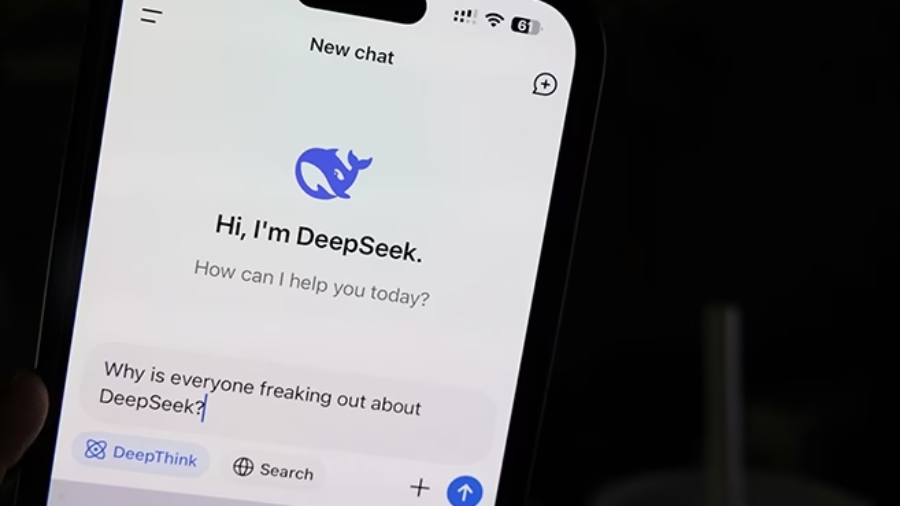
Let’s rewind to January 20, 2025, when DeepSeek released R1—its “reasoning” model designed to rival OpenAI’s o1.

Within days, DeepSeek’s app hit #1 on the U.S. App Store, dethroning ChatGPT from a position it had held for over two years. By February 2026, the industry had come to recognize this as AI’s “Sputnik Moment”—the event that fundamentally altered the economic trajectory of artificial intelligence.

Venture capitalist Marc Andreessen wasn’t being hyperbolic when he invoked the Soviet satellite launch. Just as Sputnik shattered American assumptions about technological supremacy in 1957, DeepSeek shattered Silicon Valley’s belief that frontier AI required unlimited capital and cutting-edge hardware.

The immediate market reaction was savage:

  • Nvidia: -$589 billion in one day
  • Broadcom: -$211 billion combined with Nvidia
  • Global tech stocks: -$800+ billion in combined market cap

Wall Street wasn’t just pricing in competition. It was repricing the entire AI infrastructure thesis.

The $6 Million Question: Truth, Lies, and Technicalities

Here’s where DeepSeek vs ChatGPT gets interesting—and where the media narrative falls apart under scrutiny.

DeepSeek’s technical paper states that R1’s “official training” cost $5.576 million, based on 55 days of compute time using 2,048 Nvidia H800 GPUs. That number is technically accurate.

It’s also, as Martin Vechev of Bulgaria’s INSAIT bluntly stated, “misleading.”

What the $6M Includes:

  • Rental cost of 2,048 H800 GPUs for one final training run
  • 55 days of compute time
  • The final model convergence

What the $6M Excludes:

  • Hardware acquisition costs: $50-100 million for the 2,048 H800s alone
  • Total hardware expenditure: SemiAnalysis estimates “well higher than $500 million” across DeepSeek’s operating history
  • Prior research: Multiple failed training runs, architecture experiments, and algorithm testing
  • Data collection and cleaning: An expensive, labor-intensive process
  • Infrastructure costs: Power, cooling, data center operations
  • Personnel: Approximately 200 top-tier AI researchers
  • Previous models: DeepSeek V3 and earlier iterations that laid the groundwork

As DeepSeek’s own paper acknowledges: the disclosed costs “exclude the costs associated with prior research and ablation experiments on architectures, algorithms, or data.”

Or, as investor Gavin Baker put it on X: “Other than that Mrs. Lincoln, how was the play?”

The Real Cost Comparison

When properly contextualized, here’s what the numbers actually look like:

ModelFinal Training RunTotal Development Cost (Estimated)Performance Parity
DeepSeek R1$5.6M$50M-$500M+✅ Matches o1 on reasoning
ChatGPT-4Unknown$100M-$500M✅ Frontier model
Google Gemini UltraUnknown$191M-$500M+✅ Frontier model
Claude 3.5 Sonnet“Tens of millions”Unknown✅ Frontier model

The gap is still dramatic—but it’s not 20:1. It’s more like 2:1 to 5:1, depending on what you count.

And yet, that’s still extraordinary.

DeepSeek achieved frontier-model performance with dramatically constrained resources compared to what industry leaders considered necessary. That’s the real story.

How DeepSeek Actually Did It: The Technical Breakthroughs

Forget the hype. DeepSeek’s real achievement isn’t cheap training—it’s algorithmic efficiency. Three key innovations made this possible:

1. Mixture-of-Experts (MoE) Architecture

While DeepSeek V3 contains 671 billion parameters, only 37 billion are active per query.

Think of it like a hospital: you don’t need every specialist for every patient. MoE routes each query to the specific “expert” neural networks needed for that task, dramatically reducing computational overhead.

Result: High performance with 94% fewer active parameters than a dense model of equivalent capability.

2. Group Relative Policy Optimization (GRPO)

Traditional reinforcement learning requires a separate “critic” model to monitor and reward the AI’s behavior—essentially doubling memory and compute requirements.

GRPO calculates rewards relative to a group of generated outputs, eliminating the need for that critic model. It’s an algorithmic shortcut that DeepSeek’s researchers describe as teaching a child to play video games through trial and error rather than hiring a tutor.

Result: Complex reasoning pipelines trained on what most Silicon Valley startups would consider “seed round” funding.

3. FP8 Training and Multi-Token Prediction

DeepSeek trained R1 using 8-bit floating-point precision (FP8) instead of the industry-standard 32-bit. This reduces memory consumption by up to 75% without sacrificing accuracy in most practical tasks.

Combined with multi-token prediction (predicting multiple words ahead instead of just one), these techniques further slashed training costs.

Result: Efficient use of export-restricted H800 chips that aren’t even Nvidia’s best hardware.

DeepSeek vs ChatGPT: The Benchmark Showdown

Numbers don’t lie. Let’s see how these models actually perform in head-to-head competition:

BenchmarkDeepSeek R1ChatGPT o1Winner
MATH-500 (Advanced Math)97.3%96.4%🟢 DeepSeek
AIME 2024 (Math Competition)79.8%79.2%🟢 DeepSeek
Codeforces (Competitive Programming)2,029 Elo (96.3%)Not published (96.6%)🟡 Tie
GPQA Diamond (General Reasoning)71.2%75.4%🔴 ChatGPT
MMLU (General Knowledge)90.8%87.2%🟢 DeepSeek
Response Speed45-60 tokens/sec35-50 tokens/sec🟢 DeepSeek

The Brutal Truth About Performance

For math-heavy reasoning and real-world coding—the use cases developers actually care about—DeepSeek competes head-to-head with models that cost 20 times more to train.

But here’s where the DeepSeek vs ChatGPT comparison gets nuanced:

DeepSeek crushes:

  • Mathematical reasoning and proofs
  • Coding (especially backend logic and debugging)
  • Structured problem-solving
  • Chain-of-thought transparency
  • API cost efficiency (96% cheaper)

ChatGPT dominates:

  • Creative writing and storytelling
  • Conversational fluency
  • Multimodal capabilities (image, voice, video)
  • General knowledge breadth
  • User experience polish

As one developer put it: “DeepSeek is a scalpel. ChatGPT is a Swiss Army knife.”

The Cost War: Where DeepSeek Actually Wins

Benchmarks are interesting. Economics are decisive.

Let’s talk about the cost difference that’s actually changing the game: inference pricing.

API Cost Comparison (Per Million Tokens)

ModelInput CostOutput CostTotal Cost (Typical Use)
DeepSeek R1$0.14-$0.55$2.19~$2.73
ChatGPT o1$15.00$60.00~$75.00
Cost Reduction96%96%96%

For developers running high-volume API calls, this isn’t a rounding error. It’s the difference between a $500 monthly bill and $20.

Real-World Impact

Imagine you’re running a coding assistant that processes 10 million tokens daily:

  • With ChatGPT o1: $750/day = $22,500/month = $270,000/year
  • With DeepSeek R1: $27/day = $810/month = $9,720/year

Annual savings: $260,280

That’s enough to hire three senior engineers. Or scale 10x without increasing costs.

For startups burning through tokens on backend tasks, mathematical analysis, or code generation, DeepSeek isn’t just cheaper—it fundamentally changes project economics.

The Censorship Problem Nobody’s Talking About

Here’s the dark side of DeepSeek vs ChatGPT that Western media downplays:

DeepSeek is subject to Chinese content restrictions. Ask about Xi Jinping’s policies, Taiwan, Tiananmen Square, or other sensitive topics, and the model steers you away.

For Chinese users, this is expected. For Western developers and researchers, it’s a dealbreaker.

Real-world limitations:

  • Projects involving geopolitical analysis
  • Historical research on modern China
  • News summarization that might touch sensitive topics
  • Academic work requiring uncensored information

You can run DeepSeek locally with open weights, but the model’s training data and reinforcement learning still reflect these restrictions. It’s baked in.

ChatGPT has its own content restrictions, but they’re based on safety and legal considerations in democratic countries—not government censorship of historical facts and political discussion.

Why Silicon Valley Is Terrified (And Should Be)

The real disruption isn’t that DeepSeek is better than ChatGPT. It’s that DeepSeek proved the entire AI industry’s business model is built on sand.

The Old Narrative (Pre-DeepSeek):

  1. Frontier AI requires hundreds of millions in training costs
  2. You need the latest, most expensive GPUs at massive scale
  3. Only well-funded U.S. companies can compete
  4. The infrastructure moat protects incumbents
  5. AI development is a capital-intensive arms race

The New Reality (Post-DeepSeek):

  1. Algorithmic efficiency can match brute-force scaling
  2. Export-restricted, older GPUs can train frontier models
  3. Smaller teams with constrained resources can compete
  4. The moat is algorithmic innovation, not infrastructure
  5. AI development is an intelligence race, not just a capital race

As Jon Withaar from Pictet Asset Management noted: “If there truly has been a breakthrough in the cost to train models from $100 million+ to this alleged $6 million number, this is actually very positive for productivity and AI end users as cost is obviously much lower.”

Translation: good for users, terrifying for companies betting billions on GPU clusters.

OpenAI’s Response: The API Price War That Never Came

Here’s something fascinating: despite DeepSeek’s 96% cost advantage, OpenAI hasn’t slashed prices.

No emergency price cuts, leaked competitive memos. No signs of a price war.

Why?

Because OpenAI, Google, and Anthropic aren’t competing on the same terms. They’re playing a different game:

ChatGPT’s actual moat:

  • Ecosystem integrations (Slack, Microsoft Office, Zapier, etc.)
  • Multimodal capabilities (vision, voice, soon video)
  • Enterprise-grade security and compliance
  • Polished user experience
  • Brand trust and adoption momentum

DeepSeek can match ChatGPT on reasoning benchmarks, but it can’t match the surrounding ecosystem that makes ChatGPT a “daily driver” for 800 million users.

It’s iPhone vs. Android all over again. Android might have better specs and lower cost, but the iOS ecosystem keeps users locked in.

Who’s Actually Switching? The Adoption Mystery

Here’s what’s missing from every DeepSeek vs ChatGPT comparison: concrete evidence of mass migration.

Search results show general cost advantages and impressive benchmarks, but where are the case studies?

  • No developer communities publicly reporting “$12K saved in 3 weeks”
  • No verified testimonials of teams switching from ChatGPT
  • No “holy shit” censorship moments affecting Western developers
  • No social proof of adoption at scale

The technical achievement is real. The market disruption? Still mostly theoretical.

DeepSeek appears to be winning with:

  • Cost-conscious developers in technical domains
  • Academic researchers needing math/coding capabilities
  • Teams willing to run local deployments
  • Users in markets where ChatGPT isn’t available or is expensive

But there’s no evidence of wholesale replacement of ChatGPT for general-purpose AI work.

The Efficiency Revolution: What Comes Next

DeepSeek didn’t kill the scaling era—it forced an evolution.

By February 2026, the entire industry is pivoting toward what analysts call the “Efficiency Revolution.” OpenAI and Google have:

  • Slashed API costs to match the “DeepSeek Standard”
  • Invested heavily in MoE architectures
  • Focused on test-time scaling (making models “think longer” during inference)
  • Abandoned some planned infrastructure megaprojects

The reported $100 billion infrastructure deal between Nvidia and OpenAI? Collapsed in late 2025. Investors are no longer willing to fund “circular” infrastructure spending when efficiency-focused models achieve the same results with far less hardware.

The Post-Scaling Era

The industry has hit what insiders call the “data wall”—the realization that scraping the entire internet has reached diminishing returns.

DeepSeek’s success using reinforcement learning and synthetic reasoning provides a roadmap for continued advancement. But it’s also created a more competitive, secretive environment around:

  • “Cold-start” datasets for priming efficient models
  • Proprietary algorithmic techniques
  • Custom chip architectures
  • Training optimization methods

The Verdict: Which Model Should You Actually Use?

Stop thinking about DeepSeek vs ChatGPT as a binary choice. Think about task-specific tools.

Use DeepSeek When:

✅ Running high-volume API calls for coding, math, or logic tasks ✅ Budget constraints matter ($260K/year savings at scale) ✅ You need transparent chain-of-thought reasoning ✅ You’re willing to handle open-source deployment ✅ Censorship restrictions don’t affect your use case ✅ Task requires structured, precision-heavy work

Use ChatGPT When:

✅ Creative writing, brainstorming, or storytelling ✅ Multimodal work (images, voice, documents) ✅ Ecosystem integrations matter (Slack, Office, etc.) ✅ Conversational fluency is priority ✅ Working with sensitive or geopolitically relevant topics ✅ Enterprise security/compliance required

The smartest approach? Use both.

Run DeepSeek for backend logic, mathematical analysis, and code generation where cost and precision matter. Use ChatGPT for user-facing content, creative work, and complex multimodal tasks.

That hybrid approach is how high-performing teams are actually working with AI in 2026.

The Uncomfortable Truth About AI Supremacy

Here’s what the DeepSeek vs ChatGPT war really reveals:

American AI dominance is built on money, not just talent. When a Chinese startup with export-restricted hardware can match frontier performance, it shatters the illusion of technological inevitability.

DeepSeek proved that resourcefulness beats resources. Efficiency beats brute force. Open collaboration beats closed development.

But it also proved something Silicon Valley doesn’t want to admit: the billion-dollar infrastructure buildout might have been wasteful overkill, not visionary investment.

Wall Street’s $800 billion repricing wasn’t just about DeepSeek—it was about investors realizing they’d been sold a story that didn’t hold up under scrutiny.

Your Move: The Action Plan

Don’t just read about the AI revolution—participate in it.

Developers:

  1. Pull DeepSeek R1 via Ollama and run your own benchmarks
  2. Compare API costs if you’re currently using ChatGPT o1
  3. Fine-tune DeepSeek for domain-specific tasks
  4. Test both models on your actual workflows

Businesses:

  1. Calculate potential savings on high-volume AI tasks
  2. Pilot DeepSeek for non-sensitive technical work
  3. Maintain ChatGPT for customer-facing applications
  4. Track the efficiency revolution’s impact on pricing

Investors:

  1. Reassess AI infrastructure valuations
  2. Focus on algorithmic innovation, not just compute
  3. Watch for the next efficiency breakthrough
  4. Remember: the moat isn’t hardware—it’s ecosystem

Final Thoughts: The Game Has Changed

DeepSeek vs ChatGPT isn’t about which model is “better.” It’s about what their competition reveals:

The AI industry’s emperor has no clothes. Billion-dollar training runs aren’t necessary for frontier performance. The infrastructure moat was always weaker than advertised. And efficiency, not just scale, determines winners.

DeepSeek didn’t beat ChatGPT—but it proved you don’t need ChatGPT’s budget to compete. That’s far more dangerous to incumbents than any head-to-head benchmark victory.

As Marc Andreessen’s “Sputnik Moment” framing suggests, we’re at the beginning of a new AI race—one where the rules have fundamentally changed.

The question isn’t whether DeepSeek will replace ChatGPT. The question is: how many more DeepSeeks are coming? How many teams with constrained resources and clever algorithms are about to challenge billion-dollar incumbents?

The efficiency revolution is just getting started. And unlike the scaling era, it’s accessible to anyone with intelligence and determination—not just those with the deepest pockets.

Take Action Now

The AI landscape is shifting faster than ever. Share this deep-dive with anyone working with AI models—developers need to know their options, and businesses need to understand the cost implications.

Which model are you using for what tasks? Drop your real-world experience in the comments. The best insights come from practitioners, not benchmarks.

Subscribe for AI insights that cut through hype and deliver actionable intelligence. Because in the efficiency era, information advantage matters more than capital advantage.

Key References & Technical Resources: