
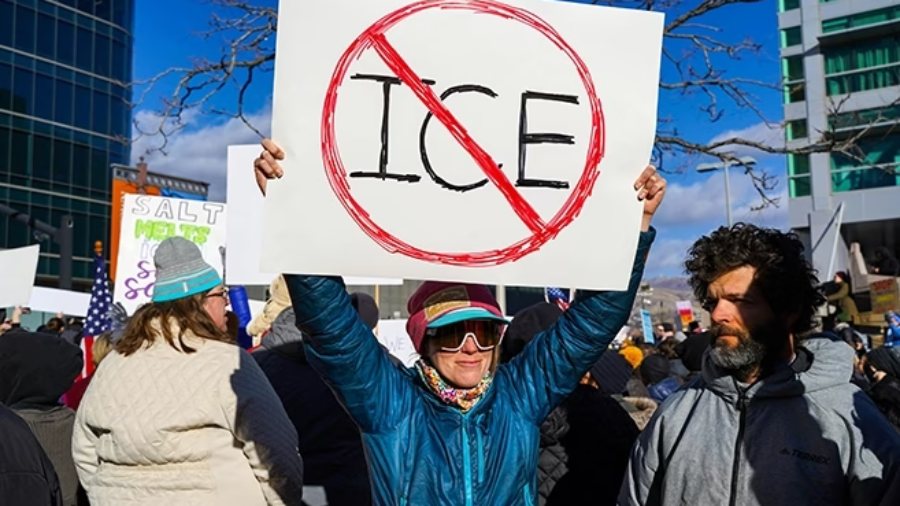
The ICE Immigration Enforcement Crisis isn’t really about budgets or funding bills. It’s about two dead Americans, thousands of protesters in the streets, constitutional rights under siege, and a political standoff so toxic that neither party can even agree on what reality looks like.
Here’s a date that should be burned into every American’s calendar: February 13, 2026. That’s when funding for the Department of Homeland Security runs out—and with it, potentially the entire infrastructure protecting our borders, airports, and disaster response systems.
On January 7, ICE agent Jonathan Ross shot and killed Renée Good, a 37-year-old mother of three, through her car window in Minneapolis. Seventeen days later, Border Patrol agents shot Alex Pretti—an ICU nurse and military veteran—multiple times in the back while he was pinned face-down on the ground, filming them with his phone.
Both were U.S. citizens, were unarmed when killed and the deaths were captured on video that went viral within hours.
Now, with 63% of Americans disapproving of how ICE enforces immigration laws and Democrats demanding sweeping reforms before they’ll fund DHS, we’re careening toward either a government shutdown or a political cave that could define the Trump administration’s second term.
The question isn’t whether the ICE Immigration Enforcement Crisis will explode on February 13. The question is how catastrophic the damage will be—and who’s going to pay the price.
The Minneapolis Powder Keg: How Two Shootings Changed Everything
Let’s be brutally clear about what triggered this crisis: federal immigration agents killed two American citizens in three weeks, and the administration’s immediate response was to call them domestic terrorists.
Renée Good: The Shooting That Sparked a Movement
On January 7, 2026, ICE launched Operation Metro Surge—what DHS called “the largest immigration enforcement operation ever carried out”—deploying 2,000 agents to Minneapolis.
Within hours, agent Jonathan Ross encountered Renée Good in her vehicle. Video footage shows Ross walking around her car, then returning and firing three shots through the window as her vehicle moved past him—turning away from him, not toward him.
Good died at the scene.
The federal response was immediate: DHS claimed Good had “weaponized her SUV” and run over the agent, who was hospitalized with injuries. Minneapolis Mayor Jacob Frey watched the video and delivered his assessment: “Having seen the video myself, I want to tell everybody directly that is bullshit.”
The narrative collapsed within 48 hours when multiple videos contradicted every official claim. But the precedent was set: shoot first, lie second, never apologize.
Alex Pretti: The Execution That Broke America
Seventeen days later, the ICE Immigration Enforcement Crisis reached a breaking point that even President Trump couldn’t ignore.
Alex Pretti was filming federal agents who had pushed a woman to the ground. When he stepped between the agent and the woman, he was pepper-sprayed, tackled by at least six officers, pinned face-down on the pavement, and shot approximately ten times in the back.
Video evidence shows Pretti holding only a phone. One agent removed Pretti’s holstered handgun—which he was legally permitted to carry—before another agent shot him while he was restrained and defenseless.
DHS Secretary Kristi Noem and senior adviser Stephen Miller immediately labeled Pretti a “domestic terrorist” planning to “massacre” officers. No investigation. No evidence. Just instant character assassination.
The problem? Alex Pretti was an ICU nurse at a VA hospital with no criminal record, an active nursing license, and a legal gun permit. He’d participated in protests after Good’s killing, exercising his First Amendment rights.
The public wasn’t buying it. A Quinnipiac poll found that 82% of registered voters had seen video of Good’s shooting, and approval of ICE operations cratered from 40% to 34% after Pretti’s death.
The Political Standoff: Irreconcilable Demands on a Collision Course
With eight days until the February 13 deadline, here’s the brutal reality: Republicans and Democrats aren’t just far apart—they’re negotiating different universes.
What Democrats Are Demanding
Senate Minority Leader Chuck Schumer and House Minority Leader Hakeem Jeffries released a list of 10 key demands as non-negotiable conditions for funding DHS:
Warrant Requirements:
- Ban ICE agents from entering private property without judicial warrants (not administrative warrants)
- End “roving patrols” that stop people without probable cause
Accountability Measures:
- Mandatory body cameras for all ICE and Border Patrol agents
- Ban on face masks and tactical gear that obscures identification
- Visible badge display at all times
- Universal code of conduct for federal law enforcement
Immediate Actions:
- Remove DHS Secretary Kristi Noem from her position
- Fully ramp down Operation Metro Surge in Minneapolis
- Compensation for U.S. citizens wrongfully arrested and detained
Additional Protections:
- Ban deportation of U.S. citizens picked up during enforcement surges
- New use-of-force standards
Democrats framed these as constitutional necessities. Jeffries stated: “The Fourth Amendment is not an inconvenience, it’s a requirement embedded in our Constitution that everyone should follow.”
What Republicans Are Demanding
House Speaker Mike Johnson flatly rejected most Democratic proposals and issued Republican counter-demands:
Sanctuary City Crackdown:
- Require local law enforcement to cooperate with ICE
- End policies that prohibit sharing immigration status information
Agent Protection:
- Maintain the right to wear masks to prevent “doxing” and targeting
- Preserve administrative warrant authority
- Protect agent identities
SAVE Act Passage:
- Nationwide voter ID requirements
- Prevent non-citizens from voting in any election
Johnson’s position on masks was unequivocal: “When you have people doxing them and targeting them, of course, we don’t want their personal identification out there on the streets.”
The Democratic response? Schumer called the SAVE Act “dead on arrival in the Senate” and a “poison pill that will kill any legislation.”
The Negotiation Reality Check
Senate Majority Leader John Thune summarized the situation bluntly: “As of right now, we aren’t anywhere close to having any sort of an agreement.”
Multiple senators from both parties admit a deal before February 13 appears unlikely. Republican Senator John Boozman said drafting and translating a bill into legal language by the deadline would be “very difficult.” Democratic Representative Ilhan Omar was even more direct: “I doubt it.”
Here’s the procedural nightmare: Democrats control enough votes to filibuster in the Senate (requiring 60 votes to pass), while Republicans control the House. Neither side can win without the other.
What Actually Happens on February 14 If There’s No Deal?
Let’s game out the scenarios, from least to most catastrophic:
Scenario 1: Another Short-Term Extension (Most Likely)
Congress passes yet another continuing resolution, punting the deadline 1-4 weeks while negotiations continue.
What this means:
- DHS operates on autopilot at current funding levels
- No new programs or initiatives
- The political fight intensifies
- Public frustration grows
Probability: 60%. This is Washington’s specialty—kicking cans down roads.
Scenario 2: Partial DHS Shutdown (Moderate Probability)
If DHS funding expires, only “essential” operations continue while most employees are furloughed without pay.
What STOPS:
| Agency/Function | Impact |
|---|---|
| TSA | Reduced airport screening, massive delays |
| FEMA | Disaster response limited to active emergencies |
| Coast Guard | Non-emergency operations suspended |
| Secret Service | Protection continues, investigations pause |
| Cybersecurity | Threat monitoring reduced |
What CONTINUES:
- USCIS: Immigration applications processing (fee-funded agency)
- ICE enforcement: Has $75 billion in funding from the 2025 reconciliation bill
- Border Patrol: Border security operations
- Critical security functions
The brutal irony? The agency at the center of the crisis—ICE—keeps operating while disaster response, airport security, and cybersecurity get hammered.
Probability: 25%. Politically toxic for both parties, but possible if negotiations completely collapse.
Scenario 3: Democrats Cave (Low Probability)
Facing public pressure over TSA delays and FEMA disruptions, Democrats fund DHS with minimal reforms.
What this means:
- ICE operations continue largely unchanged
- Body cameras might be required
- Judicial warrant requirements fail
- Progressive base revolts
Over 62% of Americans say ICE enforcement goes “too far,” so Democrats caving would be politically suicidal heading into 2026 midterms.
Probability: 10%. Democratic leadership is “unified” according to Schumer, and public opinion supports their position.
Scenario 4: Republicans Cave (Very Low Probability)
Facing 63% disapproval of ICE operations and growing moderate Republican discomfort, GOP leadership accepts significant reforms.
What this means:
- Body cameras mandated
- Mask ban implemented
- Tighter (but not judicial) warrant requirements
- Noem potentially removed
Speaker Johnson already signaled “good faith willingness to compromise on body cameras,” suggesting this isn’t impossible.
Probability: 5%. Trump’s base would view this as surrender, and primary challenges would follow.
The Constitutional Crisis Nobody’s Talking About
Here’s what makes the ICE Immigration Enforcement Crisis fundamentally different from typical budget fights: this is about whether the Fourth Amendment applies to federal immigration enforcement.
The Administrative Warrant Loophole
Republicans insist ICE agents can legally enter homes with administrative warrants issued by immigration judges, not judicial warrants from criminal court judges.
The distinction is critical:
Judicial Warrants:
- Require probable cause of a crime
- Issued by independent judges
- Based on specific evidence
- Constitutional standard for searches
Administrative Warrants:
- Require only “reason to believe” someone is deportable
- Issued by DHS-employed immigration judges
- Lower evidentiary standard
- Not mentioned in the Constitution
Democrats argue this creates a two-tier justice system where immigration enforcement operates under weaker constitutional protections than criminal law enforcement.
The Mask Debate: Safety vs. Accountability
Over 90% of voters support requiring ICE agents to wear body cameras. About 60% say agents should not be permitted to wear masks.
Republicans frame masked agents as necessary protection against “doxing” and violence. Democrats frame it as accountability evasion.
The reality? Every other major law enforcement agency in America—FBI, DEA, ATF, U.S. Marshals—operates with visible identification without systemic targeting of agents.
Why should ICE be the exception?
The Polling Catastrophe: Public Opinion Has Turned
The numbers are devastating for the administration’s immigration enforcement strategy:
| Poll Finding | Percentage | Source |
|---|---|---|
| Disapprove of ICE enforcement | 63% | Quinnipiac (Feb 2026) |
| ICE efforts go “too far” | 62% | Ipsos (Feb 2026) |
| Noem should be removed | 58% | Quinnipiac |
| ICE should withdraw from Minneapolis | 60% | Quinnipiac |
| Pretti shooting was excessive force | 55% | Ipsos |
| ICE deployed for political reasons | 56% | Quinnipiac |
| Approach makes country less safe | 51% | Quinnipiac |
| Prefer pathway to legal status | 59% | Quinnipiac |
| Recent shootings show broader problems | 59% | Quinnipiac |
Even among Republicans, support for ICE operations dropped 10 points after Pretti’s death, from 20% saying enforcement goes “too far” to 30%.
President Trump’s immigration approval fell from 44% in December to 38% in February—a 6-point drop in two months.
This isn’t a messaging problem. It’s a policy catastrophe.
The Federal Immunity Claim: Legal Chaos Ahead
In perhaps the most alarming development, senior adviser Stephen Miller told ICE agents they have “federal immunity” when dealing with protesters.
Legal experts immediately flagged this as constitutionally dubious. Federal immunity protects government officials from civil lawsuits for actions within their official duties—it doesn’t grant carte blanche to violate constitutional rights or use excessive force.
The claim raises terrifying questions:
- Can federal agents enter homes without warrants?
- Can they use lethal force against citizens exercising First Amendment rights?
- Are there any limits on enforcement actions?
These aren’t theoretical. They’re questions being litigated in real-time as nine people face federal charges for protesting inside a church, and journalists like Don Lemon face arrest for covering protests.
What You Need to Know Before February 13
As the deadline approaches, here’s your action checklist:
For Travelers:
If DHS shuts down:
- TSA will operate with reduced staff—expect 2-3 hour airport delays
- Apply for passports and Global Entry NOW, not after Feb 13
- International travel may face disruptions
For Immigrants and Families:
Critical actions:
- USCIS continues processing applications (fee-funded)
- ICE enforcement continues regardless of shutdown
- Know your rights: administrative warrants don’t authorize home entry in most cases
- Document all interactions with federal agents
- Contact legal aid organizations immediately if detained
For Disaster-Prone Regions:
FEMA limitations:
- Active disaster response continues
- New disaster declarations may face delays
- Preparedness programs pause
- Have 72-hour emergency supplies ready
For Everyone:
Civic engagement:
- Contact your representatives before Feb 13
- Specify which reforms you support (body cameras, warrants, etc.)
- Demand they state their position publicly
- Vote accordingly in November 2026
Find your representatives at House.gov and Senate.gov.
The Broader Pattern: 13 Shootings Since September
Here’s the context the ICE Immigration Enforcement Crisis exists within: Good and Pretti aren’t outliers—they’re part of an escalating pattern of violence.
The documented record:
- 13 people shot by immigration officers since September 2025
- 4 killed in federal deportation operations
- Incidents in 5 states plus Washington, D.C.
- Multiple U.S. citizens among those shot
This isn’t a Minneapolis problem. It’s a systemic problem with how federal immigration enforcement operates nationwide.
The Uncomfortable Truth About February 13
Let me be brutally honest about what the ICE Immigration Enforcement Crisis reveals:
This deadline was always artificial. The real fight isn’t about budgets—it’s about whether federal law enforcement operates under the same constitutional constraints as everyone else.
Democrats could have extracted these reforms in December when they had more leverage. Republicans could have implemented body cameras and basic accountability measures voluntarily after Good’s death and avoided this entirely.
Instead, both parties let two Americans die, thousands protest in the streets, and public approval crater before treating this as the constitutional crisis it always was.
The February 13 deadline won’t resolve anything fundamental. Even if Congress passes a bill, the underlying questions remain:
- Do administrative warrants satisfy Fourth Amendment requirements?
- Should federal agents operate with masked anonymity?
- What use-of-force standards apply to immigration enforcement?
- How do we balance enforcement with constitutional rights?
These aren’t budget questions. They’re questions about what kind of country we want to be.
Final Thoughts: The Reckoning America Isn’t Ready For
The ICE Immigration Enforcement Crisis isn’t really about immigration policy. It’s about accountability, transparency, and whether constitutional rights apply equally to all Americans—or just those who aren’t in ICE’s crosshairs.
Renée Good and Alex Pretti are dead. Their families testified before Congress about the “deep distress” of losing loved ones “in such a violent and unnecessary way.”
Congress has eight days to decide whether their deaths matter enough to change how 20,000 federal immigration agents operate across America.
President Trump himself admitted: “It should have not happened. It was very sad to me, a very sad incident.”
If it shouldn’t have happened, why is his administration fighting reforms designed to prevent it from happening again?
That’s the question February 13 forces America to answer. And based on the political dynamics, the answer is: we probably won’t.
We’ll kick the can, pass another extension, let the protests fade, and wait for the next viral video of federal agents shooting someone who shouldn’t be dead.
Because that’s what we do. That’s who we’ve become.
The only question is whether Americans are angry enough to demand something different—or whether two dead citizens and 63% disapproval ratings are just more background noise in a country that’s forgotten how to be shocked by anything.
Take Action Before February 13
Don’t be a passive observer of constitutional crisis. Share this article with everyone in your network. The more Americans understand what’s actually at stake, the harder it becomes for Congress to ignore.
Contact your representatives TODAY—not February 12. Tell them specifically which reforms you support: body cameras, visible identification, judicial warrants, use-of-force standards. Demand they state their position publicly before the vote.
Document everything. If you witness immigration enforcement actions, film them. If you’re stopped, record the interaction. Fourth Amendment rights only matter if citizens assert them.
Subscribe for ongoing coverage as the February 13 deadline approaches and follow developments in real-time. Because in a crisis this fast-moving, information is power—and silence is complicity.
Essential References & Resources:
- CBS News: Republicans Pan Democrats’ ICE Reform Demands
- ABC News: Congressional Fight Over ICE Restrictions
- Wikipedia: Killing of Renée Good
- Wikipedia: Killing of Alex Pretti
- NPR: Videos Contradict Federal Account of Fatal Shooting
- Quinnipiac Polling on ICE Operations
- House Oversight Committee Report on Minneapolis
- Find Your Representative
- Contact Your Senator