
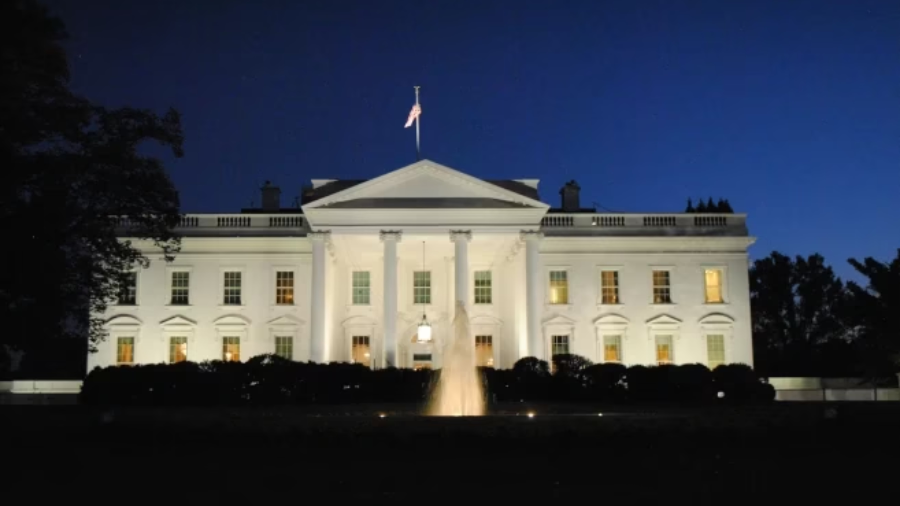
Introduction: The New Presidency Business Model
Was Trump profiting from the presidency? Few modern political questions have generated as much controversy, debate, or investigative scrutiny. The idea that a sitting U.S. president might use the Oval Office as a personal revenue stream was once unthinkable. Yet by 2017, America was staring at a new political reality: the president was also a businessman with sprawling properties, opaque finances, and a family empire intertwined with power.
This article investigates the allegations of grifting, self-enrichment, and abuse of office that defined Donald Trump’s presidency — and how their ripple effects continue today. More importantly, it explores how the phenomenon of “Trump Profiting from the Presidency” reshaped political behavior, ethical norms, and public expectations in ways that still reverberate across the American landscape.
The Businessman-President: A Built-In Conflict of Interest
Donald Trump entered the White House as the first U.S. president in history to refuse to divest from his private business empire. While previous presidents placed assets in blind trusts to avoid conflicts of interest, Trump handed the Trump Organization to his sons — but kept ownership, kept profits, and maintained decision-making influence.
This decision created:
🔹 Structural conflicts built into the office itself
- Foreign governments could book rooms at Trump hotels.
- Political allies could hold events at Trump golf clubs.
- Advisors, donors, and lobbyists could curry favor through patronage.
🔹 Legal gray areas never tested at presidential scale
The U.S. Constitution’s Emoluments Clause, which bars presidents from receiving foreign payments, had almost no modern precedent to rely on. Trump’s business entanglements forced courts, watchdog groups, and ethics experts to revisit centuries-old laws.
🔹 A blending of public and private roles
Trump appeared at official presidential events with campaign hats, mingled government announcements with political messaging, and allowed official resources to cross paths with commercial and family ventures.
This created the perfect storm for a presidency where profit and power appeared increasingly inseparable.
How Trump Profited: A Breakdown of the Most Significant Allegations
Below is a structured, detailed look at the most well-documented avenues through which Trump allegedly leveraged the presidency for personal financial gain.
1. Trump Properties as Political Power Hubs
The Pay-to-Play Hotel Effect
Foreign dignitaries, lobbyists, and political groups flocked to Trump properties — especially the Trump International Hotel in Washington, D.C.
Examples widely reported by investigative journalists include:
- Saudi-funded lobbyists booking 500+ nights at the D.C. hotel
- Malaysian and Turkish delegations using the hotel during sensitive political negotiations
- GOP political committees funneling millions into Trump events and retreats
Was this illegal?
Not necessarily.
Was it profitable?
Absolutely.
According to ethics watchdog CREW (Citizens for Responsibility and Ethics in Washington), Trump earned millions in direct revenue from political and foreign patronage at his properties while in office.
2. Secret Service Spending at Trump Properties
One of the least-discussed but most astonishing findings was this:
The U.S. government paid Trump’s businesses while protecting Trump.
Secret Service agents accompanying the president and his family were regularly required to stay at Trump properties. Investigations revealed:
- Rates as high as $650 per night
- Hundreds of thousands in accumulated bills
- Over $1 million spent at Trump properties over the course of the presidency
That means American taxpayers were paying the president’s own businesses simply to protect him — an unprecedented arrangement in modern presidential history.
3. The Mar-a-Lago Membership Surge
Trump’s decision to designate Mar-a-Lago as his “Winter White House” transformed the resort into a power access sanctuary.
Membership fees skyrocketed from $100,000 to $200,000 shortly after the inauguration.
Why?
Because being at Mar-a-Lago meant:
- Proximity to powerful politicians
- Access to Trump’s inner circle
- Visibility during major policy announcements
- Informal conversations that sometimes influenced government direction
Guests witnessed the president conduct state matters — including North Korea discussions — in public dining areas, blurring lines between private resort life and national security.
Mar-a-Lago became both a profit engine and a political theater.
4. Trump’s Family Businesses Thrived
The presidency lifted the entire Trump commercial ecosystem:
Ivanka Trump
- Fast-track patents in China
- Revenue growth in fashion and branding deals
- Access to international decision-makers
Jared Kushner
- Multi-billion-dollar financial deals with Gulf states while spearheading Middle East diplomacy
- Post-presidency investment from Saudi Arabia’s sovereign wealth fund
Eric and Donald Trump Jr.
- Accelerated global expansion of Trump-branded properties
- Political rallies doubling as marketing platforms
These benefits extended far beyond Trump personally — the entire Trump family empire expanded under the shadow of political power.
5. Political Fundraising as a Revenue Stream
Perhaps the most significant form of alleged grifting didn’t involve hotels or resorts — but small-dollar fundraising.
Trump perfected the art of political monetization through:
- Sensationalist email campaigns
- Claims of election fraud
- Subscription-based membership programs
- Legal defense funds
- “Stop the Steal” messaging
In 2020 alone, Trump raised more than $250 million from supporters for an “election defense fund” — a fund which, according to federal reports, did not exist in the manner donors believed.
Only a tiny fraction went to legal challenges.
The majority went to:
- Political committees
- Staff
- Future campaign infrastructure
- Trump-aligned organizations
Fundraising became a business model, not a political necessity.
6. Favor-Trading: Access in Exchange for Patronage
Observers documented numerous instances of individuals who:
- Stayed at Trump hotels
- Donated to Trump PACs
- Hosted events at Trump resorts
- Used Trump properties for political networking
… and subsequently saw increased political access, government invitations, or regulatory interactions.
This pattern raises significant ethical concerns:
Was access being sold?
While not legally proven, the optics were unmistakable.
Did businesses and governments believe it mattered?
Yes — because they repeatedly spent money at Trump properties before major decisions.
In politics, perception is often reality.
A Comparison Table: How Trump’s Conduct Differs from Past Presidents
To illustrate the unprecedented nature of Trump’s presidency, here’s a comparison with previous administrations:
| Category | Past Presidents | Donald Trump |
|---|---|---|
| Business ownership while in office | Divested or used blind trusts | Retained full ownership |
| Use of properties for government events | Rare, discouraged | Frequent and financially beneficial |
| Foreign patronage | Minimal, tightly regulated | Extensive, through hotels and resorts |
| Family business expansion | Limited or paused | Expanded significantly |
| Political fundraising | Issue-based | Monetized into ongoing revenue streams |
| Ethical controversies | Occasional | Systemic, multi-layered, recurring |
Trump’s presidency represented a break from centuries of ethical norms.
The Post-Presidency Continuation of the Grift (Brief Section)
While the core of this investigation focuses on the presidency, it is impossible to ignore how the grifting ecosystem expanded after leaving office.
Examples include:
Political PACs as personal slush funds
Trump’s Save America PAC reportedly spent more on:
- Legal bills
- Consultants
- Trump properties
… than on political candidates.
Ongoing fundraising off indictments and investigations
Every arrest, indictment, or legal ruling triggers a fundraising surge.
Inflated membership programs
VIP memberships, Trump-branded products, and online subscriptions keep cash flowing.
Continuation of foreign and domestic deals
Family companies continue securing investments from politically influenced entities.
The pattern remains the same: politics as profit.
Why Trump’s Self-Enrichment Matters: Threats to Democracy
This isn’t just about personal gain. It has enormous implications for governance and political norms.
1. It erodes public trust.
People lose faith when leaders appear to prioritize personal wealth over national interest.
2. It incentivizes corruption.
If one president profits freely, future leaders may feel emboldened.
3. It creates pay-to-play politics.
Foreign governments or wealthy donors may attempt to buy influence through property patronage.
4. It undermines institutional integrity.
Ethics offices, watchdog agencies, and constitutional protections weaken when routinely bypassed.
5. It creates a new political business model.
Trump normalized the merging of political and commercial endeavors.
That shift will impact American politics for decades.
Conclusion: The Legacy of a Monetized Presidency
So, was Trump profiting from the presidency?
Evidence overwhelmingly suggests yes — in multiple ways, through multiple channels, benefiting not only himself but his family, businesses, and political apparatus.
Trump didn’t just govern.
He marketed, monetized, and leveraged the presidency as a branding engine.
And because these methods proved effective and wildly lucrative, they may become a blueprint for future political actors, reshaping American democracy into something more transactional, more corruptible, and less accountable.
The real question now is not whether Trump profited —
but whether America can rebuild the ethical guardrails he shattered.
Call to Action (CTA)
Found this investigation useful?
Share your thoughts below, explore related deep-dive articles, or subscribe for more evidence-based political analysis. Let’s keep the conversation going — and hold power to account.
