
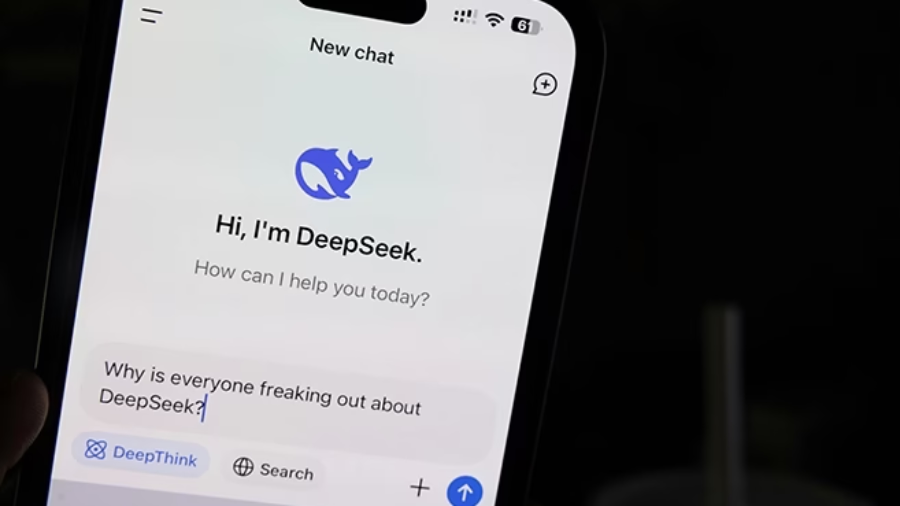
On January 27, 2025, Nvidia lost $589 billion in market value—the largest single-day loss in U.S. stock market history. The culprit? Not a recession, not a scandal, but a Chinese AI startup that claimed it built a ChatGPT-level model for $5.6 million.
DeepSeek vs ChatGPT isn’t just another tech rivalry—it’s a seismic shift that has Silicon Valley’s elite questioning everything they thought they knew about artificial intelligence.
While OpenAI spent an estimated $100+ million training GPT-4 and Google dropped $191 million on Gemini Ultra, DeepSeek walked in with export-restricted chips, a fraction of the budget, and matched their performance on key benchmarks. Then they open-sourced it.
The message to the AI establishment was brutal: your billion-dollar infrastructure moat just cracked wide open.
But here’s what the headlines won’t tell you: the $6 million figure is both completely true and deeply misleading. The real story of DeepSeek vs ChatGPT is far more complex—and far more important—than a simple cost comparison.
The Sputnik Moment: When DeepSeek Dethroned ChatGPT
Let’s rewind to January 20, 2025, when DeepSeek released R1—its “reasoning” model designed to rival OpenAI’s o1.
Within days, DeepSeek’s app hit #1 on the U.S. App Store, dethroning ChatGPT from a position it had held for over two years. By February 2026, the industry had come to recognize this as AI’s “Sputnik Moment”—the event that fundamentally altered the economic trajectory of artificial intelligence.
Venture capitalist Marc Andreessen wasn’t being hyperbolic when he invoked the Soviet satellite launch. Just as Sputnik shattered American assumptions about technological supremacy in 1957, DeepSeek shattered Silicon Valley’s belief that frontier AI required unlimited capital and cutting-edge hardware.
The immediate market reaction was savage:
- Nvidia: -$589 billion in one day
- Broadcom: -$211 billion combined with Nvidia
- Global tech stocks: -$800+ billion in combined market cap
Wall Street wasn’t just pricing in competition. It was repricing the entire AI infrastructure thesis.
The $6 Million Question: Truth, Lies, and Technicalities
Here’s where DeepSeek vs ChatGPT gets interesting—and where the media narrative falls apart under scrutiny.
DeepSeek’s technical paper states that R1’s “official training” cost $5.576 million, based on 55 days of compute time using 2,048 Nvidia H800 GPUs. That number is technically accurate.
It’s also, as Martin Vechev of Bulgaria’s INSAIT bluntly stated, “misleading.”
What the $6M Includes:
- Rental cost of 2,048 H800 GPUs for one final training run
- 55 days of compute time
- The final model convergence
What the $6M Excludes:
- Hardware acquisition costs: $50-100 million for the 2,048 H800s alone
- Total hardware expenditure: SemiAnalysis estimates “well higher than $500 million” across DeepSeek’s operating history
- Prior research: Multiple failed training runs, architecture experiments, and algorithm testing
- Data collection and cleaning: An expensive, labor-intensive process
- Infrastructure costs: Power, cooling, data center operations
- Personnel: Approximately 200 top-tier AI researchers
- Previous models: DeepSeek V3 and earlier iterations that laid the groundwork
As DeepSeek’s own paper acknowledges: the disclosed costs “exclude the costs associated with prior research and ablation experiments on architectures, algorithms, or data.”
Or, as investor Gavin Baker put it on X: “Other than that Mrs. Lincoln, how was the play?”
The Real Cost Comparison
When properly contextualized, here’s what the numbers actually look like:
| Model | Final Training Run | Total Development Cost (Estimated) | Performance Parity |
|---|---|---|---|
| DeepSeek R1 | $5.6M | $50M-$500M+ | ✅ Matches o1 on reasoning |
| ChatGPT-4 | Unknown | $100M-$500M | ✅ Frontier model |
| Google Gemini Ultra | Unknown | $191M-$500M+ | ✅ Frontier model |
| Claude 3.5 Sonnet | “Tens of millions” | Unknown | ✅ Frontier model |
The gap is still dramatic—but it’s not 20:1. It’s more like 2:1 to 5:1, depending on what you count.
And yet, that’s still extraordinary.
DeepSeek achieved frontier-model performance with dramatically constrained resources compared to what industry leaders considered necessary. That’s the real story.
How DeepSeek Actually Did It: The Technical Breakthroughs
Forget the hype. DeepSeek’s real achievement isn’t cheap training—it’s algorithmic efficiency. Three key innovations made this possible:
1. Mixture-of-Experts (MoE) Architecture
While DeepSeek V3 contains 671 billion parameters, only 37 billion are active per query.
Think of it like a hospital: you don’t need every specialist for every patient. MoE routes each query to the specific “expert” neural networks needed for that task, dramatically reducing computational overhead.
Result: High performance with 94% fewer active parameters than a dense model of equivalent capability.
2. Group Relative Policy Optimization (GRPO)
Traditional reinforcement learning requires a separate “critic” model to monitor and reward the AI’s behavior—essentially doubling memory and compute requirements.
GRPO calculates rewards relative to a group of generated outputs, eliminating the need for that critic model. It’s an algorithmic shortcut that DeepSeek’s researchers describe as teaching a child to play video games through trial and error rather than hiring a tutor.
Result: Complex reasoning pipelines trained on what most Silicon Valley startups would consider “seed round” funding.
3. FP8 Training and Multi-Token Prediction
DeepSeek trained R1 using 8-bit floating-point precision (FP8) instead of the industry-standard 32-bit. This reduces memory consumption by up to 75% without sacrificing accuracy in most practical tasks.
Combined with multi-token prediction (predicting multiple words ahead instead of just one), these techniques further slashed training costs.
Result: Efficient use of export-restricted H800 chips that aren’t even Nvidia’s best hardware.
DeepSeek vs ChatGPT: The Benchmark Showdown
Numbers don’t lie. Let’s see how these models actually perform in head-to-head competition:
| Benchmark | DeepSeek R1 | ChatGPT o1 | Winner |
|---|---|---|---|
| MATH-500 (Advanced Math) | 97.3% | 96.4% | 🟢 DeepSeek |
| AIME 2024 (Math Competition) | 79.8% | 79.2% | 🟢 DeepSeek |
| Codeforces (Competitive Programming) | 2,029 Elo (96.3%) | Not published (96.6%) | 🟡 Tie |
| GPQA Diamond (General Reasoning) | 71.2% | 75.4% | 🔴 ChatGPT |
| MMLU (General Knowledge) | 90.8% | 87.2% | 🟢 DeepSeek |
| Response Speed | 45-60 tokens/sec | 35-50 tokens/sec | 🟢 DeepSeek |
The Brutal Truth About Performance
For math-heavy reasoning and real-world coding—the use cases developers actually care about—DeepSeek competes head-to-head with models that cost 20 times more to train.
But here’s where the DeepSeek vs ChatGPT comparison gets nuanced:
DeepSeek crushes:
- Mathematical reasoning and proofs
- Coding (especially backend logic and debugging)
- Structured problem-solving
- Chain-of-thought transparency
- API cost efficiency (96% cheaper)
ChatGPT dominates:
- Creative writing and storytelling
- Conversational fluency
- Multimodal capabilities (image, voice, video)
- General knowledge breadth
- User experience polish
As one developer put it: “DeepSeek is a scalpel. ChatGPT is a Swiss Army knife.”
The Cost War: Where DeepSeek Actually Wins
Benchmarks are interesting. Economics are decisive.
Let’s talk about the cost difference that’s actually changing the game: inference pricing.
API Cost Comparison (Per Million Tokens)
| Model | Input Cost | Output Cost | Total Cost (Typical Use) |
|---|---|---|---|
| DeepSeek R1 | $0.14-$0.55 | $2.19 | ~$2.73 |
| ChatGPT o1 | $15.00 | $60.00 | ~$75.00 |
| Cost Reduction | 96% | 96% | 96% |
For developers running high-volume API calls, this isn’t a rounding error. It’s the difference between a $500 monthly bill and $20.
Real-World Impact
Imagine you’re running a coding assistant that processes 10 million tokens daily:
- With ChatGPT o1: $750/day = $22,500/month = $270,000/year
- With DeepSeek R1: $27/day = $810/month = $9,720/year
Annual savings: $260,280
That’s enough to hire three senior engineers. Or scale 10x without increasing costs.
For startups burning through tokens on backend tasks, mathematical analysis, or code generation, DeepSeek isn’t just cheaper—it fundamentally changes project economics.
The Censorship Problem Nobody’s Talking About
Here’s the dark side of DeepSeek vs ChatGPT that Western media downplays:
DeepSeek is subject to Chinese content restrictions. Ask about Xi Jinping’s policies, Taiwan, Tiananmen Square, or other sensitive topics, and the model steers you away.
For Chinese users, this is expected. For Western developers and researchers, it’s a dealbreaker.
Real-world limitations:
- Projects involving geopolitical analysis
- Historical research on modern China
- News summarization that might touch sensitive topics
- Academic work requiring uncensored information
You can run DeepSeek locally with open weights, but the model’s training data and reinforcement learning still reflect these restrictions. It’s baked in.
ChatGPT has its own content restrictions, but they’re based on safety and legal considerations in democratic countries—not government censorship of historical facts and political discussion.
Why Silicon Valley Is Terrified (And Should Be)
The real disruption isn’t that DeepSeek is better than ChatGPT. It’s that DeepSeek proved the entire AI industry’s business model is built on sand.
The Old Narrative (Pre-DeepSeek):
- Frontier AI requires hundreds of millions in training costs
- You need the latest, most expensive GPUs at massive scale
- Only well-funded U.S. companies can compete
- The infrastructure moat protects incumbents
- AI development is a capital-intensive arms race
The New Reality (Post-DeepSeek):
- Algorithmic efficiency can match brute-force scaling
- Export-restricted, older GPUs can train frontier models
- Smaller teams with constrained resources can compete
- The moat is algorithmic innovation, not infrastructure
- AI development is an intelligence race, not just a capital race
As Jon Withaar from Pictet Asset Management noted: “If there truly has been a breakthrough in the cost to train models from $100 million+ to this alleged $6 million number, this is actually very positive for productivity and AI end users as cost is obviously much lower.”
Translation: good for users, terrifying for companies betting billions on GPU clusters.
OpenAI’s Response: The API Price War That Never Came
Here’s something fascinating: despite DeepSeek’s 96% cost advantage, OpenAI hasn’t slashed prices.
No emergency price cuts, leaked competitive memos. No signs of a price war.
Why?
Because OpenAI, Google, and Anthropic aren’t competing on the same terms. They’re playing a different game:
ChatGPT’s actual moat:
- Ecosystem integrations (Slack, Microsoft Office, Zapier, etc.)
- Multimodal capabilities (vision, voice, soon video)
- Enterprise-grade security and compliance
- Polished user experience
- Brand trust and adoption momentum
DeepSeek can match ChatGPT on reasoning benchmarks, but it can’t match the surrounding ecosystem that makes ChatGPT a “daily driver” for 800 million users.
It’s iPhone vs. Android all over again. Android might have better specs and lower cost, but the iOS ecosystem keeps users locked in.
Who’s Actually Switching? The Adoption Mystery
Here’s what’s missing from every DeepSeek vs ChatGPT comparison: concrete evidence of mass migration.
Search results show general cost advantages and impressive benchmarks, but where are the case studies?
- No developer communities publicly reporting “$12K saved in 3 weeks”
- No verified testimonials of teams switching from ChatGPT
- No “holy shit” censorship moments affecting Western developers
- No social proof of adoption at scale
The technical achievement is real. The market disruption? Still mostly theoretical.
DeepSeek appears to be winning with:
- Cost-conscious developers in technical domains
- Academic researchers needing math/coding capabilities
- Teams willing to run local deployments
- Users in markets where ChatGPT isn’t available or is expensive
But there’s no evidence of wholesale replacement of ChatGPT for general-purpose AI work.
The Efficiency Revolution: What Comes Next
DeepSeek didn’t kill the scaling era—it forced an evolution.
By February 2026, the entire industry is pivoting toward what analysts call the “Efficiency Revolution.” OpenAI and Google have:
- Slashed API costs to match the “DeepSeek Standard”
- Invested heavily in MoE architectures
- Focused on test-time scaling (making models “think longer” during inference)
- Abandoned some planned infrastructure megaprojects
The reported $100 billion infrastructure deal between Nvidia and OpenAI? Collapsed in late 2025. Investors are no longer willing to fund “circular” infrastructure spending when efficiency-focused models achieve the same results with far less hardware.
The Post-Scaling Era
The industry has hit what insiders call the “data wall”—the realization that scraping the entire internet has reached diminishing returns.
DeepSeek’s success using reinforcement learning and synthetic reasoning provides a roadmap for continued advancement. But it’s also created a more competitive, secretive environment around:
- “Cold-start” datasets for priming efficient models
- Proprietary algorithmic techniques
- Custom chip architectures
- Training optimization methods
The Verdict: Which Model Should You Actually Use?
Stop thinking about DeepSeek vs ChatGPT as a binary choice. Think about task-specific tools.
Use DeepSeek When:
✅ Running high-volume API calls for coding, math, or logic tasks ✅ Budget constraints matter ($260K/year savings at scale) ✅ You need transparent chain-of-thought reasoning ✅ You’re willing to handle open-source deployment ✅ Censorship restrictions don’t affect your use case ✅ Task requires structured, precision-heavy work
Use ChatGPT When:
✅ Creative writing, brainstorming, or storytelling ✅ Multimodal work (images, voice, documents) ✅ Ecosystem integrations matter (Slack, Office, etc.) ✅ Conversational fluency is priority ✅ Working with sensitive or geopolitically relevant topics ✅ Enterprise security/compliance required
The smartest approach? Use both.
Run DeepSeek for backend logic, mathematical analysis, and code generation where cost and precision matter. Use ChatGPT for user-facing content, creative work, and complex multimodal tasks.
That hybrid approach is how high-performing teams are actually working with AI in 2026.
The Uncomfortable Truth About AI Supremacy
Here’s what the DeepSeek vs ChatGPT war really reveals:
American AI dominance is built on money, not just talent. When a Chinese startup with export-restricted hardware can match frontier performance, it shatters the illusion of technological inevitability.
DeepSeek proved that resourcefulness beats resources. Efficiency beats brute force. Open collaboration beats closed development.
But it also proved something Silicon Valley doesn’t want to admit: the billion-dollar infrastructure buildout might have been wasteful overkill, not visionary investment.
Wall Street’s $800 billion repricing wasn’t just about DeepSeek—it was about investors realizing they’d been sold a story that didn’t hold up under scrutiny.
Your Move: The Action Plan
Don’t just read about the AI revolution—participate in it.
Developers:
- Pull DeepSeek R1 via Ollama and run your own benchmarks
- Compare API costs if you’re currently using ChatGPT o1
- Fine-tune DeepSeek for domain-specific tasks
- Test both models on your actual workflows
Businesses:
- Calculate potential savings on high-volume AI tasks
- Pilot DeepSeek for non-sensitive technical work
- Maintain ChatGPT for customer-facing applications
- Track the efficiency revolution’s impact on pricing
Investors:
- Reassess AI infrastructure valuations
- Focus on algorithmic innovation, not just compute
- Watch for the next efficiency breakthrough
- Remember: the moat isn’t hardware—it’s ecosystem
Final Thoughts: The Game Has Changed
DeepSeek vs ChatGPT isn’t about which model is “better.” It’s about what their competition reveals:
The AI industry’s emperor has no clothes. Billion-dollar training runs aren’t necessary for frontier performance. The infrastructure moat was always weaker than advertised. And efficiency, not just scale, determines winners.
DeepSeek didn’t beat ChatGPT—but it proved you don’t need ChatGPT’s budget to compete. That’s far more dangerous to incumbents than any head-to-head benchmark victory.
As Marc Andreessen’s “Sputnik Moment” framing suggests, we’re at the beginning of a new AI race—one where the rules have fundamentally changed.
The question isn’t whether DeepSeek will replace ChatGPT. The question is: how many more DeepSeeks are coming? How many teams with constrained resources and clever algorithms are about to challenge billion-dollar incumbents?
The efficiency revolution is just getting started. And unlike the scaling era, it’s accessible to anyone with intelligence and determination—not just those with the deepest pockets.
Take Action Now
The AI landscape is shifting faster than ever. Share this deep-dive with anyone working with AI models—developers need to know their options, and businesses need to understand the cost implications.
Which model are you using for what tasks? Drop your real-world experience in the comments. The best insights come from practitioners, not benchmarks.
Subscribe for AI insights that cut through hype and deliver actionable intelligence. Because in the efficiency era, information advantage matters more than capital advantage.
