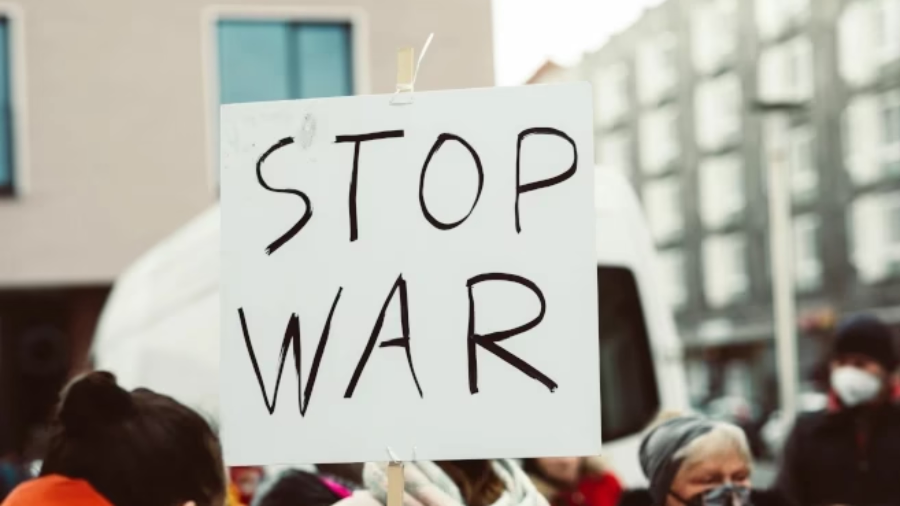
global-hospots

Global Hotspots Threatening Peace: Why the World Feels Perpetually on Edge

Introduction: The World on Edge

In 2025, humanity finds itself navigating an unprecedented web of geopolitical tension. Across continents, from Eastern Europe to the Middle East, Asia-Pacific to Africa, conflict zones — or global hotspots — are escalating. The phrase “global hotspots threatening peace” has never been more relevant.

These conflicts are not isolated events; they create ripple effects that impact economies, migration flows, food security, and global trust in institutions. Civilians, humanitarian workers, diplomats, and even ordinary citizens feel the anxiety of a world teetering on the edge.

This article investigates the most significant global hotspots, their human consequences, and the complex interplay between local strife and international security. By examining case studies, timelines, and expert commentary, we aim to provide readers with a comprehensive understanding of why the world feels perpetually on edge — and what can be done about it.

Understanding Global Hotspots and Their Impact

What Is a Global Hotspot?

A global hotspot is a region experiencing intense, ongoing conflict, political instability, or humanitarian crises that threatens not only local populations but also international peace. Hotspots often involve:

  • Ethnic or religious conflicts
  • State vs. non-state violence (civil wars, insurgencies)
  • Humanitarian emergencies (famine, displacement)
  • Proxy wars influenced by foreign powers

The combination of violence, political fragility, and human suffering makes these regions critical for monitoring, reporting, and intervention.

How Conflicts in One Region Affect the World

Global hotspots are not contained. Conflict in one region can trigger:

  • Refugee crises: Millions fleeing violence affect neighboring countries and global migration patterns.
  • Economic disruption: Trade routes, oil supply, and markets are destabilized.
  • Terrorism and insurgency spillover: Armed groups exploit instability to expand networks.
  • Diplomatic strain: International bodies like the UN, NATO, and regional alliances face pressure to intervene.

“Local conflicts are rarely local in today’s interconnected world,” says Dr. Elena Martinez, a senior researcher at the International Peace Institute. “A civil war in one country can influence migration, security policies, and even election outcomes half a world away.”

Key Global Hotspots Today

Middle East: Syria, Yemen, and Iran Tensions

The Middle East remains the epicenter of global instability.

Syria

  • Conflict Origin: 2011, Arab Spring protests escalated into civil war.
  • Current Status: Fragmented control between Assad government, rebel factions, ISIS remnants, and Kurdish forces.
  • Human Impact: Over 6 million internally displaced, 5.6 million refugees worldwide.
  • Timeline:
    • 2011: Civil uprising begins
    • 2013–2017: ISIS expansion and territorial control
    • 2018–2025: International interventions and localized peace agreements

Yemen

  • Conflict Origin: 2014 Houthi insurgency; Saudi-led coalition intervention in 2015.
  • Human Impact: 24 million people affected, cholera outbreaks, widespread famine.
  • Quote: “The humanitarian crisis is beyond imagination; children are starving while bombs fall,” reports Dr. Leila al-Sayid, UN aid coordinator.

Iran Tensions

  • Nuclear deal negotiations, regional proxy conflicts in Iraq, Syria, and Yemen continue to keep tensions high.

External links:

Eastern Europe: Ukraine and Neighboring Conflicts

The ongoing war in Ukraine, following Russia’s 2022 invasion, remains a critical global hotspot.

  • Human Impact: Over 8 million refugees, extensive civilian casualties, destruction of infrastructure.
  • Political Consequences: NATO expansion debates, sanctions regimes, and global energy crises.
  • Quote: “Ukraine is more than a regional conflict; it’s a test of international law and global resolve,” says Michael O’Hanlon, senior fellow at Brookings Institution.

Timeline:

  • 2014: Crimea annexed
  • 2022: Full-scale invasion
  • 2023–2025: Ongoing frontline battles and diplomatic stalemates

External links:

Africa: Sahel, Ethiopia, and the Horn of Africa

Sahel Region

  • Countries like Mali, Niger, and Burkina Faso face terrorism, ethnic violence, and climate stress.
  • Over 5 million people displaced; food insecurity critical.

Ethiopia

  • The Tigray conflict (2020–2022) and ongoing inter-ethnic violence continue to destabilize the Horn of Africa.

Quote:

“The Sahel is a powder keg: climate change, weak governance, and extremist networks intersect,” warns Fatima Diallo, African security analyst.

External links:

Asia-Pacific: Taiwan Strait, North Korea, and Myanmar

Taiwan Strait

  • Tensions between China and Taiwan have escalated with increased military drills.
  • Global supply chains and defense alliances remain on high alert.

North Korea

  • Nuclear tests, missile launches, and unpredictable diplomacy pose a persistent global threat.

Myanmar

  • The 2021 military coup led to violent crackdowns, ethnic conflict, and refugee flows into Bangladesh.

External links:

Why Humanity Feels on Edge

Global hotspots generate continuous anxiety:

  • Refugee crises strain host nations and trigger humanitarian emergencies.
  • Economic shocks affect global markets and food security.
  • Geopolitical uncertainty fuels arms races and military build-ups.

“Living in a world with multiple hotspots is psychologically taxing for global populations,” notes Dr. Sarah Johnson, a conflict psychologist. “Even those not directly affected experience stress through news, social media, and economic fears.”

Global Hotspot Summary Table

RegionHotspotCauseHuman ImpactExternal Source
Middle EastSyriaCivil War, Proxy Conflicts6+ million displacedUNHCR
Middle EastYemenCivil War, Famine24M affected, cholera outbreaksWHO
Eastern EuropeUkraineRussian Invasion8M refugees, civilian casualtiesNATO
AfricaSahelTerrorism, Ethnic Violence5M displacedUN Peacekeeping
AfricaEthiopiaCivil & Ethnic Conflict2M displaced, food insecurityUN OCHA
Asia-PacificTaiwan StraitChina-Taiwan TensionsMilitary escalation riskCFR
Asia-PacificNorth KoreaNuclear & Missile TestsGlobal security riskIISS
Asia-PacificMyanmarMilitary Coup & Ethnic ViolenceRefugees & human rights crisisBBC

The Role of International Diplomacy and Peacekeeping

  • United Nations: Peacekeeping missions, humanitarian aid, and mediation.
  • NATO: Defense coordination, sanctions, and military deterrence.
  • African Union & ASEAN: Regional conflict resolution and early-warning systems.

While international organizations provide crucial oversight, their efforts are often hampered by political disagreements, funding shortfalls, and strategic self-interest.

External links:

How Citizens, Media, and Civil Society Can Respond

Global hotspots are not just the concern of diplomats or military planners; public awareness, civic action, and humanitarian support matter.

  • Civic Engagement: Advocating for peaceful resolutions, supporting refugee rights, or engaging in policy discussions.
  • Humanitarian Aid: Supporting NGOs that provide food, shelter, and healthcare.
  • Responsible Journalism: Amplifying verified information and reporting the human impact of conflicts.

“Knowledge is power,” says journalist Laura Chen. “Understanding hotspots empowers citizens to push for responsible governance and humanitarian intervention.”

Internal links: Your previous posts on global human rights, citizen activism, or faith-based humanitarian initiatives.

Conclusion: Staying Informed in a World on Edge

The world is increasingly interconnected, and crises rarely remain contained. Conflicts in one region can trigger global economic shocks, migration flows, and security concerns. From Syria to Taiwan, Ethiopia to Ukraine, the threats are tangible and persistent.

By monitoring these hotspots, supporting humanitarian efforts, and engaging in civic and diplomatic initiatives, individuals and societies can play a role in reducing tension. Awareness is the first step toward action.

Call to Action:

  • Stay informed via reliable news and international organization reports.
  • Support humanitarian organizations aiding displaced populations.
  • Discuss global conflict responsibly with your community and networks.
  • Advocate for diplomatic solutions and accountability for conflict actors.

Because a world on edge requires informed, proactive citizens, not passive observers.
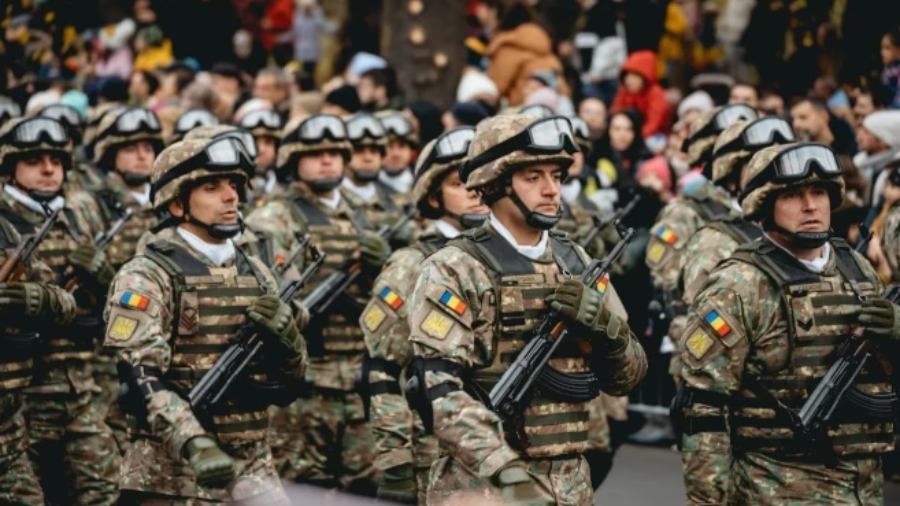
How Civilian Leaders Manipulate the Military

How Civilian Leaders Manipulate the Military: Power, Control, and the Repression of Citizens

Introduction: A Dangerous Dance of Power

When we talk about coups, political repression, or authoritarian control, we often imagine generals imposing their will over fragile civilian governments. But in reality, the more frequent and subtle danger is the reverse: How Civilian Leaders Manipulate the Military to secure power, silence their opponents, and maintain political dominance.

This dynamic—subtle, strategic, and often invisible—raises profound questions:

  • How do civilian political elites gain such influence over the armed forces?
  • Why do militaries obey orders that clearly harm citizens?
  • Why do some democracies fall into authoritarianism almost overnight?
  • And how do seemingly lawful leaders weaponize national defense structures?

Understanding this phenomenon requires unpacking the complex world of civil–military relations, political incentives, institutional weaknesses, and human psychology.

Let’s take a deep and nuanced journey into how civilian regimes—democratic or authoritarian—manage to manipulate, co-opt, and sometimes corrupt the military into becoming their personal tool for political survival.

Why Militaries Matter: The Foundation of Regime Power

Before exploring how manipulation occurs, we must understand why the military is the ultimate pillar of political power.

In every nation, the military represents:

  • Monopoly of legitimate force
  • National security and territorial integrity
  • The final arbiter in political chaos
  • A symbol of sovereignty

If a civilian leader loses the military, they lose power—sometimes literally overnight.

If they control it, they become nearly untouchable.

This explains why manipulating the military is one of the oldest political strategies in the world, from ancient empires to modern democracies.

The Tools of Manipulation: How Civilian Leaders Gain Control

Below are the six major strategies civilian leaders use to shape, influence, and weaponize the military.

1. Patronage: Buying Loyalty at the Top

Civilian rulers frequently secure military loyalty through patronage networks:

  • Promotions for friendly officers
  • Control of budgets and procurement
  • Access to economic benefits
  • Appointment of “politically safe” generals
  • Special privileges and allowances

This method creates a symbiotic relationship:
The military protects the leader, and the leader rewards the military.

This is common in:

  • Some African states
  • South Asia
  • Parts of the Middle East
  • Latin America during the Cold War

However, patronage also breeds corruption, internal divisions, and weakened institutional professionalism.

2. Institutional Fragmentation: Divide to Rule

Another tool is deliberate fragmentation of security institutions.

Civilian leaders create:

  • multiple intelligence agencies
  • different branches of armed forces
  • overlapping police units
  • private or paramilitary groups loyal to the leader

The purpose is simple:

Divide the security institutions so none can overthrow the regime alone.

Examples include:

  • Competing intelligence agencies in Russia
  • National Guard vs. Military in Venezuela
  • Revolutionary Guards vs. Army in Iran
  • Presidential Guards in several African states

This ensures the military remains loyal, busy, and under control.

3. Legal Manipulation: Hiding Repression Behind Law

Modern authoritarianism rarely looks like dictatorship.
Today, it often wears the cloak of legality.

Civilian leaders pass laws that appear constitutional but serve to:

  • expand emergency powers
  • restrict protest
  • criminalize dissent
  • give the military internal security roles
  • allow warrantless arrests
  • centralize power in the executive

When the law says the military must intervene, that intervention looks “legitimate.”

This blurs the line between defense and repression.

4. Ideology and Narrative Building

Civilian leaders know that soldiers don’t blindly obey—they’re influenced by identity, patriotism, and narrative.

So leaders craft powerful ideological stories to justify their commands:

  • “The opposition is a threat to national unity.”
  • “Protesters are violent extremists.”
  • “We are defending democracy from foreign enemies.”
  • “Critics are agents of foreign powers.”

Once this narrative is embedded:

  • Soldiers believe they are defending the nation,
  • Not repressing their own people.

This psychological manipulation is one of the most effective tools of control.

5. Militarizing Politics: Blurring Roles on Purpose

Some leaders embed the military deeply into civilian governance:

  • appointing military officers as regional administrators
  • involving them in elections
  • giving them economic sectors
  • using them in public works and development

This increases dependence on political leaders while reducing the military’s professional autonomy.

Over time, officers become political actors rather than neutral defenders of the state.

6. Fear of Chaos: The “Stability Argument”

Perhaps the most powerful emotional manipulation is the promise of stability.

Civilian leaders warn:

  • “If you don’t support me, the country will collapse.”
  • “We are the only barrier against civil war.”
  • “Disloyalty will lead to economic collapse.”

This fear-based messaging convinces the military that supporting the leader is supporting national stability.

Thus, repression becomes framed as patriotism.

Why Militaries Comply: Institutional and Human Factors

Understanding manipulation requires also examining why militaries often succumb to civilian influence.

1. The Military’s Hierarchical Culture

Military culture is built on:

  • hierarchy
  • obedience
  • discipline
  • chain of command

This makes challenging civilian orders extremely difficult.

Even when orders conflict with ethics, soldiers and officers may feel bound by duty.

2. Professional Conditioning

Militaries are trained to:

  • neutralize threats
  • maintain order
  • follow instructions
  • prioritize security

When political leaders label civilians as threats, militaries often fall in line.

3. Institutional Dependency

Militaries depend on civilian governments for:

  • budgets
  • equipment
  • salaries
  • welfare
  • compensation
  • legal protection

This dependency creates leverage:
“Support me, and I’ll support you.”

4. Fear of Internal Instability

Military leaders often fear:

  • civil wars
  • chaos
  • insurgencies
  • state collapse

Civilian leaders exploit this fear to secure compliance.

5. The Ambition Factor

Some military elites are ambitious and benefit from aligning with civilian rulers.

They receive:

  • promotions
  • contracts
  • influence
  • access to power

This creates powerful incentives for loyalty.

Case Studies: Comparing Different Regions

Below is a simplified table illustrating how civilian manipulation appears across global contexts:

RegionMethod of ControlOutcome
AfricaPatronage, presidential guards, fragmented forcesStrongman politics, politicized military
Middle EastIdeology, religious legitimacy, elite unitsEnduring authoritarianism
Latin AmericaLegal frameworks, cooptation, economic influenceCycles of democratic erosion
AsiaNarrative control, emergency powers, elite alliancesStrong civilian dominance, weak opposition
Eastern EuropeHybrid regimes, intelligence manipulationMilitarized policing, limited dissent

This demonstrates that civilian manipulation is global—not regional or ideological.

When Manipulation Turns to Repression

Civilian control is not inherently bad.
In democracies, it is necessary for preventing military interference.

But manipulation becomes dangerous when:

  • citizens are treated as enemies
  • dissent is framed as treason
  • the military is used for political survival
  • elections are militarized
  • opposition is crushed violently

Repression typically escalates through five stages:

1. Surveillance of activists and critics

intelligence agencies gather information

2. Restriction of protests

laws limit gatherings and demonstrations

3. Deployment of police forces

initial show of force to intimidate

4. Involvement of military units

framed as a “security operation”

5. Violent crackdowns

justified by “national stability”

At this point, the civilian leader has weaponized the military—often permanently.

Why Citizens Become Targets

The military is supposed to protect citizens.
So why do some regimes turn their guns inward?

Because to an insecure leader:

  • protesters = potential coup
  • journalists = destabilizers
  • opposition = enemy agents
  • civil society = foreign puppets

Manipulation changes the military’s mission from defending the nation to defending the ruler.

Breaking the Cycle: What Can Be Done?

Experts identify four major solutions:

1. Strengthening Institutions

  • independent courts
  • transparent budgets
  • nonpolitical promotion systems
  • strong oversight committees

2. Professionalizing the Military

  • ethics training
  • depoliticized leadership
  • independent military codes
  • civilian–military education programs

3. Clarifying the Military’s Role

Clear constitutions reduce manipulation.

4. Building Public Awareness

When citizens understand civil–military relations, they become harder to deceive or intimidate.

Conclusion: The Battle for the Soul of the State

Understanding How Civilian Leaders Manipulate the Military is critical for any society that values freedom, accountability, and democratic governance. This manipulation is not always obvious—it often begins quietly, legally, and under the guise of “security.”

But once the military becomes a political tool, a nation risks sliding into repression.

And history shows that once repression begins, it rarely ends voluntarily.

Call to Action

What do YOU think?
Do civilian leaders have too much power over the military?
Are citizens adequately protected from political misuse of force?

Share your thoughts below and explore more of our in-depth analyses on governance, political culture, and state institutions.

threats against Trump critics

Who Sends Death Threats After Trump’s Posts? Inside the Chaotic Ecosystem Behind the Threats

Introduction: When a Post Becomes a Weapon

Each time Donald Trump unleashes a verbal barrage on social media—targeting a judge, prosecutor, journalist, election worker, or political critic—a chilling pattern follows: the targeted individual begins receiving death threats.

This phenomenon has repeated so consistently that prosecutors, journalists, intelligence agencies, and researchers now treat it as a predictable social chain reaction.

But the critical questions remain:

  • Who is actually sending these threats?
  • Are these individuals part of an organized network?
  • Are they following instructions—or acting on their own interpretations of Trump’s words?
  • Does Trump himself implicitly fuel the threats without explicitly directing them?
  • What does existing evidence really show?

This investigative-style article explores the phenomenon with depth, nuance, and clarity.

What emerges is a picture not of a secret army or underground gang, but of something more volatile—and arguably more dangerous:
a decentralized, emotionally charged ecosystem of radicalized supporters and online actors who treat Trump’s words as marching orders, even when no orders are given.

1. The Pattern: Trump Speaks, Threats Follow

From the earliest days of Trump’s political life, researchers and intelligence analysts noticed a disturbing trend:

  1. Trump attacks an individual publicly.
  2. His comments get amplified across social media and far-right circles.
  3. Within hours or days, the targeted person receives:
    • Death threats
    • Harassment
    • Doxxing
    • Intimidating phone calls
    • Threats to family members

This pattern has appeared in case after case:

  • Federal Judge Tanya Chutkan
  • Georgia election workers Ruby Freeman & Shaye Moss
  • New York DA Alvin Bragg
  • Fulton County DA Fani Willis
  • Federal Judge Emmet Sullivan
  • Members of Congress who voted for impeachment
  • Journalists Trump labeled “enemy of the people”

In every instance, Trump’s harsh rhetoric preceded the wave of threats—not by weeks, but frequently within hours.

So again:
Who is sending these threats? And why?

2. Law Enforcement’s Findings: No Secret Organization—But a Predictable Ecosystem

The FBI, DHS, and state law enforcement agencies have repeatedly investigated these threats. Their findings are remarkably consistent:

✔ There is no evidence of a Trump-controlled secret group carrying out threats.

No:

  • hit squads
  • covert militias directed by Trump
  • coordinated networks
  • “orders” issued privately
  • direct communication with perpetrators

This is important:
Nothing in legal or intelligence findings suggests Trump personally orchestrates death threats.

However…

✔ The threats almost always come from Trump supporters.

And even more importantly:

✔ The threats spike immediately after Trump targets someone—so reliably that analysts can now predict the pattern.

This leads us to the key concept used by terrorism scholars:

3. Stochastic Terrorism: When Leadership Words Inspire Unpredictable Violence

Experts describe Trump’s rhetorical influence using a term known as stochastic terrorism.

Definition

When a person with a large audience uses hostile, dehumanizing, or inflammatory language, it increases the likelihood that an extremist will commit or attempt violence—yet no direct order is ever given.

This describes the Trump-threat pattern almost perfectly:

  • Trump labels someone “evil,” “corrupt,” “enemy,” or “traitor.”
  • Millions see the message.
  • Any one unstable or radicalized supporter may act violently or send threats.
  • Trump maintains distance from responsibility because he never explicitly commands violence.

This is not a conspiracy theory—it’s a documented behavioral chain observed repeatedly.

Trump is not coordinating attackers.
But he is inspiring them—predictably, consistently, and powerfully.

4. Who Sends the Threats? A Deep Dive into the Types of Perpetrators

From investigative reports, arrests, court transcripts, and threat analyses, four distinct groups emerge:

Group 1: Lone-Wolf Extremists

These individuals are:

  • Deeply loyal to Trump
  • Often politically obsessed
  • Consuming extremist content daily
  • Isolated, angry, or unstable
  • Acting without direction
  • Convinced they are “protecting America”

They represent the largest category by far.

Examples include the man who sent threats to Judge Chutkan after Trump criticized her, or the individuals who sent death threats to election workers after Trump’s allegations.

These people are not part of any organized network.
They are radicalized individuals acting on emotion and ideology.

Group 2: Online-Radicalized Supporters

These are people radicalized within digital spaces such as:

  • Telegram channels
  • Gab
  • Truth Social
  • 4chan / 8kun
  • Discord groups
  • Far-right Twitter/X communities

These communities:

  • Amplify Trump’s posts
  • Add inflammatory commentary
  • Share personal details of targets
  • Encourage members to “do something”

The threats emerge from this online radicalization loop.

Group 3: Ideological Fringe Groups

These include:

  • White nationalist groups
  • Militia-style organizations
  • Extremist online collectives
  • Sovereign citizen adherents
  • Conspiracy-oriented groups (QAnon, etc.)

These groups sometimes praise Trump and use his messages as ideological fuel, even though there is no operational connection to Trump himself.

They act opportunistically, using Trump’s rhetoric to justify harassment or intimidation.

Group 4: Hyperactive MAGA Media Personalities

This category is less about direct threats and more about incitement amplification.

Certain MAGA influencers:

  • Repost Trump’s attacks
  • Add aggressive commentary
  • Name targets repeatedly
  • Encourage followers to “hold them accountable”
  • Create content demonizing the targeted individuals

This group acts like an accelerant, pushing Trump’s rhetoric into more extreme online spaces where threats become more likely.

5. What Investigations Have Not Found

To avoid misinformation, it is crucial to state clearly:

✔ No evidence shows that Trump personally directs threats.

✔ No private Trump-owned networks conducting harassment have been found.

✔ No organized “Trump intimidation unit” exists.

The threats come not from coordinated orders, but from decentralized, self-motivated actors interpreting Trump’s rhetoric as a signal.

6. Why Trump’s Supporters Interpret His Words as Commands

Researchers highlight four psychological and social dynamics:

1. Parasocial loyalty

Millions of Americans feel a deep emotional connection to Trump, despite having never met him.
In their minds:

Attacking Trump’s enemies = defending someone they love or trust.

2. Moral framing

When Trump describes opponents as:

  • “traitors”
  • “enemies”
  • “vermin”
  • “illegitimate”
  • “destroying America”

he places them outside normal political disagreement.
Some supporters perceive this as permission for extreme action.

3. Conspiracy ecosystems

Online echoes of Trump’s comments blend with conspiratorial beliefs, magnifying fear and anger.

A Trump post → a conspiracy video → a Telegram group → a doxxing thread → a death threat
This chain can happen within hours.

4. The promise of heroic action

Some supporters view themselves as warriors or patriots fulfilling a historic mission.

This mentality fuels impulsive, violent messaging.

7. Do Trump’s Words Cause the Threats? A Closer Look

Legally, causation is extremely difficult to prove.
But behaviorally, researchers see a clear pattern:

  • Trump attacks → threats rise
  • Trump stops posting → threats decline
  • Trump attacks again → threats spike again

The relationship is not coincidental.

Even without coordination, Trump’s rhetoric acts as an activation trigger in a radicalized environment.

This is why national security agencies consider Trump’s language a driver of risk—even when Trump personally breaks no laws.

8. Key Case Studies: Threats After Trump’s Posts

Case 1: Ruby Freeman & Shaye Moss

After Trump falsely accused them of rigging votes, the two election workers:

  • Received death threats
  • Were stalked
  • Were harassed at home
  • Had to flee for safety

Investigators traced the threats to Trump supporters radicalized online, not to any organized group.

Case 2: Judge Chutkan

After Trump criticized her, a Trump supporter from Texas was arrested for sending explicit death threats. She acted alone.

Case 3: Prosecutors Willis & Bragg

Threats skyrocketed immediately after Trump attacked them by name.
Arrests reveal individuals acting independently.

9. Why Trump Doesn’t Need a Secret Network

A secret network would require:

  • organization
  • planning
  • communication
  • coordination
  • secrecy

But Trump has something far more powerful:

A massive audience primed to defend him emotionally and ideologically.

This audience acts without being told.

The threats are not centrally controlled—it’s a chaotic, emergent phenomenon created by:

  • rhetoric
  • loyalty
  • ideology
  • online radicalization
  • conspiracy culture
  • parasocial devotion

This combination makes the reaction to Trump’s words more potent than a directed network could ever be.

10. The Danger: Decentralized Threat Ecosystems Are Harder to Control

A coordinated organization can be dismantled.
Leaders can be arrested.
Networks can be disrupted.

But Trump’s threat ecosystem is:

  • decentralized
  • spontaneous
  • anonymous
  • global
  • unpredictable
  • psychologically motivated
  • ideologically energized
  • socially reinforced

This makes it exceptionally difficult for law enforcement to prevent or contain.

A single post can reach:

  • tens of millions instantly
  • extremists globally
  • unstable individuals
  • conspiracy-driven communities

No order needed.
No organization required.

11. So Who Sends the Threats? The Final Answer

Based on what is known:

✔ Trump does NOT have a secret hit squad or intimidation network.

✔ Trump does NOT directly instruct supporters to issue threats.

✔ But the threats DO come overwhelmingly from radicalized Trump supporters.

✔ And these threats are triggered—repeatedly and predictably—by Trump’s rhetoric.

The real story is not hidden—it is in plain sight:

Trump’s language activates a decentralized ecosystem of supporters, extremists, and online actors who believe they are defending him, punishing his enemies, or fighting for their shared worldview.

This is what makes the phenomenon so dangerous:

Trump doesn’t need to tell anyone to send threats—they do it automatically.

Conclusion: The Power and Peril of Influential Speech

The rise in threats against Trump’s critics is not the result of a shadow organization—it is the predictable byproduct of a polarizing political figure whose words carry profound emotional weight among millions.

Whether Trump intends these consequences is debatable.
Whether he causes them directly is legally unproven.

But whether his words inspire them?

That is undeniable.

Trump possesses a uniquely reactive audience, primed to act—even violently—when he frames someone as an enemy.
The danger lies not in secret coordination, but in the raw emotional power he holds over his most extreme followers.

In the end, the threats are not evidence of organization—they are evidence of influence.

And influence, in politics, can be every bit as dangerous as orders.

AI-Driven Disinformation Campaigns

The Forces Behind the Onslaught of AI-Driven Disinformation Campaigns: Who Really Benefits?

Introduction: The Ghost in the Machine

Imagine waking up to a world where any voice on the internet—television, social media, news websites—can be manufactured with perfect realism. Not just a deepfake video or a synthetic voice, but whole news sites, bot armies, and even digital operatives generated and controlled by artificial intelligence.

This is not science fiction. Welcome to the new reality of AI-Driven Disinformation Campaigns.

AI is no longer just a technological marvel; it’s becoming a geopolitical weapon. Nations, private operators, and cyber-mercenary firms are leveraging generative AI to produce convincing propaganda, influence elections, and destabilize democracies — all at a scale and speed previously unimaginable.

This investigative article dives into the forces fueling this new wave of disinformation, looks at who profits from it, and explores what this means for global power dynamics. If you believe that disinformation was bad before — think again.

What Makes AI-Driven Disinformation Different—and More Dangerous

To understand the threat, we need to first clarify what sets AI-generated disinformation apart from older propaganda:

  1. Scale & Speed
    Generative AI can produce thousands of articles, tweets, images, and even audio clips in minutes. According to a Frontiers research paper, the number of AI-written fake-news sites grew more than tenfold in just a year. (Frontiers)
  2. Believability
    Deepfake capabilities now include not just video, but lifelike voice cloning. A European Parliament report notes a 118% increase in deepfake use in 2024 alone, especially in voice-based AI scams. (European Parliament)
  3. Automation of Influence Operations
    Disinformation actors are automating entire influence campaigns. Rather than a handful of human propagandists, AI helps deploy bot networks, write narratives, and tailor messages in real time. As PISM’s analysis shows, actors are already using generative models to coordinate bot networks and mass-distribute content. (Pism)
  4. Lower Risk, Higher Access
    AI lowers the bar for influence operations. State and non-state actors alike can rent “Disinformation-as-a-Service” (DaaS) models, making it cheap and efficient to launch campaigns.

Who’s Behind the Campaigns — The Key Players

Understanding who benefits from these campaigns is critical. Below are the main actors driving AI-powered disinformation — and their motivations.

Authoritarian States & Strategic Rivals

  • Russia: Long a pioneer in influence operations, Russia is now using AI to scale its propaganda. In Ukraine and Western Europe, Russian-linked operations such as the “Doppelgänger” campaign mimic real media outlets using cloned websites to spread pro-Kremlin narratives. (Wikipedia)
  • China: Through campaigns like “Spamouflage,” China’s state-linked networks use AI-generated social media accounts to promote narratives favorable to Beijing and harass dissidents abroad. (Wikipedia)
  • Multipolar Cooperation: According to Global Influence Ops reporting, China and Russia are increasingly cooperating in AI disinformation operations that target Western democracies — sharing tools, tech, and narratives. (GIOR)

These states benefit strategically: AI enables scaled, deniable information warfare that can sway public opinion, weaken rival democracies, and shift geopolitical power.

Private Actors & Cyber-Mercenaries

  • Team Jorge: This Israeli cyber-espionage firm has been exposed as running disinformation campaigns alongside hacking and influence operations, including dozens of election manipulation efforts. (Wikipedia)
  • Storm Propaganda Networks: Recordings and research have identified Russian-linked “Storm” groups (like Storm-1516) using AI-generated articles and websites to flood the web with propaganda. (Wikipedia)
  • Pravda Network: A pro-Russian network publishing millions of pro-Kremlin articles yearly, designed to influence training datasets for large language models (LLMs) and steer AI-generated text. (Wikipedia)

These actors make money through contracts, influence campaigns, and bespoke “bot farms” for hire — turning disinformation into a business.

Emerging Threat Vectors and Campaign Styles

AI-driven disinformation isn’t one-size-fits-all. Here are the ways it’s being used today:

Electoral Manipulation

  • Africa: According to German broadcaster DW, AI disinformation is already being used to target election processes in several African nations, undermining trust in electoral authorities. (Deutsche Welle)
  • South America: A report by ResearchAndMarkets predicts a 350–550% increase in AI-driven disinformation by 2026, particularly aimed at social movements, economic policies, and election integrity. (GlobeNewswire)
  • State-Sponsored Influence: Russian and Iranian agencies have allegedly used AI to produce election-related disinformation, prompting U.S. sanctions on groups involved in such operations. (The Verge)

Deepfake Propaganda and Voice Attacks

  • Olympics Deepfake: Microsoft uncovered a campaign featuring a deepfake Tom Cruise video, allegedly produced by a Russia-linked group, to undermine the Paris 2024 Olympics. (The Guardian)
  • Voice Cloning and “Vishing”: Audio deepfakes are now used to impersonate individuals in voice phishing attacks, something the EU Parliament warns is on the rise. (European Parliament)

Training Data Poisoning

Bad actors are intentionally injecting false or extreme content into training datasets for LLMs. These “prompt-injection” or data poisoning attacks aim to subtly twist model outputs, making them more sympathetic to contentious or extreme narratives. (Pism)

H3: Bot Networks & AI-Troll Farms

AI enables the creation of highly scalable, semi-autonomous bot networks. These accounts can generate mass content, interact with real users, and amplify narratives in highly coordinated ways — essentially creating digital echo chambers and artificial viral campaigns.

Who Benefits — And What Are the Risks?

Strategic Advantages for Authoritarian Regimes

  • Plausible Deniability: AI campaign operations can be launched via synthetic accounts, making attribution difficult.
  • Scalable Influence: With AI content generation, propaganda becomes cheap and scalable.
  • Disruptive Power: Democracies become destabilized not by traditional military power but by information warfare that erodes trust.

Profits For Cyber-Mercenaries

Disinformation-as-a-Service (DaaS) firms are likely to be among the biggest winners. These outfits can deploy AI-powered influence operations for governments or commercial clients, charging for strategy, reach, and impact.

Technology Firms’ Double-Edged Role

AI companies are in a precarious position. Their tools are being used for manipulation — but they also build detection systems.

  • Cyabra, for example, provides AI-powered platforms to detect malicious deepfakes or bot-driven narratives. (Wikipedia)
  • Public and private pressure is growing for AI companies to label synthetic content, restrict certain uses, and build models that resist misuse.

Danger to Democracy and Civil Society

  • Erosion of Trust: When citizens can’t trust what they see and hear, institutional legitimacy collapses.
  • Polarization: AI disinformation exacerbates social divisions by hyper-targeting narratives to groups.
  • Manipulation of Marginalized Communities: In regions with weaker media literacy, AI propaganda can have disproportionate effects.

Global Responses and the Road to Resilience

How are governments, institutions, and societies responding — and what should be done?

Policy and Regulation

  • The EU is tightening rules on AI via the AI Act, alongside the Digital Services Act to require transparency and oversight. (Pism)
  • At a 2025 summit, global leaders emphasized the need for international cooperation to regulate AI espionage and disinformation. (DISA)

Tech Countermeasures

  • Develop “content provenance” systems: tools that can reliably detect whether content is AI-generated.
  • Deploy counter-LLMs: AI models that specialize in detecting malicious synthetic media.
  • Use threat intelligence frameworks like FakeCTI, which extract structured indicators from narrative campaigns, making attribution and response more efficient. (arXiv)

Civil Society Action

  • Increase media literacy: Citizens must understand not just what they consume, but who created it.
  • Fund independent fact-checking: Especially in vulnerable regions, real-time verification can beat synthetic content.
  • Support cross-border alliances: Democracy-defense coalitions must monitor and respond to AI influence ops globally.

Conclusion: A New Age of Influence Warfare

We are witnessing the dawn of a new kind of geopolitical contest — not fought in battlegrounds or missile silos, but online, in the heart of information networks.

AI-Driven Disinformation Campaigns represent a paradigm shift:

  • Actors can produce content at scale with unprecedented realism.
  • Influence operations can be automated and highly targeted.
  • Democratic institutions face a stealthy, potent threat from synthetic narratives.

State actors, cyber firms, and opportunistic mercenaries all have a stake — but it’s often the global citizen and the integrity of democracy that pays the highest price.

AI is a tool — and like all tools, its impact depends on who wields it, and how.

Call to Action

  • Share this post with your network: help raise awareness about these hidden AI risks.
  • Stay informed: follow institutions working on AI policy, fact-checking, and digital resilience.
  • Support regulation: advocate for meaningful, global standards on AI to prevent its abuse in disinformation.
  • Educate others: host or join community events, online webinars, and local discussions about media literacy and AI.

The fight for truth in the age of AI is just beginning — and everyone has a part to play.

References

  1. Cyber.gc.ca report on generative AI polluting information ecosystems (Canadian Centre for Cyber Security)
  2. PISM analysis of disinformation actors using AI (Pism)
  3. World Economic Forum commentary on deepfakes (World Economic Forum)
  4. KAS study on AI-generated disinformation in Europe & Africa (Konrad Adenauer Stiftung)
  5. NATO-cyber summit coverage on AI disinformation (DISA)
  6. AI Disinformation & Security Report 2025 (USA projections) (GlobeNewswire)
  7. Global Disinformation Threats in South America report (GlobeNewswire)
  8. Ukraine-focused hybrid-warfare analysis on AI’s role in Kremlin disinformation (Friedrich Ebert Stiftung Library)
  9. Academic research on automated influence ops using LLMs (arXiv)
  10. Cyber threat intelligence using LLMs (FakeCTI) (arXiv)
us-surrender-of-ukraine

The New US ‘Peace Plan’ for Ukraine: A Path to Surrender and a Gift to Russian Aggression?

Introduction: A Peace Plan or a Pyrrhic Gift?

When The New US ‘Peace Plan’ for Ukraine was unveiled, it was sold by its proponents as a breakthrough — a realistic way to end a brutal war. But for many observers, the draft reads less like diplomacy and more like capitulation. It demands Ukraine cede critical territory, slash its military forces, and abandon any hope of NATO membership. In short, critics say it’s not a path to peace — it’s a roadmap to surrender.

This proposal, which has reportedly gained backing from Donald Trump, has provoked outrage across Kyiv, Washington, and European capitals. Is it a genuine attempt to broker stability — or a dangerous appeasement that emboldens Russian aggression? And what does it mean for Ukraine’s very sovereignty?

In this post, we’ll unpack what’s in the plan, why it is deeply problematic, who stands to gain, and why many see it as “a gift to the aggressor.”

What’s Inside the So-Called Peace Plan?

Based on multiple media reports, including The Guardian and Al Jazeera, the draft includes a 28-point framework that places unusually heavy demands on Ukraine. (The Guardian) Key points include:

  • Recognition of Russian claims over Crimea, Luhansk, and Donetsk. The plan reportedly asks for de facto recognition of these regions as under Russian control. (The Guardian)
  • Limiting Ukraine’s military: The draft states that Ukraine’s armed forces would be capped at 600,000 personnel — a steep reduction from current levels. (United24 Media)
  • Abandon NATO aspirations: Ukraine is to enshrine in its constitution a ban on joining NATO, and NATO itself would amend its statutes to reflect this. (United24 Media)
  • No foreign troops in Ukraine: The proposal reportedly prohibits NATO or other foreign troops from being stationed in Ukraine, although European fighter jets would be based in Poland as part of “security guarantees.” (United24 Media)
  • Economic reintegration for Russia: The plan envisions phased sanction relief for Russia and reintegration into the global economy, including a possible return to the G8. (The Guardian)
  • Huge reconstruction fund: Around $100 billion of frozen Russian assets would be used for Ukrainian reconstruction — but with a controversial caveat: the U.S. would profit from this fund. (United24 Media)
  • Elections and constitutional changes: The draft allegedly requires Ukraine to hold elections within 100 days and to amend its constitution to reflect the new security arrangement. (Sky News)

Taken together, these elements look less like a negotiated peace and more like a deep strategic concession to Russia — one that weakens Ukraine’s sovereignty and long-term defense posture.

Why Many View It as a Capitulation

1. Territorial Surrender Under the Guise of Diplomacy

By demanding the formal or de facto cession of Crimea, Donbas, and other contested territories, the plan effectively asks Ukraine to normalize Russia’s military gains. For many, this is not compromise but capitulation. As The Guardian reported, the terms repeat Moscow’s maximalist demands, violating Ukrainian red lines. (The Guardian)

Ukraine’s leaders have historically rejected ceding these territories. As noted by AP News, recognizing Russian sovereignty over Crimea would require a constitutional amendment and a national referendum — a politically explosive move. (AP News)

2. A Weakened Military = Weakened Defense

Limiting Ukraine’s army to 600,000 soldiers significantly reduces its capacity to defend its territory, deter future aggression, or maintain internal stability. For a country still under threat, this is more than a concession — it’s a structural handicap.

3. Neutrality: Permanent Isolation from NATO

One of the most controversial parts of the proposal: Ukraine would constitutionally commit to never joining NATO. That weakens its long-term security prospects and prevents future Western alliances from offering robust guarantees against Russian re-aggression. (United24 Media)

4. Legitimizing the Aggressor

By granting Russia economic reintegration and recognizing its territorial gains, the plan could be seen as rewarding Moscow’s violent behavior. Many argue this sets a dangerous precedent for international law: conquer by force and negotiate later.

5. Opaque Guarantees

The security guarantees promised to Ukraine are vague. Reports indicate that while there would be U.S. backing, specifics are light, and the deal carries significant conditions — including a cut of profits from the reconstruction fund. (United24 Media)

Reactions from Kyiv, Europe, and Beyond

Kyiv’s Response: A Mix of Caution and Alarm

Ukrainian President Volodymyr Zelenskyy has expressed a willingness to “work honestly” on the plan, emphasizing the need for “respect for our independence, sovereignty, and dignity.” (Novaya Gazeta Europe) But not all in Ukraine are so diplomatic. Several officials have denounced the plan as “absurd”, equating it with surrender. (The Guardian)

European Leaders Push Back

European allies are deeply skeptical. Analysts and politicians from NATO countries have warned that concessions to Russia undermine the core logic of European security. As The Guardian notes, accepting this proposal could effectively hand Russia a permanent strategic advantage. (The Guardian) Germany’s defense minister has publicly rejected what he calls “weakness through peace,” arguing that capitulation risks long-term instability. (The Guardian)

Russian Influence in the Draft

Alarmingly, some reports suggest that the plan was not just U.S.-led — it may have been co-drafted with Russian officials. The Guardian names Kirill Dmitriev, a close Putin ally, as being centrally involved in the negotiations alongside U.S. envoy Steve Witkoff. (The Guardian) If true, it undermines claims that this is a balanced proposal — instead, it suggests it may more closely reflect Moscow’s agenda than Kyiv’s.

The Strategic Risk: Why This Is Dangerous for Ukraine — and Europe

A Precedent for Aggressors

If the world accepts this proposal, it sends a message:
Military aggression can pay. Stare down your adversary, grab what you want, and then negotiate.

That emboldens not just Russia — but other autocratic regimes watching.

Long-Term Military Weakening

Capping Ukraine’s army permanently weakens its deterrence against future Russian encroachment. A future conflict could become more likely, not less.

Fragile Guarantees

Ambiguous security guarantees haven’t protected Ukraine so far. Without strong, binding commitments, there’s no guarantee that future leaders — on any side — will uphold the deal.

Erosion of International Norms

Normalizing Russia’s territorial gains undermines decades of post-Cold War consensus about sovereignty, borders, and the rule of law.

European Security at Risk

With Ukraine weakened, Russia’s posture toward Europe becomes more aggressive. A weaker Ukraine could invite further destabilization on NATO’s eastern flank — not peace.

Why Is the U.S. Supporting This, If at All?

Understanding why such a controversial plan is being floated requires peeling back political, ideological, and geopolitical layers:

  1. Domestic Calculations
    For Donald Trump, the peace plan is deeply tied to his “deal-maker” identity. Offering a “deal” with Russia plays to his base and reinforces his geopolitical brand.
  2. War Fatigue
    In the U.S. and Europe, public appetite for continued involvement in Ukraine is waning. A “peace” deal with concessions may seem politically palatable — even if dangerous.
  3. Backchannel Diplomacy
    The plan seems to have been developed through informal channels (e.g., Trump envoy Steve Witkoff, Kirill Dmitriev), not through traditional diplomatic forums. This raises concerns about transparency, accountability, and whose interests are really being served. (The Guardian)
  4. Global Strategy
    Reintegrating Russia economically could appeal to U.S. economic interests, while avoiding long-term military commitments — a trade-off that some policymakers may view as pragmatic rather than principled.

Is There Any Path Forward That Avoids Surrender?

Critics argue that real peace must include:

  • No irreversible territorial concessions
  • Strong, enforceable, legal security guarantees
  • Constitutional clarity in Ukraine (with full sovereignty preserved)
  • A genuine NATO pathway or equivalent alliance guarantees
  • Transparent international reconstruction funding
  • Respect for Ukrainian national identity, including language and institutions

Without these, a “peace” deal risks being heartbreakingly hollow — more a tactical retreat than a lasting resolution.

A Personal Reflection: Why This Matters to Me

Watching this proposal unfold has been deeply unsettling. As someone who cares deeply about democratic values, global stability, and the right of oppressed nations to defend themselves, the contours of this plan feel like a betrayal.

I’ve talked with people in Ukraine — citizens, analysts, veterans — and they express a sense of déjà vu. Surrender dressed as peace, deals made in back rooms, terms that diminish national dignity. They’re haunted by history: once you concede land, once you cap your military, once you promise neutrality — the cost is not just strategic, it’s existential.

This isn’t just a geopolitical move: it’s a test of moral courage, of our collective will to defend freedom, and of whether the world supports sovereignty or sacrifice.

Key Takeaways

Here’s what should be front of mind for anyone following this proposal:

  • It’s not purely a peace plan; it mirrors Russia’s war goals.
  • Military limitations weaken Ukraine’s ability to defend itself long-term.
  • Neutrality and NATO exclusion undermine Europe’s collective security.
  • Economic reintegration of Russia could reward aggression.
  • The security guarantees are vague and potentially hollow.
  • This could set a dangerous international precedent.

Conclusion: A Peace Plan That Risks More Than It Promises

At first glance, The New US ‘Peace Plan’ for Ukraine may appear as a generous olive branch. But if you peel back the veneer, you find terms that align far more closely with Russian strategic objectives than Ukrainian sovereignty. Recognizing occupied territories, shrinking military capacity, limiting alliance membership — these are not compromises born of compromise, but terms drafted under pressure.

If this plan moves forward as is, it may mark a pivotal moment: not just for Ukraine, but for the future of international order. It could embolden aggressors, signal a weakening of NATO, and celebrate peace on terms that undermine justice.

In this moment, the world must ask: is this a path to peace, or a prescription for capitulation?

Call to Action

What do you think?

  • Is this “peace plan” a genuine diplomatic breakthrough — or a dangerous concession?
  • Can Ukraine afford to accept these terms?
  • Should the international community support or reject a deal shaped so heavily by the aggressor?

Let me know your thoughts in the comments — and please share this post if you believe the gravity of these proposals needs to be widely understood. Subscribe for more in-depth political analysis and breaking commentary about Ukraine, geopolitics, and global security.

Sources & References

  • The Guardian: analysis of U.S.-Russian drafted peace plan (The Guardian)
  • Al Jazeera: review of Ukraine ceding land and weapons (Al Jazeera)
  • Novaya Gazeta Europe: Zelenskyy’s response (Novaya Gazeta Europe)
  • Sky News: text of the 28-point draft plan (Sky News)
  • Time Magazine: Trump’s public statements on Crimea & NATO (TIME)
  • Al Jazeera: why Russia rejected earlier Trump proposals (Al Jazeera)
  • Le Monde: report on U.S. ultimatum to Ukraine (Le Monde.fr)
the Russian war in Ukraine

Talking Tough but Doing Nothing: The Inability of the US and Allies to Take Real Defense Action Against The Russian Aggression in Ukraine

When you hear Western leaders condemn the Russian aggression in Ukraine, their words are loud, urgent, and full of moral clarity. But while the rhetoric echoes across capitals and global media, the actions often fall short — or at least not decisively enough to match the scale of the threat. In short: they’re talking tough, but doing relatively little.

This gap between words and deeds is not just frustrating for Kyiv — it’s deeply perilous. Because every moment of hesitation, every limited escalation, every red line unpulled, risks emboldening Moscow’s ambitions.

In this blog post, we’ll explore why the U.S. and its allies, despite their power and influence, have struggled to take real defensive action against Russia. We’ll examine political constraints, military risks, strategic dilemmas, and the deeper paradox of deterrence in an era of nuclear-armed great powers.

The Current Reality: What “Doing Nothing” Really Means

To be clear: Western countries are doing a lot of things. There is massive financial aid, weapons shipments, intelligence-sharing, and tough economic sanctions. But when it comes to direct military intervention or meaningful escalation, there’s a striking reluctance to cross certain thresholds.

Key examples of this tepid response:

  • No no-fly zone. Despite repeated calls from Ukraine, NATO has refused to enforce a no-fly zone, fearing direct conflict with Russian aircraft. (Wikipedia)
  • Sanctions only — not boots. The European Union recently renewed its economic restrictive measures against Russia, but these remain financial and diplomatic, not a step toward putting Western troops into the fight. (Consilium)
  • Limited escalation. While countries supply Ukraine with increasingly capable weapons, they are cautious about giving long-range strike capabilities or creating the kind of escalation that could provoke a direct NATO–Russia confrontation. (Mirage News)
  • Risk of nuclear escalation. Experts warn that more aggressive actions risk triggering horizontal escalation or even a nuclear standoff. (Bulletin of the Atomic Scientists)
  • Fragile support. According to recent scenario analyses, Ukraine’s survival depends on ongoing Western aid — but that support is fragmented, condition-based, and could become unstable. (ACAPS)

So while the West is supporting Ukraine, it’s doing so in a way that appears cautious, constrained, and calculated — not bold.

Why the Reluctance? Understanding the Strategic Dilemmas

1. Fear of Escalation and the Nuclear Risk

One of the most significant barriers to decisive action is the risk of escalation. Putin doesn’t just lead a conventional military — he oversees a nuclear superpower. Western leaders know that pushing too hard could trigger catastrophic consequences.

  • The fog of war increases the danger. Analysts argue that miscalculations could lead to horizontal escalation (spreading conflict to other countries) or worse. (Bulletin of the Atomic Scientists)
  • NATO, by design, is a defensive alliance, not an offensive one. Direct intervention could be framed by Russia as an existential threat, potentially justifying a more aggressive response.
  • Some Western commentary suggests an overcautious approach may actually embolden Russia rather than restrain it. Politically safe moves often seem strategically weak. (The Guardian)

2. Domestic Political Constraints

Domestic politics matter. Western governments face significant constraints:

  • Public fatigue: Voters may support sanctions and aid, but are much more hesitant about seeing Western soldiers at war in Ukraine.
  • Partisan divides: In the U.S., for example, support for Ukraine is not uniformly bipartisan. (Wikipedia)
  • Economic risks: Escalating the conflict could further destabilize energy markets, disrupt supply chains, and hit European economies hard. (Mirage News)

These constraints mean that leaders must carefully weigh what their domestic audiences will tolerate — not just what is strategically ideal.

3. Strategic Ambiguity as Policy

Western leaders often rely on strategic ambiguity: providing Ukraine with enough help to resist, but stopping short of full-scale intervention. This ambiguity serves multiple purposes:

  • It signals resolve without committing to all-out war.
  • It gives NATO plausible deniability if things go wrong.
  • It preserves the option to escalate later — but only if necessary.

However, this ambiguity comes at a cost. It may allow Russia to interpret “restraint” as weakness, giving it room to maneuver and test the limits of Western will.

The Moral and Political Costs: Why “Tough Talk” Isn’t Enough

There is a real human cost to this cautious strategy. Every day the war drags on, civilians suffer. Infrastructure is destroyed. Ukrainian lives are put at risk not just by aggression, but by the limits of foreign support.

From a moral standpoint, one could argue that the West’s inaction undermines its own values. If defending democracy and sovereignty is truly a priority, why not take bolder action?

Politically, the cost is also high:

  • Credibility is at stake. Repeated strong statements against Russian aggression lose power when not backed by meaningful action.
  • Global norms are being tested. If the world’s most powerful militaries refuse to act decisively against a blatant act of aggression, what does that imply for future conflicts?
  • Long-term deterrence is weakened. If Russia sees that aggressive moves generate only sanctions, not intervention, it may be emboldened in the future.

The Alternatives: What Could Real Action Look Like?

Let’s explore what more robust action might involve — and why Western leaders have hesitated to take it.

  1. Enforcing a No-Fly Zone
    It’s been one of Ukraine’s most persistent asks. A no-fly zone enforced by NATO could significantly reduce Russian air superiority. But it would require Western aircraft to risk being shot down, potentially escalating into a broader war. (Wikipedia)
  2. Providing Long-Range Strike Capabilities
    Equipping Ukraine with longer-range weapons (e.g., missiles) would let them strike deeper into occupied or Russian territory. But that raises red lines: are Western countries ready for a war that could draw them directly into Russia?
  3. Deploying Troops
    Direct deployment of Western troops to fight in Ukraine would be a seismic decision — likely only if a NATO member is attacked. So far, there’s no indication that NATO wants to go that route.
  4. Stronger Multinational Forces
    Some European leaders have floated creating a “reassurance force” — a multinational force to guard Ukraine or other vulnerable regions — though it hinges on U.S. backing. (Le Monde.fr)
  5. Tightening Sanctions and Cutting Energy Ties
    More aggressive economic measures could further isolate Russia, although there’s a trade-off: energy supply, inflation, and economic blowback.

Why These Alternatives Remain Elusive

Putting these alternatives into action runs into structural and political barriers:

  • NATO’s fundamental design: It’s defensive, not offensive. Engaging Russia inside Ukraine could be seen as offensive.
  • Nuclear deterrence: Escalation risk is not theoretical — it’s real and existential.
  • Alliance politics: NATO is not a monolith; different states have different risk tolerances, histories, and political pressures.
  • Resource constraints: While the U.S. is a major supporter of Ukraine, not all allies have the capacity or political will to follow its lead.
  • Public opinion volatility: Even generous public support can reverse if costs (financial, human, or geopolitical) surge.

A Personal Reflection: Why the Gap Frustrates Me

As a global citizen and an observer of geopolitics, watching this gap between words and deeds feels deeply unsettling. It’s not just about Ukraine — it’s about what the West says it stands for, and what it actually does. The war in Ukraine is a test not only of military power, but of moral clarity and political courage.

I often think of the Ukrainian people, whose resolve is fierce and whose suffering is profound. They deserve more than just powerful statements. They deserve a coalition that matches its rhetoric with commensurate risk.

Key Insights: The True Cost of Inaction

  • Deterrence without risk isn’t deterrence: Real deterrence demands willingness to act, not just punish.
  • Moral leadership may require moral risk: Standing up to aggression sometimes means accepting escalation risk.
  • Strategic ambiguity is a double-edged sword: It gives flexibility — but may erode credibility.
  • Alliance politics shape real-world power: NATO’s structure, public opinion, and diversity of interests constrain bold action.
  • Long-term future hinges on precedent: If the West doesn’t act decisively now, future aggressors will take note.

Conclusion: The Illusion of Power

The United States and its allies appear strong when they speak, but their restraint reveals a more fragile posture. The Russian aggression in Ukraine is a test — a test not just of military mettle, but of how serious the West really is when it claims to defend democracy, sovereignty, and the rules-based order.

If the West is serious, words must evolve into risky deeds. Strategy must become courage. And alliances must commit not just to supporting Ukraine — but to standing up in a way that deters the next act of aggression. Because deterrence built on caution is fragile; and in the face of bold aggression, it may simply crack.


Call to Action

  • What do you think — should the U.S. and NATO take more aggressive action to defend Ukraine?
  • Share your views in the comments below — and if you found this post insightful, subscribe for more geopolitical analysis and deep dives into global power dynamics.
  • For further reading: check out reliable reporting from NATO, EU, and policy think tanks on Western strategy toward Russia.

References

  • Andriy Zagorodnyuk, The Guardian: On how Western caution risks emboldening Putin. (The Guardian)
  • NATO Review: Consequences of Russia’s invasion for international security. (NATO)
  • EU Council press release: Extension of sanctions on Russia. (Consilium)
  • EU timeline of response to Russian military aggression. (Consilium)
  • Scenario analysis from Supply Chain Business Council / RAND: Long-range weapons risk. (The International Trade Council)
  • Bulletin of the Atomic Scientists: Nuclear escalation & fog of war. (Bulletin of the Atomic Scientists)
  • ACAPS Ukraine scenarios report: Fragility of Western support. (ACAPS)
tariffs as a flawed political strategy

Why Tariffs Don’t Work: Exposing the Flawed Political Strategy Behind Trump’s Trade Wars

Introduction: When One Tool Becomes the Whole Toolbox

When Donald Trump launched his aggressive trade war, he framed tariffs as a masterstroke — a simple, bold, America-first solution to complex global problems. But as history, economics, and lived experience now make painfully clear, tariffs as a flawed political strategy became less a tool of negotiation and more a political crutch, wielded impulsively to project strength while masking deeper policy failures.

The Trump administration used tariffs to solve everything:
• Trade deficits
• Foreign policy disputes
• Immigration issues
• Political leverage
• Diplomatic conflicts
• Even domestic campaign messaging

The problem? Tariffs don’t work that way.
They are blunt, outdated instruments — poorly suited to the modern, integrated global economy. And yet, under Trump, tariffs were elevated from occasional remedies to the centerpiece of national strategy.

This blog post digs beneath the surface narrative:
Why did Trump rely so heavily on tariffs? Why did the strategy fail? And what does the fallout reveal about leadership, governance, and the dangers of political shortcuts?

Welcome to a deep dive into the turbulence behind the trade wars.

Tariffs as a Political Weapon — Not an Economic Strategy

Tariffs have existed for centuries, but their traditional purpose has been limited:

  • Protect young industries
  • Respond to unfair foreign practices
  • Generate government revenue
  • Balance trade deficits in isolated cases

Trump, however, transformed tariffs into a universal political weapon, applying them to scenarios that had nothing to do with trade.

Tariffs Used for Immigration Pressure

In 2019, Trump threatened tariffs on Mexico unless it stopped migrants at the U.S.–Mexico border.
This was unprecedented. Immigration enforcement and trade policy are distinct domains — but the administration blurred them for political effect.

Tariffs Used to Strong-Arm China

The U.S.–China trade war escalated into hundreds of billions in tariffs, yet:
• Manufacturing jobs did not return in meaningful numbers
• U.S. farmers were devastated, requiring up to $28 billion in bailout subsidies
• China found alternative suppliers
• U.S. consumers faced higher prices

Tariffs Used as Campaign Theater

Rallies often included dramatic declarations:
“We’re winning the trade war!”
“China is paying billions!”

This was politically effective rhetoric — but economically false.
U.S. importers (and ultimately American consumers) bore the cost.

Trump’s tariffs weren’t just economic tools — they were performance politics.

How Tariffs Backfired — A Strategy Built on Misunderstanding

The Biggest Myth — “China Pays”

Every credible economic study shows the same result:
American consumers and companies paid nearly 100% of tariff costs.

Businesses absorbed higher costs or passed them to consumers through:
• Higher retail prices
• Reduced product choices
• Slower wage growth
• Lower investment spending

The strategy’s cornerstone claim was simply untrue.

Global Supply Chains Don’t Bend Easily

Trump appeared to believe that U.S. companies could swiftly abandon China and “come home.”

But modern supply chains are:

  • Multi-layered
  • Regionally specialized
  • Capital-intensive
  • Built over decades

Shifting production is not a switch — it is a multi-year transformation costing billions.

This is why many firms paid tariffs rather than move operations.
Apple didn’t move iPhone production.
Major auto companies didn’t return factories to Ohio or Michigan.
Manufacturing reshoring remained modest.

Tariffs could not reshape the global economy — only disrupt it.

Farmers Became Collateral Damage

No group suffered more from Trump’s trade war than American farmers.

China retaliated immediately, cutting U.S. agricultural imports drastically.

The consequences:

  • Soybean exports plummeted
  • Farm bankruptcies spiked
  • Rural communities faced financial trauma
  • Taxpayer bailouts ballooned to historic levels

Many farmers supported Trump politically — but economically, they were left exposed.

The Economic Impact — Data Tells a Clear Story

Below is a simplified comparison showing the intended vs. actual outcomes of the tariff strategy.

Table: Trump’s Tariff Goals vs. Reality

GoalIntended OutcomeWhat Actually Happened
Reduce trade deficitDramatic decreaseTrade deficit reached all-time highs
Bring jobs backManufacturing boomJobs had a brief uptick, followed by slowdown and decline
Make China “pay”China absorbs tariff costsAmericans paid 90–100% of costs
Boost U.S. farmingStrong export marketFarm bankruptcies increased; subsidies required
Strengthen U.S. leverageChina capitulatesChina retaliated and diversified suppliers
Stabilize marketsPredictability and confidenceMarket volatility surged

Why Tariffs Appealed to Trump — The Psychological and Political Angle

Tariffs were not just a tool — they were a symbol.
Here’s why they fit Trump’s worldview so perfectly:

1. Tariffs Are Simple

Trade policy is complex.
Tariffs reduce everything to a single, dramatic action — ideal for political storytelling.

2. Tariffs Sound “Tough”

Trump favored optics of confrontation.
Tariffs project dominance, even when they weaken your own economy.

3. Tariffs Create Villains

China. Mexico. Europe.
Tariffs allowed Trump to frame himself as a warrior on behalf of “forgotten Americans.”

4. Tariffs Distract From Domestic Failures

Rather than address structural issues — automation, education, infrastructure, innovation — tariffs provided a quick villain and a quick applause line.

5. Tariffs Fit the “Transactional” Mindset

Trump prefers zero-sum thinking:
“If I win, you lose.”
Tariffs reinforce this worldview, even when the economics contradict it.

Global Backlash — How Allies and Competitors Responded

Trump’s tariff obsession did not just reshape domestic politics; it rattled alliances and empowered adversaries.

Europe Hit Back

The EU targeted politically sensitive products, including:
• Bourbon (Kentucky)
• Motorcycles (Wisconsin)
• Orange juice (Florida)

These were not random — they were aimed at Republican strongholds.

China Played the Long Game

China waited out Trump, doubled down on global partnerships, and invested heavily in:

  • Belt and Road Initiative
  • Semiconductor independence
  • Trade relationships with Asia, Africa, and Latin America

Trump’s tariffs accelerated China’s diversification — a long-term strategic win for Beijing.

Allies Questioned U.S. Leadership

Tariffs were placed even on allies like Canada and the EU, justified under “national security.”

This damaged trust and pushed some countries toward alternative trade blocs.

Lessons Learned — Why Tariffs Are a Political Dead End

The Trump era confirmed a truth economists already knew:
Tariffs are outdated tools in a hyper-connected world.

Tariffs fail because:

  • They hurt your citizens more than your rivals
  • They destabilize markets
  • They inflame political tensions
  • They don’t create long-term manufacturing jobs
  • They don’t reshape global supply chains
  • They invite retaliation
  • They can trigger domestic inflation

Tariffs succeed only when:

  • They are targeted
  • They are temporary
  • They address a specific unfair practice
  • They are part of a broader strategy

Trump’s tariffs met none of these conditions.

What a Real Economic Strategy Could Have Looked Like

Instead of tariffs, a smarter strategy would include:

• Investing in high-tech manufacturing

Semiconductors, EVs, medical equipment.

• Strengthening alliances

A unified front against China is far more effective.

• Workforce development

Skilled workers are the real backbone of competitive manufacturing.

• Modernizing infrastructure

Ports, broadband, energy grids.

• Incentivizing innovation at home

R&D, startups, entrepreneurship ecosystems.

Tariffs were easy politics — but the wrong tool for the real problems.

Conclusion: The Danger of Over-Simplified Political Weapons

Trump’s trade wars exposed something deeper than economic miscalculation.
They revealed the inherent weakness in leadership that relies on performative strength instead of strategic thinking.

Using tariffs as a flawed political strategy became a symbol of the broader governance style:

  • impulsive
  • confrontational
  • simplistic
  • disconnected from expert advice
  • driven by optics over outcomes

America paid the price — higher costs, broken alliances, economic turbulence, and a weakened global position.

In the end, tariffs did not fix America’s problems.
They exposed them.

Call to Action (CTA)

If you found this breakdown insightful, share your thoughts below. How do you think America should approach global trade in the years ahead?
👉 Share this post, leave a comment, and explore more of our deep-dive analyses on politics, economics, and governance.

repression-authoritarian-playbook-africa

The African Dictatorship Playbook: How Authoritarian Regimes Keep a Continent in Chains

Introduction: When Power Becomes Performance

True dictatorship isn’t always drums and tanks. Often, it’s theatre. Within The African Dictatorship Playbook, you’ll find deep-rooted tactics of control: the masking of freedom, the calibration of fear, the architecture of patronage, and the slow erosion of institutional check-points. Across Africa, from personalist “Big Men” to dominant-party rule, the game is less about open repression than about institutional capture, narrative control, and perpetual survival. (ResearchGate)
In what follows, we’ll map the playbook, compare its variations, draw insights, and ask: what hope is there for citizens when repression is so well-designed and deeply embedded?

Section I: Mapping the Core Moves of the Playbook

What are the repeating patterns? Here are the elements that define the playbook in many African contexts:

Co-option and Elite Division

Dictators don’t just dominate by force—they govern by dividing. According to research on authoritarianism in Sub-Saharan Africa, regimes survive by balancing coercion and consensual tactics.(ResearchGate)
Typical moves:

  • Promoting loyalists into key roles (security, judiciary, media)
  • Sweetening packages for the elite (business contracts, informal rents) while demanding loyalty
  • Splitting internal opposition by co-opting moderate dissenters

Narrative Control, Propaganda & Media Capture

Controlling the story is as crucial as controlling the streets. An informational-theory of dictatorship explains how modern autocrats survive less by brute force and more by convincing citizens they are competent.(European University Institute)
Common mechanisms include:

  • Kicking out or suppressing independent journalists
  • Launching state-media campaigns portraying the leader as indispensable
  • Framing dissent as foreign-backed or treasonous

Repression of Mass Mobilisation

While elites may be appeased, the masses often face sharper sticks: censorship, arrests, violence, arbitrary detention. The “playbook” is designed not only to punish dissent but to discourage it entirely. Indeed, research shows dictators rely on repression when they extract free-resources rather than productive economic activity.(SpringerLink)
Key tactics:

  • Use of security forces to break protests
  • Legal instruments like anti-terrorism laws, public order laws, to criminalise civic activity
  • Selective use of violence to signal boundaries

Institutional Capture & Weak Formal Checks

The facade of democracy remains: elections, constitutions, courts. But these become instruments of legitimacy, not constraints on power. According to studies “Authoritarianism in Sub-Saharan Africa takes … many forms … including personal dictatorships.”(ResearchGate)
Typical patterns:

  • Electoral commissions stacked with regime loyalists
  • Constitutional reforms to extend terms or remove term limits
  • Judiciary and legislature subordinated to the executive

International Legitimacy & External Patronage

Even the most isolated regimes seek international legitimacy or patronage. Whether through aid, international partnerships, or foreign investment, external resources bolster survival. This external dimension is often invisible yet critical to sustaining the playbook.

Section II: Comparative Case Studies – Two Variations

To show how the playbook works in practice, here are two contrasting cases on the African continent.

Case A: “Big Man” Personalist Regime

Consider a long-standing African presidency where the ruler has outlasted several expected term limits, relies on a cult of personality, and controls state machinery directly. This model emphasises personal loyalty, ritualised power, and minimal institutional autonomy.
Scholar Nic Cheeseman notes authoritarian rule has been dominant in sub-Saharan Africa, with “three-quarters of African states” experiencing one-party or military rule since 1945.(research.birmingham.ac.uk)
In such regimes, the playbook clearly shows: loyalty levers, repression of media, selective elite markets, rigid institutional design.

Case B: Dominant-Party Authoritarian Regime

Alternatively, some African states employ a dominant-party model—where elections still happen, multiple parties exist, but the ruling party is so entrenched that power is rarely contested. The playbook shifts: more focus on soft control, surveillance, electoral engineering, and co-option rather than full-blown repression.
In these systems:

  • The party controls the state apparatus and resource pipelines
  • Opposition exists but is constrained by regulation, funding, media bans
  • Governance appears “normal” while deeper checks are hollow

Table 1 summarises how the playbook manifests differently in these models:

FeaturePersonalist RegimeDominant-Party Regime
Power baseLeader‐centric loyaltyParty + patronage networks
Elite distributionPatronage through direct loyaltyPatronage via party structures
Electoral roleCosmetic, very low contestationHighly managed, limited competition
Repression styleBrute, visibleSubtle, surveillance + regulation
Institutional façadeWeak formal institutionsStrong institutions but captured

Section III: Why the Playbook Works—and Why It’s Dangerous

Why It Works

  • Resource control: Regimes that control rents (mining, oil, aid) are less dependent on taxation of citizens—limiting their accountability.(SpringerLink)
  • Fear + Benefit mix: The combination of reward for loyalty and punishment for dissent keeps many in a state of rational obedience.
  • Narrative legitimacy: Propaganda and control of meaning mean many citizens may perceive the leader as “competent” or better than chaos.(European University Institute)
  • International tolerance: Many external actors accept façade liberalism (elections, constitutions) and thus collaborators remain allied.

Why It’s Dangerous

  • Development traps: When power is the goal, policy suffers. Human rights, rule of law, and inclusive growth decline. For instance: “Between 2014 and 2023, 78% of Africans experienced deteriorating conditions in security and democracy.”(The Guardian)
  • Vulnerability to shocks: The frameworks of personalist and dominant‐party regimes may collapse if elite splits, economic crisis, or mass mobilisation occurs. These systems are brittle.
  • Entrenchment of fear: Over time, civic space collapses; collective action becomes dangerous; a “silent society” emerges.
  • International hypocrisy: When networks of repression go unchallenged, global norms lose credibility and authoritarianism spreads.

A Personal Reflection

I once sat in a café in an African capital where journalists whispered, “we self-censor twice: for the intelligence agents and for the tax inspectors.” The atmosphere was one of quiet calculation. What struck me was the subtlety: absence of tanks didn’t mean freedom. The playbook had worked.
These conversations revealed how ordinary citizens live with the playbook—not in terror games, but in daily practices of deferment, calculation, and survival. That cost is invisible yet immense.

Section IV: The Changing Shape of the Playbook in the 2020s

Digital Surveillance, Disinformation & Platform Control

Now regimes deploy the internet as both tool and trap. Social media is monitored; bots amplify pro-regime voices; and dissidents face digital harassment. One report on modern dictatorships shows the playbook has gone transnational and digital.(hrf.org)

International Patronages & Geopolitical Shifts

African authoritarian regimes also benefit from alternative partnerships (China, Gulf states) and are less susceptible to Western conditionality. This shifts the playbook: less demand for liberal reforms, more space for “competitive authoritarianism.”

Pandemic, Crisis, Legitimacy Lights Off

The COVID-19 crisis offered regimes excuses: emergency powers, bans on assembly, digital tracking. These tools, once introduced, may persist.

Rhino Partners & Revenue Streams

One research framework explains how dictators who rely on free resources (minerals, aid) rather than productive economy invest more in mass repression.(SpringerLink) The playbook is morphing yet its logic remains the same.

Section V: Can the Playbook Be Broken?

Conditions for Change

Scholarship on authoritarian durability suggests regimes collapse when:

  • Elite fragments and turn against the ruler
  • Economic shocks make patronage unsustainable
  • Mass mobilisation with organisational capacity emerges
  • External pressure with internal allies supports change
    (ResearchGate)

Tools of Resistance

  • Independent media & civil society networks
  • Digital activism + diaspora engagement
  • International pressure aligned with local voices
  • Institutional reforms that strengthen oversight, not just elections

Why Hope Remains

While the playbook is durable, it is not invincible. Over time, populations adapt and resist. Young Africans live in a digital world where narratives shift quickly. Authoritarian continuity may be the norm, but nowhere is pre-ordained.

Conclusion: The Playbook in Plain Sight—and the Promise of Change

The African Dictatorship Playbook is not some exotic blueprint; it is visible in the boards of ministers, the control of ministries, the hush of journalists, the strongman speeches, the rigged elections, and the empty courts. These tactics keep a continent in chains—but chains can be broken.
Understanding the playbook does not excuse it—it empowers us to see what “governance” hides and what change must target: not only ballots, but the structural capture of power, the information environment, the elite bargains, and the civic capacities of ordinary people.
In the end, the fight isn’t just for freedom—it is for dignity, for institutions, for truth.

Call to Action

If this article resonated with you:

  • Share it to help raise awareness of authoritarian dynamics in Africa.
  • Comment below: Which country’s playbook do you see most clearly in 2025-26?
  • Subscribe for more deep dives into governance, democracy and power in the Global South.
  • Support independent African media and civil society: they are on the front lines of breaking the playbook’s hold.

References

  • Nic Cheeseman, Jonathan Fisher & David Mwambari, Authoritarianism in Sub-Saharan Africa.(ResearchGate)
  • M. Harrijvan, “To appease or to repress: how dictators use economic…”(SpringerLink)
  • Sergei Guriev & Daniel Treisman, How Modern Dictators Survive: An Informational Theory of New Authoritarianism.(European University Institute)
  • Human Rights Foundation, “The 2023 Dictators’ Playbook”.(hrf.org)
  • Mo Ibrahim Foundation report: “Breakdown in global order causing progress to stall in Africa.”(The Guardian)
picture with flag-gun and the law

White Supremacy and Domestic Terrorism in America: How White Supremacy Fuels America’s Deadliest Domestic Terror Crisis

Introduction

They don’t drop bombs from abroad. They don’t storm our borders. Many of the deadliest terror acts in modern U.S. history originate inside—in neighborhoods, homes, churches, and schools. The most insidious trait of modern domestic terrorism is that the enemy often looks like ordinary citizens. That’s the brutal truth at the heart of white supremacy and domestic terrorism: the lethal fusion of an ideology built on racial hatred with the means and motive to kill Americans.

In recent years, white supremacist violence has outpaced every other domestic terror threat. Yet many Americans still treat it like occasional lunacy rather than an organized terror plague. This piece pulls back the curtain—showing how ideology turns into action, how institutions underestimate the threat, and why our failure to name white supremacism as domestic terrorism is costing lives.

What Is “Domestic Terrorism” — and Why White Supremacy Dominates It

According to U.S. law (USA PATRIOT Act, 18 U.S. Code § 2331), domestic terrorism includes acts dangerous to human life intended to intimidate or coerce a population or influence government policy within the United States (Congress.gov).

But there’s a catch: there’s no separate federal charge for domestic terrorism. Offenders are prosecuted under hate crime or firearms statutes instead, creating a gap between violence and accountability.

The Department of Homeland Security (DHS) has been blunt in its annual threat assessments:

“Racially and ethnically motivated violent extremists, specifically those advocating for white supremacy, will remain the most persistent and lethal threat in the Homeland.”
(DHS Threat Assessment 2024)

The Center for Strategic and International Studies (CSIS) confirms this, reporting that over 50% of domestic terror incidents in the U.S. between 2015–2023 were driven by white supremacist or far-right ideologies (CSIS Report, 2023).

The Anatomy of White Supremacist Terror: From Meme to Massacre

Online Radicalization → Offline Violence

White supremacist groups have refined a deadly playbook: seed propaganda online, build echo chambers, and trigger real-world attacks.
A study published by Oxford University Press (2023) found that extremist digital communities “act as accelerants, translating meme-based radicalization into violent mobilization.” (OUP Journal of Cyber Policy)

The pipeline looks like this:

  1. Propaganda seeding — conspiracy memes like “The Great Replacement.”
  2. Echo chambers — niche platforms like 8kun, Gab, or encrypted Telegram channels.
  3. Trigger events — protests, elections, or immigration news.
  4. Mobilization — lone actors commit shootings or bombings inspired by shared ideology.

Case Studies: From Buffalo to Charlottesville

  • Buffalo, 2022 – A white supremacist killed 10 Black shoppers in a supermarket, citing replacement theory. The FBI classified it as racially motivated violent extremism (FBI Buffalo Report, 2023).
  • Charlottesville, 2017 – During the “Unite the Right” rally, a neo-Nazi rammed his car into protesters, killing Heather Heyer. A federal court later ruled it an act of domestic terrorism (DOJ Case Summary, 2019).

These are not random events. They’re part of an organized ideological current that treats violence as political communication.

Infiltration of Institutions

CSIS data reveals that 6.4% of all U.S. domestic terror plots in 2020 involved current or former military personnel, often bringing tactical expertise to extremist causes (CSIS Military Extremism Report, 2021).

The FBI and Pentagon have both opened investigations into extremist networks within their ranks, underscoring a grim paradox: those sworn to protect the state sometimes help undermine it.

Why America Fails to Act Decisively

Data Blindness and Bureaucratic Paralysis

The Brennan Center for Justice reports that the Department of Justice “cannot provide complete and consistent data on domestic terrorism incidents,” especially those linked to white supremacists (Brennan Center, 2023).

A GAO Report (2023) confirmed that domestic terror investigations have more than doubled since 2020, yet information-sharing between DHS, FBI, and state agencies remains inconsistent (GAO Report 23-104720).

Without consistent data, neither Congress nor the public fully grasps the magnitude of the threat.

Legal Gaps and Political Denial

The Anti-Defamation League (ADL) and Southern Poverty Law Center (SPLC) have both argued for years that the lack of a domestic terrorism statute makes it difficult to treat white supremacist violence with the same urgency applied to Islamist extremism (ADL Testimony to Congress, 2022).

Moreover, political hesitance—especially among legislators wary of alienating constituents—has kept white supremacist terrorism a taboo subject. The reluctance to name and prosecute it as terrorism perpetuates impunity.

Unique Insights: Voices from the Frontline

From a Paramedic’s Perspective

A paramedic in the Midwest shared this chilling account:

“We responded to a shooting at a Black church. The scene had neo-Nazi insignias. But in our debrief, the term terrorism was never used—just gang violence. That word choice shapes everything: funding, urgency, even empathy.”

This anecdote illustrates a key pattern: white terror is often linguistically minimized, while violence by people of color is rapidly labeled terrorism.

From a Former FBI Agent

“With white shooters, we hear ‘troubled youth.’ With Muslims or Black suspects, we hear ‘terrorist.’ That linguistic bias affects investigative energy and resource allocation.”

This normalization of white extremist violence sustains systemic blindness.

Emerging Threat: Infrastructure Sabotage

Groups like the Atomwaffen Division and The Base are not only advocating violence against minorities but also planning attacks on infrastructure—power grids, water plants, and telecommunications.
A 2023 DHS bulletin warned of a “credible, increasing threat” of white supremacist-linked infrastructure attacks intended to cause chaos and mass casualties (DHS Bulletin, 2023).

These extremists blur the line between terrorism and insurgency, aiming to collapse civil systems rather than just kill individuals.

A Snapshot: Comparative Data

Ideological DriverShare of Domestic Terror Incidents (2015–2023)Average FatalitiesNotable Features
White supremacist / Far-right50%+ (CSIS)Highest overallOrganized online/offline networks; frequent mass shootings
Far-left / Anarchist~15%LowProperty damage, fewer fatalities
Religiously inspired~10%ModerateDeclining post-2015, more isolated
Infrastructure SabotageRisingVariableOften overlaps with far-right extremism

Policy Solutions: What Must Change

1. Enact a Federal Domestic Terrorism Statute

Congress must authorize a direct federal charge for domestic terrorism, giving prosecutors the same tools used for foreign extremists.

2. Mandatory Transparency

FBI and DOJ should publish open-access annual reports on domestic terror incidents—by ideology, state, and demographic impact.

3. Merge Hate Crime and Terror Prosecutions

Automatically elevate racially motivated mass killings to terrorism charges, removing political discretion from prosecutors.

4. Counter Radicalization at the Source

  • Dismantle extremist online networks.
  • Fund educational programs that teach media literacy and anti-hate curricula.
  • Support exit programs for individuals leaving hate groups (Life After Hate).

5. Remove Extremists from Uniform

Implement continuous vetting in military, police, and federal agencies to detect extremist affiliations early.

6. Invest in Resilience

Develop a National Domestic Terror Resilience Strategy uniting DHS, FEMA, education departments, and tech firms to counter disinformation and mobilization pipelines.

Conclusion: The Terror Within

White supremacy isn’t fringe—it’s woven into America’s violent history and remains its deadliest domestic terror crisis.
When worshippers are massacred in Charleston, shoppers executed in Buffalo, protesters run down in Charlottesville—these aren’t random outbursts. They’re coordinated ideological acts of terror, designed to fracture democracy from within.

America’s greatest threat doesn’t fly foreign flags. It flies the Confederate one.

If we continue to minimize, euphemize, and rationalize, we are complicit. The fight against white supremacist domestic terrorism demands political courage, legal clarity, and collective moral will.

Name it. Prosecute it. Eradicate it.

Call-to-Action

Share this article. Demand federal reform. Support organizations fighting hate—like the Southern Poverty Law Center, ADL, and Life After Hate.
Because silence only feeds the terror within.

References

  1. DHS Homeland Threat Assessment 2024
  2. Center for Strategic & International Studies: Domestic Terrorism Analysis (2023)
  3. Congress.gov: U.S. Code § 2331 on Domestic Terrorism
  4. Brennan Center for Justice: DOJ Transparency on Domestic Terrorism
  5. GAO Report 23-104720: Federal Coordination on Domestic Terrorism
  6. ADL Testimony: Violent White Supremacy Threats (2022)
  7. FBI Statement: Buffalo Shooting Investigation
  8. DOJ Press Release: Charlottesville Hate Crime Conviction
  9. CSIS Report: Military and Police in Domestic Terrorism (2021)
  10. Southern Poverty Law Center: Hate Map
  11. ADL: 2023 Murder and Extremism Report
  12. Life After Hate: Exit Program for Extremists