How Civilian Leaders Manipulate the Military

How Civilian Leaders Manipulate the Military: Power, Control, and the Repression of Citizens

Introduction: A Dangerous Dance of Power

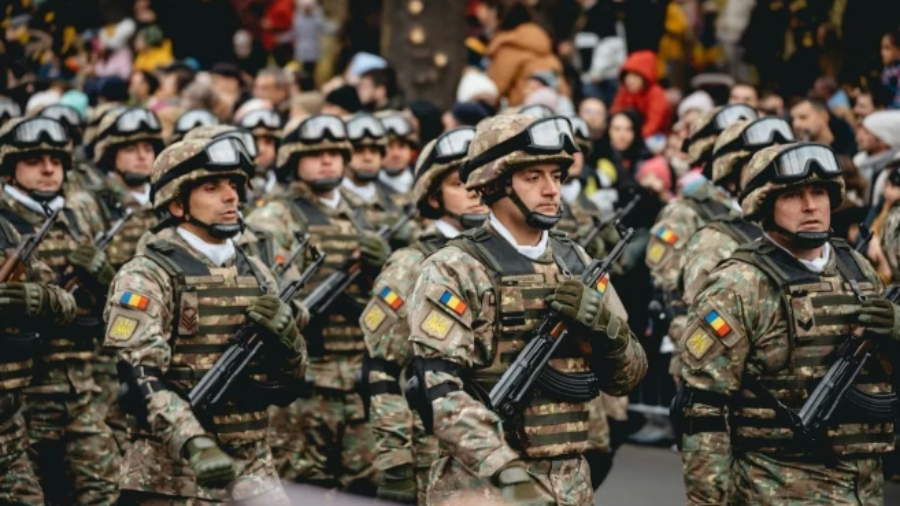
When we talk about coups, political repression, or authoritarian control, we often imagine generals imposing their will over fragile civilian governments. But in reality, the more frequent and subtle danger is the reverse: How Civilian Leaders Manipulate the Military to secure power, silence their opponents, and maintain political dominance.

This dynamic—subtle, strategic, and often invisible—raises profound questions:

  • How do civilian political elites gain such influence over the armed forces?
  • Why do militaries obey orders that clearly harm citizens?
  • Why do some democracies fall into authoritarianism almost overnight?
  • And how do seemingly lawful leaders weaponize national defense structures?

Understanding this phenomenon requires unpacking the complex world of civil–military relations, political incentives, institutional weaknesses, and human psychology.

Let’s take a deep and nuanced journey into how civilian regimes—democratic or authoritarian—manage to manipulate, co-opt, and sometimes corrupt the military into becoming their personal tool for political survival.

Why Militaries Matter: The Foundation of Regime Power

Before exploring how manipulation occurs, we must understand why the military is the ultimate pillar of political power.

In every nation, the military represents:

  • Monopoly of legitimate force
  • National security and territorial integrity
  • The final arbiter in political chaos
  • A symbol of sovereignty

If a civilian leader loses the military, they lose power—sometimes literally overnight.

If they control it, they become nearly untouchable.

This explains why manipulating the military is one of the oldest political strategies in the world, from ancient empires to modern democracies.

The Tools of Manipulation: How Civilian Leaders Gain Control

Below are the six major strategies civilian leaders use to shape, influence, and weaponize the military.

1. Patronage: Buying Loyalty at the Top

Civilian rulers frequently secure military loyalty through patronage networks:

  • Promotions for friendly officers
  • Control of budgets and procurement
  • Access to economic benefits
  • Appointment of “politically safe” generals
  • Special privileges and allowances

This method creates a symbiotic relationship:
The military protects the leader, and the leader rewards the military.

This is common in:

  • Some African states
  • South Asia
  • Parts of the Middle East
  • Latin America during the Cold War

However, patronage also breeds corruption, internal divisions, and weakened institutional professionalism.

2. Institutional Fragmentation: Divide to Rule

Another tool is deliberate fragmentation of security institutions.

Civilian leaders create:

  • multiple intelligence agencies
  • different branches of armed forces
  • overlapping police units
  • private or paramilitary groups loyal to the leader

The purpose is simple:

Divide the security institutions so none can overthrow the regime alone.

Examples include:

  • Competing intelligence agencies in Russia
  • National Guard vs. Military in Venezuela
  • Revolutionary Guards vs. Army in Iran
  • Presidential Guards in several African states

This ensures the military remains loyal, busy, and under control.

3. Legal Manipulation: Hiding Repression Behind Law

Modern authoritarianism rarely looks like dictatorship.
Today, it often wears the cloak of legality.

Civilian leaders pass laws that appear constitutional but serve to:

  • expand emergency powers
  • restrict protest
  • criminalize dissent
  • give the military internal security roles
  • allow warrantless arrests
  • centralize power in the executive

When the law says the military must intervene, that intervention looks “legitimate.”

This blurs the line between defense and repression.

4. Ideology and Narrative Building

Civilian leaders know that soldiers don’t blindly obey—they’re influenced by identity, patriotism, and narrative.

So leaders craft powerful ideological stories to justify their commands:

  • “The opposition is a threat to national unity.”
  • “Protesters are violent extremists.”
  • “We are defending democracy from foreign enemies.”
  • “Critics are agents of foreign powers.”

Once this narrative is embedded:

  • Soldiers believe they are defending the nation,
  • Not repressing their own people.

This psychological manipulation is one of the most effective tools of control.

5. Militarizing Politics: Blurring Roles on Purpose

Some leaders embed the military deeply into civilian governance:

  • appointing military officers as regional administrators
  • involving them in elections
  • giving them economic sectors
  • using them in public works and development

This increases dependence on political leaders while reducing the military’s professional autonomy.

Over time, officers become political actors rather than neutral defenders of the state.

6. Fear of Chaos: The “Stability Argument”

Perhaps the most powerful emotional manipulation is the promise of stability.

Civilian leaders warn:

  • “If you don’t support me, the country will collapse.”
  • “We are the only barrier against civil war.”
  • “Disloyalty will lead to economic collapse.”

This fear-based messaging convinces the military that supporting the leader is supporting national stability.

Thus, repression becomes framed as patriotism.

Why Militaries Comply: Institutional and Human Factors

Understanding manipulation requires also examining why militaries often succumb to civilian influence.

1. The Military’s Hierarchical Culture

Military culture is built on:

  • hierarchy
  • obedience
  • discipline
  • chain of command

This makes challenging civilian orders extremely difficult.

Even when orders conflict with ethics, soldiers and officers may feel bound by duty.

2. Professional Conditioning

Militaries are trained to:

  • neutralize threats
  • maintain order
  • follow instructions
  • prioritize security

When political leaders label civilians as threats, militaries often fall in line.

3. Institutional Dependency

Militaries depend on civilian governments for:

  • budgets
  • equipment
  • salaries
  • welfare
  • compensation
  • legal protection

This dependency creates leverage:
“Support me, and I’ll support you.”

4. Fear of Internal Instability

Military leaders often fear:

  • civil wars
  • chaos
  • insurgencies
  • state collapse

Civilian leaders exploit this fear to secure compliance.

5. The Ambition Factor

Some military elites are ambitious and benefit from aligning with civilian rulers.

They receive:

  • promotions
  • contracts
  • influence
  • access to power

This creates powerful incentives for loyalty.

Case Studies: Comparing Different Regions

Below is a simplified table illustrating how civilian manipulation appears across global contexts:

RegionMethod of ControlOutcome
AfricaPatronage, presidential guards, fragmented forcesStrongman politics, politicized military
Middle EastIdeology, religious legitimacy, elite unitsEnduring authoritarianism
Latin AmericaLegal frameworks, cooptation, economic influenceCycles of democratic erosion
AsiaNarrative control, emergency powers, elite alliancesStrong civilian dominance, weak opposition
Eastern EuropeHybrid regimes, intelligence manipulationMilitarized policing, limited dissent

This demonstrates that civilian manipulation is global—not regional or ideological.

When Manipulation Turns to Repression

Civilian control is not inherently bad.
In democracies, it is necessary for preventing military interference.

But manipulation becomes dangerous when:

  • citizens are treated as enemies
  • dissent is framed as treason
  • the military is used for political survival
  • elections are militarized
  • opposition is crushed violently

Repression typically escalates through five stages:

1. Surveillance of activists and critics

intelligence agencies gather information

2. Restriction of protests

laws limit gatherings and demonstrations

3. Deployment of police forces

initial show of force to intimidate

4. Involvement of military units

framed as a “security operation”

5. Violent crackdowns

justified by “national stability”

At this point, the civilian leader has weaponized the military—often permanently.

Why Citizens Become Targets

The military is supposed to protect citizens.
So why do some regimes turn their guns inward?

Because to an insecure leader:

  • protesters = potential coup
  • journalists = destabilizers
  • opposition = enemy agents
  • civil society = foreign puppets

Manipulation changes the military’s mission from defending the nation to defending the ruler.

Breaking the Cycle: What Can Be Done?

Experts identify four major solutions:

1. Strengthening Institutions

  • independent courts
  • transparent budgets
  • nonpolitical promotion systems
  • strong oversight committees

2. Professionalizing the Military

  • ethics training
  • depoliticized leadership
  • independent military codes
  • civilian–military education programs

3. Clarifying the Military’s Role

Clear constitutions reduce manipulation.

4. Building Public Awareness

When citizens understand civil–military relations, they become harder to deceive or intimidate.

Conclusion: The Battle for the Soul of the State

Understanding How Civilian Leaders Manipulate the Military is critical for any society that values freedom, accountability, and democratic governance. This manipulation is not always obvious—it often begins quietly, legally, and under the guise of “security.”

But once the military becomes a political tool, a nation risks sliding into repression.

And history shows that once repression begins, it rarely ends voluntarily.

Call to Action

What do YOU think?
Do civilian leaders have too much power over the military?
Are citizens adequately protected from political misuse of force?

Share your thoughts below and explore more of our in-depth analyses on governance, political culture, and state institutions.
threats against Trump critics

Who Sends Death Threats After Trump’s Posts? Inside the Chaotic Ecosystem Behind the Threats

Introduction: When a Post Becomes a Weapon

Each time Donald Trump unleashes a verbal barrage on social media—targeting a judge, prosecutor, journalist, election worker, or political critic—a chilling pattern follows: the targeted individual begins receiving death threats.

This phenomenon has repeated so consistently that prosecutors, journalists, intelligence agencies, and researchers now treat it as a predictable social chain reaction.

But the critical questions remain:

  • Who is actually sending these threats?
  • Are these individuals part of an organized network?
  • Are they following instructions—or acting on their own interpretations of Trump’s words?
  • Does Trump himself implicitly fuel the threats without explicitly directing them?
  • What does existing evidence really show?

This investigative-style article explores the phenomenon with depth, nuance, and clarity.

What emerges is a picture not of a secret army or underground gang, but of something more volatile—and arguably more dangerous:
a decentralized, emotionally charged ecosystem of radicalized supporters and online actors who treat Trump’s words as marching orders, even when no orders are given.

1. The Pattern: Trump Speaks, Threats Follow

From the earliest days of Trump’s political life, researchers and intelligence analysts noticed a disturbing trend:

  1. Trump attacks an individual publicly.
  2. His comments get amplified across social media and far-right circles.
  3. Within hours or days, the targeted person receives:
    • Death threats
    • Harassment
    • Doxxing
    • Intimidating phone calls
    • Threats to family members

This pattern has appeared in case after case:

  • Federal Judge Tanya Chutkan
  • Georgia election workers Ruby Freeman & Shaye Moss
  • New York DA Alvin Bragg
  • Fulton County DA Fani Willis
  • Federal Judge Emmet Sullivan
  • Members of Congress who voted for impeachment
  • Journalists Trump labeled “enemy of the people”

In every instance, Trump’s harsh rhetoric preceded the wave of threats—not by weeks, but frequently within hours.

So again:
Who is sending these threats? And why?

2. Law Enforcement’s Findings: No Secret Organization—But a Predictable Ecosystem

The FBI, DHS, and state law enforcement agencies have repeatedly investigated these threats. Their findings are remarkably consistent:

✔ There is no evidence of a Trump-controlled secret group carrying out threats.

No:

  • hit squads
  • covert militias directed by Trump
  • coordinated networks
  • “orders” issued privately
  • direct communication with perpetrators

This is important:
Nothing in legal or intelligence findings suggests Trump personally orchestrates death threats.

However…

✔ The threats almost always come from Trump supporters.

And even more importantly:

✔ The threats spike immediately after Trump targets someone—so reliably that analysts can now predict the pattern.

This leads us to the key concept used by terrorism scholars:

3. Stochastic Terrorism: When Leadership Words Inspire Unpredictable Violence

Experts describe Trump’s rhetorical influence using a term known as stochastic terrorism.

Definition

When a person with a large audience uses hostile, dehumanizing, or inflammatory language, it increases the likelihood that an extremist will commit or attempt violence—yet no direct order is ever given.

This describes the Trump-threat pattern almost perfectly:

  • Trump labels someone “evil,” “corrupt,” “enemy,” or “traitor.”
  • Millions see the message.
  • Any one unstable or radicalized supporter may act violently or send threats.
  • Trump maintains distance from responsibility because he never explicitly commands violence.

This is not a conspiracy theory—it’s a documented behavioral chain observed repeatedly.

Trump is not coordinating attackers.
But he is inspiring them—predictably, consistently, and powerfully.

4. Who Sends the Threats? A Deep Dive into the Types of Perpetrators

From investigative reports, arrests, court transcripts, and threat analyses, four distinct groups emerge:

Group 1: Lone-Wolf Extremists

These individuals are:

  • Deeply loyal to Trump
  • Often politically obsessed
  • Consuming extremist content daily
  • Isolated, angry, or unstable
  • Acting without direction
  • Convinced they are “protecting America”

They represent the largest category by far.

Examples include the man who sent threats to Judge Chutkan after Trump criticized her, or the individuals who sent death threats to election workers after Trump’s allegations.

These people are not part of any organized network.
They are radicalized individuals acting on emotion and ideology.

Group 2: Online-Radicalized Supporters

These are people radicalized within digital spaces such as:

  • Telegram channels
  • Gab
  • Truth Social
  • 4chan / 8kun
  • Discord groups
  • Far-right Twitter/X communities

These communities:

  • Amplify Trump’s posts
  • Add inflammatory commentary
  • Share personal details of targets
  • Encourage members to “do something”

The threats emerge from this online radicalization loop.

Group 3: Ideological Fringe Groups

These include:

  • White nationalist groups
  • Militia-style organizations
  • Extremist online collectives
  • Sovereign citizen adherents
  • Conspiracy-oriented groups (QAnon, etc.)

These groups sometimes praise Trump and use his messages as ideological fuel, even though there is no operational connection to Trump himself.

They act opportunistically, using Trump’s rhetoric to justify harassment or intimidation.

Group 4: Hyperactive MAGA Media Personalities

This category is less about direct threats and more about incitement amplification.

Certain MAGA influencers:

  • Repost Trump’s attacks
  • Add aggressive commentary
  • Name targets repeatedly
  • Encourage followers to “hold them accountable”
  • Create content demonizing the targeted individuals

This group acts like an accelerant, pushing Trump’s rhetoric into more extreme online spaces where threats become more likely.

5. What Investigations Have Not Found

To avoid misinformation, it is crucial to state clearly:

✔ No evidence shows that Trump personally directs threats.

✔ No private Trump-owned networks conducting harassment have been found.

✔ No organized “Trump intimidation unit” exists.

The threats come not from coordinated orders, but from decentralized, self-motivated actors interpreting Trump’s rhetoric as a signal.

6. Why Trump’s Supporters Interpret His Words as Commands

Researchers highlight four psychological and social dynamics:

1. Parasocial loyalty

Millions of Americans feel a deep emotional connection to Trump, despite having never met him.
In their minds:

Attacking Trump’s enemies = defending someone they love or trust.

2. Moral framing

When Trump describes opponents as:

  • “traitors”
  • “enemies”
  • “vermin”
  • “illegitimate”
  • “destroying America”

he places them outside normal political disagreement.
Some supporters perceive this as permission for extreme action.

3. Conspiracy ecosystems

Online echoes of Trump’s comments blend with conspiratorial beliefs, magnifying fear and anger.

A Trump post → a conspiracy video → a Telegram group → a doxxing thread → a death threat
This chain can happen within hours.

4. The promise of heroic action

Some supporters view themselves as warriors or patriots fulfilling a historic mission.

This mentality fuels impulsive, violent messaging.

7. Do Trump’s Words Cause the Threats? A Closer Look

Legally, causation is extremely difficult to prove.
But behaviorally, researchers see a clear pattern:

  • Trump attacks → threats rise
  • Trump stops posting → threats decline
  • Trump attacks again → threats spike again

The relationship is not coincidental.

Even without coordination, Trump’s rhetoric acts as an activation trigger in a radicalized environment.

This is why national security agencies consider Trump’s language a driver of risk—even when Trump personally breaks no laws.

8. Key Case Studies: Threats After Trump’s Posts

Case 1: Ruby Freeman & Shaye Moss

After Trump falsely accused them of rigging votes, the two election workers:

  • Received death threats
  • Were stalked
  • Were harassed at home
  • Had to flee for safety

Investigators traced the threats to Trump supporters radicalized online, not to any organized group.

Case 2: Judge Chutkan

After Trump criticized her, a Trump supporter from Texas was arrested for sending explicit death threats. She acted alone.

Case 3: Prosecutors Willis & Bragg

Threats skyrocketed immediately after Trump attacked them by name.
Arrests reveal individuals acting independently.

9. Why Trump Doesn’t Need a Secret Network

A secret network would require:

  • organization
  • planning
  • communication
  • coordination
  • secrecy

But Trump has something far more powerful:

A massive audience primed to defend him emotionally and ideologically.

This audience acts without being told.

The threats are not centrally controlled—it’s a chaotic, emergent phenomenon created by:

  • rhetoric
  • loyalty
  • ideology
  • online radicalization
  • conspiracy culture
  • parasocial devotion

This combination makes the reaction to Trump’s words more potent than a directed network could ever be.

10. The Danger: Decentralized Threat Ecosystems Are Harder to Control

A coordinated organization can be dismantled.
Leaders can be arrested.
Networks can be disrupted.

But Trump’s threat ecosystem is:

  • decentralized
  • spontaneous
  • anonymous
  • global
  • unpredictable
  • psychologically motivated
  • ideologically energized
  • socially reinforced

This makes it exceptionally difficult for law enforcement to prevent or contain.

A single post can reach:

  • tens of millions instantly
  • extremists globally
  • unstable individuals
  • conspiracy-driven communities

No order needed.
No organization required.

11. So Who Sends the Threats? The Final Answer

Based on what is known:

✔ Trump does NOT have a secret hit squad or intimidation network.

✔ Trump does NOT directly instruct supporters to issue threats.

✔ But the threats DO come overwhelmingly from radicalized Trump supporters.

✔ And these threats are triggered—repeatedly and predictably—by Trump’s rhetoric.

The real story is not hidden—it is in plain sight:

Trump’s language activates a decentralized ecosystem of supporters, extremists, and online actors who believe they are defending him, punishing his enemies, or fighting for their shared worldview.

This is what makes the phenomenon so dangerous:

Trump doesn’t need to tell anyone to send threats—they do it automatically.

Conclusion: The Power and Peril of Influential Speech

The rise in threats against Trump’s critics is not the result of a shadow organization—it is the predictable byproduct of a polarizing political figure whose words carry profound emotional weight among millions.

Whether Trump intends these consequences is debatable.
Whether he causes them directly is legally unproven.

But whether his words inspire them?

That is undeniable.

Trump possesses a uniquely reactive audience, primed to act—even violently—when he frames someone as an enemy.
The danger lies not in secret coordination, but in the raw emotional power he holds over his most extreme followers.

In the end, the threats are not evidence of organization—they are evidence of influence.

And influence, in politics, can be every bit as dangerous as orders.

AI-Driven Disinformation Campaigns

The Forces Behind the Onslaught of AI-Driven Disinformation Campaigns: Who Really Benefits?

Introduction: The Ghost in the Machine

Imagine waking up to a world where any voice on the internet—television, social media, news websites—can be manufactured with perfect realism. Not just a deepfake video or a synthetic voice, but whole news sites, bot armies, and even digital operatives generated and controlled by artificial intelligence.

This is not science fiction. Welcome to the new reality of AI-Driven Disinformation Campaigns.

AI is no longer just a technological marvel; it’s becoming a geopolitical weapon. Nations, private operators, and cyber-mercenary firms are leveraging generative AI to produce convincing propaganda, influence elections, and destabilize democracies — all at a scale and speed previously unimaginable.

This investigative article dives into the forces fueling this new wave of disinformation, looks at who profits from it, and explores what this means for global power dynamics. If you believe that disinformation was bad before — think again.

What Makes AI-Driven Disinformation Different—and More Dangerous

To understand the threat, we need to first clarify what sets AI-generated disinformation apart from older propaganda:

  1. Scale & Speed
    Generative AI can produce thousands of articles, tweets, images, and even audio clips in minutes. According to a Frontiers research paper, the number of AI-written fake-news sites grew more than tenfold in just a year. (Frontiers)
  2. Believability
    Deepfake capabilities now include not just video, but lifelike voice cloning. A European Parliament report notes a 118% increase in deepfake use in 2024 alone, especially in voice-based AI scams. (European Parliament)
  3. Automation of Influence Operations
    Disinformation actors are automating entire influence campaigns. Rather than a handful of human propagandists, AI helps deploy bot networks, write narratives, and tailor messages in real time. As PISM’s analysis shows, actors are already using generative models to coordinate bot networks and mass-distribute content. (Pism)
  4. Lower Risk, Higher Access
    AI lowers the bar for influence operations. State and non-state actors alike can rent “Disinformation-as-a-Service” (DaaS) models, making it cheap and efficient to launch campaigns.

Who’s Behind the Campaigns — The Key Players

Understanding who benefits from these campaigns is critical. Below are the main actors driving AI-powered disinformation — and their motivations.

Authoritarian States & Strategic Rivals

  • Russia: Long a pioneer in influence operations, Russia is now using AI to scale its propaganda. In Ukraine and Western Europe, Russian-linked operations such as the “Doppelgänger” campaign mimic real media outlets using cloned websites to spread pro-Kremlin narratives. (Wikipedia)
  • China: Through campaigns like “Spamouflage,” China’s state-linked networks use AI-generated social media accounts to promote narratives favorable to Beijing and harass dissidents abroad. (Wikipedia)
  • Multipolar Cooperation: According to Global Influence Ops reporting, China and Russia are increasingly cooperating in AI disinformation operations that target Western democracies — sharing tools, tech, and narratives. (GIOR)

These states benefit strategically: AI enables scaled, deniable information warfare that can sway public opinion, weaken rival democracies, and shift geopolitical power.

Private Actors & Cyber-Mercenaries

  • Team Jorge: This Israeli cyber-espionage firm has been exposed as running disinformation campaigns alongside hacking and influence operations, including dozens of election manipulation efforts. (Wikipedia)
  • Storm Propaganda Networks: Recordings and research have identified Russian-linked “Storm” groups (like Storm-1516) using AI-generated articles and websites to flood the web with propaganda. (Wikipedia)
  • Pravda Network: A pro-Russian network publishing millions of pro-Kremlin articles yearly, designed to influence training datasets for large language models (LLMs) and steer AI-generated text. (Wikipedia)

These actors make money through contracts, influence campaigns, and bespoke “bot farms” for hire — turning disinformation into a business.

Emerging Threat Vectors and Campaign Styles

AI-driven disinformation isn’t one-size-fits-all. Here are the ways it’s being used today:

Electoral Manipulation

  • Africa: According to German broadcaster DW, AI disinformation is already being used to target election processes in several African nations, undermining trust in electoral authorities. (Deutsche Welle)
  • South America: A report by ResearchAndMarkets predicts a 350–550% increase in AI-driven disinformation by 2026, particularly aimed at social movements, economic policies, and election integrity. (GlobeNewswire)
  • State-Sponsored Influence: Russian and Iranian agencies have allegedly used AI to produce election-related disinformation, prompting U.S. sanctions on groups involved in such operations. (The Verge)

Deepfake Propaganda and Voice Attacks

  • Olympics Deepfake: Microsoft uncovered a campaign featuring a deepfake Tom Cruise video, allegedly produced by a Russia-linked group, to undermine the Paris 2024 Olympics. (The Guardian)
  • Voice Cloning and “Vishing”: Audio deepfakes are now used to impersonate individuals in voice phishing attacks, something the EU Parliament warns is on the rise. (European Parliament)

Training Data Poisoning

Bad actors are intentionally injecting false or extreme content into training datasets for LLMs. These “prompt-injection” or data poisoning attacks aim to subtly twist model outputs, making them more sympathetic to contentious or extreme narratives. (Pism)

H3: Bot Networks & AI-Troll Farms

AI enables the creation of highly scalable, semi-autonomous bot networks. These accounts can generate mass content, interact with real users, and amplify narratives in highly coordinated ways — essentially creating digital echo chambers and artificial viral campaigns.

Who Benefits — And What Are the Risks?

Strategic Advantages for Authoritarian Regimes

  • Plausible Deniability: AI campaign operations can be launched via synthetic accounts, making attribution difficult.
  • Scalable Influence: With AI content generation, propaganda becomes cheap and scalable.
  • Disruptive Power: Democracies become destabilized not by traditional military power but by information warfare that erodes trust.

Profits For Cyber-Mercenaries

Disinformation-as-a-Service (DaaS) firms are likely to be among the biggest winners. These outfits can deploy AI-powered influence operations for governments or commercial clients, charging for strategy, reach, and impact.

Technology Firms’ Double-Edged Role

AI companies are in a precarious position. Their tools are being used for manipulation — but they also build detection systems.

  • Cyabra, for example, provides AI-powered platforms to detect malicious deepfakes or bot-driven narratives. (Wikipedia)
  • Public and private pressure is growing for AI companies to label synthetic content, restrict certain uses, and build models that resist misuse.

Danger to Democracy and Civil Society

  • Erosion of Trust: When citizens can’t trust what they see and hear, institutional legitimacy collapses.
  • Polarization: AI disinformation exacerbates social divisions by hyper-targeting narratives to groups.
  • Manipulation of Marginalized Communities: In regions with weaker media literacy, AI propaganda can have disproportionate effects.

Global Responses and the Road to Resilience

How are governments, institutions, and societies responding — and what should be done?

Policy and Regulation

  • The EU is tightening rules on AI via the AI Act, alongside the Digital Services Act to require transparency and oversight. (Pism)
  • At a 2025 summit, global leaders emphasized the need for international cooperation to regulate AI espionage and disinformation. (DISA)

Tech Countermeasures

  • Develop “content provenance” systems: tools that can reliably detect whether content is AI-generated.
  • Deploy counter-LLMs: AI models that specialize in detecting malicious synthetic media.
  • Use threat intelligence frameworks like FakeCTI, which extract structured indicators from narrative campaigns, making attribution and response more efficient. (arXiv)

Civil Society Action

  • Increase media literacy: Citizens must understand not just what they consume, but who created it.
  • Fund independent fact-checking: Especially in vulnerable regions, real-time verification can beat synthetic content.
  • Support cross-border alliances: Democracy-defense coalitions must monitor and respond to AI influence ops globally.

Conclusion: A New Age of Influence Warfare

We are witnessing the dawn of a new kind of geopolitical contest — not fought in battlegrounds or missile silos, but online, in the heart of information networks.

AI-Driven Disinformation Campaigns represent a paradigm shift:

  • Actors can produce content at scale with unprecedented realism.
  • Influence operations can be automated and highly targeted.
  • Democratic institutions face a stealthy, potent threat from synthetic narratives.

State actors, cyber firms, and opportunistic mercenaries all have a stake — but it’s often the global citizen and the integrity of democracy that pays the highest price.

AI is a tool — and like all tools, its impact depends on who wields it, and how.

Call to Action

  • Share this post with your network: help raise awareness about these hidden AI risks.
  • Stay informed: follow institutions working on AI policy, fact-checking, and digital resilience.
  • Support regulation: advocate for meaningful, global standards on AI to prevent its abuse in disinformation.
  • Educate others: host or join community events, online webinars, and local discussions about media literacy and AI.

The fight for truth in the age of AI is just beginning — and everyone has a part to play.

References

  1. Cyber.gc.ca report on generative AI polluting information ecosystems (Canadian Centre for Cyber Security)
  2. PISM analysis of disinformation actors using AI (Pism)
  3. World Economic Forum commentary on deepfakes (World Economic Forum)
  4. KAS study on AI-generated disinformation in Europe & Africa (Konrad Adenauer Stiftung)
  5. NATO-cyber summit coverage on AI disinformation (DISA)
  6. AI Disinformation & Security Report 2025 (USA projections) (GlobeNewswire)
  7. Global Disinformation Threats in South America report (GlobeNewswire)
  8. Ukraine-focused hybrid-warfare analysis on AI’s role in Kremlin disinformation (Friedrich Ebert Stiftung Library)
  9. Academic research on automated influence ops using LLMs (arXiv)
  10. Cyber threat intelligence using LLMs (FakeCTI) (arXiv)
Birtherism Conspiracy theory

The “Birtherism Conspiracy theory”: Donald Trump as Its Loudest and Shameless Megaphone

Introduction: When a Fringe Lie Became a Political Weapon

Every conspiracy theory has an origin story. Some fade quietly. Others ignite a spark and die out.
But then there are those rare ones—like the Birtherism Conspiracy theory—that mutate into powerful political machines when the right messenger picks up the megaphone.

And no one embraced, amplified, and weaponized Birtherism more aggressively than Donald J. Trump.

Before 2011, Birtherism was little more than a fringe rumor circulating on obscure blogs and forwarded email chains. Yet, by the time Trump was done with it, the conspiracy had shaped national discourse, influenced presidential politics, and opened a dark new chapter in America’s relationship with truth.

This post takes you on a deep, meticulously researched exploration of:

  • how Trump became the face of Birtherism
  • why the conspiracy resonated with millions
  • the racial, cultural, and political dynamics that fueled its rise
  • and how it foreshadowed the disinformation ecosystem we live in today

Let’s dig in.

What Exactly Was the Birtherism Conspiracy Theory? A Brief Refresher

Put simply, Birtherism was the false claim that Barack Obama was not born in the United States, and thus was constitutionally ineligible to be president.

Despite Obama releasing his short-form birth certificate in 2008, and later his long-form version in 2011, the conspiracy persisted for years. Why?
Because Birtherism was never truly about documents—it was about identity.

It challenged the legitimacy of the first Black president not on the basis of policy, but on the basis of belonging.

How Birtherism Started—And Why It Was Ripe for Hijacking

Birtherism didn’t begin with Trump. Initial murmurs emerged during the 2008 Democratic primaries, mostly from fringe Hillary Clinton supporters. But these were small fires, easily containable.

The conspiracy lacked:

  • a national voice
  • media amplification
  • a charismatic promoter
  • a platform large enough to push it mainstream

In other words—it needed someone like Trump.

Donald Trump Enters the Arena: How the Conspiracy Found Its Champion

A Celebrity in Search of Relevance

By 2011, Trump was known more for The Apprentice than for serious political engagement. Yet he wanted something deeper: relevance, power, a seat at the national table.

Birtherism was his gateway.

Trump began:

  • calling in to TV interviews
  • posting provocative tweets
  • demanding Obama “prove” his citizenship
  • implying he had private investigators “on the ground in Hawaii”
  • repeatedly insisting that “people are saying” shocking new details

Trump wasn’t fact-finding. He was experimenting with what would later define his political brand:

  • repetition
  • spectacle
  • manufactured controversy
  • the illusion of insider knowledge
  • media manipulation

Birtherism worked because Trump knew one simple truth:
A controversy doesn’t need evidence—only attention.

The Media’s Role: How They Fell for Trump’s Game

Birtherism exploded when major networks—CNN, NBC, Fox News—began inviting Trump onto their platforms under the guise of political commentary.

The result?

Trump turned breakfast-hour TV into a launchpad for the conspiracy.
He had:

  • free media coverage
  • millions of curious viewers
  • no fact-checking boundaries
  • an endless supply of provocative soundbites

Newsrooms treated the conspiracy as political theater, not disinformation. Ratings surged. Trump’s visibility soared. Birtherism became mainstreamed.

This moment marked a cultural shift:
America’s political conversation became a reality show, with Trump writing the script.

A Racialized Conspiracy: Why Birtherism Was Never Just About Birth Certificates

One reason Birtherism stuck is because it exploited long-standing racial anxieties in America.

Trump didn’t invent racialized doubt—but he understood how to weaponize it.

The conspiracy fed into:

  • xenophobic fears
  • stereotypes about African nations
  • discomfort with a Black man in the White House
  • the notion that Obama was “other,” “foreign,” “un-American”

Trump leaned into these sentiments with precision.

By repeatedly calling Obama’s citizenship into question, he wasn’t just spreading misinformation—
he was attacking the legitimacy of Black leadership in America.

Birtherism became a dog whistle wrapped in a question:
“Where is he really from?”

Why People Believed It: Understanding the Psychology Behind the Lie

Birtherism succeeded not because the evidence was compelling, but because the human mind is vulnerable to certain psychological triggers.

1. Confirmation Bias

People predisposed to distrust Obama saw Birtherism as validation of their fears.

2. Repetition Effect

The more Trump repeated it, the more “true” it felt—regardless of evidence.

3. Identity Protection

For some, believing the conspiracy resolved cognitive dissonance:
“How could a country elect someone who doesn’t look like our past presidents?”

4. Mistrust of Institutions

Doubting Obama was easier for many than trusting:

  • the media
  • the government
  • the Democratic Party

Trump leveraged all these psychological levers expertly—long before political analysts recognized what was happening.

Trump vs. Reality: The Moment Obama Released the Long-Form Birth Certificate

When Obama finally released his long-form birth certificate in April 2011, the media expected the conspiracy to die.

Instead, something fascinating happened:

  • Trump took a victory lap, claiming he had “forced” Obama’s hand
  • Support for Birtherism actually remained strong among conservatives
  • Public trust in Obama’s legitimacy barely shifted

This proved something profound:
Birtherism was never meant to be solved. It was meant to be sustained.

Trump wasn’t debunked—he was rewarded.

A Look at the Data: Birtherism by the Numbers

Here’s a simplified visual showing how belief in the conspiracy shifted:

YearPercentage of Republicans Who Believed Obama Was Not Born in the U.S.
2009~17%
2010~31%
2011 (Trump peak)43%–51%
2016 (Trump campaign)72% believed Obama was born abroad or were “not sure”

The more Trump amplified it, the more people believed it.

How Birtherism Became Trump’s Political Springboard

Birtherism didn’t just elevate Trump—it prepared his future base.

1. It positioned Trump as a political outsider

Someone willing to say “what others won’t.”

2. It tested his influence on conservative voters

The results? Overwhelming.

3. It built a movement grounded in grievance, identity, and distrust

These ingredients later fueled:

  • anti-immigrant rhetoric
  • attacks on the press
  • “fake news” culture
  • Stop the Steal narratives
  • January 6 disinformation

Birtherism was the prototype for Trumpism.

The 2016 Pivot: Trump Finally Admits the Truth—But Only Halfway

In 2016—five years after igniting the conspiracy—Trump finally stated:
“President Obama was born in the United States. Period.”

But even then, he:

  • refused responsibility
  • blamed Hillary Clinton (falsely)
  • used the admission as a political stunt
  • offered no apology

For Trump, retracting Birtherism wasn’t an act of honesty—it was a strategy shift.

The conspiracy had served its purpose.
A new target awaited: Hillary Clinton.

Key Insights: What Birtherism Reveals About Modern American Politics

1. Conspiracies thrive when reality is optional

For millions, belief had nothing to do with documents—only loyalty and identity.

2. Racism adapts to new languages

Birtherism offered a “respectable” vehicle for racialized doubt.

3. Media ecosystems reward spectacle over truth

Trump understood this better than any politician in generations.

4. Disinformation is powerful because it is emotional

Birtherism wasn’t just a lie—it was a narrative.

5. The conspiracy prepared the ground for future democratic erosion

Everything from COVID denialism to election lies traces its lineage to Birtherism.

Conclusion: Trump Didn’t Just Promote Birtherism—He Perfected a Political Blueprint

The Birtherism Conspiracy theory wasn’t just a smear campaign against Barack Obama.
It was the birth of a political era defined by:

  • emotional manipulation
  • racialized disinformation
  • media spectacle
  • truth decay
  • political identity wars

Trump didn’t invent the lie.
He industrialized it.

And America is still living with the consequences.

Call to Action

If you found this deep-dive insightful:
✔️ Share your thoughts in the comments — where do you think Birtherism ranks among the most damaging political conspiracies?
✔️ Explore more articles on political disinformation, Trumpism, and democratic resilience.
✔️ Subscribe to stay updated on new analyses and long-form essays.

Trump Tariffs and Turbulence

Trump, Tariffs, and Turbulence: The Unconventional Strategy That Redefined Political Playbooks

Introduction: A Presidency Built on Trade Shockwaves

Few aspects of Donald Trump’s presidency stirred as much controversy, confusion, and global attention as his aggressive use of tariffs. From steel and aluminum to Chinese imports, Trump wielded trade policy as if it were a universal tool—a blunt instrument meant to achieve multiple political objectives at once.

This strategy, emblematic of Trump, Tariffs, and Turbulence, redefined conventional political playbooks. By fusing economic nationalism with political messaging, tariffs became more than a trade mechanism—they became a symbol of disruption, loyalty, and power projection.

Understanding this legacy is critical, not just for analyzing the Trump era, but for appreciating the profound impact it had on global commerce, domestic politics, and the perception of America on the world stage.

The Philosophy Behind Trump’s Tariff Strategy

Tariffs as a Political Hammer

Unlike traditional trade tools aimed at addressing specific economic imbalances, Trump treated tariffs as a multi-purpose strategy:

  • Political Signaling: Showcasing toughness on foreign powers, particularly China, to appeal to nationalist sentiments
  • Economic Leverage: Pressuring trade partners into renegotiating agreements (e.g., USMCA)
  • Domestic Messaging: Positioning himself as the defender of American workers against “unfair” global competition

This approach transformed a conventional economic tool into a political weapon, merging economic theory with populist messaging. (source)

Disruptive Politics as a Core Tactic

Trump’s reliance on tariffs illustrates his broader political philosophy: disruption is power. By creating unpredictability in trade policy, he sought to:

  • Keep political and economic adversaries off balance
  • Dominate media narratives through controversy
  • Consolidate domestic support among industrial workers affected by globalization

The result was a political climate defined as much by shock and spectacle as by policy outcomes.

Key Tariff Battles and Their Impact

Steel and Aluminum Tariffs

In 2018, Trump imposed a 25% tariff on steel and 10% on aluminum imports from major allies, including Canada, the EU, and Mexico. (source)

  • Goal: Protect domestic industries from “unfair competition”
  • Impact:
    • Short-term gains for U.S. steel producers
    • Strained trade relations with allies
    • Retaliatory tariffs on American goods

While politically popular in certain U.S. states, these tariffs sparked global concern and demonstrated the collateral effects of unilateral trade actions.

The China Trade War

Trump’s tariffs on Chinese imports were the most consequential:

  • Scope: $360 billion in tariffs on Chinese goods
  • Objective: Force China to change trade practices, including intellectual property theft and forced technology transfers
  • Outcome:
    • Temporary trade deals and partial concessions
    • Increased costs for American businesses and consumers
    • Global supply chain disruptions

The China tariffs epitomized the turbulence of Trump’s economic strategy, blending geopolitics with domestic politics. (source)

Tariffs as Campaign Tools

Tariffs also functioned as messaging devices in election cycles:

  • Highlighted Trump’s “America First” ideology
  • Reinforced his image as a disruptor fighting unfair trade practices
  • Served as a tangible action to appease industrial and working-class voters

This dual role of tariffs—policy and political performance—reinforced Trump’s unorthodox approach.

Economic Consequences of Trump’s Tariff Strategy

Winners and Losers

Tariffs produced uneven outcomes:

  • Winners: Domestic steel producers, some agricultural sectors during temporary government support
  • Losers: Automakers, manufacturers reliant on global supply chains, and consumers facing higher prices

The strategy revealed the limits of using trade policy as a catch-all political tool.

Global Supply Chain Disruptions

Trump’s tariffs caused significant global disruptions:

  • Shifts in manufacturing hubs to avoid tariffs
  • Increased costs for multinational corporations
  • Uncertainty in markets, affecting investment and growth

This turbulence illustrated the interconnectedness of modern economies and the risks of unilateral action.

Table: Selected Tariff Impacts Under Trump

Tariff TargetObjectiveEconomic OutcomePolitical Outcome
Steel & AluminumProtect domestic producersHigher domestic prices, global tensionPopular in Rust Belt states
Chinese GoodsForce trade concessionsSupply chain disruption, higher costsReinforced nationalist messaging
Solar Panels & Washing MachinesProtect U.S. manufacturersIncreased consumer prices, limited job growthShort-term political wins
EU ImportsRetaliation for subsidiesDiplomatic tension, threat of trade warMedia attention, tough-guy image

Tariffs and the Media Spectacle

Trump’s approach to trade policy was inseparable from his mastery of media:

  • Frequent tweets amplified trade disputes
  • Controversy generated coverage that shaped public perception
  • Tariffs became a tool of narrative control, not just economics

In this sense, Trump, Tariffs, and Turbulence exemplify a strategy where policy is performance.

Critics and Supporters Weigh In

Criticism

  • Economists argue tariffs increase costs for consumers and reduce competitiveness
  • Trade partners saw tariffs as protectionist and destabilizing
  • Global markets experienced uncertainty, affecting investment

Support

  • Populist voters viewed tariffs as defending American jobs
  • Industrial states benefiting from higher prices and restricted competition rewarded Trump politically
  • Symbolically, tariffs reinforced the “America First” narrative

This contrast underscores the tension between short-term political gains and long-term economic costs.

Tariffs as a Political Playbook Re-definer

Trump’s approach changed how political actors view trade:

  1. Blurring Policy and Politics: Economic tools became messaging devices.
  2. Disruption as Strategy: Predictable trade diplomacy was replaced by unpredictability.
  3. Populism Meets Economics: Policies were tailored to appeal to emotion and identity, not just markets.

This redefinition of political playbooks will influence how future politicians engage with trade, media, and domestic constituencies.

Lessons for Future Governance

The Limits of Tariffs

  • Tariffs cannot replace comprehensive trade policy
  • Unilateral action risks global retaliation
  • Short-term political messaging may come at long-term economic costs

Strategic Communication

  • Policy effectiveness is intertwined with perception management
  • Media narratives can amplify or distort policy outcomes

Balancing Politics and Economics

  • Leaders must weigh domestic political benefits against global economic realities
  • Disruption can mobilize support but may destabilize markets and alliances

Conclusion: Trump, Tariffs, and Turbulence

Trump’s tariff strategy represents a unique blend of economics, politics, and spectacle. Trump, Tariffs, and Turbulence not only disrupted global trade but reshaped domestic political strategy, showing how a single policy tool can be leveraged as a multi-purpose weapon—economic, political, and psychological.

The era serves as a cautionary tale for policymakers: disruption may yield short-term victories, but it comes with long-term consequences for economies, alliances, and governance norms. Future leaders must balance bold action with careful strategy, or risk repeating the turbulence of the Trump years.

Call to Action

  • Stay informed: Monitor trade policies and their impacts
  • Engage civically: Understand how economic decisions affect daily life
  • Share insights: Discuss this post with peers to explore the implications of unconventional political strategies

References & Further Reading

  1. Council on Foreign Relations, Trump Tariffs and the US-China Trade War. (cfr.org)
  2. BBC News, Trump Steel and Aluminum Tariffs. (bbc.com)
  3. Peterson Institute for International Economics, Trade War Analysis. (piie.com)
  4. CNBC, Tariffs and Economic Impact on U.S. Consumers. (cnbc.com)
  5. Forbes, How Trump’s Tariffs Reshaped Political Strategy. (forbes.com)
trumpism-and-the-maga-cult

The American Undoing: Trumpism and the Cult That Captured a Nation

Introduction: The Rise of a Political Cult

The United States has long prided itself on democracy, debate, and the peaceful transfer of power. Yet, over the past decade, a powerful political phenomenon has emerged that threatens these pillars: Trumpism and the MAGA cult.

This movement goes beyond political ideology. It is a culture built on loyalty to a single personality, fueled by misinformation, grievance politics, and a fervent sense of identity. Trump’s rise did not create this movement—it captured and amplified deep-seated cultural anxieties, turning them into a political force that dominates contemporary American politics.

Understanding this phenomenon is not optional. It is essential to comprehending how American democracy can be manipulated, reshaped, and, at times, threatened from within.

What is Trumpism?

Trumpism is more than a political philosophy; it is a hybrid of populism, nationalism, and authoritarian tendencies, centered around loyalty to Donald J. Trump.

Core Features of Trumpism

  • Personality-Centric Politics: The movement revolves around Trump’s persona rather than policy.
  • Anti-Establishment Rhetoric: Institutions, experts, and long-standing political norms are portrayed as enemies.
  • Grievance Politics: Appeals to cultural, economic, and racial anxieties motivate the base.
  • Conspiratorial Thinking: Misinformation and conspiracies reinforce belief systems and loyalty.
  • Authoritarian Impulses: Norms are subverted to maintain power and control dissent.

Trumpism is not confined to Republican voters. It has influenced media, social networks, and even political discourse globally, reshaping norms and redefining the boundaries of political acceptability. (source)

The MAGA Cult: Loyalty Over Ideology

The MAGA movement is the social and psychological manifestation of Trumpism. Unlike traditional political movements, it operates more like a cult, demanding allegiance to the leader over ideology, facts, or ethical considerations.

Cult Dynamics in Politics

  • Unquestioning Loyalty: Members often defend Trump regardless of evidence or truth.
  • Demonization of Outsiders: Critics, including moderate Republicans, media, and institutions, are framed as existential threats.
  • Emotional Manipulation: Fear, anger, and grievance drive engagement and mobilization.
  • Symbolic Rituals: Slogans, rallies, and merchandise reinforce identity and belonging.

These dynamics explain why many followers remain committed even after public controversies or legal challenges, demonstrating the psychological depth of the movement. (source)


Lies and Misinformation as Glue

One of the most potent tools of the MAGA cult is misinformation. Repeated falsehoods create an alternate reality, eroding the shared factual foundation necessary for democracy.

Weaponizing Falsehoods

  • Election Fraud Claims: The 2020 election lies undermined public trust in democracy.
  • COVID-19 Misinformation: Promoting unproven treatments and downplaying risks endangered public health.
  • Media Vilification: Labeling credible sources as “fake news” delegitimizes independent oversight.

The repetition of these narratives fosters cognitive loyalty, conditioning followers to accept misinformation as truth. (source)

Table: Traditional Political Movements vs. Trumpism/MAGA Cult

Traditional MovementsTrumpism/MAGA Cult
Policy-driven debatePersonality-driven loyalty
Respect for institutionsAttacks on judiciary, media, and Congress
Fact-based discourseMisinformation and conspiracy acceptance
Democratic normsAuthoritarian impulses and norm subversion
Civil discoursePolarization and demonization of opponents
Collective civic responsibilityGrievance-driven identity politics

Racism and Cultural Division

Racism and nativism are core drivers of the MAGA cult, not just incidental features. Trumpism leverages identity politics to solidify loyalty.

Policy and Rhetoric

  • Immigration Bans: Policies disproportionately targeting Muslim-majority nations (source)
  • Border Enforcement: Aggressive deportation policies fueling cultural anxieties
  • Racialized Messaging: Repeatedly framing minorities or immigrants as threats

These tactics cultivate fear and resentment, creating a sense of shared struggle among followers, which reinforces group cohesion.

Authoritarian Tendencies and Power Consolidation

Trumpism demonstrates hallmark authoritarian strategies: centralizing power, subverting norms, and punishing dissent.

Examples of Authoritarian Governance

  • Politicizing the Department of Justice and intelligence agencies
  • Overreliance on executive orders bypassing legislative checks
  • Public threats to and marginalization of political opponents

This approach destabilizes democratic institutions and creates a culture of obedience rather than debate. (source)

Conspiracy Theories and the MAGA Psyche

Conspiratorial thinking is not just tolerated—it is amplified. From QAnon to election “stolen” narratives, these conspiracies provide the MAGA cult with an internal logic that justifies extreme loyalty and delegitimizes dissent.

Political and Social Impact

  • Reinforcement of group identity
  • Polarization of public opinion
  • Justification for political violence, exemplified by January 6th (source)

Without the conspiratorial scaffolding, the cult loses its cohesion and purpose.

Why Trumpism Persisted Despite Controversies

Even after scandals, impeachment proceedings, and electoral defeat, Trumpism endures. Key reasons include:

  • Emotional Loyalty: Personal identity is tied to support for Trump
  • Information Control: Echo chambers reinforce beliefs
  • Fear of “Other”: Cultural, racial, and political threats strengthen group cohesion
  • Punishment of Dissent: Political marginalization of those who oppose Trump consolidates base loyalty

This resilience illustrates that Trumpism is not simply political—it is social, psychological, and cultural.

Consequences for American Democracy

Erosion of Trust

  • Reduced faith in elections, courts, and media
  • Increased polarization and partisanship

Threats to Institutions

  • Politicization of independent agencies
  • Normalization of executive overreach

Societal Division

  • Deepening racial and cultural divides
  • Tribalism replacing civic engagement

The implications are long-term, affecting governance, social cohesion, and the ability to respond to national crises effectively.

Visual Suggestions:

  • Infographic: “The Anatomy of the MAGA Cult” (showing lies, loyalty, conspiracies, and identity politics)
  • Timeline: Key events in Trumpism and MAGA cult formation (2015–2025)

Lessons and the Path Forward

Rebuilding Democratic Norms

  • Protect judicial independence
  • Strengthen electoral systems and oversight
  • Promote civic education and critical media literacy

Combating Misinformation

  • Support independent fact-checking
  • Encourage media accountability
  • Educate the public on misinformation tactics

Cultural and Political Healing

  • Dialogue across ideological divides
  • Encourage ethical political leadership
  • Promote civic responsibility over partisan loyalty

Conclusion: The American Undoing and the Road Ahead

Trumpism and the MAGA cult represent more than a political movement—they are a cultural and psychological phenomenon that has reshaped American politics. Lies, conspiracies, authoritarian impulses, and cultural grievances form a self-reinforcing ecosystem, capturing loyalty and polarizing society.

The challenge is immense but not insurmountable. Restoring democracy requires vigilance, education, ethical governance, and the courage to confront misinformation and cult-like loyalty. The future of American democracy depends on understanding the mechanics of this movement—and taking steps to ensure it does not capture the nation again.

Call to Action

  • Stay informed: Critically evaluate information sources
  • Engage civically: Vote, attend town halls, and participate in community discussions
  • Promote accountability: Support transparent governance and ethical leadership
  • Share this post: Help others understand the threat of political cults and the dynamics of Trumpism

References

  1. Brookings Institution, January 6 Insurrection Analysis. (brookings.edu)
  2. Vox, Trump’s Travel Ban and Muslim Discrimination. (vox.com)
  3. Psychology Today, Trump and the Psychology of Political Cults. (psychologytoday.com)
  4. Foreign Affairs, Trumpism and Its Global Impact. (foreignaffairs.com)
  5. CDC, COVID-19 Misinformation Resources. (cdc.gov)
lies, racism, and authoritarianism

Trump’s Legacy of Lies, Racism, and Authoritarianism Fueled by Conspiracy Theories

Introduction: The Making of a Political Era

The political era of Donald J. Trump is unlike anything in modern American history. His presidency was marked not only by policy decisions but by a deliberate reshaping of political norms. At the core lies a disturbing triad: lies, racism, and authoritarianism, all amplified by conspiracy theories that undermined truth and sowed division.

This is Trump’s legacy of lies, racism, and authoritarianism—a period that redefined the Republican Party, polarized the electorate, and challenged the very foundations of American democracy.

Understanding this legacy is essential, not just to analyze the past, but to safeguard the future. In this post, we explore the mechanisms of Trump’s influence, the consequences for governance and society, and the enduring impact of misinformation on American politics.

Lies as a Tool of Political Power

Lying is not new in politics, but Trump elevated it into a systemic tool. The Washington Post reported over 30,000 false or misleading statements during his four-year presidency. (source)

Disinformation and Reality Manipulation

Trump repeatedly used false narratives to:

  • Undermine critics
  • Justify policy decisions
  • Mobilize his political base

Examples include:

  • Election fraud claims: Trump’s persistent false assertion that the 2020 election was “stolen” created widespread distrust in democratic institutions.
  • COVID-19 misinformation: From downplaying the virus to promoting unproven treatments, these lies had tangible public health consequences. (source)

By weaponizing falsehoods, Trump blurred the line between fact and fiction, weakening public trust and creating fertile ground for authoritarian impulses.

Lies as Loyalty Tests

In Trump’s ecosystem, loyalty to the leader often trumped allegiance to truth. Politicians, journalists, and even institutions faced a stark choice: align with the narrative—or risk marginalization, censure, or career damage.

This approach normalized deception and incentivized complicity, reinforcing authoritarian tendencies within the political system.

Racism as Policy and Rhetoric

Racism in the Trump era was not always overt; it often manifested through coded language, targeted policies, and symbolic gestures.

Policy-Driven Racism

Several initiatives exemplify systemic bias:

  • The travel ban: Widely criticized as targeting Muslim-majority countries. (source)
  • Immigration enforcement: Aggressive deportation policies disproportionately affected Latino communities.
  • Criminal justice rhetoric: Statements labeling certain neighborhoods and populations as “dangerous” reinforced racial stereotypes.

Symbolic Racism and Dog Whistles

Beyond policy, Trump frequently deployed racially coded language:

  • Criticizing NFL players for kneeling during the national anthem as “disrespectful”
  • Repeatedly referring to Mexican immigrants as criminals or “rapists”

These messages fueled divisions and mobilized voters along racial lines, deepening societal fractures.

Authoritarianism as Governance Style

Trump’s approach to leadership displayed hallmark traits of authoritarianism: concentration of power, attacks on dissent, and disdain for democratic norms.

Undermining Institutions

  • Politicization of the Department of Justice
  • Public attacks on federal judges who ruled against him
  • Attempts to pressure the FBI and intelligence agencies

Such actions eroded institutional independence, a cornerstone of democratic governance.

Centralization of Power

By bypassing legislative and judicial checks, Trump exemplified the authoritarian tactic of executive overreach. Executive orders became a primary tool to enforce policy unilaterally, often disregarding procedural norms.

Table: Comparing Democratic Norms vs. Authoritarian Practices Under Trump

Democratic NormsTrump Era Authoritarian Practices
Free and fair electionsRepeated false claims of election fraud
Independent judiciaryPublic attacks on judges and DOJ
Checks and balancesOveruse of executive orders, bypassing Congress
Respect for truthSystematic misinformation and conspiracy propagation
Civil discourseThreats to journalists and opponents
Transparent governanceWithholding of key information and politicized institutions

Conspiracy Theories as a Catalyst

Conspiracy theories were central to Trump’s political strategy, reinforcing lies, racism, and authoritarianism.

Popularizing Fringe Ideas

Trump elevated fringe theories into mainstream political discourse:

  • QAnon narratives suggesting a deep-state conspiracy
  • False claims about voter fraud in 2020
  • COVID-19 origin and treatment conspiracies

By doing so, he mobilized a base willing to reject evidence and reality if it contradicted party loyalty.

Effects on Political Culture

Conspiracy-driven governance:

  • Polarized society further
  • Undermined faith in elections and institutions
  • Encouraged radical actions, exemplified by the January 6th insurrection (source)

The integration of conspiracies into mainstream politics marked a shift from debate to belief-based allegiance—a defining feature of authoritarian systems.

Intersections of Lies, Racism, and Authoritarianism

Trump’s legacy cannot be understood through a single lens. Lies, racism, and authoritarianism were mutually reinforcing:

  • Lies justified authoritarian measures (“the election was stolen”)
  • Racist narratives mobilized loyalty and fear, undermining pluralism
  • Authoritarian governance enforced compliance and punished dissent

This interconnected framework created a self-reinforcing ecosystem that normalized extreme political behavior.

Societal and Political Consequences

Polarization and Distrust

  • Partisan identity now often outweighs objective reality
  • Mistrust of media, judiciary, and election infrastructure has become entrenched
  • Civic engagement is often reactive, rooted in fear or grievance

Threats to Minority Communities

  • Policies and rhetoric created environments hostile to minorities
  • Structural inequities were reinforced through legal and political channels

Erosion of Democratic Norms

  • Acceptance of falsehoods as political strategy
  • Undermining of independent institutions
  • Increasingly centralized and personalized power in executive office

Visual Suggestion:

  • Infographic showing “Cycle of Lies, Racism, and Authoritarianism”
  • Timeline highlighting key conspiracies and policy moves under Trump

Lessons and the Path Forward

Strengthening Institutions

  • Judicial independence and legislative oversight must be prioritized
  • Transparency and accountability mechanisms should be reinforced

Combating Misinformation

  • Civic media literacy initiatives
  • Fact-checking campaigns and responsible reporting
  • Social media accountability

Rebuilding Ethical Governance

  • Promote leaders committed to truth and equality
  • Reward integrity over loyalty
  • Institutionalize checks to prevent consolidation of power

Conclusion: The Enduring Legacy

Trump’s legacy of lies, racism, and authoritarianism fueled by conspiracy theories is more than a historical footnote; it is a cautionary tale. The erosion of democratic norms, amplification of racial and social divisions, and normalization of falsehoods have reshaped American politics and society.

Rebuilding trust, restoring accountability, and confronting misinformation are critical to preventing this legacy from defining future governance.

America’s democracy is resilient—but only if citizens, institutions, and civil society actively resist authoritarian and divisive forces.

Call to Action

  • Engage critically: Question information sources and verify claims
  • Defend democracy: Participate in civic duties and advocate for transparency
  • Raise awareness: Share this post to inform others about the political risks of lies, racism, and authoritarianism

Together, awareness and action can counter the dangerous trends set in motion by Trump’s legacy of lies, racism, and authoritarianism.

References & Further Reading

  1. Washington Post, Trump’s False Claims Database. (washingtonpost.com)
  2. Brookings Institution, January 6 Insurrection Analysis. (brookings.edu)
  3. Vox, Trump’s Travel Ban and Muslim Discrimination. (vox.com)
  4. Levitsky, Steven & Ziblatt, Daniel. How Democracies Die. Crown, 2018. (foreignaffairs.com)
  5. CDC, COVID-19 Misinformation Resources. (cdc.gov)
from democracy to autocracy

From Democracy to Autocracy: How Misinformation and Power Without Morality Are Leading America Astray

Introduction: The Silent Slide

The United States, long hailed as the world’s oldest continuous democracy, is undergoing a transformation few are willing to name aloud. The journey from democracy to autocracy is subtle yet relentless, driven by forces that prey on fear, misinformation, and moral flexibility.

This is not a sudden collapse. It is a slow erosion: institutions weakened, norms disregarded, and citizens polarized. What was once a shared belief in the rule of law has been replaced by loyalty to narrative over truth, identity over principle, and power over morality.

In this blog, we’ll explore how America is edging toward autocracy, the mechanisms fueling this shift, and the social, political, and ethical consequences of ignoring it.

Understanding Autocracy in a Modern Context

Autocracy is defined as a system of government where power concentrates in the hands of a single individual or a small elite, often bypassing constitutional checks, public accountability, and the rule of law.

Unlike historical coups or violent takeovers, modern autocracies often emerge gradually. Scholars like Steven Levitsky and Daniel Ziblatt, in How Democracies Die, argue that erosion of democratic norms, coupled with the manipulation of public perception, creates a fertile environment for autocratic leadership. (source)

In America today, we see several warning signs:

  • Disregard for electoral legitimacy
  • Politicization of the justice system
  • Erosion of independent media credibility
  • Attacks on civil institutions

These elements signal a shift from democracy to autocracy, even without overt dictatorship.

Misinformation as the Engine of Autocracy

The Weaponization of False Narratives

Misinformation is more than “fake news”; it’s a strategic tool used to shape public perception, delegitimize opposition, and concentrate power.

Examples include:

  • Election denial narratives claiming votes were “stolen” without evidence
  • COVID-19 conspiracies that undermined public health authorities
  • Media vilification campaigns against whistleblowers and investigative journalists

Such narratives erode the shared facts that democratic discourse depends on.

Social Media Amplification

According to Pew Research, 64% of Americans get news via social media platforms like Facebook and X/Twitter. (source)

Algorithms prioritize engagement, often promoting outrage and falsehoods. This creates “echo chambers” where misinformation thrives unchecked, making citizens susceptible to autocratic appeals framed as protective or patriotic.

Power Without Morality: The Ethics Vacuum

Unchecked power often coincides with moral compromise. In a democracy, ethical constraints act as guardrails; without them, autocracy accelerates.

Institutional Corruption

When leaders prioritize loyalty over competence, key institutions—courts, federal agencies, law enforcement—become tools of political power rather than guardians of law.

  • Example: Political interference in investigations or prosecutions to protect allies or punish critics
  • Example: Using executive orders to bypass legislative scrutiny

H3: Normalization of Rule-Bending

Moral flexibility becomes acceptable when leaders model it. Once citizens and politicians internalize that rules are optional, the foundation of democracy crumbles.

Cultural and Political Polarization

Polarization makes the shift from democracy to autocracy easier. When society is deeply divided, fear and grievance can justify extreme measures.

  • Tribal identity politics replace national identity
  • Opposition is framed as existential threat, not a legitimate competitor
  • Conspiracies and misinformation reinforce tribalism

This polarization was evident during events such as the January 6th Capitol attack, where partisan identity overshadowed constitutional norms. (source)

The Role of Leadership in the Autocratic Shift

Autocracies rarely emerge spontaneously; they are catalyzed by leaders who exploit crises and public fear. Leadership traits that accelerate the slide include:

  • Charismatic appeal paired with authoritarian instincts
  • Manipulation of truth to consolidate support
  • Delegitimization of independent institutions
  • Rewarding loyalty over competence

These traits create a feedback loop where followers reinforce autocratic behavior and reject dissenting voices.

Table: Democracy vs. Autocracy Indicators

Democracy IndicatorsAutocracy Indicators
Free and fair electionsElectoral manipulation and denial
Independent judiciaryPoliticized courts and prosecutions
Free pressState media control and censorship
Respect for institutionsAttacks on civil and political institutions
Rule of lawLoyalty to leader above law
Shared public factsWeaponized misinformation
Ethical governanceMorality subordinate to power

How Citizens Become Complicit

Autocratic shifts are rarely stopped by citizens, especially when:

  • Fear is amplified (economic, cultural, political)
  • Misinformation creates uncertainty or mistrust
  • Tribalism outweighs national interest

Sociologists refer to this as “coerced consent”—not everyone actively supports autocracy, but many comply passively, enabling its expansion.

The Consequences of Ignoring the Shift

Democratic Erosion

Unchecked, misinformation and moral compromise lead to:

  • Undermined elections
  • Weakened civil liberties
  • Decline in civic engagement

Institutional Fragility

Courts, law enforcement, and legislatures become extensions of political will rather than safeguards, reducing accountability.

Long-Term Societal Impacts

  • Civic distrust
  • Heightened social polarization
  • Risk of political violence
  • International erosion of America’s democratic credibility

Signs of Resistance and Hope

Despite these challenges, resistance exists:

  • Independent media outlets exposing misinformation (ProPublica)
  • Grassroots civic engagement promoting transparency
  • Legislative reforms to strengthen institutional checks
  • Civil society advocacy for accountability and ethics

What Can Be Done to Reverse the Slide?

Strengthening Institutions

  • Protect judicial independence
  • Reinforce electoral integrity
  • Safeguard law enforcement from political interference

Combating Misinformation

  • Media literacy campaigns
  • Fact-checking and responsible reporting
  • Transparency in government communications

Restoring Ethical Governance

  • Reward ethical leadership
  • Encourage whistleblower protections
  • Promote moral accountability in public office

Conclusion: The Urgency of Awareness

The shift from democracy to autocracy is not inevitable, but it is accelerating. Misinformation, unchecked power, and moral compromise are transforming American governance and society.

Citizens, institutions, and civil society must recognize the warning signs and act decisively to preserve democracy. History reminds us that democracy is fragile—it thrives only when its principles are actively defended.

America’s survival as a free, democratic nation depends on reclaiming truth, reinforcing moral governance, and restoring checks on concentrated power.

Call to Action

  • Stay informed: Follow reputable sources and fact-check information.
  • Engage civically: Participate in elections, town halls, and community forums.
  • Support transparency: Advocate for institutional accountability and whistleblower protections.
  • Share this post: Help others understand the warning signs of democratic erosion.

Together, awareness and action can halt the slide from democracy to autocracy and restore the promise of accountable governance.

References & Further Reading

  1. Levitsky, Steven & Ziblatt, Daniel. How Democracies Die. Crown Publishing, 2018. (foreignaffairs.com)
  2. Pew Research Center, Social Media and News Use, 2022. (pewresearch.org)
  3. Brookings Institution, January 6 Insurrection: Lessons Learned, 2023. (brookings.edu)
  4. ProPublica, Investigative Journalism on Political Corruption. (propublica.org)
  5. Freedom House, Freedom in the World Report 2025. (freedomhouse.org)
trumpism-and-the-republican-party

The Radicalization of the Republican Party: From Conservatism to Trump Worship

Introduction: How a Party Became a Personality Cult

The Radicalization of the Republican Party is not just a political shift—it is one of the most dramatic ideological transformations in modern democratic history. What was once the party of limited government, free markets, and constitutional conservatism has evolved into a movement centered around loyalty to one man: Donald J. Trump.

This evolution didn’t happen overnight. It simmered beneath the surface for decades, fueled by cultural anxiety, political polarization, and a media ecosystem designed to amplify outrage. But Trump didn’t just tap into this energy—he weaponized it. And in doing so, he reshaped the Republican Party into something unrecognizable to its own political forefathers.

Today, Trump’s grip on the GOP is so absolute that adherence to his narrative—not conservative principles—has become the litmus test for political survival.

How did we get here?

To understand the rise of Trump worship, we need to examine how traditional conservatism gradually eroded, making room for grievance politics, conspiratorial thinking, and authoritarian tendencies.

This is the deep dive many avoid—but the one America urgently needs.

Conservatism Before Trump: A Once-Ideological Movement

Before the rise of Trumpism, the Republican Party had an ideological core—one that prided itself on intellectual rigor. Thinkers like William F. Buckley Jr., economists like Milton Friedman, and presidents like Ronald Reagan anchored the party in traditional conservative principles.

Core principles of pre-Trump conservatism included:

  • Limited government
  • Strong national defense
  • Fiscal responsibility
  • Free enterprise
  • Respect for institutions
  • Moral conservatism and “family values”
  • A belief in civic responsibility

This was the conservative movement that shaped American politics for much of the 20th century.

But by the early 2000s, cracks began to appear. A series of political and cultural flashpoints changed everything.

The Conditions That Made Radicalization Possible

The Radicalization of the Republican Party didn’t come from nowhere. Several long-term forces destabilized conservatism.The Rise of Hyper-Partisan Media

With the explosion of Fox News, talk radio, and later online outlets like Breitbart, conservative media became more about entertainment than ideology.

Political identity became:

  • performative
  • fear-based
  • emotion-driven

Facts became optional. Loyalty became everything.

As one conservative commentator put it to The Atlantic, “We spent 20 years telling our audience the world was ending. Eventually, they believed us.”

Trump simply stepped into an arena already primed for a demagogue.

The Tea Party Movement: The First Radicalization Wave

Many analysts see the Tea Party Movement (2009–2011) as the beginning of the GOP’s departure from establishment conservatism.

It brought:

  • anti-government absolutism
  • conspiracy theories
  • anti-immigrant sentiment
  • deep suspicion of institutions

The Tea Party served as a proto-Trump coalition—fueled by anger at elites and fear of demographic change.

White Grievance Politics and Demographic Anxiety

By the mid-2010s, demographic projections showed the U.S. heading toward a majority–minority society.

Research by the Pew Research Center indicates that fears of cultural displacement strongly influenced conservative political identity. Trump understood this instinctively—and seized on it.

His message was simple:

“You are losing your country. Only I can save it.”

This was not policy. This was identity warfare.

Institutional Collapse and Distrust in Democracy

Long before Trump, faith in institutions—from Congress to the courts—had already plummeted. This distrust created the perfect storm for a political figure who promised to “destroy the system” rather than improve it.

Trump’s base didn’t want better governance—they wanted vengeance.

Trump’s Takeover: How Conservatism Became Trump Worship

Trump didn’t just win the GOP—he rearranged its DNA.

Below is a breakdown of exactly how the transformation unfolded.

Table: Conservatism vs. Trumpism

Traditional ConservatismTrumpism (Post-2016 GOP)
Belief in limited governmentExpansion of executive power
Fiscal restraintMassive spending + debt
Respect for constitutional institutionsAttacks on courts, DOJ, FBI
Free tradeNationalist protectionism
Strong moral valuesMoral relativism if Trump commits it
American leadership abroadIsolationism + admiration for autocrats
Policy grounded in dataConspiracy-driven worldview

Conservatism emphasized ideas.
Trumpism emphasizes loyalty to the leader.

This is the defining characteristic of political radicalization.

Trump’s Core Tactics That Radicalized the GOP

Loyalty as a Weapon

The moment Trump demanded that Republicans choose between:

  • conservative principles
    or
  • personal loyalty to Trump

most chose Trump.

Why?

He controlled the base. And Republican politicians feared the backlash more than they valued integrity.

The Purge of Republican Dissidents

Trump systematically targeted Republicans who resisted him. Names like:

  • Liz Cheney
  • Adam Kinzinger
  • Jeff Flake
  • Mitt Romney
  • Justin Amash

became symbols of defiance—and were punished accordingly.

The message to the party was clear:

Disloyalty equals political death.

This is not normal democratic behavior. It is characteristic of political cults.

Weaponization of Grievance Politics

Trump reframed conservative politics around victimhood.

Suddenly, the richest, most powerful political movement in America claimed to be:

  • oppressed
  • silenced
  • persecuted
  • under attack

This gave rise to a politics of rage rather than reason.

Scholars like Steven Levitsky and Daniel Ziblatt have warned that grievance-based political movements are precursors to authoritarianism.

Embrace of Conspiracy Theories

Trumpism thrives on conspiratorial thinking:

  • “The election was stolen.”
  • “The deep state is out to get me.”
  • “Immigrants are destroying America.”
  • “The media is the enemy.”
  • “The justice system is rigged.”

These narratives didn’t just misinform the base—they radicalized them.

The QAnon movement didn’t stay fringe. It became mainstream within GOP ranks.

This is the kind of radicalization normally seen in authoritarian regimes—not Western democracies.

January 6th: The Day Radicalization Went Mainstream

The attack on the U.S. Capitol on January 6, 2021 wasn’t an anomaly. It was the culmination of years of escalating radicalization.

It was the moment Trump supporters moved from:

  • believing conspiracy theories
    to
  • acting violently to overturn an election.

Even more concerning?

Most Republican voters still believe the election was stolen, according to surveys from YouGov and AP-NORC.

Meanwhile, Republican leaders either:

  • supported the lie
    or
  • feared publicly contradicting it

A party cannot return to conservatism if it cannot return to the truth.

Why Trump Worship Replaced Conservatism

Simplicity Over Substance

Conservatism required intellectual commitment.
Trumpism requires emotional loyalty.

People chose the easier path.

The Idolization of Strongman Politics

Many Republican voters admire Trump not despite his authoritarian tendencies—but because of them.

They see:

  • defiance
  • aggression
  • vengeance

as signs of strength.

It is the psychology of a political cult, not a democratic movement.

Identity Overshadowed Ideology

In Trumpism, being Republican means:

  • fighting liberals
  • owning the “deep state”
  • defending Trump at all costs

Ideology no longer matters.
Identity is everything.

Can the GOP Return to Conservatism?

This is the central question haunting political analysts.

There are three possible futures:

1. Total Trump Dominance

The party remains fully loyal to Trump or Trumpism, becoming a permanent populist-nationalist movement.

2. Internal Civil War

Moderates attempt to reclaim the party, leading to breakdowns, primary fights, and ideological chaos.

3. A Post-Trump Reconstruction

A new conservative movement emerges—but only after Trump exits the stage politically.

Right now, the GOP is firmly in scenario #1.

Conclusion: A Party Unmoored From Its Past

The Radicalization of the Republican Party is more than a political storyline—it is a transformation that has reshaped American democracy. Traditional conservatism didn’t die; it was absorbed, repurposed, and ultimately replaced by a movement centered on Trump’s personality, grievances, and authoritarian impulses.

This isn’t just a Republican problem.
It’s an American problem.

Because when a major political party abandons truth, democracy, and constitutional principles, the entire nation is at risk.

The question now is whether the GOP will continue down this radicalized path—or whether a new generation of conservatives will rise to reclaim the party’s lost soul.

Call to Action

If this analysis resonated, share your thoughts in the comments.
Do you believe the GOP can return to traditional conservatism?
Or has the transformation into a Trump-centric movement become permanent?

👉 Subscribe for more deep-dive political analysis, historical context, and explorations of modern democracy.
👉 Explore related articles on political polarization, Trumpism, and the future of American governance.

resistance-to-illegitimate-power

Should People Obey Un-elected Leaders? The Moral Duty to Disobey & Resist Illegitimate Leadership

Introduction: When Obedience Becomes a Trap

Imagine waking up one morning, and the “leader” announced last night was not elected, but imposed — yet still demands your obedience. In the face of illegitimate leadership, many find themselves asking: Must I obey? Or even more provocatively: Do I have a moral duty to resist?

This is not theoretical. Across the globe, from military juntas to autocratic transitions, people face precisely this question. Can an imposed ruler ever command moral authority? And when the people’s voice is silenced, is resistance an act of duty, not rebellion?

In this post, I explore that tension — the ethics of obedience vs. disobedience — by drawing on philosophy, history, and real stories from contested regimes. My aim is not to preach but to awaken reflection: when power becomes usurpation, what remains of allegiance?

Part I: Conceptual Foundations — What Is Illegitimate Leadership?

Defining “Illegitimate Leadership”

Leadership becomes illegitimate when it lacks recognized or freely given consent — when the process is fundamentally flawed (coup, fraud, imposition), or when the leader violates the norms and rights that ground legitimacy. In other words, legitimacy is not just power, but just power.

Legitimacy involves three pillars:

  1. Normative legitimacy — conforming to moral, constitutional, or ethical standards.
  2. Empirical legitimacy — accepted by the population, often through consent or acquiescence.
  3. Performance legitimacy — delivering essential goods (security, justice, welfare) that make rule acceptable.

When leadership is imposed without consent, and fails in norms or performance, it ceases being legitimate in any strong sense.

Obedience, Authority & Political Obligation

Political theory has long wrestled with whether citizens owe obedience to authority. Classical theories (Hobbes, Locke) justify obedience in exchange for order and protection. But others assert limits: when rulers betray the social contract, obedience is no longer owed.

Some philosophical accounts (e.g. S. Passini’s “Disobeying an Illegitimate Request”) argue that when an authority issues demands judged to be illegitimate, people may have a duty to disobey. (jstor.org) Similarly, legal philosophy treats “manifestly unlawful orders” as ones that must not be obeyed even by subordinates. (Default)

In sum: obedience is conditional, not absolute.

Part II: The Duty to Disobey — When Silence Becomes Complicity

Grounds for Resistance

Below are ethical arguments why resistance against illegitimate leadership can become not only justified, but mandatory.

1. Protecting Rights and Preventing Harm

If a ruler’s commands violate human dignity, basic rights, or lead to mass suffering, passive compliance becomes complicity. Resistance is a defense of justice, not anarchy.

2. Preserving Moral Integrity

When forced to act under unjust orders, individuals must protect their moral selves. To obey a tyrant may corrupt one’s conscience.

3. Preventing Normalization of Tyranny

Silent acceptance allows illegitimacy to become normalized and entrenched. Disobedience interrupts that drift.

4. Entrusted Authority via Popular Sovereignty

In many constitutions or democratic norms, ultimate authority resides in the people. Leaders are delegates, not masters. When leaders usurp that, people regain authority to repudiate them.

Limits and Risks: When Resistance Turns Dangerous

Resistance is not costless. There are significant challenges:

  • Coordination problem: Individual disobedience in a repressive environment is often quenched. Mass resistance requires coordination, trust and strategy.
  • Violence escalation: Tyrants may respond with repression, bloodshed, or crash the state’s institutions.
  • Moral risk of misdirection: Resistance may target innocent actors or cause collateral harm — not all disobedience is just. Philosophers debate legitimate vs. illegitimate targets of resistance. (journals.publishing.umich.edu)
  • Fragmentation risk: Without unified goals, resistance may splinter or be co-opted.

In short: the duty to resist is heavy, fraught, but sometimes unavoidable.

Part III: Historical & Contemporary Examples of Resistance

To make these ideas real, let’s look at examples where people withdrew obedience or overthrew illegitimate rulers.

South Africa: From Apartheid to Liberation

Under apartheid, many South Africans refused to obey laws like pass laws, segregation statutes, or oppressive curfews. The struggle was not merely electoral; it rested on mass civil disobedience, protests, international pressure, and moral mobilization. Liberation was grounded in people reclaiming legitimacy. (South African History Online)

Burkina Faso, 2014 Popular Uprising

In 2014, popular protest forced President Blaise Compaoré to resign after 27 years in power. Citizens—not the military—reclaimed the state. The uprising’s moral grounding was the refusal to obey a man who changed term-limits to stay. (Africa Faith and Justice Network – AFJN)

Cases of Military Refusal

In military contexts, when orders are manifestly unjust (e.g. targeting civilians), martial law recognizes a duty to disobey. Legal scholars term such orders “manifestly unlawful” — clear in their illegality — and therefore not to be obeyed. (Just Security)

Part IV: The Logic of Disobedience — A Model

Here’s a simplified decision flow for a citizen under illegitimate leadership:

  1. Recognize illegitimacy: Is the leadership or order clearly lacking consent or violating norms?
  2. Evaluate risk and capacity: Can I resist without extreme harm? Is there collective support?
  3. Choose mode of resistance: From symbolic protests to civil disobedience, to noncooperation, to organized movements.
  4. Maintain moral guardrails: Target legitimacy not people; apply proportionality, avoid harm to innocents.
  5. Sustain allegiance to principles: Disobedience isn’t abandonment of civic order — one must aim toward a more just alternative.

Part V: Why Many Do Not Resist — Context Matters

Even when citizens see illegitimacy, many do not act. Why?

  • Fear and repression: Brutal regimes deter resistance through surveillance, detention, extrajudicial violence.
  • Lack of organizational capacity: Without associations, networks, or leadership, people remain atomized.
  • Moral uncertainty: Many people doubt whether disobedience is justified or fear making the wrong move.
  • Clientelism & cooptation: Some benefit from the regime, blurring lines of interest.
  • Legitimacy illusions: Propaganda, narrative control, and fear often conceal the true nature of power. Scholar Guriev’s model shows dictators can survive by manipulating public information so that incompetence or usurpation appears legitimate. (European University Institute)

Part VI: The Moral Compass of Resistance—When and How to Disobey

Conditions of Just Disobedience

For resistance to be morally credible, several conditions should ideally hold:

  • Just cause: Violations must be serious (rights, dignity, justice).
  • Last resort: All peaceful avenues of redress exhausted.
  • Proportionality: Actions of resistance must not cause greater harm than the injustice.
  • Focused targeting: Resist against the source of illegitimacy—not harm innocent bystanders.
  • Public justification: Disobedience must be transparent, justified to others to foster legitimacy of resistance itself.

Modes of Resistance (Gradient, Not Binary)

  • Noncooperation / civil disobedience: Refusing to pay taxes, boycotting, strikes.
  • Symbolic protest: Slogans, signs, art, public denunciations.
  • Withdrawal of allegiance: Rejecting participation in regime rituals, refusing military or administrative service.
  • Parallel institutions: Community governance structures independent of the regime.
  • Revolutionary overthrow (extreme): Only ethically defensible when all else fails and harm is extreme.

Conclusion: Obedience Is Not Absolute — Resistance as Duty in the Face of Illegitimate Leadership

The question “Should people obey un-elected leaders?” is not rhetorical — it calls us to moral judgment. When leadership is imposed, lacking consent, violating norms, and silencing voices, obedience is no longer a virtue — it becomes complicity.

Illegitimate leadership has no claim to obedience, and in many cases, citizens have a moral duty to resist — whether symbolically, through noncooperation, or, in extreme cases, revolt. But that duty is heavy: it demands courage, strategy, and moral reflection.

If your leader lacks legitimacy, disobedience isn’t betrayal — it is the reclaiming of the social contract. As long as people resign themselves to imposed rule, tyranny deepens. But when resistance awakens, even in small forms, legitimacy shifts.

Call to Action

  • Share this post with others wrestling with leadership and legitimacy.
  • Comment below: In your nation or region, have people resisted imposed rule — what forms did they take?
  • Subscribe for more explorations of power, justice, and civic engagement.
  • For scholars or activists: consider platforms or dialogues to clarify when impossibility becomes duty.