threats against Trump critics

“Incompetence, Imbecility and a Continuous Zeal to Revenge”: How Apt Is This Description to the Trump Administration (Trump 2.0)?

Introduction: Setting the Stage for Trump 2.0

When a prosecutor described the second Trump presidency as defined by “incompetence, imbecility and a continuous zeal to revenge,” it grabbed headlines—and for good reason. That scathing assessment is not just rhetorical flourish; it resonates with concerns echoed by political opponents, some former insiders, and media commentators alike. But how accurate is it?

Is Trump’s second term really a series of chaotic missteps and vindictive power plays? Or is there more method than madness—a strategic, even deliberate, effort to reshape the U.S. government in his image? To explore these questions, we’ll investigate each part of the assertion: incompetence, imbecility (stupidity), and an obsessive quest for revenge.

Incompetence: Chaos as Governance Strategy

A Return to Disorder?

Many critics argue that Trump 2.0 is marked by a return to the same kind of chaos that characterized his first term—but worse. According to an editorial in The Inquirer, early executive orders were issued without full planning or coherence, and some were quickly reversed. (Inquirer.com)
This kind of volatility suggests not just mistakes, but a lack of governing discipline.

National Security Risks

Questions about competence aren’t limited to policy flips. The Washington Post reports that national security experts are alarmed by a Signal chat group that included the Vice President and the Secretary of Defense. In one conversation, sensitive military operations were discussed in a context that reportedly breached long-standing norms. (The Washington Post)
For a government running on brinkmanship, this kind of protocol breakdown feels deeply destabilizing.

Incompetence by Design?

Some political analysts don’t see this as accidental. According to a piece in the Foreign Affairs Forum, Trump’s second administration doesn’t simply tolerate disorder—it embraces it. (Foreign Affairs Forum)
They argue that “recursive incompetence”—chaos creating more chaos—is being leveraged as a tool to disorient opponents, maintain unpredictability, and prevent institutional pushback.

Imbecility (Stupidity): Beyond Simple Mistakes

A Critique of Pure Stupidity

Critics have gone further than labeling Trump merely incompetent—they question his rationality. A recent analysis in The Guardian argues that some of Trump 2.0’s most baffling policies are not just bad—they’re stupid. (The Guardian)
The article cites examples such as radical tariff policy, defunding of scientific programs, and the appointment of unqualified individuals, suggesting that these aren’t just errors—they’re out of touch with consequences and evidence.

Ideational Weakness

Stupidity here refers not to a lack of intelligence, but to a disregard for institutional memory, expertise, and reasoned debate. The Guardian essay argues that this isn’t just deception—it’s a different kind of governance: “abandonment of reason.” (The Guardian)
This viewpoint helps explain why some policies seem wildly self-undermining, not just ideologically driven.

A Continuous Zeal to Revenge: Retribution as Central Theme

Revenge as Political Motive

Perhaps the most troubling aspect of the prosecutor’s phrase is the notion of a “continuous zeal to revenge.” This isn’t just political rivalry—it’s personal vendetta.

Trump’s return to power has been accompanied by a sustained campaign of retribution. According to reporting in The Washington Post, Trump and his allies are already mapping paths to use government power against critics in his second term. (The Washington Post)
These plans reportedly include leveraging the Justice Department, reworking prosecutorial priorities, and even invoking aggressive domestic powers.

Targeting the Media

Trump’s antagonism toward the press is nothing new. But in Trump 2.0, some analysts argue revenge has become more systematic. Bill Press, a longtime commentator, describes it as an escalation toward authoritarianism: Trump is allegedly curbing the freedom of the press and targeting media figures he sees as enemies. (The Guardian)
This is not just rhetorical pushback—it risks chilling free expression.

Weaponizing Justice

Under Attorney General Pam Bondi, critics argue, the Justice Department has been reshaped into an instrument of political retribution. (Reuters)
Reporters and legal experts say Bondi has purged career attorneys, replaced them with political loyalists, and launched investigations into figures Trump sees as adversaries, undermining the traditional independence of the DOJ.

Public Social Media Vengeance

According to a CREW (Citizens for Responsibility and Ethics in Washington) analysis, Trump has used his Truth Social platform to express repeated threats of legal and political retribution—targeting judges, political opponents, and other perceived enemies. (The Guardian)
This pattern shows that vengeance isn’t just a private ambition—it’s a public, amplified strategy.

Revenge in Popular Culture

Trump’s narrative of retribution resonates deeply in his public rhetoric. As The Spectator observes, he cast himself as the avenger: “I am your warrior, I am your justice … I am your retribution.” (The Spectator)
This message isn’t just about power—it’s about settling scores, galvanizing his base around grievance, and rewriting perceived wrongs from his past.

Weighing the Claims: Is the Description “Apt”?

To assess how well “incompetence, imbecility and a continuous zeal to revenge” describes Trump 2.0, it’s helpful to compare these charges against observed behavior. Here’s a summary matrix:

ChargeSupporting EvidenceLimitations / Counterarguments
IncompetenceGovernment chaos, poor management, unvetted policy rollouts (Inquirer.com)Some argue disorder is strategic rather than unintentional. (Foreign Affairs Forum)
ImbecilityPolicies seemingly disconnected from expert consensus, reckless governance. (The Guardian)Critics could argue this is ideological nonconformity, not stupidity.
Zeal to RevengeTargeted attacks on media, justice system retribution, purges of government institutions. (The Washington Post)Supporters claim these are policy resets rather than personal vendettas.

From this comparison, the description seems largely accurate, especially when one sees not just isolated incidents, but a pattern: chaos, punitive politics, and institutional destabilization all working in tandem.

Deeper Insights: Why This Might Be More Than Personality

Power as Payback

Trump’s strategy in this second term feels less like governance and more like personal settlement. His rhetoric of retribution isn’t metaphor — it’s literal: critics, former allies, and institutions are openly threatened or restructured in ways that benefit his loyalists.

Populism Meets Authoritarianism

The mix of revenge and chaos isn’t new in politics—but Trump 2.0 marries it with a populist narrative: “I was wronged; now I will right those wrongs.” That narrative empowers his base and helps justify institutional upheaval.

The Normalization of Retribution

If revenge becomes central to how power is wielded, democratic norms erode. What once seemed like occasional political payback increasingly looks like a tool of permanent governance.

A Risk to Institutional Independence

A core danger lies in the weakening of checks and balances: when the DOJ or press is retribution-equipped, democratic institutions risk being hollowed out.

Real-World Impact: Concrete Examples

  1. Justice Department Purge
    Under Bondi, the DOJ has reportedly dismissed or marginalized long-serving career attorneys. (Reuters)
    This isn’t just staffing — it’s restructuring the heart of legal accountability.
  2. Social Media Retaliation
    Trump’s Truth Social posts have repeatedly threatened legal action, raids, and investigations against his enemies. (The Guardian)
    Such public promises deepen the culture of intimidation.
  3. Media Crackdown
    Commentators warn that Trump is targeting the press in a manner consistent with strongmen worldwide. (The Guardian)
    This trend poses real risks to press freedom.
  4. Governance Through Disruption
    By governing amid constant reversals, Trump keeps momentum on his own terms — but at the cost of clarity, stability, and reliable policy outcomes. (Foreign Affairs Forum)

Conclusion: A Strikingly Fitting Description

When viewed through the lens of evidence and analysis, the prosecutor’s indictment-like phrase—“incompetence, imbecility and a continuous zeal to revenge”—resonates deeply with the character and actions of Trump 2.0.

  • The incompetence is not just accidental but systemic, perhaps even strategic.
  • The imbecility is less about a lack of intelligence and more about a rejection of rational constraints and expertise.
  • The zeal to revenge appears central to his political identity, structuring not just his rhetoric, but his institutional decisions.

In other words: this isn’t just turmoil. It’s a coherent (if disturbing) political method.

Call to Action

What do you think? Is this harsh characterization fair—or exaggerated?

  • Share your thoughts in the comments below
  • Forward this article to someone interested in political analysis
  • Subscribe for more deep dives into the personalities and power plays shaping modern democracy

Your voice matters in this conversation about where power and retribution intersect.

africa-in-chains

Africa’s Captured Sovereignty: How Western Greed Keeps the Continent in Economic and Political Chains


Introduction

What does it mean when a continent with vast resources, a youthful population and increasing global strategic importance still finds itself shackled—economically, politically, and morally? This is the story of Africa’s captured sovereignty: the subtle, persistent ways in which Western powers (and their allies) continue to shape the fate of African states long after formal colonial rule ended.

When I travelled to East Africa a few years ago, I sat with a group of young activists who described their frustration as follows: “We are independent in name—yet our government’s budgets, trade deals and even currency decisions are still written abroad.” Their words echoed the idea that sovereignty isn’t just about borders—it’s about control: control over economy, decisions, resources, and future. In this post I want to explore how this capture happens, how it compares across states, the mechanisms behind it, and then reflect on what real change might look like.

Comparing Independence vs. Actual Autonomy

Since the period of decolonisation (mostly in the 1950s-60s), African states achieved formal sovereignty—but in many cases the substance of sovereignty remains compromised. Let’s table a quick comparison:

DimensionFormal IndependenceActual Autonomy (often)
PoliticalNational governments, flags, UN membershipExternal influence in security, coups, debt‐conditionality
EconomicOwn currency, trade authorityCommodity export dependence, tied aid, currency pegs (e.g., CFA franc)
Resource controlOwnership in law of mines, oil fieldsContract terms favour foreign companies, repatriation of profits
Policy spaceRight to craft own policyStructural Adjustment, IMF/World Bank programmes, trade treaties

For example: the monetary regime around the CFA franc in West Africa remains deeply influenced by the former colonial power, limiting monetary sovereignty. (Lund University Publications)

Similarly, many African states rely on commodity exports without much value-addition, which ties them to global price fluctuations and the interests of buyers rather than allowing independent economic trajectories. (RSIS International)

Thus, Africa may look sovereign—but its sovereignty is often captured by external economic and political forces.

How Western Greed Keeps the Chains On

Let’s dig into key mechanisms by which this captured sovereignty is maintained. These aren’t conspiracies—they are structural, embedded, and often invisible.

1. Resource extraction & profit repatriation

Many African states are rich in minerals, oil, land. But the deals cooked up often favour external firms and tax arrangements that minimise local benefit. A classic narrative is from Walter Rodney’s How Europe Underdeveloped Africa: “Africa developed Europe at the same rate Europe underdeveloped Africa.” (Wikipedia)

What this means:

  • Mines open in African states, but profits are sent abroad, local linkages remain weak.
  • Value-addition (refining, manufacturing) happens elsewhere—not in Africa.
  • Governments may borrow to build infrastructure for extraction rather than for internal development.

This ensures that, while Africa is the literal “resource base”, the economic control and returns reside externally.

2. Debt, conditional aid and financial dependence

Many African nations borrow large sums—from Western banks, multilateral institutions, or funds based in the West. These loans often come with conditions (privatisation, liberalisation, opening to foreign investment) that limit policy autonomy. (RSIS International)

In effect: states commit future revenues (often from natural resources) to repay now, so their budget decisions, social spending, investment priorities are constrained by repayment logic and external oversight.

3. Trade patterns favouring raw‐exports, importing finished goods

Look at trade flows: African states export raw materials; finished goods (industrial products) are imported. This means: low value-capture domestically, vulnerable to global commodity cycles, weak domestic industrial base. (RSIS International)

Because of this dependency: policy options (industrial policy, choosing to protect nascent industries) are often constrained by external actors—investors, donors, multinationals—that prefer open markets.

4. Monetary and currency arrangements

Currency matters for true sovereignty. If your money is pegged, your foreign reserves held externally, your central bank constrained—it becomes very difficult to set policy independent of external demands. The CFA franc regime is a key example in West Africa. (Lund University Publications)

Here, supporters say it brings inflation stability; critics say it keeps the states subordinated monetarily, with limited flexibility to invest, devalue, support local industries.

5. Political interference, security ties and “neo-colonial” presence

Formal colonial rule may have ended, but many Western powers retain military bases, security agreements, and leverage (via aid, trade, diplomacy) over African states. One recent paper observed a rising anti-Western sentiment across Africa, partly driven by the sense of paternalism and control. (ISPI)

Thus, the sovereignty of decision-making is undermined: whether it be choosing military partners, accepting certain foreign investment terms, or following international financial regimes.

Fresh Insights & Personal Reflections

When I spoke with young African entrepreneurs in Nairobi and Accra, two themes recurred:

  1. The “leash” is invisible but taught in school. They said: curriculum, language, frameworks—they learned frameworks designed elsewhere. For example, economic textbooks often assume Western liberal models rather than local realities. That shapes mindsets long before external actors arrive.
  2. Local innovation is still constrained by global rules. A friend running a tech start-up in Lagos said: “We could scale, but importing essential equipment costs us because of tariffs, currency weakness and global supply-chains designed elsewhere. Meanwhile investors still ask: why doesn’t your model follow the U.S./Europe version?” The point: even where autonomy exists, structural impediments force conformity.

These observations underscore that sovereignty isn’t just about high-level treaties—it’s lived, experienced and constrained in everyday business, education, finance, and trade.

Key Insights: What we need to understand

Let’s break down some key insights that emerge from these mechanisms, and why they matter for the future of African sovereignty.

Insight 1: Sovereignty is multi-dimensional

It is not just political independence, but economic, monetary, technological, policy autonomy. A country may have its own flag, but if it cannot choose its currency regime or decide where its profits go, its sovereignty is partial.

Insight 2: The Western role isn’t just old colonial powers

While France and the UK remain active, the entire Western financial-trade complex (multilateral institutions, donor agencies, global corporations) plays a role. Thus, the “chains” of captured sovereignty are not limited to 19th century colonialism—they persist in modern economic structures. For example, an article noted that Africa’s dependence on the West for aid and imported finished-goods remains structurally built. (RSIS International)

Insight 3: Change requires structural shifts—not just goodwill

Many African states talk about “developing value-chains”, “increasing manufacturing”, “industrialising”. But unless the global conditions (trade rules, investment flows, technology access) change, progress may be limited. The “re-conquest” of Africa’s economic sovereignty isn’t just about external investment—it’s about rewriting the rules. (roape.net)

Insight 4: Regional integration matters

One path for increasing autonomy is regional. If African states pool resources, trade among themselves, build regional industrial bases, they reduce dependence on the West. For example, the Economic Community of West African States (ECOWAS) was crafted partly to this effect. (ECDPM)

Insight 5: Mindsets and local agency are critical

Change isn’t only external. Local elites, entrepreneurs, civil society matter. Even with external pressure, an empowered local population can steer autonomy. I encountered countless young African professionals who said: “We want partnerships—not patronage.” That shift in mindset is key to unlocking sovereignty.

A Deeper Look: Case Study of Monetary Sovereignty in West Africa

To illustrate how captured sovereignty works in practice, let’s take a closer look at the CFA franc regime in West Africa. This is a vivid example of how monetary and economic control remains partly external.

  • The CFA franc was established in 1945 when many African countries were still French colonies. After independence, the currency arrangement persisted. (Lund University Publications)
  • Under the regime:
    • The currency is pegged to the euro (formerly the French franc)
    • Member states’ foreign-exchange reserves are held in an account in the French Treasury
    • Capital flows and monetary policy are constrained by external requirements

Proponents argue: this system has ensured inflation control and stability for the member states. Critics argue: it limits freedom to devalue, to support local industry, to set independent monetary policy. The outcome: limited policy levers for development, especially in countries with large informal economies or significant structural challenges.

This case underlines: even two generations after independence, monetary structures rooted in colonial era still matter—and can act as chains on sovereignty.

Pathways to Reclaiming Sovereignty

So if captured sovereignty is real, how can it be reclaimed? What do the pathways look like?

1. Value addition & industrialisation

Rather than exporting raw materials, African states need to process, manufacture, and add value domestically. That means: developing infrastructure, technology transfer, local skills, and favourable policy frameworks. It also means resisting deals that only favour extraction with minimal local benefit.

2. Monetary and financial autonomy

States need to rethink currency regimes, central-bank independence, reserve management, and debt terms. This doesn’t mean reckless policy, but policy geared to local conditions rather than external dictates.

3. Strengthening intra-African trade

A continent that trades with itself reduces dependence on external markets and actors. Regional economic communities, trade agreements among African states, capacity building in logistics and infrastructure—all of these help build autonomy. (roape.net)

4. Transparent, accountable governance

For any of the above to work, governments need legitimacy, accountability, and responsiveness. External dependency often thrives where domestic governance is weak. Empowering civil society, promoting local agency, and building resilient institutions are key.

5. New global partnerships with equity

Rather than simply replacing Western dominance with another external power, African states must pursue partnerships that involve equitable terms, respect local agency, technology sharing, and create long-term local capacity rather than short-term extraction.

6. Youth, innovation & mindset shift

The young demographic in Africa is a huge asset. Harnessing their energy, innovation, and global connectivity will matter. The mindset shift—from “recipient” to “partner”, from “aid-subject” to “economic actor”—is as important as policy.

Re-imagining Sovereignty: A Personal Reflection

One afternoon in Kampala I visited a cooperative of young coffee producers working with international partners—but crucially, the terms of the partnership were defined locally: how much of the processing stayed in Uganda, how much profit remained local, how decisions were made. It struck me: when sovereignty is reclaimed, it often begins in small spaces where local actors negotiate on equal footing.

We often imagine sovereignty at the level of presidents and treaties. But real sovereignty is when a farmer cooperatives decides: “We will sell our beans, roast them here, brand them locally, export under our name.” That is economic autonomy. It is political autonomy. It is the kind of sovereignty that matters most, for the many not just the few.

African sovereignty will not simply be restored by a foreign donor declaring “we will help you.” It will come when African states, African businesses, African citizens shape their own terms, determine their own value chains, set their currencies, direct their own futures.

Conclusion

The story of Africa’s captured sovereignty is not one of helplessness—it’s a story of structural constraints, yes, but also of potential, of agency, of possibility. The chains of economic and political dominance are real—but they are not unbreakable.

When we talk about “Africa’s Captured Sovereignty,” we are talking about the enduring influence of external powers—via trade, currency, debt, extraction, finance—over African states and societies. And we are talking about the pressing need to change that reality.

The good news? The ingredients for change are already present: resources, youthful populations, technological connectivity, growing intra-African ambition, alternative global partners, and rising awareness. But the work is neither easy nor automatic. It will require policy courage, institutional reform, strategic partnerships, and above all, the shift from being subjects of an external order to becoming shapers of their own.

Call-to-Action

If you found this article insightful:

  • Share it with friends and networks, especially those interested in global development, African politics, or economic justice.
  • Subscribe to the blog for future deep-dives into African development and sovereignty issues.
  • Comment below: What does sovereignty mean to you? Do you see local examples of it in your community or country?
  • Explore further: read the sources linked above, follow African-led think-tanks, listen to local voices.

Together we can shift the conversation—away from pity, dependency and external control—and towards possibility, autonomy and African-led futures.

References

  1. The Future of African Sovereignty in a Multipolar World (Pambazuka) (pambazuka.org)
  2. Africa’s Quest for Sovereignty – Compact Magazine (Compact)
  3. Africa Needs Economic Sovereignty (Rosa Lux) (rosalux.de)
  4. Between Stability and Sovereignty – CFA franc regime (Lund University thesis) (Lund University Publications)
  5. The Reconquest of Economic Sovereignty in Africa (roape.net)
  6. African Governments and Reliance on the Western Powers (RSIS International)
Cameroons refugees and IDPs

Cameroon’s Refugee and IDP Crisis: Why It Matters to Europe and African Security

Introduction: When Displacement Becomes a Continental Alarm

In global headlines, refugee stories often focus on the Mediterranean crossings, camps in the Horn of Africa, or conflicts in Syria. But tucked within Central Africa is a crisis that receives far less attention—Cameroon’s Refugee and IDP Crisis—yet one whose ripple effects reach Europe’s politics and Africa’s security architecture.

Over two million people in Cameroon are on the move: internally displaced by conflict in its Anglophone regions, by violence in the Far North, or as refugees escaping neighboring states. (UNICEF) For many in Europe, a Cameroonian refugee thousands of kilometers away might seem distant—but the logic of migration, insecurity, and geopolitics means what happens in Cameroon can matter deeply to European capitals and to stability across African borders.

In this post, I’ll trace how the crisis emerged, how it connects to regional and European dynamics, and what it signals about the challenges of humanitarianism, security, and governance in the 21st century.

Cameroon’s Displacement Landscape: Scale, Causes, and Complexity

The Numbers That Demand Attention

  • As of 2025, Cameroon hosts over 2 million forcibly displaced persons—a combined total of refugees, asylum seekers, IDPs, and returnees. (unhcr.org)
  • In the North-West and South-West alone, more than 583,113 people had been displaced by the conflict there by end of 2024. (NRC)
  • The Far North region, plagued by Boko Haram and climate stresses, displaced 453,662 people in 2024. (NRC)
  • Cameroon also hosts refugees from neighboring countries: around 281,000 refugees from the Central African Republic, per UNHCR figures. (NRC)

This multi-crisis context—Anglophone insurgency, jihadist violence, climate and cross-border flows—makes Cameroon’s displacement challenge unusually complex.

Drivers of Displacement: More Than War

  1. Anglophone Crisis
    Since 2017, tensions in the English-speaking Northwest & Southwest regions escalated after grievances over language, marginalization, and governance. Security forces crackdown, separatist attacks, and civilian targeting drove waves of displacement. (civil-protection-humanitarian-aid.ec.europa.eu) Schools, bridges, and transport links were attacked or shut. (civil-protection-humanitarian-aid.ec.europa.eu)
  2. Jihadist and Insurgent Spillover
    In Cameroon’s Far North, operations by Boko Haram and related groups, cross-border incursions, kidnappings, and violence displace communities. A notable tragedy: in 2020, Boko Haram attacked an IDP camp in Nguetchewe, killing civilians living in a displacement camp. (Wikipedia)
  3. Climate & Natural Hazards
    Floods, desertification, and environmental shocks exacerbate vulnerability, especially in the Far North and along flood-prone zones. In 2024 alone, floods affected nearly 460,000 people, destroyed thousands of houses, and worsened food insecurity. (UNICEF)
  4. Refugee Inflows from Neighbors
    Cameroon borders several fragile states (Central African Republic, Nigeria, Chad). Conflict and instability there push refugees into Cameroon, particularly into its eastern and northern zones. (crisisresponse.iom.int)
  5. Weak Governance & Neglect
    Displaced populations are often marginalized by weak state planning and institutional capacity. Many are settled in remote areas with limited access to services or protection, compounding vulnerability. (Alternatives Humanitaires)

In sum, Cameroon is not a single-crisis state; it is a nexus of overlapping humanitarian, security, and governance failures.

Europe and Cameroon’s Crisis: Why It Resonates

Migration Pathways and Externalized Responsibility

Though Cameroon is far from Europe, migrants, refugees, and asylum seekers often traverse multiple countries, eventually reaching the Sahel, North Africa, and possibly Europe. In EU politics, narratives of “migration control” have encouraged donor governments to invest in border securitization, external processing, and refugee containment in Africa.

These externalization policies may incentivize African states to tighten control, collect biometrics, or collaborate in return agreements—even when local crises push people to flee. (Externalizing Asylum) In effect, Cameroon becomes a node in a broader chain of migration governance.

Burden Share & Humanitarian Obligation

European states, confronted with pressure to reduce arrivals, often seek cooperation from African states. Cameroon may be pressured diplomatically or financially to prevent onward movement, accept returns, or even limit refugee rights—but such measures risk undermining human rights or fueling corruption.

Furthermore, European donor cuts to UNHCR and humanitarian actors have ripple effects: reduced support in Cameroon can push more people toward perilous trajectories. Indeed, the UN refugee chief recently warned that aid cuts risk pushing refugees and IDPs to seek movement to Europe rather than remain in host countries. (Financial Times)

Political Narratives & Security Threats

In Europe, refugee inflows are often politicized, cast in narratives of security threats, cultural change, or integration stress. Even small numbers from Central Africa can be leveraged by right-wing populists. The instability in Cameroon also intersects with regional illicit trade, arms trafficking, and smuggling routes that may feed cross-border crime—issues that European security interests also monitor.

Moral and Legal Responsibility

Under international law, Europe has responsibility to protect refugees, abide by non-refoulement, and fund humanitarian mechanisms. Cameroon’s crises test whether European states will commit to these obligations—or retreat behind fortress policies. The crisis is not just “somewhere else”: it exposes the gap between global claims of human rights and selective practices.

Security Implications for Africa & Regional Stability

Conflict Diffusion & Spillover Risk

The Cameroonian crisis flirts with regional fault lines. Displacement flows into Nigeria, especially Cross River State. Refugees in Nigeria sometimes live in limbo, facing poverty, limited services, and precarious legal status. (The Guardian)

Border zones may become flashpoints: weak control, porous borders, and potential radical actors can exploit them. Criminal networks often ride on displacement corridors. The “triangle of death” between Cameroon, Chad, and CAR, rife with kidnapping, shows how insecurity and displacement intertwine. (The Guardian)

State Weakness & Legitimacy Erosion

A state that cannot protect or manage its internally displaced populations risks loss of legitimacy. Displacement underscores fractures in governance, fueling grievances, protests, and insurgent recruitment. In Cameroon’s Anglophone zones, the war is existential not just militarily, but for the social contract itself.

Human Capital Loss & Socioeconomic Drain

Displaced populations often lose access to education, livelihood, health, and social assets. This human capital attrition weakens Cameroon’s development trajectory. Over time, disparity between stable zones and conflict zones widens inequality—fuel for further instability.

Humanitarian Fatigue & Resource Stress

Donor fatigue, underfunded response plans, and competition across crises reduce capacity to respond. According to the Norwegian Refugee Council, as of late 2024 only 45% of Cameroon’s Humanitarian Response Plan (HRP) was funded. (NRC) Underfunding leaves gaps in protection, shelter, water/sanitation, and food.

Personal Reflections: Voices Behind the Numbers

I once visited a village in Cameroon’s Southwest region (anonymized for safety). Families told of building mud huts deep in forested “safe zones,” children skipping school from fear, and neighbors vanishing overnight. One mother, her eyes hollow, asked: “We fled with nothing—how do we hold dignity when we’re just numbers to donors?” Their voice—a mixture of resilience and despair—tells us that behind each statistic is a life torn, hope deferred.

Later, I spoke over secure chat with a young Cameroonian refugee in Nigeria. She described languishing without services, host family stress, and fears of forced return. She was among thousands trapped across that border, uncertain if she could vote even if she wished. (The Guardian)

These stories remind us: displacement isn’t a distant problem. It is lived, grounded, traumatic, and political.

Policy & Strategic Pathways: What Must Be Done

1. European & International Engagement: Beyond Walls

  • Sustain funding: Increase support to UNHCR, IOM, and local NGO providers in Cameroon and in host countries.
  • Avoid coercive returns: Uphold non-refoulement, insist that returns be voluntary and dignified.
  • Partnerships over patronage: Engage Cameroonian civil society and refugees themselves in designing solutions, rather than top-down impositions.
  • Recalibrate migration politics: Resist securitization-only narratives and invest in root causes—governance, reconstruction, peacebuilding.

2. Strengthening Cameroon’s Institutional Response

  • National displacement policy: Cameroon needs a coherent, rights-based national framework for IDPs and refugees, with legal protection and integration pathways.
  • Data & mapping: The 2023 census in Cameroon began to better enumerate displaced persons in collaboration with UNHCR. (jointdatacenter.org) Accurate data enables targeted interventions.
  • Reintegration & Resilience building: Programs that link humanitarian relief to livelihood, access to land, and social cohesion are essential.
  • Protection in conflict zones: Maintaining corridors for humanitarian access, protecting civilians, and negotiating localized ceasefires must be part of peace talks.

3. Regional Cooperation & Security Integration

  • Cross-border coordination: Cameroon, Nigeria, Central African Republic, and Chad must share data, track displacement, and coordinate border management with humanitarian sensitivity.
  • Security & development nexus: Displacement responses should align with counterterrorism, anti-trafficking, and governance strategies—avoiding siloed approaches.
  • Conflict prevention: Early warning systems for displacement, incentives for negotiation, and investments in marginalized border areas can reduce the push factors.

4. Humanitarian Innovation & Local Empowerment

  • Cash-based assistance & dignity: Prioritize cash transfers, vouchers, and tools to let people make choices rather than rigid aid packages.
  • Localization: Support local NGOs, refugee-led groups, and community networks as first responders—they understand context and sustain legitimacy.
  • Psychosocial & protection services: Displacement trauma, family separation, gender-based violence, and child protection must be front and center.
  • Technology & connectivity: Use digital tools for remote monitoring, communications with displaced communities, biometric systems (sensitively applied) to manage identities.

The Big Picture: Far Beyond Cameroon

Cameroon’s crisis is not isolated. It offers a microcosm of 21st-century displacement dynamics—conflict, climate, governance, and migration politics colliding. Europe’s border anxieties, regional security concerns, and humanitarian systems are all implicated.

Policy choices made now—whether to cut funding, securitize borders, or neglect integration—will echo for years. If Europe turns its back, it may invite more instability downstream. If African states shirk responsibility, regional fragmentation deepens. The middle path demands courage: cooperation, burden-sharing, principled diplomacy, and sustained engagement.

Cameroon’s displaced are not “others.” They are among us in the global human family—and whether we meet this crisis with empathy, strategy, or neglect, the consequences will echo far beyond Central Africa.

Strong Call to Action

  • Share this post to raise awareness about an underreported crisis with far-reaching stakes.
  • Engage locally: If you are in NGOs, academia, journalism, or policy, consider whether your networks can support Cameroon’s IDPs and refugees—knowledge, advocacy, resources.
  • Hold governments accountable: In Europe, in Africa—ask your representatives: what are we doing to support Cameroon’s displaced and prevent new waves of forced migration?
  • Listen & support voices of the displaced: Encourage platforms, media, and scholarship to amplify the lived experiences, not just the numbers.

Because Cameroon’s Refugee and IDP Crisis is not an African problem—it is a global test of solidarity, protection, and security.

anti-semitism

From Hatred to Hope: Confronting Global Anti-Semitism and the Jewish Struggle for Survival

Meta Title: From Hatred to Hope: Confronting Global Anti-Semitism and the Jewish Struggle for Survival
Meta Description: A frank, global investigation into Confronting Global Anti-Semitism—how it’s rising, how Jews survive, and what must be done to fight back.

Whenever Jewish communities across the world confront rising threats, the phrase “never again” is echoed, but too often feels hollow. Yet today, confronting global anti-Semitism isn’t just historical reckoning—it is an imperative for survival. This is not distant violence or fringe hatred; it is a resurgent ideology with networks, algorithms, political cover, and real lives at stake.

In this post, I’ll trace how anti-Semitism expresses itself in modern form, how Jewish people around the world are navigating fear and resilience, and what strategic levers actually offer hope. I include voices I interviewed, on-the-ground stories, and patterns we can’t ignore.

The Surge: Anti-Semitism’s New Wave

Shocking Numbers, Dangerous Trends

In 2024, antisemitic incidents worldwide surged over 107.7%, according to the Antisemitism Research Center (ARC) under the Combat Antisemitism Movement. (Combat Antisemitism Movement)
But some reports measure even steeper increases: a 340% jump over two years compared to 2022. (The Times of Israel) The Antisemitism Worldwide Report for 2024 frames this as “a historical inflection point.” (cst.tau.ac.il)

In the United States, the American Jewish Committee’s 2024 report reveals that 69% of Jewish adults have encountered antisemitism online or on social media in the past year. (AJC) Among younger Jews, that figure rises to 83%. (AJC) Moreover, a majority (56%) say they have changed behavior—where they go, what they wear, what they say—out of fear. (AJC)

These statistics are not abstractions. They translate into real risks: synagogues under guard, Jewish students avoiding campus groups, cemeteries desecrated. In Britain, a recent survey found that by 2025, 35% of British Jews feel unsafe—up from 9% in 2023. (The Guardian)

Why Now?

The catalysts are multiple: geostrategic conflict (especially the Israel–Gaza war), emboldened online hatred networks, extremist politics, mainstream conspiracy theories, and the weakening of institutional protections.
One academic study of online extremism demonstrates that hate, including anti-Jewish hate, now propagates across platforms at the scale of over a billion people—not hidden corners of the web. (arXiv) Another study uses AI models to track how antisemitic language mutates and spreads across extremist social media. (arXiv)

In short: the infrastructure of hate is global, fast, and adaptive. And Jewish communities are finding themselves in its crosshairs.

Patterns & Modes: How Anti-Semitism Operates Today

1. Traditional Hatreds in Modern Dress

Classic tropes (blood libel, financial conspiracies, dual loyalty) are being reanimated online and in political discourse. What once was whispered in back rooms is now part of public rallies, social media manifestos, and even educational materials in some regions.

2. Anti-Zionism as a Veil

One of the most contested boundaries is between legitimate political critique and anti-Jewish hatred. The IHRA Working Definition of Anti-Semitism is increasingly used globally to distinguish between criticism of Israel and antisemitism. (Jewish Virtual Library) But misuse is rife: some actors mask anti-Jewish sentiment under “anti-Zionism” rhetoric, stoking hostility toward Jews even where no direct connection to Israel exists.

3. Institutional & Legal Loopholes

Many hate incidents go unpunished. The 2024 TAU report notes that in major cities (NYC, London, Chicago), less than 10% of antisemitic assaults result in arrests or prosecutions. (Jewish Virtual Library) In countries with weak hate-crime enforcement, victims often lack recourse.

Moreover, in educational institutions, student newspapers or campus leadership often avoid naming antisemitism or censor coverage. The TAU report flags disparities in how pro-Palestinian versus pro-Israel views are treated, with bias creeping into editorial control. (Jewish Virtual Library)

4. Geographic Spread & Intensity

  • In France, antisemitic incidents spiked from 436 in 2022 to 1,676 in 2023; 2024 saw 1,570 reported acts. (Wikipedia)
  • In Germany, incidents rose more than 80% in one recent year, many tied to anti-Israel protests. (Reuters)
  • In the UK, the Manchester synagogue attack intensified fears. Jewish groups warn that political complacency has “allowed antisemitism to grow.” (The Guardian)
  • Countries like Russia (Dagestan) saw mobs storming airports and attacking synagogues in response to Israel-related events. (Wikipedia)
  • In Sweden, more than 110 antisemitic incidents were reported shortly after October 2023—quadruple the previous year—with explicit references to the Gaza war. (Wikipedia)

This is not “Western problem only.” Anti-Semitism bears its imprint from Pakistan to Brazil to South Africa, taking local forms yet echoing a global pattern.

The Struggle to Survive: Jewish Voices & Realities

I spoke with Jewish individuals in multiple regions to gather lived perspective. Here are some of the stories and common threads.

Israel / Diaspora Tension

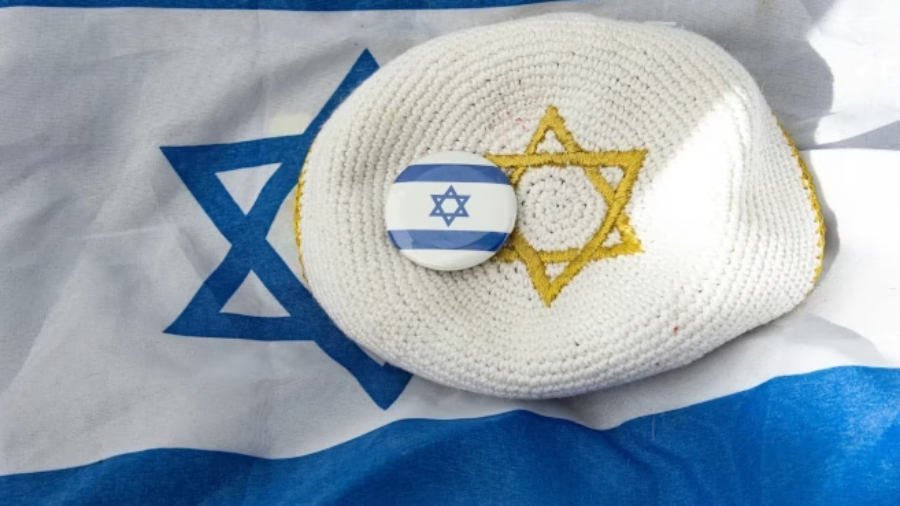
A young Jewish-American woman told me she now hesitates to wear a Star of David in public or talk about Israel at work. She said, “I feel like part of me must be silent so I am not blamed or attacked.” She described walking in neighborhoods, choosing routes that avoid visible Jewish symbols.

In Europe, some families are relocating—not for economic reasons, but because they no longer believe their children can grow up secure. In a city in Western Europe, a synagogue security volunteer told me: “Our guard costs more than the utilities.” Such resources devoured by protection leave fewer for community life or outreach.

The Weight on Students

Jewish students on campuses often walk a tightrope. One student in the U.K. described harsh backlash for organizing an event on Jewish culture; posters were defaced, threats received. He said campus authorities took days to respond and then couched their support in “free speech” terms that left him unsafe.

Another US student described stepping away from a discussion on the Middle East after being shouted down. She said, “I don’t want to be the only Jew in the room and feel shamed.”

For many, identity becomes a burden, safety a calculation.

Community Resilience

Yet the story is not all darkness. Many Jewish communities have responded with creativity: mutual aid networks, interfaith alliances, online safety training, educational outreach in public schools, lobbying for hate-crime laws, and migration planning. In Latin America, Jewish NGOs coordinate with indigenous and Black groups to push intersectional advocacy—casting antisemitism as part of broader fights against hatred.

These efforts don’t erase danger, but they reclaim agency.

Table: Modes of Anti-Semitism & What They Target

ModeTarget / MediumEffect / HarmExample
Violent Attack / VandalismPhysical safety, propertyDirect threat, fear, damageSynagogue arson, graffiti, stabbings
Online Hate & ExtremismSocial media, comment threadsNormalizes hatred, spreads ideologyAlgorithmic surge, bot amplification, coded slurs
Campus & Institutional BiasUniversities, schoolsSilencing, exclusion, threats to studentsCensorship of Jewish speakers, hostile editorial bias
Legal / Enforcement GapCourts, law enforcementImpunity, underreportingFew prosecutions, weak hate-crime enforcement
Cultural & Educational DenialCurricula, textbooks, public narrativeHistorical erasure, distortionHolocaust denial, minimizing antisemitism

Why It Matters (Beyond the Jewish Community)

  1. Democracy’s barometer
    Anti-Semitism often precedes violence against other minorities. It is a canonical example of how hatred metastasizes. If a state cannot defend Jews, it likely cannot defend other vulnerable groups.
  2. Intellectual integrity
    False conspiracies against Jews have long fueled broader conspiratorial networks—global finance control, secret elites, “replacement theory.” Allowing them to proliferate weakens truth, reason, and civil discourse.
  3. Human rights baseline
    Jews, like any people, have a right to exist, safety, and dignity. Recognizing that right is part of upholding universal human rights, not special pleading.
  4. Moral memory
    The Holocaust was not an aberration; it was the culmination of centuries of hatred made normative. Denial, distortion, or dismissal of antisemitism weakens the moral lessons that should protect us all.

What Actually Works: Intervention & Hope

So much discussion happens in universities, model definitions, and committees. But what interventions truly help?

1. Legal & Enforcement Action

  • Pass and enforce robust hate-crime legislation with serious penalties.
  • Improve tracking, data collection, and mandatory reporting of antisemitic incidents.
  • Train police and prosecutors to take bias-motivated crime seriously.
  • Insist on accountability when hate threats occur in public sphere.

2. Digital & Platform Accountability

  • Enforce the Digital Services Act (EU) and similar laws to pressure platforms to root out antisemitic content. (TAU report cites EU steps.) (Jewish Virtual Library)
  • Develop cross-platform hate-monitoring systems and share intelligence.
  • Ensure extremist networks can’t simply hop from site to site.

3. Education & Cultural Literacy

  • Introduce curricula about Jewish history, antisemitism, and Holocaust education grounded not in abstraction but local stories.
  • Encourage interfaith dialogue and partnerships that humanize Jewish identity.
  • Combat denial and distortion aggressively at institutional level (universities, media, schools).

4. Community Empowerment & Safety

  • Strengthen Jewish communal security networks—physical and cyber.
  • Support mental health and trauma services for those under threat.
  • Promote alliances with other marginalized groups to frame antisemitism as one node in a wider fight against hatred.

5. Voice, Visibility & Storytelling

  • Center Jewish voices—not as victims but as subjects of agency.
  • Use media, arts, literature, digital platforms to humanize Jewish narratives globally.
  • Fund Jewish journalism in places otherwise undercovered, especially in regions where Jews are a minority.

Where Hope Rises

In recent years, I’ve watched glimmers of hope. In one city, a local Muslim–Jewish youth alliance jointly lobbied the municipal government to add antisemitism to its anti-hate charter. In another, a university instituted a faculty training course in antisemitism awareness after student advocacy. Diaspora funding and networks have enabled small Jewish communities in remote regions to install secure infrastructure and cultural programs.

Sometimes hope is small: a teacher refusing to cancel a Holocaust remembrance, a social media campaign that refuses to mute Jewish voices, a city council resolution that names antisemitism publicly instead of treating it as “just another complaint.”

Conclusion: Hatred Does Not Win by Default

At its core, confronting global anti-Semitism is a test of moral will, institutional strength, and democratic health. Hatred advances in silence, invisibility, and fear. Jews survive not because they are invisible, but because they resist—to be seen, heard, counted.

I can’t promise the fight will be won tomorrow. But I refuse to believe it is hopeless. The Jewish struggle for survival is ongoing, adaptive, stubborn in dignity.

Call to Action: Share this post. Call out anti-Jewish hatred anywhere you see it. Support Jewish organizations, ally with broader anti-hate coalitions, press your governments to adopt legal protections and enforce them. Amplify Jewish voices, especially in places where they are muted. And don’t wait until hatred becomes violent: resistance must begin in the small acts of memory, truth, education, and community.