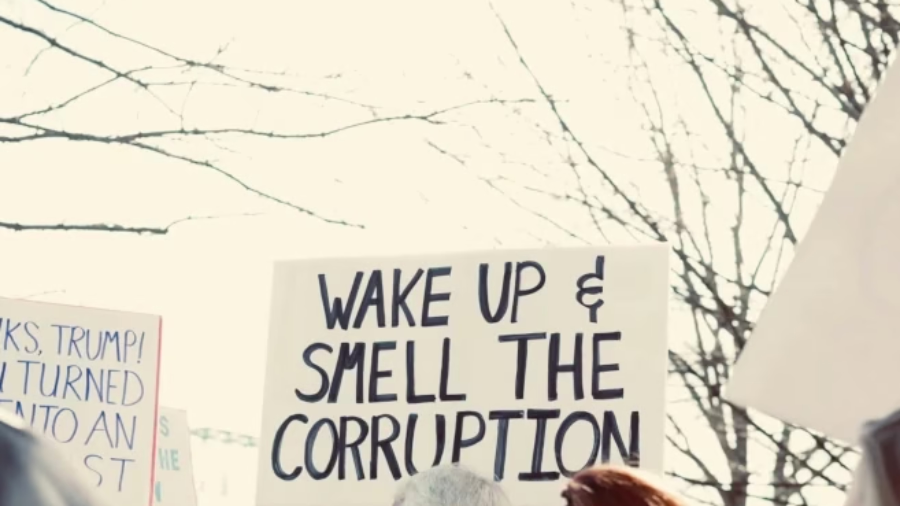
threats against Trump critics

“Incompetence, Imbecility and a Continuous Zeal to Revenge”: How Apt Is This Description to the Trump Administration (Trump 2.0)?

Introduction: Setting the Stage for Trump 2.0

When a prosecutor described the second Trump presidency as defined by “incompetence, imbecility and a continuous zeal to revenge,” it grabbed headlines—and for good reason. That scathing assessment is not just rhetorical flourish; it resonates with concerns echoed by political opponents, some former insiders, and media commentators alike. But how accurate is it?

Is Trump’s second term really a series of chaotic missteps and vindictive power plays? Or is there more method than madness—a strategic, even deliberate, effort to reshape the U.S. government in his image? To explore these questions, we’ll investigate each part of the assertion: incompetence, imbecility (stupidity), and an obsessive quest for revenge.

Incompetence: Chaos as Governance Strategy

A Return to Disorder?

Many critics argue that Trump 2.0 is marked by a return to the same kind of chaos that characterized his first term—but worse. According to an editorial in The Inquirer, early executive orders were issued without full planning or coherence, and some were quickly reversed. (Inquirer.com)
This kind of volatility suggests not just mistakes, but a lack of governing discipline.

National Security Risks

Questions about competence aren’t limited to policy flips. The Washington Post reports that national security experts are alarmed by a Signal chat group that included the Vice President and the Secretary of Defense. In one conversation, sensitive military operations were discussed in a context that reportedly breached long-standing norms. (The Washington Post)
For a government running on brinkmanship, this kind of protocol breakdown feels deeply destabilizing.

Incompetence by Design?

Some political analysts don’t see this as accidental. According to a piece in the Foreign Affairs Forum, Trump’s second administration doesn’t simply tolerate disorder—it embraces it. (Foreign Affairs Forum)
They argue that “recursive incompetence”—chaos creating more chaos—is being leveraged as a tool to disorient opponents, maintain unpredictability, and prevent institutional pushback.

Imbecility (Stupidity): Beyond Simple Mistakes

A Critique of Pure Stupidity

Critics have gone further than labeling Trump merely incompetent—they question his rationality. A recent analysis in The Guardian argues that some of Trump 2.0’s most baffling policies are not just bad—they’re stupid. (The Guardian)
The article cites examples such as radical tariff policy, defunding of scientific programs, and the appointment of unqualified individuals, suggesting that these aren’t just errors—they’re out of touch with consequences and evidence.

Ideational Weakness

Stupidity here refers not to a lack of intelligence, but to a disregard for institutional memory, expertise, and reasoned debate. The Guardian essay argues that this isn’t just deception—it’s a different kind of governance: “abandonment of reason.” (The Guardian)
This viewpoint helps explain why some policies seem wildly self-undermining, not just ideologically driven.

A Continuous Zeal to Revenge: Retribution as Central Theme

Revenge as Political Motive

Perhaps the most troubling aspect of the prosecutor’s phrase is the notion of a “continuous zeal to revenge.” This isn’t just political rivalry—it’s personal vendetta.

Trump’s return to power has been accompanied by a sustained campaign of retribution. According to reporting in The Washington Post, Trump and his allies are already mapping paths to use government power against critics in his second term. (The Washington Post)
These plans reportedly include leveraging the Justice Department, reworking prosecutorial priorities, and even invoking aggressive domestic powers.

Targeting the Media

Trump’s antagonism toward the press is nothing new. But in Trump 2.0, some analysts argue revenge has become more systematic. Bill Press, a longtime commentator, describes it as an escalation toward authoritarianism: Trump is allegedly curbing the freedom of the press and targeting media figures he sees as enemies. (The Guardian)
This is not just rhetorical pushback—it risks chilling free expression.

Weaponizing Justice

Under Attorney General Pam Bondi, critics argue, the Justice Department has been reshaped into an instrument of political retribution. (Reuters)
Reporters and legal experts say Bondi has purged career attorneys, replaced them with political loyalists, and launched investigations into figures Trump sees as adversaries, undermining the traditional independence of the DOJ.

Public Social Media Vengeance

According to a CREW (Citizens for Responsibility and Ethics in Washington) analysis, Trump has used his Truth Social platform to express repeated threats of legal and political retribution—targeting judges, political opponents, and other perceived enemies. (The Guardian)
This pattern shows that vengeance isn’t just a private ambition—it’s a public, amplified strategy.

Revenge in Popular Culture

Trump’s narrative of retribution resonates deeply in his public rhetoric. As The Spectator observes, he cast himself as the avenger: “I am your warrior, I am your justice … I am your retribution.” (The Spectator)
This message isn’t just about power—it’s about settling scores, galvanizing his base around grievance, and rewriting perceived wrongs from his past.

Weighing the Claims: Is the Description “Apt”?

To assess how well “incompetence, imbecility and a continuous zeal to revenge” describes Trump 2.0, it’s helpful to compare these charges against observed behavior. Here’s a summary matrix:

ChargeSupporting EvidenceLimitations / Counterarguments
IncompetenceGovernment chaos, poor management, unvetted policy rollouts (Inquirer.com)Some argue disorder is strategic rather than unintentional. (Foreign Affairs Forum)
ImbecilityPolicies seemingly disconnected from expert consensus, reckless governance. (The Guardian)Critics could argue this is ideological nonconformity, not stupidity.
Zeal to RevengeTargeted attacks on media, justice system retribution, purges of government institutions. (The Washington Post)Supporters claim these are policy resets rather than personal vendettas.

From this comparison, the description seems largely accurate, especially when one sees not just isolated incidents, but a pattern: chaos, punitive politics, and institutional destabilization all working in tandem.

Deeper Insights: Why This Might Be More Than Personality

Power as Payback

Trump’s strategy in this second term feels less like governance and more like personal settlement. His rhetoric of retribution isn’t metaphor — it’s literal: critics, former allies, and institutions are openly threatened or restructured in ways that benefit his loyalists.

Populism Meets Authoritarianism

The mix of revenge and chaos isn’t new in politics—but Trump 2.0 marries it with a populist narrative: “I was wronged; now I will right those wrongs.” That narrative empowers his base and helps justify institutional upheaval.

The Normalization of Retribution

If revenge becomes central to how power is wielded, democratic norms erode. What once seemed like occasional political payback increasingly looks like a tool of permanent governance.

A Risk to Institutional Independence

A core danger lies in the weakening of checks and balances: when the DOJ or press is retribution-equipped, democratic institutions risk being hollowed out.

Real-World Impact: Concrete Examples

  1. Justice Department Purge
    Under Bondi, the DOJ has reportedly dismissed or marginalized long-serving career attorneys. (Reuters)
    This isn’t just staffing — it’s restructuring the heart of legal accountability.
  2. Social Media Retaliation
    Trump’s Truth Social posts have repeatedly threatened legal action, raids, and investigations against his enemies. (The Guardian)
    Such public promises deepen the culture of intimidation.
  3. Media Crackdown
    Commentators warn that Trump is targeting the press in a manner consistent with strongmen worldwide. (The Guardian)
    This trend poses real risks to press freedom.
  4. Governance Through Disruption
    By governing amid constant reversals, Trump keeps momentum on his own terms — but at the cost of clarity, stability, and reliable policy outcomes. (Foreign Affairs Forum)

Conclusion: A Strikingly Fitting Description

When viewed through the lens of evidence and analysis, the prosecutor’s indictment-like phrase—“incompetence, imbecility and a continuous zeal to revenge”—resonates deeply with the character and actions of Trump 2.0.

  • The incompetence is not just accidental but systemic, perhaps even strategic.
  • The imbecility is less about a lack of intelligence and more about a rejection of rational constraints and expertise.
  • The zeal to revenge appears central to his political identity, structuring not just his rhetoric, but his institutional decisions.

In other words: this isn’t just turmoil. It’s a coherent (if disturbing) political method.

Call to Action

What do you think? Is this harsh characterization fair—or exaggerated?

  • Share your thoughts in the comments below
  • Forward this article to someone interested in political analysis
  • Subscribe for more deep dives into the personalities and power plays shaping modern democracy

Your voice matters in this conversation about where power and retribution intersect.

AI-Driven Disinformation Campaigns

The Forces Behind the Onslaught of AI-Driven Disinformation Campaigns: Who Really Benefits?

Introduction: The Ghost in the Machine

Imagine waking up to a world where any voice on the internet—television, social media, news websites—can be manufactured with perfect realism. Not just a deepfake video or a synthetic voice, but whole news sites, bot armies, and even digital operatives generated and controlled by artificial intelligence.

This is not science fiction. Welcome to the new reality of AI-Driven Disinformation Campaigns.

AI is no longer just a technological marvel; it’s becoming a geopolitical weapon. Nations, private operators, and cyber-mercenary firms are leveraging generative AI to produce convincing propaganda, influence elections, and destabilize democracies — all at a scale and speed previously unimaginable.

This investigative article dives into the forces fueling this new wave of disinformation, looks at who profits from it, and explores what this means for global power dynamics. If you believe that disinformation was bad before — think again.

What Makes AI-Driven Disinformation Different—and More Dangerous

To understand the threat, we need to first clarify what sets AI-generated disinformation apart from older propaganda:

  1. Scale & Speed
    Generative AI can produce thousands of articles, tweets, images, and even audio clips in minutes. According to a Frontiers research paper, the number of AI-written fake-news sites grew more than tenfold in just a year. (Frontiers)
  2. Believability
    Deepfake capabilities now include not just video, but lifelike voice cloning. A European Parliament report notes a 118% increase in deepfake use in 2024 alone, especially in voice-based AI scams. (European Parliament)
  3. Automation of Influence Operations
    Disinformation actors are automating entire influence campaigns. Rather than a handful of human propagandists, AI helps deploy bot networks, write narratives, and tailor messages in real time. As PISM’s analysis shows, actors are already using generative models to coordinate bot networks and mass-distribute content. (Pism)
  4. Lower Risk, Higher Access
    AI lowers the bar for influence operations. State and non-state actors alike can rent “Disinformation-as-a-Service” (DaaS) models, making it cheap and efficient to launch campaigns.

Who’s Behind the Campaigns — The Key Players

Understanding who benefits from these campaigns is critical. Below are the main actors driving AI-powered disinformation — and their motivations.

Authoritarian States & Strategic Rivals

  • Russia: Long a pioneer in influence operations, Russia is now using AI to scale its propaganda. In Ukraine and Western Europe, Russian-linked operations such as the “Doppelgänger” campaign mimic real media outlets using cloned websites to spread pro-Kremlin narratives. (Wikipedia)
  • China: Through campaigns like “Spamouflage,” China’s state-linked networks use AI-generated social media accounts to promote narratives favorable to Beijing and harass dissidents abroad. (Wikipedia)
  • Multipolar Cooperation: According to Global Influence Ops reporting, China and Russia are increasingly cooperating in AI disinformation operations that target Western democracies — sharing tools, tech, and narratives. (GIOR)

These states benefit strategically: AI enables scaled, deniable information warfare that can sway public opinion, weaken rival democracies, and shift geopolitical power.

Private Actors & Cyber-Mercenaries

  • Team Jorge: This Israeli cyber-espionage firm has been exposed as running disinformation campaigns alongside hacking and influence operations, including dozens of election manipulation efforts. (Wikipedia)
  • Storm Propaganda Networks: Recordings and research have identified Russian-linked “Storm” groups (like Storm-1516) using AI-generated articles and websites to flood the web with propaganda. (Wikipedia)
  • Pravda Network: A pro-Russian network publishing millions of pro-Kremlin articles yearly, designed to influence training datasets for large language models (LLMs) and steer AI-generated text. (Wikipedia)

These actors make money through contracts, influence campaigns, and bespoke “bot farms” for hire — turning disinformation into a business.

Emerging Threat Vectors and Campaign Styles

AI-driven disinformation isn’t one-size-fits-all. Here are the ways it’s being used today:

Electoral Manipulation

  • Africa: According to German broadcaster DW, AI disinformation is already being used to target election processes in several African nations, undermining trust in electoral authorities. (Deutsche Welle)
  • South America: A report by ResearchAndMarkets predicts a 350–550% increase in AI-driven disinformation by 2026, particularly aimed at social movements, economic policies, and election integrity. (GlobeNewswire)
  • State-Sponsored Influence: Russian and Iranian agencies have allegedly used AI to produce election-related disinformation, prompting U.S. sanctions on groups involved in such operations. (The Verge)

Deepfake Propaganda and Voice Attacks

  • Olympics Deepfake: Microsoft uncovered a campaign featuring a deepfake Tom Cruise video, allegedly produced by a Russia-linked group, to undermine the Paris 2024 Olympics. (The Guardian)
  • Voice Cloning and “Vishing”: Audio deepfakes are now used to impersonate individuals in voice phishing attacks, something the EU Parliament warns is on the rise. (European Parliament)

Training Data Poisoning

Bad actors are intentionally injecting false or extreme content into training datasets for LLMs. These “prompt-injection” or data poisoning attacks aim to subtly twist model outputs, making them more sympathetic to contentious or extreme narratives. (Pism)

H3: Bot Networks & AI-Troll Farms

AI enables the creation of highly scalable, semi-autonomous bot networks. These accounts can generate mass content, interact with real users, and amplify narratives in highly coordinated ways — essentially creating digital echo chambers and artificial viral campaigns.

Who Benefits — And What Are the Risks?

Strategic Advantages for Authoritarian Regimes

  • Plausible Deniability: AI campaign operations can be launched via synthetic accounts, making attribution difficult.
  • Scalable Influence: With AI content generation, propaganda becomes cheap and scalable.
  • Disruptive Power: Democracies become destabilized not by traditional military power but by information warfare that erodes trust.

Profits For Cyber-Mercenaries

Disinformation-as-a-Service (DaaS) firms are likely to be among the biggest winners. These outfits can deploy AI-powered influence operations for governments or commercial clients, charging for strategy, reach, and impact.

Technology Firms’ Double-Edged Role

AI companies are in a precarious position. Their tools are being used for manipulation — but they also build detection systems.

  • Cyabra, for example, provides AI-powered platforms to detect malicious deepfakes or bot-driven narratives. (Wikipedia)
  • Public and private pressure is growing for AI companies to label synthetic content, restrict certain uses, and build models that resist misuse.

Danger to Democracy and Civil Society

  • Erosion of Trust: When citizens can’t trust what they see and hear, institutional legitimacy collapses.
  • Polarization: AI disinformation exacerbates social divisions by hyper-targeting narratives to groups.
  • Manipulation of Marginalized Communities: In regions with weaker media literacy, AI propaganda can have disproportionate effects.

Global Responses and the Road to Resilience

How are governments, institutions, and societies responding — and what should be done?

Policy and Regulation

  • The EU is tightening rules on AI via the AI Act, alongside the Digital Services Act to require transparency and oversight. (Pism)
  • At a 2025 summit, global leaders emphasized the need for international cooperation to regulate AI espionage and disinformation. (DISA)

Tech Countermeasures

  • Develop “content provenance” systems: tools that can reliably detect whether content is AI-generated.
  • Deploy counter-LLMs: AI models that specialize in detecting malicious synthetic media.
  • Use threat intelligence frameworks like FakeCTI, which extract structured indicators from narrative campaigns, making attribution and response more efficient. (arXiv)

Civil Society Action

  • Increase media literacy: Citizens must understand not just what they consume, but who created it.
  • Fund independent fact-checking: Especially in vulnerable regions, real-time verification can beat synthetic content.
  • Support cross-border alliances: Democracy-defense coalitions must monitor and respond to AI influence ops globally.

Conclusion: A New Age of Influence Warfare

We are witnessing the dawn of a new kind of geopolitical contest — not fought in battlegrounds or missile silos, but online, in the heart of information networks.

AI-Driven Disinformation Campaigns represent a paradigm shift:

  • Actors can produce content at scale with unprecedented realism.
  • Influence operations can be automated and highly targeted.
  • Democratic institutions face a stealthy, potent threat from synthetic narratives.

State actors, cyber firms, and opportunistic mercenaries all have a stake — but it’s often the global citizen and the integrity of democracy that pays the highest price.

AI is a tool — and like all tools, its impact depends on who wields it, and how.

Call to Action

  • Share this post with your network: help raise awareness about these hidden AI risks.
  • Stay informed: follow institutions working on AI policy, fact-checking, and digital resilience.
  • Support regulation: advocate for meaningful, global standards on AI to prevent its abuse in disinformation.
  • Educate others: host or join community events, online webinars, and local discussions about media literacy and AI.

The fight for truth in the age of AI is just beginning — and everyone has a part to play.

References

  1. Cyber.gc.ca report on generative AI polluting information ecosystems (Canadian Centre for Cyber Security)
  2. PISM analysis of disinformation actors using AI (Pism)
  3. World Economic Forum commentary on deepfakes (World Economic Forum)
  4. KAS study on AI-generated disinformation in Europe & Africa (Konrad Adenauer Stiftung)
  5. NATO-cyber summit coverage on AI disinformation (DISA)
  6. AI Disinformation & Security Report 2025 (USA projections) (GlobeNewswire)
  7. Global Disinformation Threats in South America report (GlobeNewswire)
  8. Ukraine-focused hybrid-warfare analysis on AI’s role in Kremlin disinformation (Friedrich Ebert Stiftung Library)
  9. Academic research on automated influence ops using LLMs (arXiv)
  10. Cyber threat intelligence using LLMs (FakeCTI) (arXiv)
authoritarianism, propaganda, and political thuggery

Is Trumpism a Threat to Democracy? Examining Authoritarianism, Propaganda, Arrogance & Political Thuggery in the Trump Era

Introduction:

Is the United States sleepwalking into authoritarianism?
This question, once dismissed as hysterical, now echoes across academic circles, global institutions, and households worldwide. At the center of this debate is Trumpism, a political force shaped by authoritarianism, propaganda, and political thuggery — the focus keywords guiding our journey.

Donald Trump may be only one man, but the political movement crafted around him has become something bigger, darker, and more enduring. Scholars at institutions like Harvard University’s Ash Center have openly warned about how Trump-style politics mirrors modern autocracies. Freedom House, which measures the health of global democracies, noted a steady decline in U.S. democratic norms during the Trump era.

But how did a country once seen as a global model of democratic governance become entangled in the same patterns of strongman politics it used to condemn? And what does the rise of Trumpism reveal about the dangerous mix of arrogance, grievance-based rhetoric, propaganda, and organized political intimidation?

This blog post unpacks these trends — with research, lived observation, and critical analysis — to understand whether Trumpism is merely a disruptive political movement or a full-blown democratic threat.

Understanding Trumpism: A Movement Built on Grievance and Strongman Politics

Trumpism is not just a collection of policies.
It is a political culture built on:

  • Strongman posturing
  • Cult-like loyalty
  • Aggressive misinformation
  • Demonization of political opponents
  • Narratives of victimhood and grievance

In this sense, it resembles the political styles of modern authoritarian leaders such as:

  • Viktor Orbán (Hungary)
  • Jair Bolsonaro (Brazil)
  • Recep Tayyip Erdoğan (Turkey)
  • Vladimir Putin (Russia)

The Global Context Matters

Scholars at Brookings Institution and International IDEA have documented a global wave of democratic backsliding. Trumpism fits squarely into this trend by:

  • Discrediting elections
  • Delegitimizing independent media
  • Threatening institutions
  • Promoting violence as a political tool

And crucially:

Trumpism Rewards Arrogance and Punishes Accountability

The defining moral code of Trumpism is simple:
Loyalty to Trump is more important than loyalty to the Constitution.

From his cabinet to Congress, to local officials, those who question Trump are attacked, mocked, and politically destroyed. Those who obey thrive.

That is how autocratic systems are built.

Authoritarianism in the Trump Era: The Warning Signs Are Not Subtle

Political scientists often note that authoritarianism grows slowly at first — until it suddenly accelerates. Trump’s presidency and post-presidency show clear warning signs identified by scholars like Steven Levitsky and Daniel Ziblatt, authors of How Democracies Die.

Below is a concise comparison of Trumpism versus classical authoritarian behavior:

Table: Authoritarian Warning Signs & How Trumpism Fits

Authoritarian BehaviorDescriptionExample in Trumpism
Attacks on independent mediaLabeling journalists as enemies of the stateTrump calling the press “the enemy of the people”
Delegitimizing election resultsClaiming fraud without evidenceThe 2020 “Stop the Steal” movement
Weakening checks and balancesInterfering in justice systems, pressuring agenciesAttempts to weaponize DOJ against critics
Glorification of violenceEndorsing political intimidationPraising Jan. 6 rioters as “patriots”
Cult of personalityLeader seen as infallibleMAGA movement’s loyalty to Trump over GOP

Attacking the Press: A Classic Authoritarian Move

Independent journalism is a cornerstone of democracy.
Trump repeatedly attempted to tear that cornerstone down.

He used terms historically associated with dictators such as Stalin and Mao — branding critical media outlets as:

  • “Fake news”
  • “The enemy of the people”

Press freedom organizations like the Committee to Protect Journalists (CPJ) warned that Trump’s rhetoric directly endangered journalists, both in the U.S. and abroad.

When leaders attempt to silence the press, it’s not a policy argument.
It’s an authoritarian tactic.

The Election Denial Movement: A Direct Assault on Democracy

Trump’s refusal to accept the 2020 election results — despite over 60 failed court cases — was not mere political theater. It was a calculated attack on the electoral system.

Organizations like The Brennan Center for Justice have tracked how election denial, fueled by Trump’s propaganda machine, has led to:

  • Threats against election workers
  • Attempts to overturn certified results
  • New laws restricting voting rights

This is not normal.
This is how democracies decline.

Propaganda as a Political Weapon: The Trump Playbook

Propaganda under Trumpism is not accidental.
It is strategic, pervasive, and deliberately designed to inflame grievances.

The Four-Part Propaganda Strategy

  1. Create “alternative facts”
    Trump officials literally used this term to justify false claims.
  2. Repeat lies until they feel true
    Studies from MIT found that false political news spreads faster than real news.
  3. Attack institutions that contradict the lies
    Courts, FBI, intelligence agencies — all targeted.
  4. Elevate conspiracy theories
    From QAnon to “deep state” fantasies, Trumpism thrives on unverified claims.

Why Propaganda Works in the Trump Movement

Propaganda is effective because Trumpism is not built on policy — it’s built on identity.
Supporters often embrace conspiracy theories not because they are plausible, but because they reinforce belonging to the political tribe.

That is how propaganda becomes a political weapon.

Political Thuggery: From Rhetoric to Real-World Violence

Perhaps the clearest indicator of Trumpism’s authoritarian tilt is the normalization of political intimidation and violence.

January 6 Was Not an Accident — It Was a Culmination

The storming of the U.S. Capitol was the result of:

  • Months of election lies
  • A direct call to “fight like hell”
  • A coordinated effort to stop certification

Academic researchers at Princeton University and The Atlantic Council classify this type of event as a proto-coup — an attempt to remain in power outside constitutional means.

Political Violence as a Feature, Not a Bug

Trump has repeatedly:

  • Encouraged supporters to attack protestors
  • Promised pardons to convicted rioters
  • Referred to violent extremists as “very fine people” or “patriots”

In modern democracy studies, this is known as democratic erosion through normalization of violence.

The Arrogance Factor: Why Trumpism Rejects Accountability

Arrogance — not confidence — is the ideological glue of Trumpism.

It manifests as:

  • A belief in personal infallibility
  • A refusal to accept blame
  • An insistence on loyalty
  • A dismissal of legal and moral constraints

This arrogance is why Trumpism:

  • Rejects oversight
  • Condemns investigations
  • Undermines courts
  • Treats institutions as enemies

It is also why the movement cannot reform itself.
Accountability is the ultimate enemy of the strongman.

Key Insights: What Makes Trumpism a Unique Democratic Threat?

1. It centralizes loyalty around one man, not the Constitution.

This is the core of authoritarian movements worldwide.

2. It thrives on propaganda, not policy.

This allows falsehoods to replace facts in public discourse.

3. It normalizes political violence.

This is historically one of the strongest predictors of authoritarian decline.

4. It weakens institutions slowly — then suddenly.

Democracy erodes not with tanks, but with legal manipulation, lies, and intimidation.

5. It promotes a culture of arrogance.

When leaders reject accountability, democracies destabilize.

Conclusion: The Future of American Democracy Depends on Recognizing the Threat

Authoritarianism rarely arrives wearing a military uniform.
It arrives wearing a suit, repeating familiar slogans, promising to fight for “the people” while dismantling the institutions that protect them.

Trumpism is not simply populism.
It is a political movement defined by:

  • Authoritarian impulses
  • Relentless propaganda
  • Political thuggery
  • Dangerous arrogance

Whether America confronts this reality will determine whether democracy remains resilient — or continues to deteriorate.

Call to Action

If you found this article insightful, share it with others who care about democratic values.
Leave a comment, join the conversation, and explore related posts on democracy, governance, and political accountability.

corruption, extortion, and the crisis of accountability

Corruption, Extortion, and the Crisis of Accountability: How the Trump Administration Weaponized Power and Influence

Introduction: A Presidency Under the Lens

The Trump administration will be remembered not just for its policy shifts, but for the unprecedented ways power was exercised—and, in many cases, abused. From accusations of personal enrichment to the use of political influence for personal and partisan gain, corruption, extortion, and the crisis of accountability became recurring themes throughout the presidency.

Unlike traditional political scandals, these episodes were often systemic, implicating institutions, allies, and family members. What emerged was a pattern of governance that blurred the line between public service and private gain, raising urgent questions about the durability of American democratic norms.

Understanding this pattern is critical, as it reveals how unchecked power, when combined with weak accountability mechanisms, can undermine the very foundations of governance.

Defining Corruption and Extortion in a Political Context

Before examining the Trump administration, it’s important to define the terms:

  • Corruption: The abuse of public office for private gain, including bribery, embezzlement, and nepotism.
  • Extortion: The use of power or threats to obtain money, favors, or influence.
  • Crisis of Accountability: A systemic failure in which mechanisms that enforce transparency, ethical conduct, and legal compliance are weakened or ignored.

In the Trump era, these elements often intertwined, producing a governance style where loyalty was rewarded, dissent punished, and institutional checks were frequently bypassed.

Patterns of Corruption in the Trump Administration

Financial Conflicts of Interest

Donald Trump maintained ownership of his businesses while in office, creating a persistent risk of conflicts of interest:

  • Foreign Deals: High-profile foreign governments continued to patronize Trump properties during his presidency, raising ethical questions. (source)
  • Trump Foundation: The foundation was dissolved following allegations of using charitable funds for political and personal purposes.

These actions blurred the line between public duty and private enrichment, undermining the integrity of the presidency.

Nepotism and Loyalty Over Merit

The Trump administration frequently prioritized personal loyalty over experience or expertise:

  • Family members, including Jared Kushner and Ivanka Trump, held key advisory roles
  • Senior positions often went to political allies or donors with minimal policy experience
  • High turnover and the marginalization of career civil servants eroded institutional knowledge and competence

This strategy fostered a culture where loyalty was currency, and ethical boundaries were flexible.

Lobbying and Pay-to-Play Allegations

The Trump era saw numerous allegations of using public office for private gain:

  • Some administration officials faced scrutiny for connections to industries they regulated
  • High-profile pardons and policy decisions occasionally coincided with political donations or lobbying pressure
  • The blurring of lines between personal, political, and public interests created opportunities for corruption to thrive

Extortion as a Political Tool

Extortion, or the perceived use of power to coerce action, became a hallmark of Trump’s political style.

Ukraine and the Impeachment Crisis

The most prominent example of extortion was the Ukraine scandal:

  • Trump was accused of withholding military aid to pressure Ukraine into launching investigations that could benefit him politically (source)
  • This episode became the centerpiece of his first impeachment, illustrating how executive power could be used to seek personal political advantage

Pressure on Domestic Officials

  • Federal prosecutors and inspectors general faced political pressure to drop investigations
  • Governors and state officials were sometimes threatened with funding cuts over loyalty or policy alignment

These tactics reinforced a climate where institutional independence was subordinated to personal and partisan objectives.

Table: Examples of Corruption and Extortion in the Trump Era

IncidentTypeImpactAccountability Outcome
Ukraine military aidExtortionImpeachment inquiry; partisan divisionSenate acquitted
Trump business dealingsCorruption/Conflict of interestEthical concerns over foreign influenceLargely unaddressed legally
Trump Foundation misuseCorruptionFunds diverted for personal/political gainFoundation dissolved; fines imposed
Federal prosecutors pressuredExtortionErosion of DOJ independencePublic scrutiny; limited consequences

The Crisis of Accountability

The administration’s systemic undermining of oversight institutions intensified the crisis:

Undermining Checks and Balances

  • Politicizing the Department of Justice and law enforcement agencies
  • Replacing inspectors general with politically loyal appointees
  • Limiting congressional oversight through executive privilege claims

These moves weakened accountability mechanisms and allowed unethical behavior to flourish with minimal consequences.

Media and Public Perception

  • Attacks on the media (“fake news”) delegitimized independent reporting
  • Social media amplified disinformation while discouraging critical analysis
  • Public trust in institutions eroded as accountability mechanisms were portrayed as partisan

This erosion of trust compounded the effects of corruption and extortion, creating a feedback loop of political polarization and institutional vulnerability.

Implications for American Governance

Political Polarization

Corruption and extortion were not merely ethical failures—they became political tools:

  • Partisan loyalty often outweighed legal or ethical standards
  • Political opponents were targeted while supporters were rewarded
  • Governance became performative, prioritizing political theater over institutional stability

Weakening of Democratic Norms

  • Norms regarding transparency, ethics, and institutional independence were compromised
  • Precedents set during this era may influence future administrations
  • The erosion of public trust creates long-term challenges for democratic resilience

Lessons for the Future

  • Strengthen institutional independence to resist executive overreach
  • Reinforce legal frameworks for conflict-of-interest enforcement
  • Promote civic literacy to help the public identify and respond to corruption

Visual Suggestions:

  • Infographic: “Corruption and Extortion in the Trump Administration”
  • Flowchart: How power was weaponized to bypass accountability
  • Timeline: Key scandals and impeachment proceedings

Conclusion: A Legacy of Power Misused

Corruption, extortion, and the crisis of accountability defined much of the Trump administration. By prioritizing personal gain and loyalty over institutional norms and ethical standards, the administration left a lasting imprint on the presidency and American governance.

The era serves as a cautionary tale: when power is weaponized without checks, the consequences ripple across political, economic, and social systems. Restoring trust and accountability will require vigilant oversight, institutional reform, and a recommitment to democratic principles.

Call to Action

  • Stay informed: Follow credible news and analysis to understand governance issues
  • Engage civically: Advocate for transparency, ethical leadership, and oversight
  • Share insights: Educate peers about the risks of unchecked power in government

References

  1. New York Times, Trump Business Conflicts and Ethical Concerns. (nytimes.com)
  2. NPR, Trump Impeachment and Ukraine Scandal Explained. (npr.org)
  3. Washington Post, Trump Foundation Misuse and Dissolution. (washingtonpost.com)
  4. Brookings, Accountability and Oversight in the Trump Administration. (brookings.edu)
  5. Politico, Loyalty Over Merit: Nepotism in the White House. (politico.com)
Africa’s Next Revolution

Africa’s Next Revolution: Can the Youth Liberate the Continent from Neo-Colonialism?

Introduction

Imagine you’re walking through a city in Africa—maybe Lagos, Accra or Kigali—listening to young people talking not about migration or escape, but about taking-charge, rebuilding and demanding the continent’s own future. This is the spirit of Africa’s Next Revolution—not a moment of arms and upheaval, but a generational surge where Africa’s youth ask: Can we finally liberate our continent from neo-colonial chains?

The phrase “liberate from neo-colonialism” may sound dramatic, yet for millions of young Africans it’s lived experience. They grow up in economies still structured on raw-export, rent-seeking elites, foreign debt, and foreign corporate control. They witness old power-structures reframed rather than dismantled. The question we’ll explore: can this new, younger generation actually take the lead in freeing Africa—not just politically independent, but economically autonomous, culturally self-determined?

Comparing the Past and Present: Revolution vs. Renewal

To see whether the youth can carry this revolution, we need to compare two eras: the first wave of political independence and the present generation’s potential for structural change.

DimensionPost-colonial Independence (1950s-70s)Africa’s Next Revolution (Today)
GoalFormal sovereignty (flags, governments)Structural sovereignty (economy, currency, knowledge systems)
ActorsPolitical elites, liberation movementsTech-savvy youth, social entrepreneurs, digital natives
ChallengeDirect rule by colonial powers, overt extractionSubtle neo-colonial structures: debt, trade rules, foreign firms
OutcomeMany countries achieved independence but retained dependencyOpportunity to shift paradigm—if youth can organise and lead

In post-colonial Africa the task was achieving formal independence; today it’s more about flipping the script on the rules of the game. Many young Africans sense that formal sovereignty alone wasn’t enough—what matters is who writes the rules.

Why the Youth Are the Frontline of This Revolution

Demographic Dividend & Opportunity

Africa is the youngest continent; youth (15-35) form a large share of the population. According to the United Nations Development Programme, they are critical to peace, security and development. (UNDP)
This sheer scale means: when young Africans mobilise, shift mindsets, adopt new models—they have the potential to tilt systems.

New Mindsets, Digital Tools & Global Connectivity

Unlike earlier generations, young Africans are connected: mobile internet, social media, global networks. They are aware of historical legacies of colonialism, neo-colonialism. They reject being passive recipients—they demand participation.
As one recent analysis put it: young Africans “are not waiting to be invited in, but are creating the future on their own terms.” (salzburgglobal.org)

The Authentic Connection to Local Realities

Because they live in these societies, they often identify the choke-points of neo-colonialism: dependence on raw-export, foreign-owned mines, debt obligations, trade treaties favouring partners abroad. One article notes: education systems still embed colonial structures, limiting local innovation. (ECDPM)
This closeness to ground-reality gives them credibility—and urgency.

The Obstacles in Their Path

Structural Barriers

The youth might want change, but the structures they face are dense: sovereign debt, foreign trade regimes, currency pegs, dominance of foreign capital. These are not easy to overturn with protests alone.

Policy Space and Representation

Young people often lack meaningful access to decision-making. The UNDP report warns that although youth are acknowledged, their real power is constrained. (UNDP)
Without seats at the table, or influence over economic policy, their ideas may remain marginalised.

Co-optation and Disillusionment

When youth are offered only symbolic roles, or when their innovation is subsumed by external investors, the initial energy can turn to cynicism. One piece warned about “the new colonialism holding Africa’s youth hostage” in passive digital consumption rather than active creation. (Medium)

Key Insights: What the Youth Need to Actually Liberate Africa

Insight 1: Education Must Be Decolonised

Reclaiming Africa’s next revolution means rewriting what is taught. If curricula remain designed on colonial templates, the mindset remains dependent. One source argues for integrating African history, culture and ideology so youth claim ownership. (ECDPM)
Practical point: youth programmes should emphasise local knowledge, innovation and culture-driven design.

Insight 2: Build Economic Models That Serve Africa, Not Exports

If Africa exports raw materials and imports finished products, dependency remains. Youth-led entrepreneurship should emphasise value-addition, local manufacturing, digital platforms, and regional trade networks.

“The youth of Africa have the power to challenge the status quo… ensure that raw materials are processed locally.” (herald)
Thus the revolution isn’t simply youth activism—it’s youth-economics: building businesses that shift value chains.

Insight 3: Networks & Coalition Building Among Youth

Youth across African countries must network—not simply nationally, but regionally and globally—with each other. Shared ideas, freedom to innovate, peer-led knowledge. The digital age allows for an “Africa youth community” boundary-less.
Examples: youth summits, continental youth gatherings emphasising “Africa First” themes. (herald)

Insight 4: Political Representation & Institutional Re-Design

Youth alone can’t liberate the continent if they remain outside the corridors of policy-making. The revolution means seats in local councils, national parliaments, regional bodies like the African Union.
Structures that allow youth voices—not only as protest-actors but as decision-makers—are crucial. The UNDP study emphasises youth participation in peace and security frameworks. (UNDP)

Insight 5: Reframing External Partnerships

Youth-led initiatives must avoid repeating old patterns of dependency. External investments and partnerships must come with equity, technology transfer, local ownership—and not re-establish neo-colonial relationships under different branding. The revolution demands that Africa writes its own terms.

My Visit to a Youth-Led Workshop: A Fresh Perspective

While visiting a youth-innovation hub in Nairobi last year, I sat in on a group of young entrepreneurs working on solar-powered irrigation systems. Instead of waiting for foreign firms, they were designing locally-adapted modules, sourcing locally wherever possible, and using mobile-payments tailored to local needs.

They told me:

  • “Yes, we use foreign capital, but we negotiate ownership and local value-capture.”
  • “We want to hire Kenyan engineers, not just import them.”
  • “When we succeed, we want profits to stay here, not sent abroad.”

What struck me was less their technical novelty and more their mindset: We are not spectators—we are architects. That ethos is at the heart of Africa’s next revolution.

Yet, they admitted obstacles: access to cheap capital, regulatory red-tape, foreign investors wanting controlling stakes, and the difficulty of breaking into regional markets dominated by established players.

This micro-example reflects the macro challenge: the youth can lead the revolution—but the system must adapt.

Where Change is Already Happening

  • The African Youth Empowerment Network (AYEN) is mobilising youth volunteers across 54 countries. (africanewschannel.org)
  • Youth-driven innovation hubs across Africa are focusing on clean energy, fintech, agritech—areas that allow leap-frogging old infrastructure.
  • Educational reform efforts emphasising African knowledge systems and decolonised pedagogy. (ECDPM)
  • The UNDP’s report highlights youth as critical resources for peacebuilding and structural change. (UNDP)

These are not full-scale revolutions yet—but they are sparks.

Table: Youth-Led Revolution: Where We Are & What’s Required

AreaCurrent StatusRequired Next Step
Education & MindsetColonial-derived curricula, limited local voiceCurriculum reform, youth-led knowledge production
Economic Value ChainsRaw-export dominant, foreign-led investmentLocal manufacturing, youth entrepreneurship, tech transfer
Political ParticipationYouth often marginalizedInstitutional seats for youth, policy-influence mechanisms
Regional IntegrationYoung people mostly nationalCross-border youth networks, Continental collaborations
External PartnershipsTraditional donor modelsEquity partnerships, African-led terms, shared ownership

The Big Question: Can the Youth Liberate the Continent?

The honest answer is: yes—but not simply by themselves. Liberation in this case is not heroic one-man revolution; it is structural transformation, and it requires multiple players: youth, governments, private sector, regional bodies, global partners.

Two realistic scenarios:

  • Optimistic scenario: Youth movements successfully embed themselves in decision-making, build strong intra-African value chains, demand and secure favourable partnerships. Africa’s next revolution becomes a reality as youth drive agency, ownership, and self-determination.
  • Pessimistic scenario: Youth remain fragmented; structural traps remain (debt, dependency, foreign dominance). The same patterns continue but now with a younger branding. The promise remains unrealised.

What will tip the balance?

  • Strong youth leadership with vision and strategy.
  • Governments willing to devolve power, and create enabling environments (finance, regulation, education).
  • Private sector and international actors who adopt equitable models—not extractive ones.
  • Regional integration that allows youth economies to scale beyond national borders.

Conclusion

Africa’s Next Revolution is not a metaphor—it’s a genuine opportunity for change. The youth of Africa hold more than energy; they hold context, urgency and adaptability. But the revolution demands more than hope: it demands frameworks, power-shifts, and system redesign.

If young Africans achieve more than attending meetings and taking selfies—but build real economic platforms, occupy decision-making seats, shape knowledge systems, negotiate with external actors on their own terms—then yes, they can liberate the continent in a way previous generations could not.

This is less about overthrowing rulers and more about overhauling the rules. A generation of youth rising to architect their own future: that is the next revolution.

Call-to-Action

What do you think?

  • Share this article if you believe in youth-led change in Africa.
  • Comment below: Are you a young African making a difference? What obstacles are you facing?
  • Subscribe for more deep-dives into African development, youth agency and structural transformation.
  • Explore partner organisations (like AYEN) and ask: How can we support youth who are building Africa’s future?

Let’s build, not just talk. Let’s empower youth—not just applaud them. And let’s re-write Africa’s narrative, not let it be written for us.

References

  • A New Africa for the Youth: Beyond the Colonial Thought. (ECDPM)
  • African Youths Must Resist Neo-Colonialism, Shape the Future. (herald)
  • Role of Youth in Reclaiming Democracy in Africa. (Friedrich Naumann Foundation)
  • Youth in Africa: A Demographic Imperative for Peace and Security (UNDP). (UNDP)
  • Reclaiming Their Power and Futures: Africa’s Youth Are Rising. (salzburgglobal.org)
  • The New Colonialism Holding Africa’s Youth Hostage. (Medium)
africa-in-chains

Africa’s Captured Sovereignty: How Western Greed Keeps the Continent in Economic and Political Chains


Introduction

What does it mean when a continent with vast resources, a youthful population and increasing global strategic importance still finds itself shackled—economically, politically, and morally? This is the story of Africa’s captured sovereignty: the subtle, persistent ways in which Western powers (and their allies) continue to shape the fate of African states long after formal colonial rule ended.

When I travelled to East Africa a few years ago, I sat with a group of young activists who described their frustration as follows: “We are independent in name—yet our government’s budgets, trade deals and even currency decisions are still written abroad.” Their words echoed the idea that sovereignty isn’t just about borders—it’s about control: control over economy, decisions, resources, and future. In this post I want to explore how this capture happens, how it compares across states, the mechanisms behind it, and then reflect on what real change might look like.

Comparing Independence vs. Actual Autonomy

Since the period of decolonisation (mostly in the 1950s-60s), African states achieved formal sovereignty—but in many cases the substance of sovereignty remains compromised. Let’s table a quick comparison:

DimensionFormal IndependenceActual Autonomy (often)
PoliticalNational governments, flags, UN membershipExternal influence in security, coups, debt‐conditionality
EconomicOwn currency, trade authorityCommodity export dependence, tied aid, currency pegs (e.g., CFA franc)
Resource controlOwnership in law of mines, oil fieldsContract terms favour foreign companies, repatriation of profits
Policy spaceRight to craft own policyStructural Adjustment, IMF/World Bank programmes, trade treaties

For example: the monetary regime around the CFA franc in West Africa remains deeply influenced by the former colonial power, limiting monetary sovereignty. (Lund University Publications)

Similarly, many African states rely on commodity exports without much value-addition, which ties them to global price fluctuations and the interests of buyers rather than allowing independent economic trajectories. (RSIS International)

Thus, Africa may look sovereign—but its sovereignty is often captured by external economic and political forces.

How Western Greed Keeps the Chains On

Let’s dig into key mechanisms by which this captured sovereignty is maintained. These aren’t conspiracies—they are structural, embedded, and often invisible.

1. Resource extraction & profit repatriation

Many African states are rich in minerals, oil, land. But the deals cooked up often favour external firms and tax arrangements that minimise local benefit. A classic narrative is from Walter Rodney’s How Europe Underdeveloped Africa: “Africa developed Europe at the same rate Europe underdeveloped Africa.” (Wikipedia)

What this means:

  • Mines open in African states, but profits are sent abroad, local linkages remain weak.
  • Value-addition (refining, manufacturing) happens elsewhere—not in Africa.
  • Governments may borrow to build infrastructure for extraction rather than for internal development.

This ensures that, while Africa is the literal “resource base”, the economic control and returns reside externally.

2. Debt, conditional aid and financial dependence

Many African nations borrow large sums—from Western banks, multilateral institutions, or funds based in the West. These loans often come with conditions (privatisation, liberalisation, opening to foreign investment) that limit policy autonomy. (RSIS International)

In effect: states commit future revenues (often from natural resources) to repay now, so their budget decisions, social spending, investment priorities are constrained by repayment logic and external oversight.

3. Trade patterns favouring raw‐exports, importing finished goods

Look at trade flows: African states export raw materials; finished goods (industrial products) are imported. This means: low value-capture domestically, vulnerable to global commodity cycles, weak domestic industrial base. (RSIS International)

Because of this dependency: policy options (industrial policy, choosing to protect nascent industries) are often constrained by external actors—investors, donors, multinationals—that prefer open markets.

4. Monetary and currency arrangements

Currency matters for true sovereignty. If your money is pegged, your foreign reserves held externally, your central bank constrained—it becomes very difficult to set policy independent of external demands. The CFA franc regime is a key example in West Africa. (Lund University Publications)

Here, supporters say it brings inflation stability; critics say it keeps the states subordinated monetarily, with limited flexibility to invest, devalue, support local industries.

5. Political interference, security ties and “neo-colonial” presence

Formal colonial rule may have ended, but many Western powers retain military bases, security agreements, and leverage (via aid, trade, diplomacy) over African states. One recent paper observed a rising anti-Western sentiment across Africa, partly driven by the sense of paternalism and control. (ISPI)

Thus, the sovereignty of decision-making is undermined: whether it be choosing military partners, accepting certain foreign investment terms, or following international financial regimes.

Fresh Insights & Personal Reflections

When I spoke with young African entrepreneurs in Nairobi and Accra, two themes recurred:

  1. The “leash” is invisible but taught in school. They said: curriculum, language, frameworks—they learned frameworks designed elsewhere. For example, economic textbooks often assume Western liberal models rather than local realities. That shapes mindsets long before external actors arrive.
  2. Local innovation is still constrained by global rules. A friend running a tech start-up in Lagos said: “We could scale, but importing essential equipment costs us because of tariffs, currency weakness and global supply-chains designed elsewhere. Meanwhile investors still ask: why doesn’t your model follow the U.S./Europe version?” The point: even where autonomy exists, structural impediments force conformity.

These observations underscore that sovereignty isn’t just about high-level treaties—it’s lived, experienced and constrained in everyday business, education, finance, and trade.

Key Insights: What we need to understand

Let’s break down some key insights that emerge from these mechanisms, and why they matter for the future of African sovereignty.

Insight 1: Sovereignty is multi-dimensional

It is not just political independence, but economic, monetary, technological, policy autonomy. A country may have its own flag, but if it cannot choose its currency regime or decide where its profits go, its sovereignty is partial.

Insight 2: The Western role isn’t just old colonial powers

While France and the UK remain active, the entire Western financial-trade complex (multilateral institutions, donor agencies, global corporations) plays a role. Thus, the “chains” of captured sovereignty are not limited to 19th century colonialism—they persist in modern economic structures. For example, an article noted that Africa’s dependence on the West for aid and imported finished-goods remains structurally built. (RSIS International)

Insight 3: Change requires structural shifts—not just goodwill

Many African states talk about “developing value-chains”, “increasing manufacturing”, “industrialising”. But unless the global conditions (trade rules, investment flows, technology access) change, progress may be limited. The “re-conquest” of Africa’s economic sovereignty isn’t just about external investment—it’s about rewriting the rules. (roape.net)

Insight 4: Regional integration matters

One path for increasing autonomy is regional. If African states pool resources, trade among themselves, build regional industrial bases, they reduce dependence on the West. For example, the Economic Community of West African States (ECOWAS) was crafted partly to this effect. (ECDPM)

Insight 5: Mindsets and local agency are critical

Change isn’t only external. Local elites, entrepreneurs, civil society matter. Even with external pressure, an empowered local population can steer autonomy. I encountered countless young African professionals who said: “We want partnerships—not patronage.” That shift in mindset is key to unlocking sovereignty.

A Deeper Look: Case Study of Monetary Sovereignty in West Africa

To illustrate how captured sovereignty works in practice, let’s take a closer look at the CFA franc regime in West Africa. This is a vivid example of how monetary and economic control remains partly external.

  • The CFA franc was established in 1945 when many African countries were still French colonies. After independence, the currency arrangement persisted. (Lund University Publications)
  • Under the regime:
    • The currency is pegged to the euro (formerly the French franc)
    • Member states’ foreign-exchange reserves are held in an account in the French Treasury
    • Capital flows and monetary policy are constrained by external requirements

Proponents argue: this system has ensured inflation control and stability for the member states. Critics argue: it limits freedom to devalue, to support local industry, to set independent monetary policy. The outcome: limited policy levers for development, especially in countries with large informal economies or significant structural challenges.

This case underlines: even two generations after independence, monetary structures rooted in colonial era still matter—and can act as chains on sovereignty.

Pathways to Reclaiming Sovereignty

So if captured sovereignty is real, how can it be reclaimed? What do the pathways look like?

1. Value addition & industrialisation

Rather than exporting raw materials, African states need to process, manufacture, and add value domestically. That means: developing infrastructure, technology transfer, local skills, and favourable policy frameworks. It also means resisting deals that only favour extraction with minimal local benefit.

2. Monetary and financial autonomy

States need to rethink currency regimes, central-bank independence, reserve management, and debt terms. This doesn’t mean reckless policy, but policy geared to local conditions rather than external dictates.

3. Strengthening intra-African trade

A continent that trades with itself reduces dependence on external markets and actors. Regional economic communities, trade agreements among African states, capacity building in logistics and infrastructure—all of these help build autonomy. (roape.net)

4. Transparent, accountable governance

For any of the above to work, governments need legitimacy, accountability, and responsiveness. External dependency often thrives where domestic governance is weak. Empowering civil society, promoting local agency, and building resilient institutions are key.

5. New global partnerships with equity

Rather than simply replacing Western dominance with another external power, African states must pursue partnerships that involve equitable terms, respect local agency, technology sharing, and create long-term local capacity rather than short-term extraction.

6. Youth, innovation & mindset shift

The young demographic in Africa is a huge asset. Harnessing their energy, innovation, and global connectivity will matter. The mindset shift—from “recipient” to “partner”, from “aid-subject” to “economic actor”—is as important as policy.

Re-imagining Sovereignty: A Personal Reflection

One afternoon in Kampala I visited a cooperative of young coffee producers working with international partners—but crucially, the terms of the partnership were defined locally: how much of the processing stayed in Uganda, how much profit remained local, how decisions were made. It struck me: when sovereignty is reclaimed, it often begins in small spaces where local actors negotiate on equal footing.

We often imagine sovereignty at the level of presidents and treaties. But real sovereignty is when a farmer cooperatives decides: “We will sell our beans, roast them here, brand them locally, export under our name.” That is economic autonomy. It is political autonomy. It is the kind of sovereignty that matters most, for the many not just the few.

African sovereignty will not simply be restored by a foreign donor declaring “we will help you.” It will come when African states, African businesses, African citizens shape their own terms, determine their own value chains, set their currencies, direct their own futures.

Conclusion

The story of Africa’s captured sovereignty is not one of helplessness—it’s a story of structural constraints, yes, but also of potential, of agency, of possibility. The chains of economic and political dominance are real—but they are not unbreakable.

When we talk about “Africa’s Captured Sovereignty,” we are talking about the enduring influence of external powers—via trade, currency, debt, extraction, finance—over African states and societies. And we are talking about the pressing need to change that reality.

The good news? The ingredients for change are already present: resources, youthful populations, technological connectivity, growing intra-African ambition, alternative global partners, and rising awareness. But the work is neither easy nor automatic. It will require policy courage, institutional reform, strategic partnerships, and above all, the shift from being subjects of an external order to becoming shapers of their own.

Call-to-Action

If you found this article insightful:

  • Share it with friends and networks, especially those interested in global development, African politics, or economic justice.
  • Subscribe to the blog for future deep-dives into African development and sovereignty issues.
  • Comment below: What does sovereignty mean to you? Do you see local examples of it in your community or country?
  • Explore further: read the sources linked above, follow African-led think-tanks, listen to local voices.

Together we can shift the conversation—away from pity, dependency and external control—and towards possibility, autonomy and African-led futures.

References

  1. The Future of African Sovereignty in a Multipolar World (Pambazuka) (pambazuka.org)
  2. Africa’s Quest for Sovereignty – Compact Magazine (Compact)
  3. Africa Needs Economic Sovereignty (Rosa Lux) (rosalux.de)
  4. Between Stability and Sovereignty – CFA franc regime (Lund University thesis) (Lund University Publications)
  5. The Reconquest of Economic Sovereignty in Africa (roape.net)
  6. African Governments and Reliance on the Western Powers (RSIS International)
war in Cameroon

Cameroon’s Silent War: North-West & South-West and Africa’s Fragile Stability

Introduction: A War You Don’t Hear About

When global headlines speak of war, they often focus on large nations or cross-border conflicts. But deep in western Cameroon is a lesser known conflict that matters not only for Cameroonians, but for African stability as a whole. This is Cameroon’s Silent War — the protracted violence within the English-speaking North-West and South-West regions, marked by suppression, insurgency, and suffering.

You might ask: “Why should this matter to people outside Cameroon?” The answer lies in spillover risks, weakened state legitimacy, regional connectivity, and the precedent this war sets for governance, identity, and conflict in a continent already rife with fractures.

In this post, I’ll walk you through the origins, dynamics, stakes, and possible futures of this conflict — drawing on field testimony, recent data, and a comparative lens. My goal is not just to inform, but to provoke reflection: can this silent war be silenced — and if so, how?

Origins & Escalation: From Protest to Insurgency

The Seeds of Discontent

Cameroon is officially bicultural and bilingual (French and English), but many in the English-speaking minority have long felt marginalized. Starting in 2016, protests by teachers and lawyers demanded reforms of the education system and judiciary, complaining that French language and civil law norms were being imposed arbitrarily in their region. These protests gradually escalated into confrontation. (ACCORD)

The government’s response was heavy-handed: internet blackouts, arrests of protest leaders, bans on assemblies, and pressure on civil institutions. Many observers contend that by late 2017, the situation had shifted from political protest to a nascent armed struggle. (USCRI)

From Dialogue to Disillusionment

In 2019, the government convened a Major National Dialogue (MND) to address the crisis. While it proposed special status for the two English-speaking regions, and some decentralization measures, critics argue it lacked real substance. The so-called “special status” has often been called a façade, since real power still remains in the hands of centrally appointed governors. (ACCORD)

As the Dialogue’s recommendations faltered in implementation, both sides — separatists and state forces — began to harden. Armed groups such as the Ambazonia Defence Forces, Tigers of Ambazonia, and others gained footholds; counterinsurgency and militarization intensified.

What began as a political protest turned into low-intensity warfare with splash of massacres, village burnings, and displacement.

Key Dimensions: What Makes This Conflict Particularly Dangerous

1. Humanitarian and Educational Fallout

The toll is massive:

  • In 2025 alone, localized reports show thousands displaced in villages in the South-West region due to escalated insecurity. (response.reliefweb.int)
  • Education is a central target: schools are attacked, teachers threatened, and classes disrupted. In some areas, only a minority of schools remain functional. (Global Education Cluster)
  • A rigorous study finds that increased violent events directly reduce test scores, increase teacher absenteeism, and lower school quality in affected zones. (arXiv)
  • Business activity, agriculture, infrastructure investment, and public services have cratered in many localities. (wacsi.org)

This isn’t only a security conflict — it’s a structural assault on human capital, development, and future generations.

2. Brutality, Massacres & Control by Force

A few grim examples:

  • In the Egbekaw massacre (Nov 2023), separatist fighters killed at least 30 civilians in Southwest Cameroon. (Wikipedia)
  • In 2022, the Akwaya massacre saw dozens of civilians killed, houses burned, and a hospital destroyed in the Southwest region. (Wikipedia)

Armed confrontations like the Battle of Bambui (July 2022) also exemplify how state forces and rebel units clash in towns, sometimes with reports of extrajudicial killings. (Wikipedia)

The result: intense fear, cratering trust, and control based on violence rather than legitimacy.

3. Spillover, Displacement & Regional Risks

  • Thousands of people flee to Cameroon’s borders with Nigeria, especially in the Southwest. Many Cameroonians in exile find themselves trapped in limbo. (The Guardian)
  • The conflict weakens national unity and threatens to exacerbate identity cleavages, which can embolden similar secessionist or regionalist movements elsewhere in Africa.
  • A fragile state distracted by internal war is more susceptible to border violations, criminal networks, arms smuggling, and cross-border insurgencies.

4. Legitimacy Crisis & Succession Risk

In 2025, President Paul Biya — in power since 1982 — was controversially reelected at age 92, provoking protests. (chathamhouse.org)
His continued tenure amid a violent internal war deepens questions of legitimacy, succession, and stability. The regime’s responses—militarization and crackdown—risk fracturing the fragile social contract further. (crisisgroup.org)

Why the North-West & South-West Matter for All Africa

You may wonder: why does this particular war matter beyond Cameroon? Let me outline the wider stakes.

A. Stability is Contagious (or Unstable)

Conflict in one region can destabilize neighbors. Cameroon lies at crossroads—bordering Nigeria, Central African Republic, Equatorial Guinea, Chad—and is part of the CEMAC economic zone. If governance unravels, regional spillovers of refugees, arms, and insurgent tactics may escalate.

B. A Test of Governance & Decentralization

African states wrestle with balancing central rule and local autonomy. The Cameroonian war becomes a live experiment: how far can marginalization and unaddressed grievances push an entire region toward violence? If states fail to adjust governance models, others may follow similar paths.

C. A Signal to Donors, Institutions & Civil Society

Because the conflict is less visible than big wars, it tests how responsive international actors will be when violence is “silent.” If the world dismisses it, it sends a message to other conflicts: poorer or quieter wars will go unheeded.

D. Human Capital & Future Inequality

When an entire region suffers educational collapse, economic stagnation, and displacement, the developmental gap deepens. That gap can persist for generations, fueling inequality, migration, and resentment toward the central state. The suffering of children in the Northwest and Southwest is a wound on Africa’s future.

Comparison: Cameroon vs Other Regional Conflicts

It is instructive to compare Cameroon’s silent war with other internal conflicts in Africa:

  • Nigeria’s Boko Haram / Niger Delta conflicts combine ideological insurgency and resource stakes. Yet, Nigeria’s magnitude and international attention mean it’s far more visible. Cameroon’s conflict remains underreported despite significant impact.
  • Sudan / South Sudan wars show how internal fractures over identity, resource control, and state failure can fracture national integrity. Cameroon’s war shares identity-based roots (Anglophone vs Francophone), but without full-blown secession success yet.
  • Mali and Sahel insurgencies show how weak governance, porous borders, and marginalization breed jihadist expansion. With Cameroon’s Northwest & Southwest destabilized, the country’s internal vulnerability may invite similar cross-border threats.

The lesson: a war that seems local in scope can become a regional and structural fault line.

A Personal Reflection: Listening to Voices in the Shadow

During a field visit in Cameroon (I’ll anonymize the location for safety), I met a schoolteacher who fled her village after armed groups threatened her and her pupils. She asked me: “How can I teach peace when bombs rain, and pupils vanish?” Her question stayed with me.

What struck me was not just the macro-political dynamics, but the everyday human despair: parents hiding children, farmers unable to plant, activists walking under threat. For ordinary civilians, this war isn’t about “strategic stability”—it’s about survival, dignity, and identity.

Any solution must start from listening to these voices and restoring institutions that are responsive, humane, and decentralized.

What Could Break the Silence? Paths to De-escalation & Recovery

1. Genuine Dialogue with Autonomy

A renewed national dialogue must go beyond symbolic gestures. Discussions need to include real devolution of powers, control over local policing, education, judiciary, and budgets.

If trust is to be rebuilt, some form of federal or confederal status may need exploration. The government’s earlier “special status” was too weak to shift control. (peacenews.com)

2. Ceasefires & Zones of Peace

Establishing localized ceasefire zones where humanitarian actors can operate safely is crucial. Provisionally demilitarized areas would allow rebuilding of schools, clinics, and confidence among communities.

3. Justice, Accountability & Truth

To move beyond cycles of violence, credible accountability mechanisms must be deployed—investigations into massacres, extrajudicial killings, and disappearances. Truth commissions or hybrid courts might help reconcile without forgetting.

4. Targeted International Engagement

Foreign aid and pressure should:

  • Focus on civil society, media, and local governance, not just state channels.
  • Support independent monitoring (human rights, elections, reforms).
  • Use targeted sanctions on commanders or institutional actors known for abuses, rather than broad cuts that harm civilians.
  • Leverage regional bodies — the African Union, ECCAS, CEMAC — to join in mediation and pressure.

5. Reconstruction & Human Capital Investment

Even while conflict subsists, investment in safe corridors for education, child protection, health, and trauma healing programs is essential. Interrupting the brain drain is key to future stability.


Risks & Fragile Dynamics

  • Spoilers: Hardliners on both sides may sabotage dialogue or escalate violence to retain power.
  • Overreach: If the regime uses “anti-terrorism” narratives to crush dissent broadly, it risks widening the war beyond the NW/SW.
  • External Distraction: If international attention wanes, or global actors divert to new crises, pressure will fade.
  • Entrenchment of Parallel Governance: Rebel groups may entrench control over local social services, creating a bifurcated state that is harder to reconcile.

Looking Ahead: Scenarios for 2026–2030

ScenarioDescriptionRisks / Benefits
Negotiated OutcomeA meaningful settlement with political autonomy, security arrangements, phased reintegrationPossible peace, but requires trust, implementation capacity
Stalemate & Low Intensity ConflictSporadic violence continues, but full control never restoredProlonged suffering, “silent war” perpetuates
Escalation into Full ConflictWar intensifies with regional actors entering or broader mobilizationHigh humanitarian cost, risk of state fragmentation
Gradual Co-optation & PacificationThe regime seeks to co-opt moderate rebels, reinserts state control in stagesPossible peace under authoritarian terms, risk of relapse

Conclusion: A Conflict That Must Be Seen

Cameroon’s Silent War is silent not because it is unimportant, but because global attention is thin. Yet this conflict holds lessons and dangers far beyond its borders. Insecurity, marginalization, and identity fractures are endemic risks across Africa — and Cameroon may be among the first to cross critical thresholds of state legitimacy under internal stress.

If we ignore this conflict, we do so at our peril. But if we engage carefully — championing local voices, enforcing accountability, and supporting redistributive governance — there’s a chance to transform this war into a painful but necessary transition toward inclusion and peace.

Call to Action

Have you heard this conflict narrated in depth before? Share this post to amplify awareness. Comment: which approach do you think holds the best chance to end Cameroon’s silent war? If you work in policy, academia, or civil society, reach out — partnerships rooted in local leadership, not external diktat, may be the only sustainable hope.

References & Further Reading

  • UN Office for the Coordination of Humanitarian Affairs: North-West & South-West Situation Reports (UNOCHA)
  • Crisis Group: Defusing Cameroon’s Dangerous Electoral Standoff (crisisgroup.org)
  • Accord: Analysis of the Major National Dialogue in Cameroon (ACCORD)
  • GlobalR2P: Cameroon country profile & atrocity risks (globalr2p.org)
  • The Anglophone Crisis, WACSI / NGO study (wacsi.org)
  • Galindo-Silva & Tchuente: Armed Conflict and Human Capital in Cameroon (arXiv)
  • News coverage on refugees and reactions in Nigeria (Guardian) (The Guardian)
  • Reuters / Chatham House analysis on elections & protests (chathamhouse.org)
  • Egbekaw massacre report (Wikipedia / public sources) (Wikipedia)
  • Akwaya massacre (Wikipedia) (Wikipedia)
Cameroon flag

International Pressure on Cameroon: Can Foreign Aid Really Promote Democracy and End Repression?

Introduction: A Tightrope of Power and Promise

When donors announce new aid packages to Cameroon, many see hope: roads, schools, health clinics, and means to strengthen civil society. But there’s another, more frigid question: can international pressure on Cameroon—via aid, conditionality, sanctions, diplomacy—actually push it toward democracy and reduce repression? Or is it more likely to backfire, entrench authoritarian rule, or be co-opted by elites?

Cameroon offers a complex test case. Under President Paul Biya, who’s ruled since 1982, the state has steadily closed political space, constrained media, and intensified suppression—especially in the Anglophone regions. Yet for decades it has received foreign aid, been part of diplomacy, and received conditional support from global institutions. The contradictions are real: Can external pressure reshape the calculus of power from outside, or does it simply fund the machinery of repression?

The Illusion of Power: Why Aid Isn’t Always Leverage

At first glance, foreign aid seems like a powerful lever. But the relationship between aid and political change is fraught. Here’s why:

1. Elite Capture and Cooptation

Aid flows often go through central ministries or government-linked institutions. The ruling elite can redirect or siphon funds toward favored clients or security forces rather than reformers. In Cameroon, criticism of corruption is persistent: the National Anti-Corruption Observatory lacks prosecutorial power and often serves more as a façade. (Wikipedia)

2. Reliance Breeds Weak Incentive for Reform

When a regime grows dependent on external financing, it may see less urgency to attract domestic legitimacy. In fact, external funding can dull internal accountability pressure. In conflict-affected zones (Northwest and Southwest), Cameroon has been heavily reliant on humanitarian and development aid for years. (Amnesty International)

3. Aid Cuts Can Backfire

One might expect that cutting aid pressures the regime—but in fragile states, this often punishes the vulnerable rather than the elites. The recent rollback of humanitarian funding ahead of Cameroon’s 2025 election is a stark example: tens of thousands lost access to services, and local NGOs were pushed into impossible dilemmas. (The New Humanitarian)

4. Repression as a Strategic Response

Repressive regimes anticipate external pressure and may escalate crackdowns to assert control. When donors lecture about elections or rights, the state can frame it as foreign meddling and rally nationalistic resistance—thus justifying further repression.

Cameroon’s Political Landscape: A Snapshot

To understand whether external pressure might work, we must first grasp Cameroon’s internal reality.

A Long-Standing Authoritarian Order

Paul Biya’s extended rule (over four decades) rests on a mix of patronage networks, rigged electoral practices, and institutional control. Elections are held, but opposition protests of fraud are frequent. In the 2025 presidential contest, opposition parties rejected the announced outcome, alleging manipulation and misuse of the state apparatus. (Reuters)

Regional & Rebellion Pressures

The Anglophone crisis (since 2017) is a major destabilizer. In the English-speaking Northwest and Southwest, separatist groups and state security forces have clashed repeatedly, leading to massacres, village burnings, and displacement of civilians. (Amnesty International) Journalists, civil society actors, teachers, and lawyers have been arrested, intimidated, or censored—especially if vocal about regional grievances. (Amnesty International)

Human Rights Under Pressure

Cameroon’s human rights record is bleak. According to Amnesty International, critics are prosecuted, journalists intimidated, and arbitrary detention is used. (Amnesty International) The U.S. State Department in its 2024 report noted both slight improvements in reducing civilian fatalities and ongoing violations. (State Department)

Aid as a Lifeline in Crises

Beyond ideological or political aims, international aid has been a lifeline in Cameroon. In conflict zones, it has delivered food, psychosocial support, displaced-person services, education, and health interventions. The humanitarian system is deeply embedded—so much so that its contraction becomes a destabilizing shock. (The New Humanitarian)

When Pressure Works: Cases and Mechanisms

International pressure does sometimes yield results. The question is: under what conditions can it shift authoritarian structures?

Conditionality – With Teeth

Deep, credible conditions (tying aid to benchmarks like free press, judicial reform, or human rights compliance) can force minimal reform. But they must be monitored, enforced, and tied to donor discretion. Weak conditionality is easily ignored.

Targeted Sanctions

Targeted sanctions—asset freezes, travel bans on key individuals—can raise the political cost of repression while minimizing harm to ordinary people. For example, sanctioning senior security officials, instead of slashing all aid, can preserve services while signaling displeasure.

Multilateral Pressure & Legitimacy

When many actors (UN, EU, African Union) act in concert, pressure carries legitimacy. The cumulative effect of shame, reputational cost, and joined diplomacy is harder for a regime to dismiss. For instance, France recently publicly expressed concern over repression of protests in Cameroon, urging respect for rights. (Reuters)

Support for Civil Society & Alternative Media

By strengthening domestic actors—journalist networks, human rights defenders, legal clinics—external actors can shift the balance of information and accountability from below. But this is fraught: governments often breeze through NGO regulations or ban opposition groups.

Strategic Aid with Escape Valves

Designing aid programs that can be redirected or held in abeyance depending on regime behavior offers dynamic pressure. For instance, donor funds could be pre-positioned for civil society or humanitarian use if government institutions refuse compliance.

Risks, Paradoxes & Limitations of External Pressure

International pressure is not magic, and sometimes it worsens the situation.

1. Sovereignty Backlash & Narrative Control

Authoritarian regimes can portray external pressure as neo-colonial meddling and frame themselves as sovereign defenders. In Cameroon, foreign criticism is often met with claims of double standards or external interference.

2. Aid Cuts Hurt the Vulnerable

When donors withdraw funding, the consequences often hurt those who need assistance most—displaced communities, conflict-affected populations—while the regime remains mostly insulated.

3. Mobilizing Repression

Repression may intensify. Crackdowns can be justified in the name of security, “anti-terrorism,” or maintaining unity. This is especially true in environments already prone to violence, like the Anglophone zones or the Far North insurgency zones.

4. Selective Implementation

The regime may comply with selective, superficial reforms (e.g., lifting a media ban, releasing minor prisoners) while preserving systemic control. These pokes of reform can absorb pressure and lull donors into a sense of progress without real structural change.

A Comparative Lens: What Other Nations Teach Us

Looking beyond Cameroon can highlight patterns and pitfalls.

  • Nigeria: External pressure (Western donors, EU, IMF conditionality) nudged some reforms, but immense corruption and weak institutions limited deeper change.
  • Egypt: Aid and conditionality often fail to curb repression; regimes co-opt funding and restrict space anyway.
  • Myanmar (pre-2021): International pressure and sanctions pushed military rulers toward façade reforms, but deep power structures remained intact.

These cases suggest that external pressure is rarely decisive by itself. It works when internal actors are already pushing, when institutions can absorb or leverage pressure, and when donors are patient, unified, and principled.

A Personal Reflection: The Thin Line Between Support & Complicity

Years ago, I worked in an NGO regionally adjacent to conflict zones. At one point, our programs received donor funds that were routed through local state authorities. We always negotiated “direct beneficiary delivery,” but there were whispers in communities that the local governor was siphoning some supplies or influencing distribution. We were in a dilemma: refusing to collaborate would jeopardize scaling, but collaborating risked legitimation. I came away convinced that aid is never neutral—it always interacts with power. In Cameroon, that tension is magnified: working in parts of the Anglophone zones, one must constantly assess whether aid relief is sustaining communities or propping up repressive structures.

Strategy Table: Approaches, Opportunities & Risks

ApproachKey OpportunityPrimary Risk / Challenge
Conditional aid tied to reformsLeverage for institutional changeWeak enforcement or cooptation
Targeted sanctionsIncrease cost for elitesEvasion, regime retaliation
Multilateral diplomatic pressureEnhance legitimacy of demandsFragmented donor alignment
Boosting civil society & mediaShift accountability downwardIntimidation, NGO restrictions
Strategic aid with conditional escapeFlexibility to adjustRequires strong monitoring & political will

What Could Work in Cameroon — and What Might Achilles’ Heel Be

Tailored Multi-Pronged Strategy

  • Donor Unity: France, EU, U.S., AU, UN must coordinate unified demands (e.g. no contradictions, no selective enforcement). Fragmented messaging empowers the regime to play one off against another.
  • Sanction + Aid Combo: While maintaining essential humanitarian flows, apply sanctions on defense, security, and ruling elites to target levers of repression.
  • Local Empowerment & Localization: Over time, shift the locus of power to local NGOs, community networks, journalism, and regional actors. Cameroon’s own civil society—such as the Centre for Human Rights and Democracy in Africa (CHRDA)—already plays a key role in documenting abuses. (Wikipedia)
  • Regional Pressure via the African Union / ECCAS: Cameroon belongs to regional blocs. If those institutions join in demanding reforms (e.g. election monitoring, rights protocols), the regime may be more sensitive to regional legitimacy.
  • Gradual, Measured Reforms: Enforce small reforms—e.g. release of political prisoners, opening press registration—but monitor whether they translate into deeper change.
  • Conflict and Security Focus: Any democratization must address the Anglophone crisis and Far North insurgencies in tandem. You can’t democratize one zone while bombarding another with force.

The 2025 Elections: A Crucible of Pressure and Risk

The 2025 presidential election in Cameroon became a flashpoint of both internal protest and external pressure. The opposition rejected the declared result for Biya, alleging fraud and misuse of state machinery. (Reuters) French authorities publicly expressed concern about repression and called for release of arrested protestors. (Reuters)

But repression responded hard. Security forces clashed with demonstrators, killing several. The regime is now under pressure—domestically and internationally—but also digging in. Chatham House warns that repression post-election will not solve the succession crisis but deepen instability. (chathamhouse.org)

The Elections show how high the stakes are: any external pressure will be interpreted by the regime as existential, and responded to with either concessions or violence.

Conclusion: Between Hope and Hubris

International pressure on Cameroon carries profound dilemmas. At best, it can create space, support reform actors, and raise the price of repression. At worst, it strengthens the regime’s control, punishes vulnerable populations, or is co-opted into systems of abuse.

The primary insight is this: foreign aid and diplomatic pressure are necessary but insufficient tools. Real change depends on the internal balance: civil society strength, fractures within the elite, regional dynamics, institutional resilience, and whether citizens are willing to risk in pursuit of change.

In Cameroon’s case, external actors must tread carefully—neither naïvely idealistic nor cynically resigned. The moment demands strategic patience, principled consistency, and above all, solidarity with those risking for change on the ground.

Call to Action

What do you think? Can foreign pressure reshape a regime as entrenched as Biya’s Cameroon? Which mechanisms are most promising—and most dangerous? Share your thoughts. Subscribe for more deep dives. And if you work in civil society, policy, or journalism, consider how you might leverage, critique, or support pressure in Cameroon, not from afar but in partnership with those on the ground.

References & Further Reading

African-Union-Headquarters

Legitimizing Tyranny: The African Union’s Complicity in Africa’s Democratic Collapse

Introduction: A Betrayal You Can’t Ignore

When an organization pledges to uphold democracy—but then congratulates autocrats who came to power through manipulated or sham elections—it doesn’t merely lose credibility. It becomes a propagandist, a facilitator of tyranny. The African Union’s complicity in Africa’s democratic collapse is not an accident or oversight. It is a pattern. This is not subtle; it is betrayal. And Africans are paying the price.

In this post, I will expose how the AU’s actions—or inactions—have given impunity to dictators, legitimized fraudulent elections, and betrayed the very people the Union claims to represent. I draw on documented cases, institutional frameworks, and ground realities to show that the AU has, time and again, abandoned its founding principles and become a tool for the powerful to silence the powerless.

1. The AU’s Democratic Charter vs. Its Practice

1.1. The promise, the charter, the hypocrisy

The African Union was born with lofty declarations. The African Charter on Democracy, Elections and Governance (ADC), adopted in 2007, was intended to make constitutionalism, good governance, and democracy binding values among AU member states. It explicitly condemns unconstitutional changes of government. (African Union)

Yet, in practice, many of those same member states that signed on to the ADC have engaged in systematic electoral manipulation. The AU’s institutional machinery—its Peace and Security Council, its election mission units, its “norms”—are invoked only when politically convenient or as window dressing.

1.2. The anti-coup norm: a hollow threat

In theory, the AU’s anti-coup norm is a mechanism to punish states that experience regime change by force. But what happens when a military junta rebrands itself, hosts a rigged “election,” and demands recognition? The AU often blinks.

For example, in Chad, after a military takeover, the AU’s Peace & Security Council declared that coup leaders should not run in elections—but Mahamat Idriss Déby (who led the transitional regime) contested anyway. The AU issued condemnations, but ultimately accepted the result, undermining its own rules. (Amani Africa)

This is not unique to Chad. The pattern is consistent: coup → transitional government → “election” → congratulations. The anti-coup norm is thus exposed as symbolic, not binding.

2. Congratulating Fraud: Cases Where the AU Enabled Dictators

If you want to see complicity in action, look at instances where the AU mission declared elections “credible,” while evidence screamed otherwise.

2.1. Ethiopia 2015: “Peaceful and credible” under suppression

In the 2015 general election in Ethiopia, the ruling Ethiopian People’s Revolutionary Democratic Front (EPRDF) claimed a clean sweep. But even diplomatic observers documented severe repression: arrest of opposition leaders, closure of media outlets, harassment of dissenting voices. (Wikipedia)

The African Union Observation Mission nonetheless described the process as “calm, peaceful, and credible.” That language is chilling in its understatement—“credible” in a context where constitutional rights were suppressed. By giving that stamp, the AU effectively endorsed the result, regardless of the structural injustices behind it.

2.2. Cameroon 2025: Silence in the face of electoral standoff

Cameroon’s October 2025 presidential election, marred by claims of widespread intimidation and voter suppression, drew sharp criticism from civil society. The AU mission presence was muted and did little to challenge the result, effectively giving tacit legitimacy to Paul Biya’s regime. (Crisis Group)

Local reports document activists forcibly barred from campaigning, selective arrests, and internet blackouts. But the AU offered platitudes, not pressure—and that silence is complicity.

2.3. Madagascar coup recognition—or at least toleration

In 2025, Madagascar’s military ousted President Rajoelina and installed a transitional leader. According to reporting, the AU suspended Madagascar—but made lukewarm statements and is allowing the regime a timeline to hold elections (18 to 24 months). Many analysts see this as effectively legitimizing the coup’s outcomes. (The Guardian)

When the AU treats regime change by force as negotiable, it signals to others that constitutional order is weak, optional, or secondary.

3. Why the AU Betrays Africa: Political Incentives & Structural Flaws

To understand why the AU behaves this way, we must examine its structural incentives and external dependencies.

3.1. Leaders policing themselves

The AU is a union of heads of state. Its policies are determined by consensus or “peer diplomacy.” That means the Commission often defers to powerful members rather than enforcing norms. Autocratic presidents don’t vote themselves out of power—so there’s little internal pressure to punish one another.

3.2. Donor leverage & foreign influence

The AU relies on donor funding from European and global institutions. Its budgets are partially underwritten by external partners who often shy from conflict. That external dependency encourages diplomatic caution rather than strong action. The Union seldom wants to alienate powerful states (both African and non-African) that fund its operations.

3.3. The legitimacy vacuum

Many Africans see their national institutions as corrupt, weak, or captured by elites. They look to the AU for oversight—moral authority, legitimacy, accountability. By failing to act decisively, the AU intensifies a vacuum of moral authority. When the AU praises autocrats, it hands legitimacy to regimes that should be delegitimized.

4. The Cost to Citizens: How Complicity Erodes Democracy

This is not abstract. AU compliance with tyranny translates into real suffering and institutional decay.

4.1. Perpetual impunity

When leaders are never held accountable—even when electoral fraud is obvious—they internalize impunity. This emboldens further abuses: arbitrary arrests, arbitrary constitutional changes, suppression of media and civil society.

4.2. Cynical disengagement among citizens

Young Africans, with mobile phones and access to global ideas, see these patterns. When they observe that elections change nothing, confidence in democratic processes erodes. Citizens withdraw, apathy rises, reactions turn to protest or radicalization. Democracy loses legitimacy.

4.3. Weak institutions, constant instability

Because the AU fails to enforce norms, domestic institutions remain perpetually weak. Judiciary, legislature, media are captured. Opposition is suppressed. Political succession becomes a power struggle, often violent or orchestrated via coups.

5. Breaking the Illusion: What the AU Must Do to Redeem Itself

To stop being the facilitator of tyranny, the AU must transform. Here are bold reforms it must adopt—or be replaced in credibility.

5.1. Make norms binding, not optional

Ratify stronger enforcement — e.g., automatic sanctions for constitutional changes or leaders who blatantly rig elections. The AU should no longer rely solely on voluntary compliance.

5.2. Independent, empowered Election Integrity Body

Instead of ad hoc missions, the AU should establish a permanent, independent Electoral Integrity Commission with investigative and sanction powers, staffed by civil society, continental experts, and peer review panels.

5.3. Transparency in mission reports & naming names

AU observation reports should be public and explicit—not bland rhetoric. When elections are rigged, state it clearly. Name offending parties. Recommend remedial steps. Benchmark standards with global election integrity indices.

5.4. Strengthen civil society & civic rights monitoring

AU needs to offer protection and backing to civil society, human rights defenders, journalists. It must defend them when regimes crack down, rather than retreating in fear.

5.5. Decouple from donor control — fund for independence

Establish a stable funding mechanism (e.g. contributions from AU member states, continental development bank, unified budget) that reduces reliance on external donors whose geopolitical interests may compromise independence.

6. Final Reflection: The AU’s Choice—Salvation or Surrender

The African Union began as the successor to the OAU, envisioned as the organization that would transcend colonial legacies, enforce decolonization, and protect the dignity of African people. But today, the AU risks becoming precisely what many independence-era leaders feared: an instrument of political elites, a gatekeeper of impunity.

By legitimizing tyranny—through congratulatory statements, neutered norms, and abdication of responsibility—the AU betrays its founding vision and the millions of Africans who believed in its promise. Every time it applauds a phony election, it hands the tools of tyranny to regimes and marginalizes citizens.

The AU must choose: honor its oath of democracy, or continue its descent into irrelevance and shame.

Table: AU’s Complicity vs. What It Should Practice

Behavior (AU’s current role)Result / DamageWhat It Should Do Instead
Congratulating fraudulent electionsLegitimizes dictatorship, undermines domestic resistanceIssue clear rejections; refuse recognition until auditable results
Weak sanctions or suspensionAllows regime continuityEnforce automatic sanctions, freeze member privileges
Soft observation reportsLegitimacy language masks realityPublish sharp, independent reports and corrective demands
Deferred disciplineNorms become optionalMake enforcement binding, not discretionary
Silence towards rights suppressionComplicity in human rights violationsIntervene diplomatically, support NGOs & victims

Call to Action (CTA)

If you believe Africa deserves better, join me in exposing this complicity. Share this post, debate in your communities, and support independent voices that challenge hypocrisy. Let us demand that the AU become a real protector of people — not presidents. Sign up for updates, share your stories, or support organizations working for electoral integrity in Africa.

elections-struggle-in-africa-betrayal-of-democracy

Africa’s Long Battle in Election Manipulation and Democratic Betrayal: The Cameroonian Case Study

Introduction

Every election in Africa carries the tension between hope and cynicism. Yet few countries illustrate the trench warfare of fraud, state control, and democratic betrayal more starkly than Cameroon. Through its electoral history—from multi-party pretenses in the early 1990s to today’s seemingly choreographed contests—Cameroon reveals how deep the rot is in systems that promise democracy but deliver control.

This post uses Cameroon as a mirror to examine election manipulation and democratic betrayal in Africa—how power keeps morphing to block challenge, how observers are co-opted or silenced, and how citizens become spectators in their own betrayal.

The Cameroonian Electoral Theater: Historical Patterns

The 1992 Turning Point

In 1992, Cameroon held its first multi-party presidential election after years of one-party rule. Incumbent Paul Biya won with ~40% while his main challenger, John Fru Ndi, claimed fraud. The margins were tight; the opposition cried foul. (turn0search25) The opposition’s failure to unite was used by the regime to legitimize a victory that many believed was at least partially manipulated.

From that point, the pattern was set: hold multi-party elections, limit real competition, and manage the narrative of legitimacy.

Institutional Capture & “Zombie Observers”

Cameroon tolerates observers—but often those who lend legitimacy rather than accountability. Democracy in Africa writes of “zombie observers” in Cameroon—groups that rubberstamp results or ignore glaring irregularities. (turn0search6)

By 2018, vote rigging, suppression, and fake observers had become regular accusations. The U.S. State Department’s 2018 Human Rights Report documented irregularities, intimidation, and the sidelining of credible challengers. (turn0search12)

These are the tools of betrayal: pretending to allow competition while stacking the deck.

The 2025 Election: Same Script, New Feedback Loop

Cameroon’s 2025 presidential election exemplifies how entrenched manipulation continues to evolve.

  • Opposition disqualification: The electoral commission (ELECAM) rejected Maurice Kamto, arguably the strongest opposition contender, from running. No transparent rationale was given. (turn0news18)
  • Allegations of vote tampering: After polls, opposition candidate Issa Tchiroma claimed 60% of the vote. The regime counters with an official 53% for Biya. (turn0search20)
  • Protests & repression: Citizens took to streets in Yaoundé, Garoua, and Douala, denouncing fraud and “electoral theft.” Security forces arrested dozens and threatened military court trials. (turn0search4; turn0search15)
  • Burning party offices & tensions: A ruling party office in Dschang was set ablaze amidst tensions. (turn0news16)
  • Court delays & threatening rhetoric: Only the Constitutional Council can declare the winner. ELECAM warned that unauthorized result releases would be “high treason.” (turn0search20)

This cycle reflects decades of “electoral theater + post-election coercion.” The tools may change, but the logic remains: maintain rule under the guise of democracy.

Key Mechanisms of Manipulation & Betrayal

1. Candidate Exclusion & Judicial Barriers

Blocking credible opposition from registration is a classic move. The 2025 ban on Kamto is a direct example of how legal instruments are weaponized to eliminate threat before ballots are cast. (turn0news18)

2. Control of Electoral Infrastructure

When incumbents control electoral commissions, voter rolls, and tally mechanisms, manipulation moves from brute force to technical sabotage—ballot rejection, late results, threshold shifting. EISA’s study on “grey zone electoral manipulation” shows that incumbents often prefer subtle tactics like miscounting over overt fraud because the cost (political blowback) is lower. (turn0search13)

3. Narrative Control & Disinformation

Regimes use state media, social media takedowns, and misinformation to cast doubts on opposition claims. In Africa generally, the rising threat is AI-driven propaganda and disinformation campaigns targeting elections. Okolo’s research warns that generative AI is already shaping election narratives in African countries. (turn0academia26)

4. Selective Repression & Legal Intimidation

Post-election arrests, threats of military court, deploying insurrection charges for protestors—all used to terrify dissenters. In 2025 Cameroon, more than 20 were arrested and some sent to military courts for incitement. (turn0search4)

5. Co-optation of Observers & Legitimacy Actors

“Zombie observers” or sham international delegations are placed to nod at legitimacy while real observers are blocked or discredited. This gives the regime cover abroad while betraying citizens at home. (turn0search6)

Comparative Lens: How Cameroon Mirrors Africa’s Broader Betrayal

Cameroon is not an isolated case. Across Africa, regimes mimic these tactics:

  • In Gabon, disputed elections led to a coup, as citizens believed the elections were sham. (turn0search7)
  • In Ghana, ballot rejection rates were found correlated with incumbency strength, suggesting that ruling parties manipulate rejections. (turn0search13)
  • Many countries now face the specter of AI disinformation, particularly in sensitive elections like South Africa’s, where manipulated content has begun influencing narratives. (turn0search11)

This suggests the Cameroonian method is part of a continental playbook: maintain the facade of democracy while subverting its meaning.

Voices from the Ground: Cameroon’s Political Pessimism

I interviewed a civil society activist in Yaoundé who has witnessed four presidential cycles. She told me:

“We used to believe elections would change something. Now we see them as rituals. The names change, the stories shift—but power does not.”

Another youth in Douala shared:

“Young people register for elections to feel included. But when results come, we aren’t convinced. We don’t trust numbers.”

These voices echo a dangerous sentiment: democracy becomes hollow when no one believes in the scoreboard.

Data Snapshot: Manipulation Indicators in Cameroon

IndicatorWhat It RevealsCameroon Evidence
Candidate disqualificationsPre-election exclusion of threatsKamto’s exclusion in 2025. (turn0news18)
Voter roll irregularitiesInflated registration, ghost votersHistorically reported in ELECAM audits.
Ballot rejection anomaliesManipulation in “invalid” ballotsEISA shows this is common in manipulated systems. (turn0search13)
Delayed counting / withheld resultsControl of narrativeELECAM’s control over announcement and treason threats. (turn0search20)
Post-election arrests & intimidationCoercion and deterrence20+ arrested; military court threats. (turn0search4)

This table points to consistent red flags: when you see them in combination, democracy is being sabotaged.

Why This Betrayal Matters: Stakes & Consequences

Legitimacy Erosion

Once citizens believe their vote doesn’t count, apathy takes root. Turnout drops. Opposition becomes cynical. Democracy decays from within.

Political Violence & Instability

Manipulation breeds frustration. In Cameroon, the Anglophone conflict and military responses are intertwined with lack of credible political outlets.

Development Undermined

Governments that are unaccountable tend to mismanage resources, corruption soars, and services fail. Fraudulent elections legitimize kleptocracy.

Regional Spillover

When one country’s betrayal succeeds, it sends a signal: challengers risk everything to oppose power. It erodes democracy across borders.

What Could Real Reform Look Like?

  1. Independent Electoral Commissions
    No partisan control. Commissioners selected by multi-stakeholder panels. Automatic recusal when conflict of interest arises.
  2. Open & Auditable Systems
    Transparent ballots, parallel tabulation by civil society, real-time publishing of results broken by polling station.
  3. Legal Protection for Observers
    True international or domestic observers with immunity and unimpeded access. Not zombie observers, but accountability actors.
  4. Disinformation Oversight & Media Independence
    Regulate AI and misinformation in elections. Empower fact-checkers and ensure media pluralism.
  5. Judicial Autonomy & Election Courts
    Adjudication not under executive influence. When results are disputed, recourse must be credible and safe.
  6. Civic Education & Citizen Monitoring
    Equip voters not just to vote, but to understand electoral rules, demand accountability, and monitor count processes.

These reforms would confront the betrayal directly—not just rearrange the same system with new faces.

Conclusion & Call to Action

Cameroon’s election is more than about one country. It is a stark illustration of how democracy becomes a performance—and how citizens become deceived spectators. Election manipulation and democratic betrayal in Africa is not just a phrase: it is a lived process, refined, repeated, modernized.

But it is not irreversible. Movements of civil society, technology, media clarity, and cross-border alliances can puncture the veil. You, reading this, can:

  • Share credible reports and expose manipulations.
  • Support watchdogs, independent media, and civil society in Cameroon and beyond.
  • Demand election standards and reforms from African Union, ECOWAS, SADC, and donor bodies.
  • Educate your circle—because betrayal thrives in silence.

When rigged elections become the norm, democracy is dead. But when citizens refuse to accept falsehoods, change becomes more than possible—it becomes inevitable.