
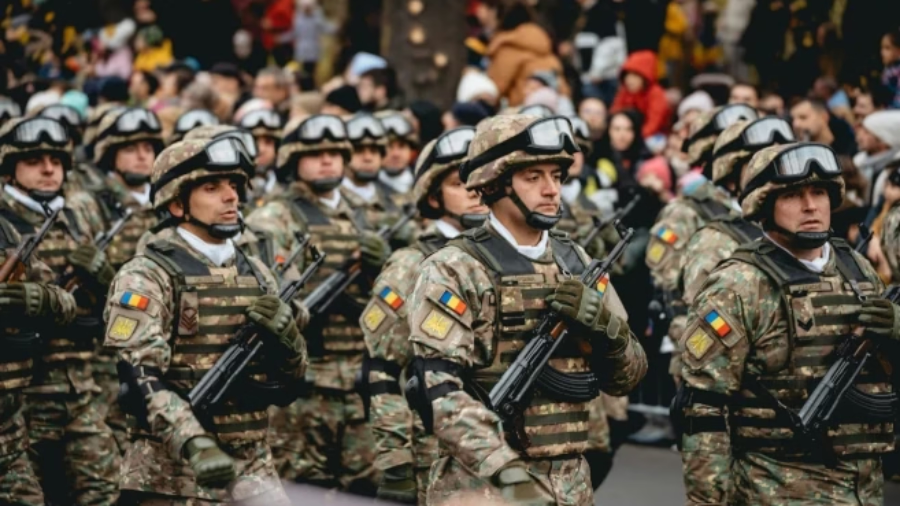
Introduction: A Dangerous Dance of Power
When we talk about coups, political repression, or authoritarian control, we often imagine generals imposing their will over fragile civilian governments. But in reality, the more frequent and subtle danger is the reverse: How Civilian Leaders Manipulate the Military to secure power, silence their opponents, and maintain political dominance.
This dynamic—subtle, strategic, and often invisible—raises profound questions:
- How do civilian political elites gain such influence over the armed forces?
- Why do militaries obey orders that clearly harm citizens?
- Why do some democracies fall into authoritarianism almost overnight?
- And how do seemingly lawful leaders weaponize national defense structures?
Understanding this phenomenon requires unpacking the complex world of civil–military relations, political incentives, institutional weaknesses, and human psychology.
Let’s take a deep and nuanced journey into how civilian regimes—democratic or authoritarian—manage to manipulate, co-opt, and sometimes corrupt the military into becoming their personal tool for political survival.
Why Militaries Matter: The Foundation of Regime Power
Before exploring how manipulation occurs, we must understand why the military is the ultimate pillar of political power.
In every nation, the military represents:
- Monopoly of legitimate force
- National security and territorial integrity
- The final arbiter in political chaos
- A symbol of sovereignty
If a civilian leader loses the military, they lose power—sometimes literally overnight.
If they control it, they become nearly untouchable.
This explains why manipulating the military is one of the oldest political strategies in the world, from ancient empires to modern democracies.
The Tools of Manipulation: How Civilian Leaders Gain Control
Below are the six major strategies civilian leaders use to shape, influence, and weaponize the military.
1. Patronage: Buying Loyalty at the Top
Civilian rulers frequently secure military loyalty through patronage networks:
- Promotions for friendly officers
- Control of budgets and procurement
- Access to economic benefits
- Appointment of “politically safe” generals
- Special privileges and allowances
This method creates a symbiotic relationship:
The military protects the leader, and the leader rewards the military.
This is common in:
- Some African states
- South Asia
- Parts of the Middle East
- Latin America during the Cold War
However, patronage also breeds corruption, internal divisions, and weakened institutional professionalism.
2. Institutional Fragmentation: Divide to Rule
Another tool is deliberate fragmentation of security institutions.
Civilian leaders create:
- multiple intelligence agencies
- different branches of armed forces
- overlapping police units
- private or paramilitary groups loyal to the leader
The purpose is simple:
Divide the security institutions so none can overthrow the regime alone.
Examples include:
- Competing intelligence agencies in Russia
- National Guard vs. Military in Venezuela
- Revolutionary Guards vs. Army in Iran
- Presidential Guards in several African states
This ensures the military remains loyal, busy, and under control.
3. Legal Manipulation: Hiding Repression Behind Law
Modern authoritarianism rarely looks like dictatorship.
Today, it often wears the cloak of legality.
Civilian leaders pass laws that appear constitutional but serve to:
- expand emergency powers
- restrict protest
- criminalize dissent
- give the military internal security roles
- allow warrantless arrests
- centralize power in the executive
When the law says the military must intervene, that intervention looks “legitimate.”
This blurs the line between defense and repression.
4. Ideology and Narrative Building
Civilian leaders know that soldiers don’t blindly obey—they’re influenced by identity, patriotism, and narrative.
So leaders craft powerful ideological stories to justify their commands:
- “The opposition is a threat to national unity.”
- “Protesters are violent extremists.”
- “We are defending democracy from foreign enemies.”
- “Critics are agents of foreign powers.”
Once this narrative is embedded:
- Soldiers believe they are defending the nation,
- Not repressing their own people.
This psychological manipulation is one of the most effective tools of control.
5. Militarizing Politics: Blurring Roles on Purpose
Some leaders embed the military deeply into civilian governance:
- appointing military officers as regional administrators
- involving them in elections
- giving them economic sectors
- using them in public works and development
This increases dependence on political leaders while reducing the military’s professional autonomy.
Over time, officers become political actors rather than neutral defenders of the state.
6. Fear of Chaos: The “Stability Argument”
Perhaps the most powerful emotional manipulation is the promise of stability.
Civilian leaders warn:
- “If you don’t support me, the country will collapse.”
- “We are the only barrier against civil war.”
- “Disloyalty will lead to economic collapse.”
This fear-based messaging convinces the military that supporting the leader is supporting national stability.
Thus, repression becomes framed as patriotism.
Why Militaries Comply: Institutional and Human Factors
Understanding manipulation requires also examining why militaries often succumb to civilian influence.
1. The Military’s Hierarchical Culture
Military culture is built on:
- hierarchy
- obedience
- discipline
- chain of command
This makes challenging civilian orders extremely difficult.
Even when orders conflict with ethics, soldiers and officers may feel bound by duty.
2. Professional Conditioning
Militaries are trained to:
- neutralize threats
- maintain order
- follow instructions
- prioritize security
When political leaders label civilians as threats, militaries often fall in line.
3. Institutional Dependency
Militaries depend on civilian governments for:
- budgets
- equipment
- salaries
- welfare
- compensation
- legal protection
This dependency creates leverage:
“Support me, and I’ll support you.”
4. Fear of Internal Instability
Military leaders often fear:
- civil wars
- chaos
- insurgencies
- state collapse
Civilian leaders exploit this fear to secure compliance.
5. The Ambition Factor
Some military elites are ambitious and benefit from aligning with civilian rulers.
They receive:
- promotions
- contracts
- influence
- access to power
This creates powerful incentives for loyalty.
Case Studies: Comparing Different Regions
Below is a simplified table illustrating how civilian manipulation appears across global contexts:
| Region | Method of Control | Outcome |
|---|---|---|
| Africa | Patronage, presidential guards, fragmented forces | Strongman politics, politicized military |
| Middle East | Ideology, religious legitimacy, elite units | Enduring authoritarianism |
| Latin America | Legal frameworks, cooptation, economic influence | Cycles of democratic erosion |
| Asia | Narrative control, emergency powers, elite alliances | Strong civilian dominance, weak opposition |
| Eastern Europe | Hybrid regimes, intelligence manipulation | Militarized policing, limited dissent |
This demonstrates that civilian manipulation is global—not regional or ideological.
When Manipulation Turns to Repression
Civilian control is not inherently bad.
In democracies, it is necessary for preventing military interference.
But manipulation becomes dangerous when:
- citizens are treated as enemies
- dissent is framed as treason
- the military is used for political survival
- elections are militarized
- opposition is crushed violently
Repression typically escalates through five stages:
1. Surveillance of activists and critics
intelligence agencies gather information
2. Restriction of protests
laws limit gatherings and demonstrations
3. Deployment of police forces
initial show of force to intimidate
4. Involvement of military units
framed as a “security operation”
5. Violent crackdowns
justified by “national stability”
At this point, the civilian leader has weaponized the military—often permanently.
Why Citizens Become Targets
The military is supposed to protect citizens.
So why do some regimes turn their guns inward?
Because to an insecure leader:
- protesters = potential coup
- journalists = destabilizers
- opposition = enemy agents
- civil society = foreign puppets
Manipulation changes the military’s mission from defending the nation to defending the ruler.
Breaking the Cycle: What Can Be Done?
Experts identify four major solutions:
1. Strengthening Institutions
- independent courts
- transparent budgets
- nonpolitical promotion systems
- strong oversight committees
2. Professionalizing the Military
- ethics training
- depoliticized leadership
- independent military codes
- civilian–military education programs
3. Clarifying the Military’s Role
Clear constitutions reduce manipulation.
4. Building Public Awareness
When citizens understand civil–military relations, they become harder to deceive or intimidate.
Conclusion: The Battle for the Soul of the State
Understanding How Civilian Leaders Manipulate the Military is critical for any society that values freedom, accountability, and democratic governance. This manipulation is not always obvious—it often begins quietly, legally, and under the guise of “security.”
But once the military becomes a political tool, a nation risks sliding into repression.
And history shows that once repression begins, it rarely ends voluntarily.
Call to Action
What do YOU think?
Do civilian leaders have too much power over the military?
Are citizens adequately protected from political misuse of force?
Share your thoughts below and explore more of our in-depth analyses on governance, political culture, and state institutions.


