russian-false-claims-on-Ukraine

The Myth of Justification: Deconstructing Russia’s Historical Claims to Ukraine

Meta Description: Russia’s war against Ukraine lacks any historical or legal justification. This in-depth analysis dismantles Putin’s false claims and reveals the truth about Ukrainian sovereignty.


Let me be blunt: Russia’s war against Ukraine is not—and never was—historically justifiable. Not by the standards of international law, not by the facts of history, and certainly not by any moral framework that values human dignity and national sovereignty.

Yet Vladimir Putin has spent years crafting elaborate historical justifications for an invasion that boils down to naked imperial aggression. He’s rewritten history, weaponized memory, and distorted facts to manufacture a pretext for war. And millions have died as a result.

This isn’t academic hairsplitting. Understanding why Russia’s war against Ukraine is historically unjustifiable matters because Putin’s propaganda has convinced many Russians—and confused some observers worldwide—that Moscow has legitimate grievances. Let’s dismantle these lies systematically.

The “One People” Myth: Putin’s Foundational Lie

What Putin Claims

In his infamous 5,000-word essay “On the Historical Unity of Russians and Ukrainians,” published in July 2021, Putin argued that Ukrainians and Russians are “one people” sharing a common heritage from Kievan Rus. He claims Ukraine never existed as a separate state and that Ukrainian nationality was always part of a “triune nationality” alongside Russians and Belarusians.

In his February 21, 2022 speech—just days before the invasion—Putin went further, declaring Ukraine was an artificial creation of Soviet leaders, particularly Vladimir Lenin. He literally suggested Ukraine should be renamed for its supposed “author.”

The Historical Reality

This is historical revisionism of the most egregious kind. Yes, Russians, Ukrainians, and Belarusians all trace roots to Kievan Rus (862-1242), a loose medieval federation. But as University of Rochester historian Matthew Lenoe explains, acknowledging shared medieval origins doesn’t justify modern conquest any more than England could claim France because of Norman heritage.

Ukrainian identity has deep historical roots extending back centuries:

The Cossack Era (16th-18th centuries): Ukrainian Cossacks established the Zaporozhian Sich, a semi-autonomous military republic that defended Ukrainian lands and developed distinct political traditions. This wasn’t “Russian” identity—it was distinctly Ukrainian self-governance that often resisted Russian imperial expansion.

Cycles of National Revival: Despite Russian and Soviet repression, Ukrainian language, culture, and national consciousness persisted and repeatedly reasserted itself throughout the 19th and 20th centuries. The fact that these movements had to be violently suppressed proves Ukrainian identity existed independently.

The 1991 Referendum: When given the chance to freely express their will, over 90% of Ukrainians voted for independence, with majorities in every single region—including 55% in Crimea and solid majorities in the Donbas. Even 55% of ethnic Russians living in Ukraine voted for Ukrainian independence.

This wasn’t a close call manufactured by Western propaganda. It was an overwhelming democratic mandate across all of Ukraine’s diverse regions and ethnicities.

The NATO “Threat” Excuse: Manufacturing an Enemy

The Russian Narrative

Putin claims Russia’s war against Ukraine was necessary to prevent NATO expansion that threatens Russian security. He frames Ukraine’s potential NATO membership as an existential threat justifying military intervention.

Why This Fails Every Test

Ukraine wasn’t joining NATO: At the time of invasion, Ukraine had no membership action plan and NATO had made no commitment to Ukrainian membership. In fact, Germany and France had blocked Ukraine’s NATO path at the 2008 Bucharest Summit. The “imminent NATO threat” was entirely fictional.

Sovereign nations choose their alliances: Even if Ukraine wanted to join NATO—which is its sovereign right—this doesn’t justify invasion. Mexico choosing to ally with China wouldn’t give the United States legal grounds to invade Mexico City.

The real threat: Putin doesn’t fear NATO tanks on Russia’s border (Finland joined NATO in 2023 without Russian invasion). He fears something far more dangerous to autocracy: Ukrainian democracy succeeding. A prosperous, democratic Ukraine would expose the lie that Slavic peoples need strongman rule. That’s the existential threat Putin actually fears.

International law is clear: Article 2(4) of the UN Charter prohibits the use of force against territorial integrity. Self-defense (Article 51) requires an actual armed attack—which Ukraine never launched or threatened.

The “Denazification” Absurdity

Putin’s Propaganda

One of the most offensive justifications for Russia’s war against Ukraine is the claim that Russia must “denazify” Ukraine, supposedly run by fascists and neo-Nazis oppressing Russian speakers.

The Reality Check

Ukraine’s president is Jewish: Volodymyr Zelenskyy, whose grandfather fought the Nazis and whose family members died in the Holocaust, leads a government Putin calls “Nazi.” The absurdity speaks for itself.

Far-right parties receive minimal support: Ukraine’s nationalist parties peaked at about 10% in 2012 and have since dropped below 5%. By contrast, far-right parties in Russia, France, Italy, and even the United States often poll higher.

The complicated history: Yes, some Ukrainian nationalists collaborated with Nazis during World War II—as did some Russians, Belarusians, Balts, and others under brutal occupation. The 2012 designation of Stepan Bandera as “Hero of Ukraine” was controversial and faced significant liberal opposition within Ukraine. But this doesn’t make modern Ukraine “Nazi.”

Foreign Policy notes that even Wagner Group founder Yevgeny Prigozhin—before his mutiny—admitted the Nazi threat was manufactured. Russia’s own mercenary leader called out the lie before rebelling against Putin.

The “Genocide” Fabrication

The Russian Claim

Putin alleged Ukrainian forces were committing “genocide” against Russian speakers in Donbas, with propaganda machines claiming “for eight years they bombed Donbas!”

The Facts

Civilian casualties were relatively low: From 2015-2022, civilian deaths in Donbas numbered in the hundreds, not the tens of thousands a genocide would require. Professor Thomas Sherlock notes this claim “lacks any supporting evidence.”

Russia fueled the conflict: The fighting in Donbas was sustained by Russian weapons, funding, and military personnel supporting separatists. Moscow wasn’t protecting Russian speakers—it was creating the very conflict it claimed to be solving.

Language rights were protected: Despite Russian propaganda, Russian language use was never banned in Ukraine. Russian remained widely spoken across eastern and southern Ukraine. The 2019 language law promoted Ukrainian in official contexts but didn’t prohibit Russian.

The Linguistic Manipulation

Russian state media even weaponizes grammar. They use “na Ukraine” (on Ukraine) instead of “v Ukraine” (in Ukraine)—treating Ukraine as a region rather than a sovereign state. This linguistic colonialism appears throughout Russian official discourse, subtly delegitimizing Ukrainian statehood in the minds of Russian citizens.

The “Protecting Russians Abroad” Gambit

The Justification

Moscow claims a responsibility to protect ethnic Russians living outside Russia’s borders—approximately 8 million in Ukraine in 2001, primarily in the south and east.

Why This Doesn’t Work

The “responsibility to protect” doctrine: This legitimate international norm applies to preventing mass atrocities like genocide. It doesn’t give countries carte blanche to invade neighbors because co-ethnics live there. Otherwise, France could invade Quebec, Germany could invade Austria, and Turkey could invade Germany (home to millions of ethnic Turks).

Russia violated the Budapest Memorandum: In 1994, Ukraine gave up the world’s third-largest nuclear arsenal in exchange for security guarantees from Russia, the United States, and United Kingdom. Russia’s invasion shattered these solemn commitments, teaching future nuclear aspirants that disarmament guarantees mean nothing.

Ethnic Russians weren’t under threat: Ukrainian Russians weren’t facing systematic persecution. Many held prominent positions in government, business, and society. The mayor of Russian-speaking Kharkiv—a city Russia now shells regularly—was ethnically Russian himself.

The Historical Precedent Putin Actually Follows

Let’s acknowledge the uncomfortable truth: Russia’s war against Ukraine does follow historical precedent—just not the righteous kind Putin claims.

The Sudetenland Playbook

Putin’s annexation strategy mirrors Hitler’s absorption of Czechoslovakia’s Sudetenland in 1938. The pattern is identical:

  1. Claim co-ethnics face persecution in a neighboring country
  2. Foment unrest and support separatists
  3. Demand territorial concessions to “protect” the persecuted
  4. Annex the territory
  5. Insist this is the final demand

The Lieber Institute at West Point notes that while carried out in different legal contexts, these territorial expansions share the same imperial DNA stretching back to 19th century colonialism.

Russia’s Own Imperial Pattern

Georgia 2008: Russia invaded Georgia, recognized South Ossetia and Abkhazia as independent, and maintains military occupation today.

Crimea 2014: Russia annexed Crimea after a sham referendum conducted under military occupation.

Donbas 2014-2022: Russia supported separatists, creating frozen conflict to destabilize Ukraine.

Full invasion 2022: Russia launched a massive war of conquest.

This is imperial expansion, pure and simple. Putin himself has compared his actions to Peter the Great’s conquests, saying the goal is to “reclaim historically Russian lands.” At least that’s honest imperialism.

What International Law Actually Says

Let’s cut through the propaganda and examine what international law—which Russia claims to respect—says about Russia’s war against Ukraine.

The Legal Consensus is Unanimous

Article 2(4) of the UN Charter: All UN members “shall refrain in their international relations from the threat or use of force against the territorial integrity or political independence of any state.” Russia violated this foundational principle.

No valid self-defense claim: Article 51 permits self-defense against armed attack. Ukraine launched no attack against Russia. Even Russia’s claim of defending the “Donetsk and Luhansk People’s Republics” fails because these weren’t recognized states and no armed attack threshold was met.

The UN General Assembly’s verdict: Multiple resolutions have condemned Russia’s invasion:

  • Resolution ES-11/1 (March 2022): 141 countries condemned Russian aggression (only 5 opposed: Russia, Belarus, North Korea, Eritrea, Syria)
  • Resolution 68/262 (2014): Affirmed Ukraine’s territorial integrity after Crimea’s annexation
  • Resolution ES-11/4 (2022): Declared referendums in occupied territories illegal

Budapest Memorandum violation: Russia explicitly guaranteed Ukraine’s borders in 1994. This wasn’t ambiguous—it was a treaty obligation Russia shredded.

The Legal Experts Weigh In

The European Council on Foreign Relations states unequivocally: “Russia’s invasion of Ukraine is a clear act of aggression and a manifest violation” of the UN Charter.

Lawfare’s analysis confirms Russia’s justifications are “absurd” and that Putin’s speech “highlights that international law retains some rhetorical significance while it simultaneously underscores how weak the legal restraints are in practice.”

The Brookings Institution notes that while the U.S. invasion of Iraq in 2003 was also illegal and corrosive to international order, “one illegal use of force does not justify another.”

The Crime of Aggression

Russia’s war against Ukraine constitutes the crime of aggression under international criminal law. While procedural obstacles prevent ICC prosecution (Russia isn’t a member), multiple countries have opened investigations under universal jurisdiction principles.

War crimes prosecutions are already underway for documented atrocities in Bucha, Mariupol, and elsewhere—crimes including murder, torture, deportation of children, and deliberate targeting of civilians.

The Referendum Sham

After capturing territory in 2022, Russia held “referendums” in occupied Donetsk, Luhansk, Zaporizhzhia, and Kherson regions, claiming local populations wanted to join Russia.

Why These Were Illegal

Conducted under occupation: Residents voted at gunpoint with Russian soldiers present. That’s not democratic expression—it’s coercion.

No international monitoring: These referendums lacked any independent observation or verification.

Displacement of populations: Russia had already deported or displaced pro-Ukrainian residents before voting.

Short notice and suspicious results: Hasty organization and implausibly high “yes” votes (often above 95%) signal fraud.

Violation of uti possidetis: International law principle holds that new nations keep their colonial borders to prevent territorial conflicts. Changing borders by force threatens global stability.

The UN General Assembly declared these annexations illegal, with the Kenyan ambassador noting: “At independence, had we chosen to pursue states on the basis of ethnic, racial or religious homogeneity, we would still be waging bloody wars these many decades later.”

The Ukrainian Identity Question

Perhaps Putin’s most fundamental error is denying Ukrainian identity exists as something distinct from Russian identity.

The Evidence Against Putin’s Claims

Language shift: In 1991, Russian speakers outnumbered Ukrainian speakers in most eastern oblasts. By 2001, Ukrainian speakers were the majority everywhere except Crimea, Donetsk, and Luhansk. Today, over two-thirds of Ukrainian citizens claim Ukrainian as their native language.

This shift reflects individual choices and state policy promoting Ukrainian—a normal process for newly independent nations establishing linguistic identity.

Religious independence: The 2018 granting of autocephaly (independence) to the Orthodox Church of Ukraine from Moscow’s control represents another step in Ukrainian disentanglement from Russia. Support for the Moscow-controlled church has plummeted from 23.6% in 2010 to around 12% today.

Political divergence: Ukrainian and Russian political outlooks have steadily diverged since 1991, with Ukrainians increasingly identifying with European democratic values rather than Russian authoritarianism.

The war itself proves Ukrainian identity: If Ukrainians and Russians were truly “one people,” why have millions of Ukrainians fought desperately to resist Russian rule? Why have Ukrainian soldiers died by the tens of thousands defending their country? The heroic resistance proves Putin’s fundamental premise false.

The “Historic Justice” Illusion

Putin’s Grievance Narrative

Putin frames Russia’s war against Ukraine as correcting historical injustices—reversing the USSR’s “catastrophic” collapse, rectifying Khrushchev’s 1954 “error” of transferring Crimea to Ukraine, and restoring Russia’s “rightful” sphere of influence.

Why Historical Grievances Don’t Justify Modern War

Every border was drawn at some point: If historical grievances justified changing borders by force, the entire international system collapses. Poland has stronger historical claims to parts of Ukraine (and Ukraine to parts of Poland) than Russia does to Crimea. Should we relitigate every historical boundary?

The USSR’s collapse wasn’t a crime: The Soviet Union dissolved because its constituent republics—including Russia itself—chose independence. Boris Yeltsin, as Russian president, recognized Ukrainian independence on December 2, 1991. Russia helped dissolve the USSR through the Belavezha Accords.

Crimea was transferred legally: Whatever one thinks of Khrushchev’s 1954 decision, it occurred within the Soviet system’s legal framework. When the USSR dissolved, Ukraine inherited Crimea—just as Russia inherited territories that weren’t historically Russian.

“Historic justice” is selective: Putin ignores the Holodomor—Stalin’s engineered famine that killed millions of Ukrainians in 1932-33. If we’re settling historical accounts, shouldn’t that genocide warrant reparations? But Putin’s “justice” only flows in Russia’s favor.

What Genuine Concern for Russian Speakers Would Look Like

If Moscow genuinely cared about Russian speakers in Ukraine (rather than using them as a pretext), we’d see:

Diplomatic engagement: Russia could have worked through international organizations to address any legitimate grievances about language rights.

Economic support: Invest in Russian-speaking communities rather than funding armed separatists.

Respect for their choices: Many Russian speakers fought in Ukraine’s military against Russian invasion. Moscow claims to “protect” people who explicitly reject that “protection.”

Not bombing them: Russian forces have destroyed Russian-speaking cities like Mariupol, killing tens of thousands of the very people Russia claims to protect.

The contradiction exposes the lie: this was never about protecting Russian speakers. It was about subjugating all Ukrainians.

The Double Standards Dilemma

Critics rightly note that the international community responded more forcefully to Russia’s invasion of Ukraine than to other illegal uses of force—particularly U.S. interventions in Iraq, Libya, and elsewhere.

This is a legitimate concern about double standards. But it doesn’t justify Russia’s war against Ukraine.

Two Wrongs Don’t Make a Right

Legal principle: As Professors Blum and Modirzadeh note, “one illegal use of force does not justify another.” The correct response to American violations of international law is to strengthen the rules, not to abandon them entirely.

Scale matters: The Iraq War was illegal and catastrophic. But it didn’t aim to erase Iraqi nationhood or annex Iraqi territory permanently to the United States. Russia explicitly denies Ukraine’s right to exist as an independent state—a far more fundamental challenge to international order.

Whataboutism doesn’t equal justification: Pointing to Western hypocrisy may be valid criticism, but it doesn’t make Russia’s invasion legal or morally defensible.

The solution to double standards is consistent application of international law—including accountability for all violations—not acceptance of a lawless world where might makes right.

What This War Actually Threatens

The Rules-Based International Order

Political scientists document that interstate conflict over territory is more likely to escalate into full-scale war than other disputes. The link between territorial conflict and militarized disputes suggests international law is most effective at generating peace by reducing conflict over territory.

The prohibition on conquest—enshrined in the UN Charter and multiple subsequent agreements—has largely succeeded since 1945. Borders have been remarkably stable compared to pre-World War II eras.

If Russia’s war against Ukraine succeeds in permanently changing borders by force, this framework collapses:

China and Taiwan: Beijing watches intently. If Russia conquers Ukraine with limited consequences, Taiwan’s prospects dim.

Every frozen conflict reactivates: From Moldova to the Caucasus to the Balkans, frozen conflicts could become hot wars.

Nuclear proliferation: Ukraine gave up nukes for security guarantees that proved worthless. Every nation considering disarmament now recalculates. Iran, North Korea, and others see validation for their nuclear programs.

Emboldening authoritarians globally: From the Middle East to Africa to Southeast Asia, autocrats observe whether territorial conquest still works in the 21st century.

The Verdict of History

Let me state this as clearly as possible: Russia’s war against Ukraine has no legitimate historical justification whatsoever.

Putin’s historical claims are fabrications built on selective memory, invented threats, and imperial nostalgia. His legal arguments fail every test of international law. His moral case collapses under the weight of dead Ukrainian civilians.

What History Will Remember

Future historians—including Russian historians, once Putin’s propaganda apparatus eventually falls—will judge this war with the same clarity we now view Hitler’s invasion of Czechoslovakia or Iraq’s invasion of Kuwait: naked aggression dressed up in elaborate justifications that convinced no one but those with interests in being convinced.

The Atlantic Council’s analysis of Russia’s new history textbook—which glorifies imperial expansion and dehumanizes Ukrainians as Nazis—reveals the Orwellian rewriting of history necessary to maintain the war’s justifications.

When a regime must ban the word “war,” imprison dissidents for calling the conflict what it is, and mandate propagandistic textbooks to indoctrinate children, it reveals the fundamental weakness of its position.

The Test Ukraine Poses

Ukraine has become a test case for whether the post-World War II international system—imperfect as it is—can survive the 21st century.

If territorial conquest succeeds, we return to a world where borders are decided by military force, where democracies live at the mercy of nuclear-armed neighbors, and where international law becomes a polite fiction.

If Ukraine prevails with international support, we affirm that sovereignty matters, that international law has meaning, and that democratic nations will defend each other against authoritarian aggression.

The Way Forward

What Justice Requires

Ukrainian territorial integrity: Ukraine’s borders as they existed on January 1, 2014 must be restored. Every inch of occupied territory—Crimea, Donbas, Zaporizhzhia, Kherson—belongs to Ukraine under international law.

Accountability for war crimes: Documented atrocities demand prosecution. The ICC investigation must continue, with perpetrators held responsible regardless of rank.

Reparations: Russia must compensate Ukraine for the massive destruction it has caused. Frozen Russian assets should fund Ukrainian reconstruction.

Security guarantees: Ukraine needs concrete security commitments to prevent future Russian aggression—whether through NATO membership, bilateral guarantees, or other mechanisms with teeth.

The Choice Before the World

Every nation must decide: Do we live in a world governed by law and mutual respect for sovereignty, or a world where power alone determines outcomes?

The answer will shape the 21st century.

Conclusion: Truth Matters

Russia’s war against Ukraine is not historically justifiable by any honest reading of history, any fair application of international law, or any moral framework that values human life and dignity over imperial ambition.

Putin’s elaborate historical justifications are propaganda—clever lies told with conviction, but lies nonetheless.

The truth is simpler and darker: An authoritarian leader, afraid of democracy succeeding next door, chose to invade a neighboring country to prevent its people from choosing their own destiny.

Everything else is window dressing.

Your Role in This Story

Share the truth. Counter the propaganda. Support Ukrainian resistance. Pressure governments to maintain support for Ukraine’s defense.

Because Russia’s war against Ukraine isn’t just about Ukraine—it’s about whether we allow authoritarian aggression to reshape the world, or whether we defend the principle that might doesn’t make right.

History is watching. Choose your side carefully.


Take Action

This isn’t just a historical debate—it’s happening now, with people dying every day. Here’s what you can do:

Educate yourself and others: Share accurate information. Counter Russian propaganda when you encounter it. Use the sources linked throughout this article.

Support Ukrainian refugees: Millions have been displaced. Organizations worldwide need donations and volunteers.

Contact elected representatives: Urge continued military and humanitarian aid to Ukraine. Sanctions on Russia must remain until full withdrawal.

Remember the human cost: Behind every statistic is a person—someone’s child, parent, sibling, friend. Keep their stories alive.

Defend truth: In an age of disinformation, simply stating facts clearly is a revolutionary act.

The world is watching to see whether the post-World War II commitment to preventing wars of conquest still means anything. Make sure your voice is heard.


References & Further Reading

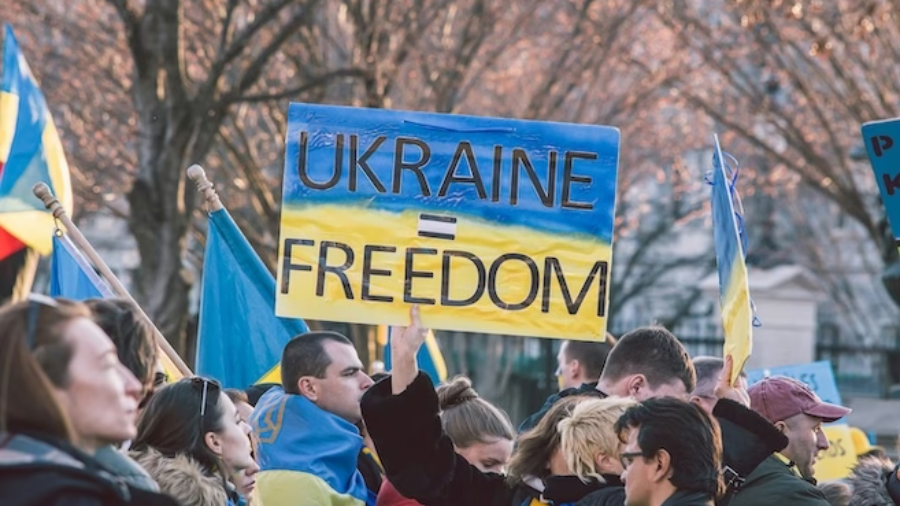
Ukraine needs freedom

When Diplomacy Becomes Deference: The Dangerous Reality of President Donald Trump’s Softness Towards Vladimir Putin

Introduction

Let’s cut through the diplomatic niceties and confront an uncomfortable truth: President Donald Trump’s relationship with Russian President Vladimir Putin isn’t just unusual—it’s actively undermining decades of international security architecture and emboldening aggression at precisely the moment when global peace hangs in the balance.

As I write this on December 30, 2025, the world watches another chapter unfold in this troubling saga. Just this past Sunday, Trump spoke with Putin for over an hour before hosting Ukrainian President Volodymyr Zelenskyy at Mar-a-Lago, reportedly catching Ukrainian officials off guard. The optics alone should alarm anyone concerned about America’s role as a defender of democracy and international law.

The Pattern of Presidential Deference

Helsinki: The Original Sin

To understand President Donald Trump’s softness towards Vladimir Putin and its impact on international peace, we must rewind to July 16, 2018. Standing beside Putin in Helsinki, days after Special Counsel Robert Mueller indicted twelve Russian intelligence officers for election interference, Trump delivered what Senator John McCain called “one of the most disgraceful performances by an American president in memory.”

Trump’s own words that day remain stunning: “I have great confidence in my intelligence people, but I will tell you that President Putin was extremely strong and powerful in his denial today.” He chose Putin’s “denial” over the unanimous assessment of seventeen U.S. intelligence agencies. This wasn’t diplomacy—it was capitulation on the world stage.

Former CIA Director John Brennan didn’t mince words, calling Trump’s performance “nothing short of treasonous.” Even Trump’s usual allies recoiled. Former House Speaker Newt Gingrich termed it “the most serious mistake of his presidency.”

What makes Helsinki particularly relevant today? Trump himself referenced it during Sunday’s meeting with Zelenskyy, claiming the “Russia, Russia, Russia hoax” had somehow bonded him with Putin. This revisionist history ignores a documented Russian interference campaign that has been confirmed by multiple bipartisan investigations, Mueller’s probe, and Trump’s own intelligence officials.

The NATO Threat That Won’t Die

President Donald Trump’s softness towards Vladimir Putin manifests most dangerously in his consistent undermining of NATO, the most successful military alliance in history. In February 2024, Trump told a rally crowd that he would “encourage” Russia to do “whatever the hell they want” to NATO countries he deemed “delinquent” on defense spending.

Think about that for a moment. An American president—the leader of NATO’s most powerful member—publicly encouraging Russian aggression against democratic allies.

NATO Secretary General Jens Stoltenberg’s response was unusually blunt: “Any suggestion that allies will not defend each other undermines all of our security, including that of the US, and puts American and European soldiers at increased risk.”

The criticism transcended party lines. President Biden called it “appalling and dangerous,” while Polish Defense Minister Władysław Kosiniak-Kamysz warned that “undermining the credibility of allied countries means weakening the entire NATO.”

Here’s what Trump fundamentally misunderstands: NATO isn’t a protection racket where countries pay dues. It’s a collective defense agreement where an attack on one is an attack on all—a principle that has prevented World War III for seventy-five years. The 2% GDP defense spending goal is about each nation’s domestic military investment, not payments to the United States.

Trump’s NATO rhetoric does Putin’s work for him. Russia doesn’t need to attack when doubt about American commitment might paralyze the alliance’s response to aggression in the Baltic states or Eastern Europe.

The Current Crisis: Territorial Concessions and False Peace

The Troubling Mar-a-Lago Summit

Sunday’s meeting revealed that territorial demands in the Donbas region remain the thorniest unresolved issue, with Trump pushing for an agreement that would require painful Ukrainian concessions. Sources close to the Ukrainian government have characterized the proposal as heavily biased toward Russia, noting it clearly specifies Russia’s tangible gains while being vague about Ukraine’s benefits.

The leaked details of Trump’s peace framework are staggering:

  • De facto U.S. recognition of Russian control over Crimea, nearly all of Luhansk, and occupied portions of Donetsk, Kherson, and Zaporizhzhia
  • Ukraine would cede additional territory in Donbas beyond what Russia has captured
  • Constitutional abandonment of NATO membership
  • Limits on Ukraine’s military to 600,000-800,000 personnel
  • Establishment of a demilitarized zone

This isn’t peace—it’s rewarding aggression. Russia invaded a sovereign nation, killed hundreds of thousands, committed documented war crimes, and now Trump proposes legitimizing these conquests.

The Ceasefire Rejection That Speaks Volumes

Perhaps most revealing: Trump and Putin jointly rejected Ukraine’s proposal for a temporary ceasefire, with Trump stating he understood Putin’s position that stopping and potentially restarting would be problematic. This alignment with Putin over Zelenskyy exposes where Trump’s sympathies truly lie.

Zelenskyy wants a sixty-day ceasefire to hold a referendum on territorial concessions—a democratic process allowing Ukrainians to decide their own fate. Putin wants no ceasefire, only immediate capitulation. And Trump? He sides with the autocrat who invaded, not the democratically elected leader defending his homeland.

The Strategic Consequences: Why This Matters Beyond Ukraine

Emboldening Global Aggression

Every territorial concession to Russia sends a message to authoritarian regimes worldwide: military aggression works. China watches intently as it considers Taiwan. Iran observes as it calculates regional moves. North Korea takes notes on nuclear brinkmanship.

The Carnegie Endowment for International Peace warns that Trump’s “Russia First” approach may attempt to pull Putin from Xi Jinping’s orbit, but it’s more likely to undermine the most successful alliance in history and make the world more dangerous for both America and Europe.

The Erosion of Democratic Unity

Trump’s recent National Security Strategy document describes the U.S. as “at odds” with European NATO allies over “unrealistic expectations” for Ukraine and criticizes them for “subversion of democratic processes” to suppress opposition wanting quicker peace with Russia.

Let that sink in. The American president is attacking democratic allies for supporting a democracy under invasion while cozying up to the autocrat doing the invading. This inverted moral framework threatens the entire post-World War II international order.

Military Reality: Starving Ukraine While Russia Advances

President Donald Trump’s softness towards Vladimir Putin has manifested in concrete military consequences. Ukrainian commanders now face artillery fire ratios as dire as 1:9, directly resulting from suspended U.S. ammunition shipments. This isn’t leverage—it’s manufacturing the “military reality” used to justify territorial concessions.

By depriving Kyiv of defensive weapons, Washington creates the very weakness it then cites as reason for surrender. Russia advances 12-17 square kilometers daily not because of superior military prowess, but because Ukraine fights with one hand tied behind its back.

The Historical Parallel We Can’t Ignore

This moment echoes the 1930s in uncomfortable ways. Then, Western democracies chose appeasement, allowing Hitler to consume territory piece by piece—the Rhineland, Austria, the Sudetenland—each time accepting assurances that this would be the last demand.

We know how that ended.

Putin has already taken Crimea in 2014, parts of Georgia in 2008, and now large swaths of Ukraine. What makes anyone believe recognizing these conquests will satisfy him rather than embolden him? History suggests the opposite.

As the Institute for the Study of War notes, at current advance rates, Russia wouldn’t fully capture Donetsk until August 2027. Yet Trump pushes Ukraine to surrender it now, manufacturing urgency that serves only Putin’s interests.

What Genuine Peace Would Require

Let’s be clear: wanting peace isn’t naive. Everyone wants this devastating war to end. But peace isn’t simply the absence of active combat—it requires conditions that prevent future aggression.

A genuine peace framework would include:

Security Guarantees with Teeth
Not vague promises, but binding commitments from NATO members to defend Ukraine against future Russian attacks. The alternative is watching Putin rebuild his military and attack again in 5-10 years.

Territorial Integrity
International law prohibits changing borders by force. Any settlement legitimizing Russia’s conquests destroys this principle and invites global chaos.

Accountability for War Crimes
Documented atrocities in Bucha, Mariupol, and elsewhere demand justice, not amnesty. Trump’s original plan included automatic amnesty for all war crimes—a moral obscenity.

Ukrainian Self-Determination
Any territorial concessions must receive approval through free referendum under international supervision during a genuine ceasefire—not forced acceptance under ongoing bombardment.

Rebuilding Support Without Rewarding Aggression
Reconstruction aid should come from frozen Russian assets and the international community, not from normalizing relations with Moscow before accountability.

The European Response: Democracy’s Last Stand?

To their credit, European allies haven’t followed Trump down this path. France’s Emmanuel Macron has convened a “Coalition of the Willing” meeting in Paris for early January, ensuring Europe isn’t sidelined by a Washington-Moscow deal.

The European counter-proposal rejects preordained territorial concessions, keeps NATO membership as an option pending alliance consensus, and proposes using frozen Russian assets for reconstruction rather than handing them to U.S. investors. It reaffirms Ukraine’s sovereignty rather than bartering it away.

The Kremlin rejected this European framework, calling it “completely unconstructive.” Of course they did—it doesn’t give Putin everything he wants.

That European leaders must work around American policy rather than with it represents a profound failure. The transatlantic alliance faces its gravest crisis since World War II, not from external threat but from American abdication.

The Questions Trump Can’t Answer

President Donald Trump’s softness towards Vladimir Putin raises questions that deserve straight answers:

Why does Trump consistently accept Putin’s word over American intelligence? From election interference to current negotiations, Trump sides with Moscow’s version of events despite overwhelming evidence to the contrary.

Why the rush to deal-making that benefits Russia? Trump boasted he’d end the war in a day as a candidate. Now he pushes Ukraine toward territorial surrender while Russia bombs civilians during peace talks.

What happened in Helsinki? That two-hour private meeting between Trump and Putin, with no American note-taker present, remains shrouded in mystery. What was discussed that Trump doesn’t want disclosed?

Why undermine NATO while courting Putin? Trump threatens America’s oldest allies while seeking to normalize relations with a regime that invaded a neighbor, committed war crimes, and continuously threatens Europe.

What does Putin have on Trump? Whether kompromat, business entanglements, or simple ego manipulation, something drives Trump’s consistent pro-Kremlin tilt that defies American interests.

The Stakes: Beyond Ukraine to Global Order

This isn’t just about one country in Eastern Europe. The international order built after World War II—however imperfect—has prevented great power conflicts for eighty years. It’s based on principles: territorial integrity, collective security, democratic self-determination, and accountability for aggression.

President Donald Trump’s softness towards Vladimir Putin threatens these foundational concepts. If military conquest succeeds in Ukraine with American blessing, every border dispute becomes a potential war. Every dictator with military capability and territorial ambitions gets a green light.

The Defense Post warns that without restored U.S. commitment, European countermeasures may prove insufficient against Russia emboldened by diplomatic concession. Trump may believe he’s closing a deal, but he’s actually presiding over the quiet normalization of a Russian sphere of influence.

A Call for Moral Clarity

Americans deserve better than a president who treats democratic allies as adversaries and autocrats as friends. We need leadership that understands that genuine strength means defending principles, not cutting deals that reward aggression.

Supporting Ukraine isn’t about foreign aid charity—it’s about preserving a world where borders aren’t changed by force, where democracies stand together, where international law matters. Every dollar spent supporting Ukraine’s defense saves future expenditures confronting unchecked aggression elsewhere.

President Donald Trump’s softness towards Vladimir Putin represents a betrayal of these values and a danger to American interests. His approach doesn’t make America safer—it makes the world more dangerous for everyone.

What Happens Next?

The negotiations continue. Trump projects optimism while acknowledging talks could “go poorly.” European leaders scramble to salvage what they can. Ukrainian forces fight and die daily as diplomatic games play out in luxury Florida estates.

Putin watches, calculating, knowing time favors Russia as Ukrainian ammunition dwindles and Trump pushes Zelenskyy toward capitulation. The Russian leader gets what he wants without winning militarily—Trump does the work for him.

Meanwhile, the fundamental question looms: When this “peace” inevitably collapses because it rewards rather than punishes aggression, will Trump finally understand that appeasement never works? Or will we repeat this cycle as Putin eyes Moldova, Georgia, or the Baltic states?

History suggests we already know the answer. The only question is whether enough Americans recognize the danger before it’s too late.


Take Action

This isn’t academic theory—it’s unfolding now with consequences for decades to come. Contact your representatives in Congress. Demand they support robust Ukraine aid regardless of presidential pressure. Support organizations working to preserve democracy and international law. And when you vote, remember that leadership matters, that moral clarity matters, and that President Donald Trump’s softness towards Vladimir Putin represents a clear and present danger to peace.

The time for silence has passed. Democracy requires vigilance, and right now, it needs your voice.


References

threats against Trump critics

Is Donald J. Trump the Most Dangerous Human Being on Earth? A Multi-Perspective Analysis

Meta Description: Examining whether Donald J. Trump most dangerous human being claims hold merit through analysis of democratic norms, foreign policy disruption, and opposing viewpoints on his presidency.


When historians evaluate the most consequential—and controversial—figures of the early 21st century, Donald J. Trump’s name inevitably surfaces. The question of whether the 47th U.S. President represents the most dangerous human being on earth presently sparks fierce debate across political, academic, and international spheres. This analysis examines multiple perspectives on Trump’s influence, exploring concerns about democratic institutions, international stability, and social cohesion alongside counterarguments defending his policies and approach.

The Democratic Backsliding Argument

Concerns from Political Scientists

A striking development emerged in early 2025 when more than 500 political scientists surveyed by Bright Line Watch gave American democracy a rating that plummeted from 67 (after Trump’s November election) to 55 just weeks into his second term. Harvard professor Steven Levitsky, co-author of “How Democracies Die,” characterizes the current situation starkly: the United States has slid into what he describes as a relatively mild but reversible form of authoritarianism.

The concerns center on several key areas. During his first week as president in January 2025, Trump issued numerous executive orders, statements, and restructurings that targeted the executive branch, horizontal institutions, and civil society, with this three-level effort continuing in subsequent months. The Carnegie Endowment for International Peace notes that while Trump’s pursuit of executive dominance has been particularly fast, the degree of democratic erosion isn’t yet as severe as in most backsliding peer nations.

Project 2025 and Institutional Transformation

The Heritage Foundation’s Project 2025 blueprint has become central to understanding Trump’s second-term agenda. Within the first six months of Trump’s second term, nearly half of Project 2025’s hundreds of policy proposals were implemented, touching virtually every aspect of public and private life. Critics argue this represents a systematic dismantling of checks and balances that have existed since the nation’s founding.

Trump’s pardon of roughly 1,500 January 6 insurrectionists on his first day in office, including individuals who assaulted police officers, raised concerns about undermining the impartiality and independence of U.S. rule of law. The Brookings Institution warns that such actions threaten the pillars of protecting elections, defending rule of law, and fighting corruption.

The Unitary Executive Theory Push

Trump’s administration has aggressively pursued the unitary executive theory, arguing for maximum presidential control over the executive branch. In December 2025, Supreme Court arguments on Trump’s firing of Federal Trade Commissioner Rebecca Slaughter revealed the administration’s expansive vision of presidential power. US Solicitor General D. John Sauer argued for far-reaching power that would extend well beyond the ability to fire officials at independent agencies, prompting Justice Elena Kagan to warn that “once you’re down this road, it’s a little bit hard to see how you stop”.

The conservative Supreme Court majority appears sympathetic to these arguments, potentially overturning 90 years of precedent limiting presidential removal powers. Critics warn this could fundamentally restructure American governance by eliminating genuine independence from regulatory agencies designed by Congress to be insulated from political interference.

International Disruption and Foreign Policy Chaos

Allies Alienated, Adversaries Emboldened

Trump’s approach to international relations represents perhaps the most visible manifestation of disruption. When Trump took office in 2017, he unknowingly surrounded himself with foreign policy officials who rejected his worldview and sought to deflect his impulses, but Trump now sees these staffing choices as mistakes he will not repeat, assembling a team prizing loyalty over qualifications and expertise.

The consequences have been significant. A Fox News survey found that 55 percent of registered voters disapprove of Trump’s job performance, with the president underwater on both tariffs (33 percent to 58 percent) and foreign policy (40 percent versus 54 percent). Allied nations have expressed dismay at Trump’s unpredictable approach, with both Beijing and Moscow reportedly cheering the strain on U.S. alliance networks.

Withdrawal from International Institutions

Trump’s second term has seen sweeping withdrawals from multilateral organizations. During his first eleven days in office, Trump withdrew the United States from the Paris Agreement and the World Health Organization, imposed a ninety-day pause on most U.S. foreign aid programs, and suggested using force to claim Greenland and retake the Panama Canal.

Stephen Walt of Harvard University argues that Trump fundamentally misunderstands international relations. Wise leaders recognize that norms, rules, and institutions serve as useful tools for managing relations between states. Trump’s team views these as annoying constraints, believing unpredictability maximizes U.S. leverage—without realizing that chronic rule-breaking forces others to seek more reliable partners.

The “America First” Paradox

When Americans were given twelve adjectives to choose from regarding Trump’s foreign policy approach, they most frequently described him as reckless or destructive, though also tough. On most foreign policy issues, more Americans believe Trump is making things worse than better, with negative net approval on relations with China, climate change, foreign trade, relations with U.S. allies, America’s international standing, and nuclear risk.

The Counterargument: Legitimate Exercise of Presidential Power

Defenders’ Perspective on Executive Authority

Trump supporters argue he’s using powers legitimately granted by law and the Constitution. James Campbell, a retired political scientist at the University at Buffalo, SUNY, contends that Trump is using legitimate presidential powers to address long-standing problems. This view holds that previous administrations allowed federal bureaucracies to operate with insufficient accountability to elected leadership.

The argument for unitary executive authority rests on constitutional interpretation. Proponents contend the principle dates to the founding of the United States, with supporters often arguing that the President has control over all officials in the executive branch based on the Vesting Clause. From this perspective, Trump isn’t seizing unprecedented power but rather restoring proper constitutional balance.

Economic Performance Claims

The Trump administration has vigorously defended its economic record. White House officials pointed to revised second-quarter GDP growth of 3.8 percent in 2025, attributing the economic resurgence to Trump’s agenda of tax cuts, deregulation, tariffs, and energy abundance. Supporters highlight unemployment rates, stock market performance, and GDP growth as evidence of successful economic stewardship.

The gross domestic product increased by 4.3 percent in the third quarter of 2025, according to the Bureau of Economic Analysis, with the Associated Press describing the numbers as “surprisingly strong”. Trump defenders argue these metrics demonstrate competent management that benefits Americans across the economic spectrum.

The “Disruption Was Necessary” Argument

Some conservatives argue that disruption itself represents a feature, not a bug, of Trump’s presidency. The pre-Trump status quo, they contend, featured entrenched interests, unaccountable bureaucracies, and foreign policy establishments that consistently failed to deliver results. From this viewpoint, Trump’s willingness to challenge norms represents overdue accountability rather than dangerous authoritarianism.

The Reality Check: Empirical Disputes and Nuanced Assessment

Economic Pain Points Contradicting Success Narratives

While headline economic numbers appear strong, deeper analysis reveals complications. Nearly a year into his second term, Trump faces growing skepticism as Americans feel persistent cost-of-living pressures, with polls showing a wide swath of Americans aren’t feeling the optimism about the economy that Trump projects.

While inflation has cooled since peaking at a 40-year high in 2022, prices remain elevated, squeezing many Americans and making it hard to cover even basic expenses, with the economy described as “K-shaped” in which higher-income consumers spend robustly while lower- and middle-income consumers pull back. Housing costs have continued increasing, averaging $410,800 in the second quarter of 2025 compared to $367,800 at the same point in Biden’s presidency.

Mixed Public Opinion on Democratic Norms

Americans are divided on whether Trump respects democratic institutions and traditions: 26% say he does a great deal, 18% say a fair amount, 12% say not much, and 36% say not at all. This division reflects deep polarization rather than consensus about Trump’s threat level.

Notably, in November 2025 gubernatorial races, Democratic candidates won victories by casting themselves as pragmatic moderates, with exit polling showing both won 7% of voters who cast ballots for Trump in 2024. This suggests some Trump voters distinguish between supporting him and backing his party’s broader agenda.

Congressional Resistance and Institutional Resilience

Despite concerns about democratic backsliding, institutional resistance persists. Democracy Forward reported filing hundreds of legal actions challenging the Trump-Vance administration’s federal attacks and winning numerous court orders blocking unlawful policies, from protecting SNAP benefits for over 42 million people to reversing unlawful government-wide firings.

Some Republicans, including Senator Lisa Murkowski, have publicly stated their responsibility to stand up for congressional powers under the Constitution, though Senate Majority Leader John Thune argues Congress hasn’t relinquished authority and differences with the administration are often handled privately rather than litigated publicly.

Comparative Context: Other Dangerous Global Actors

Any assessment of Trump as “the most dangerous human being on earth” requires comparison with other global actors wielding significant destructive power.

Vladimir Putin continues prosecuting a war of aggression in Ukraine that has killed hundreds of thousands, threatens nuclear escalation, and undermines the post-World War II international order prohibiting territorial conquest.

Xi Jinping oversees an authoritarian state of 1.4 billion people, maintains concentration camps for Uyghur Muslims, suppresses democratic movements in Hong Kong, and threatens Taiwan with invasion while building military capabilities to challenge U.S. power globally.

Kim Jong Un rules North Korea with totalitarian brutality while developing nuclear weapons and intercontinental ballistic missiles capable of striking the United States.

Ayatollah Ali Khamenei leads Iran’s theocratic regime, which supports terrorist proxies across the Middle East, pursues nuclear weapons capabilities, and brutally suppresses internal dissent.

These leaders operate without democratic constraints, command nuclear arsenals or seek them, and demonstrate willingness to use extreme violence against their own populations and others. Trump, whatever his flaws, operates within—even while testing—a system with elections, courts, free press, and constitutional limits that constrain his power in ways unknown to these authoritarian rulers.

Social Cohesion and Democratic Culture

The Erosion of Shared Reality

Perhaps Trump’s most profound impact involves not specific policies but the degradation of shared factual basis for democratic discourse. His consistent rejection of unfavorable information as “fake news,” willingness to advance demonstrably false claims, and encouragement of supporters to distrust mainstream institutions create conditions where democratic deliberation becomes nearly impossible.

The absence of democratic informal norms, such as mutual toleration and forbearance, has enabled the undermining of key foundational frameworks, with Trump’s divisive rhetoric exacerbating political polarization and making Republicans and Democrats more ideologically fractured.

The “Salami Slice” Strategy

Democracy experts describe Trump’s approach as implementing changes incrementally—taking “salami slices” of democratic norms and institutions rather than attempting sudden coups. This gradual erosion makes each individual action seem less alarming while the cumulative effect fundamentally alters democratic functioning. The strategy proves effective precisely because it’s difficult for citizens and institutions to identify the moment when the line into authoritarianism has been definitively crossed.

The Verdict: Dangerous, But Context Matters

Assessing whether Donald J. Trump represents “the most dangerous human being on earth presently” requires distinguishing between different types and scales of danger.

Trump poses genuine dangers to:

  • Democratic norms and institutions in the United States
  • The post-World War II liberal international order
  • Climate change mitigation efforts through withdrawal from international agreements
  • Alliance relationships and U.S. global credibility
  • Truth and shared factual basis for democratic discourse

However, comparative assessment reveals:

  • Other world leaders command greater capacity for immediate mass violence
  • American institutional resilience continues providing meaningful resistance
  • Democratic accountability mechanisms, including elections and courts, still function
  • Trump’s power remains constrained by constitutional limits unknown to truly authoritarian regimes

The most accurate characterization might be that Trump represents the most disruptive democratic leader of a major power in the modern era—a figure whose actions test institutional boundaries and democratic norms to an unprecedented degree for an American president, creating risks of democratic backsliding and international instability, while still operating within a system that provides checks on his worst impulses.

Whether this disruption proves catastrophic or merely turbulent depends substantially on factors beyond Trump himself: the resilience of American institutions, the willingness of other political actors to defend democratic norms, the vigilance of citizens, and the decisions of courts and Congress to enforce constitutional limits.

What This Means for Global Stability

The question isn’t solely whether Trump is personally the most dangerous individual, but whether his presidency represents a dangerous tipping point for American democracy and international order. A United States sliding toward competitive authoritarianism would reshape global power dynamics fundamentally, potentially emboldening authoritarian regimes worldwide while weakening the coalition of democracies.

Americans overwhelmingly support the constitutional system of checks and balances, including judicial review and Congress’s oversight authority and power of the purse, while expressing disapproval of measures such as ordering the military to use force against peaceful protestors, firing government watchdogs, imposing tariffs without congressional approval, and impounding funds allocated by Congress. This public sentiment suggests democratic values remain strong even as they face unprecedented testing.

The stakes involve not just Trump’s personal character or specific policy choices, but the precedents being set and norms being eroded for future leaders. If Trump successfully expands presidential power, weakens institutional independence, and demonstrates that norm-breaking carries no consequences, future presidents from any party could exploit these precedents with potentially devastating effects.

Conclusion: The Danger of Democratic Erosion

Rather than declaring Trump definitively “the most dangerous human being on earth”—a title more fittingly applied to totalitarian rulers commanding nuclear arsenals without democratic constraints—a more nuanced assessment recognizes him as perhaps the most dangerous challenge to American democracy in the modern era and a significantly disruptive force in international relations.

The danger Trump represents is insidious precisely because it operates through democratic processes while undermining democratic substance. He wins elections, appoints judges, issues executive orders, and claims constitutional authority while simultaneously eroding the informal norms, mutual restraint, and institutional independence that make democracy function properly.

For concerned citizens, the path forward involves neither panic nor complacency. Democratic resilience requires:

  • Active engagement with democratic institutions
  • Support for independent journalism and fact-based discourse
  • Pressure on elected officials to defend constitutional limits
  • Legal challenges to overreach through courts
  • Participation in elections at all levels
  • Building coalitions across political divides around democratic values

The ultimate answer to whether Trump is the most dangerous human being on earth depends less on his personal characteristics than on how American institutions, citizens, and leaders respond to the test he represents. Democracy doesn’t die with a single leader—it erodes through collective failure to defend it.

Final Assessment: Trump represents an extraordinary danger to democratic norms and international stability, operating at a scale and with consequences that affect billions globally. However, truly answering whether he is “the most dangerous” requires acknowledging that his power remains constrained by democratic institutions in ways totalitarian rulers’ power does not. The danger he poses is real, significant, and demands vigilant response—but it exists within a context where democratic resistance remains possible and potentially effective.


References and Further Reading

  1. Democratic Erosion – Trump’s America
  2. Brookings – Threats to US Democracy
  3. NPR – Hundreds of Scholars Say U.S. Heading Toward Authoritarianism
  4. Carnegie Endowment – US Democratic Backsliding in Comparative Perspective
  5. Council on Foreign Relations – First 100 Days: Trump’s Foreign Policy Disruption
  6. Foreign Policy – How Trump Ruined U.S. Foreign Policy
  7. Democracy Forward – 2025 Impact Report

This analysis draws on current reporting, academic research, and expert assessment while presenting multiple perspectives to enable informed judgment about complex political questions.

threats against Trump critics

Inside the Pressure Machine: Investigating the Intimidation, and threats against Trump Critics

Introduction: When Speaking Out Comes With a Cost

In the past several years, one phrase has appeared again and again across interviews, court transcripts, opinion essays, and congressional hearings: “I spoke up — and then the threats started.” This pattern is especially visible among people who have publicly disagreed with or investigated former President Donald Trump. The threats against Trump critics—whether online abuse, doxxing, legal intimidation, or political pressure—have become a defining feature of the modern political climate. But how did disagreement become dangerous? Why do so many whistleblowers, election workers, judges, journalists, and former administration officials say they experienced harassment after breaking ranks? And what does this intimidating ecosystem reveal about vulnerability, power, and civic courage in a polarized era? This investigation explores the structures, networks, media environments, and cultural feedback loops that contribute to the pressure — and how these forces shape public behavior, silence dissent, and test the foundations of American democracy.

Understanding the Ecosystem of Pressure: What Drives Threats Against Trump Critics?

While no single organization “coordinates” threats, researchers and journalists have documented converging dynamics that create an intimidating environment for dissenters around high-profile political figures.

These forces include:

  • Massive online communities mobilized by political messaging
  • Hyper-partisan media amplification
  • Social media algorithms that reward outrage
  • Influencers who name, target, or mock critics
  • Political rhetoric that frames dissent as betrayal
  • Anonymous online actors willing to escalate to threats

The result is not a traditional conspiracy.
It is an ecosystem — a decentralized pressure machine in which political statements, viral posts, and televised commentary can trigger waves of harassment or scrutiny.

Case Study #1: Election Workers Under Attack

One of the most widely documented examples involves local election workers after the 2020 election.

The Example of Ruby Freeman & Shaye Moss (Georgia)

When Trump and some allies promoted false claims about vote manipulation in Georgia, two poll workers — Shaye Moss and her mother, Ruby Freeman — became the center of national harassment.

According to sworn congressional testimony and reporting from outlets such as The New York Times and Reuters:

  • Their names and images circulated across social platforms.
  • They received thousands of threats.
  • Anonymous callers warned them they would be lynched.
  • People showed up outside their homes.
  • Both women had to temporarily relocate for safety.

Moss testified: “I have never been so scared in my life. I don’t go anywhere without looking over my shoulder.” This wasn’t orchestrated by a single “network” but grew from a chain reaction:

  1. Public accusations →
  2. Viral amplification →
  3. Social media mobilization →
  4. Real-world threats

This sequence recurs in multiple cases involving critics, investigators, public servants, and political dissenters.

Case Study #2: Judges and Prosecutors Facing Threats After High-Profile Investigations

Judges, prosecutors, and their families have increasingly faced harassment following decisions or investigations involving Trump.

Documented Examples:

  • Judges presiding over Trump-related cases reporting heightened security needs
  • Prosecutors receiving threats and online abuse after filing charges
  • Court staff being doxxed on anonymous forums
  • Sheriffs’ offices warning about violent rhetoric spreading online

These incidents have been noted in public safety bulletins, media reports, and legal filings—not as political claims, but as documented realities. The Department of Homeland Security, in various public advisories, has described politically motivated threats against public officials as a growing concern across multiple ideological groups.

Case Study #3: Former Administration Officials Who Broke Ranks

Former Trump advisers, cabinet members, and officials who later disagreed with him publicly often describe facing:

  • Online harassment
  • Threats from anonymous accounts
  • Intense backlash from partisan media followers
  • Pressure campaigns labeling them “traitors” or “disloyal”

Several well-known officials have stated in interviews that speaking out required security measures or personal caution.

These stories highlight a political culture of retaliation where criticism is reframed as treason — amplifying the pressure to stay silent.

How Pressure Campaigns Function: A Journalistic Breakdown

The threats against Trump critics follow consistent patterns. Below is a table summarizing common mechanisms, based on public reporting and social-media research.


📊 Table: The Pressure Machine — Common Patterns of Harassment

MechanismHow It WorksImpact on Critics
Public namingA figure criticizes an institution or individual on social media or in interviews.Sudden spikes in harassment, doxxing, and online mobs.
Viral outrage cyclesA clip is circulated across partisan platforms.Thousands of angry comments and reposts intensify the target’s visibility.
Media amplificationPartisan outlets repeat the messaging.Audience segments mobilize around perceived “enemies.”
Anonymous escalationUnidentified actors post threats or personal info.Targets experience fear, must increase security, or withdraw from public life.
Political framingCritics are labeled as corrupt, disloyal, or dangerous.Public perception shifts, and professional consequences follow.

No single individual controls this system — but high-profile commentary often triggers predictable responses across digital environments.

The Psychology Behind the Pressure: Why Outrage Travels Fast

Researchers studying online harassment point to several factors that intensify pressure on political critics:

1. Identity-driven politics

Supporters may interpret criticism of a leader as a personal attack on themselves, escalating emotional reactions.

2. Digital mob behavior

People act more aggressively when anonymous and part of a large group.

3. Algorithmic rewards

Anger and sensational content spread faster because platforms prioritize engagement.

4. Polarization-driven framing

Opposition is cast as betrayal, not disagreement.

These dynamics help explain why even small public comments can unleash massive harassment waves.

Real-World Impact: Silencing, Fear, and Withdrawal

Threats against Trump critics — and political critics of any high-profile figure — have tangible consequences:

• Professionals leaving public service

Election workers, school board members, and local officials have resigned in large numbers citing harassment.

• Reduced willingness to testify or speak publicly

Fear of retaliation discourages transparency.

• Damage to democratic participation

People avoid civic engagement if participation invites threats.

• Polarization that becomes self-reinforcing

When moderate voices withdraw, more extreme voices dominate the conversation.

This is not an issue unique to Trump — but his highly mobilized supporter base, amplified by partisan media and algorithmic incentives, has made the phenomenon especially intense in his orbit.

Media Ecosystems That Amplify Pressure

A crucial part of this story involves the media environments that shape public behavior.

1. Social Media Platforms

Platforms like X (Twitter), Facebook, Truth Social, TikTok, and YouTube:

  • Amplify emotionally charged content
  • Allow rapid mobilization
  • Host anonymous communities where threats proliferate
  • Spread viral memes and misinformation

2. Hyper-partisan Media

Some outlets frame dissent as betrayal or corruption, which can intensify anger among supporters.

3. Influencers and Online Personalities

Large accounts can rapidly bring attention — and pressure — to specific individuals through commentary or mockery. Together, these networks create a landscape where a simple post can lead to real-world danger for individuals named in political disputes.

Can It Be Proven That These Actions Are Coordinated?

Legally and journalistically, it is important to avoid claiming explicit “coordination” without evidence. What exists, according to researchers, is a “convergence”:

  • Rhetoric signals a target
  • Media amplifies the signal
  • Online communities react
  • Anonymous threats escalate

This system behaves like a coordinated pressure network, but functions through decentralized social dynamics, not centralized planning. This distinction matters for accuracy. The intimidation is real — the mechanism is cultural, technological, and political, not conspiratorial.

The Courage of Those Who Speak Out

Despite the risks, many individuals continue to speak publicly. These include:

  • Local election workers
  • Former administration advisors
  • Military veterans
  • Journalists
  • Judges and legal professionals
  • Civic volunteers
  • Everyday citizens

Their ongoing willingness to speak up provides an essential counterbalance to fear-driven silence. One election supervisor said in an interview: “I stayed because democracy only works if regular people refuse to be intimidated.” Their resilience matters — for society, governance, and public trust.

How Citizens Can Respond: Building a Culture That Rejects Intimidation

1. Support Threatened Public Servants

Share verified information; avoid spreading personal details; promote respectful discourse.

2. Demand More Responsible Political Rhetoric

Hold leaders accountable for language that could endanger private citizens.

3. Advocate for Stronger Safety and Oversight Measures

Public institutions need updated threat assessment and protection mechanisms.

4. Strengthen Media Literacy

Help communities identify manipulated outrage and misinformation.

5. Encourage Civic Participation

Democracy depends on ordinary people refusing to be bullied out of public life.

Conclusion: Breaking the Cycle of Intimidation

The threats against Trump critics—and political critics in general—reveal a fundamental tension in American democracy:

Can a society remain free when disagreement carries personal danger?

This is not a partisan question. It is about ensuring that every citizen — regardless of party — has the right to speak, serve, testify, vote, and participate without fear. The pressure machine thrives on silence.
It grows powerful when people retreat.

But it weakens when citizens refuse to be intimidated, when institutions protect those who serve them, and when communities recognize that dissent is not disloyalty — it is democracy’s heartbeat.

Call to Action

If you believe in protecting dissent, supporting public servants, and defending democratic norms:
Share this article, start the conversation, and help build a safer civic space.

Your voice matters. Silence helps intimidation thrive. Speaking up helps democracy survive.

global-hospots

Global Hotspots Threatening Peace: Why the World Feels Perpetually on Edge

Introduction: The World on Edge

In 2025, humanity finds itself navigating an unprecedented web of geopolitical tension. Across continents, from Eastern Europe to the Middle East, Asia-Pacific to Africa, conflict zones — or global hotspots — are escalating. The phrase “global hotspots threatening peace” has never been more relevant.

These conflicts are not isolated events; they create ripple effects that impact economies, migration flows, food security, and global trust in institutions. Civilians, humanitarian workers, diplomats, and even ordinary citizens feel the anxiety of a world teetering on the edge.

This article investigates the most significant global hotspots, their human consequences, and the complex interplay between local strife and international security. By examining case studies, timelines, and expert commentary, we aim to provide readers with a comprehensive understanding of why the world feels perpetually on edge — and what can be done about it.

Understanding Global Hotspots and Their Impact

What Is a Global Hotspot?

A global hotspot is a region experiencing intense, ongoing conflict, political instability, or humanitarian crises that threatens not only local populations but also international peace. Hotspots often involve:

  • Ethnic or religious conflicts
  • State vs. non-state violence (civil wars, insurgencies)
  • Humanitarian emergencies (famine, displacement)
  • Proxy wars influenced by foreign powers

The combination of violence, political fragility, and human suffering makes these regions critical for monitoring, reporting, and intervention.

How Conflicts in One Region Affect the World

Global hotspots are not contained. Conflict in one region can trigger:

  • Refugee crises: Millions fleeing violence affect neighboring countries and global migration patterns.
  • Economic disruption: Trade routes, oil supply, and markets are destabilized.
  • Terrorism and insurgency spillover: Armed groups exploit instability to expand networks.
  • Diplomatic strain: International bodies like the UN, NATO, and regional alliances face pressure to intervene.

“Local conflicts are rarely local in today’s interconnected world,” says Dr. Elena Martinez, a senior researcher at the International Peace Institute. “A civil war in one country can influence migration, security policies, and even election outcomes half a world away.”

Key Global Hotspots Today

Middle East: Syria, Yemen, and Iran Tensions

The Middle East remains the epicenter of global instability.

Syria

  • Conflict Origin: 2011, Arab Spring protests escalated into civil war.
  • Current Status: Fragmented control between Assad government, rebel factions, ISIS remnants, and Kurdish forces.
  • Human Impact: Over 6 million internally displaced, 5.6 million refugees worldwide.
  • Timeline:
    • 2011: Civil uprising begins
    • 2013–2017: ISIS expansion and territorial control
    • 2018–2025: International interventions and localized peace agreements

Yemen

  • Conflict Origin: 2014 Houthi insurgency; Saudi-led coalition intervention in 2015.
  • Human Impact: 24 million people affected, cholera outbreaks, widespread famine.
  • Quote: “The humanitarian crisis is beyond imagination; children are starving while bombs fall,” reports Dr. Leila al-Sayid, UN aid coordinator.

Iran Tensions

  • Nuclear deal negotiations, regional proxy conflicts in Iraq, Syria, and Yemen continue to keep tensions high.

External links:

Eastern Europe: Ukraine and Neighboring Conflicts

The ongoing war in Ukraine, following Russia’s 2022 invasion, remains a critical global hotspot.

  • Human Impact: Over 8 million refugees, extensive civilian casualties, destruction of infrastructure.
  • Political Consequences: NATO expansion debates, sanctions regimes, and global energy crises.
  • Quote: “Ukraine is more than a regional conflict; it’s a test of international law and global resolve,” says Michael O’Hanlon, senior fellow at Brookings Institution.

Timeline:

  • 2014: Crimea annexed
  • 2022: Full-scale invasion
  • 2023–2025: Ongoing frontline battles and diplomatic stalemates

External links:

Africa: Sahel, Ethiopia, and the Horn of Africa

Sahel Region

  • Countries like Mali, Niger, and Burkina Faso face terrorism, ethnic violence, and climate stress.
  • Over 5 million people displaced; food insecurity critical.

Ethiopia

  • The Tigray conflict (2020–2022) and ongoing inter-ethnic violence continue to destabilize the Horn of Africa.

Quote:

“The Sahel is a powder keg: climate change, weak governance, and extremist networks intersect,” warns Fatima Diallo, African security analyst.

External links:

Asia-Pacific: Taiwan Strait, North Korea, and Myanmar

Taiwan Strait

  • Tensions between China and Taiwan have escalated with increased military drills.
  • Global supply chains and defense alliances remain on high alert.

North Korea

  • Nuclear tests, missile launches, and unpredictable diplomacy pose a persistent global threat.

Myanmar

  • The 2021 military coup led to violent crackdowns, ethnic conflict, and refugee flows into Bangladesh.

External links:

Why Humanity Feels on Edge

Global hotspots generate continuous anxiety:

  • Refugee crises strain host nations and trigger humanitarian emergencies.
  • Economic shocks affect global markets and food security.
  • Geopolitical uncertainty fuels arms races and military build-ups.

“Living in a world with multiple hotspots is psychologically taxing for global populations,” notes Dr. Sarah Johnson, a conflict psychologist. “Even those not directly affected experience stress through news, social media, and economic fears.”

Global Hotspot Summary Table

RegionHotspotCauseHuman ImpactExternal Source
Middle EastSyriaCivil War, Proxy Conflicts6+ million displacedUNHCR
Middle EastYemenCivil War, Famine24M affected, cholera outbreaksWHO
Eastern EuropeUkraineRussian Invasion8M refugees, civilian casualtiesNATO
AfricaSahelTerrorism, Ethnic Violence5M displacedUN Peacekeeping
AfricaEthiopiaCivil & Ethnic Conflict2M displaced, food insecurityUN OCHA
Asia-PacificTaiwan StraitChina-Taiwan TensionsMilitary escalation riskCFR
Asia-PacificNorth KoreaNuclear & Missile TestsGlobal security riskIISS
Asia-PacificMyanmarMilitary Coup & Ethnic ViolenceRefugees & human rights crisisBBC

The Role of International Diplomacy and Peacekeeping

  • United Nations: Peacekeeping missions, humanitarian aid, and mediation.
  • NATO: Defense coordination, sanctions, and military deterrence.
  • African Union & ASEAN: Regional conflict resolution and early-warning systems.

While international organizations provide crucial oversight, their efforts are often hampered by political disagreements, funding shortfalls, and strategic self-interest.

External links:

How Citizens, Media, and Civil Society Can Respond

Global hotspots are not just the concern of diplomats or military planners; public awareness, civic action, and humanitarian support matter.

  • Civic Engagement: Advocating for peaceful resolutions, supporting refugee rights, or engaging in policy discussions.
  • Humanitarian Aid: Supporting NGOs that provide food, shelter, and healthcare.
  • Responsible Journalism: Amplifying verified information and reporting the human impact of conflicts.

“Knowledge is power,” says journalist Laura Chen. “Understanding hotspots empowers citizens to push for responsible governance and humanitarian intervention.”

Internal links: Your previous posts on global human rights, citizen activism, or faith-based humanitarian initiatives.

Conclusion: Staying Informed in a World on Edge

The world is increasingly interconnected, and crises rarely remain contained. Conflicts in one region can trigger global economic shocks, migration flows, and security concerns. From Syria to Taiwan, Ethiopia to Ukraine, the threats are tangible and persistent.

By monitoring these hotspots, supporting humanitarian efforts, and engaging in civic and diplomatic initiatives, individuals and societies can play a role in reducing tension. Awareness is the first step toward action.

Call to Action:

  • Stay informed via reliable news and international organization reports.
  • Support humanitarian organizations aiding displaced populations.
  • Discuss global conflict responsibly with your community and networks.
  • Advocate for diplomatic solutions and accountability for conflict actors.

Because a world on edge requires informed, proactive citizens, not passive observers.

threats against Trump critics

Fighting the Inhumanity and Lawlessness of the Trump Administration: Case Studies

Introduction: When Policy Becomes a Weapon

The phrase “the inhumanity and lawlessness of the Trump Administration” is often treated as political rhetoric. But beneath the partisan noise lies a stark reality: U.S. government policies, from immigration enforcement to human-rights reporting, were designed, implemented, and defended in ways that inflicted measurable harm on real people.

For many families, public servants, immigrants, faith leaders, and even federal officers, the years 2017–2021 left behind scars that have not yet healed. This article offers an investigative, human-centered account of those impacts. Through detailed case studies, timelines, and firsthand accounts, we explore how the Trump Administration’s approach reshaped lives — and what those stories reveal about the fragility of democratic norms.

Case Study 1: Family Separation — The Ramírez Family and the Mechanics of Trauma

H2 — Family Separation and the Inhumanity and Lawlessness of the Trump Administration

In April 2018, the Trump Administration launched the “zero-tolerance” policy, directing federal prosecutors to criminally charge every adult crossing the border without authorization. While previous administrations had detained families, this was the first time the U.S. systematically separated parents from children as a deliberate strategy.

Timeline of Key Events

  • April 2018: Zero-tolerance policy implemented.
  • May–June 2018: Thousands of children separated.
  • June 2018: Federal judge orders reunification.
  • 2019–2020: Reports reveal hundreds of children remain unaccounted for.

Among those separated were María and Jorge Ramírez, Honduran parents who legally presented for asylum at a U.S. port of entry — an action protected under U.S. and international law. Border officers took their 5-year-old daughter, Lucía, without explanation.

“It’s temporary,” they told María.

It wasn’t.

Lucía spent 18 months in U.S. shelters and foster care. Government tracking was so chaotic that the reunification team later admitted they had no system to match parents with children.

When asked why she sought asylum, María said:

“I did not know America would take my daughter. I thought America protected children.”

Today, trauma specialists say Lucía exhibits symptoms aligned with childhood PTSD, including separation anxiety and night terrors — common among many of the affected children.

Authoritative Source Suggestions (for backlinks):

  • ACLU report on family separation
  • Physicians for Human Rights study on trauma
  • Human Rights Watch analysis

Case Study 2: The Travel Ban and the Broken Promises to Refugees

H2 — Refugee Bans and the Inhumanity and Lawlessness of the Trump Administration

In January 2017, the Trump Administration issued an Executive Order banning travel from seven predominantly Muslim countries. The rollout was chaotic: travelers were detained mid-flight, families stranded at airports, and green-card holders turned away.

The Story of Amir and Samir

Amir (19) and Samir (22) fled Syria’s civil war after their father was killed in an airstrike. They endured over two years of U.S. refugee vetting, one of the most rigorous processes in the world — including biometric screening, FBI background checks, and homeland security interviews.

Their dream was to attend an American university offering them full scholarships.

On the day they landed in Chicago, the travel ban had been signed just hours earlier.

They were detained overnight, denied legal representation, and deported the next morning.

Their scholarships were rescinded.

In an interview later, Amir said:

“I believed in America. I still want to. But now I don’t know if America believes in us.”

Backlink Suggestions:

  • UNHCR guide on refugee vetting
  • Amnesty International analysis of the travel ban
  • Reuters archive on airport detentions

Case Study 3: Suppressing Human-Rights Reports — When Truth Becomes Optional

H2 — Human Rights Reporting Under the Trump Administration

The U.S. State Department has long published annual human-rights reports. These documents shape foreign policy, influence international aid, and guide global pressure campaigns against oppressive regimes.

Under the Trump Administration, several career officials reported systematic alterations to these reports.

The Experience of “Leah,” a Mid-Level Analyst

“Leah,” who worked at the State Department, reviewed drafts of reports concerning authoritarian allies. She noticed edits removing references to:

  • extrajudicial killings,
  • political repression,
  • violence against journalists,
  • and discrimination against women and minorities.

When she objected, she was told:

“We need strategic allies. Don’t make trouble.”

Her resignation letter summarized the crisis:

“When truth becomes negotiable, government becomes dangerous.”

Backlink Suggestions:

  • Human Rights Watch analysis
  • Foreign Policy article on altered reports
  • Freedom House annual report

Case Study 4: Criminalizing Humanitarian Aid — The Prosecution of Pastor Daniel

H2 — Criminalizing Compassion and the Inhumanity and Lawlessness of the Trump Administration

Humanitarian aid volunteers in Arizona regularly leave water, blankets, and food along desert routes to prevent migrant deaths. Under the Trump Administration, several volunteers were arrested and prosecuted.

Pastor Daniel, a long-time volunteer, was charged under “harboring” statutes for leaving water bottles in the desert.

Prosecutors argued he was “encouraging illegal immigration.”

In court, Pastor Daniel said:

“If offering water to people dying in the desert is illegal, then the law has forgotten its soul.”

He was acquitted — but the message was unmistakable:

Compassion was being treated as a crime.

Backlink Suggestions:

  • No More Deaths case files
  • NPR coverage on humanitarian prosecutions
  • ACLU analysis of harboring laws

Case Study 5: Internal Pressure on Public Servants — The Whistleblower Attorney

H2 — How the Trump Administration Pressured Public Servants to Break the Law

Asylum attorneys within DHS are trained to apply strict legal standards. But beginning in 2019, whistleblowers revealed that Trump Administration appointees issued directives urging them to:

  • deny legitimate claims,
  • ignore evidence of persecution,
  • reinterpret statutes to reduce asylum grants,
  • and meet “productivity quotas” incompatible with due process.

“Thomas,” an asylum officer and attorney, refused to sign decisions he believed were illegal. Supervisors told him:

“This is what the President wants. If you can’t follow orders, maybe this isn’t the job for you.”

He faced internal investigations and reassignment.

His emotional toll was severe:

“I swore an oath to the Constitution, not to a man.”

Backlink Suggestions:

  • Whistleblower complaints filed with the Office of Special Counsel
  • Politico coverage of asylum directive leaks
  • UNHCR handbook on refugee law

Case Study 6: ICE Officer Resignation — The Officer Who Walked Away

H2 — Turning Federal Agencies Into Political Tools

Not all enforcement officers agreed with the administration’s approach. “Alex,” an ICE deportation officer, joined believing his job was to remove dangerous criminals.

By 2018, agency priorities shifted. Officers were directed to target:

  • parents picking children up from school,
  • neighbors with long-standing community ties,
  • asylum seekers awaiting hearings,
  • and people arrested for misdemeanors.

During a raid, Alex witnessed a young girl clinging to her mother during her birthday party as his team took the woman into custody.

He resigned the next day. In his letter, he wrote:

“I didn’t sign up for political theater. I signed up to enforce the law with integrity.”

Backlink Suggestions:

  • ICE whistleblower statements
  • ProPublica investigations
  • Government Accountability Office reports

Timeline: Key Actions During the Trump Administration

YearActionHuman Impact
2017Travel BanFamilies stranded, refugees blocked
2017–2018TPS Protections Ended300,000+ people placed under threat of removal
2018Zero-Tolerance Family Separation5,500+ children separated
2019Asylum Restrictions TightenedHistoric reduction in asylum grants
2020Pandemic Border ExpulsionsAsylum effectively suspended

Policy-to-Human Impact Table

Trump PolicyTarget GroupDocumented OutcomeSource Suggestion
Zero ToleranceAsylum-seeking familiesPsychological trauma, lost childrenACLU
Travel BanRefugees, visa holdersThousands denied entryUNHCR
Human Rights Report SuppressionForeign policy communityReduced transparencyHuman Rights Watch
Humanitarian Aid ProsecutionsVolunteersCriminalization of compassionNPR
Asylum DirectivesDHS officersRetaliation, resignationsOSC Complaints
ICE Enforcement ExpansionImmigrant communitiesFamily disruptionProPublica

Why These Stories Matter: Beyond Politics

Each case study reveals a deeper truth about governance:

1. Law can be manipulated to justify cruelty.

When leaders treat legality as malleable, institutions bend.

2. Public servants can be pressured to break ethical codes.

Many resisted — but not all could.

3. Human dignity becomes optional under certain policy mindsets.

The cost is carried by the powerless.

4. Democracy requires accountability, not blind loyalty.

The Trump Administration’s actions demonstrated how quickly norms can erode when leaders reject constitutional limits and use state power as a punitive tool.

Conclusion: Accountability Is Not Optional

The stories documented here are not relics of a previous presidency; they are evidence. Evidence that democratic systems weaken not only through coups or violent uprisings, but through a steady corrosion of legal norms, humanitarian principles, and institutional integrity.

Fighting the inhumanity and lawlessness of the Trump Administration is not a partisan act — it is a civic responsibility.

Democracy survives only when citizens stay informed, journalists investigate, public servants resist unlawful directives, and communities organize around shared principles of dignity and compassion.

History does not record intentions — it records outcomes.
The people in these stories deserve to be remembered. Their suffering deserves recognition. And our collective future demands that we never allow such abuses to occur again.

Call to Action

If you believe in accountability, transparency, and humane governance:

  • Share this article to raise awareness.
  • Support organizations defending civil liberties (ACLU, RAICES, Human Rights First).
  • Engage with your community about the importance of constitutional limits.
  • Vote and participate in democratic processes at every level.

Because democracy does not protect itself — people do.

How Civilian Leaders Manipulate the Military

How Civilian Leaders Manipulate the Military: Power, Control, and the Repression of Citizens

Introduction: A Dangerous Dance of Power

When we talk about coups, political repression, or authoritarian control, we often imagine generals imposing their will over fragile civilian governments. But in reality, the more frequent and subtle danger is the reverse: How Civilian Leaders Manipulate the Military to secure power, silence their opponents, and maintain political dominance.

This dynamic—subtle, strategic, and often invisible—raises profound questions:

  • How do civilian political elites gain such influence over the armed forces?
  • Why do militaries obey orders that clearly harm citizens?
  • Why do some democracies fall into authoritarianism almost overnight?
  • And how do seemingly lawful leaders weaponize national defense structures?

Understanding this phenomenon requires unpacking the complex world of civil–military relations, political incentives, institutional weaknesses, and human psychology.

Let’s take a deep and nuanced journey into how civilian regimes—democratic or authoritarian—manage to manipulate, co-opt, and sometimes corrupt the military into becoming their personal tool for political survival.

Why Militaries Matter: The Foundation of Regime Power

Before exploring how manipulation occurs, we must understand why the military is the ultimate pillar of political power.

In every nation, the military represents:

  • Monopoly of legitimate force
  • National security and territorial integrity
  • The final arbiter in political chaos
  • A symbol of sovereignty

If a civilian leader loses the military, they lose power—sometimes literally overnight.

If they control it, they become nearly untouchable.

This explains why manipulating the military is one of the oldest political strategies in the world, from ancient empires to modern democracies.

The Tools of Manipulation: How Civilian Leaders Gain Control

Below are the six major strategies civilian leaders use to shape, influence, and weaponize the military.

1. Patronage: Buying Loyalty at the Top

Civilian rulers frequently secure military loyalty through patronage networks:

  • Promotions for friendly officers
  • Control of budgets and procurement
  • Access to economic benefits
  • Appointment of “politically safe” generals
  • Special privileges and allowances

This method creates a symbiotic relationship:
The military protects the leader, and the leader rewards the military.

This is common in:

  • Some African states
  • South Asia
  • Parts of the Middle East
  • Latin America during the Cold War

However, patronage also breeds corruption, internal divisions, and weakened institutional professionalism.

2. Institutional Fragmentation: Divide to Rule

Another tool is deliberate fragmentation of security institutions.

Civilian leaders create:

  • multiple intelligence agencies
  • different branches of armed forces
  • overlapping police units
  • private or paramilitary groups loyal to the leader

The purpose is simple:

Divide the security institutions so none can overthrow the regime alone.

Examples include:

  • Competing intelligence agencies in Russia
  • National Guard vs. Military in Venezuela
  • Revolutionary Guards vs. Army in Iran
  • Presidential Guards in several African states

This ensures the military remains loyal, busy, and under control.

3. Legal Manipulation: Hiding Repression Behind Law

Modern authoritarianism rarely looks like dictatorship.
Today, it often wears the cloak of legality.

Civilian leaders pass laws that appear constitutional but serve to:

  • expand emergency powers
  • restrict protest
  • criminalize dissent
  • give the military internal security roles
  • allow warrantless arrests
  • centralize power in the executive

When the law says the military must intervene, that intervention looks “legitimate.”

This blurs the line between defense and repression.

4. Ideology and Narrative Building

Civilian leaders know that soldiers don’t blindly obey—they’re influenced by identity, patriotism, and narrative.

So leaders craft powerful ideological stories to justify their commands:

  • “The opposition is a threat to national unity.”
  • “Protesters are violent extremists.”
  • “We are defending democracy from foreign enemies.”
  • “Critics are agents of foreign powers.”

Once this narrative is embedded:

  • Soldiers believe they are defending the nation,
  • Not repressing their own people.

This psychological manipulation is one of the most effective tools of control.

5. Militarizing Politics: Blurring Roles on Purpose

Some leaders embed the military deeply into civilian governance:

  • appointing military officers as regional administrators
  • involving them in elections
  • giving them economic sectors
  • using them in public works and development

This increases dependence on political leaders while reducing the military’s professional autonomy.

Over time, officers become political actors rather than neutral defenders of the state.

6. Fear of Chaos: The “Stability Argument”

Perhaps the most powerful emotional manipulation is the promise of stability.

Civilian leaders warn:

  • “If you don’t support me, the country will collapse.”
  • “We are the only barrier against civil war.”
  • “Disloyalty will lead to economic collapse.”

This fear-based messaging convinces the military that supporting the leader is supporting national stability.

Thus, repression becomes framed as patriotism.

Why Militaries Comply: Institutional and Human Factors

Understanding manipulation requires also examining why militaries often succumb to civilian influence.

1. The Military’s Hierarchical Culture

Military culture is built on:

  • hierarchy
  • obedience
  • discipline
  • chain of command

This makes challenging civilian orders extremely difficult.

Even when orders conflict with ethics, soldiers and officers may feel bound by duty.

2. Professional Conditioning

Militaries are trained to:

  • neutralize threats
  • maintain order
  • follow instructions
  • prioritize security

When political leaders label civilians as threats, militaries often fall in line.

3. Institutional Dependency

Militaries depend on civilian governments for:

  • budgets
  • equipment
  • salaries
  • welfare
  • compensation
  • legal protection

This dependency creates leverage:
“Support me, and I’ll support you.”

4. Fear of Internal Instability

Military leaders often fear:

  • civil wars
  • chaos
  • insurgencies
  • state collapse

Civilian leaders exploit this fear to secure compliance.

5. The Ambition Factor

Some military elites are ambitious and benefit from aligning with civilian rulers.

They receive:

  • promotions
  • contracts
  • influence
  • access to power

This creates powerful incentives for loyalty.

Case Studies: Comparing Different Regions

Below is a simplified table illustrating how civilian manipulation appears across global contexts:

RegionMethod of ControlOutcome
AfricaPatronage, presidential guards, fragmented forcesStrongman politics, politicized military
Middle EastIdeology, religious legitimacy, elite unitsEnduring authoritarianism
Latin AmericaLegal frameworks, cooptation, economic influenceCycles of democratic erosion
AsiaNarrative control, emergency powers, elite alliancesStrong civilian dominance, weak opposition
Eastern EuropeHybrid regimes, intelligence manipulationMilitarized policing, limited dissent

This demonstrates that civilian manipulation is global—not regional or ideological.

When Manipulation Turns to Repression

Civilian control is not inherently bad.
In democracies, it is necessary for preventing military interference.

But manipulation becomes dangerous when:

  • citizens are treated as enemies
  • dissent is framed as treason
  • the military is used for political survival
  • elections are militarized
  • opposition is crushed violently

Repression typically escalates through five stages:

1. Surveillance of activists and critics

intelligence agencies gather information

2. Restriction of protests

laws limit gatherings and demonstrations

3. Deployment of police forces

initial show of force to intimidate

4. Involvement of military units

framed as a “security operation”

5. Violent crackdowns

justified by “national stability”

At this point, the civilian leader has weaponized the military—often permanently.

Why Citizens Become Targets

The military is supposed to protect citizens.
So why do some regimes turn their guns inward?

Because to an insecure leader:

  • protesters = potential coup
  • journalists = destabilizers
  • opposition = enemy agents
  • civil society = foreign puppets

Manipulation changes the military’s mission from defending the nation to defending the ruler.

Breaking the Cycle: What Can Be Done?

Experts identify four major solutions:

1. Strengthening Institutions

  • independent courts
  • transparent budgets
  • nonpolitical promotion systems
  • strong oversight committees

2. Professionalizing the Military

  • ethics training
  • depoliticized leadership
  • independent military codes
  • civilian–military education programs

3. Clarifying the Military’s Role

Clear constitutions reduce manipulation.

4. Building Public Awareness

When citizens understand civil–military relations, they become harder to deceive or intimidate.

Conclusion: The Battle for the Soul of the State

Understanding How Civilian Leaders Manipulate the Military is critical for any society that values freedom, accountability, and democratic governance. This manipulation is not always obvious—it often begins quietly, legally, and under the guise of “security.”

But once the military becomes a political tool, a nation risks sliding into repression.

And history shows that once repression begins, it rarely ends voluntarily.

Call to Action

What do YOU think?
Do civilian leaders have too much power over the military?
Are citizens adequately protected from political misuse of force?

Share your thoughts below and explore more of our in-depth analyses on governance, political culture, and state institutions.

threats against Trump critics

Fighting the Inhumanity and Lawlessness of the Trump Administration — Defending Democracy as a Moral Duty

Introduction – A Warning We Can’t Ignore

When a government treats power as a personal weapon, when laws are bent or broken to punish dissent or target the vulnerable — democracy itself trembles. The phrase “the inhumanity and lawlessness of the Trump Administration” may sound like a political slogan — but behind it lies a stark reality for millions whose lives and rights have been directly impacted.

What happens when institutions meant to guard liberty — courts, civil-rights protections, immigration laws, watchdog agencies — are undermined? When power is concentrated in one person or a faction, and compassion is replaced by cruelty? The consequences extend far beyond partisan politics.

This article explores how democratic systems, human-rights norms, and the rule of law strain under such pressure — why resisting this trend isn’t optional, but a moral and civic duty.

How Lawlessness and Cruelty Have Been Systematically Embedded

Erosion of Human Rights and Assaults on Vulnerable Groups

From early in his presidency onward — and with renewed vigor in his current term — Donald J. Trump has led policies that human-rights groups describe as “cruelty and chaos.” (Amnesty International)

  • Under the administration, asylum protections have been sharply curtailed; migrants have faced family separations, mass deportations, and harsh detentions. (Wikipedia)
  • Vulnerable communities — immigrants, refugees, minorities, women, LGBTQ+ individuals — have seen protections scaled back, and government rhetoric has often demonized them. (Amnesty International Australia)
  • Internationally, the United States under Trump has weakened its role as a human-rights advocate — reducing pressure on abusive regimes and softening official reports of rights violations. (The Washington Post)

The result: a climate of fear, marginalization, and dehumanization — where people’s dignity and rights are treated as expendable under political expediency.

Targeting Institutions, Undermining Checks and Balances

Human rights abuses don’t only stem from individual policies. Equally dangerous is the undermining of institutions meant to restrain power.

  • According to Human Rights Watch, the administration has waged a systematic assault on the institutions responsible for accountability — courts, justice system agencies, oversight bodies. (Human Rights Watch)
  • The effect is chilling: civil servants and public servants who resist abuses are marginalized, career-officials silenced or removed, and legal definitions manipulated to protect power rather than justice. (AP News)
  • On a global scale, U.S. leadership in human rights has weakened. The administration’s “human-rights diplomacy” has shifted toward geo-political interest, often at the expense of defending minorities, refugees, and persecuted communities. (The Washington Post)

Institutional decay like this doesn’t just affect laws — it magnetizes fear, discourages dissent, and signals to the world that power might now be above accountability.

The “Weaponization” of Government: Law as a Tool of Retaliation

One of the most dangerous aspects of this shift is how law and justice — traditionally shields for the weak — have become weapons for the powerful.

  • The administration has reportedly used executive orders and internal directives to punish critics, target law-firms and attorneys, and reshape judicial oversight in ways that prioritize loyalty over justice. (The White House)
  • Civil-servants working in agencies like the U.S. Department of Justice (DOJ) have testified that political loyalty, not lawful conduct, has become the standard — undermining independence, fairness, and public trust. (AP News)
  • Reports indicate removal of content or softening of language in official human-rights documents — undermining transparency and erasing abuses in partner countries or allied regimes. (Human Rights Watch)

This transformation of government into an instrument of power and retaliation turns law into its own opposite — not a guardian of justice, but a tool of suppression.

Why This Matters — Beyond Politics

Democracy’s Fragile Foundations

Democracy isn’t just elections — it’s institutions. Checks and balances. The rule of law. Respect for human dignity.

When core institutions degrade, when laws no longer protect the vulnerable but instead shield the powerful — democracy begins to hollow out.

  • Courts lose independence when law-firms and judges are threatened or punished for rulings.
  • Civil-rights protections lose meaning when agencies meant to enforce them are politicized or dismantled.
  • Trust dissolves — among minorities, immigrants, and the general public — when rights are eroded, and justice becomes selective.

In such a climate, the social contract fractures. Citizens lose faith, and resentment grows. The next generation sees not protection, but danger — not representation, but power for sale.

Global Ripple Effects — From Precedent to Empowerment of Autocrats

When the world’s most powerful democracy scales back human-rights advocacy, the impact is global.

  • Authoritarian regimes take heart: if the U.S. no longer sanctions abuses or calls out corruption, repression abroad gains a powerful cover. This undermines global human-rights norms and emboldens oppressive governments. (OCCRP)
  • Organizations and civil-society defenders abroad lose a powerful ally. With the U.S. withdraw from moral leadership — or polarizing that leadership — vulnerable populations worldwide become more exposed.
  • International human-rights frameworks, treaties, and conventions weaken if a founding global power abandons them or violates their spirit.

The “Trump effect,” as some human-rights organizations call it, isn’t just domestic — it reverberates worldwide. (The Guardian)

Humanity’s Moral Debt — The Voice of Conscience

Beyond institutions and geopolitics lies the human toll — the pain of families separated, of refugees turned away, of minorities stripped of dignity, of individuals persecuted for who they are.

We have a moral debt — not only to those affected now, but to future generations.

If we allow cruelty and lawlessness to take root with impunity, we risk normalizing the unacceptable. We risk teaching our children that might makes right, that power absolves morality.

Who Must Resist — The Many Roles of Defenders

Fighting this isn’t the job of one group. It requires a coalition — a mosaic of voices.

Citizens & Voters

Your vote, your voice, your activism can shape public opinion and influence policy. Silence becomes complicity. Use your voice to challenge abuses, support rights, and demand accountability.

Journalists & Media Organizations

Truth must be told. Through rigorous reporting, exposing abuses, and holding power to the light — journalism remains one of democracy’s most important defenses.

Public Servants & Whistleblowers

Those inside government — civil-service employees, lawyers, inspectors — who value justice over politics, who report abuses despite risk, are crucial. Their courage preserves institutional integrity.

Faith Leaders, Community Organizers & Civil-Society Actors

Compassion, solidarity, and moral clarity often come from faith communities and grassroots activists. They remind us: behind every policy are real people with dignity, suffering, or hope.

International & Human-Rights Organisations

Global coalitions amplify pressure, document abuses, and defend international law. Their work ensures that power cannot hide behind borders.

A Call for Moral Clarity — Not Political Partisanship

Resisting “the inhumanity and lawlessness of the Trump Administration” is not about political parties or ideological purity.

It’s about defending what it means to be human.

It’s about insisting that power must be limited, rights must be protected, and justice must be real — for everyone.

It’s about refusing to allow cruelty, fear, and oppression to become “normal operations.”

Because when we tolerate injustice — even indirectly — we lose more than laws. We lose our dignity, our compassion, our collective humanity.

What You Can Do: Concrete Steps

ActionWhy It Matters
✉️ Write to your representatives — demand oversight and transparencyElected officials can pressure institutions and enact protective laws
📢 Support independent journalism and human-rights organizationsEnsures abuses are exposed and documented
🛑 Stand with immigrants, minorities, marginalized communitiesSolidarity reduces fear and strengthens resistance
💬 Speak publicly — blogs, social media, community forumsVoices create awareness and challenge normalization of cruelty
🧑‍⚖️ Support judges, whistleblowers, civil-servants who defend justiceInstitutional integrity depends on individuals with moral courage
🌍 Promote international human-rights cooperation and solidarityRebuilds global norms weakened by domestic lawlessness

Conclusion — Why This Struggle Matters for All of Humanity

The inhumanity and lawlessness of the Trump Administration — real, repeated, systemic — is not just an American problem. It is a universal warning.

When power goes unchecked, when rights are stripped, when institutions crumble, and when cruelty becomes policy — any society can descend into oppression.

But history also shows another path: the path of resistance, of solidarity, of justice. The path where citizens, communities, and conscience unite to defend dignity.

If you believe that human life — every human life — matters. If you believe that laws exist not to serve power, but to protect people. If you believe that democracy is more than elections — more than politics — but a covenant of trust, respect, and shared responsibility — then this struggle is yours too.

Fighting this inhumanity is not optional. It is a moral duty.

Stand with me. Stand for dignity. Stand for justice.

Trump Tariffs and Turbulence

Donald Trump’s Increase Net Worth During “Trump 2.0” Smacks of Grifting, Self-Enrichment, & Abuse of Power (Part 2).

Introduction: A Second Coming or a Second Carve-Up?

When political power becomes a personal revenue stream, democracy begins to rot from the inside. Few political figures illustrate this danger quite like Donald Trump. As his influence surges again in what many call “Trump 2.0,” one pattern has become brutally clear: the sharp rise in his net worth mirrors a troubling cocktail of grifting, self-enrichment, and abuse of power.

And while presidential legacies are usually measured in policies, institutions, and societal shifts, Trump’s may increasingly be measured in profit margins, licensing deals, and asset valuations.

The question isn’t merely whether Trump is benefitting financially from political influence—it’s whether this benefit is intentional, orchestrated, and strategically engineered as part of a broader grift.

Let’s dive deep.

How Trump’s Net Worth Surged in “Trump 2.0”

If Trump’s first presidency was about rewriting traditional norms, his second wave of influence has been about monetizing them.

Following years of declining business prospects, collapsing brand value, bankrupt golf courses, and mounting legal pressure, Trump’s net worth suddenly ballooned again—precisely in the period where his political relevance resurged.

The correlation is hard to miss.
The causation is even harder to ignore.

Political Relevance → Financial Gain: A Trump Signature Move

During “Trump 1.0,” his businesses benefited from:

  • Foreign governments booking expensive hotel stays
  • Political donors using Trump properties for events
  • Taxpayer-funded Secret Service payments for staying at Trump hotels and golf resorts
  • Massive fundraising hauls with limited transparency over how the money was used
  • Licensing and branding deals tied to the prestige of the presidency

With “Trump 2.0,” the formula has not only returned—it has evolved.

Grifting in Plain Sight: The New Revenue Streams of Trump 2.0

Trump’s latest wealth boom comes from a blend of amplified political leverage and strategic branding. Below are the clearest examples.

1. Political Fundraising as a Personal Piggy Bank

Political campaigns typically use funds for political activities.
Trump uses them like a multi-million-dollar slush fund.

Multiple investigations into past fundraising have shown:

  • Donations being used to pay Trump’s legal fees
  • Payments to Trump-owned businesses
  • Huge administrative “fees” routed through shell entities aligned with Trumpworld

Fundraising has become a business model in itself.

2. Media and Influence Deals

With his political celebrity supercharged, Trump’s presence drives:

  • Social media platform valuations
  • Book deals
  • Speaking fees
  • Media licensing agreements
  • Fundraising through Trump-affiliated PACs

“Trump 2.0” has almost made political influence more profitable than real estate ever was for him.

3. The Return of the Trump Brand

Many of Trump’s businesses were fading before his presidency.
But political power revived them.

Golf courses regained value.
Hotels drew new bookings.
Partners returned.

In “Trump 2.0,” businesses aren’t recovering organically—they’re recovering because Trump’s political base treats patronage as a form of activism.

4. A New Era of Foreign Money?

Foreign states historically seek influence through:

  • Hotel bookings
  • Real estate purchases
  • Business deals
  • High-end memberships

Given Trump’s past relationship with Gulf monarchies, foreign lobbyists, and international business elites, “Trump 2.0” presents even more opportunities.

When political power is for sale, global buyers always appear.

Comparing Trump 1.0 and Trump 2.0

Below is a simple comparison showing how Trump’s financial ecosystem has evolved:

CategoryTrump 1.0 (2016–2021)Trump 2.0 (2025–present)
Revenue SourceHotels, golf courses, foreign bookings, campaign fundsSocial media platforms, PACs, media deals, revived brand, foreign interest
Primary StrategyMonetize presidencyMonetize political relevance & influence
TransparencyLowEven lower
Legal RiskHighHigher, but shielded by political base
Public ScrutinyIntenseFragmented and partisan
Financial OutcomeStabilized struggling assetsSignificant net worth increase

The Symptoms of Grifting, Self-Enrichment, and Abuse of Power

Trump’s pattern mirrors classic political grifting structures seen globally:
leaders who treat political influence as a business opportunity rather than a public service.

Here are the clearest indicators.

Using Public Office as a Private ATM

Whether intentionally or not, Trump has converted political power into personal wealth with:

  • Taxpayer-funded expenditures funnelled into his businesses
  • Inflated event prices at Trump properties
  • PACs purchasing Trump-branded merchandise
  • Loyalists channeling donor money back into Trump family operations

It’s not subtle anymore—it’s structural.

The Cult of Personality as a Business Strategy

Trump isn’t just a political leader; he’s a brand.

His followers don’t buy products—they buy identity, belonging, and symbolic membership.
This creates:

  • Bulletproof demand
  • Guaranteed revenue streams
  • Political loyalty that transforms into financial loyalty

This isn’t politics.
It’s cult-driven consumer capitalism.

Influence Peddling and Pay-to-Play Behavior

The more influence Trump regains, the more valuable his favor becomes.

  • Politicians seek his endorsement
  • Corporations seek his goodwill
  • Foreign governments seek access
  • Lobbyists seek his blessing

In many cases, the cost of such blessings often finds its way into Trump’s financial universe—directly or indirectly.

Why This Matters: The Threat to Democratic Integrity

Trump’s wealth surge is not just a personal financial story.
It’s a democratic warning sign.

When leaders profit personally from political influence, they create:

  • Distorted incentives
  • Decisions driven by personal gain
  • Policy corruption
  • Declining trust in institutions
  • Dangerous expectations for future leaders
  • A normalization of political grifting

Democracies don’t die overnight.
They decay when people stop noticing corruption because it has become ordinary.

Fresh Perspective — My Personal Reflection

I’ve spent years observing political systems around the world.
From Africa’s post-colonial kleptocracies to Eastern Europe’s oligarchic power structures, one theme is constant:

When leaders profit from power, citizens pay the cost.

Watching Trump’s second-era financial boom unfold feels eerily familiar.
It mirrors systems where power is not exercised—it is monetized.

Trump didn’t invent political grifting.
But he reinvented how openly it can be done in a developed democracy.

Conclusion — The Future of “Trump 2.0” and the Price We Pay

The rise of Trump’s net worth during “Trump 2.0” isn’t an accident.
It’s the product of a carefully engineered ecosystem where political relevance equals financial reward.

This is the hallmark of leaders who see public service not as a duty, but as an opportunity for Grifting, Self-Enrichment, and Abuse of Power.

The danger isn’t only in what Trump gains.
It’s in what America stands to lose:

  • Public trust
  • Institutional integrity
  • Democratic norms
  • The line between politics and profiteering

If democracy becomes a marketplace, autocracy becomes the inevitable buyer.

Call to Action

If this piece resonated with you, share it widely.
Challenge misinformation.
Bookmark this page and explore related articles on political accountability, democratic erosion, and corruption in modern governance.

Your engagement helps keep the conversation alive—and helps defend the very institutions under threat.

References (You may replace links with your own)

  • New York Times investigation into Trump finances
  • ProPublica reporting on Trump businesses
  • CNN investigative reports on PAC spending
  • Government Accountability Office findings
  • House Oversight Committee publications
  • Ethics watchdog reports (CREW, Citizens for Responsibility and Ethics in Washington)
  • Forbes annual review of Trump’s net worth
american-military-on-obeying-illegal-orders

“You Should Not Obey Illegal Orders”! Why Speaking the Truth Is Now Being Treated as Treason

Introduction — The New Fear Around an Old Truth

“You should not obey illegal orders.”

It’s a sentence so basic, so uncontroversial, so deeply woven into both military law and moral conscience that it should never spark debate. Every service member learns it. Every commander understands it. Every democratic society relies on it.

And yet — today — reciting this principle is being branded as “sedition,” even “treason.”

In the tense political climate surrounding controversial military operations — specifically presidential commands to strike boats in the Caribbean suspected of drug activity — some military personnel have questioned the legality of the orders. A group of lawmakers publicly reminded troops of their duty: you must refuse unlawful orders.

What came next was astonishing:

  • The administration labeled this reminder as “traitorous.”
  • Officials publicly suggested the speech could be punishable by death.
  • The core teaching of the Uniform Code of Military Justice (UCMJ) itself was suddenly recast as rebellion.

This blog takes a deep, well-researched look at how we reached this dangerous moment — and why defending the right to refuse illegal orders is essential for democracy, humanity, and the rule of law.

What the Military Law Actually Says

Before diving into the politics, we need to establish a simple truth:

The law requires obedience to lawful orders — and requires refusal of unlawful ones.

The UCMJ and the Duty to Refuse

The Uniform Code of Military Justice, especially Articles 90–92, is absolutely clear:

  • A service member must obey lawful orders.
  • No one is required to obey unlawful orders.
  • Orders that contradict the Constitution, U.S. law, or international law are void.

Military legal experts have reiterated this for decades — the principle is foundational, not optional.
See discussions on LA Progressive, FreePress.org, and the Manual for Courts-Martial for thorough breakdowns of this duty.

International Law: No Hiding Behind “Just Following Orders”

The global standard, set after WWII and reaffirmed in modern law, is even stricter:

  • Under the Rome Statute of the International Criminal Court (ICC), “following orders” is not a defense for war crimes when the order is manifestly illegal.
  • Humanitarian law frameworks explicitly require combatants to refuse orders involving:
    • Torture
    • Execution of civilians
    • Disproportionate attacks
    • Crimes against humanity

This principle was born from history. The world saw what happens when armies follow illegal orders — and vowed never again.

Why Illegal Orders Are Hard in Practice

Legal clarity doesn’t eliminate moral fog. Combat situations are chaotic. Intelligence can be wrong. Rules of engagement can shift.

But one thing remains constant:
When an order clearly violates the law or basic human rights, the soldier must refuse — even if it risks punishment.

This is why the system provides protections like Judge Advocate General (JAG) counsel and internal reporting mechanisms. The duty isn’t easy — but it’s essential.

How a Legal Reminder Became “Treason”

The Political Spark

When lawmakers released a public video reminding troops:
“Obey the law. If an order is illegal, you must refuse it.”

— the response from the administration was explosive.

According to reporting from outlets such as The Washington Post, Time, and Associated Press:

  • The president labeled the video “seditious behavior.”
  • Officials implied the speakers were “traitors.”
  • Some even suggested the conduct could warrant capital punishment.

In effect:
Repeating military law became an act of treason.

Why This Shift Is So Dangerous

Recasting lawful advice as sedition amounts to something historically associated with authoritarian behavior:

  • Intimidation of dissent
  • Centralization of military loyalty toward a leader instead of the law
  • Criminalization of reminders about legal limits on power

This is exactly why liberal democracies insist — forcefully — that the military’s loyalty is to the Constitution, not any single leader.

A Disturbing Reversal

Until very recently, it would have been unimaginable to say that telling a soldier to obey lawful orders was “treason.”

This reversal happened not because military law changed —
but because political power sought to redefine what loyalty looks like.

Instead of loyalty to law → loyalty to the executive
Instead of obeying lawful orders → obey all orders
Instead of refusing war crimes → silence or punishment

This is the slope every democracy must refuse to slide down.

The Real Human Cost: What Service Members Face

When those in command issue potentially illegal orders — for example, to bomb civilian boats suspected of drug activity in the Caribbean — soldiers face an unbearable dilemma:

Obey the order and risk committing a war crime.

Refuse the order and risk court-martial or being labeled a traitor.

This is emotional, psychological, and moral torment.

This Is What Real People in Uniform Are Living Through

Service members have quietly expressed confusion and alarm, seeking legal clarification through:

  • JAG channels
  • Command liaisons
  • Internal reporting procedures

Some privately fear being implicated in war crimes. Others fear punishment for refusing.

When speaking about legality becomes dangerous, everyone in uniform is at risk.

What History Teaches Us About Blind Obedience

Let’s look at what happens when militaries obey without question.

✔ The Nuremberg Trials

Nazi officials claimed they were “just following orders.”
The tribunal rejected that defense — permanently.

✔ The My Lai Massacre (Vietnam)

U.S. soldiers killed hundreds of civilians.
Only one soldier refused — and he was the hero, not the obedient ones.

✔ Abu Ghraib (Iraq)

Systemic abuse happened because lower-ranking personnel felt compelled to obey unethical orders and cultural pressure.

History’s judgment is clear:
Blind obedience leads to atrocity. Moral courage prevents it.

Table: Lawful Obedience vs. Blind Obedience

CategoryLawful ObedienceBlind Obedience
DefinitionFollowing orders consistent with lawFollowing all orders regardless of legality
Loyalty TargetConstitution & legal systemA person / regime
OutcomeProtection of civilians, ethics, lawAtrocities, war crimes
Personal RiskProtected by the lawCriminal liability
Historical JudgmentHonoredCondemned
Military CultureProfessionalismAuthoritarianism

Why Saying “You Should Not Obey Illegal Orders” Is NOT Treason

1. Legally Protected Speech

Military law requires troops to refuse illegal orders.
Saying so publicly is not urging insubordination — it’s restating the law.

2. Essential to Military Integrity

The military is not a private army of any president.
Its legitimacy depends on adherence to legal norms.

3. Critical for Democracy

A military that obeys all orders automatically — whether legal or illegal — is the foundation of authoritarian rule.

4. Morally Right

Human lives depend on moral courage — especially in wartime.
A soldier refusing to fire on civilians is not a rebel. They’re a guardian of humanity.

The Slippery Road to Authoritarianism

When speech becomes “treason,” democracy becomes fragile.

Here’s how the erosion usually happens:

Step 1: Redefine disobedience as disloyalty

Step 2: Redefine lawful dissent as sedition

Step 3: Encourage personal loyalty to a leader

Step 4: Criminalize constitutional duty

Step 5: Expand executive power without oversight

We are currently hovering between steps 2 and 3.

What Service Members Should Do Right Now

Here are responsible, safe steps:

✔ 1. Know your oath

Your oath is to the Constitution, not to the executive.

✔ 2. Request clarification

If an order seems unlawful, ask your commanding officer or legal counsel.

✔ 3. Document everything

Times, witnesses, exact words — this protects you.

✔ 4. Seek legal channels immediately

JAG officers exist for this exact purpose.

✔ 5. Understand your rights under international law

If you obey a manifestly illegal order, you can be held criminally responsible — even decades later.

What Civilians Must Do

This is not just a military issue — it’s a democratic one.

✔ Demand oversight

Congress must clarify the legality of any foreign military actions.

✔ Defend lawful speech

Calling lawful advice “treason” is authoritarian behavior.

✔ Support transparency

Military activity must be subject to public scrutiny.

✔ Vote for leaders who respect the rule of law

Not leaders who weaponize patriotism to silence dissent.

A Personal Reflection: The Soldier in the Middle

When I think about the phrase “You should not obey illegal orders,” I don’t picture lawmakers or cable news hosts.

I picture a young 19-year-old sailor in the Caribbean.
I picture a drone operator staring at a screen with blurry, uncertain intelligence.
I picture a commander trying to balance loyalty, legality, morality, and pressure.

And I imagine the fear in their minds:

“What if I follow this order and it turns out to be illegal?”
“What if I refuse and get court-martialed — or worse?”
“Who will protect me?”

That burden is too heavy for any one person.
That is why the law exists.
That is why reminders are not “treason.”
They are compassion.
They are a lifeline.
They are protection against forcing young service members into morally impossible actions.

Conclusion

“You should not obey illegal orders.”

This principle is not controversial. Not radical. Not rebellious.

It is the backbone of military professionalism, human dignity, and democratic governance.

When its recitation becomes treated as treason, it is not the speaker who is dangerous —
it is the political system attempting to silence them.

In this moment of rising tension and dangerous rhetoric, we must hold firm to the truth:

  • The military obeys the law, not individuals
  • The Constitution is the ultimate commander
  • Speaking about legality is not treason — it is patriotism
  • Refusing illegal orders is not rebellion — it is duty

A democratic nation cannot survive without the courage of those willing to speak the truth.

Call-to-Action

If you believe in democracy, lawful governance, and moral military service:

✅ Share this post

✅ Comment with your thoughts

✅ Support organizations that defend military whistleblowers

✅ Read more of our analyses on military ethics, constitutional duty, and executive accountability

Your voice matters.
Silence does not protect democracy — speaking up does.

References (hyperlinked)

  • Washington Post — “Does the military have to follow unlawful orders?”
  • Time Magazine — Legal experts on unlawful orders and military duty
  • Associated Press — Reaction to lawmakers’ video
  • LA Progressive — Duty to disobey unlawful orders
  • FreePress — International law and unlawful orders
  • NLG Military Law Task Force — FAQ on refusing illegal orders
  • Manual for Courts-Martial (U.S. Government)