money-laundering

Money Laundering 101: How Dirty Cash Becomes Clean

Meta Title: Money Laundering 101: Inside the Dirty Money Flow
Meta Description: Learn how Money Laundering 101 works—from method to enforcement gaps—and why it matters in today’s world of hidden finance and crime.


Introduction: The Alchemy of Illicit Money

Imagine criminal enterprises generating millions in cash daily—but holding piles of cash is dangerous: traceable, suspicious, vulnerable. So these syndicates must perform a kind of alchemy: turn “dirty” money (illicit proceeds) into “clean” money (legitimate-looking assets). That process—money laundering—is what turns crime into business, corruption into legitimacy. In this post, we break down Money Laundering 101 with brutal clarity: how it happens, who wins, who loses, and how (if at all) it can be stopped.

1. Why Money Laundering Matters

Money laundering is not a niche topic. It’s central to organized crime, corruption, drug trafficking, terrorism, and state capture. Its effects:

  • It enables crime: Without laundered proceeds, criminals can’t reinvest, pay operatives, or shield funds.
  • It distorts economies & markets: Assets inflated by laundered capital make real competition harder, housing more expensive, financial sectors less stable.
  • It weakens governance: Officials can hide graft via channels; illicit funds help undermine institutions.
  • It threatens national security: Terror groups, smugglers, corrupt elites use it to move funds across borders.

The 2024 National Money Laundering Risk Assessment from the U.S. Treasury puts it bluntly: money laundering “facilitates crime, distorts markets, and has a devastating economic and social impact on citizens” and is tied to drug trafficking, human trafficking, fraud, and corrupt officials. (U.S. Department of the Treasury)

Globally, estimates place the laundered money volume at 2–5% of global GDP—between USD $800 billion to $2 trillion yearly. Only a tiny fraction is ever seized or punished. (KYC Hub)

2. The Classic Three Stages of Money Laundering

It’s often taught in three phases. Real-life laundering is messier—but this structure helps us understand the logic.

StagePurposeTypical Methods
PlacementIntroduce criminal proceeds into the financial systemCash deposits, smuggling, structuring (smurfing), currency exchanges, using cash-based businesses
LayeringObscure the money’s trailRewired transfers, shell companies, offshore accounts, trade-based laundering, mixing with legitimate funds
IntegrationBring laundered funds back into economy as “clean” assetsReal estate, luxury goods, business acquisitions, stock, loans to self

Let’s unpack each with detail and real tactics.

2.1 Placement: Getting the Money In

The most vulnerable point is when the cash is first introduced—if it can’t be placed in some financial system or plausible cover, it fails.

Common methods:

  • Smurfing / structuring: Breaking large sums into many small deposits under reporting thresholds. (Wikipedia)
  • Cash-intensive businesses: Restaurants, bars, casinos, laundromats, car washes—places with lots of legitimate cash flows. Criminals mix illicit funds with day revenue. (rahmanravelli.co.uk)
  • Bulk cash smuggling: Physically moving cash across borders to jurisdictions with weak scrutiny. (rahmanravelli.co.uk)
  • Bank capture / complicit institutions: Some banks or branches may be directly complicit, ignoring red flags or colluding. (OCC.gov)

Once money is “placed,” laundering criminals increasingly rely on encryption, digital finance, and anonymity in cross-border movement.

2.2 Layering: Hiding the Tracks

This is where laundering gets complex. The goal is to sever links between origin and destination.

Tactics include:

  • Shell companies and trusts: Entities that exist on paper, with beneficial owners concealed, used to move funds. (FATF)
  • Trade-based money laundering: Over- or under-invoicing, fictitious trade, false shipping, trading goods to rationalize flows. (FATF)
  • Transaction laundering: Using e-commerce as a front: customers making purchases using criminal funds. (rahmanravelli.co.uk)
  • Cross-jurisdiction layering: Moving funds via multiple countries, shell trusts, offshore accounts to confuse jurisdictional responsibilities.
  • Round-tripping: Exporting capital disguised as foreign investment, then re-importing it as legitimate funds.

Layering is the part where most detection fails because trails are broken, records obfuscated, time delays introduced.

2.3 Integration: Turning It “Clean”

After layering, the cash must re-enter the “real” economy without suspicion.

Methods:

  • Real estate & property: Buying high-value properties, then selling or renting. This “cleans” capital and gives appearance of legal wealth.
  • Luxury goods & art: Art, jewels, yachts—all high-value and often lightly regulated—serve as assets. (Deloitte Insights)
  • Business investments: Buying shares in legitimate companies, injecting funds as “capital.”
  • Loans to self: Criminal gives “loan” to a shell company, then “services” or repay with laundered money.
  • Debt instruments & securities: Investing in or trading in equities, bonds for plausible return narratives.

Once integrated, it’s extremely difficult to untangle unless there’s painstaking forensic audit.

3. Sophisticated & Emerging Money Laundering Techniques

By 2025, criminals have added new layers. Some worth noting:

3.1 Crypto & DeFi Laundering

Digital assets provide anonymity and speed. Criminals use mixers, chain-hopping, privacy coins like Monero, or decentralized exchanges. Many AML systems struggle here.
A recent deep learning system integration (graph neural networks) shows promise in detecting laundering patterns in crypto transaction graphs. (arXiv)
Another new study proposes fully AI-based AML systems that outperform rule-based ones. (arXiv)

3.2 Real Estate Opacity: The OREO Index

A new index, OREO (for real estate laundering), shows that many jurisdictions allow anonymous real estate purchases. Countries like the U.S., UK, China, UAE allow property purchases with shell companies or cash, creating laundering vulnerabilities. (Transparency.org)

3.3 Professional Money Laundering (PML)

Criminal enterprises acquire or co-opt financial firms, law firms, corporate services providers, or shell registry services, to create legitimate financial arms. (FATF)

3.4 AI & Automation

Machine learning systems are being used by laundering networks to optimize money flows, avoid detection, and choose jurisdictions dynamically. As financial institutions also lean into RegTech, the arms race intensifies. (silenteight.com)

4. Barriers, Gaps & Why Laundering Persists

If laundering is so destructive, why do many succeed?

4.1 Jurisdictional Fragmentation

No global authority rules financial crime. Laws, enforcement, regulatory capacity vary hugely across nations.

4.2 Beneficial Ownership Secrecy

Many countries still permit companies to register without disclosing real owners, enabling shell structures. The FATF has repeatedly flagged shell companies as core laundering enablers. (Reuters)

4.3 Weak Enforcement & Low Detection Rate

Only ~1% of illicit flows are ever detected or seized. (CoinLaw)
In 2024, fines across 52 enforcement actions came to ~$4.6 billion—vast relative to crimes but tiny compared to total laundered volume. (shuftipro.com)
Even where convictions occur, sentences vary. In the U.S., average sentence for money laundering is about 62 months. (ussc.gov)

4.4 Technological Blind Spots

Legacy AML systems struggle with sophisticated patterns, especially in crypto, cross-border layering, and AI-driven flows.

4.5 Corruption & State Capture

If political systems are corrupt, anti-money laundering agencies may be weak, blocked, or complicit. Some high-net-worth individuals and political elites use laundering to maintain power.

5. Table: Techniques & Detection Tools

Laundering TechniqueDetection / Countermeasure
Structuring / smurfingAutomated thresholds, anomaly detection
Trade-based launderingTrade data cross-checking, customs analytics
Shell companies / trustsBeneficial ownership registers, transparency mandates
Crypto mixers / chain-hoppingBlockchain analytics, transaction chaining, KYC on exchanges
Real estate launderingTitle scrutiny, third-party intermediaries reporting
Professional laundering (PML)Audit trails in legal corporations, mandatory licensing of service providers

6. Case Study: Operation “Destabilise”

Between 2021 and 2024, Operation Destabilise uncovered an international money laundering network involving drug cartels, Russian actors, and shell firms. The UK National Crime Agency led the effort; £20 million was seized out of an estimated £700 million in laundered funds. (Wikipedia)

This ring showed many of our 101 techniques: shell companies, cross-jurisdiction flows, real estate proxies, corrupted intermediaries. It underscores how state-level investigation matters but is hard-fought and partial.

7. How to Resist the Flow: What Can Be Done

To make “dirty money” hard to launder, we need a multipronged approach:

7.1 Reform & Regulation

  • Mandatory beneficial ownership registries with public access.
  • Strong laws across all jurisdictions on AML / CFT (Anti-Money Laundering / Countering Financing of Terrorism).
  • Extend AML obligations to art dealers, real estate agents, luxury goods, corporate service providers.

7.2 Technology & Analytics

  • Deploy graph neural network systems, AI anomaly detection, deep learning models. (arXiv)
  • Real-time transaction monitoring across borders, linking multiple ledgers.
  • Cross-institution data sharing among banks, FIUs, law enforcement.

7.3 Enforcement & International Cooperation

  • Strong intelligence sharing and joint operations across nations.
  • Seizure and forfeiture regimes must be fast, irrevocable.
  • Accountability for shell company facilitators and intermediaries.

7.4 Civil Society, Journalism & Transparency

  • Investigative reporting to expose laundering schemes.
  • Whistleblower protections for insiders who reveal laundering structures.
  • Open databases on property ownership, corporate registrations.

7.5 Demand-side controls & public awareness

  • Educate about the dangers of laundering to democracy, institutions, inequality.
  • Pressure legal industries (banks, real estate, law firms) to adopt strict AML practices.

Conclusion: Dirty Money, Clean War

Money Laundering 101 is not optional—it’s a foundational pillar for modern criminal and corrupt networks. When dirty cash becomes clean, crime is rewarded, war is prolonged, power is hidden.

To break its grip, we must enter the shadows with tools: regulation, technology, enforcement, transparency—and uncompromising will.

We may not eliminate laundering entirely, but we can make it harder, costlier, and riskier to operate.

Call to Action

Do you suspect illicit financial flow in your country or industry? Post credible leads (securely).
Want me to map top laundering hotspots by country (2025) and suggest intervention strategies?
I can also build a flowchart or visual map of laundering pathways for your blog: want me to produce one?

References

  • Moody’s, Money Laundering 101: How Criminals Launder Money (2025) (Moody’s)
  • Rahman Ravelli, Common Money Laundering Techniques Explained (rahmanravelli.co.uk)
  • FATF, Professional Money Laundering (2018) (FATF)
  • Kroll, 2025 Financial Crime Report (Kroll)
  • Citi, Anti-money Laundering Evolution in 2025 and Beyond (Citi)
  • LexisNexis, Examples of Money Laundering Techniques (LexisNexis)
  • U.S. Sentencing Commission, Quick Facts: Money Laundering sentencing (ussc.gov)
  • Basel AML Index (Basel Institute on Governance) (Basel AML Index)
  • Transparency International, OREO Index on Real Estate Laundering Vulnerabilities (Transparency.org)
  • Operation Destabilise (UK ring) (Wikipedia)
  • Silent Eight, Trends in AML & Financial Crime Compliance 2025 (silenteight.com)
  • Global Anti-Money Laundering Market Reports (2025 forecast) (GlobeNewswire)
government shutdown

The 2025 U.S. Government Shutdown: Why Americans Are Losing Faith in Washington

Introduction: A Government in Lock-down — and Trust in Crisis

They say power is like water: it finds every crack. In 2025, the U.S. government shutdown was that flood, seeping into every institution, every job, every family’s sense of security. But far more damaging than closed doors or furloughed employees is the visible rot: Americans are watching their country grind to a halt—and they’re losing faith in Washington’s dysfunction.

This isn’t just politics as usual. It’s a moment when the machinery of government, so often taken for granted, reveals itself broken. And when the people see it break, the question becomes: will they ever trust it again?

A Comparative Lens: Shutdowns Then vs. Now

Shutdowns in American history have often been framed as political theater. They’re brinkmanship, bargaining chips, or legislative pressure points. Some last days, others weeks. Still, in most prior shutdowns:

  • The economic pain was visible—but relatively short term
  • Public outrage was strong, but trust in institutions recovered (gradually)
  • The blame game was bipartisan; neither side viewed as wholly culpable

2018–19 saw the longest shutdown (35 days) under Trump’s first term. (Wikipedia)

2025’s shutdown, however, feels different. Washington is no longer merely gridlocked — it looks broken. The key differences:

  1. Concentration of blame on the party in power. With Republicans controlling presidency and Congress, many Americans see this as self-inflicted. Polls show nearly half blame Trump and the GOP. (ABC News)
  2. Aggressive politicization of federal agencies. Even departmental out-of-office auto-replies were altered mid-shutdown to place political blame. (Wikipedia)
  3. Real threat of permanent cuts, not mere furloughs. The Office of Management and Budget had instructed agencies to prepare for reduction-in-force (permanent layoffs), not just temporary backup plans. (Wikipedia)

So yes: this shutdown feels like a turning point.

Key Flashpoints: What Americans See, Feel & Fear

Below are the domains where the shutdown isn’t an abstract event — it’s actively damaging the social contract.

1. Federal Workers & Essential Services

Some 800,000+ federal workers were furloughed or forced to work without pay when the 2025 shutdown hit. (Wikipedia) Many among them are non-political civil servants—administrators, analysts, doctors in public facilities, park rangers.

For them:

  • Bills don’t pause.
  • Rent, mortgages, medical costs keep coming.
  • Credit scores, mental health, family stress—everything is on the line.

One postal worker confided: “I don’t know whether to pay rent or buy food this week.” That sentiment is spreading in breakrooms from D.C. to small towns.

Even more insidious: contractors—janitors, maintenance staff, guards—aren’t guaranteed reimbursement under existing law. Many won’t see a dime. (Al Jazeera)

The optics are brutal: public servants punished for dysfunction at the top.

2. Services Shut Down, Programs Frozen

National parks, permit offices, public radio funding, parts of the CDC, NIH, many research programs — these were frozen or shuttered. (Wikipedia)

Families relying on WIC (Women, Infants & Children) nutrition support worried about continuity. Some states are scrambling to fill the gaps. (Al Jazeera)

Even more egregious: previously nonpolitical federal programs are being used as political messaging spaces. Departments are blamed publicly for the impasse, and communications are weaponized. (Al Jazeera)

3. Economic Paralysis & Data Dead Zones

With agencies shuttered, economic reporting and data release has been suspended. Policymakers, analysts, markets are “flying blind.” (The Guardian)

The White House itself warned that each week of shutdown costs $15 billion in GDP and risks 43,000 additional unemployed. (Politico)

Small businesses dependent on federal contracts, local governments reliant on federal grants, and industries tied to government (e.g., defense, research) are already jittery. Confidence slides, investment delays ripple, credit tightening looms.

4. Political Cynicism & Disillusionment

Perhaps the most corrosive: trust is evaporating.

  • Polls already show that 66% of Americans are “very or somewhat concerned” about the shutdown. (ABC News)
  • Among independents, frustration is increasingly leveled at Washington as a whole, not just one party.
  • Many who once believed in political reform now see the system as self-sustaining: “They’ll never let it work.”

One civic volunteer in Ohio said: “People used to call my office. Now they say, ‘What’s the point? No one in D.C. can agree.’” That despair is the real crisis.

What the Polls & Public Say

Poll / SourceFindingImplication
Washington Post / ABC47% blame Trump/GOP, 30% blame Democrats (ABC News)When one side holds power, blame is more focused
PBS / Marist38% blame Republicans, 27% Democrats (PBS)No single party owns the narrative entirely
Al Jazeera Fact-CheckPolitical talking points are being distorted aggressively (Al Jazeera)Citizens must unpick spin to find truth
Wikipedia on 2025 shutdown~800k federal workers furloughed; permanent layoffs being planned (Wikipedia)The scale is historic and possibly unprecedented

The picture: America is caught in a mirror of blame, spun narratives, and deepening suspicion.

Why This Shutdown Feels Different (and Dangerous)

  1. Power alignment
    Usually shutdowns implicate divided government. Here, the ruling party has full control—but still fails to govern.
  2. Weaponized messaging
    If a department’s auto-reply can be altered mid-shutdown to blame the other side, the tools of governance become tools of propaganda.
  3. Threat of permanent damage
    Reduction-in-force plans suggest this may not end cleanly. Some cuts may never be reversed.
  4. Erosion of citizen faith
    The shock is not only that government stops—but that it stopped by design, and that service is dependent on partisan will.
  5. Institutional immunity
    While many suffer, Members of Congress continue to receive pay. (Yes, even during shutdowns.) The inequality is stark. (Al Jazeera)

In short, this shutdown doesn’t only warn of paralysis—it illustrates who the system is built for and who it discards.


The Path Forward: Rebuilding From the Rubble

1. Transparent Accountability

  • A full audit: which programs were cut, which shifted, who suffered.
  • Public hearings where federal workers testify.
  • Clear restitution — not vague promises, but defined compensation and protection.

2. Reinstall Norms & Guardrails

  • Mandate that communication from federal agencies remain nonpartisan—even in crises.
  • Enforce the Impoundment Control Act of 1974 (which bars arbitrary withholding of funds) as active, not background law. (Wikipedia)
  • Restrict executive overreach during appropriation lapses.

3. Structural Reform

  • Move toward automatic continuing resolutions when budgets lapse — so government doesn’t simply stop.
  • Tighten oversight over emergency budgets and impoundments.
  • Empower independent auditor/inspectors general to intervene during funding gaps.

4. Reinvest in Civic Trust

  • Launch a national platform where citizens track which services are cut, which are running, and who bears the cost.
  • Encourage local forums: communities must debrief the shutdown’s impact on people’s lives.
  • Education campaigns to help citizens understand budgets, appropriations, and the mechanics of shutdowns.

5. Political Renewal from Local Up

  • Recognize that the heartbreak is often felt in small towns, isolated counties, rural districts.
  • Support local candidates who resist national polarization and put government function ahead of ideology.
  • Use recall, civic pressure, town halls — force accountability where distance makes it easy to hide.

Conclusion: The Trust Deficit Is the Real Shutdown

The 2025 U.S. Government Shutdown is more than a funding lapse. It’s a crisis of governance legitimacy. Americans don’t just see Congress failing — they see a republic failing them.

What lies ahead won’t be fixed by signatures or “compromise bills.” It must be fixed by recommitting to trust, rebuilding from ground truth, restoring institutions, and demanding that the government works—even when politics doesn’t.

So here’s where you come in:

  • Share your community’s shutdown story. Who lost work, access, stability?
  • Demand clarity: which programs you care about, ask how your representatives will safeguard them.
  • Watch for communication abuse in agencies you interact with.
  • Engage locally: civic groups, budget watchers, municipal oversight.

This shutdown didn’t just pause government—it paused faith. And restarting that faith may be the hardest work ahead.

pack of guns

The Black Arms Market: How Weapons Flow Into Conflict Zones

Meta Title: The Black Arms Market: Secrets of Weapon Flow into War Zones
Meta Description: How the black arms market fuels conflicts across continents—traffickers, routes, state complicity, and the human cost exposed.


Introduction: When Guns Travel in the Dark

Every war is powered by more than ideology and hatred—it’s fueled by bullets, rifles, and silent corridors. The black arms market is the dark artery feeding conflict zones, enabling warlords, insurgents, militias, and shadow actors to wage violence where legal supply cannot reach. This hidden world is not just crime—it is infrastructure for war.

In this exposé, I trace how weapons cross borders, how they evade sanctions, who profits, and why global treaties often fail. I also explore how, in some corners, I encountered firsthand traces of this underworld. Because until we understand the supply chain of violence, we cannot dismantle the wars it sustains.

1. The Scope and Stakes of Illicit Arms Flow

Weapons trafficking is not a marginal problem—it underpins many conflicts in the Global South, fragile states, and contested borderlands.

  • UN and OHCHR reports highlight that arms transfers to conflict zones facilitate serious violations of international humanitarian law and prolong suffering. (International Committee of the Red Cross)
  • A 2020 UNODC Global Study on Firearms Trafficking maps the scale: small arms, parts, components, ammunition—global seizures only capture a fraction of the total flow. (UNODC)
  • Research in “Weapons and war: The effect of arms transfers on internal conflict” showed that in Africa, increases in arms imports correlate with higher civilian and combatant fatalities. (ScienceDirect)
  • In regions like the Sahel, illicit arms streamline operations of violent extremist groups and amplify instability across states such as Mali, Niger, and Burkina Faso. (THE INTERNATIONAL AFFAIRS REVIEW)

The human cost is masked by geopolitics, but it is real: ruptured communities, cycles of revenge, perpetual insecurity.

2. Anatomy of the Black Arms Trade

Unlike legal arms deals that go through governments and oversight, the black arms market operates via clandestine networks of producers, brokers, and recipients. As Michael Klare articulates, the illicit trade involves “traffickers” bridging arms suppliers and recipients who cannot access legitimate channels. (CIAO)

Here are key elements:

2.1 Producers & Surplus Diversion

  • Some state arsenals or defense contractors generate surplus or faulty weapons that leak into illicit channels.
  • License agreements, shadow manufacturing, or corrupt diversion from stockpiles are common leak points.
  • In conflict zones, arms capture and reuse is a major source—when one militia is defeated, arms are seized and re-circulated.

2.2 Broker Networks & Route Crafting

  • Brokers are the middlemen—often using shell companies, multi-tiered logistics, false paperwork, re-flagged shipments.
  • They exploit weak states, porous borders, and corruption.
  • Routes often cross multiple nations: origin → transit hub → final conflict zone.

For example, a recent Global Initiative report mapped possible westward arms routes out of Ukraine through Poland, Slovakia, Hungary, and Romania. (Global Initiative)

2.3 Conflict Zone Reception & Redistribution

  • Local militias, warlords, insurgents receive arms and further redistribute them internally.
  • Some create mini-arms markets inside conflict zones—for fighters, local actors, tribal groups.
  • Smuggling across internal borders, checkpoints, or via hidden trade corridors.

2.4 Small Arms & Light Weapons (SALW) Dominance

Much of the black arms trade revolves around small arms and light weapons, because they are cheap, mobile, concealable, and lethal. (disarmament.unoda.org)
These include assault rifles, machine guns, pistols, grenades, RPGs, light mortars, ammunition.

3. Routes, Tactics & Weak Links

To understand how arms physically move, we need to see the where and how.

3.1 Transit States & Buffer Zones

Certain countries—by geography, weak governance, or corruption—become conduits.

  • The UAE flights into Sudan have come under scrutiny: evidence suggests these aircraft supply the Rapid Support Forces with arms under cover of humanitarian cargo. (Reuters)
  • In West Africa’s Sahel, arms move across porous borders, communities, conflict zones. (THE INTERNATIONAL AFFAIRS REVIEW)

Transit states might have complicit actors in customs, military, or civilian supply chains.

3.2 Concealment & Packaging

  • Weapons are hidden among civilian cargo, disguised as machinery parts, goods, humanitarian supplies.
  • Ammunition is often decoupled from weapons (shipped separately) to obfuscate detection.
  • Documents forged, forged origin tags, false manifests are common.

3.3 Corruption & Complicity

  • Corrupt officials at checkpoints, port authorities, customs or military can facilitate pass-through.
  • Sometimes security forces are directly complicit, providing safe passage, escort or cover.
  • In fragile states, the separation between “state” and “non-state” can blur.

3.4 Black Market Pricing & Incentives

  • Price spreads are massive: the same weapon can cost thousands more in the conflict zone than at the origin.
  • High margins motivate risk-taking.
  • Demand spikes during conflict onset, encouraging traffickers to flood zones early.

4. State Complicity & Legal Blind Spots

It is seldom “states vs smugglers.” Many traffickers and arms flows implicate states, defense contractors, and legal gaps.

4.1 Legal Ambiguities & Loopholes

  • The Arms Trade Treaty (ATT) sets standards, but many states don’t ratify or weakly enforce it. (disarmament.unoda.org)
  • The Firearms Protocol supplements the UN Convention against Transnational Organized Crime, but major arms exporters (like the U.S., China, UK, Russia) have not all ratified it. (Wikipedia)
  • National laws often lack traceability, stockpile accounting, or severe penalties for diversion.

4.2 Shadow Sales by Legitimate Arms Firms

Some arms manufacturers or exporters wear two hats: official government contracts and clandestine transfers to third parties. The paper “Arms exports to conflict zones and the two hats of arms companies” explores how firms navigate loyalty and profit. (Taylor & Francis Online)

4.3 Arms Embargo Violations

Even when UN or regional arms embargoes are imposed, black arms markets often circumvent them.
According to ICRC, uncontrolled supply to armed parties in conflict zones “facilitates violations of IHL” and bloats harm on civilian populations. (International Committee of the Red Cross)

4.4 State-sponsored Proxy Supply

Some states covertly fund or supply militias or proxy forces through black arms avenues, maintaining deniability. This perpetuates conflict, avoids accountability, and undermines regional stability.

5. Case Studies: Real Conflicts, Real Weapons

5.1 Sudan: Missiles in Civil War

In Sudan’s brutal civil war, surface-to-air missiles and advanced drones appear in stockpiles of paramilitary groups, many of them new and still wrapped. (The Washington Post)
These weapons likely crossed through air routes from nations including UAE, Turkey, Iran, or Bulgaria — by deception or false manifests. The presence of MANPADS (portable antiaircraft missiles) heightens the threat — 40 civilian aircraft have been downed historically by such missiles. (The Washington Post)

5.2 Sahel & West Africa: Militia Arms Flow

Across Mali, Niger, Burkina Faso, jihadist groups and militias thrive in large part because of black arms flows. (THE INTERNATIONAL AFFAIRS REVIEW)
Local instability, porous borders, weak state control, and illicit trade routes make the Sahel fertile for traffickers.
Some groups trade arms for drugs, people, or safe passage with criminal networks.

5.3 Global South / Legal Export Diversion

Large-scale legal arms transfers sometimes divert into conflict zones. The Arms Trade Treaty regime addresses such diversion. (Arms Trade Treaty)
In many conflicts, weapons originate from donor nations, are sold legally to friendly regimes, then leak through corruption or battlefield capture.

5.4 Afghanistan / Taliban Era

During Taliban rule, arms smuggling dynamics shifted: weapons came across Pakistan, Iran, Central Asia, through illicit channels and local manufacturing. (Small Arms Survey)

6. The Feedback Loop: Conflict, Supply & Escalation

It’s not just that arms enable war—arms flows change the war’s character.

  • Arms flow → conflict intensity: More weapons prolong conflicts, raise casualty counts, enable full-scale battles vs small insurgencies. UNIDIR’s study “Harnessing Arms Flow Data for Conflict Early Warning” shows pathways linking weapons flow to conflict onset, duration, and intensity. (UNIDIR → Building a more secure world.)
  • Supply impacts tactics: Availability of heavier weapons, drones, missiles changes the nature of violence.
  • Post-conflict instability: After wars, surplus weapons don’t vanish—they feed criminality, militias, insurgencies.

Thus, controlling arms flow is core to peace, not just reactive force removal.

7. Table: Comparing Legal vs Black Arms Markets

FeatureLegal Arms MarketBlack Arms Market
ActorsStates, licensed companies, government agenciesTraffickers, brokers, non-state actors
OversightControlled, regulated, transparentSecretive, no oversight, opaque
RouteOfficial export/import channels, customsConcealed shipments, shell companies, corruption
Price premiumLower margins, legal costHigh risk premium—very high margins
Weapon typesHeavy arms, military contractsSmall arms, light weapons, illicit exports
AccountabilityLegal liability, treatiesAlmost none, deniability, immunity

8. Disrupting the Black Arms Market: What Works and What Doesn’t

To stem weapon flows, the approaches must be multidimensional:

8.1 Enforcement & Intelligence

  • Tracking & tracing: Improving the capacity to trace weapons using marking, serial numbers, and tracing frameworks (ITI, PoA). (disarmament.unoda.org)
  • Joint operations: Border control, customs, military cooperation across states to intercept illicit shipments.
  • Sanctions & accountability: Penalizing complicit states, firms, brokers.

8.2 Legal Reform & Regulation

  • Tighten national arms laws; require rigorous stockpile control.
  • Ratify and enforce the Arms Trade Treaty, Firearms Protocol. (disarmament.unoda.org)
  • Implement diversion controls and end-use assurances.

8.3 Demand Reduction & Conflict Prevention

  • Address root drivers: structural poverty, grievances, weak governance.
  • Support post-conflict demobilization and disarmament (DDR) programs.
  • Reclaim or destroy surplus arms so they can’t re-enter illicit streams.

8.4 Technology & Data

  • Use machine learning, satellite imagery, open-source intelligence to map arms movement.
  • Predict hot routes, nodes, shifts using arms flow data (as UNIDIR suggests). (UNIDIR → Building a more secure world.)

8.5 Civil Society & Transparency

  • Encourage NGOs, whistleblowers, investigative journalism to expose arms networks.
  • Publish arms-trace data (Conflict Armament Research does this). (Wikipedia)
  • Empower citizens to report suspicious trafficking.

9. The Moral Weight: Why It Matters

This isn’t abstract geopolitics—this is life and death:

  • Civilians in war zones bear the brunt. Arms extend wars, hinder recovery, enable mass atrocities.
  • Weak states slide further into insecurity.
  • Oversight failures implicate powerful states and industries in war crimes.
  • The world commits systemic violence when we ignore the flows that power conflict.

I recall visiting a remote border town in West Africa. Local residents told me: “You hear gunshots in the night. The arms don’t come from nowhere—they pass through our soil every week.” That human truth sits behind every statistical report.

Conclusion: Break the Artery of War

The black arms market is not a peripheral crime—it is a central pillar of global conflict. As long as arms can move with impunity, wars will remain fed.

We must shift from reactive seizures to structural prevention: fix governance, close loopholes, enforce treaties, and bring visibility to the shadows. Only when we target the supply chain of violence will we starve war of its tools.

Call to Action

Do you know suspected arms trafficking routes or actors in your region? Share credible leads (with safety in mind).
Would you like me to map the top 10 conflict zones currently suffering from illicit arms flow (with data) and propose targeted interventions?
Also, if you want a visual route-map infographic, I can build one for your blog.

References

dark-web-empires

Dark Web Empires: The Hidden World of Online Black Markets

Meta Title: Dark Web Empires: Inside the Hidden World of Online Black Markets
Meta Description: Explore how Dark Web Empires function, evolve, and persist. A deep, candid look at illicit trade, trust, law enforcement, and danger.


Introduction: Where the Internet’s Underbelly Becomes a Kingdom

When you hear “dark web,” you may picture shadowy forums, drug deals, anonymous hackers. But that’s only the surface. Below the surface lies entire empires—vast, structured, global networks of illicit trade sustained by secrecy, technology, and ruthless trust systems. These empires live in plain sight (for those who know), transacting in goods, data, weapons, identity, and power.

In this post, I trace the anatomy of dark web empires: how they rise, how they govern, how they adapt, and how we (governments, organizations, citizens) find them and fight them. This is not just sensationalism—it’s the architecture of the illegal internet in 2025, and a warning that these empires shape more of our real-world security than we often accept.

1. The Rise of Dark Web Markets: From Silk Road to Modern Empires

The modern dark web market era began with Silk Road (2011–2013), the first high-profile darknet bazaar where drugs were sold over Tor, paid for in Bitcoin. The founder, Ross Ulbricht (alias “Dread Pirate Roberts”), built an Amazon-style reputation system to foster trust among buyers and sellers. Wikipedia+2Federal Bureau of Investigation+2

Silk Road’s shutdown by the FBI in 2013 did not kill the model—it spawned dozens of successors (Silk Road 2.0, AlphaBay, Hansa, Dream, etc.). The cat-and-mouse game between law enforcement and market builders continues, and today’s dark web is a patchwork of empires rising and falling, merging, rebranding, and diversifying. Europol+2SecuritySenses+2

Over time, these empires evolved beyond just drug markets: they now trade stolen data, zero-day exploits, hacker-for-hire services, forged documents, identity kits, and services for laundering money. Some even embed themselves into encrypted chat platforms, private messaging, and satellite networks.

2. How Dark Web Empires Operate: Structure, Trust & Governance

These are not ad hoc markets. They are complex ecosystems with norms, rules, hierarchies, and risk mitigation. Key operational features:

  • Escrow & reputation systems: Sellers deposit funds or use multi-sig wallets so money isn’t released until buyers confirm delivery. Good reviews elevate seller standing, bad ones get flagged.
  • Verification / vetting: Many markets require invite codes, proof of prior volume, or deposit to join. Some operate in “whitelisted” or invite-only modes to resist infiltration.
  • Multi-market strategies & redundancy: Many operators run several markets in parallel or prepare backup sites so that takedowns don’t kill the business.
  • Use of privacy coins & mixers: Monero, ZCash, coin mixers, chain-hopping to obfuscate transaction history.
  • Geographic segmentation: Some markets restrict regions (e.g. no U.S.) or split into national sub-domains to reduce exposure.
  • Technical safeguards: Use onion routing, layered encryption, distributed servers, anti-DDoS protections, and stealth modes (mirror sites, mirrors over HTTPS).
  • Governance & mediation: Disputes, moderation, bans, vendor rules, and even “censorship” of harmful goods. (Yes—some markets refuse to host weapons or CSAM to maintain legitimacy).

These structural features make them resilient against disruption and infiltration.

3. Markets Under Pressure: Takedowns, Declines & Shifts

Even empires are vulnerable. Recent trends and law enforcement successes show how pressure reshapes the terrain.

3.1 Declining Revenues & Law Enforcement Impact

A 2025 Chainalysis report shows darknet market bitcoin inflows fell to just over $2 billion in 2024, indicating disruption from enforcement actions. Chainalysis
Markets collapse, shrink, or merge. But markets also adapt—some shift to encrypted platforms, private messaging, or peer-to-peer trade ecosystems.

3.2 Recent Market Seizures

In June 2025, Europol and U.S. authorities dismantled Archetyp Market, a long-running dark web drug marketplace that had allowed sales of fentanyl and synthetic opioids. The arrest of its administrator dealt a blow to the supply chain of high-risk drugs. Reuters
Telegram also shut down two massive Chinese-language black markets (Xinbi Guarantee and Huione Guarantee) hosting massive amounts of data, scamming, and laundering activity—apparently exceeding the scale of many darknet drug markets. Reuters

These takedowns show that empires may shift instead of vanish—they reconfigure or relocate.

3.3 Technological Arms Race

Researchers develop tools to infiltrate, monitor, and dismantle markets. For example, a 2025 paper “Scraping the Shadows” uses advanced named entity recognition to extract intelligence from darknet markets with 91–96% accuracy. arXiv
Another recent work proposes a language model-driven classification framework for detecting illicit marketplace content across dark web, Telegram, Reddit, Pastebin, effectively bridging hidden and semi-hidden markets. arXiv

Dark web empires must now behave like adversarial actors—hiding, mutating, deceiving detection models, limiting exposure.

4. What’s for Sale—and What It’s Worth

Dark Web Empires are marketplaces—but their merchandise is often the lifeblood of other illegal operations. Let’s look at what’s on offer and how much it sells for.

4.1 Common Goods & Services

  • Drugs (including opioids, stimulants, synthetic compounds)
  • Stolen credentials, bank logins, SSNs, passports, identity kits
  • Hacking tools, zero-day exploits, malware
  • Forged IDs, passports, documents
  • Cybercrime services (phishing, ransomware-as-service, DDoS, money laundering)
  • Data dumps, personal health records, company internal documents

4.2 Price Index & Economics

In August 2025, a data leak pricing report showed: SSNs often fetch $1–$6; bank credentials and crypto account access may sell for $1,000+ depending on balance or verification. DeepStrike
Such prices reflect risk, utility, freshness, and trustworthiness. Access to privileged systems or corporate domains can sell for tens of thousands.
Meanwhile, the entire dark web market is projected to grow—some reports estimate a $1.3 billion valuation by 2028 with a 22.3% CAGR. Market.us Scoop

These figures show that this is not fringe—it’s significant digital underground commerce.

5. The Shadow Contracts: Power, Risk, and Violence

It’s not all code. Many market wars are violent, coercive, and deeply political.

  • Exit scams: Administrators vanish with users’ funds (millions)—a form of digital betrayal—ruining trust.
  • Vendor attacks: Doxing, threats, even physical violence if identities are discovered.
  • State agents and infiltration: Some markets are penetrated by law enforcement or rival hackers.
  • Regulation of markets: Some markets ban truly extreme content to avoid heat; others partition such goods.
  • Private capture and alliances: Some operators form alliances, joint ventures, cross-market linkages, cartel-like behavior.

These dynamics make empires more than shops—they’re battlegrounds of trust, survival, and power.

6. Table: Lifecycle of a Dark Web Empire

PhaseCharacteristicsVulnerabilities
EmergenceInvite-only, stealth launch, minimal listingsLow visibility, limited trust
GrowthHigh vendor recruitment, public listings, reputation buildingScalability risk, traffic attracts attention
MaturityDiversified goods, stable reputation, multiple revenue streamsRegulatory exposure, infiltration risk
Contraction / DeclineExit scams, fragmentation, rebrand to new marketsLaw enforcement takedowns, internal betrayals
ReinventionMigration to encrypted platforms, closed networks, peer tradeSmaller scale, less liquidity, trust collapse

7. How Dark Web Empires Shape the Broader World

These empires don’t exist in isolation. They influence politics, cybersecurity, finance, even public health.

  • They fuel the opioid crisis and synthetic drug trafficking to regions with weak enforcement.
  • They drive identity theft, financial fraud, ransomware—often upstream of visible crime.
  • They create underground supply chains for weapons, chemicals, state actors.
  • They push cybersecurity arms races—defense, surveillance, threat intel industries.
  • They erode trust in digital systems and crypto infrastructure, making regulation and oversight more urgent.

Even if we never see the transactions, the consequences often reach us.

8. What We Can Do: Strategies to Resist the Empire

You cannot abolish the dark web—but you can disrupt it, make it costlier, and defend against its threats:

  1. Threat intelligence & dark web monitoring: Organizations and governments must proactively scan for compromised credentials and leaks.
  2. Cross-border law enforcement cooperation: Markets are global—so must be takedown coalitions (like Europol, ICE).
  3. Regulation of crypto flows: Tighter KYC, anti-money-laundering controls, mixing service restrictions.
  4. Infiltration & intelligence tools: Use AI/ML tools (NER, language models, graph analysis) to detect market hubs and break anonymity.
  5. Incentives for vendor defection / witness protection: Offer pathway for insiders to exit, providing evidence.
  6. Civic awareness & digital hygiene: Users must protect passwords, enable 2FA, monitor dark web exposure.
  7. Legal reform & extradition treaties: Harmonize laws to prosecute cross-border cybercrime more efficiently.

The goal is not utopia—just tilting the balance.

Conclusion: Empires in the Shadows

Dark Web Empires are modern kingdoms in the shadows, built on secrecy, trust, anonymity—and risk. They adapt, mutate, and sometimes spread their influence into the “clear web” via proxies, encrypted channels, and collaboration with corrupt actors.

But they’re not invincible. Their strength is in their opacity; we counter them with light—intelligence, collaboration, policy, resistance.

The next time you read “data leak,” “ransomware,” or “dark web marketplace bust,” know you’re not just seeing a flash—it’s a ripple from subterranean empires. And if we don’t map them, constrain them, and defend against them, they will shape more of our future than we admit.

Call to Action

Do you want a list of emerging dark web markets to monitor for 2025 (with .onion domains, vendors, etc.)?
Or would you prefer I produce a visual map/infographic of the dark web empire architecture for your blog?

Leave a comment below—or share your experience if you’ve detected or defended against dark web threats.

References

  • Chainalysis, Crypto Crime Report 2025: Darknet market revenue declines amid law enforcement disruption. Chainalysis
  • DeepStrike, Dark Web Data Pricing 2025: Real Costs of Stolen Data & Services. DeepStrike
  • Prey Project, Dark web statistics & trends for 2025. preyproject.com
  • Europol & ICE — dark web marketplace seizures and takedowns (Archetyp, Silk Road history). IMF+3Reuters+3ice.gov+3
  • “Scraping the Shadows: Deep Learning Breakthroughs in Dark Web Intelligence” (2025) arXiv
  • “Language Model-Driven Semi-Supervised Ensemble Framework for Illicit Market Detection” (2025) arXiv

authoritarianism-against-freedom

Authoritarianism Disguised as “National Security” – A Hidden Threat to Freedom

Meta Title: Authoritarianism Disguised as National Security: The Silent Coup on Liberty
Meta Description: How regimes weaponize “national security” to erode freedoms subtly. A sharp, fact-driven expose of hidden authoritarian tactics.


Introduction: The Trojan Horse Called Security

There is a lie dressed in a uniform. We are told: “This law is for your safety. These restrictions are to defend the nation.” But every such measure is a potential Trojan Horse. Authoritarianism disguised as “national security” is one of the most dangerous stealth tactics in modern politics—because it doesn’t announce itself as tyranny. It claims to protect, even to save. And freedoms bleed slowly, almost imperceptibly.

In this post, I peel back the facade. I show how “security” becomes the pretext for censorship, surveillance, judicial capture, suspension of rights, and arbitrary power. I show how even ostensibly democratic societies are vulnerable when the language of insecurity becomes permanent. And I warn: vigilance and resistance are the medicine of freedom.

1. What It Means to Hide Authoritarianism Behind Security

Before the guns and prisons come precedents, narratives, laws. Authoritarianism disguised as national security means the state claims the mantle of existential threat to justify exceptionalism, legal expansions, secrecy, and repression. It’s not always a full dictatorship—it may be a “guided democracy,” “competitive authoritarianism,” or “electoral autocracy” that keeps “security” as its core justification.

Some mechanisms include:

  • Laws granting emergency powers, defense acts, or antiterrorism statutes that bypass ordinary legislative oversight
  • Secrecy in surveillance, intelligence, classification regimes
  • Judicial manipulation by labeling dissent “treasonous,” “terrorist,” or “undermining national unity”
  • Speech restrictions, censorship, press filtering, forced takedowns
  • Legalistic camouflage—“on paper” it’s constitutional, but in practice the constraints are heavy or discretionary (also called autocratic legalism)
  • Redefinition of the “enemy” to include opposition, civil society, critics

The result: the paradox of a society governed in the name of defending itself against threats—including internal ones.

2. Comparison: When Security Claims Go Legit vs When They Serve Repression

When “security” is legitimateWhen “security” hides authoritarianism
Real, external threats (invasion, large-scale terror)Manufactured or exaggerated threats (political opponents labeled “terrorists”)
Transparent process, oversight, sunset clausesSecrets, classification, open-ended powers, no accountability
Rights preserved proportionallyRights eroded incrementally (assembly, expression, due process)
Independent judiciary & legislature to check powerJudiciary, legislature co-opted or neutered
Public debate on threat vs responsePreemptive “needs no debate” framing

One can slide from the left column to the right if institutions are weak and leaders ambitious.

3. Modern Case Studies: The Cloak of Security in Action

China & the Great Firewall

China’s regime has mastered authoritarian control under the guise of “social stability” and “national security.” The Great Firewall, facial recognition systems, digital ID tracking, and mass data harvesting are justified as protecting social order and preventing terrorism. Those are security narratives; they also allow suppression of dissent, censorship, and social control. Air University

Hungary, Poland & “Defending Morality”

In Europe, Viktor Orbán in Hungary has repeatedly invoked “illiberal state” and “Christian civilization” as national security essentials, justifying media control, constitutional reforms, and suppression of NGOs. The shift is subtle—he does not abolish democracy; he reframes its parameters. The world today is friendlier to authoritarian regimes, and such regimes exploit information asymmetries and institutional weaknesses. Journal of Democracy

El Salvador’s Military Discipline in Schools

A recent example: El Salvador’s government has enforced army-style discipline in schools: mandatory haircuts, etiquette codes, weekly national anthem recitals, fines for “disrespect.” The move is justified as discipline and anti-gang security—but the optics are deeply authoritarian, aimed at shaping children’s loyalty and suppressing individual expression. Financial Times

These examples show a common pattern: use of “security,” “discipline,” “stability” language to push boundaries of state control.

4. Why Democracies Are Especially Vulnerable

It is a cruel paradox: open societies, which prize freedoms, are precisely the most vulnerable to this stealth authoritarianism. Because:

  • Their openness makes them targets—for espionage, disinformation, covert influence
  • They tend to obey the rule of law, making it easier to hide power grabs behind legal veneer
  • Citizens often give the benefit of doubt to security claims (fear, war, crisis)
  • Media fragmentation and social polarization make it easier to frame opponents as enemies
  • Technological tools (surveillance, AI, data collection) are accessible and powerful

A recent report, How Democracies Defend Themselves Against Authoritarianism, warns that democracies must shore up institutions, oversight, and norms before the damage becomes irreversible. Center for American Progress

In essence: democracies are not defeated overnight by tanks—they sink by tolerating incremental overreach.

5. Key Techniques: How Power Hides Behind Security

Let me name and unpack the primary techniques by which authoritarianism gets concealed under security:

5.1 Autocratic Legalism

Leaders co-opt the law itself. They pass “security” bills, constitutional revisions, national defense laws that give sweeping discretion to the executive. The law becomes the tool of repression. This is autocratic legalism, wherein repression is legalized rather than being extralegal violence. Wikipedia

5.2 Counterintelligence State

Security services penetrate nearly every institution—schools, corporations, media, neighborhoods—to root dissent. The state acts as a constant watcher, with informants, metadata collection, wide surveillance. Modern regimes such as China or Russia exemplify elements of a counterintelligence or surveillance state. Wikipedia

5.3 Guided Democracy / Electoral Masking

Elections continue, but they are controlled. Opposition is fragmented, election laws are tweaked mid-cycle, media is controlled, debates curtailed. The veneer of democracy remains while the structure is hollowed out. This model has been called “guided democracy” or electoral autocracy. Wikipedia

5.4 Manufactured Threats & Fear Narratives

Governments amplify (or invent) security threats—terrorism, foreign interference, “extremism” within—to scare the public into accepting restrictions. These narratives become justification for sweeping powers and surveillance.

5.5 Collusion of Authoritarian Regimes

Authoritarian states share tactics, surveillance technologies, legal models, intelligence cooperation. They forge alliances of repression, reducing external pressure on each other. A recent study on modern authoritarian collaboration shows how repressive regimes coordinate in information-sharing and legitimacy efforts. University of Glasgow

6. The Human Cost: What Freedom Loses

When we normalize security-first governance, we lose:

  • Freedom of expression: Self-censorship grows, dissent loses legal protection.
  • Privacy: Surveillance replaces anonymity. The state knows what you read, where you go, who you meet.
  • Due process & justice: Trials become security tribunals, classified evidence, secret courts.
  • Pluralism, debate, innovation: Only sanctioned ideas survive; intellectual diversity dries up.
  • Trust: Citizens distrust each other; fear becomes a tool.

I once spoke with a journalist in a nominal democracy who told me: “I no longer dare publish investigative stories about the military. The threat is never explicit—just suggestions that I may be labeled a national traitor.” That quiet intimidation is the daily cruelty of disguised authoritarianism.

7. Signs You Are Living Under Its Shadow

Here are red flags — warning signs that security talk is being weaponized:

  • Laws passed “for your protection” without debate or sunset clauses
  • Excessive classification/executive secrecy
  • Sudden purges in oversight agencies, courts, inspectors general
  • Media outlets shut down or labeled “threats”
  • NGOs forced to register as “foreign agents”
  • Discourse that frames dissent as betrayal
  • Expanding internal intelligence powers over ordinary life

These are the tactics, not rare acts—they are the creeping chapters of a slow coup.

8. Table: Techniques of Security-Disguised Authoritarianism

TacticSecurity JustificationAuthoritarian Purpose / Effect
Emergency / defense laws“We must act swiftly to protect against threat”Bypass oversight, centralize power
Surveillance & data monitoring“For counterterrorism and crime prevention”Intelligent control, anonymity, chilling effect
Judicial “reform” or loyalty tests“To secure independence or rooting out corruption”Pack courts, kill dissent in legal form
Media censorship / propaganda“We protect society from harmful speech”Control narratives, silence critics
NGO / civil society regulation“To prevent foreign interference”Criminalize activism, cut funding pathways
Election law manipulation“To ensure fair votes / stop fraud”Entrench incumbents, reduce competition

9. How Societies Resist the Shadow Regime

If disguised authoritarianism is stealthy, resistance must be deliberate and strategic:

  • Institutional fortification: protect independent courts, rule-of-law agencies, ombuds offices.
  • Sunset & oversight clauses: all “security” laws should expire; citizen oversight.
  • Transparency & whistleblowing protections: allow leaks, shield reporters, protect truth-tellers.
  • Media pluralism & decentralized platforms: avoid centralizing media control.
  • Legal challenges & constitutional litigation: push back in courts.
  • Education & civic awareness: teach citizens to spot the Trojan Horse rhetoric.
  • International pressure & alliances: democratic states must name and shame; cut repressive cooperation.
  • Digital democracy tools: blockchain voting, encryption, decentralized identity solutions.

Democracies do not fight this by brute force—they fight by norms, institutions, culture. As How Democracies Defend Themselves argues: incremental erosion must be stopped before it calcifies. Center for American Progress

Conclusion: The Poison Is in Prevention

True tyranny rarely arrives in one day. It creeps in, hides behind security, infiltrates law, surveillance, culture. When citizens shrug and say, “If they do it for the nation, maybe it’s okay,” the line vanishes.

Authoritarianism disguised as national security is a silent coup. The defense is vigilance, collective memory, robust institutions, and refusing to cede power in the name of fear.

Let us not wait until the last candle of freedom is snuffed out. Expose the Trojan Horses early. Debate security, demand oversight, insist on accountability. That is how a free society survives.

Call to Action

Which “security” law or discourse in your country smells like a Trojan Horse? Investigate it. Share the signs. Debate it publicly. Ask your legislators: What oversight exists? When will it expire?

If you’re interested in related readings, see our posts on “Authoritarianism Disguised as National Security” and “Media Manipulation & Digital Control”. And please share this post—because the first duty of freedom is to resist the silence.

References

  • Encyclopaedia Britannica, “Authoritarianism: definition, history, examples.” Encyclopedia Britannica
  • “The World Has Become Flatter for Authoritarian Regimes,” Journal of Democracy, Dec 2023. Journal of Democracy
  • China’s regime reinforcement of social control. JIPA / Air University (Nov 2023). Air University
  • “How Democracies Defend Themselves Against Authoritarianism,” Center for American Progress, 2025. Center for American Progress
  • “Modern authoritarian collaboration” study. Understanding and Interrupting Modern Day Authoritarian Collaboration (2024) University of Glasgow
  • “Autocratic Legalism” – how law becomes repression. Wikipedia
  • Counterintelligence state & surveillance regimes. Wikipedia
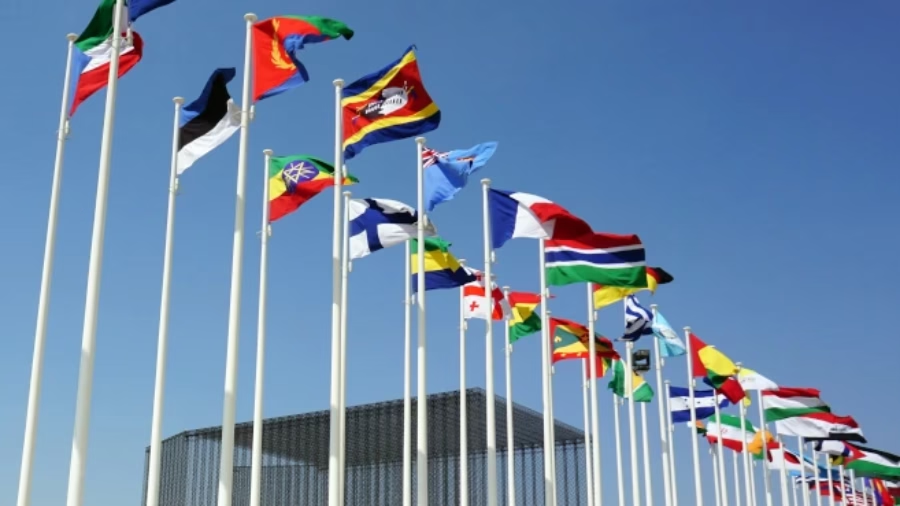
image showing flags

The Decay of Multilateralism & Global Governance: A World in Transition

Introduction: When the World Stops Talking

The decay of multilateralism & global governance is no longer an abstract debate—it’s unfolding in real time. We see it in the paralysis of the United Nations Security Council, in the weakening of the World Trade Organization, and in the tendency of powerful states to act unilaterally rather than collectively. Once hailed as the cornerstones of post-war stability, global institutions now struggle to adapt to a multipolar, fragmented world.

As nationalism resurges, and as geopolitical rivalries sharpen, the cooperative spirit that once held these institutions together is faltering. The big question is: what happens when states stop trusting—or even needing—multilateral frameworks?

From the Post-War Order to Today: A Quick Look Back

To understand today’s decay, we need to revisit the origins of global governance.

  • 1945: After World War II, the United Nations was born, along with the Bretton Woods institutions—the IMF and World Bank—aimed at stabilizing economies and preventing another great war.
  • 1947–1991: During the Cold War, multilateralism functioned imperfectly, often paralyzed by U.S.-Soviet rivalry. Yet, it still provided a framework for diplomacy, peacekeeping, and development.
  • 1990s–2000s: The post-Cold War era saw optimism. The EU expanded, the WTO emerged, and global institutions seemed to thrive. Multilateralism looked ascendant.
  • 2010s–Present: The rise of populism, renewed great power competition, and economic fragmentation have since eroded that optimism. COVID-19 further exposed the fragility of collective action.

The arc is clear: institutions designed for cooperation are increasingly out of sync with today’s world.

Symptoms of Decay in Global Governance

Multilateralism is not dead, but it is deeply weakened. Here’s how the symptoms manifest:

1. The UN Security Council Paralysis

Great powers increasingly use their veto to block consensus. Whether on Syria, Ukraine, or Gaza, the Security Council has been unable to act decisively.

2. The Weakening of the WTO

Once the guardian of free trade, the World Trade Organization is in crisis. Its dispute settlement mechanism has been paralyzed by U.S. refusal to appoint new judges. Trade wars now bypass multilateral rules.

3. Climate Change Gridlock

Despite global summits like COP, binding agreements remain elusive. Major emitters prioritize domestic politics over global commitments.

4. Health and Pandemic Failures

The COVID-19 pandemic revealed the limits of institutions like the World Health Organization. Vaccine nationalism and unilateral border closures trumped collective strategies.

5. Rise of Ad-Hoc Alliances

States increasingly prefer mini-lateral or bilateral deals—think QUAD, AUKUS, or Belt and Road—over large, unwieldy multilateral bodies.

Why States Prefer Unilateral Action

The preference for unilateralism is not simply arrogance; it’s also a rational calculation. Here’s why:

  • Speed and Flexibility: Multilateral negotiations are slow. Acting alone or with a small group produces faster results.
  • Sovereignty Concerns: Leaders facing domestic populist pressures often reject binding international commitments.
  • Great Power Competition: The U.S., China, and Russia use multilateral forums when convenient but avoid them when they constrain national interests.
  • Distrust of Institutions: Many states see global institutions as biased, dominated by Western powers, or outdated.

Comparing the Past and Present

FeaturePost-War Multilateralism (1945–1990s)Today’s Reality (2010s–2020s)
Power StructureBipolar or unipolar dominanceMultipolar fragmentation
Decision-MakingConsensus-oriented (slow but steady)Frequent deadlock and veto use
State BehaviorCommitment to institutionsPreference for unilateralism
Public PerceptionOptimism in global governanceSkepticism and populist backlash
EffectivenessImperfect but functionalIncreasingly paralyzed

Personal Reflection: Watching Multilateralism Fade

In 2020, I attended a virtual international policy forum during the height of COVID-19. The panelists—diplomats, academics, and NGO leaders—spoke passionately about solidarity. Yet behind the inspiring words was an uncomfortable truth: while they were talking about global cooperation, governments were hoarding vaccines, closing borders, and blaming each other.

That moment stuck with me. It was a reminder that the decay of multilateralism & global governance isn’t about abstract theory. It affects real people—patients waiting for vaccines, refugees trapped at borders, communities facing climate disasters. For them, the failure of institutions isn’t academic—it’s existential.

The Stakes: Why Decay Matters

The weakening of multilateralism has serious consequences:

  1. Conflict Escalation: Without strong forums for mediation, regional conflicts risk spilling into global crises.
  2. Trade Fragmentation: Without global rules, protectionism and trade wars harm economies.
  3. Climate Inaction: Fragmentation undermines collective climate action, worsening global warming.
  4. Weakened Humanitarian Response: From pandemics to natural disasters, the absence of coordination delays aid and costs lives.

Possible Pathways Forward

Is multilateralism doomed? Not necessarily. But it needs reform, renewal, and creativity.

1. Institutional Reform

The UN Security Council must adapt. Expanding membership to include India, Brazil, or Africa could make it more representative.

2. Empowering Regional Organizations

Bodies like the African Union or ASEAN can complement global institutions, filling gaps where the UN struggles.

3. Digital Multilateralism

As cyber threats and AI reshape global security, new digital governance frameworks are needed.

4. Public-Driven Multilateralism

Civil society and NGOs are increasingly important. Global governance can’t just be about states—it must include citizens.

5. Flexible Multilateralism

Perhaps the future lies in hybrid models: smaller coalitions (mini-lateralism) feeding into broader global frameworks.

A World at a Crossroads

The decay of multilateralism & global governance isn’t just a story of institutions failing—it’s about the choices states and societies make. Do we retreat into national silos, or do we adapt our institutions to a more complex, interconnected world?

History shows that crises often spark innovation. The League of Nations failed, but out of its ashes came the United Nations. Perhaps today’s breakdown is not the end, but the beginning of a new chapter in global governance.

Conclusion: Rebuilding Trust in a Fractured World

The decay of multilateralism & global governance reflects both the limitations of old institutions and the urgency of new global challenges. While unilateralism may seem appealing in the short term, long-term solutions to pandemics, climate change, and global security require cooperation.

Rebuilding trust, reforming institutions, and embracing innovation won’t be easy. But the alternative—global fragmentation—is far worse. If we want a livable future, multilateralism must not just survive—it must evolve.

Call to Action

Multilateralism affects us all. Whether it’s the air we breathe, the food we eat, or the peace we depend on, global cooperation is not optional—it’s essential. Share your thoughts: Do you think global institutions can still be reformed, or is a new model needed? Join the discussion below, subscribe for more insights, and help keep the conversation alive.

References & Further Reading

hands handcuffed holding passport

Transnational Crime Networks: The Hidden Web of Global Crime

Introduction: The Invisible Empire Next Door

When most of us think of crime, we picture local incidents—robbery, fraud, maybe a gang turf war in a city neighborhood. But the real engines of global crime today are not confined to a single block or country. They operate across borders, weaving a vast, invisible empire that touches nearly every corner of our lives. These are transnational crime networks—organizations that don’t just traffic drugs or people, but also exploit forests, oceans, minerals, and even our digital economies. Their influence is so pervasive that, in many ways, they rival nation-states in power and reach.

From the coca farms of Colombia to the illegal gold mines of West Africa, from counterfeit goods in Southeast Asia to human trafficking routes in Eastern Europe, transnational crime networks shape global markets, fuel corruption, and destabilize societies. This post takes a deep dive into how they operate, why they thrive, and why their activities matter far more than we often realize.

What Makes Transnational Crime Networks Different?

Unlike local gangs, these networks are structured to cross borders seamlessly. Their agility lies in:

  • Global Supply Chains: Just like multinational corporations, they move goods—illicit or not—across continents.
  • Diversification: Many networks don’t stick to one crime. Drug cartels may also dabble in illegal logging or human smuggling.
  • State Capture: By infiltrating politics, law enforcement, and economies, they ensure protection and longevity.
  • Use of Technology: Dark web markets, encrypted messaging apps, and cryptocurrency transactions are now staples of organized crime.

This flexibility makes them harder to combat than traditional, localized criminal enterprises.

The Dark Portfolio of Transnational Crime

Transnational crime networks thrive by exploiting vulnerabilities in global governance. Let’s examine their “business models.”

1. Drug Trafficking

Drug trafficking remains the backbone of many networks. From Mexican cartels to Afghan opium producers, narcotics generate billions annually. The UN estimates the global drug trade at over $320 billion per year.

What’s changed is the synthetic drug boom. Fentanyl and methamphetamines are easier to produce than traditional crops like coca, making them more profitable and deadlier. These drugs also rely heavily on global supply chains—precursor chemicals sourced in Asia, production in clandestine labs, and distribution in North America and Europe.

2. Human Trafficking and Smuggling

Human trafficking is one of the most disturbing aspects of transnational crime. Networks profit by exploiting desperate migrants, women, and children. Victims are forced into sexual exploitation, bonded labor, or domestic servitude.

Unlike drug shipments, human trafficking has a renewable commodity—victims can be exploited repeatedly. The International Labour Organization (ILO) estimates nearly 28 million people live in forced labor conditions globally.

3. Environmental Crimes

Environmental crimes may sound less urgent, but they are devastating. Illegal logging, fishing, and wildlife trade generate over $100 billion annually while accelerating climate change and biodiversity loss.

For example:

  • Illegal logging fuels deforestation in the Amazon and Southeast Asia.
  • Wildlife trafficking pushes species like rhinos and pangolins toward extinction.
  • Illegal fishing undermines food security for millions.

These crimes are often less policed, making them a favorite revenue stream for syndicates.

4. Illegal Mining

Gold, cobalt, and rare earth minerals are in high demand, especially with the green energy transition. But illegal mining, often controlled by criminal groups, devastates ecosystems and funds armed conflict. In places like the Democratic Republic of Congo, illegal cobalt mining has links to both crime syndicates and child labor.

5. Counterfeit Goods and Cybercrime

Counterfeit products—from luxury handbags to fake medicines—are a booming business worth $500 billion annually. Add cybercrime to the mix, and transnational networks have entered digital realms. Ransomware attacks, identity theft, and cryptocurrency laundering are now part of their arsenal.

How These Networks Thrive

1. Weak Governance and Corruption

Transnational crime networks thrive where states are weak. Corruption ensures police, customs officers, and politicians turn a blind eye. In extreme cases, entire governments are captured, becoming partners in crime.

2. Globalization and Open Markets

The same global trade and finance systems that benefit legitimate businesses also facilitate crime. Container shipping, offshore banking, and free trade zones can be exploited to hide illicit goods.

3. Technology and Digital Finance

Cryptocurrencies and encrypted communication tools offer anonymity. Darknet markets allow traffickers to reach customers without physical contact.

4. Conflict Zones and Instability

War-torn or fragile states provide safe havens. Groups like al-Shabaab and Hezbollah have financed themselves through smuggling and illicit trade.

Comparing the Old Mafia to Modern Transnational Crime Networks

FeatureTraditional MafiaModern Transnational Networks
Geographic ScopeLocal/RegionalGlobal, spanning continents
Primary BusinessGambling, extortion, drugsDiversified: drugs, humans, minerals, cybercrime
Technology UseMinimalHeavy use of digital tools
State InteractionBribery, corruptionFull-scale infiltration, state capture
Impact on SocietyLocalized disruptionGlobal destabilization

A Personal Encounter: Witnessing the Reach

Several years ago, while traveling in Latin America, I met a small-scale farmer whose land bordered a coca-growing region. He explained how local cartels had forced him to rent out part of his land for cultivation, threatening his family if he refused. His story wasn’t about abstract geopolitics—it was about survival. For him, transnational crime networks weren’t hidden; they were daily realities dictating his choices.

That encounter reshaped my understanding: these networks aren’t distant “shadowy syndicates.” They directly affect the lives of millions, often the most vulnerable.

The Global Cost of Transnational Crime Networks

  • Economic Impact: The World Bank estimates trillions are siphoned from global GDP through illicit activities.
  • Political Instability: These networks erode trust in governments and weaken democratic institutions.
  • Social Impact: Human suffering—from addiction to exploitation—is immeasurable.
  • Environmental Destruction: Crimes against nature have irreversible consequences for climate and biodiversity.

Can We Stop Them?

While eradicating transnational crime networks entirely may be unrealistic, several strategies can weaken them:

  1. Stronger International Cooperation – Crime doesn’t respect borders, but law enforcement often does. Joint task forces and intelligence sharing are crucial.
  2. Targeting Financial Flows – Following the money is often more effective than seizing shipments. Cracking down on money laundering is key.
  3. Investing in Technology – Using AI to detect suspicious trade patterns or blockchain to secure supply chains can outpace criminals.
  4. Strengthening Governance – Anti-corruption measures and building resilient institutions are long-term but essential solutions.
  5. Community Engagement – Local communities must be empowered as stakeholders in fighting crime. Farmers, fishers, and miners often have the most to lose.

Conclusion: A Global Problem Demanding Global Solutions

Transnational crime networks are not fringe players. They are central actors in today’s world, shaping economies, politics, and even the environment. Their ability to adapt, diversify, and infiltrate makes them formidable opponents.

Yet history shows that when nations cooperate—on issues like piracy or terrorism—progress is possible. Combating these networks requires not only better policing but also tackling root causes: poverty, inequality, weak governance, and global demand for illicit goods.

The question isn’t whether these networks affect us—they already do. The real question is whether we are willing to recognize their scale and build the collective will to confront them.

Call to Action

The fight against transnational crime networks begins with awareness. Share this post, engage in discussions, and push for policies that address corruption, enforce accountability, and strengthen global cooperation. This isn’t just a problem for “somewhere else.” It’s a challenge that affects us all.

References & Further Reading

nuclear-plan

Nuclear Proliferation in the 21st Century: Doctrines, Dangers, and the Future of Global Security

Introduction: The Shadow That Never Left

Nuclear proliferation is one of those phrases that instantly pulls us into the darker corners of modern history—the mushroom clouds over Hiroshima and Nagasaki, the Cuban Missile Crisis, the Cold War standoff. Many assumed that with the Cold War’s end, the nuclear shadow would fade. But here’s the unsettling truth: nuclear proliferation is more relevant than ever. From modernization of arsenals in Washington, Moscow, and Beijing to the nuclear ambitions of regional players like North Korea and Iran, the world is in the midst of a quiet but dangerous nuclear arms race.

Unlike the bipolar rivalry of the Cold War, today’s nuclear world is multipolar, unpredictable, and dangerously entangled with new doctrines and technologies. This post explores the realities of nuclear proliferation, the emerging doctrines guiding nuclear states, and what modernization of arsenals means for our collective future.

The Return of the Nuclear Question

After the Cold War, many optimists believed nuclear weapons would slowly lose relevance. Treaties like START and the Nuclear Non-Proliferation Treaty (NPT) were meant to curb the arms race. But history has proven otherwise:

  • The U.S., Russia, and China are modernizing their arsenals, replacing aging stockpiles with more sophisticated, precise, and survivable weapons.
  • India and Pakistan continue to expand capabilities in South Asia, raising risks of regional escalation.
  • North Korea is refining long-range delivery systems capable of striking the continental U.S.
  • Iran has inched closer toward nuclear capability despite diplomatic setbacks.

The global nuclear order is no longer about two superpowers. It is about multiple actors, each with unique doctrines and thresholds for use.

Modernization of Arsenals: Not Just About Numbers

Modernization is not simply about building more weapons. It’s about making them smarter, faster, and harder to intercept. Let’s break down some trends:

CountryKey Modernization FocusStrategic Implication
United StatesRevamping triad (land, sea, air) with B-21 bombers, Columbia-class subs, ICBM replacementsMaintain credibility of deterrence vs. Russia & China
RussiaHypersonic glide vehicles (Avangard), nuclear-powered torpedoesEvade missile defense; intimidate NATO
ChinaExpanding silos, MIRV-capable missiles, nuclear subsShifting from minimal deterrence to parity with U.S./Russia
India/PakistanTactical nukes, mobile launchers, submarine programsIncrease regional instability
North KoreaICBMs, miniaturization of warheads, solid-fuel missilesDirect challenge to U.S. homeland security

This modernization wave raises questions: If deterrence was stable with old weapons, why the rush to upgrade? The answer lies in new doctrines.

The Rise of New Nuclear Doctrines

Nuclear doctrines are the rulebooks (often unwritten) that guide how nations think about using their weapons. Here’s how they’re evolving:

1. Escalate to De-escalate (Russia)

Russia’s doctrine now includes the possible use of tactical nuclear weapons in conventional conflicts, particularly if its territorial integrity is threatened. This blurs the line between conventional and nuclear war.

2. No First Use? Or Maybe Not (China & India)

China historically maintained a No First Use (NFU) pledge, but modernization of its arsenal raises questions about its long-term credibility. India, once committed to NFU, has also introduced caveats, hinting it may reconsider under certain threats.

3. Ambiguity as Strategy (United States)

The U.S. has deliberately left its nuclear doctrine ambiguous, preferring “calculated uncertainty” to keep adversaries guessing. But ambiguity can backfire, especially when rivals interpret it as willingness to strike first.

4. Nuclear Blackmail (North Korea)

Pyongyang openly leverages its nuclear capability for political concessions, a new type of doctrine where deterrence becomes coercion.

Why This Moment is Uniquely Dangerous

You might wonder: Haven’t we lived with nukes for 80 years without catastrophe? True—but today’s nuclear landscape has distinct risks:

  1. Multipolarity: More nuclear actors mean more flashpoints and fewer predictable dynamics.
  2. Technological Disruption: Hypersonic weapons, AI-enabled decision-making, and cyber vulnerabilities reduce warning times and increase chances of miscalculation.
  3. Weak Arms Control: With treaties like INF dead and New START uncertain, there’s little restraint on modernization.
  4. Regional Conflicts: Escalation risks in South Asia or the Korean Peninsula are much higher than global attention suggests.

This isn’t the Cold War redux—it’s messier, riskier, and less regulated.

A Personal Reflection: Living Under the Shadow

I still remember a vivid moment from my teenage years during the late 1990s. News broke about nuclear tests in India and Pakistan. Even as a young student, the footage of jubilant crowds cheering nuclear explosions struck me with unease. It was paradoxical: people celebrating what was essentially the creation of a doomsday device.

That moment shaped my lifelong interest in security studies. Nuclear proliferation isn’t just an abstract geopolitical issue. It is about ordinary people living under policies crafted in distant capitals. It’s about whether a local border clash can spiral into something unthinkable. That personal lens is why I believe the current modernization wave is not just a technical or strategic issue—it’s an existential one.

Lessons from History: Cold War Parallels (and Differences)

During the Cold War, nuclear deterrence was built on Mutually Assured Destruction (MAD). Both the U.S. and USSR knew that a first strike meant national suicide. That terrifying stability paradoxically kept the peace.

But today:

  • Russia’s willingness to brandish tactical nukes in Ukraine has broken taboos.
  • China’s expansion signals a potential tripolar nuclear rivalry.
  • Smaller states may not see deterrence as existential but as leverage.

The Cold War’s “balance of terror” was horrific, but it was a balance. The current era lacks that symmetry.

What Can Be Done? A Path Forward

If proliferation and modernization are realities, the question becomes: how do we manage them? Some pathways include:

  • Reviving Arms Control: Expanding agreements to include emerging technologies like hypersonics and cyber threats.
  • Reinforcing Non-Proliferation Regimes: Strengthening the NPT framework, especially against states exploiting loopholes.
  • Regional Dialogues: Encouraging nuclear-armed neighbors (India-Pakistan, U.S.-China) to create hotlines and crisis-management mechanisms.
  • Public Awareness: Keeping nuclear issues in the public conversation; too often, the topic vanishes until a crisis erupts.

Conclusion: Living with the Unthinkable

Nuclear proliferation is not a relic of the Cold War—it’s the defining challenge of global security today. Modernization of arsenals, shifting doctrines, and regional rivalries are reshaping the nuclear landscape into something more dangerous and less predictable than before.

The real test is whether humanity can learn from its near-misses—the Cuban Missile Crisis, Kargil, North Korea’s missile tests—and build a framework that prevents the ultimate catastrophe. Because in a multipolar nuclear world, the margin for error is shrinking, and the cost of miscalculation is unimaginable.

Call to Action

The debate on nuclear proliferation shouldn’t be confined to policymakers and academics. It affects every one of us. Share your thoughts: Do you believe modernization strengthens deterrence or increases risks? Join the conversation below, subscribe for more insights, and let’s keep the spotlight on an issue too important to ignore.

References & Further Reading

picture of free speech

Authoritarianism and Free Speech: The Confrontation between Authoritarian Leaders and Free Speech

Introduction: The Tyrant’s First Enemy Is a Voice

When an authoritarian leader rises, one of their first acts is not to pass a law about taxes—it’s to silence dissent. Authoritarianism and free speech are in perpetual conflict because a free voice is existentially threatening to concentrated power.

My own journey — from a country where state media dictated everything, to working with underground writers in exile — taught me this truth: authoritarian rulers don’t negotiate with criticism. They weaponize censorship, defamation laws, threats, disappearance, and co-opted institutions. The battle over who gets to speak—and who is silenced—is not academic. It is life and death.

In this post, I peel back the rhetorical placards and expose the raw mechanics of how authoritarian regimes confront free speech—and how some courageous actors fight back.

The Anatomy of the Confrontation

Why Authoritarians Fear Speech

Authoritarians understand that power is not secured by force alone — it requires legitimacy or at least acquiescence. Dissenting voices, media scrutiny, satire, whistleblowers — they all erode the image of legitimacy. A single viral protest clip can ignite a movement. So regimes often act preemptively.

The Tools of Suppression

Authoritarian governments don’t rely on blunt force alone—they wield an arsenal. Here are some mechanisms they use to neutralize speech:

ToolMethodPurpose / Example
Surveillance & control of mediaState-run media monopoly, licensing revocations, censorship boardsEnsures narratives align with the regime
Defamation / “fake news” lawsCriminalizing criticism as defamation or “false information”Judges often stack in favor of regime
Internet shutdowns & content filteringDDoS, throttling, DNS blocking, deep packet inspectionCut off mobilizing platforms
Strategic lawsuits (SLAPPs)Flood critics with legal costsSilence journalists through economic pressure
Licensing / accreditation regimesRequire media to register and be revocableKeeps media under regulatory thumb
Harassment, threats, violenceKidnapping, torture, assassination of dissidentsSend chilling message to all others
Co-optation / propaganda front groupsCreate government-controlled “independent” voicesCrowd out real opposition
Self-censorship & chilling effectAmbiguous laws force people to silence themselvesThe regime doesn’t need to arrest everyone

In Russia, for instance, the return of Soviet-era repression includes punitive psychiatry against outspoken critics. (Reuters) In other countries, authoritarian governments impose mobility controls, revoking passports or blocking exit, effectively silencing critical voices abroad. (Freedom House)

A Spectrum: Not All Authoritarianism Looks the Same

Some authoritarian states tolerate a narrow space of “harmless” speech—art, consumer issues, infrastructure complaints—as a pressure valve. But they draw red lines around politics, leadership criticism, human rights. A classic study, Free Speech Without Democracy, shows how autocracies permit limited expression while enforcing severe boundaries. (lawreview.law.ucdavis.edu)

Others—like China—construct a parallel digital reality: censorship, social credit, controlled dissent. Research on Weibo shows how users self-censor and adapt, often before the regime even reaches them. (arXiv)

Europe grapples with “free speech absolutism” vs. authoritarian mimicry: some policymakers argue that an absolutist approach to speech ironically makes it easier for authoritarian disinformation to flourish. (3CL Foundation)

Realities on the Ground: Voices Under Siege

Case Study 1: Russia’s Return to Soviet Tactics

Since the invasion of Ukraine, Russia has doubled down on silencing dissent. Reports show opposition journalists facing forced psychiatric detention—a tactic from the Soviet era. (Reuters) The legal system, national security laws, regulatory authorities, and media ownership all function as suppression arms.

Case Study 2: Ethiopia’s “Hate Speech and Disinformation” Law

In 2020, Ethiopia passed a law criminalizing social media content deemed “hate speech” or “disinformation,” punishable by years in prison. Observers say this is a vehicle to silence political dissent under the guise of stability. (Wikipedia)

Case Study 3: The U.S. and Borderline Authoritarian Moves

Even democracies can flirt with repression. The Trump-era use of “deportation on speech grounds” is not censorship alone—it weaponizes immigration law to silence diaspora voices. (The Guardian) In academic institutions, policies that require faculty to seek permission before publishing or speaking abroad echo authoritarian control. (Reuters)

These aren’t fringe countries—they show that the struggle over speech crosses political systems.

Why Free Speech Isn’t “Just Talk”

There’s a misconception that free speech is abstract, academic. I’ve heard it in development meetings: “What do words matter when people are dying of disease?” But words shape perception, mobilize resistance, expose corruption, restructure power. Here’s how:

  • Narrative control: Discourse crafts reality. If you control the story, you control legitimacy.
  • Accountability: Journalism, whistleblowing, citizen reporting expose abuses.
  • Mobilization: Protests, campaigns, litigation are seeded in discourse.
  • Psychological safety: People need to speak truth to feel agency.

When speech is closed, corruption proliferates unchecked; dissent goes underground into radical channels. A world with no speakable dissent is a world of us vs. them.

The Fightback: How Voices Resist Authoritarianism

The regime may have heavy artillery—but resistance often wins battles of meaning.

Strategy 1: Exile & Diaspora Media

When voices can no longer operate at home, many move abroad—launching independent media, broadcasts, or podcasts targeting their home countries. Regimes may cancel passports or revoke citizenship to punish them. (Freedom House)

Strategy 2: Technology & Encryption

Encrypted platforms (Signal, Telegram, Tor) help activists evade censorship. But tech is a double-edged sword: authoritarian regimes are catching up with surveillance, deep packet inspection, AI-based filtering.

Strategy 3: Legal & International Pressure

Strategic litigation at regional human rights courts, UN Special Rapporteurs, international media campaigns, and diplomatic pressure can create external accountability.

Strategy 4: Cultural Resistance & Satire

In authoritarian settings, satire and metaphor become powerful. The regime often fears humor more than protest, because it undermines gravitas. When satirists speak truth, the walls tighten.

Strategy 5: Hybrid Spaces & Tactical Openness

Sometimes regimes allow limited public forums to let criticism emerge in controlled spaces, only to co-opt or redirect energy. But savvy voices use these openings to push boundaries.

The Paradox: Free Speech in Autocracies That Allow It

Some authoritarian regimes allow limited free speech. Why? Because that can strengthen their control:

  • Selective tolerance builds legitimacy.
  • Bulletin board oversight: regime monitors critical voices inside allowable limits.
  • Chilling effect through uncertainty: vague laws force everyone to self-censor.

The “grey area” in censorship is more powerful than outright bans. Free Speech Without Democracy describes how ambiguity is a tool of control. (lawreview.law.ucdavis.edu)

In fact, regimes that permit safe criticism let dissent vent harmlessly—while keeping real power off-limits.

Risks, Tradeoffs & Ethical Dilemmas

  • Host states: Do host democracies censor voices from abroad to preserve diplomacy?
  • Overreach in resistance: When opposition uses hate speech or violence, regimes exploit that to justify crackdown.
  • Ethical limits of anonymity: Should activists lie or impersonate to protect themselves?
  • Global institutions: Are they complicit when they ignore digital repression?

Key Insights to Carry Forward

  1. The first thing authoritarianism attacks is speech—no regime can tolerate uncontrolled narrative.
  2. Free speech is not optional or symbolic—its presence or absence changes entire power configurations.
  3. Silence is a weapon—even when people are not jailed, the threat of punishment chills millions.
  4. Resistance is relational—networks, diaspora, tech and culture conspire with speech to resist.
  5. We must push boundaries—not just protect what already exists—because authoritarian regimes always test limits.

Conclusion: No Tyrant Survives All Voices

If you tell me free speech is dead, I will answer: it is buried, but it is not defeated. Every regime has cracks—every wall has sounds through it. The battle with authoritarianism and free speech is a long one, but surrender is never inevitable.

Your voice matters. Share your local dissent, support independent media, back digital freedom tools, and refuse the normalizing of censorship. The state may control infrastructure—but ideas flow through human networks.

Call to Action:

  • Share this post with someone who thinks “speech doesn’t matter.”
  • Subscribe or follow independent media that fight authoritarian silence.
  • Donate to organizations that train and protect journalists under threat.

Break the silence. Because the walls are only as strong as the silence they enforce.

References & Further Reading

  • Free Speech Without Democracy (Bhagwat) — exploring the paradox of speech in non-democratic regimes (lawreview.law.ucdavis.edu)
  • How We Express Ourselves Freely: Censorship, Self-Censorship, and Anti-Censorship on Chinese Social Media (arXiv)
  • Free Speech Absolutism: A Gateway for Competitive Authoritarianism? (3CL Foundation)
  • Freedom House — “No Way In or Out: Authoritarian Controls on Mobility & Repression” (Freedom House)
  • How Democracies Defend Themselves Against Authoritarianism — strategic lessons for resisting power consolidation (Center for American Progress)
  • NED — “Challenging Authoritarian Censorship and Protecting Free Speech” (NATIONAL ENDOWMENT FOR DEMOCRACY)
  • Research on authoritarianism, extraversion and censorship behavior (National Communication Association –)
  • Recent news on Russia reviving Soviet-era tactics (Reuters)
  • U.S. academic free speech suppression lawsuit at West Point (Reuters)
  • Deporting speakers under “propaganda” charges as an authoritarian tactic (The Guardian)

migration-global-policies

Anti-Migration Policies Across the Globe: Is it Possible for Humanity to Ever End Migration?

“When the desert blooms in one place, it silently dies in another — people will move.”

That image—arid land turning into dust, people marching toward any place that still yields life—is central to the question: despite anti-migration policies, can humanity ever truly end migration? To ask it is to confront deep structural, social, climatic, economic, and moral forces. In this post, I explore how anti-migration policies are being deployed around the world, what they can (and can’t) achieve, and whether the idea of a “world without migration” is realistic—or even ethical.

Introduction — Why “anti-migration policies” fascinate and frighten

The phrase anti-migration policies conjures lines of barbed wire, walls, fences, expulsion orders, deterrent funding, pushbacks at sea, and ever-stricter visa regimes. From asylum deterrence tactics in Europe to de facto bans in Gulf states, many nations are doubling down on restricting who moves and how. But migration is not merely a choice—it is an expression of inequity, climate distress, conflict, economic divergence, and human aspiration.

So the central tension: states assert the right to control their borders; people assert the right to seek safety and opportunity. Can anti-migration policies ever fully “solve” migration? Or are they destined always to fall short, forcing societies to live with a paradox?

Mapping anti-migration policies globally

Before we address whether migration can end, we first need to survey the landscape of how states try to stop, slow or manage migration.

Major types of anti-migration policies

StrategyMechanismNotable examples / issues
Border fortification & physical barriersWalls, fences, border patrol intensificationU.S.–Mexico wall, fences in Hungary/Poland, Australia’s offshore processing
Externalization / outsourcingPaying transit or third countries to intercept migrantsEU funding to Libya, agreements with Turkey, “safe third country” rules (Wikipedia)
Deterrence via harsh conditionsDetention, prolonged asylum processing, criminalizationAustralia’s Nauru/Manus detention; Greece threatening jail for rejected asylum seekers (AP News)
Deportation & “return” agreementsMass expulsions, bilateral readmission dealsUK’s “one in, one out” deportations to France (AP News)
Visa restrictions / restrictive immigration quotasTighter work visas, high thresholds, family migration limitsU.S. 1924 Immigration Act (migrationpolicy.org); recent UK proposed limits
Technological & algorithmic controlsAI border checks, risk scoring, biometric constraintsThe EU is increasingly using ADM (automated decision-making) at borders — with serious ethical risks (arXiv)
Discursive / narrative control & misinformationCriminalizing migrants linguistically, demonizing rhetoricAnti-immigration posts spread faster than pro-immigration content on social media (arXiv)

These tactics are often layered together: a border wall alone doesn’t stop people if pushbacks at sea or detention inside the country remain. The more difficult the journey, the likelier that migrants funnel into more dangerous routes.

Recent trends & shifts

  • Europe’s New Pact on Migration and Asylum (effective from 2026) will push more deportations to third countries and harmonize stricter asylum rules (Wikipedia).
  • Greece is introducing prison sentences for rejected asylum seekers as part of a crackdown. (AP News)
  • The UK’s new “one in, one out” policy shipped a migrant back to France, marking a harder-line shift. (AP News)
  • In many countries, political leaders evoke migrant “invasions” or loss of national identity—normalizing strict control rhetoric. The influence of U.S. anti-immigration discourse in European policy is well documented (Real Instituto Elcano).

These shifts reflect more than policy changes—they reflect deeper political realignments where migration becomes a boogeyman for economic anxiety and identity upheaval.

Why anti-migration policies cannot end migration

Having mapped how states try to resist migration, let’s now dig into why such efforts will always partially fail if the root forces pushing people remain.

1. Migration is older than states

Human migration long predates nations. The Migration Period (c. 300–600 AD) saw mass movements of tribes across Europe that reshaped civilizations (Wikipedia). In modern times, industrialization and global inequality have turned migration into a structural constant. As historian Ian Goldin notes:

“People moved in search of safety, stability, and opportunity” — until the 1890s, migration within Europe mirrored cross-Atlantic flows. (IMF)

Put simply: migration is a response to geography, economics, conflict, climate and human aspiration. No border wall can stop a climate-driven drought or a violent war.

2. Push factors intensify

As conflicts, climate change, resource scarcity, weak governance, and inequality worsen, push factors either remain steady or accelerate. Anti-migration policies act on the symptom (movement), not the cause (conditions driving movement). Without addressing the deeper crises in origin countries, deterrence won’t make people stay—they’ll take ever more perilous paths.

3. Smuggling & underground routes adapt

Whenever a migration corridor is blocked, new, more dangerous routes open. Smugglers evolve. When the U.S. tightened access from Mexico, migrants rerouted through Central America or the Darien Gap. The ‘closing’ of migration paths seldom stops movement—it shifts it.

4. Human rights, asylum obligations & international law

No matter how strict, states must respect rights of asylum seekers, refugees, torture conventions, and non-refoulement principles. Many anti-migration laws skirt legal lines or make legal challenges. The safe third country doctrine is often abused—removing asylum possibility entirely (which may violate protection obligations) (Wikipedia).

5. Demographic, economic and aging pressures

Many countries now face aging populations and labor shortages. Immigrants are often part of the solution to demographic decline. If a state truly tried to end migration, it would starve its labor market, stunt innovation, and risk stagnation.

6. Moral and ethical constraints

A world without migration is a world of sealed borders and a fortress mentality. That undermines the ethos of human dignity: people seeking safety, family reunification, education, life. The moral pressure to offer refuge will always resist total closure.

Counterexamples & illusion of “success”

Some regimes boast near-zero migration, but their “success” is costly, coercive, or unsustainable.

  • North Korea keeps almost all movement internal via extreme controls, but at tremendous human cost and near total suppression of freedoms.
  • Gulf states often restrict citizenship and maintain a large underclass of migrant workers with precarious rights—not truly “ending migration,” but tightly controlling it.
  • Japan’s rising “Japanese first” rhetoric (by the Sanseito party) is more symbolic than absolute; the nation still accepts foreign labor under strict conditions (Wikipedia).

These are not ethical models for global policy—they limit migration by limiting human freedoms.

Fresh perspectives & personal reflections

Over years of reading migration testimonies and field reports, several patterns struck me:

  • Migrants don’t view movement as “illicit.” When forced, it’s survival, opportunity, family. Anti-migration laws criminalize hope.
  • Many migrants said: “I would not have left, but conflict killed the choice to stay.” You can’t legislate away war or climate.
  • Community networks matter enormously. Diasporas, remittances, information flow keep paths alive—closing one border may not knock out the chain of trust and networks.
  • Digital tools, WhatsApp routes, satellite connections—all help shape “invisible highways” beyond state control.

These suggest that migration is not only physical movement—it is relational, human and adaptive.

Toward realistic aims: not ending, but managing & humanizing migration

Given that migration cannot (and probably should not) be entirely ended, the question becomes: how do we make it safer, more equitable, and better governed?

1. Shift from deterrence to opportunity

Instead of punishing movement, invest in local opportunity in origin countries—jobs, infrastructure, governance, climate resilience. If movement is a safety valve, strengthen conditions so that staying becomes an acceptable and dignified option.

2. Transparent, humane migration channels

Rather than shutting doors, open safe routes: labor migration visas, mobility pacts, migration corridors. A rigid gate creates clandestine tunnels; an open window lets people come safely.

3. Shared responsibility & burden sharing

No country should absorb all migration. Mechanisms like the EU’s Pact (2026), which forces burden-sharing and joint processing, point in this direction (Wikipedia).
Multilateral systems that distribute hosting, resettlement and integration costs can reduce the pressure to “close borders.”

4. Legal oversight of tech & algorithmic borders

As states deploy AI and automated decision systems at borders, strong legal frameworks must protect privacy, prevent bias, and ensure appeal rights (arXiv). Borders must serve people—not the other way around.

5. Narrative change, civic inclusion & countering misinformation

Anti-migration sentiment is powerfully shaped by narratives and social media. Studies show anti-immigration content spreads faster online than pro content (arXiv). Investing in counter-narratives, fact checks, diaspora voices, and legislative bans on hate speech can change public terrain.

6. Gradual integration & community bridges

When migration is inevitable, welcoming systems (education, language, social connection) reduce friction. Integration over exclusion yields social cohesion over conflict.

Can humanity ever end migration? The verdict

If I were to answer simply: No—migration cannot realistically be ended. But that is not defeatism. It is a recognition that migration is as much a human need as hunger or health.

  • Attempting to end migration at the border level is like trying to suppress waves with a sandcastle.
  • Anti-migration policies can reduce certain flows (especially lower-risk, legal ones), but they can never fully block high pressure flows.
  • The only way “migration ends” is when the root causes—geopolitical inequality, climate breakdown, conflict, exclusion—are resolved at global scale. And even then, movement will persist as part of human exchange.

Rather than “end migration,” our goal should be to transform migration—make it safer, more humane, more equitable, better governed.

Key insights: what every reader should remember

  1. Migration is structural — rooted in global inequality, climate, conflict and aspiration.
  2. Anti-migration policies are always partial — they displace flows, increase danger, and often violate rights.
  3. Human agency resists total closure — social networks, desperation and choice always find a way.
  4. Ethics matter — walls may close borders, but not human dignity.
  5. Transformation over elimination — safer routes, equitable systems, responsibility sharing offer the real future.

Conclusion & Call to Action

Anti-migration policies are tactical experiments in border control—they will never extinguish the human drive to move, to survive, to hope. But we must channel our energy into building better systems, not tighter ones.

If you found yourself shaken by this post, here are three actions you can take:

  • Share your voice: bring this topic into your community, challenge simplistic narratives.
  • Support humane migration NGOs: organizations working on safe routes, legal aid, refugee support.
  • Stay informed: follow reliable sources (e.g. IOM, Migration Policy Institute, UNHCR) and push for legislation that protects rights, not erodes them.

⚠️ Migration may never end—but it can be kinder, fairer, more just. That’s what’s worth fighting for.

References

  1. International Organization for Migration (IOM). (2024). World Migration Report 2024. Geneva: IOM.
  2. UNHCR. (2023). Global Trends: Forced Displacement in 2023. Geneva: UNHCR.
  3. European Commission. (2024). New Pact on Migration and Asylum. Brussels: European Union. Retrieved from https://ec.europa.eu
  4. Goldin, I. (2025). “A Moving History.” Finance & Development, International Monetary Fund. Retrieved from https://www.imf.org
  5. Migration Policy Institute. (2023). “The U.S. Immigration Act of 1924 and Its Legacy.” Washington, DC. Retrieved from https://www.migrationpolicy.org
  6. Real Instituto Elcano. (2024). The Trail of Trump’s Anti-Immigration Policies in Europe. Madrid. Retrieved from https://www.realinstitutoelcano.org
  7. AP News. (2024). “Greece Approves Prison Sentences for Rejected Asylum Seekers.” Retrieved from https://apnews.com
  8. AP News. (2024). “UK Deports Migrants Back to France under New Policy.” Retrieved from https://apnews.com
  9. Arxiv. (2024). “Automated Decision-Making and Migration Management at the EU Border.” Retrieved from https://arxiv.org
  10. Arxiv. (2024). “Misinformation and Anti-Immigration Narratives Online.” Retrieved from https://arxiv.org
  11. Wikipedia. (2025). Migration Period. Retrieved from https://en.wikipedia.org/wiki/Migration_Period
  12. Wikipedia. (2025). Safe Third Country. Retrieved from https://en.wikipedia.org/wiki/Safe_third_country
  13. Wikipedia. (2025). Sanseitō Party (Japan). Retrieved from https://en.wikipedia.org/wiki/Sanseit%C5%8D